Have you ever noticed this paradox: we step out into the cold and shiver, take the subway and instantly break out in a sweat. And then, when we get to the office, we're forced to change from boots to shoes right under our desks to avoid being boiled alive? Winter is a daily stress test for your style. And let's be honest, most wardrobes fail this test miserably.
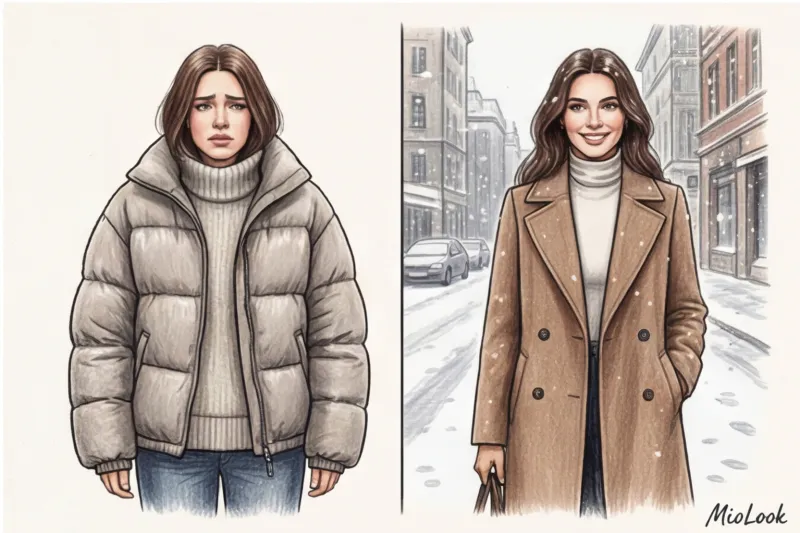
We talked about the foundation of the style in more detail in our The complete guide to the perfect basic wardrobe , but the winter season requires a special approach. In 12 years of working as a personal stylist in Europe, I've realized one thing: a competent Basic winter wardrobe for women is based not on the thickness of things, but on their architecture and the physics of fabrics.
Cabbage Syndrome: Why Do We Lose Our Elegance in Winter?
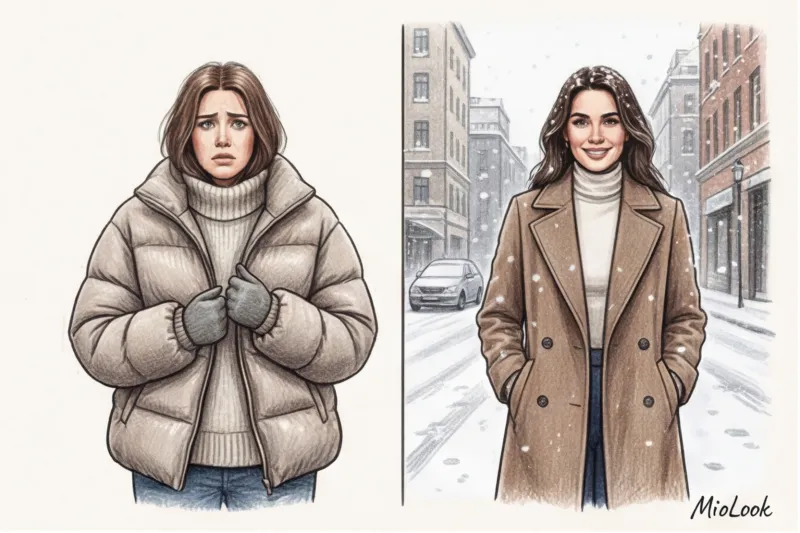
The biggest mistake I see on the streets from Warsaw to Stockholm is trying to warm up by adding bulk. Women wear a cotton T-shirt, a thick, chunky knit sweater over it, and then a down jacket that makes it impossible to hang their arms down. The result? A visual increase of 5-7 kilograms, limited mobility, and... still cold.
Winter style works like architecture: if you have a poor foundation (synthetic fabrics, poor cut), no beautiful facade (an expensive bag) will save it. The right winter base is when you're completely comfortable at -15°C outside and +22°C in the office without having to completely change.
"Warmth isn't about the thickness of the sweater, it's about the amount of air between the layers of the right fabric," Katarzyna Nowak.
Access to MioLook for €0.99 — one-time payment
A smart AI stylist will select the perfect look based on the season and your wardrobe.
Get access — €0.99 onceThe Anatomy of Heat: Reading Labels Like a Professional Stylist
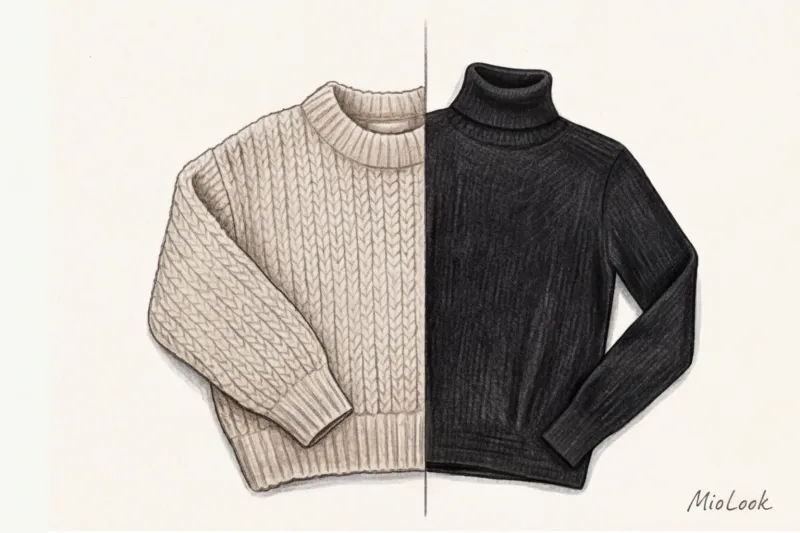
This is where the fun begins—myth busting. Chunky knit sweaters are the enemy of a basic wardrobe. Sure, they look great in Pinterest photos when you're sitting by the fireplace with a cup of cocoa. But in real life, they don't fit under an elegant coat, they distort the sleeves of your outerwear, and they make you sweat indoors.
According to the Textile Institute (2023), to retain body heat, a base layer should contain at least 50% natural fibers (wool, cashmere, alpaca). This is the golden rule for shopping at mass-market stores: if the label at Zara or H&M says "30% wool, 70% acrylic," the item stays there.
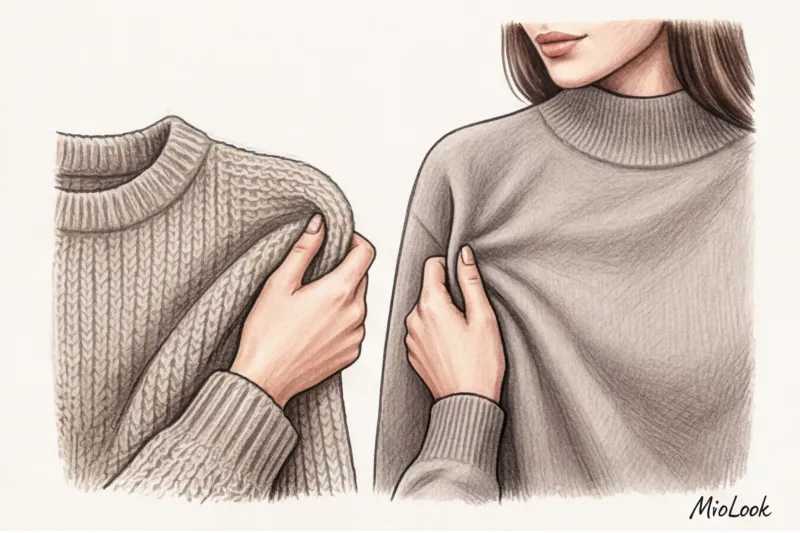
Let's calculate the cost-per-wear. A cheap, bulky polyester sweater will cost you around €40. After five washes, it will pill, lose its shape, and you'll only wear it around the house. The cost per wear is €8. A smooth, 100% merino wool jumper from COS or Massimo Dutti costs around €90-110. With proper care (hand wash or dry clean), it will last you 3-4 seasons (at least 60 wears). The cost per wear is €1.50. The choice is obvious.
Why Acrylic Is the Worst Winter Investment
- Greenhouse effect: Acrylic doesn't regulate temperature. It doesn't warm you in freezing temperatures (it lets cold air through), and indoors it acts like a plastic bag—you sweat instantly.
- Peeling: Acrylic fibers are short and brittle. Wrinkles on your elbows and pilling under your arms will appear within the first week.
- Visual cheapening: Acrylic knitwear has a characteristic unnatural sheen that reveals the item's low-cost nature at first glance.
Outerwear: 3 Pillars of a Winter Basic Wardrobe
Outerwear is your calling card from November to March. According to the analytical agency WGSN (2024), applying the Pareto principle (80/20) to outerwear means that 80% of the time you'll be wearing one or two perfectly fitting pieces.
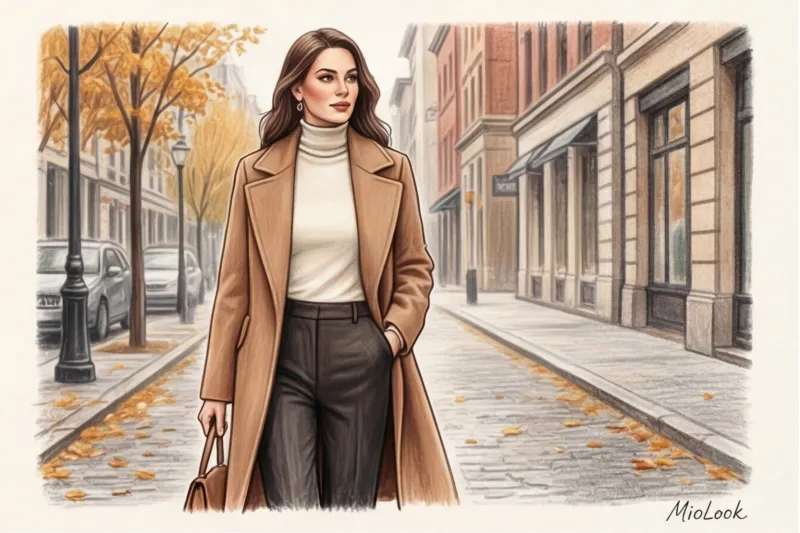
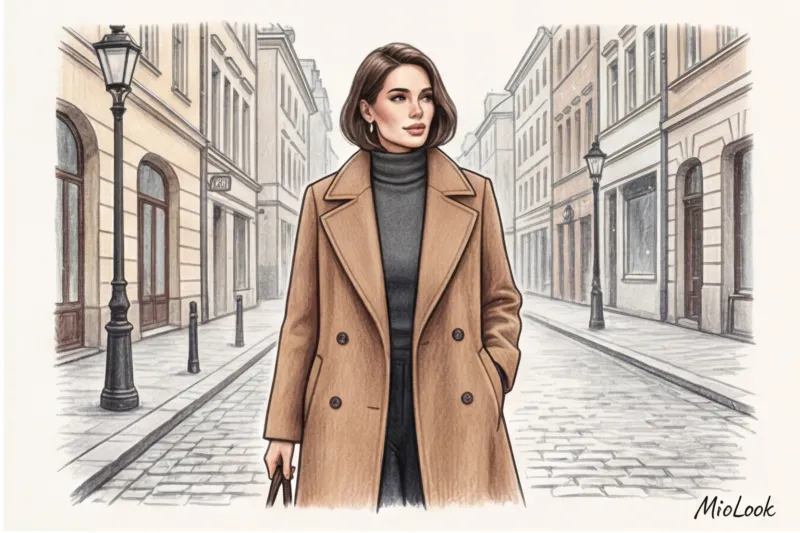
1. Structured wool coat in midi or maxi length.
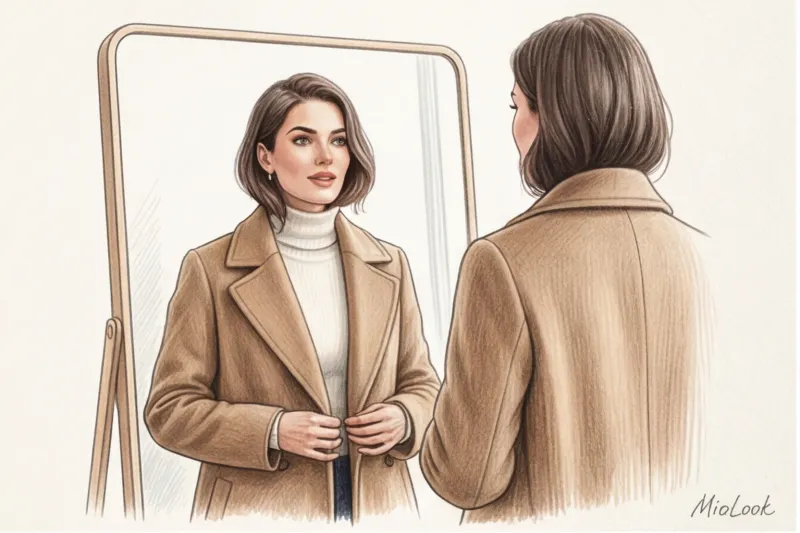
Personal test: I compared the performance of a COS coat (70% wool) and a cheaper model (30% wool) after a season of heavy wear in Warsaw. The coat with the lower wool content lost its stiffness in the shoulders and stretched out at the elbows. Invest in dense coat fabrics with set-in or slightly dropped, but distinct sleeves. Important rule: Try the coat over the jacket. If the armholes are tight, go up a size.
2. Elegant down jacket.
How to avoid looking like a "caterpillar"? Choose matte fabrics, a straight or slightly A-line cut, and a minimal amount of horizontal stitching. The less stitching, the more expensive the down jacket looks.
3. Aviator sheepskin coat (or a simple eco-fur coat).
For active days when you're driving or planning a long walk in jeans.
Stylist's advice: Your base coat or down jacket should always be longer than your longest skirt or dress (except for maxi dresses). A midi hem that sticks out from under your outerwear will cut your silhouette into unflattering blocks.
Secret Weapon: An "Invisible" Layer and a Smart Base
The secret to Parisian and Italian winter warmth isn't magic—it's a quality base layer. Last winter, one of my clients complained that she was constantly cold despite layering. We swapped her three thick synthetic sweaters for a single cashmere cardigan, layered underneath with next-generation micromodal and silk thermal underwear.
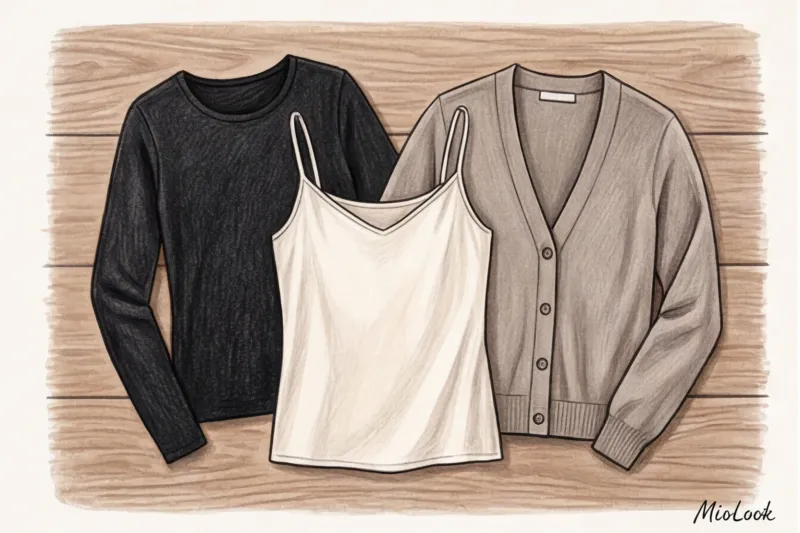
Modern thermal underwear is ultra-thin, cut out low, and invisible under clothing. It allows for seemingly unimaginable style tricks: for example, wearing your favorite summer silk blouses or slip dresses in December.
Another micro-trend that's become a staple: a thick cotton tank top worn under a scratchy wool sweater. Cotton with a weight of at least 180 g/m² acts as a buffer, protecting the skin from irritation and the expensive wool from contact with deodorant and sweat.
Your perfect look starts here
Having trouble combining layers? Upload your wardrobe to the app, and the AI will create flawless outfits.
Try MioLookKnitwear: Investing in the Right Shapes
If we've given up on voluminous textures, what's left? The ideal basic winter wardrobe for women requires just three knitwear pieces that cover 90% of the needs.
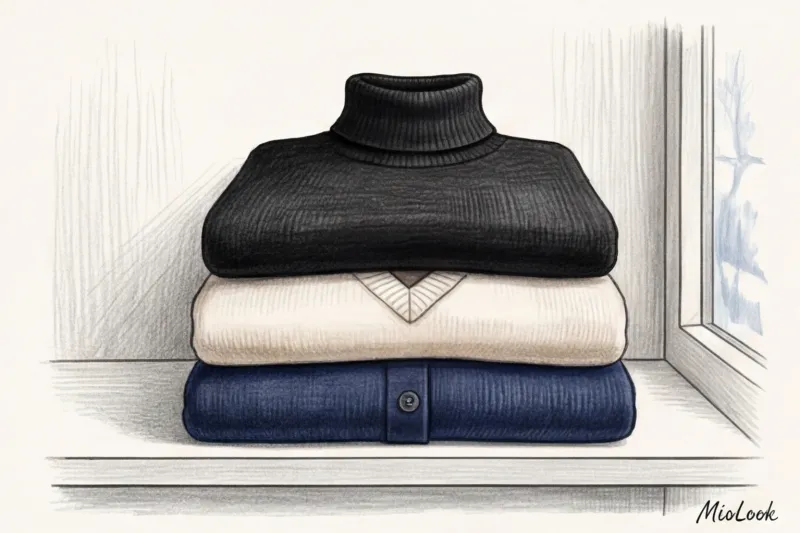
- Smooth merino turtleneck. Semi-fitted, it doesn't cling to every fold of the body. It's the perfect backdrop for statement jewelry and looks great under a jacket.
- Straight cut cardigan with buttons. The cardigan's V-neck visually elongates the neck. In winter, it successfully replaces a formal jacket in relaxed office looks (especially when worn over a silk top or that essential tank top).
- V-neck jumper. Creates a vertical line. Wear it with a contrasting turtleneck or a shirt with a stiff collar.
Bottoms and winter footwear: solving the main style problem
My clients' most common complaint is the gap between the hem of their trousers and the top of their winter boots. Tucking straight-leg cropped jeans into skinny ankle boots is a stylistic crime, instantly shortening the legs and creating a "pencil-in-a-cup" effect.
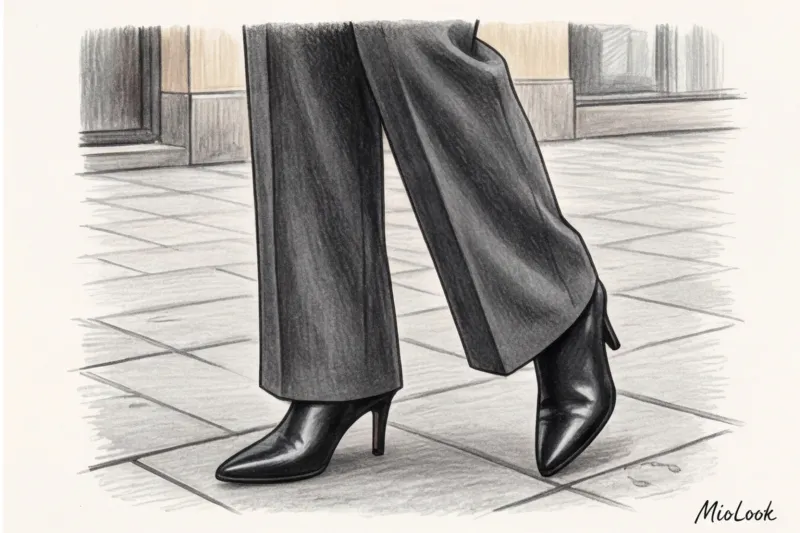
How to solve this elegantly?
- Wide, floor-length wool trousers. They should cover the heel almost completely. When paired with ankle boots with an elongated (or slightly square) toe, this creates an incredibly classy and elongated silhouette. Fair Limit: This advice doesn't work during heavy snowfalls and mud—the hem will be ruined. In such weather, switch to Plan B.
- Midi skirts made of thick wool or eco-leather. The length should cover the top of the boots (tube boots). No gaps from tights.
- Straight cut jeans. Choose a dense 100% cotton (no elastane) fabric that holds its shape and is windproof. Wear them with lace-up boots (Chelsea or military style), tucking the hem of the jeans over the top.
Accessories: What Gives Away an Expensive Winter Wardrobe
In winter, our clothes are predominantly soft: down jackets, knitwear, scarves. To prevent the look from turning into a shapeless cloud, we need strong contrast. This is the law of composition.
That's why a winter bag must maintain a rigid shape. A structured leather tote or crossbody bag with clean, geometric lines instantly brings together a relaxed look.
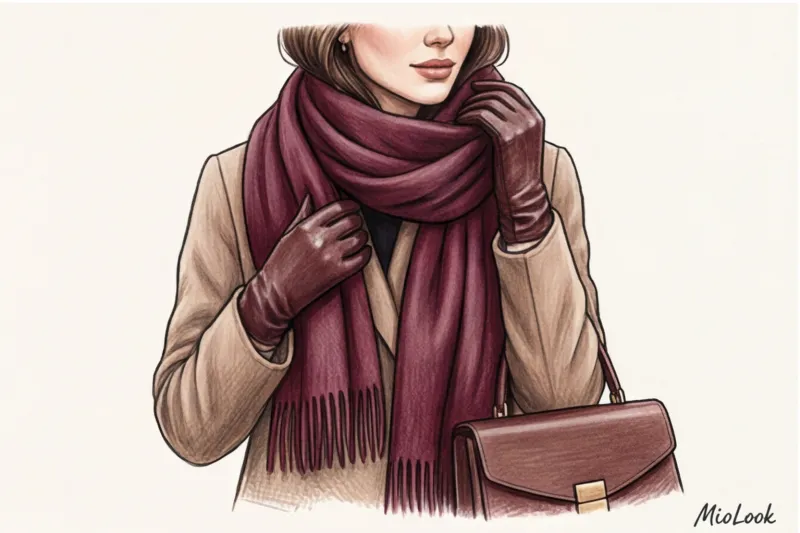
Another sign of elegance is avoiding matchy-matchy outfits (pre-made sets of identical hats, scarves, and gloves). This looks childish. Choose accessories in different but complementary textures: for example, a smooth cashmere beanie, a voluminous wool-blend scarf to match the coat, and tailored leather (not knitted!) gloves.
Checklist: An Audit of Your Basic Winter Wardrobe
To put all your theory into practice, set aside 15 minutes this weekend and do a thorough review.
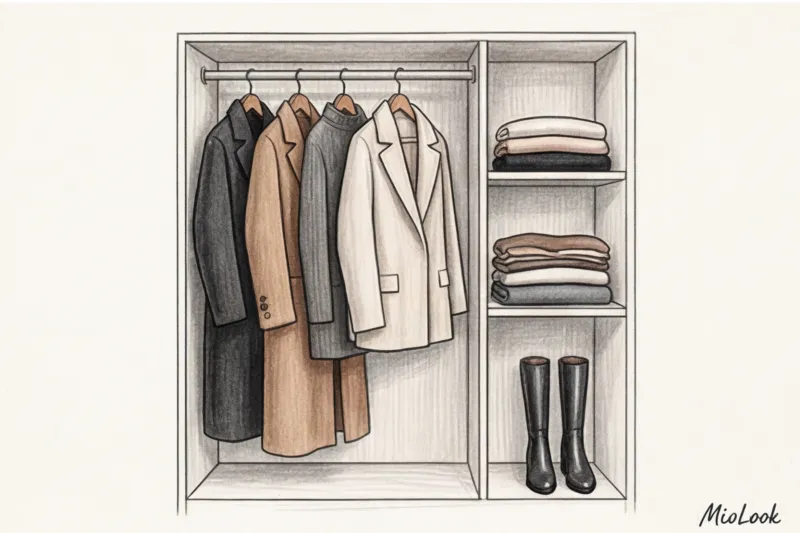
- Step 1: Eliminate dead weight. Remove all sweaters with pilling, stretched collars, and items made from 100% acrylic. Place them in a recycling bag. You don't need 10 bad sweaters, you need two perfect ones.
- Step 2: Check the foundation. Do you have high-quality thin thermal underwear or long sleeves made of micromodal/silk? If not, these are your number one purchase for this winter.
- Step 3: Compatibility test. Take your favorite winter bottoms (like wide-leg wool trousers) and try them on with all your tops, one by one. If a jumper or cardigan doesn't fit, it's a sign that the base layer isn't working properly. To automate this process, you can digitize your items in MioLook and clearly see which elements cannot be combined with each other.
A proper basic winter wardrobe for women isn't a never-ending battle against the cold or a compromise between beauty and comfort. It's a mathematically sound system where fabric density, invisible layers, and the right lengths work to complement your silhouette. Stop warming up with bulk and start warming up with quality.