I vividly remember my first ride on the ÖBB Nightjet from Vienna to Paris. Having watched countless movies, I decided that ribbed silk pajamas were the perfect choice for a romantic journey to the sound of the train's wheels. Reality hit me about two hours into the journey: the train's sudden braking turned my tea into an abstract pattern on my silk blouse, and the icy air conditioning left my teeth chattering until the early hours. After 12 years as a fashion journalist and constant travel, I've learned one thing: the romance of trains demands stern pragmatism in wardrobe.
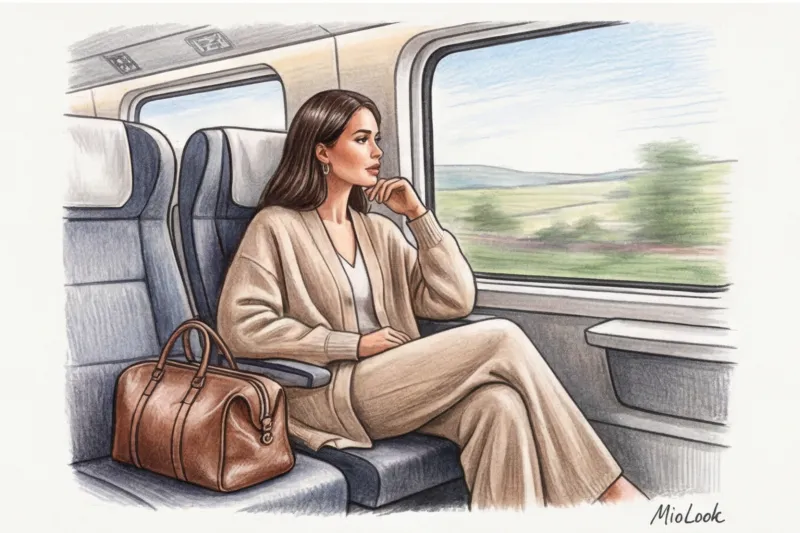
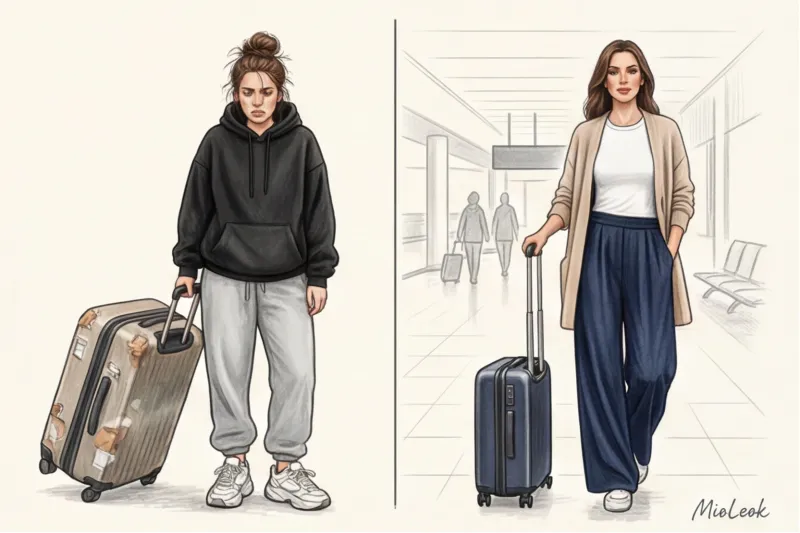
The question is, What to wear on the train , often boils down to two extremes: either people wear old, faded sweatpants ("no one's looking anyway"), or they dress as if they're about to walk the red carpet right in the vestibule. But a train is a unique social environment and a complex microclimate. It requires a special approach, balancing pajama-like comfort with the aesthetics of "quiet luxury." Incidentally, if you're looking forward to a flight, not the clatter of wheels, we've covered this issue in detail in our a complete guide to what to wear on a plane.
What to Wear on a Train: The Anatomy of the Ideal Travel Wardrobe
Preparing your wardrobe for a train is completely different from packing for a plane. On a train, you might walk, lie down, stand on the platform during long stops, and dine in the dining car. This requires creating a hybrid look, which fashion analysts jokingly call Train-Core.
The main dictator of your packing is the microclimate of the train car. Unlike on an airplane, where humidity drops to an extreme 10-20% (data from the Aerospace Medical Association), on a train it stays at a quite comfortable 40-50%. The problem lies elsewhere: temperature fluctuations. At night, under the blast of air conditioning, the temperature can feel like 18°C, while during the day, on the sunny side, the car warms up to 26°C. Add to this the drafty corridors and stuffy vestibules.
"Train clothes should work like a smart thermostat and not restrict movement in the confined space of a compartment" – this is a rule I repeat to all my clients before their vacation.
The rule of architectural layering
Forget about thick sweaters worn next to nothing. On the train, only architectural layering works. Your base layer is a breathable T-shirt or tank top in case of sudden heat or an air conditioning failure. For warmth, consider a cardigan, oversized shirt, or hoodie.
An important detail: the top layer should be unbuttoned (zipped or buttoned), not pulled over your head. Have you ever tried to pull off a thick hoodie while lying on the top berth of a reserved seat or a cramped compartment? It's an acrobatic feat that usually ends with your elbow hitting the ceiling. Clothing should be easy and discreet to remove.
The biggest mistake travelers make: why a cotton suit will let you down
I'm going to tell you something that might surprise you. A 100% cotton tracksuit is the worst choice for a long trip. Yes, we're used to thinking of cotton as the king of comfort, but on a train, it reveals all its shortcomings.
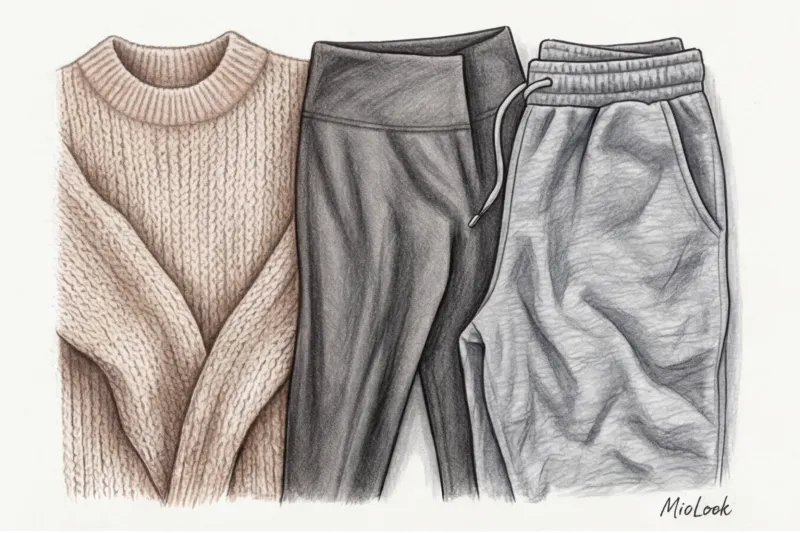
Firstly, pure cotton loses its shape instantly. After one night of sleeping on the shelf, you'll wake up with "stretched knees" and blistered elbows. By the end of the trip, your appearance will look unkempt. Secondly, cotton absorbs moisture but dries extremely slowly. If you sweat while boarding with a heavy suitcase, this damp fabric will instantly chill you under the train's air conditioning.
What to choose instead? Consider high-tech fabrics. Research by The Woolmark Company (2024) confirmed that fine merino wool has unique thermoregulation and natural antibacterial properties. Merino clothing remains odor-resistant even after two days of travel. Modal, Tencel, or high-quality blended fabrics with 5-10% elastane are excellent alternatives—they flow, don't wrinkle, and return to their shape after stretching.
Your perfect look starts here
Join thousands of users who look flawless every day with a smart AI stylist.
Get access — €0.99 onceClothes for long trips: putting together a capsule for the train car
When packing a travel capsule, I always start with the bottoms. Ideal choices are thick knit joggers, palazzo pants with a soft, wide elastic waistband, or ribbed leggings. The main rule: no tight drawstrings at the waist. When sitting for long periods, tight drawstrings dig into the stomach and compress the lymphatic system, leading to swelling and discomfort.
However, there is fair limitation The advice about wide palazzo pants doesn't always work. If you're traveling on a modern express train, they look chic. But if you're traveling on an older train with narrow corridors, wide pants will collect all the dust from the carriage floor. In such cases, cuffed joggers are a safer choice.
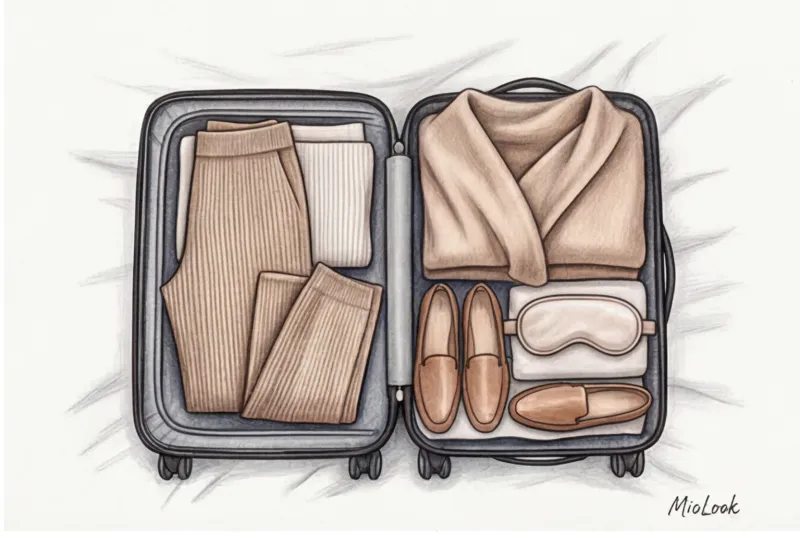
For your top, choose loose-fitting long sleeves. Make sure the top is long enough to cover your lower back when bending over or reaching for luggage. Avoid tight seams around the armholes.
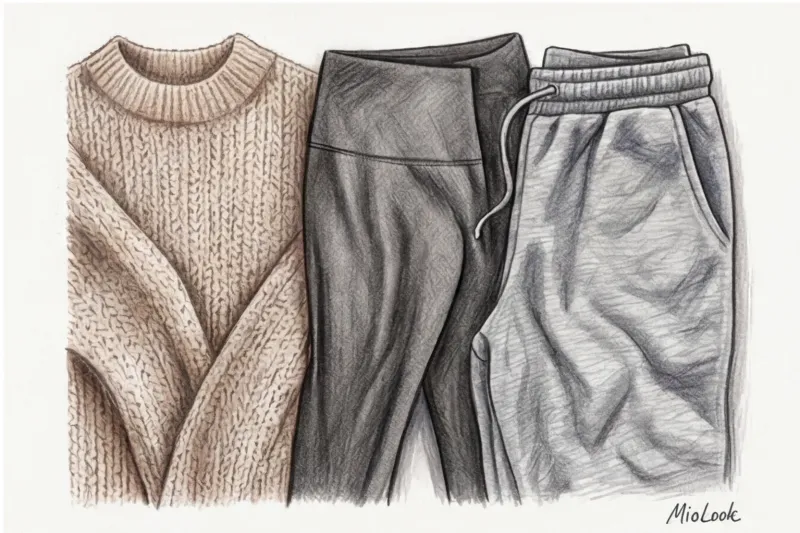
As for color, forget about black. Every speck of dust, every lint from a train blanket, and every cookie crumb will show on black knitwear. White is also a clear underdog. The optimal palette for a train: gray mélange (an absolute champion at hiding stains), deep blue, chocolate, olive, or rich burgundy.
Footwear: train car etiquette and hygiene
Walking around the train car barefoot or in socks is not only a violation of basic hygiene but also bad manners. Hundreds of feet pass through the train floor every day.
Ideal change shoes should meet the rule hands-free — put your shoes on hands-free. When you get down from the top bunk at night, you just need to slip your feet into your shoes, rather than fumbling with laces in the dark. Choose leather mules, slip-ons, sturdy Birkenstocks, or special closed-toe travel slippers with hard rubber soles (not soft hotel slippers that will get wet the first time you use the restroom).
How to look appropriate in the dining car and on the platform
A trip to the dining car is a small event in the routine of a long journey. How can you avoid looking like you just rolled out of bed without having to change into an evening gown? Historically, the dress code of the famed Orient Express called for tuxedos and evening gowns. Today, we adapt this chic through the lens of "Quiet Luxury."
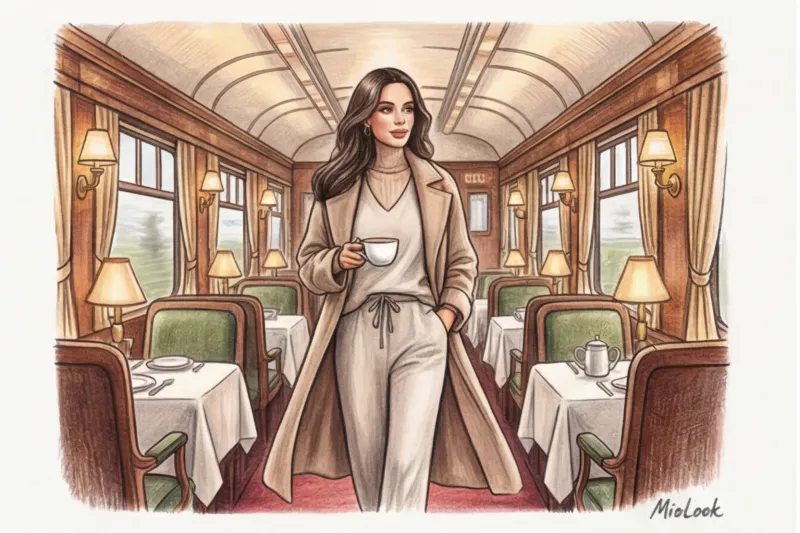
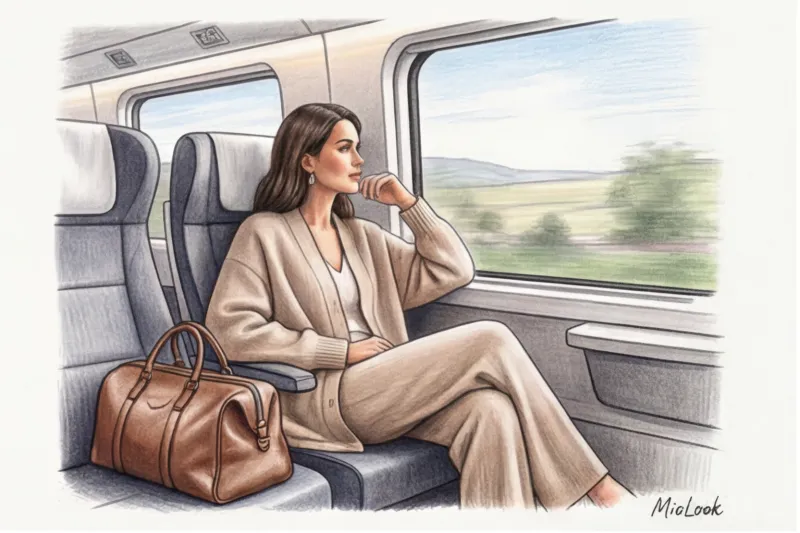
The secret lies in the use of "status capes." My favorite trick is a long knit duster cardigan or a voluminous cashmere stole. You can wear the simplest basic leggings and a T-shirt, but drape a high-quality long camel cardigan over your shoulders and the look instantly comes together and becomes elegant.
Monochromatic outfits (when the top and bottom are the same shade) visually elongate the silhouette and always look more expensive than mismatched pieces. Add neatly tied hair and clean shoes, and you're ready for dinner.
Access to MioLook for €0.99 — one-time payment
A smart AI stylist will analyze your wardrobe and select the perfect look for any trip.
Get access — €0.99 onceStop list: what you should absolutely not wear on the train
I had a client, Marina, who chose a trendy denim jumpsuit for a 24-hour trip. She described it as the longest night of her life. Trying to unzip the complex back piece in the tiny, shaking train toilet became pure torture. Learn from others' mistakes.
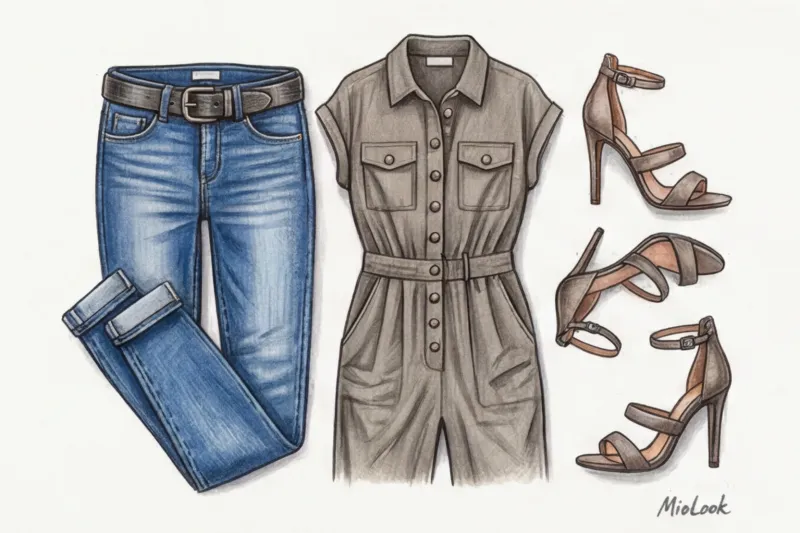
Here's a quick checklist of things to pack for the train:
- Rigid jeans and trousers with a belt. Denim heavier than 12 ounces will restrict pelvic circulation during prolonged sitting. A belt will dig into your stomach.
- Jumpsuits and rompers. Save them for walking around the city. They're impractical on the train.
- Light flowing floor-length fabrics. Wide white linen trousers will collect all the dirt in the corridor before the train departs.
- Intricate back fastenings and corset elements. Any metal fittings on the back (zippers, large buttons) will painfully dig into the body while you sleep.
Stylist Checklist: Accessories That Will Save Your Trip
The right clothes are only half the battle. Over the years of business travel, I've developed a must-have travel accessory kit that always stays in my carry-on.
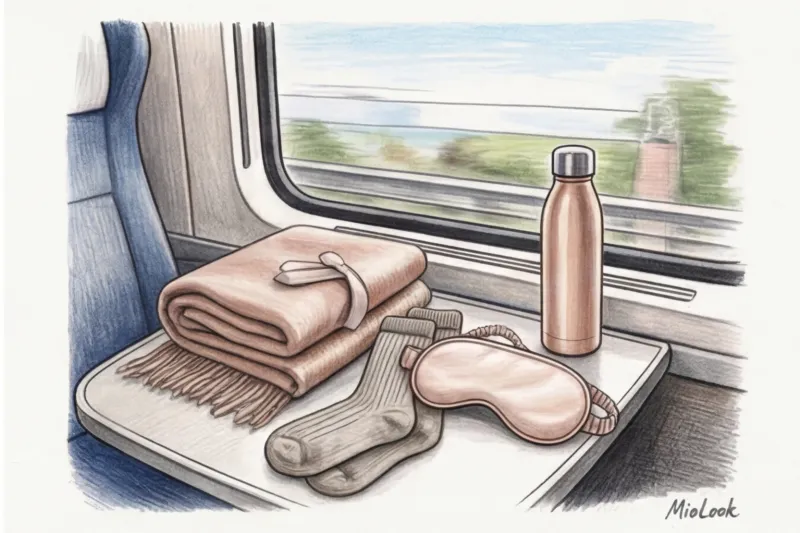
You will definitely need:
- Thick compression stockings. Yes, legs also swell on the train due to sitting with your legs dangling for long periods. Phlebologists recommend using Class 1 compression as a preventative measure.
- Wool or cashmere socks for sleeping. Temperatures often drop at night, and cold feet are a guarantee of insomnia.
- Silk hair tie. Cheap train pillowcases can be very staticky and can damage your hair. Tie your hair into a loose braid or bun with a soft silk scrunchie to prevent creasing.
- Sleeping mask made of natural silk and earplugs. The light of street lamps at stations and the snoring of neighbors will no longer be your problem.
Results: The formula for the perfect train look
Clothes directly affect our well-being. In psychology, this is called enclothed cognition (embodied cognition) - a 2012 study from Northwestern University demonstrated that what we wear alters our cognitive processes and mood. Putting on unkempt, old clothes subconsciously makes you feel tired even before you start your journey.
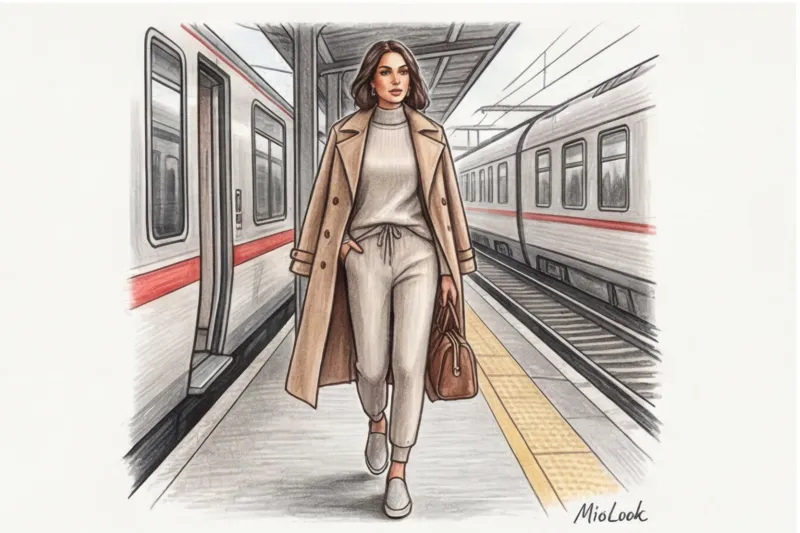
The formula for the perfect train look is simple: the comfort of pajamas, combined with the visually put-together look of casual wear, and high-tech fabrics. Plan your "travel wardrobe" as carefully as you would your vacation capsule. And to avoid racking your brain over combinations, upload photos of your items to MioLook , and our AI stylist will create flawless travel outfits for you in seconds. Travel in style!