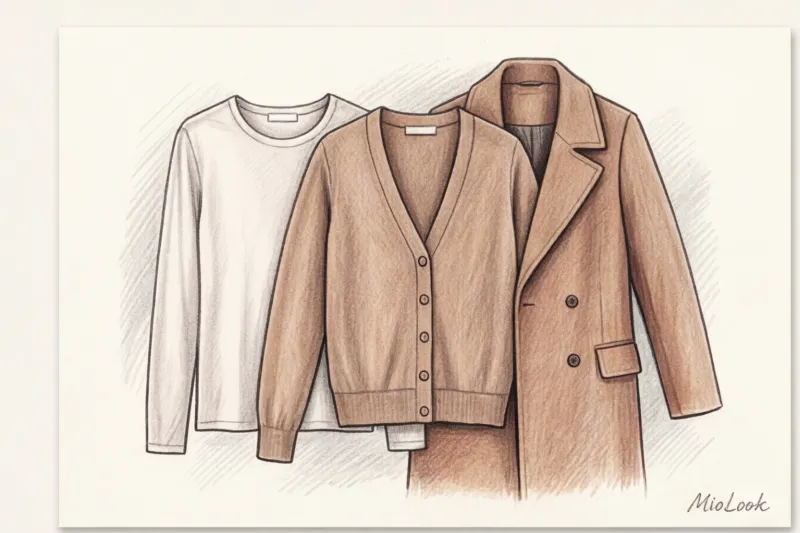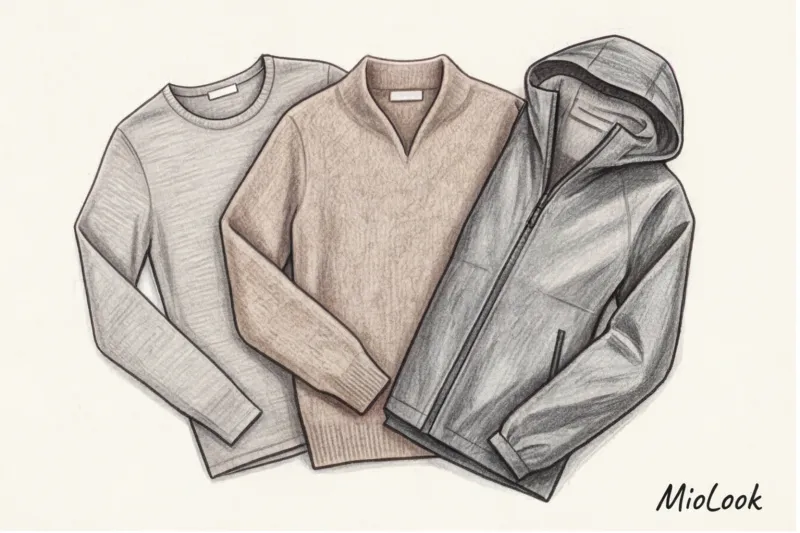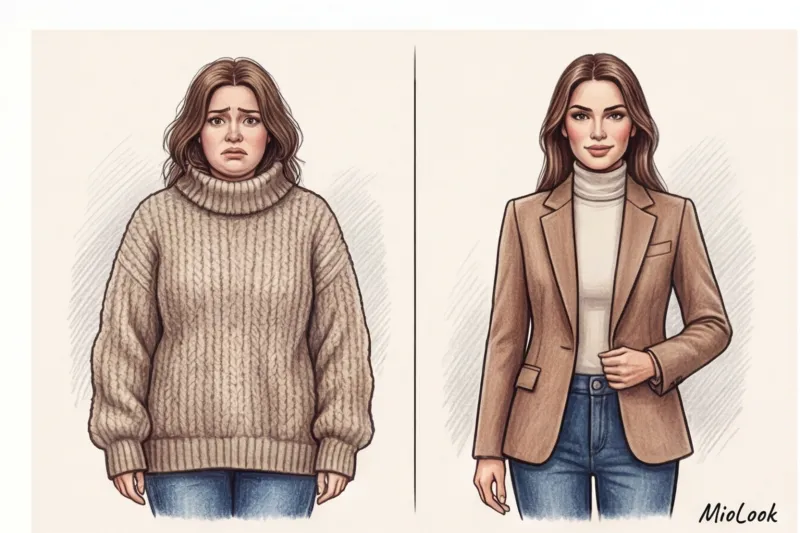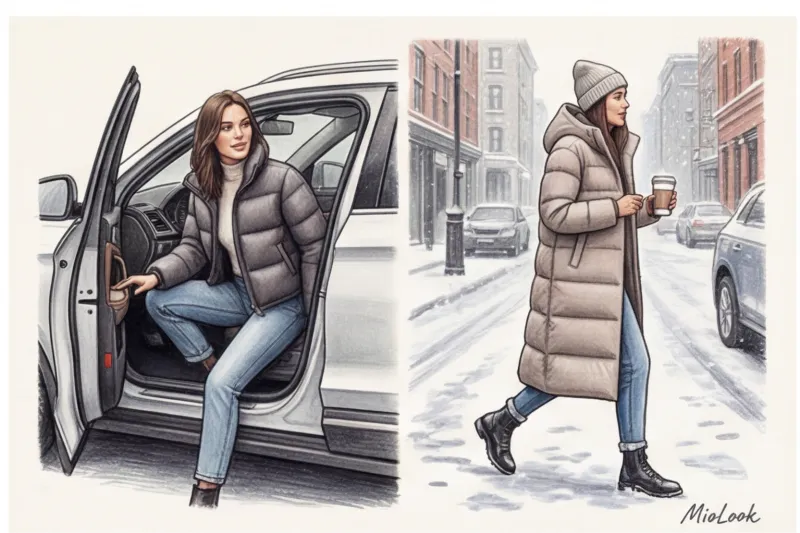
"I wore my thickest wool sweater and a puffer vest under my coat, but I still froze at the bus stop as soon as the wind blew," a client complained to me last winter. Sound familiar? We're used to thinking that the more layers we wear, and the thicker they are, the more reliable our protection from the cold. I'm sorry to disappoint you: from a textile physics perspective, this is a fatal mistake.

The paradox is that thick outerwear worn over an overly bulky inner layer literally squeezes the heat out of it. That's why a properly selected a thin down jacket under a coat It will keep you much warmer than a bulky mass-market down jacket. We've already discussed the architecture of the silhouettes in more detail in our A complete guide to fashionable outerwear: current styles and trends , and today we'll look at the anatomy of the ideal bottom layer.
Why Wear a Thin Down Jacket Under a Coat: A Fashion Paradigm Shift
According to the analytical agency WGSN (2024), demand for extravagant and complex outerwear has fallen by 34%. Microtrends have been replaced by the concept of modern classics—"slow fashion," where functionality is valued equally with aesthetics. Designers have finally solved the age-old female problem: how to look elegant in freezing temperatures without looking like a ski resort tourist.
The secret lies in the "thermos" principle. It's not the down itself that warms us, but the air it traps between its fluff. An architectural wool coat acts as an outer shield, blocking the wind, while a thin, technologically advanced layer underneath creates that impenetrable air cushion. You get a clean silhouette on the outside and a cozy microclimate on the inside.
Access to MioLook for €0.99 — one-time payment
A smart AI stylist will select the perfect look.
Get access — €0.99 onceThe Anatomy of a Proper Base Layer: Fill Power and Composition
Let's get one thing straight: not every lightweight jacket is suitable for layering. A city down jacket and a specialized liner are fundamentally different things. The main problem with cheaper alternatives is shiny nylon. The glossy surface creates strong static friction against the coat's lining. As a result, the liner rides up when you walk, statics your hair, and bunches up.
For the base layer, look for matte ripstop (a fabric with reinforced thread) or microfiber. They are quiet, aesthetically pleasing, and won't clash with the viscose lining of your outerwear.
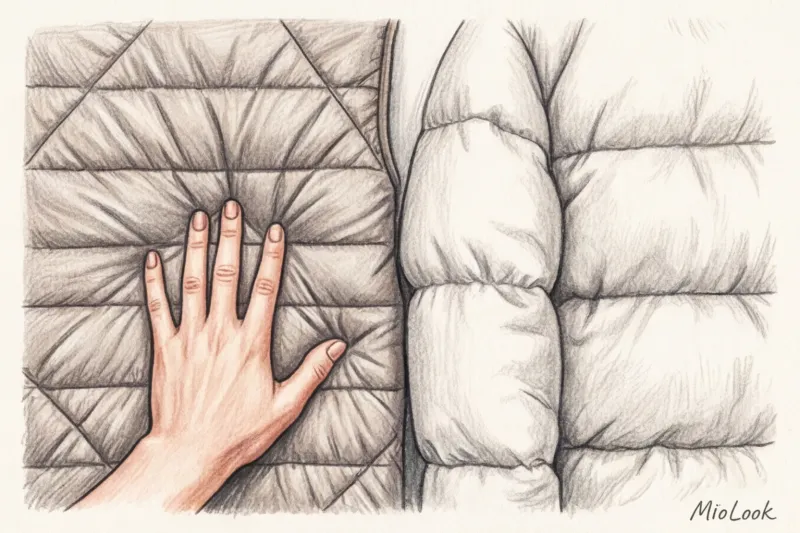
Natural down or eco-alternatives?
If you're choosing natural down insulation, look for the abbreviation RDS (Responsible Down Standard) on the label. This guarantees that the down has been harvested ethically. However, the industry is rapidly becoming more environmentally friendly: the Textile Exchange Recycled Down Market Report for 2024 shows that 40% of premium brands have switched entirely to recycled materials without compromising quality.
Next-generation synthetics shouldn't be discounted either. Insulations like PrimaLoft Gold or Thinsulate were originally developed for the military and mountaineering. Their main advantage over natural down is that they retain up to 98% of their insulating properties even when wet. If you're caught in wet snow, a synthetic liner will protect you from hypothermia.
Fill Power Rule: Why a Thick Down Jacket Won't Keep You Warm
Now let's bust the biggest winter myth. Down's resilience is measured by its fill power (FP). According to the International Down and Feather Bureau (IDFB) standards, basic down has an FP of around 400-500, while premium down has an FP of 750 and above.
The higher the fill power, the less down is required to create the desired volume. A liner with FP 800 will be half as thin but one and a half times warmer than a jacket with FP 400.
What happens when you wear a heavy double-breasted coat over a cheap, thick vest (with a low FP)? The heavy wool simply crushes the light down. The air pocket disappears, and you're left with a cold nylon rag. For layering, look for liners with an FP rating of 750 to 900—only these have enough resilience to withstand the pressure of the coat.
Access to MioLook for €0.99 — one-time payment
Start creating perfect images with the help of artificial intelligence
Get access — €0.99 onceHow to choose the perfect thin down jacket to wear under a coat
In my practice, one of the most challenging tasks was putting together a winter capsule for a top manager client. She needed to look classy, but she also needed to travel by public transportation. Initially, she bought a regular sports vest for €30, but it mercilessly ruined the elegance of her Max Mara cashmere, creating a "cabbage" effect. We replaced it with an ultra-thin liner for €120 with the right geometry, and the problem was solved.
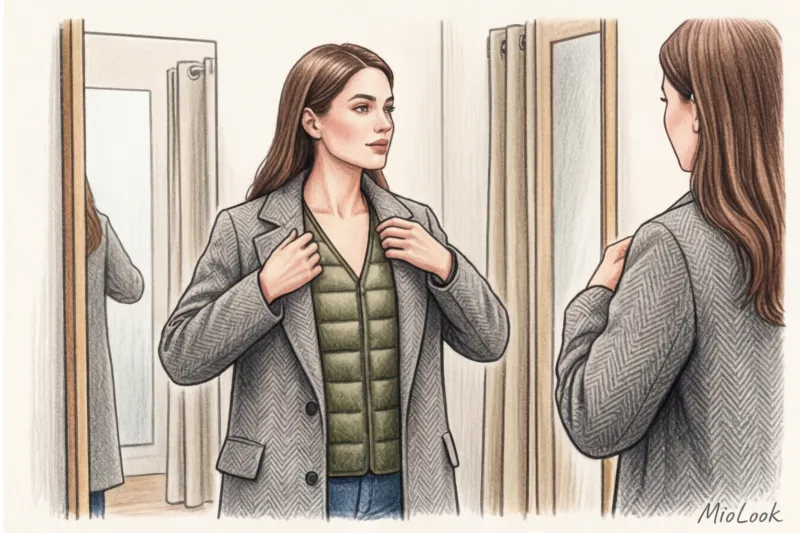
What to look for when buying:
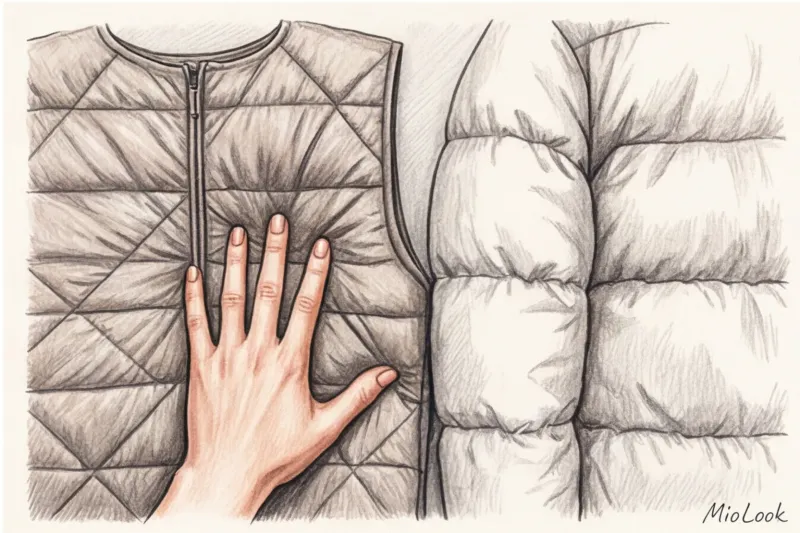
- Neck shape. A deep V-neckline is perfect for a stealth look with a formal coat collar. A stand-up collar is ideal if you want to add a sporty touch.
- Vest or sleeves. If your coat has narrow sleeves, choose a vest only. A jacket with sleeves is only acceptable with an oversized or raglan coat.
- Stitch step. Large horizontal stripes visually widen the figure. Choose a small diamond quilt—it better holds the minimum amount of fluff and slims the silhouette.
Cut Architecture: Choosing a Coat for Layered Looks
The fitted coats of the 2000s (the tight fit) are completely unsuitable for modern layering. If you try to squeeze a down jacket underneath, the fabric will stretch at the back and the buttons will come undone. To test the combination of your pieces before leaving the house, I often recommend smart wardrobe feature in the MioLook app , where you can visualize layers.
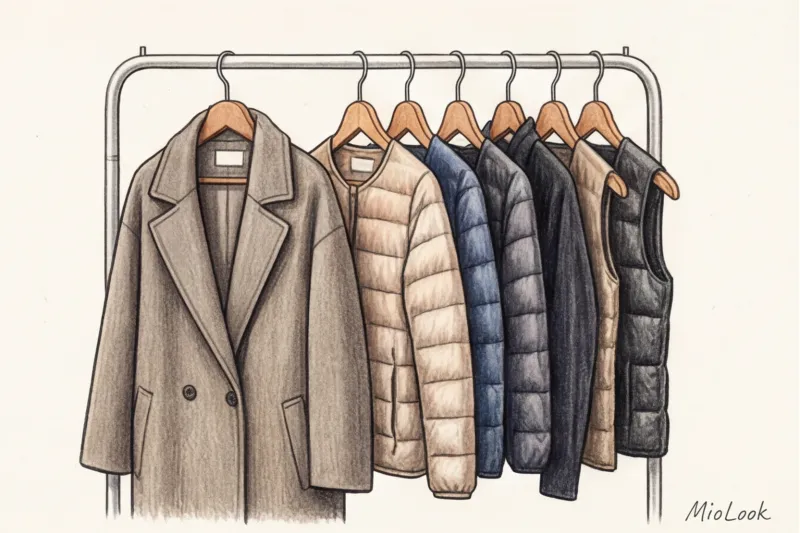
The secret lies in the balance of textures. You want a stiff, structured shoulder line on the coat and a soft, pliable volume on the inner layer. Be sure to check the composition of the coat's lining: viscose or cupra ensures perfect glide. A polyester lining paired with a nylon down jacket will create a sauna-like effect.
Your perfect look starts here
Join thousands of users who look flawless every day with MioLook.
Get access — €0.99 onceThe secret to the perfect armhole for freedom of movement
About 30% of winter heat loss occurs because a coat's armhole is too narrow, compressing the underarm area of the down jacket, impairing circulation and displacing warm air. Your best friends here are a dropped armhole and raglan sleeves. It's easy to check comfort: after putting on both layers in the fitting room, raise your arms as if you were holding onto a handrail on the subway. If the coat rises up along with your shoulders, all the way to your ears, look for a larger size.
To hide or to show: 4 formulas for styling a thin down jacket
Styling depends on your dress code. Here are four tried-and-true formulas that work flawlessly, from a formal office to a relaxed weekend.

- "Invisible" (for strict dress code). Choose a matte V-neck liner that matches your coat exactly (for example, camel on camel). When the coat is buttoned, it's completely invisible. Perfect for meetings where a formal look is required.
- "Color Block" (for creative environments). Use a vest as an accent. An emerald or burgundy liner under a basic gray coat instantly adds sophistication and polish to the look.
- "Sport-chic" (for weekends). We put on a thin down jacket with a hood under a straight wool coat. We let the nylon hood out over the wool collar. We pair it with chunky boots (by the way, if you're unsure about choosing footwear, check out our article on Who suits chunky shoes? ).
- "Play of textures" (smart casual). A combination of a matte, slightly shimmery drape coat and a liner with a subtle, satin shimmer. The contrast in textures is eye-catching.
Layering Mistakes: What to Avoid When Combining a Coat and Down Jacket
Even the best idea can be ruined by sloppy execution. Over the years as a stylist, I've compiled a list of the top layering mistakes.
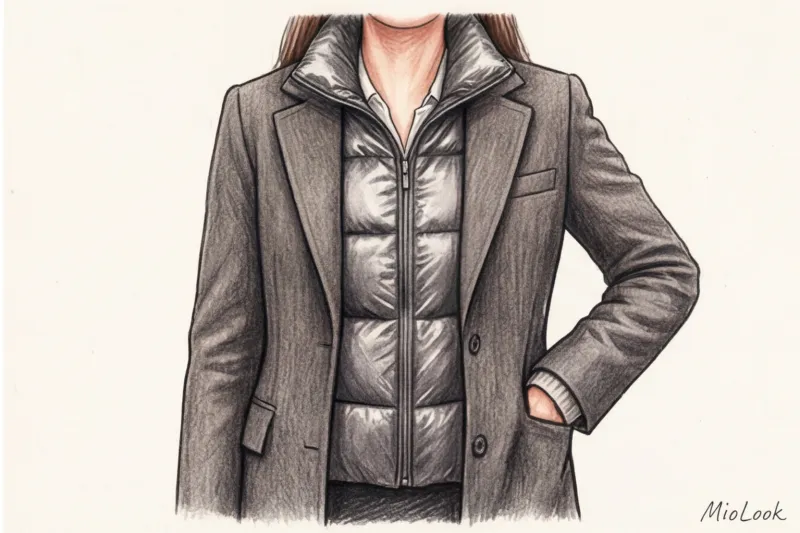
Firstly, a down jacket should not be longer than a coat A nylon hem peeking out from below visually cuts off the legs and disrupts the proportions of the silhouette. If your coat is knee-length, the liner should end at the hip line.
Secondly, collar conflict If your coat has a classic English collar and your down jacket has a voluminous puff collar that reaches to the chin, you'll create the effect of a "missing neck." Your face will appear wider and your posture will appear hunched.
Thirdly, it is worth mentioning an important limitation: This trick will NOT work if your coat is made of very thin wool without lining. (For example, summer dusters or robe-style coats made of double-face fabric.) Through soft, thin fabric, the texture of a quilted down jacket will show through in unsightly lumps.
Checklist: Checking the quality of the liner in the store
So, you're at the store. You can find some great options for between €50 and €150, but you need to know where to look. Don't trust labels—trust your hands.
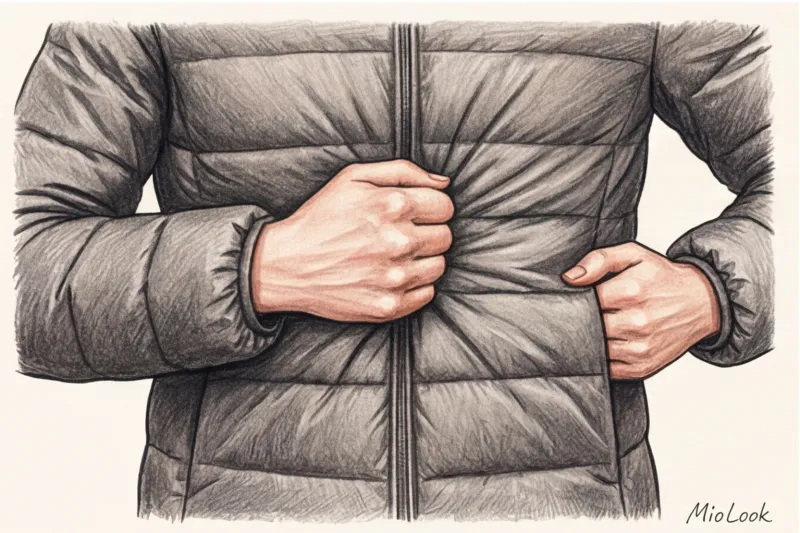
Take a quick test drive before you buy:
- The Squeeze Test. Tightly squeeze the sleeve or hem of your down jacket in your fist, hold for 5 seconds, and then release quickly. High-quality down (FP 750+) will straighten out and return to its original volume almost instantly (in 2-3 seconds). If the fabric remains wrinkled and flat, leave the garment on a hanger; it won't keep you warm.
- Checking the fittings. For a base layer, flat matte snaps are always better than chunky zippers. A zipper under a coat often ripples and sticks out at the stomach, while snaps create a smooth, unnoticeable line.
- Inspection of seams. Gently tug the fabric near the stitching. If you see tiny white fluff protruding from the needle holes, the lint will migrate. Within a week, your dark wool coat and cashmere sweater will be coated with white fluff on the inside, which will be a real pain to remove.
Incorporating a thin down jacket into your basic wardrobe is a game-changer. You're no longer dependent on the weather, you don't sacrifice style for warmth, and you can finally wear your favorite elegant coats even in sub-zero temperatures. The key is to remember this rule: invest in fill power and a comfortable fit, not thickness.