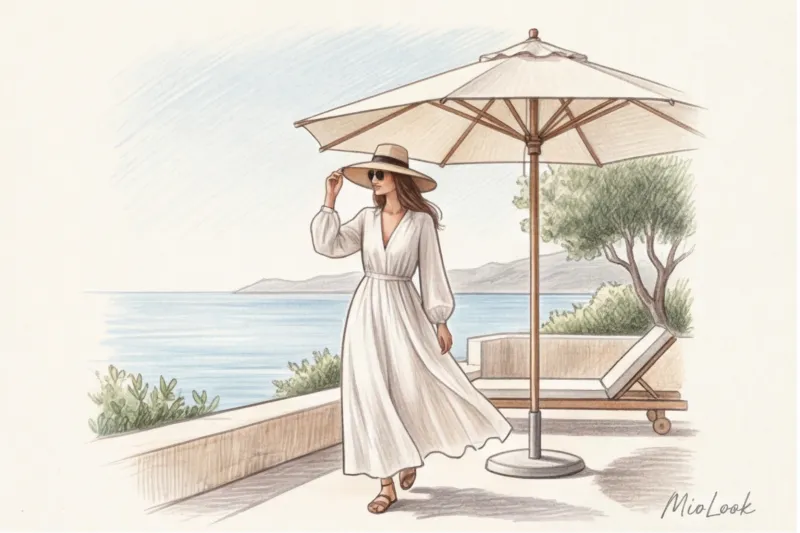
August. Lake Como. The thermometer is hovering at 32°C, and the humidity is so thick you could cut the air with a knife. At a lavish wedding ceremony, most of the guests, in revealing miniskirts and slip dresses with thin straps, are desperately fanning themselves, trying to escape the sticky heat. Only one of my clients, in a tightly capped column dress of flowing dark green crepe, looks as if an invisible personal air conditioner is spinning around her.
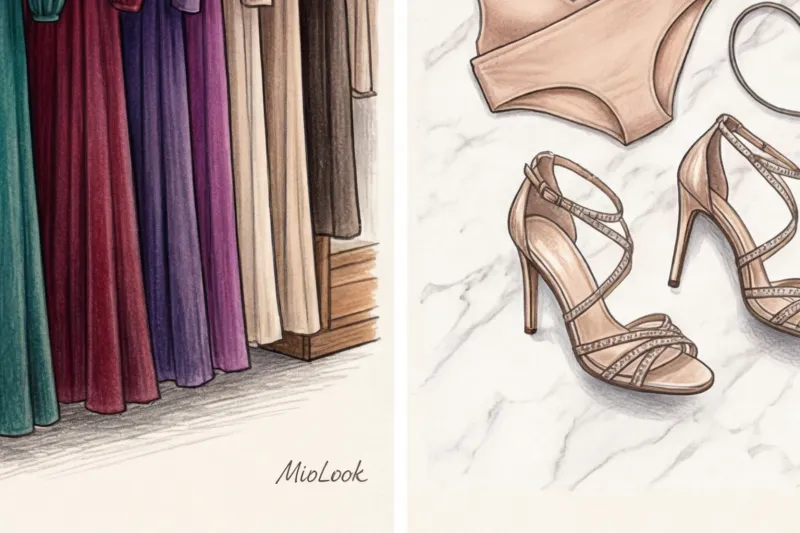
Is it a paradox? Not at all. While glossy magazines, by inertia, advise us to bare as much as possible at the first rays of sun, the laws of physics and physiology dictate the opposite. When choosing summer closed dresses for celebrations , you're not just relying on status elegance. You're embracing the principle of intelligent thermoregulation. We've discussed in more detail why the aesthetics of "quiet luxury" today are inextricably linked to the rejection of deep necklines in our The Complete Guide to Evening Dresses: A Symbol of New Luxury.
The Heat Paradox: Why Summer Dresses Keep You Cooler Than Open Dresses
Let's bust the biggest summer myth: exposed skin doesn't help you cool down in the heat. On the contrary, exposed to direct sunlight at temperatures above 28°C (82°F), bare skin heats up instantly, forcing the body to frantically produce liters of sweat to cool down.
Consider the traditional clothing of desert dwellers. They are always long, closed, and loose-fitting. Scientifically, this is called the "Bedouin effect"—a loose, closed garment creates convection currents within the body. Hot air rises from the body and escapes through the collar, while cooler air is drawn in from below, under the hem. This creates natural ventilation.
In hot weather, it's not the lack of fabric on your body that cools you down, but the layer of air between the fabric and your skin. A full-length dress acts like an awning, protecting you from the harsh sun.
That's why today's top managers, CEOs, and aristocrats choose long-sleeved maxis for summer social events. It's not just a dress code observance—it's a way to save face (literally and figuratively) while other guests are melting in the heat.
Fabric Anatomy: What to Wear to Stay Cool Even in August

Even the most ingenious architectural cut can be ruined by one detail: polyester. In eveningwear, it's the worst enemy. Over 14 years as a stylist, I've developed a rigorous filter. In my studio, I often test garments with a powerful steamer, simulating 80% summer humidity. Polyester instantly turns into a wet, sticky film. Natural and synthetic cellulose fibers behave differently.
According to research by textile institutes on thermoregulation, the best materials for closed summer outfits are:
- Cupro and Tencel. High-tech cellulose materials. They feel like washed silk, but are incredibly absorbent. They literally "cool" the skin to the touch.
- Matte silk and crepe de chine. Thanks to its special, slightly grainy weave, crepe de chine doesn't cling to the skin. Furthermore, the tightly woven dark silk has a UPF rating of approximately 50, acting as a reliable sunscreen.
The Linen Trap: Why 100% Linen Isn't Suitable for Evening Dresses
I adore linen in my everyday wardrobe, but for evening receptions it's a disaster. Yes, it breathes beautifully. But after exactly 30 minutes of sitting at a banquet table or in a taxi, deep, unsightly creases form in a 100% linen dress in the groin area, at the elbows, and behind the knees. That classy look vanishes instantly.
If you want the texture of linen, look for the right blends. The ideal option for evening wear is 50-60% viscose or silk and 40-50% linen. Viscose gives the fabric heft and fluidity, preventing the linen from bunching up.
Access to MioLook for €0.99 — one-time payment
A smart AI stylist will analyze your appearance and select the perfect look for a summer celebration, taking into account your body type.
Get access — €0.99 onceArchitectural cut: the effect of a "built-in air conditioner"

A closed dress doesn't mean a "bodycon dress." A sheath dress with tight sleeves will turn into a torture device in August. Air is your main insulator.
When choosing a style, pay attention to the following design elements:
- Sleeve shape. A dolman or bishop sleeve is ideal. The deep armholes avoid touching the armpit, preventing sweat stains.
- Refusal of corsages. Avoid tight fitting under the bust and waist. The fewer seams pressed tightly against the body, the easier it will be for you to breathe.
- Hem. A column dress with a slit or a soft A-line silhouette works like a pump. With every step, the hem sways, drawing fresh air down your legs and back.
A practical tip from the fitting room: after putting on the dress, be sure to walk briskly and raise your arms a couple of times. You should physically feel the cool air moving inside the fabric cocoon. If the fabric drags or clings, take it off.
Color and decor: how to avoid turning into a "greenhouse"
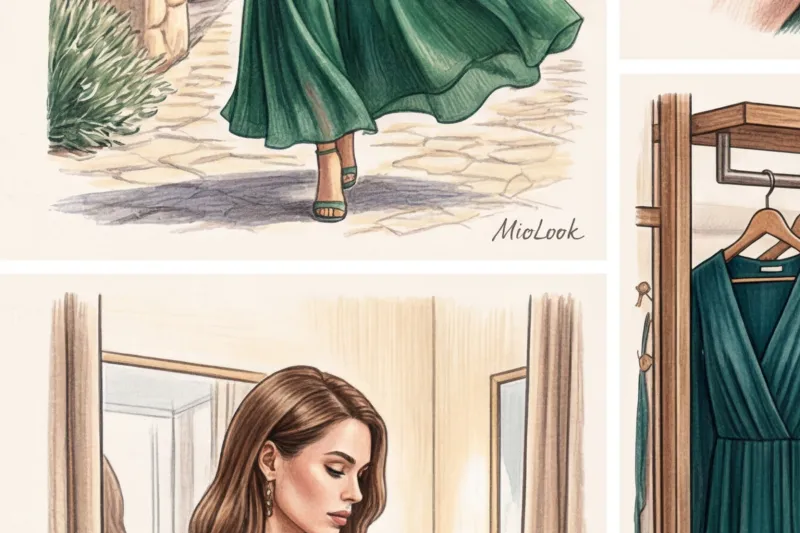
Forget heavy embellishments. All-over beading, glass beads, or large sequins adds not only visual but also physical weight to a dress. This shell completely blocks air circulation, acting as a first-class thermal insulator.
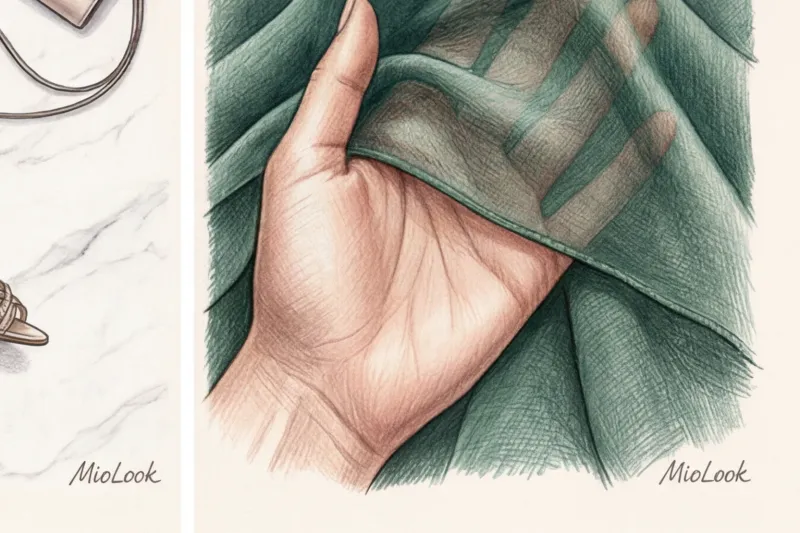
Texture and color are equally important. Glossy satin (even 100% natural silk) is tricky. Due to the specific refraction of light, even the smallest drop of moisture on the body becomes instantly visible. Matte crepe or georgette, on the other hand, visually absorb light and conceal imperfections.
As for the palette, deep, rich shades—emerald, sapphire, dark chocolate, and wine—always look more luxurious than pale pastels in the evening light. And, crucial for a summer celebration, they prevent awkward sweating situations. If you're worried about embarrassment, I recommend checking out our article: Fabrics that don't show sweat stains: A guide for speakers.
Where to Look for the Right Models: A Look at European Brands

Finding summer, high-necked dresses for a special occasion without cheap synthetics is a challenge, but I solve it regularly for my clients. Here's where to look for the gems:
- Massimo Dutti. The absolute leaders in cupro in the mid-range segment. Their long-sleeved maxi dresses in cupro will cost you around €100–€150, while a similar cut in 100% silk from premium brands starts at €300.
- COS. Go here for that architectural cut that doesn't cling to the body. They have perfectly tailored puff sleeves and deep, ventilated armholes.
- Zara (SRPLS and Studio lines). Don't write off mass-market fashion. Zara's limited-edition collections feature stunning pieces made from natural silk or premium viscose twice a year.
An insider's secret for reading labels: many are wary of elastane. But for a high-necked evening dress, 5-10% elastane (spandex) paired with viscose or cotton is a huge plus. It won't stretch out at the knees after dinner or bunch up on your buttocks.
If you bought a dress with a complex cut and don’t know how to accessorize it, upload a photo of it to the app. MioLook Artificial intelligence will help you put your image together without overloading it.
Hidden Details: Lingerie and Styling for Hot Weather

What you wear under your dress affects your thermoregulation just as much as the fabric itself. Avoid thick lace or tight spandex shapewear—these guarantee skin irritation in hot weather.
Choose seamless, laser-cut microfiber panties. Avoid bras with thick layers of foam (push-up). Every extra millimeter of foam on your chest at 30°C is like a personal sauna. A secret from the stylists on the summer red carpet at the Cannes Film Festival: to prevent chafing under a loose dress, we use anti-chafing sticks or regular, clear, unscented talc.
Pay special attention to footwear. A closed-toe maxi dress calls for minimal footwear. Wearing closed-toe pumps with this outfit will create a heavy, autumnal look. Sandals with thin straps, showcasing a beautiful pedicure, will instantly lighten the silhouette and balance out the closed-toe top.
Jewelry: The One-Zone Rule
A solid-color, closed dress is a brilliant backdrop for statement jewelry. But in hot weather, metal or stone necklaces placed tightly on the collarbones quickly become warm from the body and begin to cling to the neck. My advice: leave the neck free.
Draw attention to your face or hands. Large, structured chandelier earrings in crushed metal or a chunky cuff worn directly over the sleeve of a dress on the wrist look incredibly expensive without causing physical discomfort.
Your perfect look starts here
Join thousands of users who look flawless every day by managing their wardrobe with MioLook.
Get access — €0.99 onceKatarzyna's Checklist: 5 Steps to Buying a Summer A-Line Dress
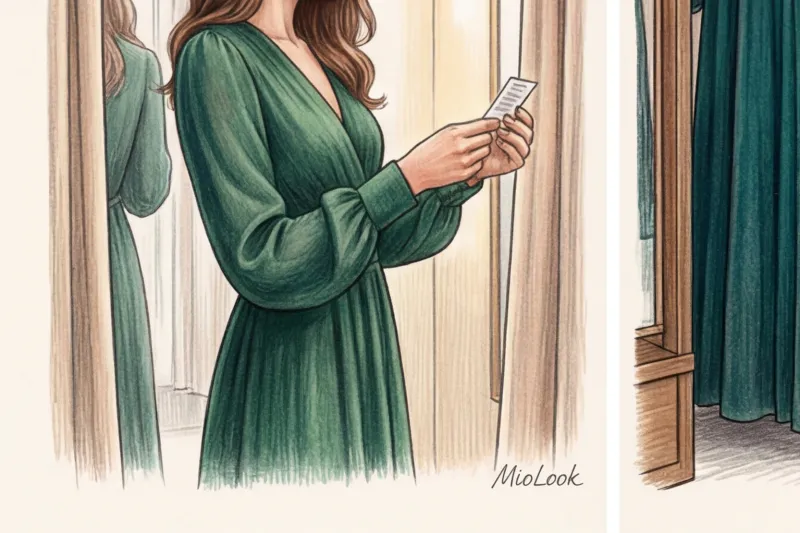
I teach my clients pragmatic shopping: every item should be worth every penny invested in it. If the dress you've chosen doesn't meet even one of these criteria, feel free to leave it on the store hanger.
- Crease test. Firmly squeeze the hem in your fist for 10 seconds. If the fabric is still chewed up like paper after you release it, you'll look the same at the banquet in half an hour.
- Transparency test. Step away from the fitting room mirror and hold the fabric up to a bright light. Make sure the silhouette of your legs doesn't show through more than you intended.
- Armhole assessment. Raise your arm, pretending to hail a taxi or grab a glass. The armhole shouldn't dig into your armpit—there should be at least 3-4 centimeters of space.
- Checking the composition. We search for the following words: Cupro, Tencel, Lyocell, Silk, Viscose. Polyester is allowed only as an additive (no more than 30%) to reduce wrinkling.
- Ventilation test. Take a quick walk down the store's aisle. Feel the air move under the fabric? We'll take it.
The key insight to remember: a high-neck summer dress for a special occasion isn't a compromise between dress code and comfort. It's the most elegant way to beat the heat, leaving behind a trail of impeccable taste and absolute self-confidence.