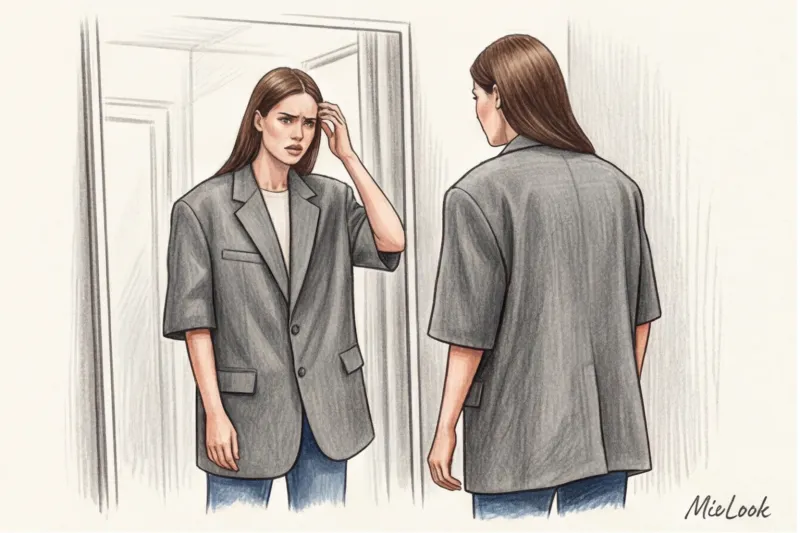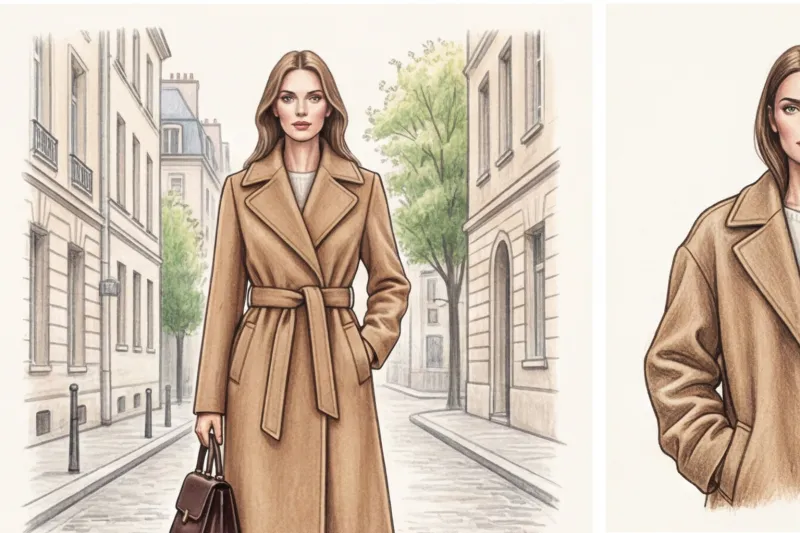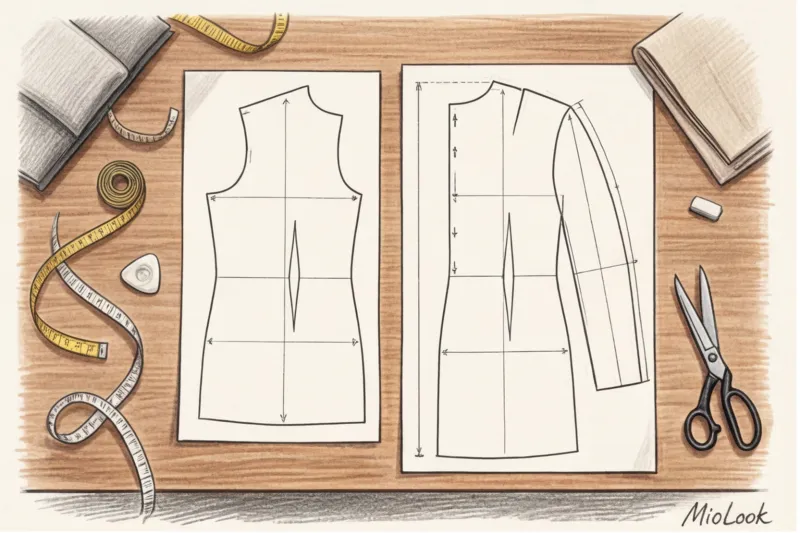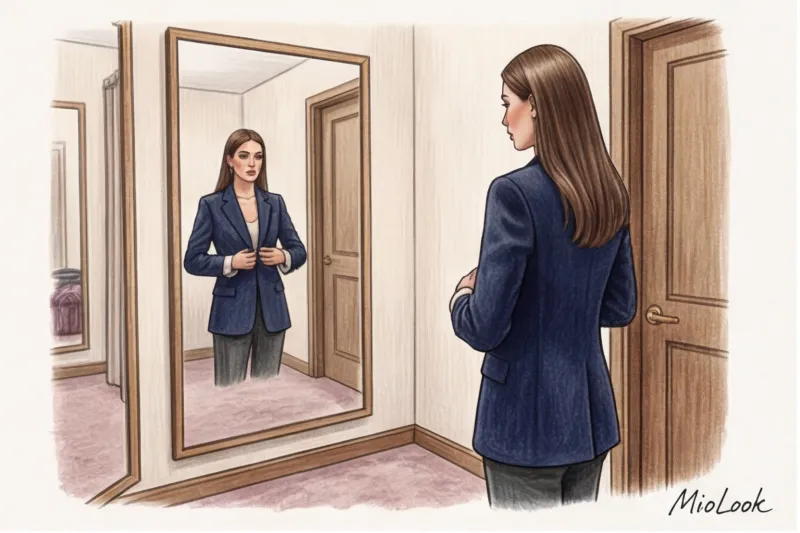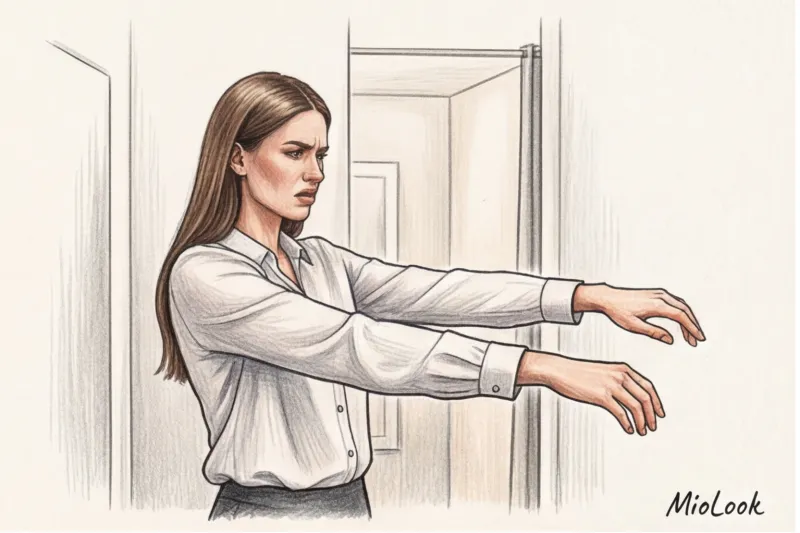
It's a familiar feeling: you put on a stunning new item, fasten the buttons, stretch your arms forward—and feel a chill on your wrists. Again, those treacherous five centimeters of bare skin between the cuff and the wrist. If you're taller than 175 centimeters, finding a basic top becomes a quest for survival. We tend to chalk it up to "body features," when in fact, the problem lies in the dry mathematics of industrial design.
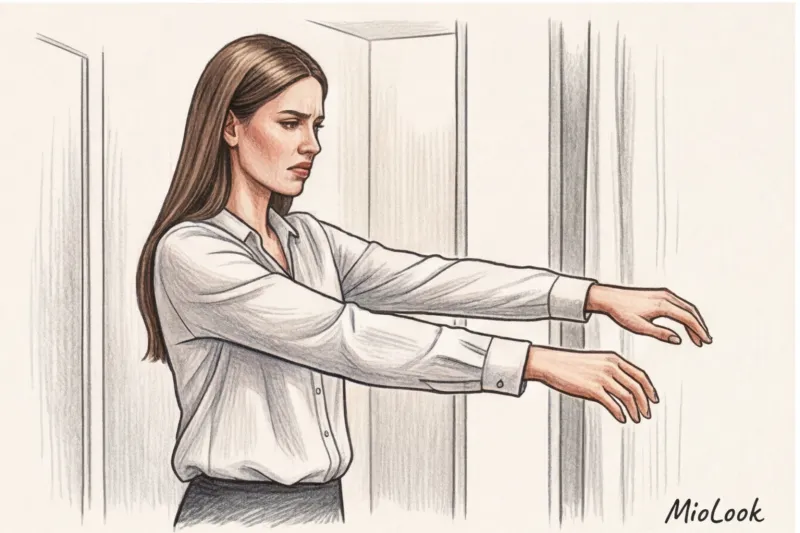
We talked in more detail about the basic principles of fit for this type of figure in our The complete guide to perfect clothing for tall girls But today I want to dissect the most annoying detail. Correct shirts for tall girls And sweaters with adequate sleeve lengths do exist. And no, the solution isn't simply rolling up your sleeves three-quarters of the way all year round.
Anatomy of the Problem: Why Standard Mass-Market Ignores Your Proportions
Let's look at the numbers. International clothing design standards (such as the ISO 8559 system), which is used by most global brands from Zara to H&M, use an average female height of 164–168 cm as a baseline. For these measurements, the standard sleeve length is set at 58–60 cm.
Now, let's get real: if your height is close to 178–180 cm, the anatomical length of your arm from the shoulder joint to the wrist bone is at least 64–66 cm. This creates a deficit of 6 centimeters, which cannot be compensated for simply by tightening the fabric.
"When increasing from a size M to a size L, factory pattern grading algorithms add a full 4 centimeters to the garment's width, but only 0.5–1 centimeter to the sleeve length. Mass-market clothing scales in width, not height."
And the problem isn't limited to your wrists. When you put on a garment tailored for a height of 165 cm, the entire cut falls apart. The waistline of a sweater ends up under your ribs, the bust darts on a blouse point somewhere toward your collarbone, and the armhole cuts into your armpit. You feel constrained simply because the three-dimensional geometry of the garment doesn't align with your skeleton.
Access to MioLook for €0.99 — one-time payment
A smart AI stylist will select the perfect look based on your individual parameters.
Get access — €0.99 onceShirts for Tall Girls: How to Stop Buying Two Sizes Too Big
The most fatal mistake I see in my styling practice is trying to compensate for a lack of length by buying oversized clothes.
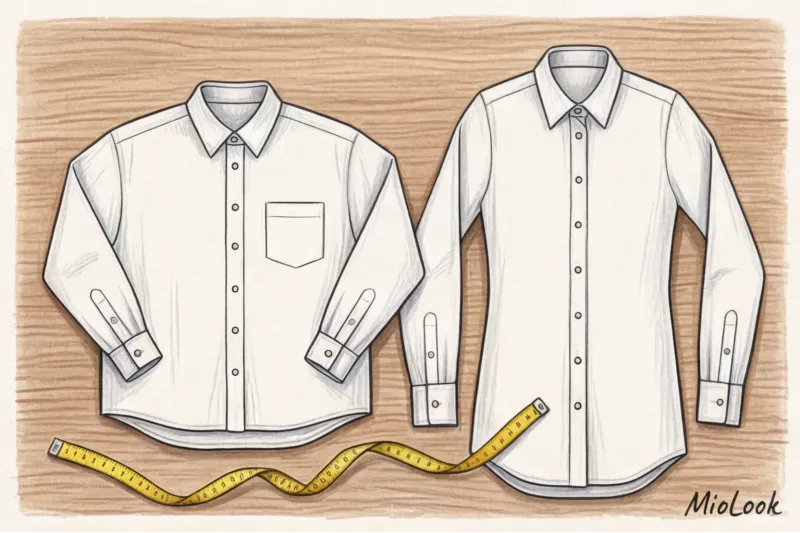
I had a client, Anna, a stunningly beautiful woman, 182 cm tall. She was a size 44 (Russian size), but for years she'd been buying size 50 shirts. She hid her petite figure in shapeless "covers" with one sole goal: to have the cuffs at least touch her wrists. As a result, the dropped shoulder seam of the enormous shirt fell mid-bicep, making the sleeve itself look even more stunted against the enormous square "body" of the garment. We immediately stopped this practice.
The architecture of a proper fit works differently. If you're looking for an item in a brand's standard line, look for the following markers:
- Dropped armhole. But it must be structurally embedded (as in a batwing or kimono cut), and not simply the result of gigantic size.
- Back length. For a height of 175 cm or more, the correct basic shirt should have a back length of at least 72–75 cm. If it is shorter, it will immediately come loose from the trousers when raising your arms.
- Specialized Tall lines. This isn't a marketing ploy. Tall collections (for example, at ASOS, and partially at COS and Massimo Dutti) have redesigned the entire mesh: sleeves are longer, the waistline is lower, and the chest height is adjusted.
Men's department: stylish hack or compromise?
If you don't have specialized rulers on hand, the men's section is a real lifesaver. Men's patterns are initially designed for heights of 176 cm and above, so the standard sleeve there is that all-important 65–67 cm.
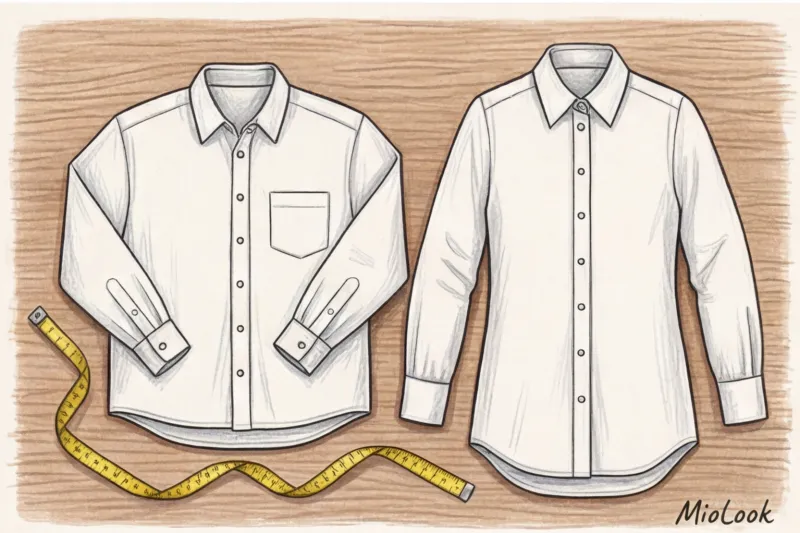
But there is a clear limitation here: This doesn't work for girls with full breasts. Men's shirts don't have bust darts. If you have a C cup or larger, the heavy cotton will "tent" from the bust down, adding visual weight by 10 kilograms.
What items can we confidently borrow from men? Heavy Oxford shirts (180 g/m² cotton) and flannel. To avoid the "I'm wearing a lumberjack shirt" look, apply the rule of contrast balance: pair a rugged, masculine top with a decidedly feminine bottom—a silk slip skirt or elegant palazzo pants. This is a great base if you're putting together a women's denim total look or looking for relaxed smart-casual solutions.
Sweaters and jumpers: saving proportions and choosing texture
Sweaters are a little different, thanks to the stretchiness of knitwear. However, an ill-fitting, oversized short-sleeved sweater can create a comical "Alice in Wonderland" effect.
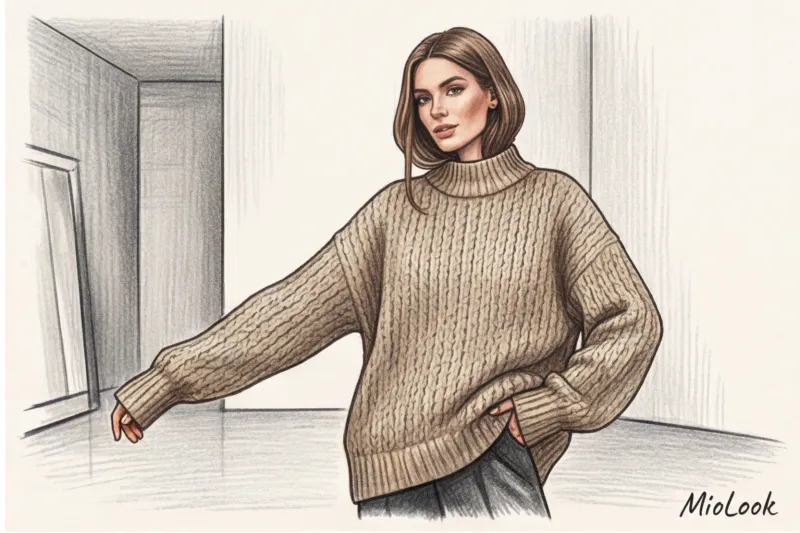
A study of the properties of knitwear conducted by the Institute of Textile Technologies (2023) confirms an important fact: heavy fibers behave differently when worn than lighter ones. Dense cotton with acrylic or heavy, chunky merino wool can stretch under their own weight by 2–3 centimeters over the course of a day. However, lightweight premium cashmere or fine mohair will remain exactly where they ended in the morning. Keep this law of physics in mind when trying on clothes: a thin cashmere jumper that's "a little short" in the fitting room will remain that way.
My favorite sweater ideas:
- Thumb slots. These styles feature a sleeve that's 5-7 cm longer. Even if you don't wear it on your finger, the resulting accordion-like shape on your wrist looks casual and very stylish.
- Crop sweaters. It's a paradox, but cropped styles look great on tall women. The trick is to pair them with ultra-high-rise trousers (at least 30 cm high). This creates infinitely longer legs and shifts the emphasis from sleeve length to the waistline.
Your perfect look starts here
Join thousands of users who look flawless every day with intelligent wardrobe selection.
Get access — €0.99 onceStylist's secrets: what to do if your sleeves are still too short
Let's say you already have a stunning blouse or the perfect cardigan that you're dying to wear, but the sleeves are hopelessly short. Let's turn to some styling tricks.
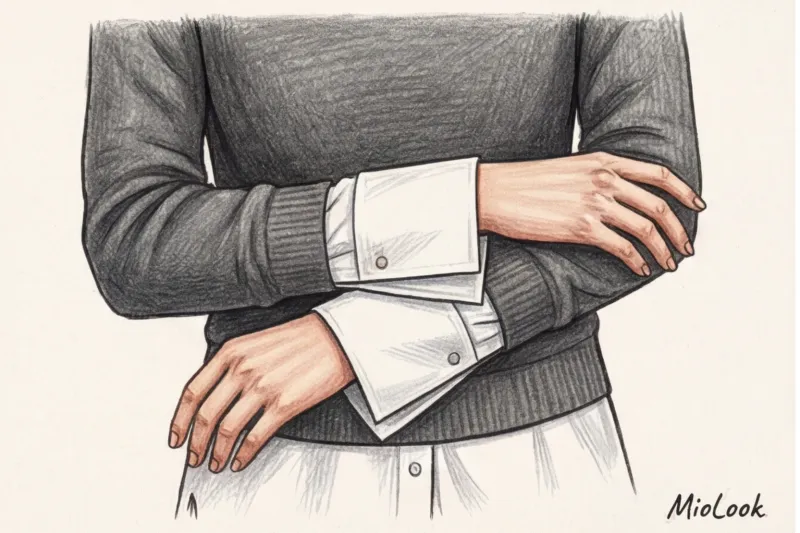
Architectural roll (Italian roll)
Don't simply gather the fabric at the elbow—it will slip off quickly. Unbutton the cuff and fold it up until it's just below the elbow. Then fold the remaining sleeve up until it overlaps the edge of the cuff, leaving only the stiff corner visible.
Insider Hack: During photo shoots, I always place clear silicone hair ties on my clients' forearms and then conceal them with a fold of fabric. The sleeve stays in place and maintains beautiful volume all day.
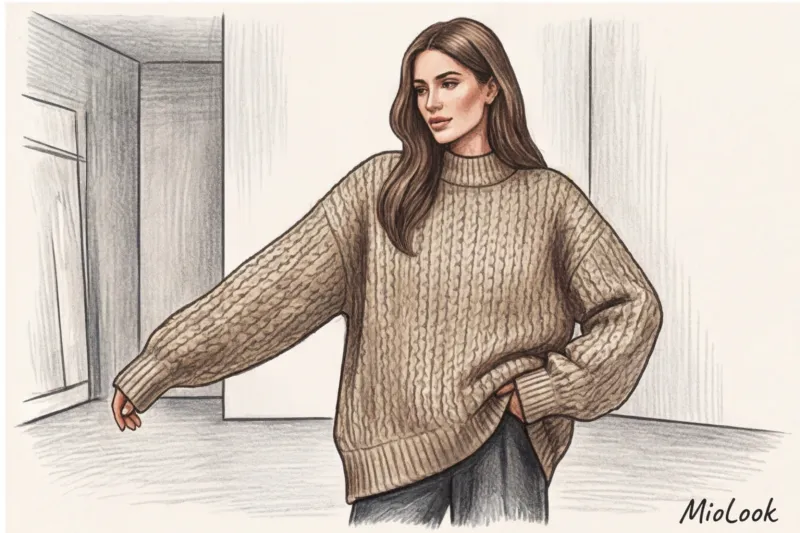
Smart layering
Find one perfect, long (perhaps men's) shirt or turtleneck. Wear it under all your regular-sleeve sweaters. Let the cuffs hang 3-4 centimeters. The contrasting textures and exposed hem transform a necessary measure into a sophisticated, well-thought-out look.
Accessory bridge
The bare skin between the hem of a garment and the wrist draws attention precisely because of its emptiness. Fill this gap! A chunky, masculine watch and a set of metal bracelets worn over the short cuff of a thin turtleneck visually connect the sleeve and wrist. The eye perceives the bracelet as an organic extension of the garment.
How technology is making it easier to find the perfect top
We live in the age of data, and buying clothes by guesswork is no longer necessary. Knowing your exact measurements is your defense against shopping disasters. You need to measure not only your chest circumference, but also your arm length from the shoulder seam to the wrist bone, as well as the back length from the seventh cervical vertebra to your natural waistline.
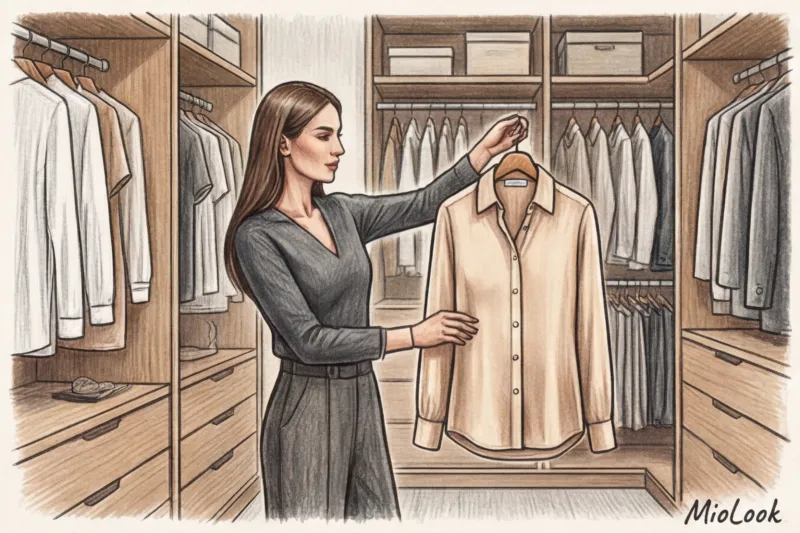
Over 12 years of practice, I've noticed that 80% of my tall clients stopped buying random, one-time-use items after they digitized their wardrobes. Today, you don't need a personal consultant to do this. In the article about The best capsule wardrobe app We've already discussed how smart tools work.
Using the app MioLook , you can create a digital database of your ideal items. By uploading the measurements of that shirt that fits you perfectly, AI stylist algorithms will help you create new looks based on real proportions, not abstract trends. This eliminates impulse purchases: you can immediately see whether a new item will fit into your wardrobe and how it will look in layered combinations.
Checklist: 5 Steps to the Perfect Top for Those Over 175cm
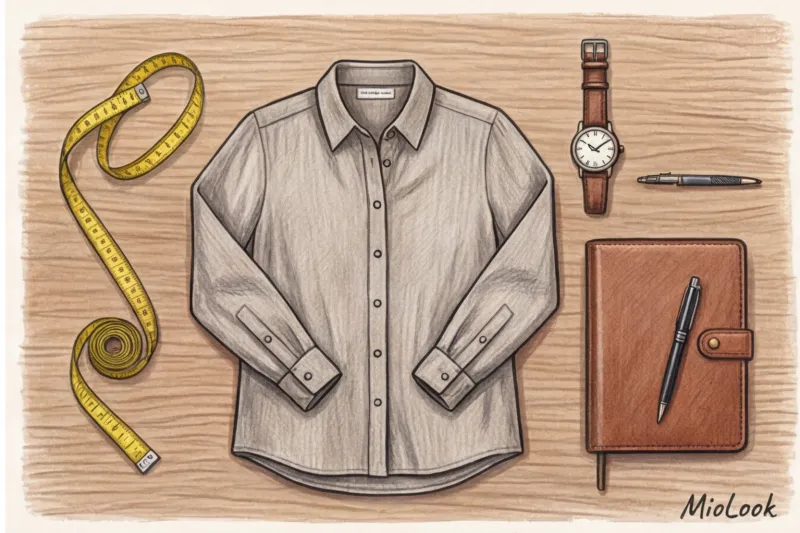
Take a screenshot of this plan before you go shopping or start your closet renovation:
- Take accurate measurements of your hand. Ask someone to measure the distance from the tip of your shoulder to the base of your hand with your elbow slightly bent. This is your reference number.
- Veto the blind oversize. Stop buying XL clothes when you're an M just for the sleeves - it ruins your silhouette and makes you look shapeless.
- Test the men's department. Go there for basic shirts in heavy cotton, flannel shirts and oversized, chunky knit cardigans (but remember the limit for fuller busts).
- Buy clear rubber bands. Master the Italian fold and secure it with hidden silicone elastic bands on those shirts that are still a bit short.
- Digitize your successful finds. Add perfectly fitting items to your smart wardrobe MioLook so that in the future the algorithm will build images based on your verified proportions.
Long arms, a tall height, and a statuesque figure are amazing assets. Stop trying to squeeze them into the generic shapes of fast fashion. When you begin to control your proportions with the right cutting architecture and techniques, your style reaches a whole new level of confidence.