From body geometry to detail: how Larson's body-type prints change the perception of appearance
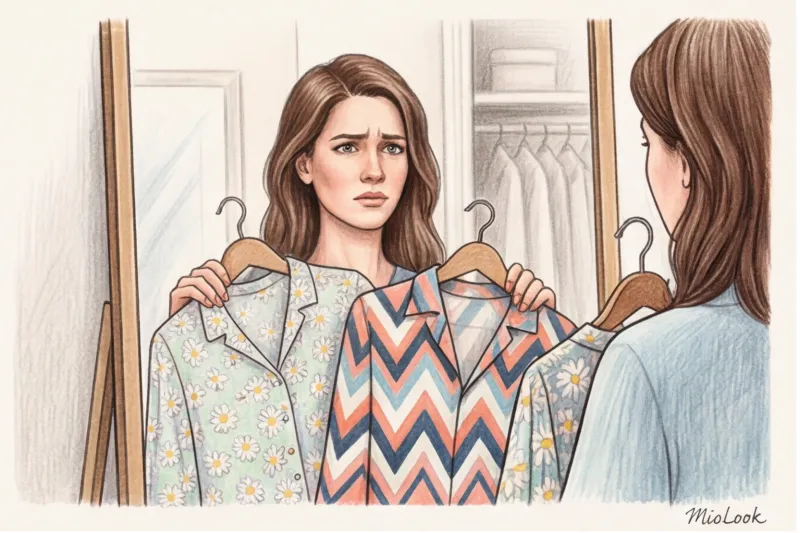
I still remember the day I almost threw out my favorite jewelry box. Early in my career, having read too many glossy magazines of the 2000s, I firmly believed in the versatility of a "basic wardrobe." I tried wearing neat stud earrings, thin gold chains for €50, and blouses with small, sophisticated polka dots. And every time I looked in the mirror, I saw a tired, faded woman whose face seemed large and rough against this jewelry delicacy.
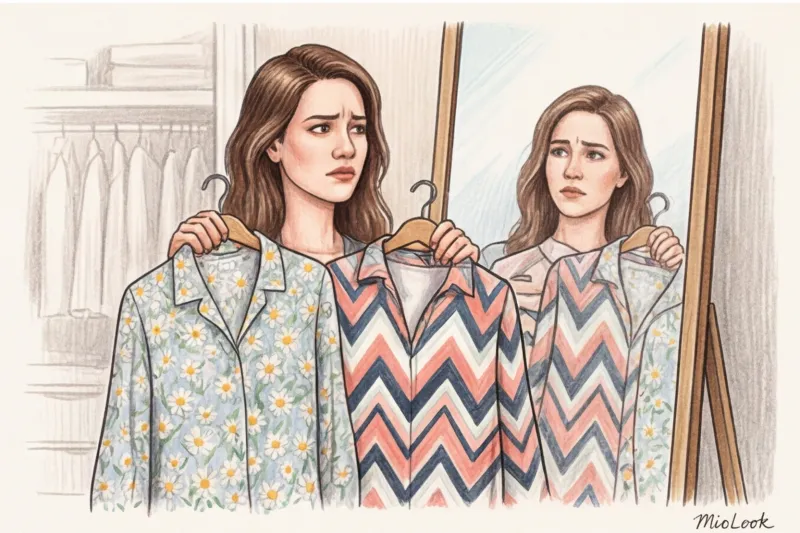
The problem wasn't me or the quality of the clothes. The problem was that David Kibbee's system, which all stylists venerated at the time, was woefully outdated. It confined us to rigid boundaries, ignoring the most important thing: 85% of women have a mixture of facial and body features. That's why pure types are so rare, and standardized advice doesn't work.
We discussed the evolution of this approach in more detail in our The complete guide to Larson's body types: how to find your style based on your face and body type Unlike Kibby, Dwyn Larson proposed a mathematically precise system of 20 body types. She proved that the devil is in the details: correctly chosen prints based on Larson's body types can visually enhance the contours of the face, while a mismatch in jewelry size can add 5 kilograms and 10 years to your age.
In neuropsychology, there's a "three-second rule." That's how long it takes our brain to detect visual dissonance. If the natural lines of your face clash with the geometric print on your dress, others will subconsciously sense that something's wrong. Let's figure out how to turn this optical mechanism into your greatest asset.
Scale and Line: The Foundation of Parts Selection by Dvin Larson
Larson's entire theory is built on the intersection of two vectors. The first is Angularity (Yang energy, straight, hard lines) versus Roundness (Yin energy, smoothness and softness). The second vector is scale: Large versus Small. It sounds like a geometry lesson, but in practice, it's pure physics of perception.
Did you know that the size of a print directly affects your body volume? In optics, there's the famous Müller-Lyer illusion (1889), the principles of which are widely used today in fashion psychophysics. The idea is simple: if you place a small, detailed pattern on a large surface, that surface will appear even larger. And vice versa.
"Large, expressive eyes and full lips will literally 'eat up' a small gingham pattern. Your face will look puffy, and your clothes will look orphaned, as if you borrowed them from your younger sister."
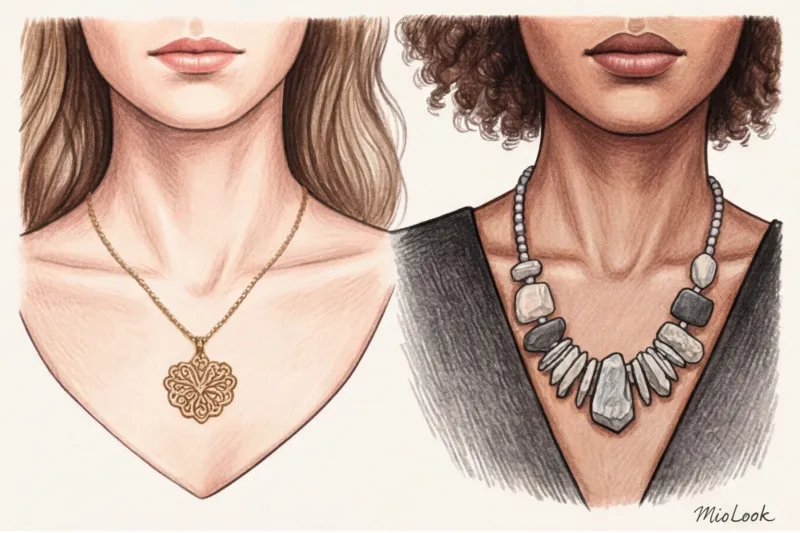
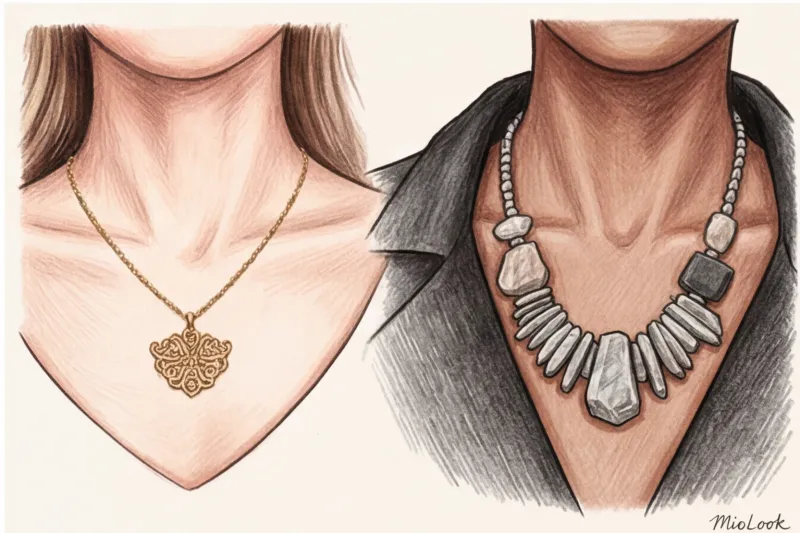
Your bone structure dictates not only the size of the pattern on the fabric but also the thickness of the metal in your jewelry. Wide wrists and prominent collarbones call for dense, heavy textures—wide cuff bracelets and anchor chains. Fine-boned women, on the other hand, will be lost behind a massive necklace, turning it into a "hanger" for the accessory.
Print contrast: from soft watercolor to hard graphics
In addition to size, contrast and rhythm are crucial. Pay attention to the edges of the elements. Clearly defined, scalpel-cut edges are ideal for high-Yang types (Dramatics and Gamines). They need dynamism and rigidity.
Yin types (Romantics and Naturals) require a "sfumato" effect—washed-out, watercolor-like transitions where one color flows smoothly into another. The rhythm of the print slows down here. A dense, eye-catching houndstooth print will make the Romantic look tense, while a smooth, sparse floral pattern will highlight their natural softness.
Your personal style guide
Upload your photos to MioLook and let the AI stylist analyze your natural curves. Choose the perfect prints and accessories without lengthy fittings.
Get access — €0.99 onceYang Types: Dramatic and Natural in the World of Accessories and Patterns
Yang-dominant women have a strong, expressive bone structure. Their greatest strength lies in their boldness and boldness. Attempts by Yang-types to wear "cute" polka dots, micro pearls, or thin headbands with bows always end in failure. It looks as awkward as trying to tie pink ribbons to a powerful SUV.
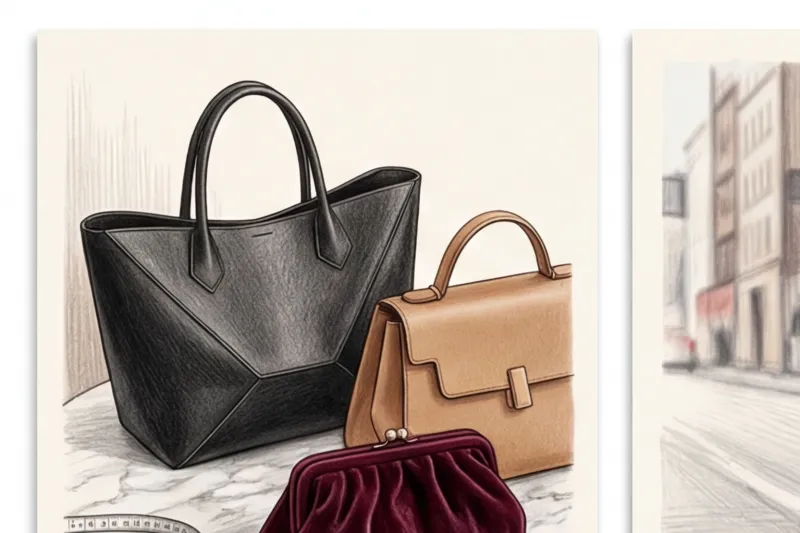
For Dramatic The keywords are: charcoal geometry, monumentality, high contrast, and asymmetry. Smooth, polished metals, rigidly shaped bags (for example, structured totes for €150–200 made of thick leather), large abstract brushstrokes on silk. No fuss or small details.
For the Natural The scale remains large, but the angles are softened. Natural is wild. Textured materials reign supreme: matte or dented metal, untreated wood, suede, leather. Prints include large ethnic prints, wide, blurred stripes, and large leaves (not small flowers!).
I had a revealing case in my practice. My client, Marina (a pure Dramatic face shape), came to a consultation wearing a silk blouse with a small, romantic floral print from Zara for €30. Her luxurious, sculpted cheekbones appeared heavy and rough. We simply changed her into a thick cotton shirt (from 180 g/m²) from COS with a single, large, asymmetrical print. The effect was comparable to a high-quality facelift—her face instantly looked aristocratic and fresh.
Yin Types: Romantic and Gamin – Miniature Art
If Yang is a monumental sculpture, then Yin is a Fabergé piece. Detail reigns supreme here. But Gamin and Romantic approach this small scale in completely different ways.
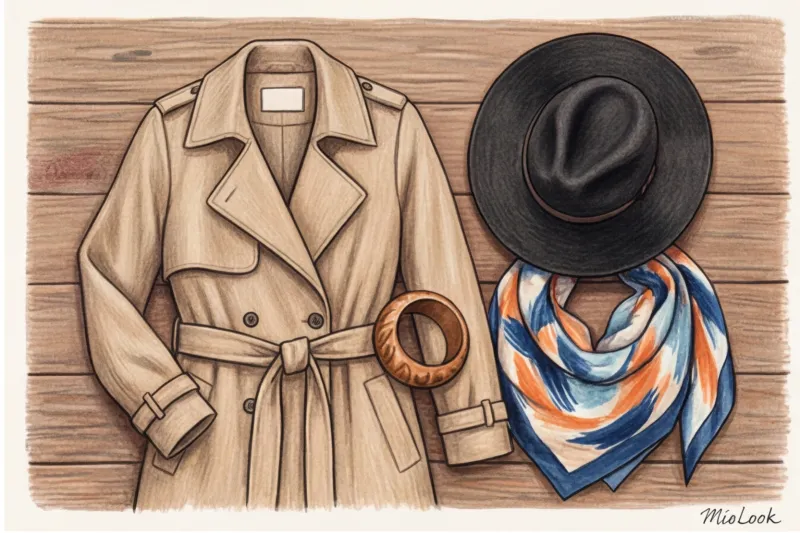
Romantic Woven from rounded, flowing lines. Its element is ornateness, monograms, intricate weaving, baroque pearls, and soft draperies. The print should envelop the figure. Watercolor buds, flowing paisley, delicate lace. No sharp angles or harsh graphics.
Gamin — is also small-scale, but with a sharp, bold charcoal quality. Imagine the clash of Yin (size) and Yang (shape). Gamin desperately needs a dynamic, pulsating rhythm in prints. Small, contrasting checks, pop art, playful stylized designs (like in comics), geometric stud earrings.
To understand the difference, compare the two floral motifs. For the Romantic, it's a realistic, soft rose with a color gradient. For the Gamin, it's a sharp, graphic flower made of four clear triangles. This is a crucial rule that many ignore when combination of textures in clothing.
Mixed personality types: how to combine conflicting lines?
We've reached the most interesting part. As I mentioned, 85% of us are a mix. What if nature has blessed you with the face of a Gamine (a subtle sharpness) and the body of a Natural (a large, softer complexion)? This is the most common mixed type in our latitudes.
An insider stylist trick that saves clients thousands of euros on bad purchases: we divide the zones of influence The face dictates the shape and scale of prints in the portrait area, while the body dictates the silhouette and texture of the fabric.
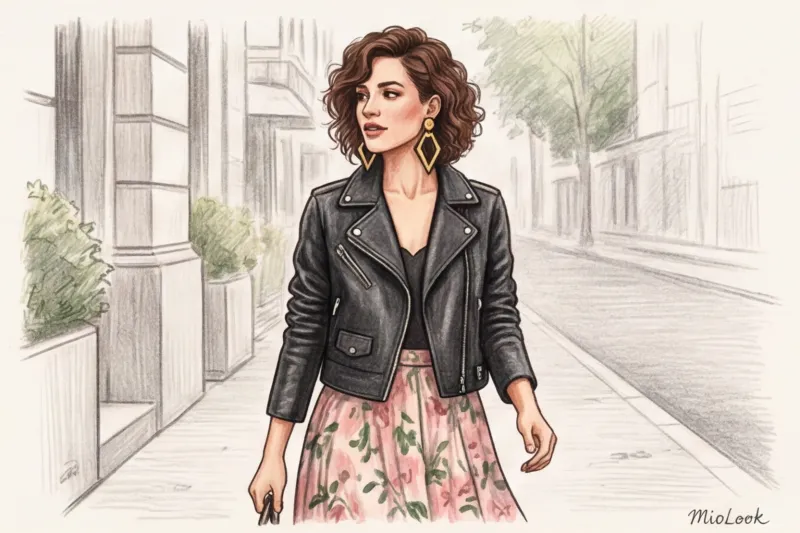
- Gamin-Natural: We wear gamine details near the face (a shirt with a sharp collar and a small graphic print), and below, we use natural textures (wide-legged linen trousers, a suede hobo bag). Medium-sized jewelry with a mix of textures—for example, smooth metal paired with rough wood.
- Dramatic-Romantic: True ice and fire. How to combine large-scale sharpness with small softness? Choose jewelry that's large in scale but has smooth, rounded edges. Ideal examples include enormous, irregularly shaped baroque pearls or large, smooth spherical rings.
- Gamine-Romantic: Detailing squared. You're lucky; you can wear as many small details as possible at once without looking like a "Christmas tree." Your balance is a mix of small, intricate elements with sharp accents.
Fair Limit: This method does NOT work if you have pronounced facial asymmetry. In this case, we completely avoid bold prints near the face and shift the focus exclusively to the refined texture of the fabric (for example, thick viscose or cashmere), relegating prints to accessories such as bags or shoes.
Not sure about your type?
Organize your wardrobe with the MioLook app. Create capsule wardrobes, experiment with prints, and find your perfect combinations in just a few clicks.
Try MioLookThe Biggest Myths About Accessories: What You Should Stop Wearing
Over 12 years of wardrobe review, I've peered into hundreds of jewelry boxes. Do you know what 90% of women have in there? "Basic" thin chains, diamond-studded studs, and classic round pearls. It's time to break these stereotypes using the theory of scale.
Myth 1: “A thin gold chain with a pendant suits absolutely everyone.”
Reality: On large-scale types (Dramatic, Natural), a minimalist 1mm necklace looks like a forgotten thread on a sweater. It doesn't add any beauty; it creates visual noise. It's not a base; it's a killer for your scale. If you're a Yang type and love minimalism, your "base necklace" should be at least 5-7mm wide.
Myth 2: “Pearls are a timeless classic for any age.”
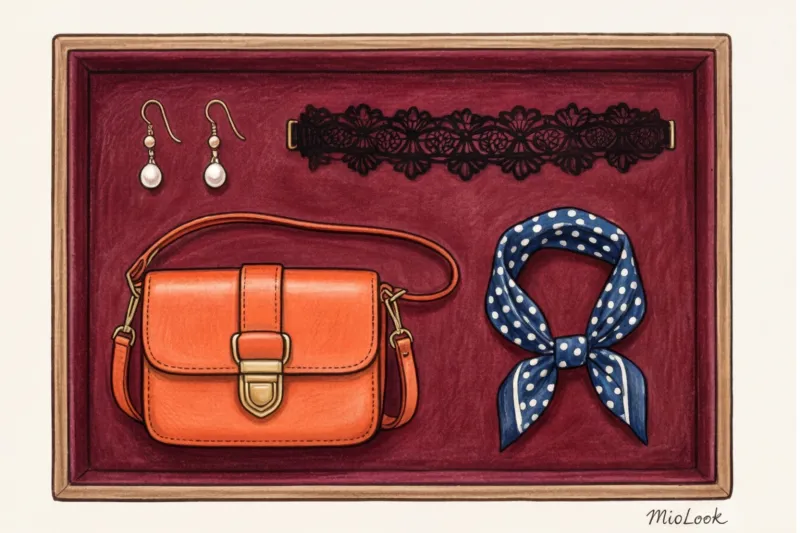
Reality: Perfectly round, mother-of-pearl pearls look natural only on Romantics. A classic strand of pearls will instantly add a decade to a Dramatic or Gamin's age, making the look mothballed. Your alternatives are angular mother-of-pearl, crushed baroque pearls, or pearls embedded in hard metal.
Myth 3: “Leopard print looks cheap and vulgar.”
Reality: According to a 2024 report by the analytical agency WGSN, animal print has finally become a perennial staple. What makes it vulgar isn't the pattern, but the cheap synthetic materials (polyester) and the incorrect scale. Leopard is a natural, natural print for Naturals. The main rule: the size of the spots should correspond to the size of your facial features.
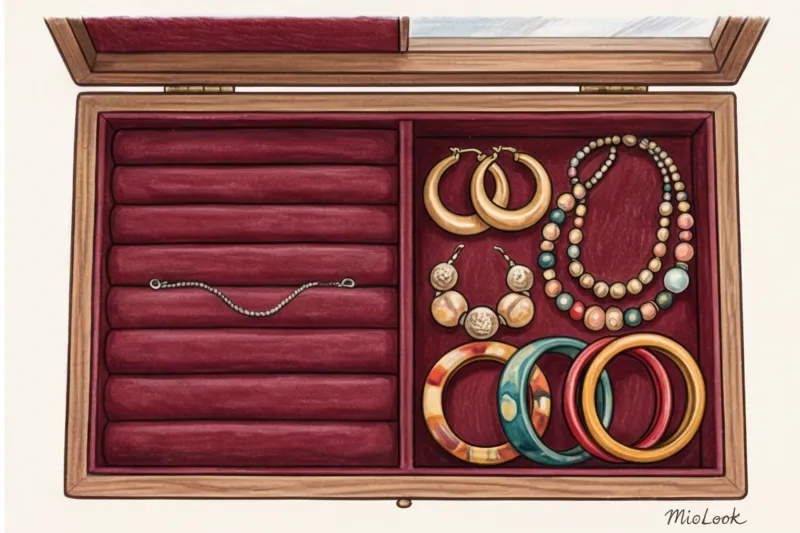
Checklist: Inspecting Your Jewelry Box and Wardrobe Using the Larson System
Ready to put this knowledge into practice? Take 15 minutes today, stand in front of a mirror in good daylight, and follow these four simple steps:
- Determine the dominant face. Gather your hair into a sleek ponytail. Do you have more sharp angles (cheekbones, chin, straight nose) or soft ovals (cheekbones, full lips) on your face? Assess the scale of your features: are they large and expressive or small and compact?
- Remove parasitic accessories. Take out all your jewelry. Ruthlessly discard any that clash with your size. If you're straight, hide the micro studs. If you're gamine, put away the heavy gypsy hoop earrings.
- Assemble the functional capsule. For everyday wear, you only need three basic sets (earrings + necklace or bracelet) that perfectly complement your curves. Plus two statement sets for evening wear (here, the scale can be slightly exaggerated for dramatic effect).
- Test the print before purchasing. Never buy something with a bold print just because it looks good on a hanger. Hold the fabric to your face, take a selfie without filters, and look at the photo after three seconds. What did you see first: your face or the blouse? If it was the blouse, the print was too much for you.
You can make this process much easier by uploading your digitized items to MioLook smart wardrobe section , so you can create images on your smartphone screen instead of scattering things across the bed.
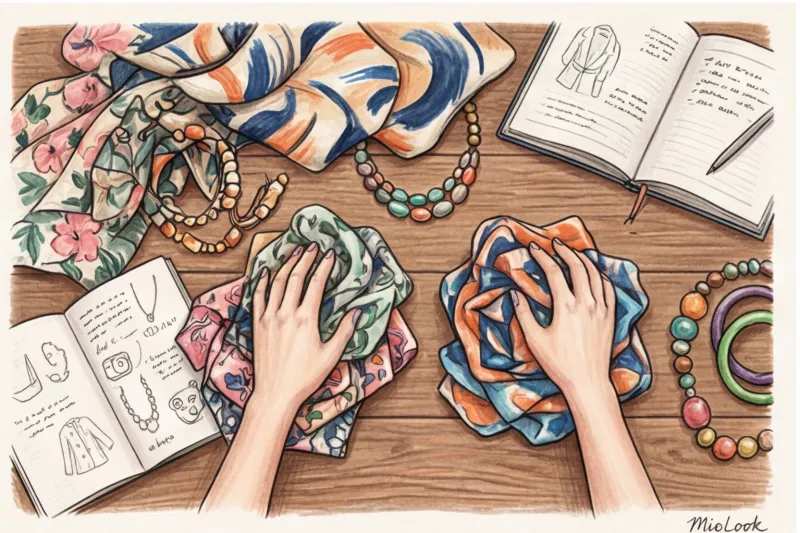
Accessories and prints aren't just the finishing touch or the icing on the cake. They're optical tools that literally redraw your proportions. Stop buying "universal" pieces that don't suit everyone, and start choosing pieces that are mathematically precisely tailored to your facial architecture.