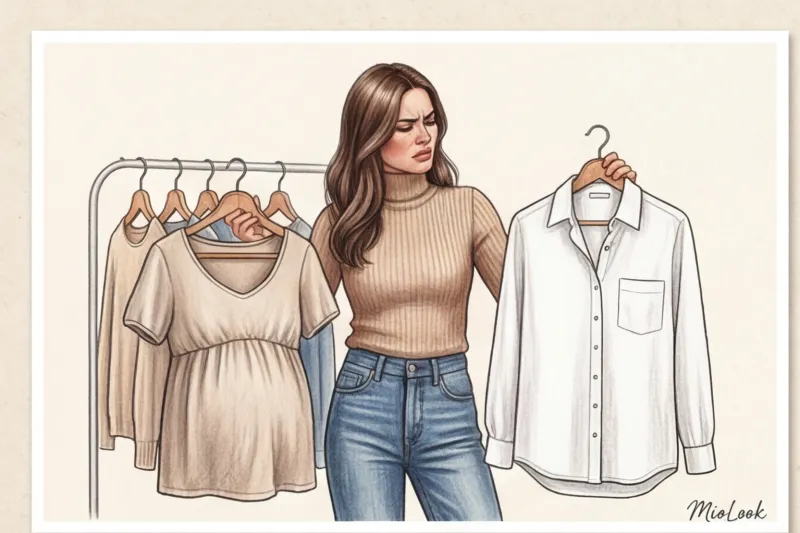
Over twelve years of working as a personal stylist, I've learned one ironclad rule: the maternity industry masterfully sells women their own fears. I remember my client Anna, who came to me three months after giving birth. She'd spent about €600 on baggy tunics with hidden zippers, lost her confidence, and complained that she felt like "service personnel" rather than a beautiful woman.
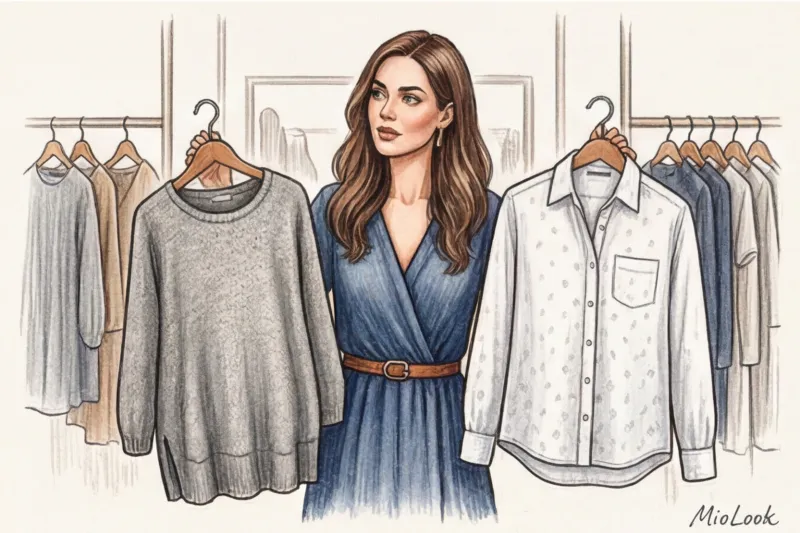
We are used to thinking that clothes for nursing mothers — is a separate wardrobe category. We're convinced that it's impossible to survive without special chest flaps and horizontal fasteners. Spoiler: this is a marketing myth. It's much more eco-friendly, cheaper, and stylish to integrate regular, high-quality items into your life that will last for years. I wrote more about how to avoid buying unnecessary things before the baby arrives in our The complete maternity wardrobe guide.
Today, we'll explore how to put together a functional postpartum wardrobe that will allow you to breastfeed in ten seconds while still looking like you just stepped out of the pages of Paris Vogue.
The main mistake when choosing clothes for nursing mothers
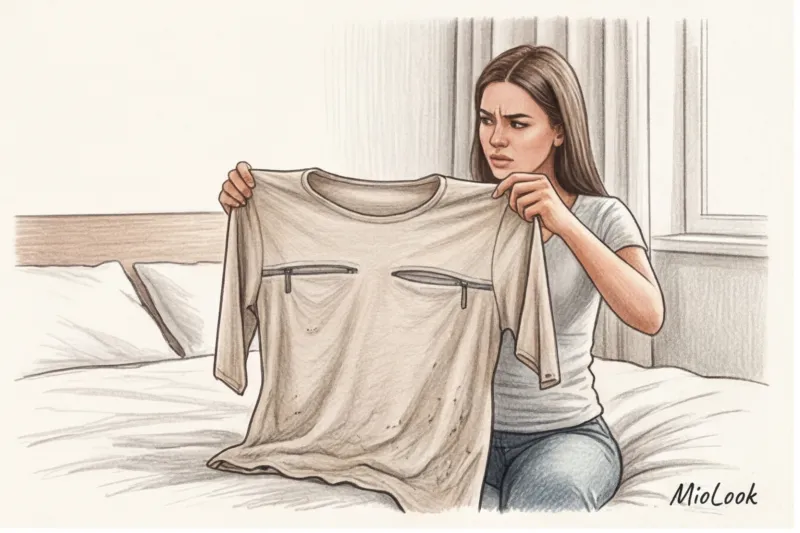
The biggest deception maternity brands make is the hidden zippers sewn into the chest. Have you noticed how they ruin the silhouette?
From a clothing design perspective, this is a disaster. Most long-sleeved maternity tops are made from thin cotton jersey (a single jersey with a weight of around 160 g/m²). When a stiff nylon or pull-on zipper is sewn into such a soft fabric, the fabric inevitably begins to wrinkle. The zipper becomes stiff, visually cutting the chest in half, and adding unnecessary bulk where it's completely unnecessary.
"Clothes with special secrets for nursing are often disposable. Once lactation ends, women happily throw these items away because they are strongly associated with a period of sleepless nights and physical vulnerability."
Instead of buying a functional item, I suggest buying an easy-to-access, emotionally charged item. Choose clothes that aren't labeled "for moms."
Access to MioLook for €0.99 — one-time payment
A smart AI stylist will create the perfect look from your basic items.
Get access — €0.99 onceThe Perfect Postpartum Wardrobe Formula: The Cost Per Wear Rule
According to the World Health Organization, the average duration of breastfeeding is between 6 months and 2 years. That's too long to put your style on hold. Italian and French women, whose style I often analyze at fashion weeks, never give up on life after giving birth. Their secret lies in a mathematical approach to shopping.
Let's count Cost Per Wear (CPW) — the cost of putting an item on once. I discussed this mechanic in detail in the article Cost-per-wear formula: calculating the real cost of an item.
- Scenario A: You buy a specialized nursing hoodie for €80. You wear it for six months, 40 times. CPW = €2. Then it goes in the trash.
- Scenario B: You invest in a luxurious cashmere cardigan with a deep V-neck for €200. You wear it while breastfeeding, and then for the next 5 years to the office, on dates, and on outings. You'll wear it at least 300 times. CPW = €0.66.
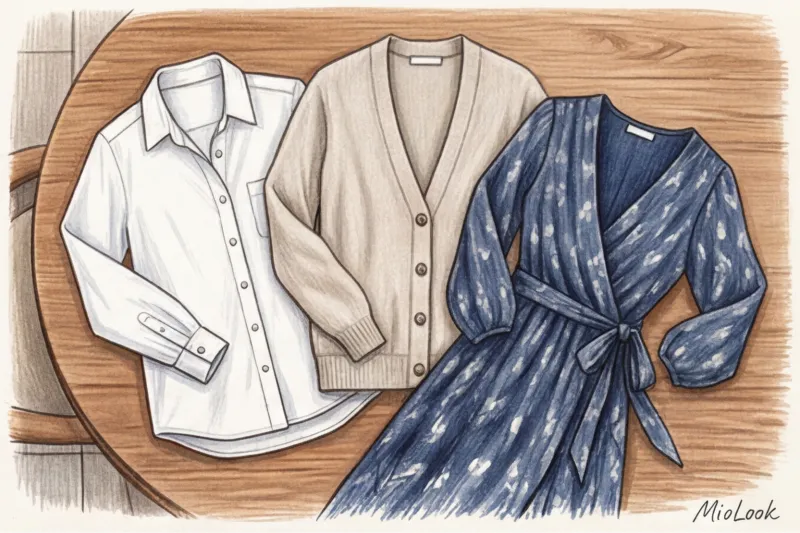
Mathematics is merciless: an expensive, high-quality base costs us less than a specialized mass-market one.
A nursing mom's basic wardrobe: 5 essentials
The stereotype that mom style consists of shapeless sweatpants is long outdated. The main principle we use with our clients is layering. A basic tank top with thin straps (easy to pull down) paired with the right top layer solves 90% of problems.
Oversized shirt: from poplin to thick silk
Unbuttoned buttons are the most natural, physiological and elegant access for breastfeeding.
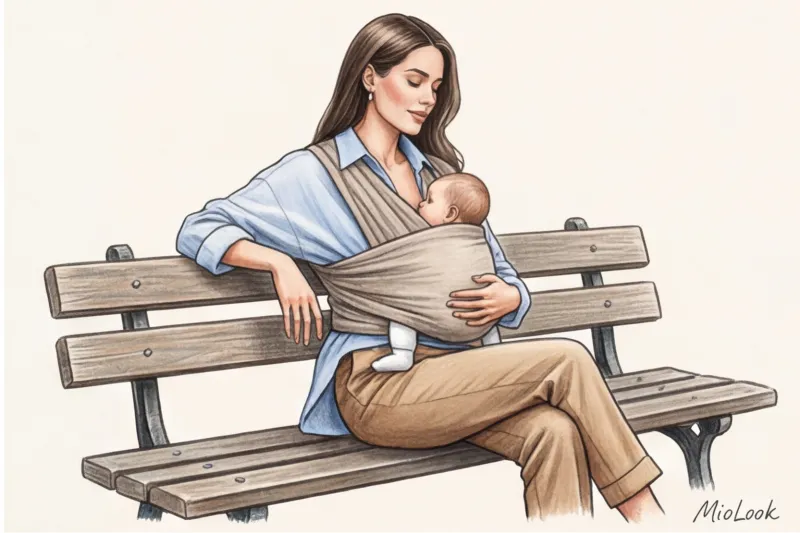
How to wear this to look trendy?
- Tuck your shirt halfway into jeans or trousers with a soft elastic band (French tuck).
- Tie in a knot at the waist over the slip dress.
- Wear unbuttoned over a ribbed cotton tank top.
Stylist's advice: Choose the right fabric weight. Thin viscose will wrinkle after five minutes of baby care. Look for cotton poplin with a weight of at least 120 g/m² or heavy silk. By the way, don't be afraid of silk—modern chemicals work wonders, and if you get a stain, check out our instructions. How to remove a stain from silk.
Wrap Dress: A Historical Silhouette in the Service of Mothers
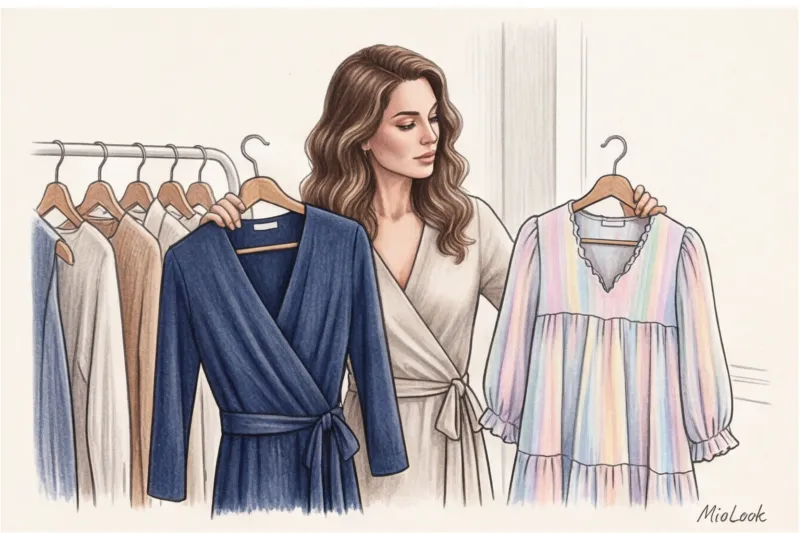
When Diane von Furstenberg created her iconic wrap dress in 1974, she was hardly thinking solely about nursing mothers. She was creating a symbol of female freedom. But historically, this silhouette has become a lifesaver in the postpartum period.
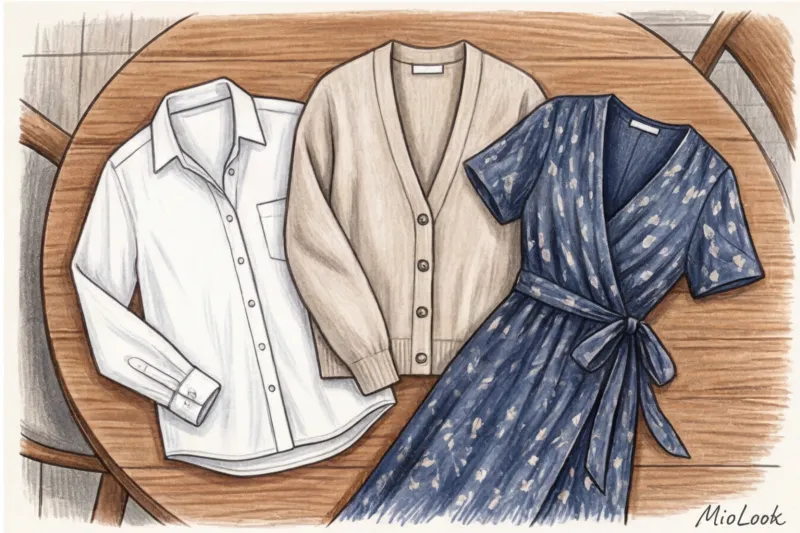
Breasts can change size throughout the day during lactation. Stiff darts don't work here. A wrap dress adapts to your shape: it can be tightened or loosened with a single movement. The deep V-neckline easily slides back for nursing.
To be fair, this advice doesn't work for everyone. If you have a bust size larger than an E (DD) cup, a classic wrap dress may not hold the volume, and you will need a hidden safety pin at the neckline or a tight bandeau top underneath.
V-neck sweaters and chunky knit cardigans
Avoid stiff turtleneck sweatshirts. Knitwear is your best friend, as long as it's the right blend. A cardigan with large buttons allows you to adjust the neckline. If your baby nurses outside, you can simply unbutton a few buttons to stay warm.
Avoid 100% acrylic (it will make you sweat) and 100% wool (it may irritate your baby's cheeks). The ideal formula is 70% cotton and 30% cashmere or extrafine merino.
Your perfect wardrobe starts here.
Join thousands of users who organize their capsules with MioLook.
Get access — €0.99 onceHidden Danger: Fabrics and Accessories to Forget About
In my experience, dozens of ideal images have been shattered by the wrong choice of texture. Let's be honest: motherhood is a period of stains. From milk, from spitting up, from purees.
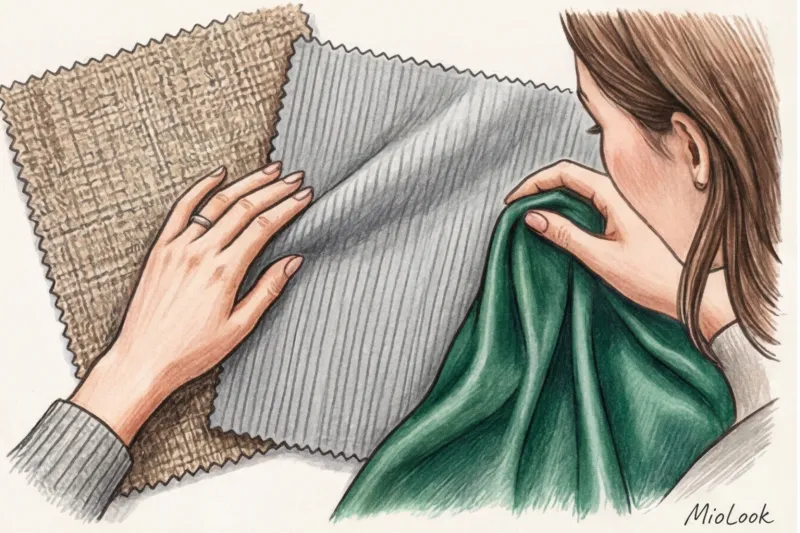
What should absolutely not be in a nursing mother’s wardrobe:
- Smooth, plain satin or viscose. Any drop of milk will leave a dark stain that will be visible from a mile away. If you want silk, choose a fabric with a small, vibrant print (polka dots, abstract patterns, millefleurs), which will make stains look less noticeable.
- Large metal zippers and sequins on the chest. A newborn's skin is incredibly delicate. What seems like stylish decoration to you could scratch your baby's forehead during feeding.
- 100% linen. It's a wonderful summer fabric, but pure linen wrinkles at the slightest touch. By the time you get your baby out of the car seat, the shirt will look like a dinosaur chewed it. Replace it with a blend: 55% linen, 45% viscose—it breathes, but flows beautifully and wrinkles less.
How to Look Expensive While Strolling (Stylist Secrets)
Have you ever noticed that 90% of women at playgrounds look the same? A stretched-out T-shirt, leggings, and running shoes. We once experimented with a client: she swapped her velour tracksuit for a thick knit two-piece set (palazzo pants and a long cardigan) in a camel color. In the first week, she received three compliments from strangers on the street.
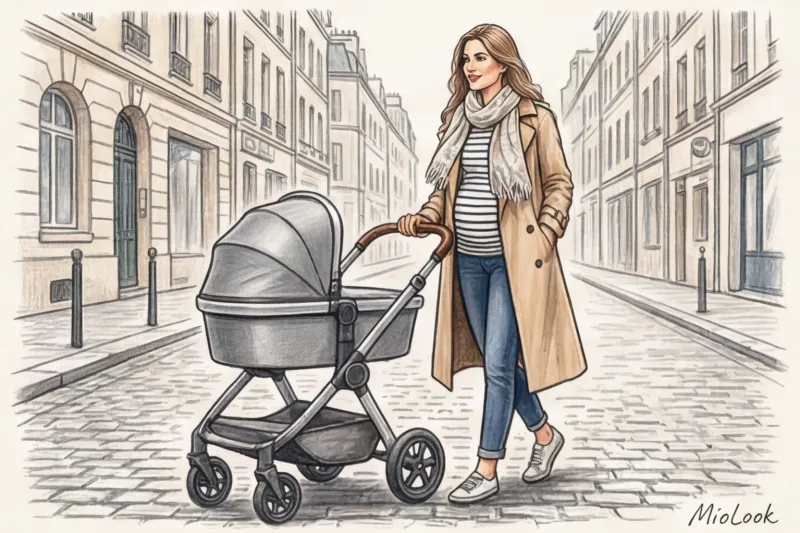
How to add status to simple images:
- Shoes matter. Save the mesh sneakers for the gym. Opt for suede loafers, leather Chelsea boots, or minimalist white sneakers. They're just as comfortable, but the style factor instantly skyrockets.
- Safe accessories. While a child is small, chunky chains and long earrings are dangerous—they'll rip them off. Move the accents out of reach. A silk scarf (a bob) woven into a ponytail. High-quality geometric sunglasses. An expensive watch.
- Rigid bag. Soft tote bags often look sloppy. Try a medium-sized crossbody with a rigid frame—it instantly ties together even the most casual look, leaving your hands free.
Nursing Capsule: A Smart Shopping Checklist
To avoid standing in front of a full closet in a panic while a hungry baby cries, your wardrobe should work like a Swiss watch. My clients often use MioLook app to digitize your belongings and create looks while lying in bed. A well-assembled capsule wardrobe of 10 items yields around 30 unique looks.
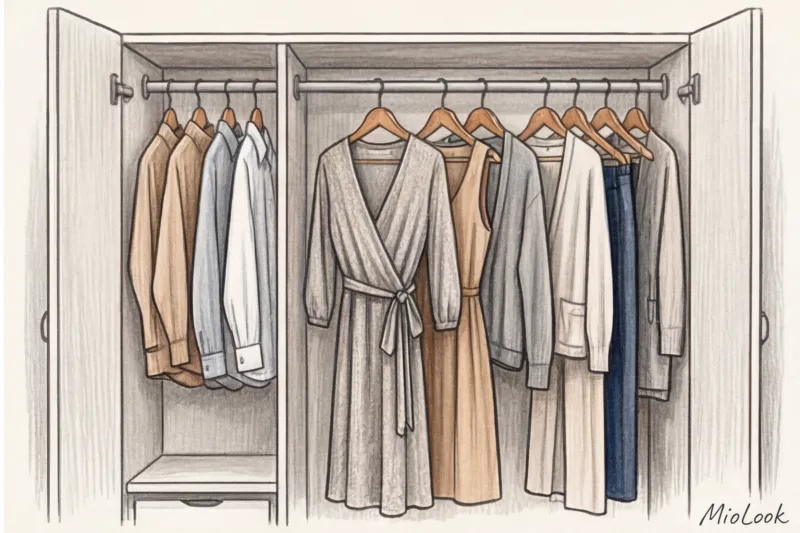
Before you buy anything new during this period, ask yourself two questions:
- "Will I be able to feed my baby in 10 seconds on a park bench with this?"
- "Will I wear this to meet my friends in a year, when I'm done breastfeeding?"
If the answer to at least one question is “no,” return the item to the hanger.
An ideal base might look like this:
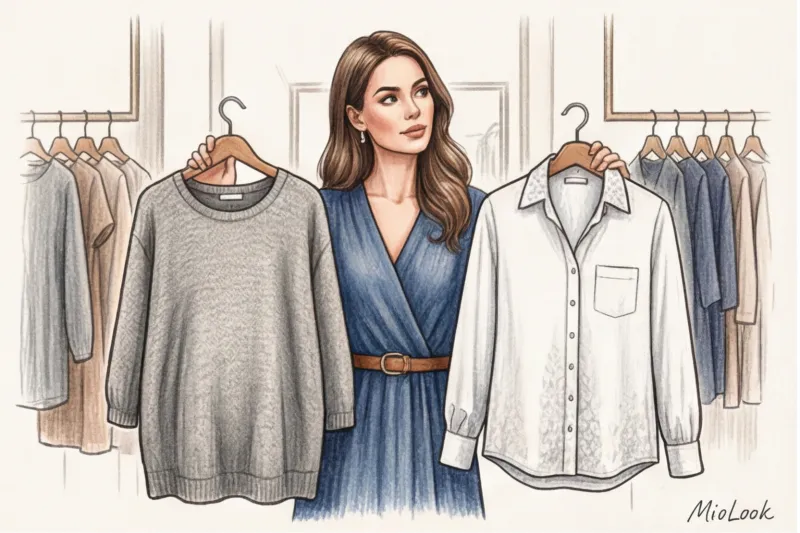
2 oversized shirts (white and light blue stripes), 1 midi wrap dress, 2 ribbed tank tops (white and graphite), 1 thick-knit cardigan, 1 cashmere V-neck sweater, 1 comfortable straight-leg jeans (with 2% elastane), 1 drawstring palazzo pants, and 1 stylish trench coat. Color scheme: mélange, ripple, complex beige—these shades perfectly camouflage minor imperfections and stains.
Conclusion: Returning to Oneself
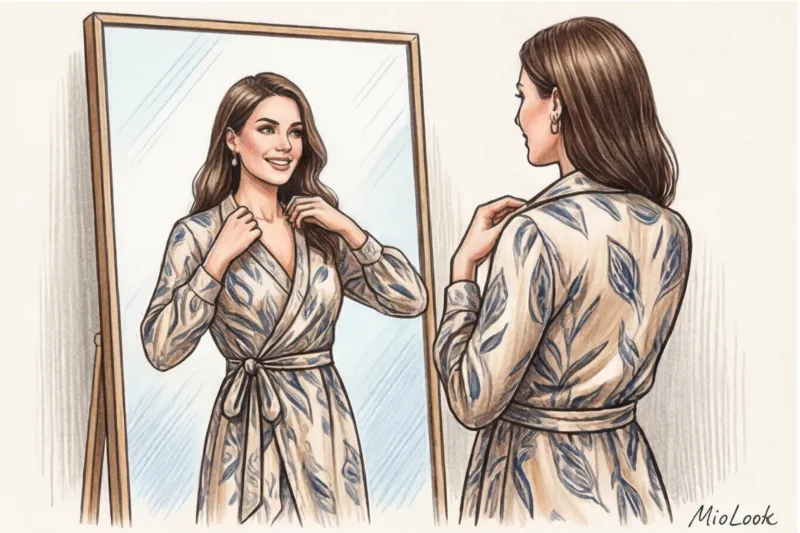
Nursing clothes shouldn't be a uniform for caring for a baby. During this fragile period of adaptation to a new role, your wardrobe is your armor. It's a way to say to the world and to yourself: "I've become a mother, but I haven't stopped being a woman."
Stop buying compromised maternity clothes that ruin your figure and your mood. Invest in quality cuts, luxurious fabrics, and silhouettes that work for you. Choose basic shirts, cardigans, and wrap dresses—and you'll see how your reflection in the mirror will make you happy again.