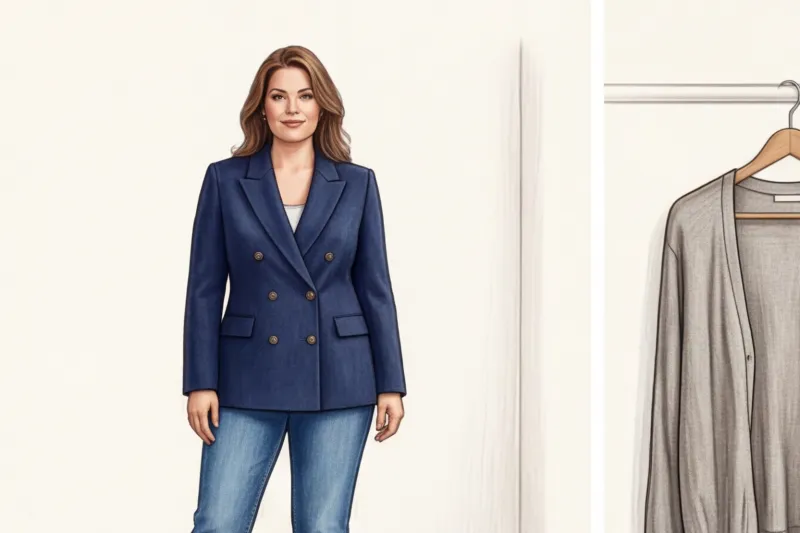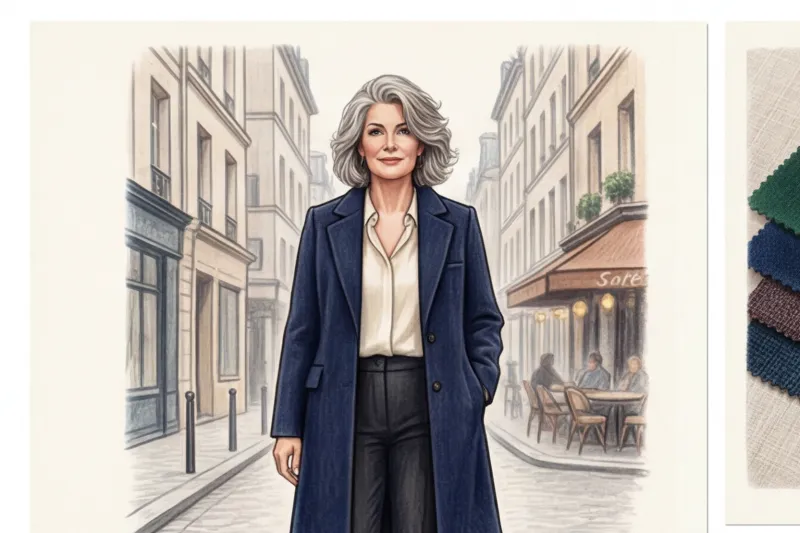
In my 12 years as a personal stylist and luxury wardrobe consultant in Milan, I've witnessed the same scene hundreds of times. A curvy, gorgeous woman walks into a fitting room, sighs, and, out of habit, reaches for a shapeless, loose-fitting knit cardigan. "It'll hide my curves," she confidently declares. I have to gently but firmly stop her. In reality, shapeless clothes don't hide weight; they transform the figure into a massive, structureless monument.
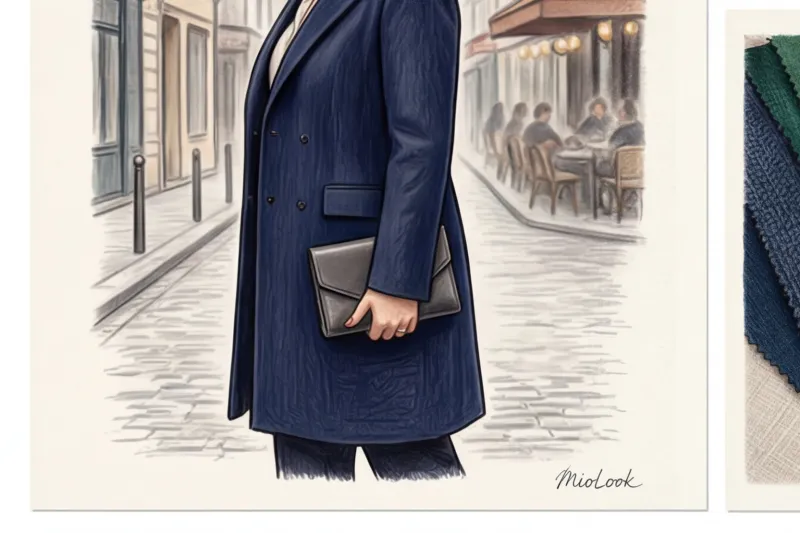
Modern Fashion for plus-size women in their 50s is built on a completely different paradigm. We don't disguise anything anymore. We use an architectural approach: dense fabrics, a crisp cut, and clear lines that literally "sculpt" a prestigious and expensive silhouette. We discussed the basics of an age-appropriate wardrobe in more detail in our The Complete Guide to Modern Style for Women Over 50 , but today we will talk specifically about working with complex proportions.
Architecture Instead of Camouflage: A New Look at the Silhouette
Italian tailoring standards (Sartorial rules) state: the more complex the figure, the more rigid the garment's frame should be. Trying to hide behind a thin, oversized garment is a major mistake, instantly cheapening the look.
Consider the difference between a hoodie and a structured jacket. A hoodie hugs the widest point of your body (usually your chest or hips) and falls in a straight line, visually extending the volume to this maximum width. A structured jacket works differently: a sharp shoulder line, defined lapels, and a well-defined dart create a new, artificial contour within which your body appears more fragile.
"Your clothes should hold their shape on their own, even when they're just hanging on a hanger. If a piece falls to the floor in a shapeless puddle, it has no place in a high-status wardrobe"—I repeat this rule to every client.
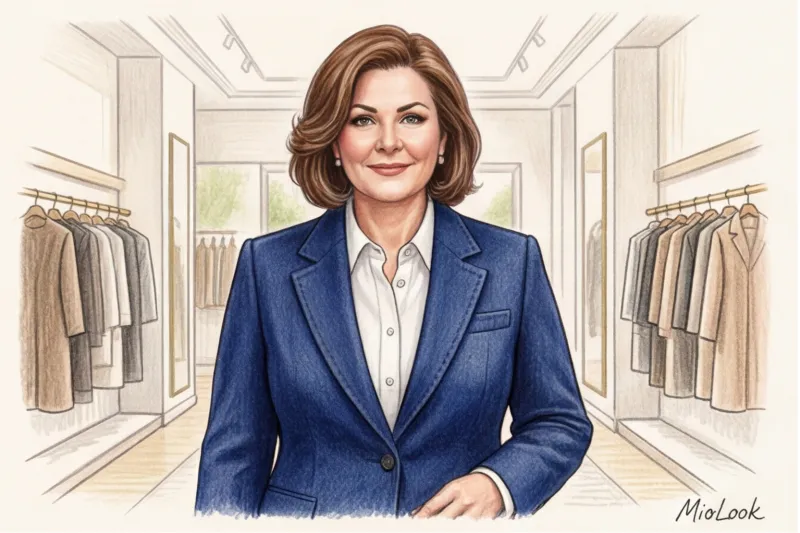
I had a revealing case. A client, a top manager at a major bank, had been wearing soft knit two-piece suits for years. We replaced them with semi-fitted jackets made of Italian wool with accentuated shoulders. Colleagues started asking what diet she was on—visibly, she'd dropped two sizes solely through the correct cut. Fashion for plus-size women over 50 is primarily about conveying your status and experience, not trying to look like a thirty-year-old.
Investing in Fabrics: Why Texture Matters
Thin viscose or cotton jersey is your worst enemy. It treacherously sinks into every crease on your back, highlights your underwear seams, and stretches at the elbows by midday.
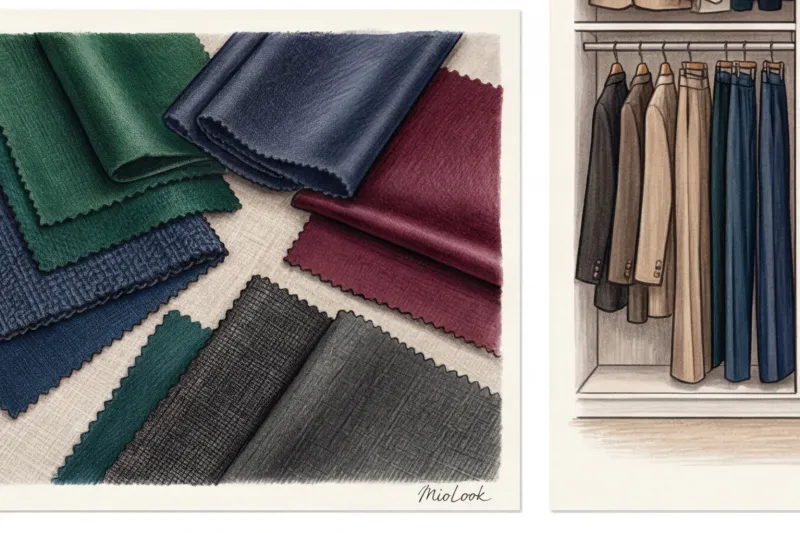
To create a slimming silhouette, you need investment fabrics that have enough weight to drape beautifully, rather than feel clingy:
- Crepe and Merino Wool: Ideal for trousers and suits, they are heavy and fall in beautiful folds.
- Heavy silk: Pay attention to the density. Silk with a density below 19 momme is absolutely contraindicated for plus-size figures; it will become staticky and highlight uneven skin. Look for a density of 22-30 momme.
- Blended fabrics with elastane: The gold standard is 2% to 4% elastane in cotton or wool. This will provide you with comfort while moving, but will prevent the fabric from sagging at the knees or hips.
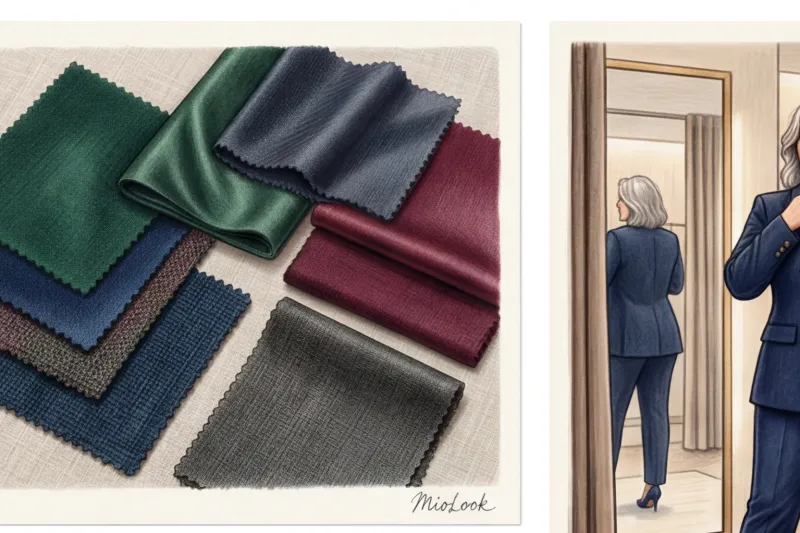
I know premium fabrics aren't cheap. But let's do the math. Cost-per-wear (cost per wear). A cheap knit dress from a mass-market store for €40 will lose its shape after three washes. You'll wear it maybe 10 times. Bottom line: €4 for each time you wear something that makes you look fat. A high-quality, thick wool blazer for €250 will last you 5-7 years. If worn 100 times a year, it costs only €0.50 per wear. A cold calculation proves: one expensive item is better than five cheap ones.
Access to MioLook for €0.99 — one-time payment
A smart AI stylist will select the perfect look based on your proportions and help you digitize your wardrobe.
Get access — €0.99 onceDebunking the Myth: Why Black Doesn't Make You Look Slimmer
"I'll wear all black to look slimmer" is the most persistent and destructive myth. Research into visual perception and Johannes Itten's color theory prove otherwise. The dull black of cheap fabric absorbs light. It doesn't make you look slimmer, but rather turns your figure into a heavy, massive black hole with no definition or contours.
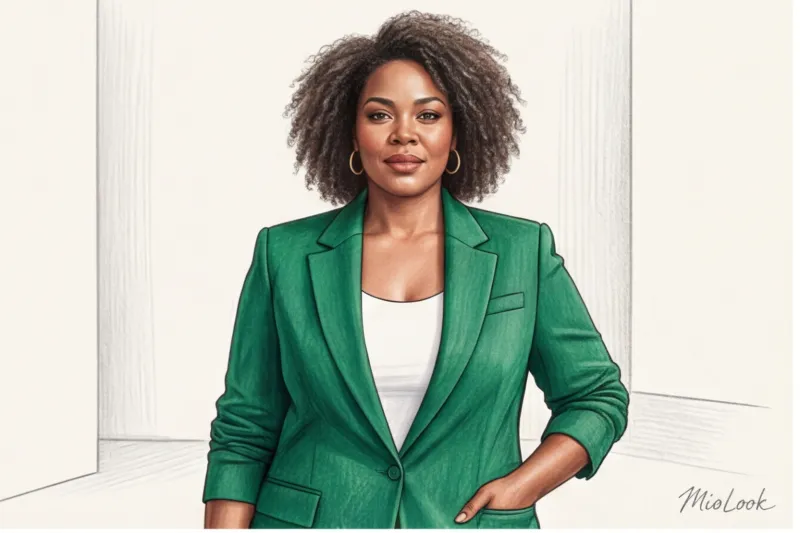
Moreover, after age 50, black acts as a harsh filter on the face: it casts harsh shadows, emphasizing nasolabial folds, pigmentation, and signs of fatigue. According to the Pantone Color Institute (2024), complex dark shades are much more complementary for mature skin. Replace black with deep navy (sea blue), rich burgundy, dark chocolate, or deep emerald. In monochrome looks, these colors elongate the vertical line 10 times more effectively than black, while maintaining the skin's refined glow.
Basic Wardrobe: 5 Statement Pieces That Elongate Your Silhouette
Instead of buying dozens of random items, focus on five architectural pieces of a basic wardrobe.
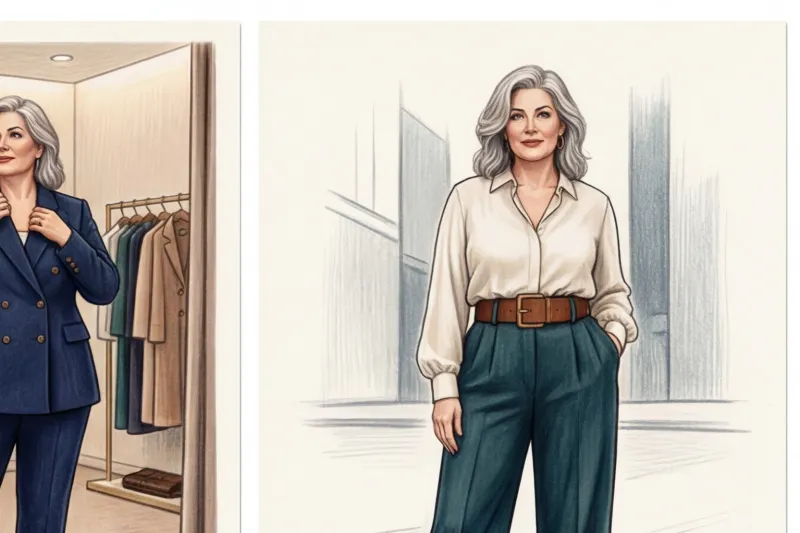
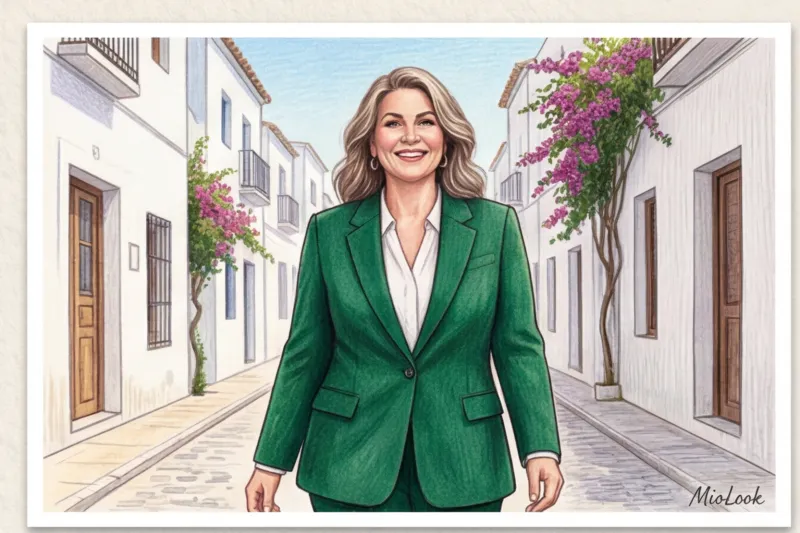
- Long structured blazer. A semi-fitted cut with strong shoulders. Important: it should end below the widest part of your hips. If you wear the blazer unbuttoned over a contrasting top, you create that "slimming inner vertical." The eye only notices the narrow strip of color inside, ignoring the actual volume on the sides.
- Palazzo or straight leg trousers with a mid/high waist. Make sure they're made of a dense, flowing fabric. No waist cinches if most of your fullness is concentrated in the abdominal area. Ideally, pants should reach halfway up the heel.
- Shirt dress made of thick cotton (from 180 g/m²). The stand-up collar and buttons create a central vertical axis. Important limitation: This cut won't work if the buttons on the chest come apart. There should be at least 2 centimeters of air space between the body and the fabric.
- High-quality straight-cut coat. No soft robes with caterpillar belts that cut your figure in half and make you look like a barrel. Just set-in sleeves, English collars, and straight lines.
- Blouse with V-neck. Pure geometry. The V-neckline visually elongates the neck and breaks up a large bust, making the upper body more graceful.
If you are unsure how these things will go together, I recommend testing them out. MioLook — This app lets you upload photos of your belongings and, using AI, watch how the capsules are assembled before you even leave the house.
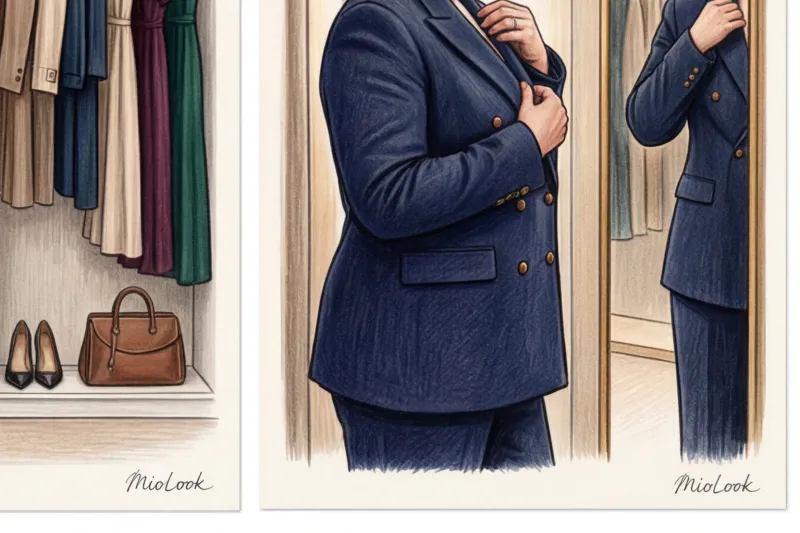
The Rule of Thirds: How to Manage Proportions After 50
Silhouette design is a mathematical exercise. The worst thing you can do to a plus-size figure is to divide it in half (a 1/1 ratio) by wearing a contrasting blouse worn untucked just to mid-thigh. This makes the figure appear squat and boxy.
We use the golden ratio: 1/3 to 2/3. This means that your top (or jacket) should visually take up one-third of your height, and your pants or skirt should take up two-thirds. This can be achieved by wearing your pants high up and tucking in your top partially (at least at one end).
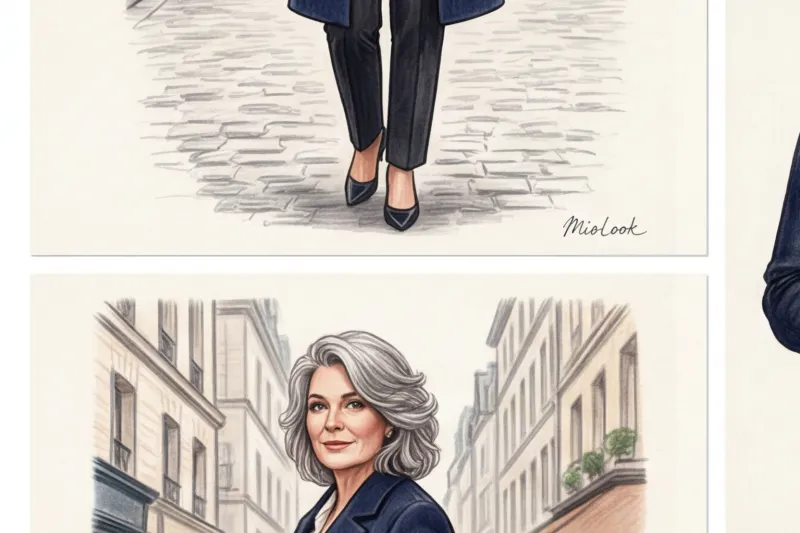
Another secret from my practice that works absolutely flawlessly: the art of revealing wrists and ankles. These are the most delicate parts of a woman's body. When a client stands in the fitting room wearing a bulky sweater and feels "bulky," I simply roll up her sleeves, revealing her delicate wrists, and suggest she change from her closed-toe boots to ankle-baring loafers. The observer's eye automatically builds up the volume of the entire body based on the most delicate exposed areas. This micro-trick instantly makes a woman appear 3-4 kilograms lighter.
Your perfect look starts here
Join thousands of users who look flawless every day with MioLook. AI will select a wardrobe tailored to your body proportions.
Get access — €0.99 onceStatus accessories: shifting the focus of attention
Is it possible to save money on a basic white T-shirt? Yes, it's entirely possible to find excellent heavyweight cotton for €30-€40. But shoes and a bag must be impeccable. This is an Italian rule that never fails. Premium accessories act as an eye-catcher, distracting attention from any figure imperfections.
For overweight women it is critically important scale Forget micro bags (they'll make you look twice your size) and thin, barely-there chains that disappear into the folds of your skin. You need sculptural, chunky jewelry and statement accessories.
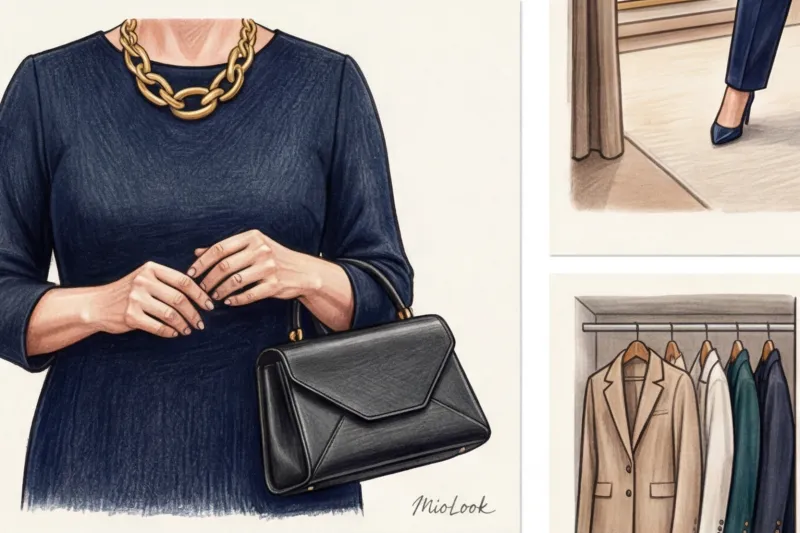
The bag's geometry also matters. Soft hobo bags or sacks add a sloppy feel and visually convey the same "shapelessness" as knitted cardigans. Choose bags with a rigid frame (totes, satchels) with defined angles. Budget-conscious, it's better to invest €250-€400 in a single, well-shaped, high-status leather shopper than to replace cheap polyurethane bags every season.
When it comes to shoes, a round toe makes the foot look like a hoof and visually shortens the height. A pointed or almond-shaped toe (even without a heel, on flat shoes) continues the line of the leg, making it look more graceful. A stable heel of 4-5 cm not only elongates the height but also dramatically changes the posture, forcing the shoulders to square.
Checklist: Your Plan for Transitioning to a Sleek Wardrobe
Transitioning to a new style requires a ruthless audit. Start today.
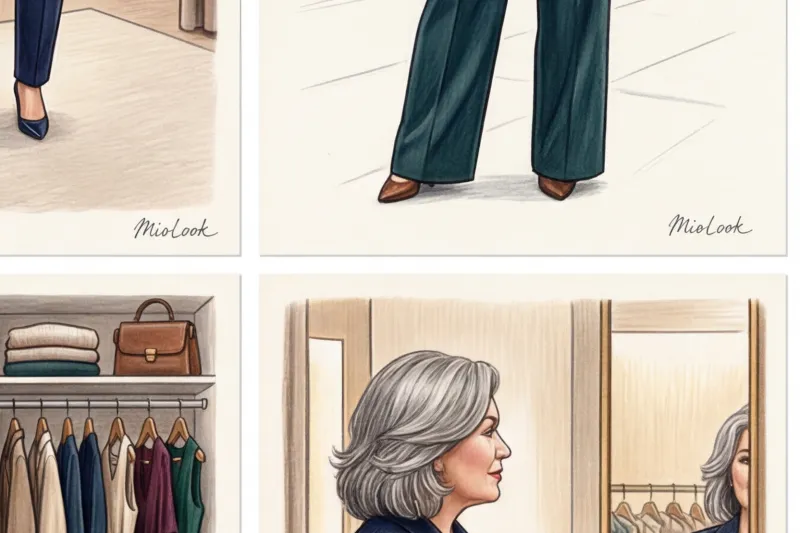
- What should be thrown away immediately: thin translucent knitwear, blouses with abundant guipure and rhinestones (they cheapen the look), shapeless tunics with psychedelic patterns and low-rise elasticated jeans.
- Where to start shopping: The rule "basics are more important than accents." Until you have the perfect inky blue jacket, well-fitting trousers, and a quality coat, don't buy a tenth colorful blouse.
- How to properly evaluate an item in a fitting room: Don't stand statically in front of the mirror! Sit on a pouf—is the belt cutting into your stomach? Turn your back—is the fabric forming telltale folds under your bra? Crumple the edge of the garment in your fist for 10 seconds—if it's chewed, leave it at the store.
Building a status wardrobe isn't about the size on the tag, but about self-love and respect for your experience. Resist the urge to hide. Choose high-quality fabrics, precise, architectural cuts, and deep colors. Elegance knows no weight limits—it requires precision and good taste.