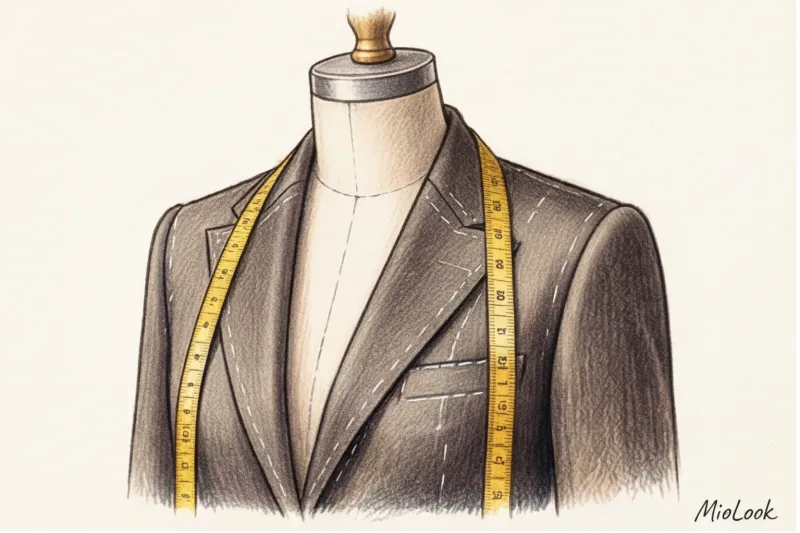
I remember Anna, the CFO of a large IT company, approached me. She had five black suits in her closet, mass-market items she'd bought on the run. She felt uncomfortable at every important meeting: the jackets restricted her movement, the fabric shone under the office lights, and after the third dry cleaning, the lapels were unsightly bubbling. We replaced those five suits with two premium, bespoke suits. A month later, Anna admitted that her perception of herself at board meetings had changed dramatically. She stopped tugging at her skirt and adjusting her collar.
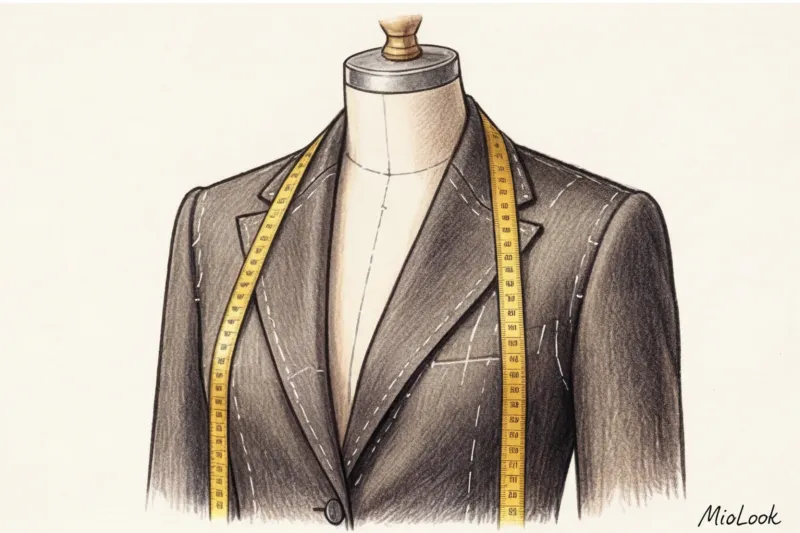
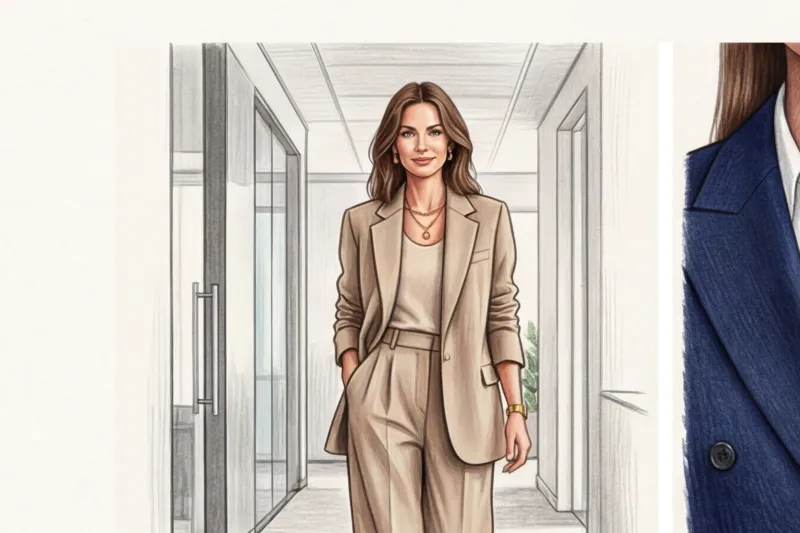
As a stylist, I often tell my clients: quality women's business suit — it's more than just a dress code element. It's a complex engineering construct and your best financial investment in your personal brand. We've already discussed the appropriateness of different styles and levels of formality in our complete guide to Business dress code for women from formal to casual And today I want to teach you how to look at suits through the eyes of a professional tailor.
The architecture of the ideal women's business suit: what a stylist looks for
When I was interning in Milan, I spent hours watching Italian craftsmen construct a woman's shoulder. The difference between an expensive garment and a mass-market one lies not in the brand's logo, but in what lies between the fabric and the lining.
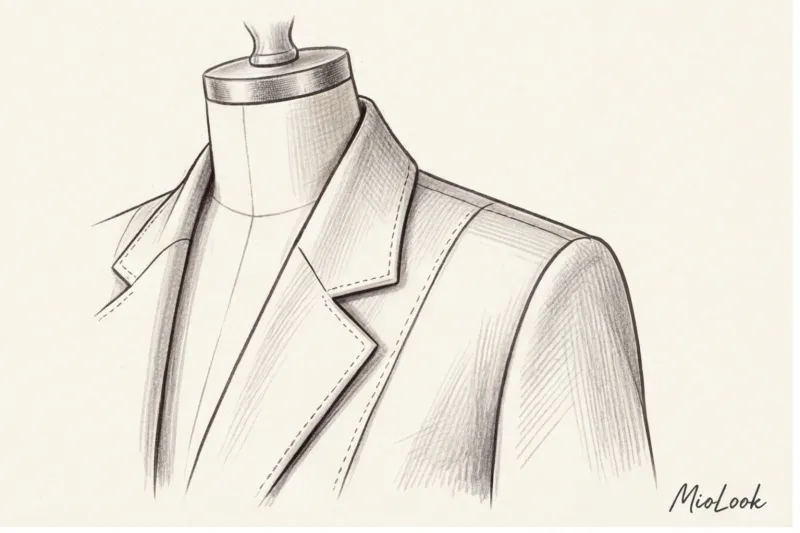
90% of inexpensive suits use technology fused — the fabric is simply bonded to the interlining at high temperatures. It's quick and inexpensive. But if you get caught in heavy rain or dry-clean a couple of times, the glue starts to peel. The result? Those telltale bubbles on the chest and lapels that are impossible to iron out. A prestigious women's business suit is created using this technology. half-canvas (half-collared). A layer of horsehair and cotton is sewn into the chest area between the main fabric and the lining. It breathes, conforms to your body shape, and only improves in fit over time.
The second status marker is the lining. Remember: polyester is unacceptable in a good suit. It creates a greenhouse effect, attracts static, and has a cheap sheen. Look for cupro (often labeled as Bemberg) or high-quality viscose on the label. Cupro is a breathable cotton fiber material that feels like silk but is much more durable.
- Fittings: Plastic buttons instantly cheapen the look. Premium options include natural horn, corozo (walnut), or mother-of-pearl.
- Lapel roll: On a cheap jacket, the lapel is pressed flat, like a sheet of paper. On an expensive one, it rolls smoothly and voluminously toward the top button, creating a beautiful dynamic.
Access to MioLook for €0.99 — one-time payment
A smart AI stylist will select the perfect look for the office and help you digitize your wardrobe.
Get access — €0.99 onceThe Biggest Myth: Why a Black Women's Business Suit Is a Bad Investment
Open any basic article online, and you'll read: "Every woman should own a black suit." This is one of the most pernicious fashion misconceptions. In my experience, it's the black suit that becomes the biggest disappointment when putting together an office capsule wardrobe.
Why does this happen? First, the psychology of color. According to research by the Pantone Color Institute, deep blue (Navy Peony) inspires 40% more trust in negotiations, conveying competence and reliability. Black, on the other hand, creates a strong sense of distance and, during the day, is often associated with service staff uniforms rather than executive attire.
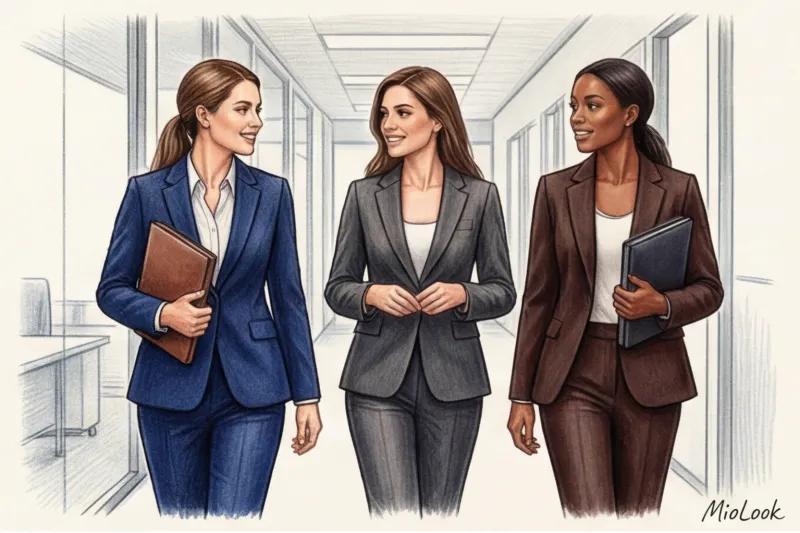
Secondly, the merciless light of day. Black acts as a magnifying glass for any imperfections in the fabric. Cheap wool or wool blends look downright poor in black, and every speck of dust and lint is visible. Save black for evening events and tuxedos (Le Smoking), where artificial lighting reigns.
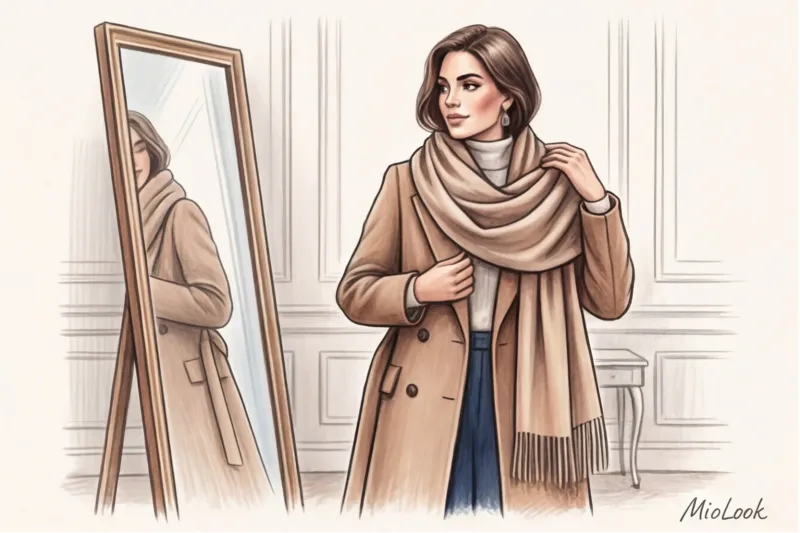
"For a classy everyday wardrobe, choose deep navy, charcoal, dark chocolate, or camel shades. They look significantly more expensive and are easier to combine with other pieces."
Choosing a jacket style: geometry that changes proportions
The right jacket follows the golden ratio. The ideal length of a classic jacket should end where the line of your thumb begins when you lower your hand. If the jacket is shorter, it visually cuts off your hips at their widest point. If it's longer, it shortens your legs.
Single-breasted vs. double-breasted: matters of status and silhouette
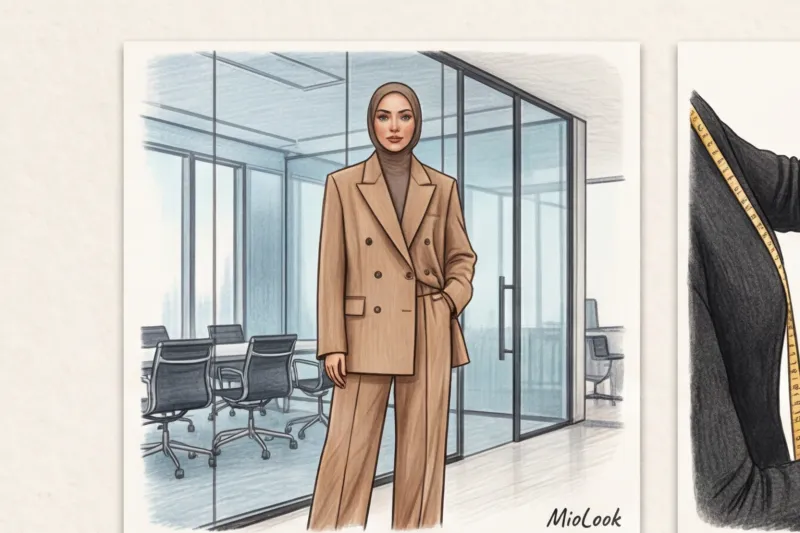
The double-breasted jacket is a symbol power dressing Its peaked lapels visually broaden the shoulders and nip the waist, creating an authoritative silhouette. However, it does have a drawback: a double-breasted jacket looks poorly unbuttoned due to the excess fabric at the front. If you enjoy a dynamic look and often wear your jacket unbuttoned, a single-breasted model is your choice.
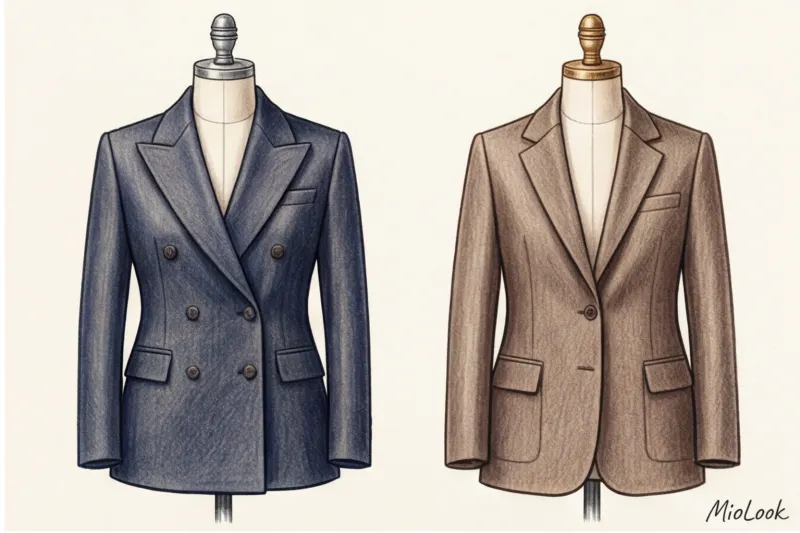
A single-breasted jacket with one or two buttons is versatile. It creates a deep V-neck that elongates the neck and slims the figure. It's the perfect canvas for silk blouses or cashmere turtlenecks.
Shoulder length and line: modern standards
The tight micro-jackets popular in the early 2010s have finally left the business wardrobe. Today, structured shoulders reign supreme. Stiff yet precise shoulder pads act as a posture corset—you physically cannot slouch in a well-tailored jacket.
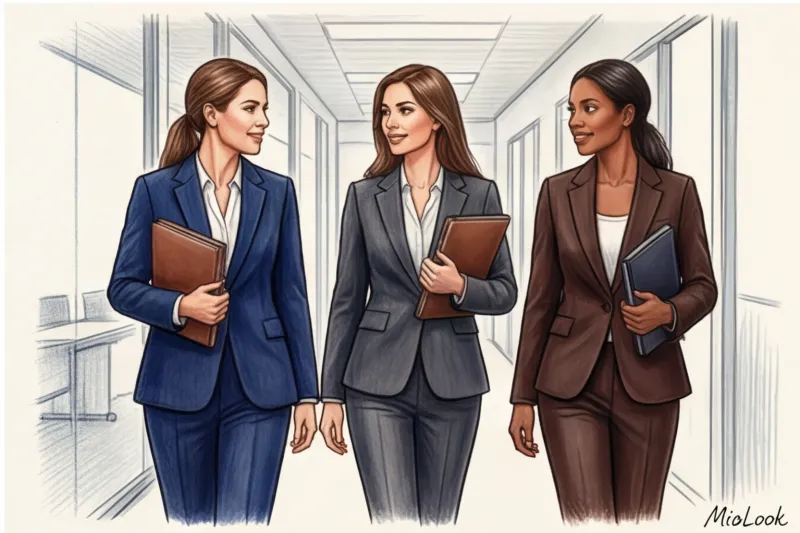
It's important not to go to extremes. Oversized clothing is appropriate in the fashion industry, but in a corporate environment, the line between "relaxed elegance" and "sloppiness" is very thin. The shoulder seam should extend no more than 1-1.5 centimeters beyond your natural shoulder.
Your perfect look starts here
Join thousands of users who look flawless every day with MioLook.
Get access — €0.99 onceTrousers and skirts: the perfect bottom for the perfect top
No jacket, no matter how expensive, will save a look if the pants don't fit well. Wide-leg palazzo pants with a crisply pressed crease are all the rage right now. A crease is a vertical line that endlessly elongates the legs. These pants should almost completely cover the shoes, leaving only the toes of the shoes or loafers visible.
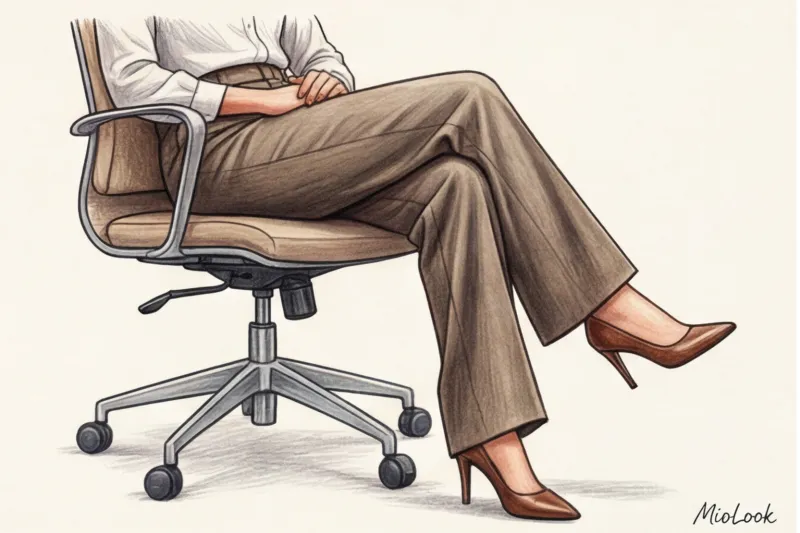
Cropped cigarette pants are dangerous. If they end at the widest part of your calf, they will make your legs appear shorter and fuller. The correct cigarette length is right at the ankle bone, the narrowest part of your leg.
If you prefer skirts, forget about the knee-length cut. The modern pencil skirt is a confident midi (a hand's breadth below the knee), made of a dense fabric that doesn't bunch up as you walk. A proper back vent is essential, allowing for freedom of movement without a garish slit.
Personal advice from a stylist: Always buy two pairs of trousers or trousers and a skirt to go with a jacket. Bottoms wear out and require washing or dry cleaning twice as often as tops. Buying a three-piece suit with a spare pair of trousers will extend the life of your outfit by several years.
Fabrics That Work for You: Reading Labels Like a Pro
Choosing a fabric is the moment when a women's business suit becomes an investment. Look for labels from Italian factories (for example, Loro Piana, Vitale Barberis Canonico, or Reda). But what do those mysterious Super 100s, 120s, or 150s numbers mean?
This number indicates the thread's thickness. The higher the number, the finer, softer, and more expensive the wool. But there's a catch. Many people think they need Super 150s for everyday wear. That's a mistake! This fabric is luxurious, but it wrinkles at the first glance and wears out quickly. For everyday work, the ideal balance of strength and softness is Super 110s or 120s.
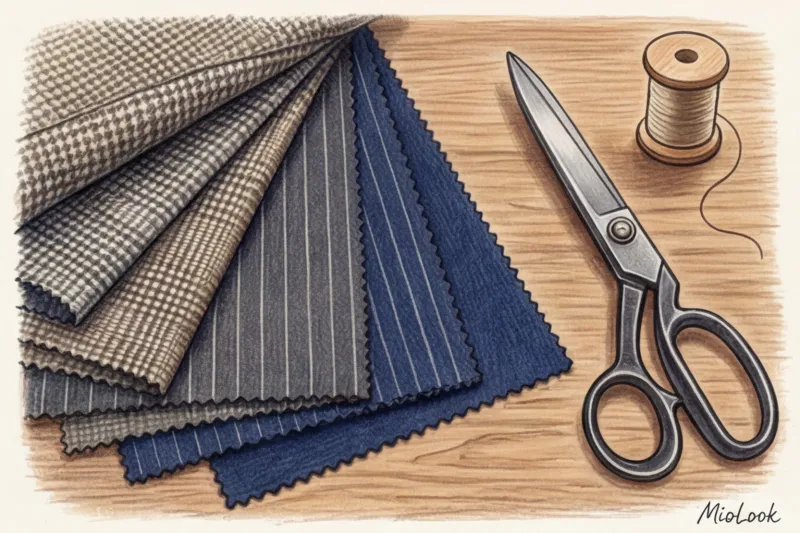
Worried about 100% virgin wool being too hot in the summer? Look for fresco wool. It has an open weave that allows air to pass through while maintaining a crisp, businesslike shape.
Regarding blends: 2-3% elastane is essential for comfort in the elbows and knees. But if you see 10% elastane or 30% polyester, feel free to return the item to the hanger. Summer suits made of linen and cotton are wonderful, but to avoid the "wrinkled pajamas" effect by midday, choose fabrics with a tight weave (at least 180 g/m²) or linen-silk-wool blends.
Cost-Per-Wear Formula: When to Pay More for a Women's Business Suit
Let's do the wardrobe math. A $200 women's business suit from a mass-market store will lose its shape after about 20 wears (one active season). The cost-per-wear (CPW) is $10. You'll be constantly battling pilling and wrinkled elbows.
A premium $1,000 Super 120s wool suit with a half-lapel will last you at least 5 years (about 150 wears). Its Cost-Per-Wear is $6.60. And you'll look impeccable for each of those 150 wears. To avoid having to keep these calculations in your head, I recommend using wardrobe digitization feature in the MioLook app - it will automatically calculate the usage statistics for each item.
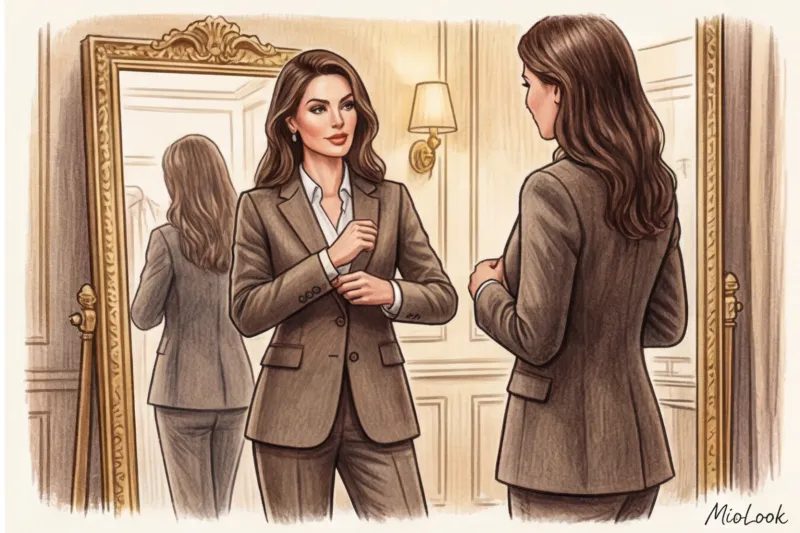
But there is another aspect that is rarely discussed. In psychology, there is a term enclothed cognition (embodied cognition). A study published in the Journal of Experimental Social Psychology (2012) proved that clothing directly influences our cognitive processes. Putting on a perfectly tailored suit literally makes you think more strategically and negotiate with greater confidence. This confidence pays for itself with the first successful deal.
And remember: budget for a tailor. A $500 suit tailored to your body (shortened sleeves, nipped waist) will always look more expensive than a $2,000 suit that fits too baggy.
Ready to get started?
Try the MioLook free plan—no commitments required. Organize your business wardrobe with AI.
Get access — €0.99 oncePre-purchase checklist: test drive in the fitting room
Never buy a suit simply by standing in front of a mirror. The item should undergo a rigorous test drive right in the fitting room. Here's my checklist that I use during shopping tours:
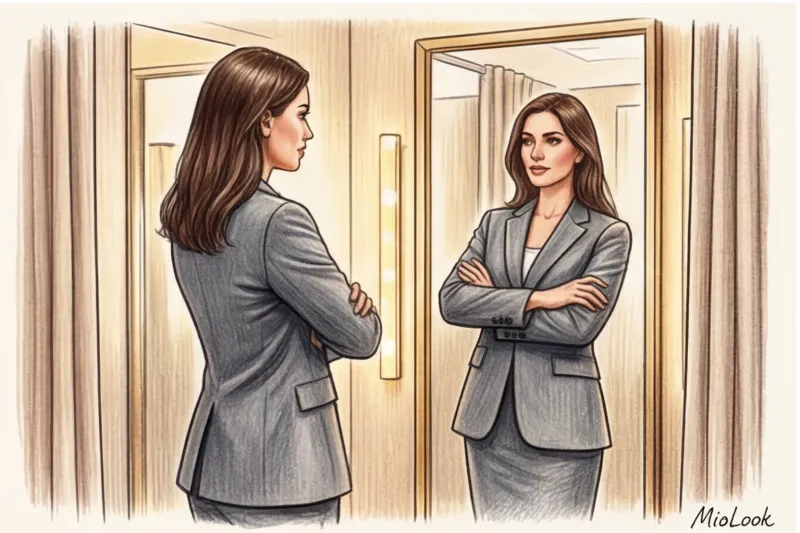
- The Hug Test: Put on the jacket, button it at the top, and cross your arms over your chest, as if hugging yourself. If the fabric is ragged at the back and the sleeves are digging into your biceps, you need a larger size.
- Squat Test: Be sure to sit on a chair in the fitting room. Pants shouldn't cut into your waist, and a button on your jacket shouldn't feel taut as if it's about to fall off. If you're wearing a skirt, check that the vent doesn't flare too high, exposing your thigh.
- Balance check: Stand up straight with your arms at your sides. The side seams on your trousers and jacket should be strictly perpendicular to the floor. If the seam is slanted forward or backward, the pattern is not correct for your figure.
- Inspection of the collar: Ask a friend or a consultant to take a photo of you from the back. The jacket collar should fit snugly around your neck. If there's a gap between the shirt collar and the jacket, it's a collar gap, which is very difficult and expensive to fix, even with a good tailor.
Choosing the perfect business suit takes time and knowledge. But once you find your perfect fit and experience the difference between fused mass-market fabric and breathable Italian wool, you'll never compromise again. The right suit isn't a restriction on your freedom. It's your armor, working for you even before you utter your first word in a meeting.