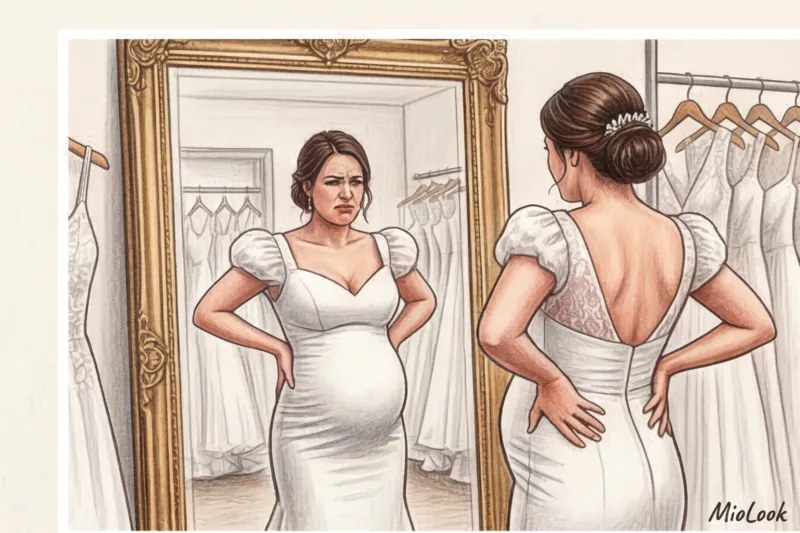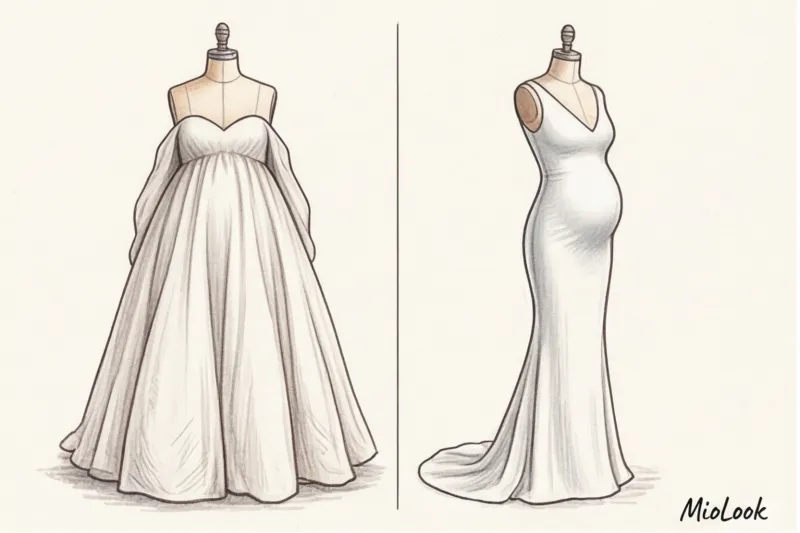
Have you ever seen a bride crying in the fitting room, not from happiness, but because she looks like a giant, multi-tiered meringue in the mirror? Over 12 years of working as an image consultant, I've witnessed this scene dozens of times. Expectant mothers come to the salon armed with stereotypes from the 2000s and try to "hide" their beautiful status under meters of stiff tulle. The result is always the same: lost proportions, 22 pounds added, and a ruined mood.
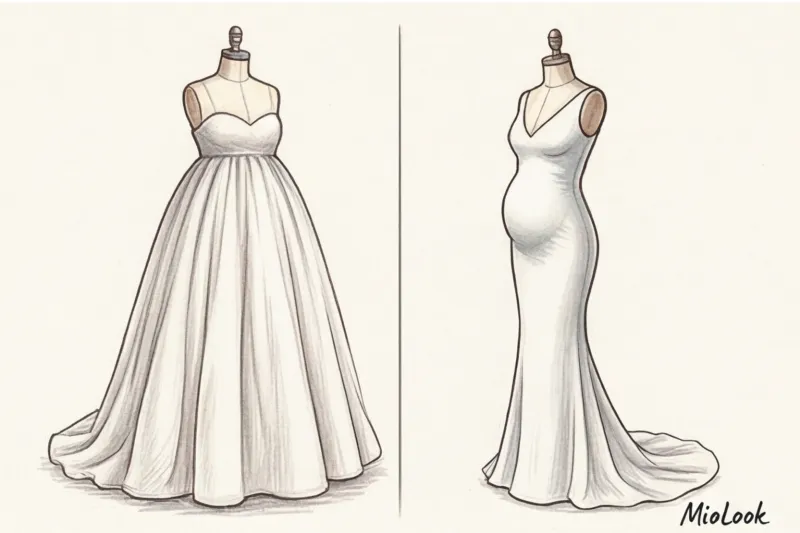
Today we will forget about shapeless robes forever. Choose the perfect one wedding dress for pregnant women — means using the laws of visual architecture of cut and color to look like a luxurious woman on the red carpet. We've already discussed the style philosophy of this period in more detail in our The complete guide to elegant maternity clothes Now let's explore the anatomy of a flawless wedding look that will highlight your beauty, not hide it.
Maternity Wedding Dresses: Key Myths and Style Mistakes
The most harmful advice still offered on forums is: "Just buy a regular dress two or three sizes too big." As a stylist, I declare this a catastrophic mistake. Oversized clothing ruins the architecture of the shoulder girdle. The shoulder line will slide down, the armholes will bulge, and empty folds of fabric will form across the chest. Instead of delicately framing your changed shape, you'll become a visual "rectangle."
The second myth is the obligatory "Grecian" (empire) silhouette with a cutoff line under the bust. Yes, historically, this was considered a lifesaver. But let's face it: if you have large breasts (and they increase during pregnancy), a cutoff line under them will create a "balcony" effect. From this line, the fabric falls straight down, making your silhouette equal to the volume of your bust plus your stomach. This is the so-called "monolith rule," in which excess draping expands the figure to the extreme limits of the fabric.
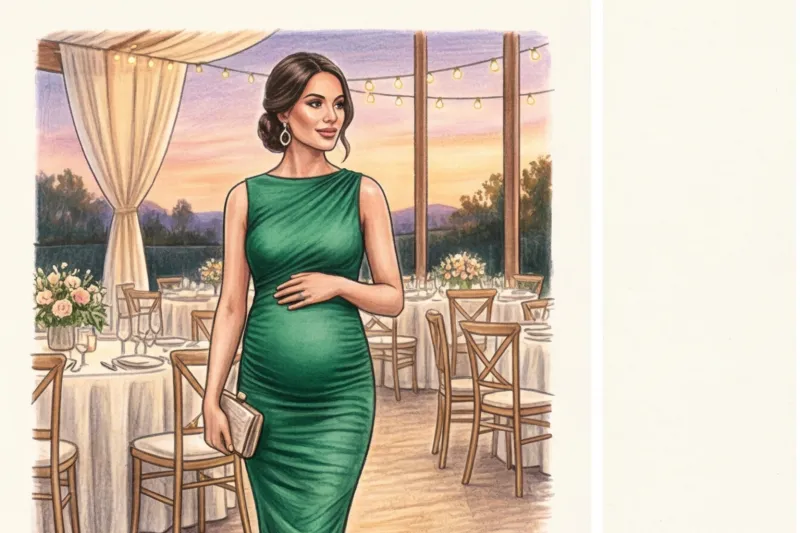
I had a client, Anna, who was seven months pregnant. She came to me in despair after trying on a dozen empire-style dresses. We radically changed our approach and chose a form-fitting sheath dress made of thick stretch crepe. It accentuated her trim stomach while preserving the graceful curves of her back and hips. She was the true star of her celebration, proving that pregnancy is a source of pride, not something to hide.
Your perfect look starts here
Join thousands of users who look flawless every day with MioLook. Artificial intelligence will help you choose a silhouette based on your individual parameters.
Get access — €0.99 onceCut Architecture: Choosing a Wedding Dress for a Pregnant Bride by Trimester
According to the Association of Image Consultants (AICI), during pregnancy, your bust size increases by an average of 1-2 cup sizes, and your natural waistline shifts 5-10 cm higher. Your center of gravity shifts. Leading bridal houses like Pronovias and Vera Wang design their maternity dresses to compensate for this weight. The key is to maintain vertical lines and use V-necklines, which visually elongate the neck, offsetting curves.
First trimester (up to 13 weeks): secret or accent?
During this period, changes in your waistline are minimal, but you already feel that your usual clothes have become too tight. Your main concern is tight corsets. Pressure on your stomach is absolutely contraindicated now. Switch to styles with hidden internal lacing and soft silicone underwire.
A-line dresses made of thick satin that hold their shape, or elegant peplum styles, are ideal. A peplum (an architectural ruffle at the waist) creates a beautiful volume shift and allows for some room around the midriff if you'd like to keep your pregnancy under wraps for now.
Second Trimester (14–27 Weeks): The Perfect Balance
This is a golden time for most brides. Your health improves, and your tummy looks its best. And it's the perfect time for fitted silhouettes. Opt for a mermaid cut, but with an important caveat: the skirt should flare out from the mid-thigh, not just above the knee (which can restrict your stride).
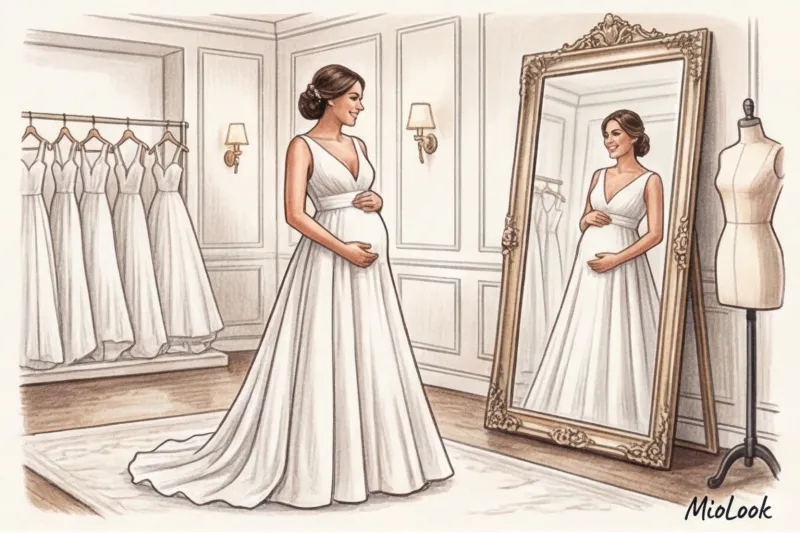
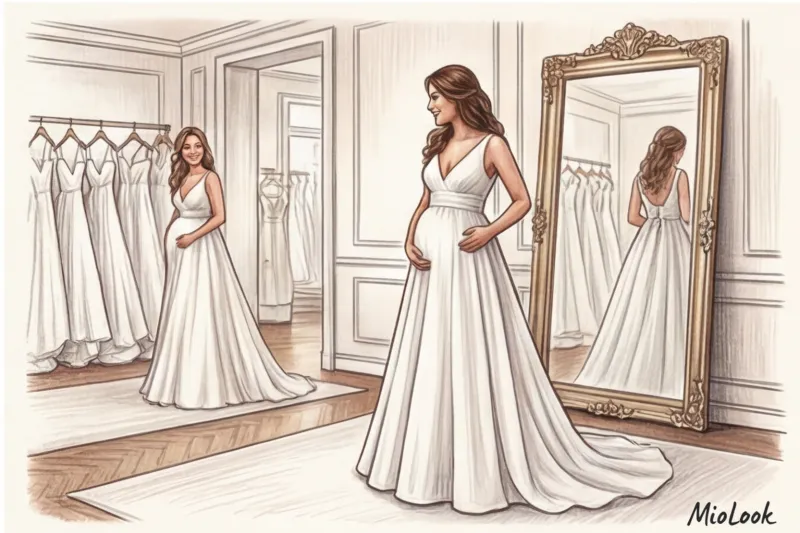
If you prefer a loose fit, look for dresses with a high waist, but not subchest waist. The seam line should be approximately 3-4 fingers above the navel, gently supporting the belly from below, not hanging over it.
Third Trimester (28 Weeks and Up): Comfort Without Losing Chic
In later stages, the law of volume distribution comes into play: a smooth, simple bodice and a flowing skirt. Avoid heavy embellishments (stones, 3D flowers) in the neckline, as they will make the top look heavier.
Pay attention to the length. A protruding belly will always cause the hem to rise in the front. If you're buying a standard maxi dress, be prepared for a "hitched-up" effect. To avoid this, the dressmaker should create an asymmetrical cut: the front of the skirt is cut 5-8 cm longer than the back (before final trimming).
Fabrics that work for you (not against you)
Even the most impeccable cut can be ruined by the wrong texture. A pregnant bride's worst enemy is stiff taffeta and cheap, inelastic tulle. These fabrics are stiff, creating sharp angles and unnecessary volume. Furthermore, they are not breathable, which is critical for the expectant mother's body heat.
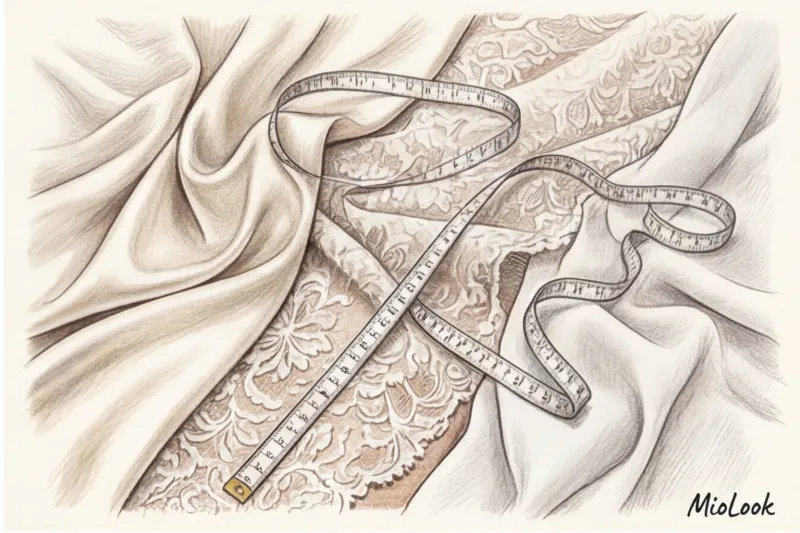
Your best friends in the fabric world:
- Stretch crepe (density from 250 g/m²): It has enough weight to fall gracefully and enough elasticity to hug the figure without being tight.
- Silk charmeuse: lies in soft folds, like liquid gold.
- Soft French Chantilly lace: Unlike hard guipure, it is flexible and takes the shape of the body.
Stylist's secret: Avoid intense shine. Smooth, shiny satin acts like a magnifying glass. Camera flashes will visually add volume where light refracts (on curves). Choose matte textures or fabrics with a delicate pearlescent sheen. We wrote about how textures can save the day during the warmer season in our article about choosing an evening dress for summer.
Access to MioLook for €0.99 — one-time payment
Unsure which fabric and style is right for you? Our smart AI stylist will analyze your body shape and suggest the best options.
Choose an imageColor Type and Pregnancy: Why Snow White Isn't Always the Best Choice
As a certified colorist, I often encounter brides' surprise when their tried-and-true "perfect color" suddenly no longer suits them. Hormonal changes during pregnancy alter skin undertones. Some develop a bright flush, others a tendency toward pigmentation, or, conversely, an aristocratic pallor.
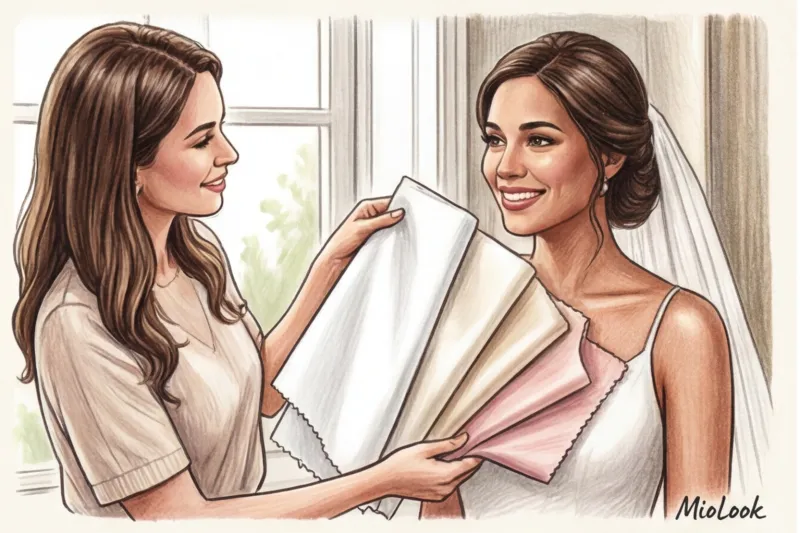
Snow-white (with a bluish undertone) is a high-contrast color. It mercilessly highlights any redness, signs of fatigue, and dark circles under the eyes. If you don't get enough sleep, snow-white will make your face look gray.
What's the alternative? A huge palette of complex white shades:
- Ivory: It has a warm, creamy undertone, perfectly smooths out skin imperfections and gives the face a fresh look.
- Champagne: A luxurious shade with a slight golden note that looks incredibly expensive in photographs.
- Powder pink or pearl gray: For daring brides. WGSN's 2024 Wedding Trends Survey shows that 34% of brides are ditching classic white for pastel tones.
Be sure to test in natural light: place the fabric on your bare face. The right shade will act as a reflector, highlighting your eyes and smoothing out your skin tone. If you're unsure of your palette, check out our article about 12 color types of appearance.
Buy a special one or adapt a regular one? Timing and life hacks
Should you look for salons exclusively for pregnant women? Not necessarily. Most specialized brands in the budget segment (under €300) are guilty of boring designs. You can easily buy a designer dress from a regular collection (in the €800–€1,500 range) and have it customized.
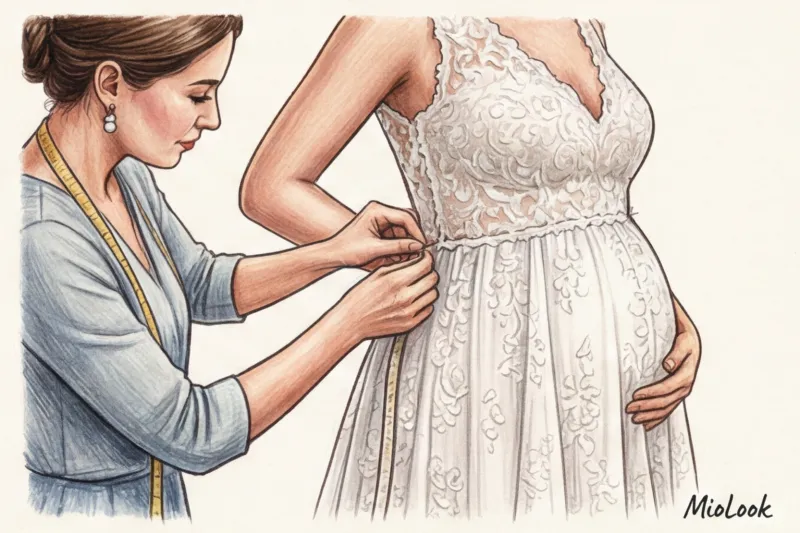
A skilled tailor's tricks can work wonders. Concealed elastic mesh gussets can be sewn into the side seams. The rigid back zipper can be replaced with an elegant lacing system with a wide satin flap, giving you 1-2 sizes more room.
But here lies the main trap - timing.
The average bride buys a dress six months in advance. For you, it's a roulette wheel. Your schedule should look like this:
- 1-1.5 months before the wedding: choosing and buying a dress (it’s not worth it earlier, you won’t be able to predict the rate at which your belly will grow).
- In 2 weeks: first fitting at the tailor's, outlining changes.
- 5-7 days in advance (STRICTLY!): final fitting.
Fair Limit: This tip for adapting a regular dress does NOT work if you've chosen a mermaid silhouette made of non-stretch mikado with intricate beaded embroidery along the side seams. Such a dress cannot be embroidered. In this case, look only for specialized styles with built-in volume.
Details that change everything: lingerie, shoes, and accessories
The right look starts with a foundation. That foundation is seamless, invisible lingerie. Save lace panties and push-up bras for your wedding night. Smooth, stretchy shorts or briefs with supportive bandages are essential under your maternity wedding dress. They will prevent chafing on your inner thighs (a common problem due to mild swelling) and smooth out your midriff.
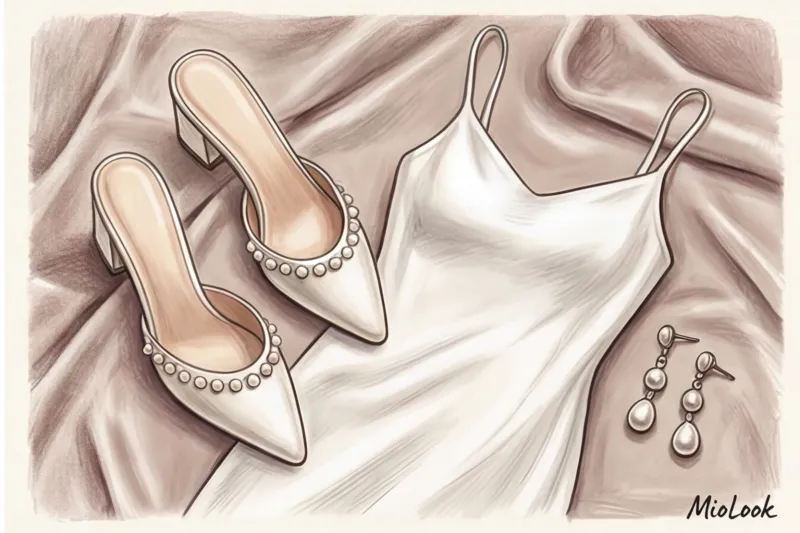
Shoes are a different matter. Classic 10-centimeter stilettos are a risk to your lower back and a surefire way to evening puffiness. Shift your weight to elegant kitten heels (3-4 cm heel), stylish satin mules with pearls, or ballet flats with a hidden wedge. Trust us, the look won't be compromised. More ideas for comfortable and elegant footwear can be found in our article about Office shoe etiquette and alternatives , the rules of which are perfectly adapted to long-term festive events.
Shift the visual focus to your upper body with accessories. Large portrait earrings, a sparkling necklace, or a strand of baroque pearls will draw attention to your happy face and décolleté. Learn how to choose the right jewelry in this article. about status accessories.
Ready to create the perfect capsule for your celebration?
Upload photos of your accessories and shoes to MioLook, and the app will suggest how best to pair them with your wedding dress.
Organize your wardrobeA checklist for the perfect wedding dress for the expectant mother
Before you say "Yes!" to the dress, take it for a final test drive right there in the showroom. Don't just stand in front of the mirror. Do the following:
- Movement test: Sit on a chair (the fabric should not cut into your ribs), stand up, raise your arms up (as if you were hugging a tall relative).
- Fabric check: Press the fabric against your cheek for 10 seconds. If you feel hot or the material itches, this will turn into torture at the wedding.
- Plan B: Consider a cape (a cashmere stole, a silk trench coat if the wedding is in the fall). The weather and temperature regulation of pregnant women are unpredictable.
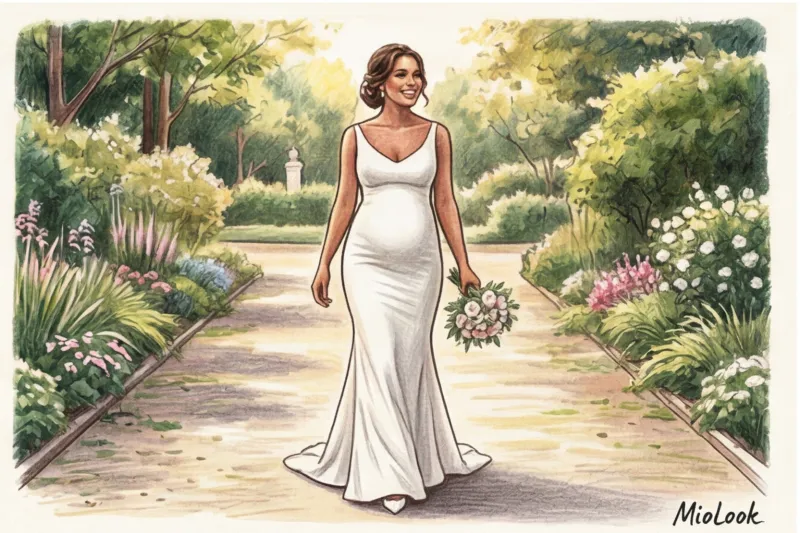
Pregnancy is a stunningly beautiful time that deserves the very best frame. Don't try to camouflage yourself with the standards of a bygone era. Choose thick, luxurious fabrics, smart, stretchy cuts, and shoes that support you. Remember: your inner confidence and comfort are the very light that will make your wedding photos truly stunning.