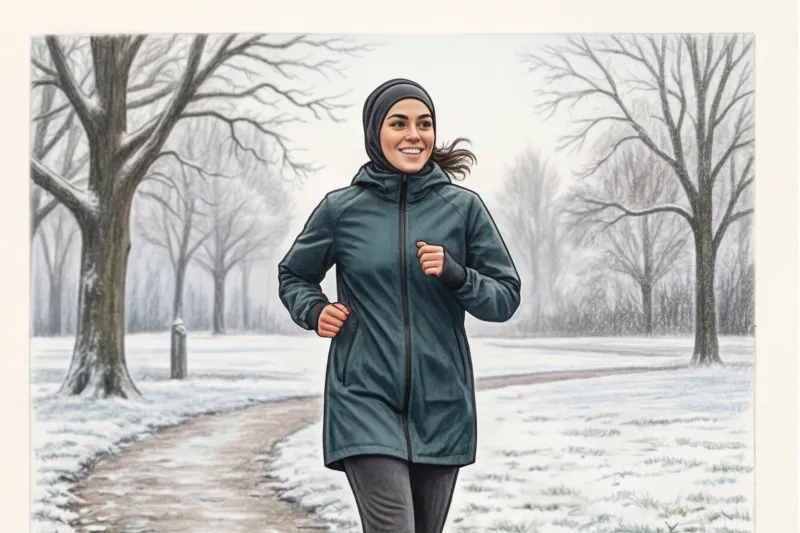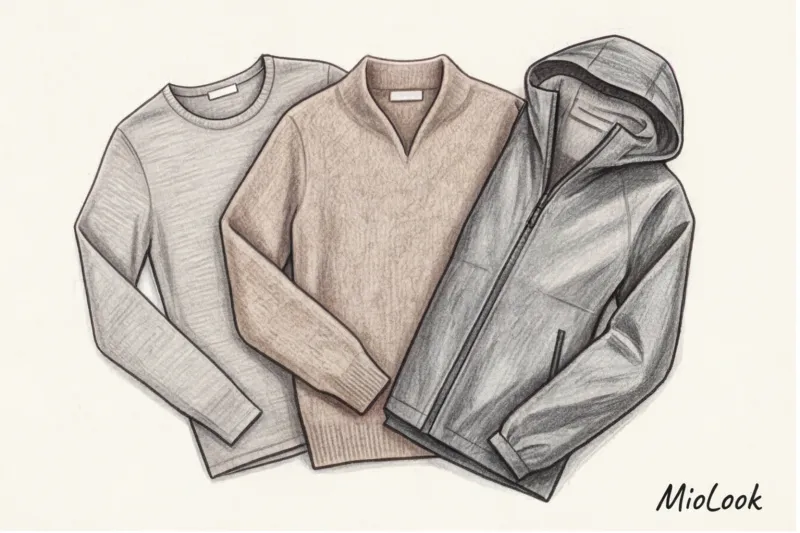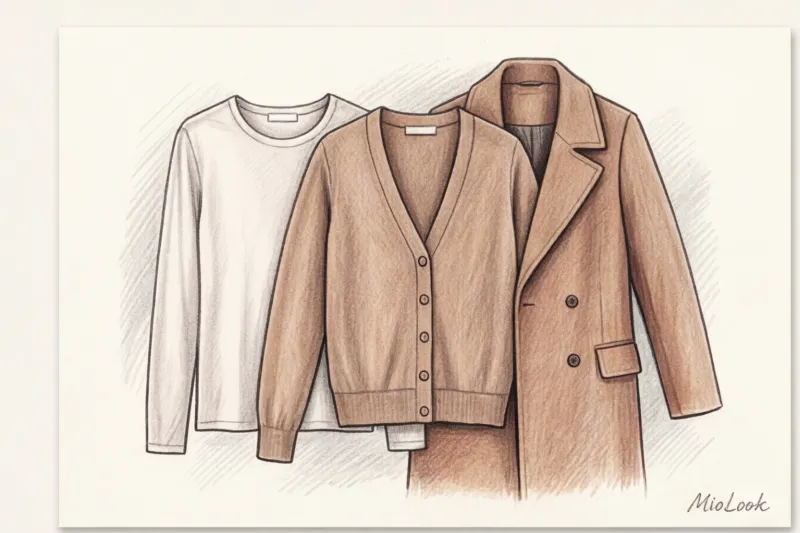
Have you ever noticed this striking paradox? A woman who brilliantly layers for the office, chooses the perfect jacket fit, and invests in a cashmere coat often goes for a run in an old, stretched-out cotton sweatshirt. The excuse is always the same: "It's just for sweat, so what difference does it make how I look?" As a personal stylist, I strongly disagree. A well-chosen clothes for running outdoors It's not a matter of vanity. It's your biomechanical armor and a powerful motivational trigger.

Your sports wardrobe should be built according to the same strict investment principles as your business foundation. We've covered the principles of such construction in more detail in our The complete guide to creating a premium sports capsule Today, we'll combine the rigorous physiology of the "three-layer rule" with a fashion stylist's approach to create an elegant, monochrome running capsule that performs flawlessly and looks classy.
The Cotton Trap: Why Your Outdoor Running Clothes Are Sabotaging Your Results
I had a client in my practice, a top manager at a major bank. At the office, she exuded confidence in three-piece suits, but for her morning runs, she'd wear shapeless gray sweatpants and her husband's old T-shirt. She complained that her back hurt after running 3 kilometers, and that she constantly caught colds in the winter. The problem wasn't her physical fitness, but her woefully inadequate equipment.
The anatomy of this failure lies in the materials. According to thermoregulation research (Journal of Sports Sciences, 2023), ordinary cotton can retain 27 times its own weight in moisture. What happens in practice? Your shirt absorbs sweat, becomes heavy, clings to your body, and instantly cools with the slightest gust of wind. You're literally running in a cold, wet compress.
Switching to high-tech gear changes not only the physics of the process but also the "architecture" of the body. The right compression fabric in tights supports muscles, reducing vibration, and the anatomical cut of a long-sleeve t-shirt forces you to reflexively square your shoulders. When we ditched a client's old sweatpants and put together a simple running capsule for her, her posture during runs changed on the very first day.
Running Capsule Architecture: How the Three-Layer Rule Works
As a clothing designer, I always say: putting together a sporty look should be as thoughtful as layering a complex autumn outfit. Each element has its own function, and they shouldn't be interchanged.
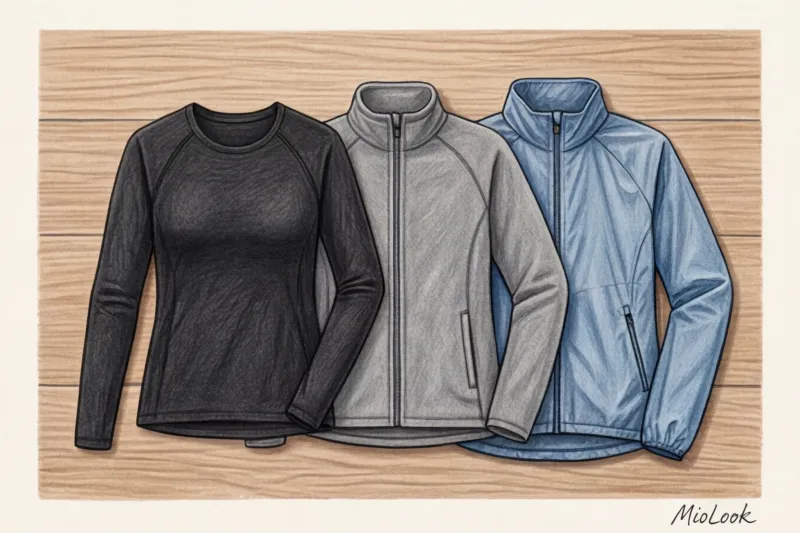
The basic principle of layering accomplishes three things: moisture management, warmth insulation, and weather protection. Skipping a layer or wearing a windbreaker directly over a sports bra on a chilly morning can disrupt your entire thermoregulation system.
Access to MioLook for €0.99 — one-time payment
A smart AI stylist will help you digitize your sports capsule and suggest ideal combinations for any weather.
Get access — €0.99 onceLayer One: Base (Moisture Wicking)
Its only job is to draw moisture away from the skin and transfer it further. Your body should stay dry. Only synthetic materials (polyester, nylon, elastane) or ultra-fine-knit merino wool for winter work here.
A garment should fit like a second skin. If a basic tank top hangs loosely, moisture simply won't be able to wick away—sweat beads will run down your back. Look for the "seamless" label: this isn't a marketing gimmick, but a real solution to chafing in the armpits and ribs.
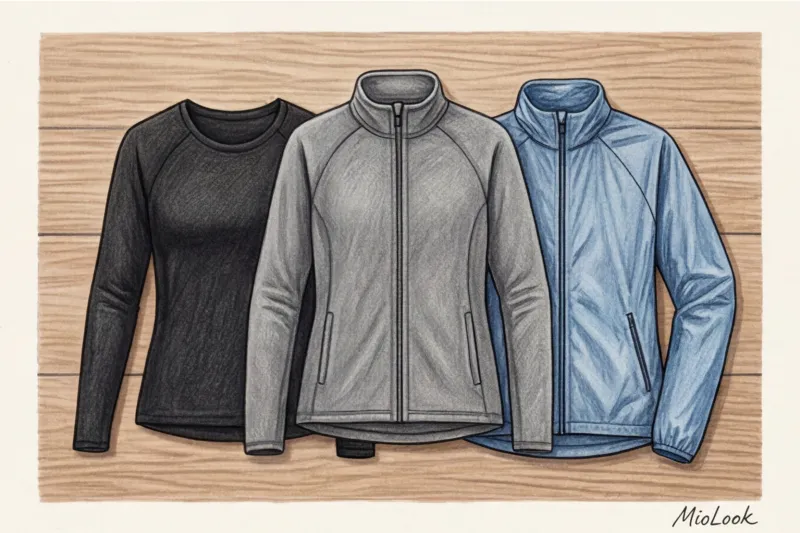
Layer two: Insulating (Heat retention)
Herein lies the main counterintuitive truth: The myth "the thicker the item, the warmer" doesn't work in sports. When it comes to winter running, your favorite fleece-lined sweatshirt is your worst enemy. The best insulator isn't fabric, but air.
That's why high-tech microfleece or long sleeves with a waffle texture (grid fleece) are warmer than down jackets. The squares of fabric trap body heat in air pockets, while allowing vapor to escape freely. The ideal second layer always has a half-zip across the chest: if you get hot, unzip it, let in cool air, and your temperature regulation is restored in a second.
Layer Three: Protective (Weather Shield)
The third layer's job is to block out icy wind and rain without turning you into a greenhouse. It's important to understand the difference between a regular windbreaker and a membrane (like Gore-Tex).
A standard windbreaker protects against light wind and light drizzle thanks to its DWR treatment. It's lightweight and breathable. A membrane is the heavy artillery for pouring rain and sleet. When choosing a protective layer, be sure to check for ventilation vents (slits or mesh) under the arms and on the back—without them, you'll simply sweat.
Temperature Checklist: What to Wear for Temperatures from +15°C to -15°C
The most common mistake beginners make is dressing based on the thermometer outside. If you're warm and comfortable the moment you step outside, you're too warm. After two kilometers of intense running, you'll overheat.
Professional runners have a golden rule called "+10°C": dress for a run as if it's 10 degrees warmer outside than your phone shows.
Let's look at some specific scenarios:
- +10°C... +15°C: It may feel chilly, but it's the perfect temperature for running. Shorts (or 3/4-length tights) and a lightweight, basic long-sleeved top are all you need.
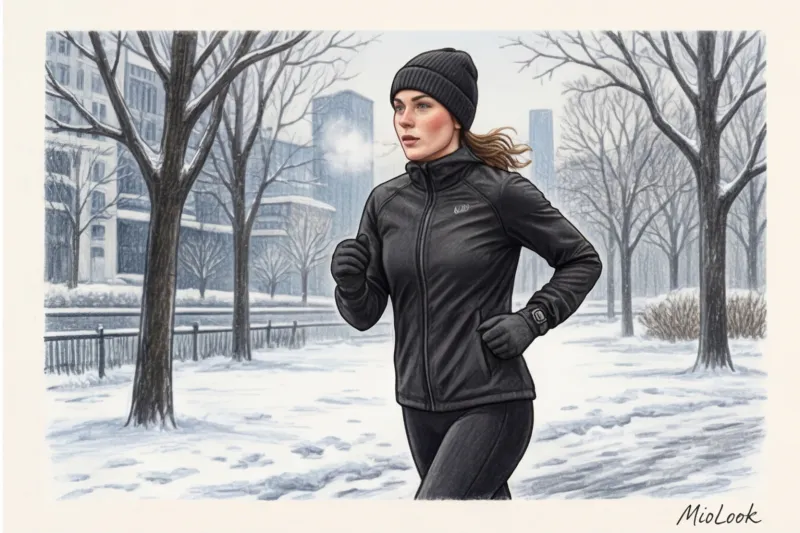
- +5°C... 0°C: It's time to layer up. Thick, long tights, a moisture-wicking baselayer, and a lightweight windbreaker. Be sure to add thin running gloves—hands are the first to freeze in the cold, as blood rushes to the working leg muscles.
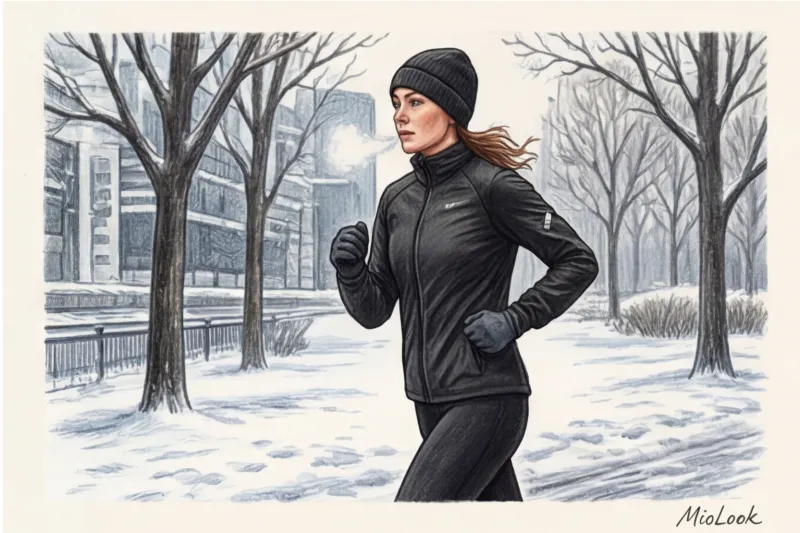
- 0°C... -10°C: Three full layers: merino-blend thermal underwear, a fleece layer, and a membrane jacket. Insulated tights (with windproof inserts on the thighs) for the legs. A neck buff.
- Below -10°C: Extreme sub-zero temperatures require protection for exposed areas. A buff should be pulled over the face (or a balaclava used), long insulated socks should be worn to cover the ankles, and light shorts can be worn over tights for additional wind protection around the pelvis.
Running Aesthetics: How to Create a Stylish Look Without the "Neon Highlighter" Effect
I've always been frustrated by the long-held belief among sportswear manufacturers that runners should look like splashes of color: neon pink tank tops, lime green laces, and garish prints. Such visual noise cheapens the look.
Your sports capsule collection should be composed of the same elegant shades as your everyday essentials. Swap boring black for deep monochrome colors: emerald, burgundy, dark chocolate, or deep sapphire (navy). Monochrome visually elongates the silhouette and looks luxurious, even when you're running through slush.
Over the course of 12 years of working with wardrobes, I've tested numerous brands. And I can confidently say: today, European mass-market fashion has mastered the art of sporting elegance. H&M Move, Oysho, and COS Active offer stunning, minimalist designs without flashy logos plastered all over the chest. If you want to add safety to your evening runs, choose items with built-in reflective elements—they look like stylish architectural piping in daylight and sparkle brightly in headlights.
Your perfect look starts here
Join thousands of users who look flawless every day with MioLook, from the office to the treadmill.
Get access — €0.99 once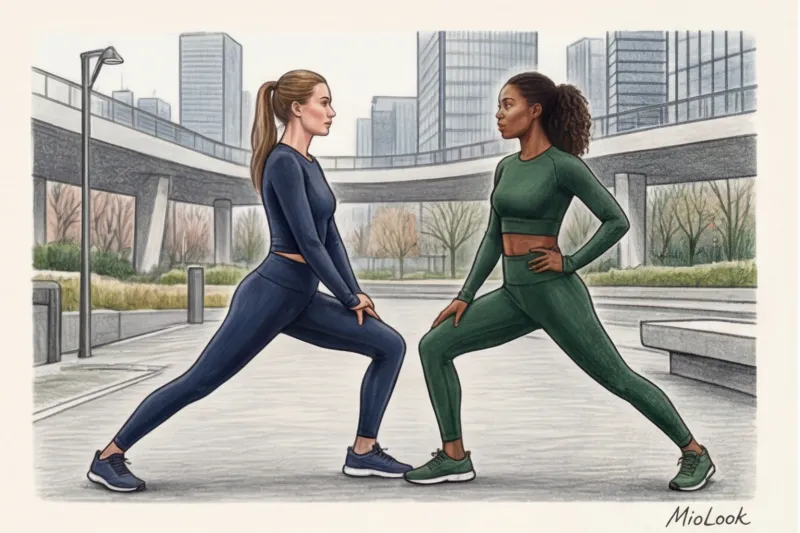
Cost-per-wear in sports: where to save and what to pay for
My favorite tool is cost-per-wear (CPW) calculations. Sportswear wears out faster than other clothing due to the harsh environment (sweat, friction) and frequent washing. So, the math is ruthless.
Let's take a pair of mass-market leggings for €25 and premium running tights for €130. Cheaper leggings will lose their elasticity, become see-through at the buttocks, and start to slide down the waist after about 10 washes. Their CPW is €2.50 per run. High-quality tights with the right compression will last at least 150 workouts (my personal best is three years of active wear). Their cost per run is only €0.86.
Where you can save money safely: Basic T-shirts and long sleeves. Simple polyester from Zara, Uniqlo, or H&M for €15–20 will do a great job of wicking away moisture. Thin microfleece is also a safe bet on the budget end.
What to invest in (CPW will pay off 100%):
- Running shoes. This is your protection against knee and spine injuries.
- High Impact Sports Bra. The chest has no muscles, only ligaments. A strain on Cooper's tendons during running is irreversible.
- Membrane jacket (Gore-Tex). High-quality waterproofing with taped seams costs from €150, but it will last you for a decade.
Stylist's Checklist: 5 Unforgivable Mistakes in Running Gear
Even if you've created the perfect layered base, minor flaws can ruin the look. Check yourself with this checklist:
- Mistake 1: Wearing regular underwear under tights. Wearing lace thongs or bulky cotton briefs under tight leggings not only creates a visible panty line (VPL) but also guarantees painful chafing. Opt for seamless, laser-cut athletic underwear.
- Mistake 2: Cotton socks. Another less obvious pitfall: Cotton on your feet rolls, gets wet, and creates the perfect conditions for water retention. Synthetic running socks with reinforced heels and toes are essential.
- Mistake 3: Wearing a soft yoga top while jogging. Yoga bras are designed for static stretching. Running requires a firm hold (encapsulation or strong compression). If your chest moves when you jump in front of a mirror, the bra is not suitable.
- Error 4: Forgotten accessories. At temperatures around zero degrees, your body may be warm, but exposed hands and frozen ears will turn a run into torture. A thin buff and running gloves take up minimal space but make all the difference.
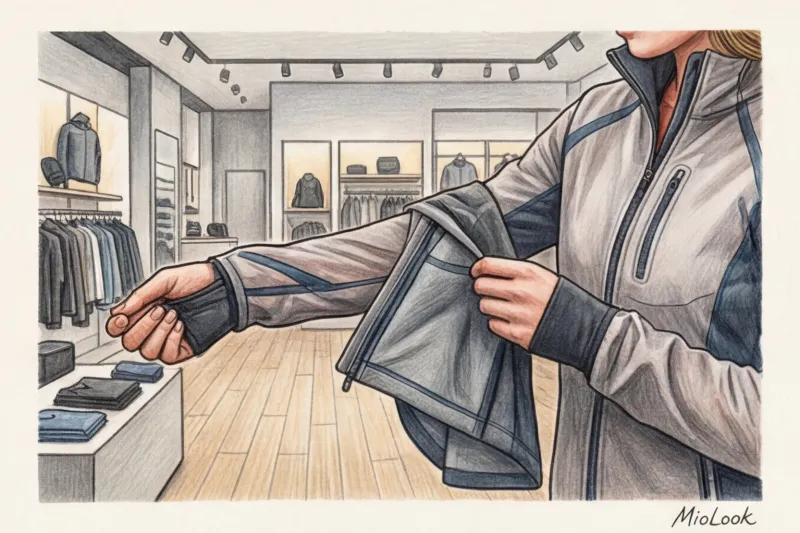
- Mistake 5: Crop jackets. Save cropped windbreakers for coffee walks. When you run, your body moves vigorously, so a short jacket will bounce up, and the icy wind will blow across your sweaty lower back. Choose models with a longer back.
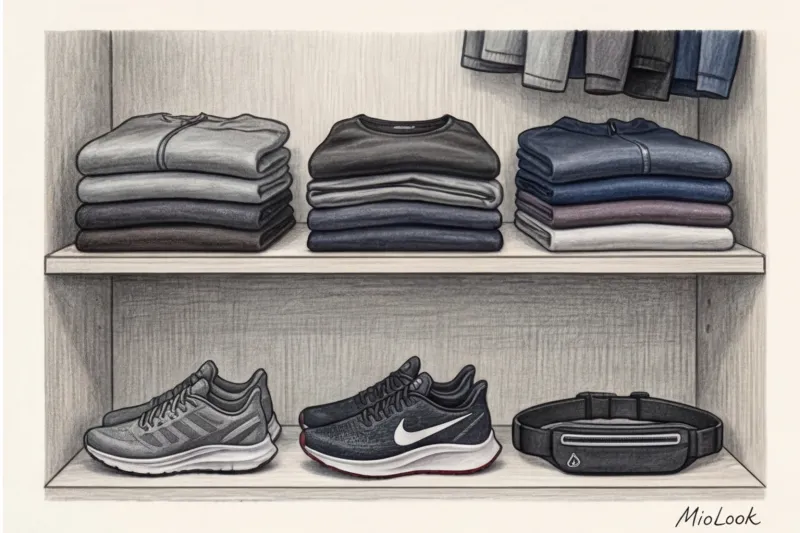
A beautiful and functional workout wardrobe is an investment in your health and discipline. When your clothes fit perfectly, don't pinch anywhere, protect you from the icy wind, and look like a page from an editorial, you'll have no excuses to skip a workout.