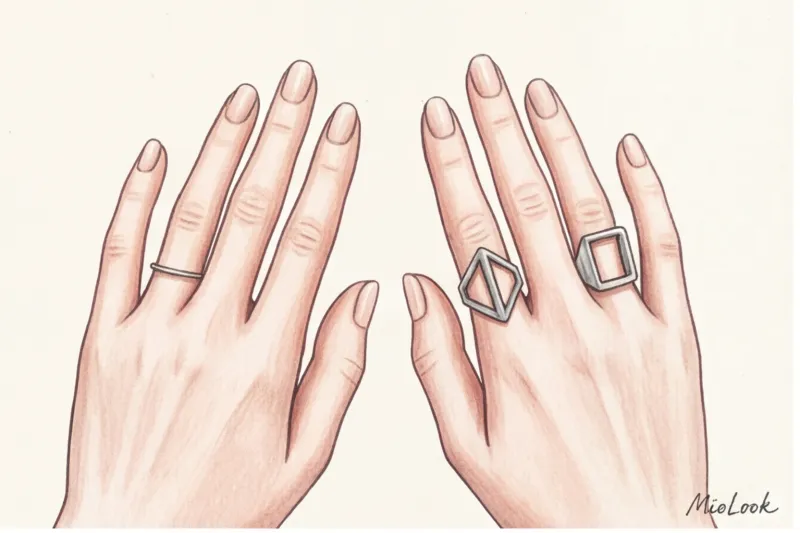
How many times have you turned down a beautiful ring in a store simply because it looked like a piece of string tied tightly around a sausage? It sounds harsh, but that's exactly how one of my clients described her jewelry shopping experience. We often blame our hands: fingers too full, wrists too wide, knuckles protruding. But after 12 years of working as a personal stylist in Europe, I've realized one thing: the problem isn't your hands. The problem is geometry and a lack of understanding of basic optical principles.
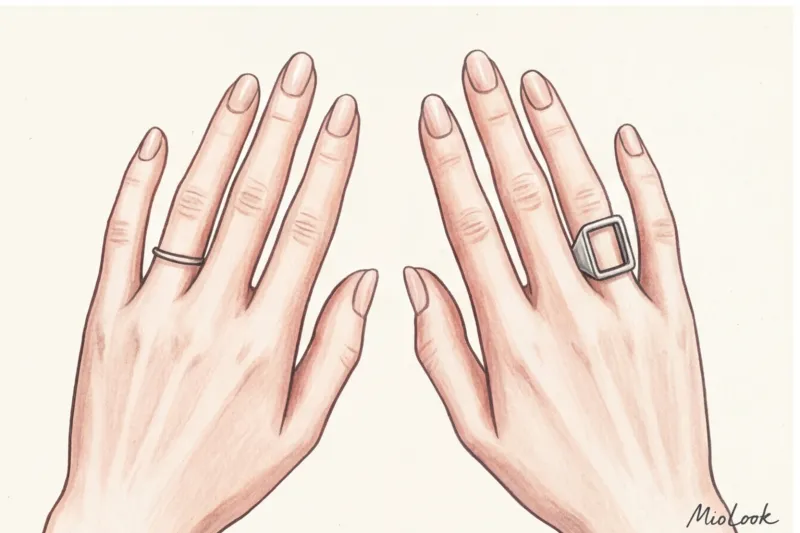
Knowing how to choose the right ring for your finger size isn't magic, but pure physics and the psychology of perception. A well-chosen ring works like expert contouring: it can visually elongate the hand, conceal puffiness, and create a graceful appearance. We've covered the basic laws of scale in style in more detail in our guide. Ideal accessories for your body type: selection rules Today we'll explore specific jewelry techniques that you can apply at your next fitting.
The Ebbinghaus Illusion on Your Hands: How Jewelry Size Changes Proportions
In 1901, psychologist Hermann Ebbinghaus (and, concurrently, Edward Titchener) described an optical illusion of size perception. The idea is simple: the same circle appears smaller when surrounded by large objects, and larger when surrounded by small ones. How does this work in styling?
When you wear a microscopic, thin ring on a large hand, it acts as those tiny objects that make your hand seem monumental. The biggest mistake I regularly see from clients is buying jewelry that's too tight. When the metal presses against the skin, creating overhanging ridges, the hand instantly looks heavy and puffy, even if you're wearing a size XS.
In modern jewelry design, there's the concept of "negative space" or "air." This is the gap between the jewelry and your body. It's this air, not the physical weight of the metal, that creates the feeling of fragility.
"Fragility is created by contrast. If a garment fits loosely, your brain reads: this woman is so graceful that even the metal on her is loose."
Access to MioLook for €0.99 — one-time payment
A smart AI stylist will select the perfect look based on your proportions and suggest accessories to complete your outfit.
Get access — €0.99 onceHow to choose a ring based on your finger thickness: 4 types of hands
The shape of the hand and the structure of the joints are far more important than the overall build. You could be a plus-size woman with long, asthenic, musical fingers, or a petite woman with wide, working hands. Let's look at the four most common scenarios and find architectural solutions for them.
Short and plump fingers: elongating the silhouette
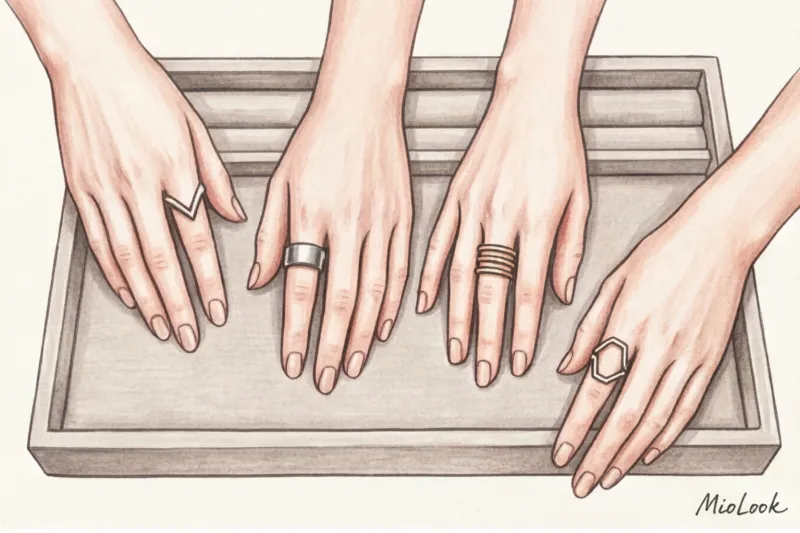
If your goal is to visually lengthen your hand, absolutely avoid wide horizontal bands (signet rings) and perfectly round, massive stones. They cut the finger in half.
Asymmetry and angles are your savior. Choose V-shaped rings (called chevrons) or open-shank designs. Vertically oriented marquise, baguette, or emerald-cut stones act as arrows, drawing the eye along the finger rather than across it.
A real-life example: I was recently putting together a capsule collection for a job interview with a client. She had rather short fingers, which she was self-conscious about. We added an open, geometric brass ring from &Other Stories for just €25. The diagonal lines of the metal and the open space at the knuckle made her hand appear a good centimeter longer.
Large knuckles (knotty fingers): distracting attention
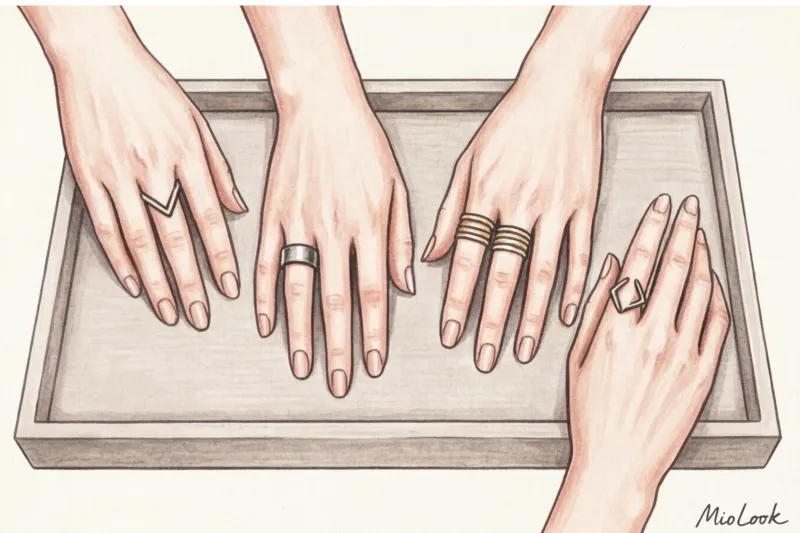
A classic problem: a ring that fits painfully hard across a wide knuckle and then dangles treacherously at the base of the finger, constantly tipping over with the stone facing down.
Solution number one: architectural, massive designs that draw attention away from the knuckle and onto the jewelry itself. Solution number two: open-joint rings. You easily slide them over the knuckle and then slightly adjust them to fit the knuckle.
There's also a cheap stylist secret: silicone inserts (springs) for rings. You buy a ring that fits easily over your knuckle, and to prevent it from spinning at the bottom, you wrap an inconspicuous transparent spring around the back of the band.
Long and thin fingers (asthenic): adding volume
It would seem that many people dream of having hands like these. But when you put a massive ring with a huge stone on long, thin fingers, the hand begins to resemble a spider. The metal looks heavy and alien.
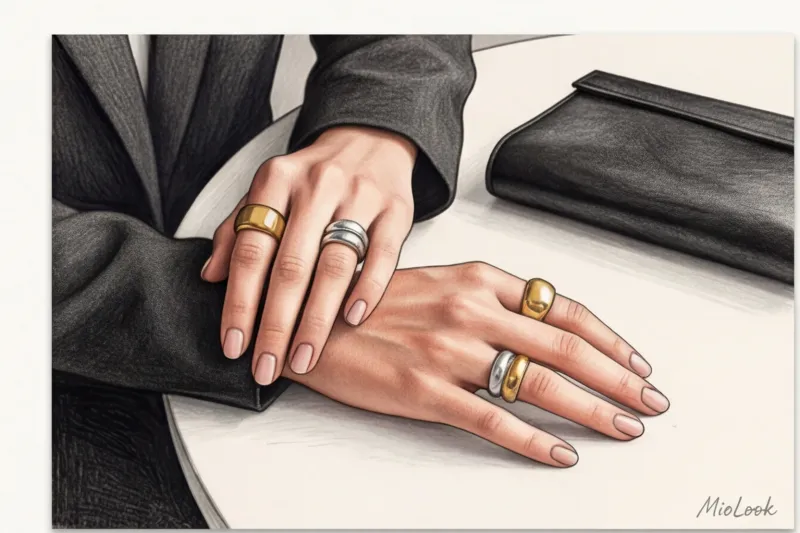
Wide, smooth cigar bands (6 to 10 millimeters wide) work perfectly here. They "eat up" the excess length of the finger, creating harmonious proportions. Horizontally oriented stones also look great—they visually widen the finger.
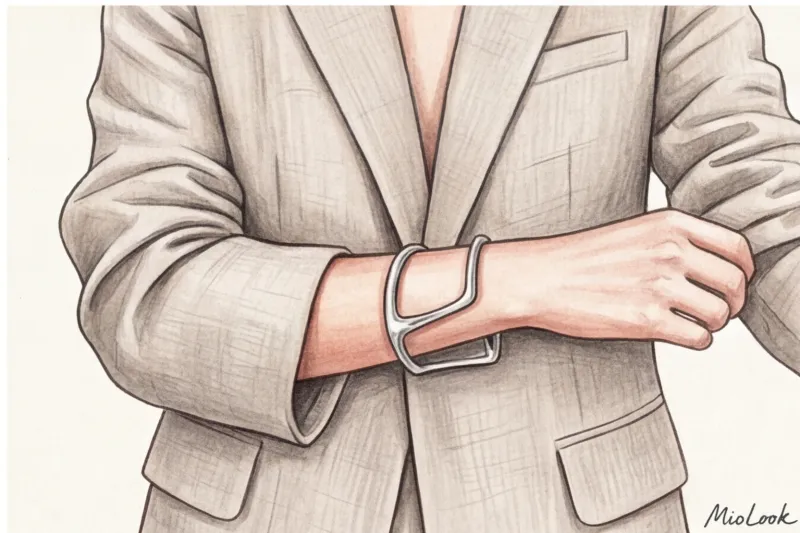
Wrists and forearms: choosing the right bracelet for your hand size
We've covered the arms, but what about the wrists? Bracelets follow the same scale rules, but with a slight twist: gravity.
If you have narrow, bony wrist Heavy chain bracelets (especially the popular Bismarck weave or anchor chains with large links) will look like handcuffs. They physically pull the arm down. Choose delicate chains and thin, rigid bracelets that fit snugly and don't fall to the middle of the wrist.
If you have full or wide wrist Say a firm "no" to thin chains with micro-pendants. They dig into your skin and disappear against your wrist. Cuff bracelets are the ideal choice. Remember the 1.5-centimeter rule: there should be a gap of 1 to 1.5 cm between the bracelet and your skin. This gap creates the illusion of a fragile wrist.
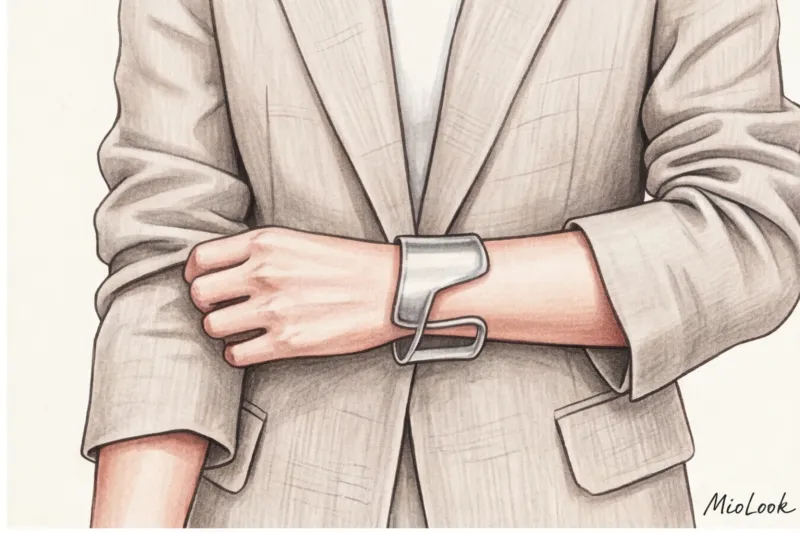
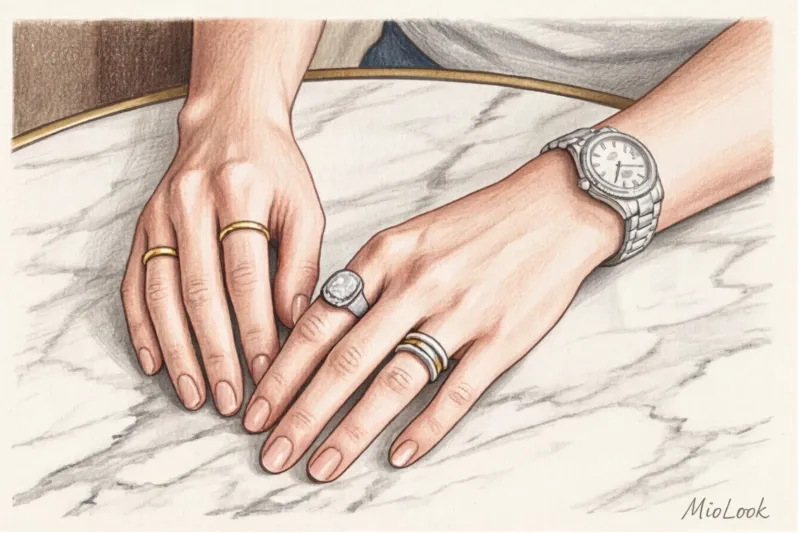
When it comes to watches, a strict rule of proportion applies. According to watchmaking standards (and regularly confirmed by WGSN's accessory reports), the dial should occupy at least two-thirds of your wrist's width, but not extend beyond it. My personal testing with clients has repeatedly proven that miniature vintage watches on a 15mm strap make a fuller forearm appear massive, while a men's 40mm chronograph ties the look together.
Mass-market jewelry: smart shopping at COS, Massimo Dutti, and & Other Stories
Many people think that the right architectural jewelry can only be found in the premium segment. This is a myth. For working with "unconventional" hands, I adore the Scandinavian and European mid-market. Their designers emphasize form and texture, not a scattering of glittering stones.
- COS: The undisputed leader in creating simple, minimalist cuffs. They always have wide bracelets (from 4 cm wide) that fit full wrists perfectly without squeezing. Budget: €35–€50.
- Massimo Dutti: I go here for a classy geometric look. They're masters at using the "hammered metal" effect. This texture diffuses light and has no clear edges, which brilliantly conceals the fullness of my nails. Budget: €30–€60.
- &Other Stories: The best place to find open rings and ready-made stacking kits. They make a great imitation of antique gold that doesn't look cheap. Budget: €20–€40.
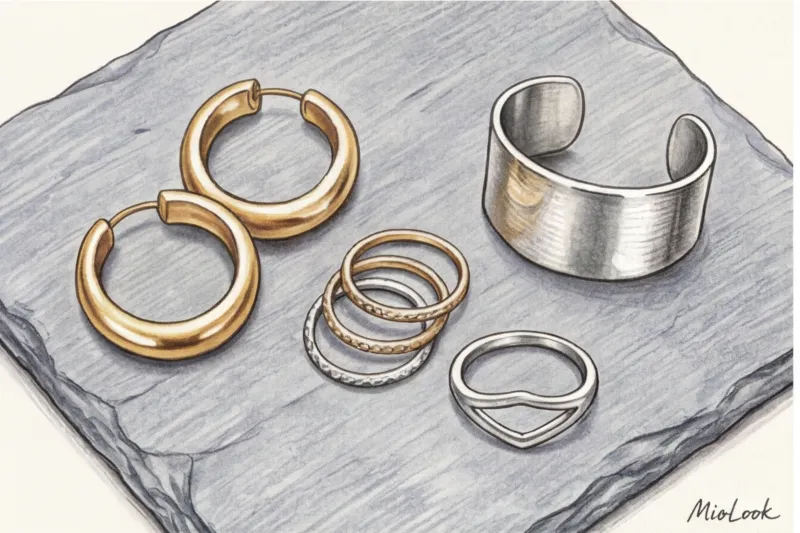
When choosing jewelry in these stores, pay attention to the weight. A high-quality alloy (plated brass) should feel comfortable in your hand, but not lead-heavy.
Your perfect look starts here
Not sure if a chunky bracelet will go with your new jacket? Upload your items to MioLook and create coordinated capsule collections right on your phone.
Get access — €0.99 onceBusting the Myth: Why Thin Rings CAN Be Worn on Full Fingers
Any basic style article will tell you the rule: thick rings for plump hands. But as a practitioner, I'm obliged to challenge this stereotype. A single, thick, 15mm-wide ring on a plump finger can act like a cast, visually making the knuckle appear shorter and thicker.
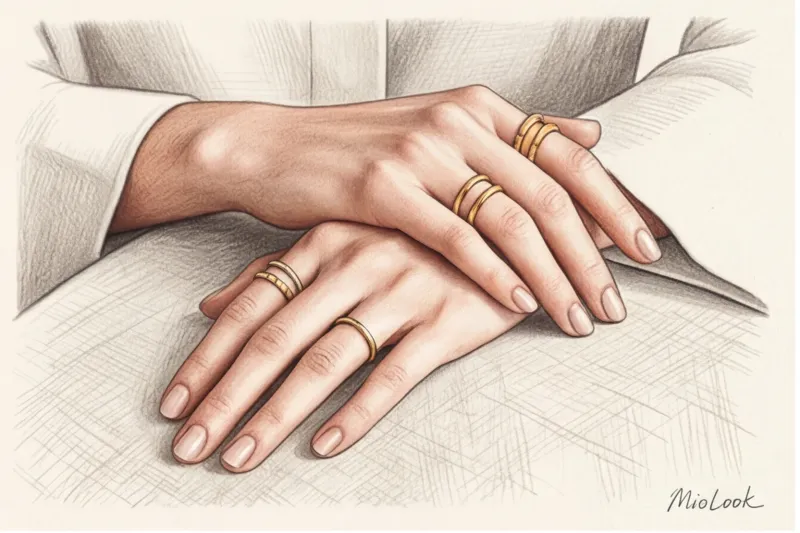
There is a counterintuitive but incredibly effective technique: stacking very thin rings. The idea is to put three or four string-shaped rings (each about 1-1.5 mm thick) on one finger.
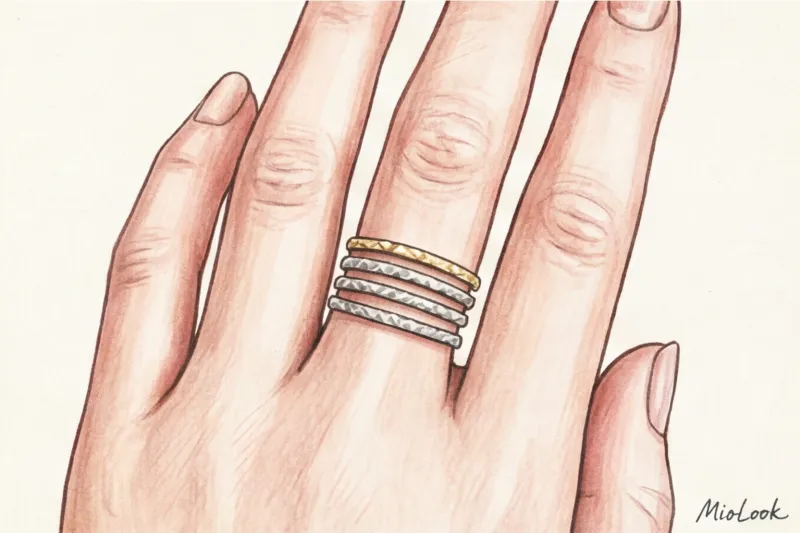
Why does this work? When you wear several thin rings, they inevitably shift as you move. Micro-gaps form between them, revealing skin. The brain perceives the overall width of this composition (it's about the size of a large hand), but the gaps make the design appear light and dynamic. This is the "air" we talked about at the beginning. The main rule is that the rings should have different textures (for example, one smooth, one twisted, one with a fine embossing), but they should fit completely loosely, without digging into the skin.
A Stylist's Checklist: 5 Rules for Trying on Jewelry in a Store
Even knowing all the theoretical rules, it's easy to give in to emotions in the fitting room. To prevent your purchased ring from becoming a dead weight in your jewelry box, use this step-by-step algorithm.
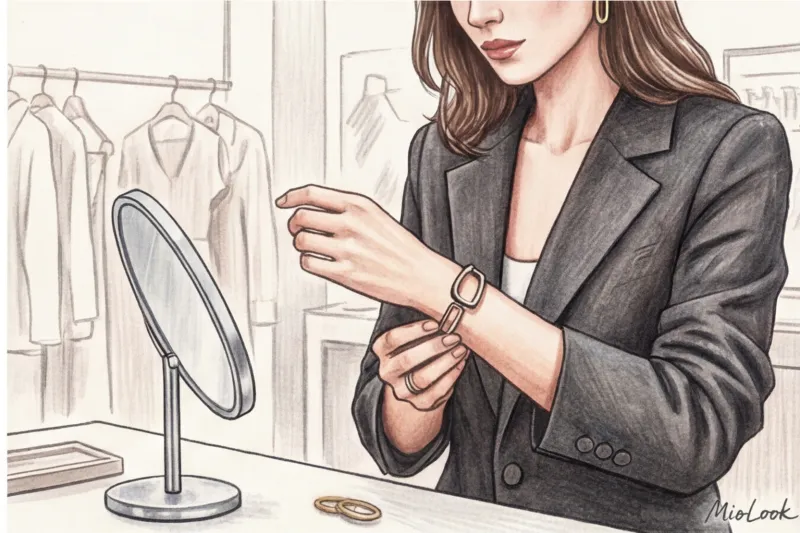
- Consider the time of day: Never buy rigid bracelets and rings early in the morning or after a long walk in the heat. Almost everyone's hands swell in the evening. Try them on a relaxed hand in the middle of the day.
- Fist test: Put the ring on? Now clench your hand into a fist. If the metal digs into the adjacent fingers and there's skin hanging over the ring itself, it's too small. Even if it whistles through the knuckle.
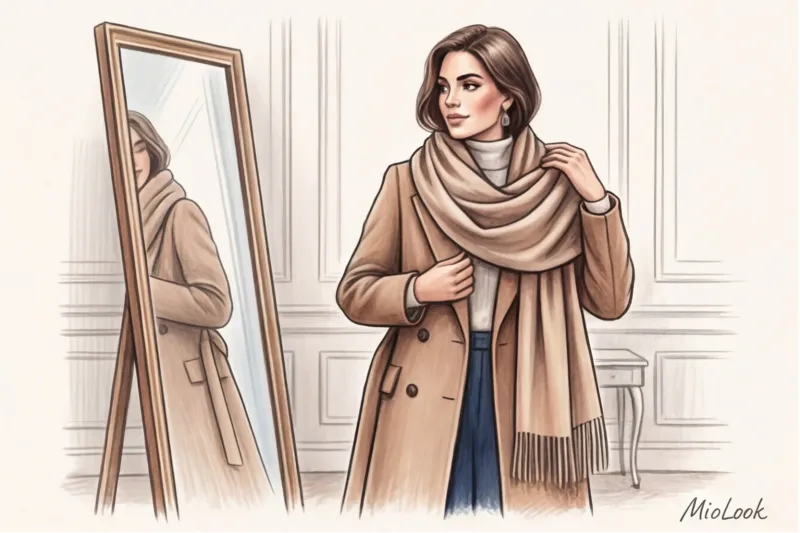
- The one meter rule: Women often examine a ring with their hand right up to their nose. This distorts the scale! Put on the ring, place your hand along your hip, and look at your reflection in a full-length mirror from a distance of 1 meter. Only then will you truly assess its proportions in relation to your body. You can read more about choosing basic pieces based on proportions in the article about basic wardrobe for short women.
- Gravity Check: Put on the bracelet and shake it vigorously. If it's upside down or hits the bracelet painfully, it's not your model.
- Little finger test: The pinky finger of your other hand should fit comfortably between a rigid bracelet or watch and your wrist. If it doesn't, the jewelry will strangle you by the end of the workday.
Jewelry should serve you, not dictate your body. Don't try to squeeze into a standard size just because you like a ring. Embrace asymmetry, play with the textures of European mid-market jewelry, and leave some "air" between the metal and your skin. One well-chosen geometric ring will do more for your hands than a dozen featureless gold bands digging into your fingers.