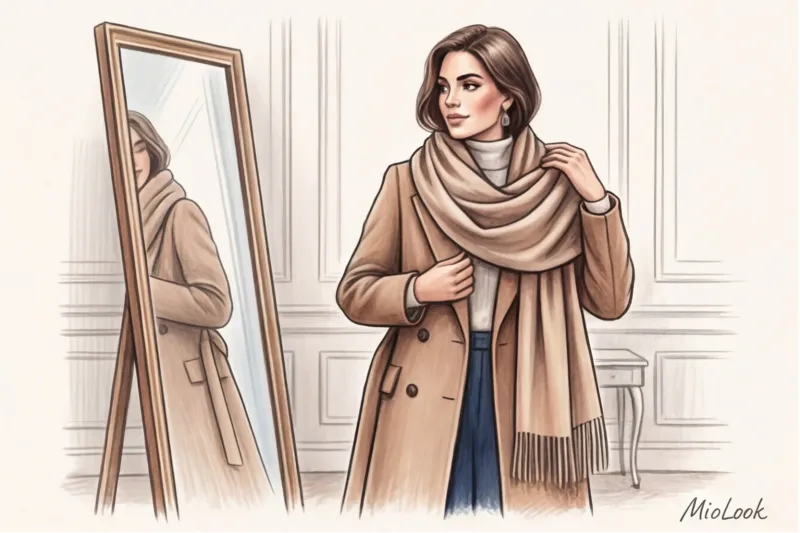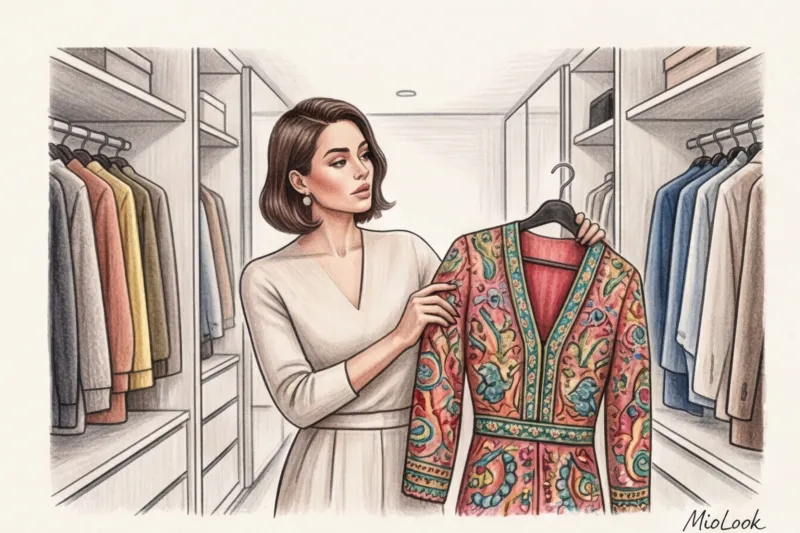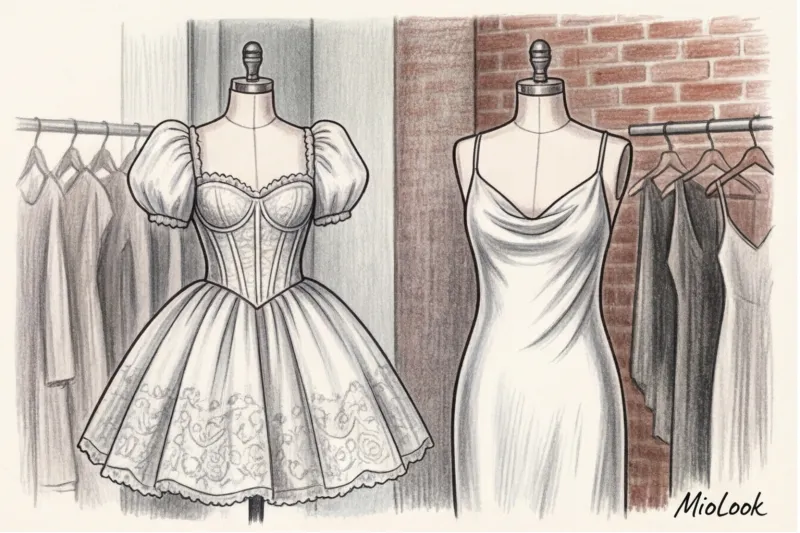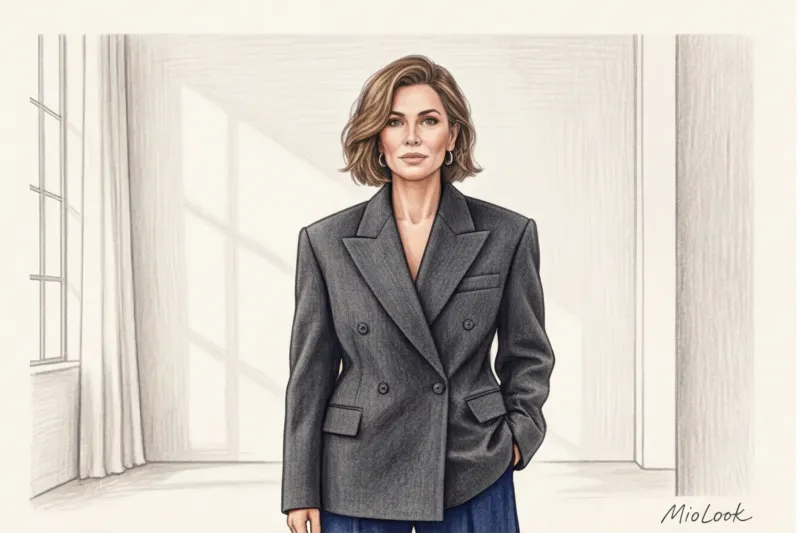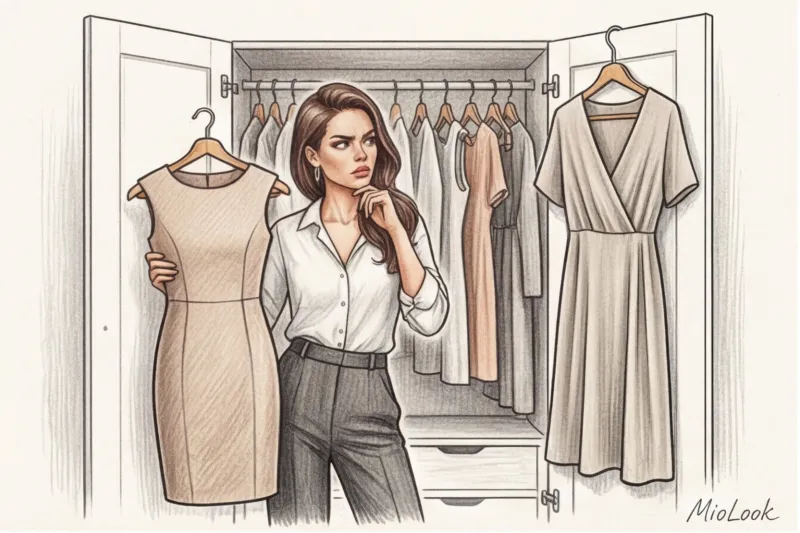
A couple of months ago, Elena, a successful partner at a law firm, came to me for a wardrobe review. Opening the doors of her enormous closet, I saw a perfectly coordinated array of fifteen sheath dresses, all cut to just above the knee. "These are my safe, classic pieces," she said proudly. But the truth was, compared to her colleagues in relaxed, boxy suits, Elena looked like she was stuck in 2014. Her "timeless classics" actually worked against her, depriving her look of status and adding age.
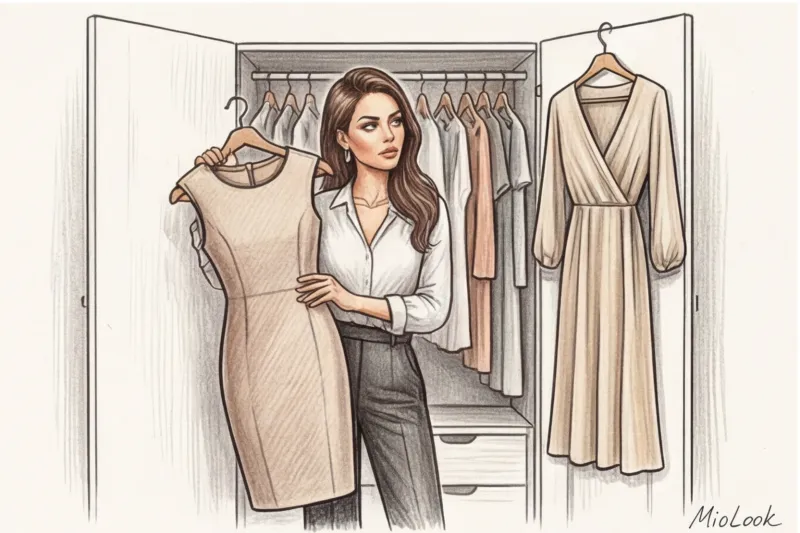
I often hear the same question: What dresses are out of fashion? This season? Most girls expect to hear a list of prints (leopard or florals?) or colors (neon or pastel?). But the secret is that color and print are secondary. It's not the shade that becomes outdated, but the architecture of the silhouette: the cut lines, darts, fit, and length, which distort the body's proportions. We've already discussed the global shifts in silhouettes in more detail in our a complete guide to anti-trends in clothing , and today I propose to dissect dresses and skirts.
Why We Continue to Wear Outdated Clothes: The Psychology of Anti-Trends
According to global analytics agency WGSN, macrotrends for basic silhouettes last from 5 to 7 years in 2024. This means that a wardrobe assembled according to all the rules of style in 2017 is fundamentally outdated today. But why is it so hard for us to part with it?
The answer lies in psychology. We become attached not to a piece of fabric, but to emotions. We bought that same figure-hugging sheath dress when we got our first promotion. We wore that low-waisted skirt on our most romantic date. The item becomes an "anchor of success," and the brain refuses to recognize it as anti-trend. But fashion is merciless to nostalgia.
Silhouette architecture is more important than color these days. A basic black or beige dress can look completely out of fashion if it lacks "air"—space between the body and the fabric. Microtrends (like feather sleeves) come and go within six months, but if a dress is fundamentally outdated in cut, no trendy belt will save it. If you find it difficult to objectively assess your closet, try uploading photos of your items to MioLook — analyzing the database from the outside is very sobering.
Access to MioLook for €0.99 — one-time payment
A smart AI stylist will select the perfect look.
Get access — €0.99 onceLet's sort through our wardrobe: which dresses are out of fashion and irrevocably outdated
Let's get down to specifics. The main design mistake I see in 8 out of 10 new clients is the obsessive desire to accentuate every curve of the body at once. In the 2000s and 2010s, tightness was synonymous with sexiness. Today, a tight silhouette is perceived as stiffness and self-doubt.
The second problem is the "undefined" length. A hemline that ends exactly at the mid-knee (the widest part of the knee) visually "cuts" the leg in half, making the calves appear massive and the height appear squat. But let's look at specific styles.
The myth of the eternal classic: the stiff, knee-length sheath dress
For years, glossy magazines have convinced us that a slim sheath dress is a timeless investment. Discover the Vogue Runway archives and explore the evolution of the classic Dior silhouette over the past 10 years: from the rigid hourglass silhouette of the early 2010s to fluid tailoring, asymmetry, and midi lengths.
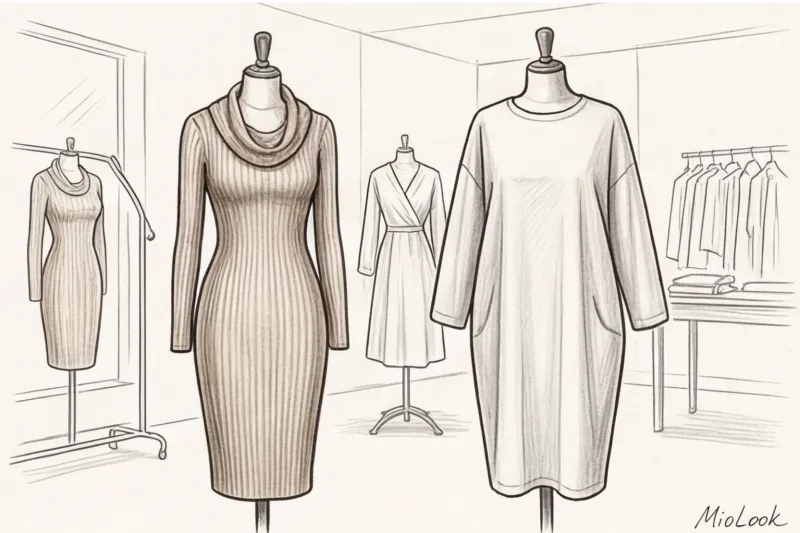
The statistics from international retailers are stark: according to Lyst reports, sales of classic office sheath dresses have fallen by 60% over the past five years. Why? Because today, this style, with its horizontal darts and excessively tight waist, is associated with bank clerk uniforms rather than the image of a modern woman. successful woman.
- What's the problem: The fabric stretches across your hips, bunches up as you walk, and forces you to constantly tug at the hem.
- Modern alternative: Straight-cut dresses that don't restrict your steps, or A-line dresses in midi and maxi lengths made of suiting wool.
Thin knitwear with a flimsy collar
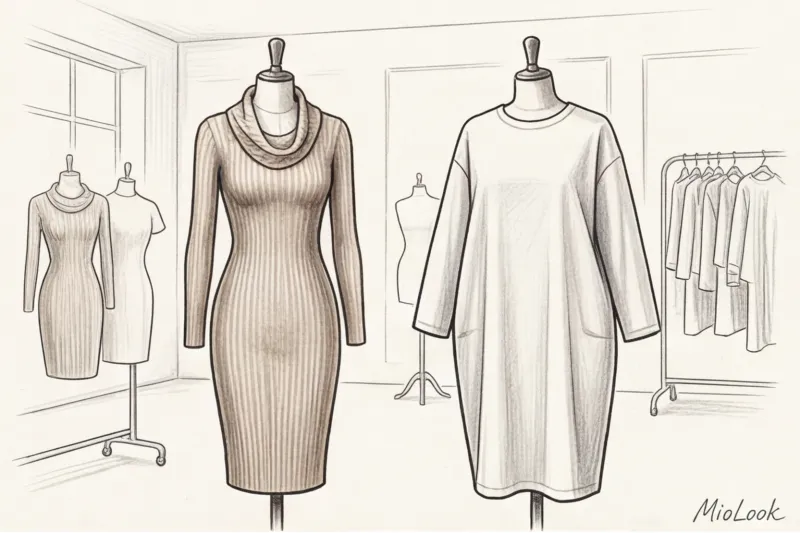
Nothing cheapens an outfit like thin ribbed viscose knitwear that hugs the body like a second skin, highlighting even those nuances of the figure that you yourself weren't aware of (for example, the contours of your underwear or the slightest puffiness).
"The lack of air between the body and the garment is the main marker of an outdated wardrobe. A modern garment should drape, not be taut like a drum."
Forget about flimsy 150 g/m² fabric with a soft, shapeless turtleneck. If you love knitted textures, look for dense cotton (300 g/m² and above), merino wool, or blended fabrics that hold their shape regardless of your curves. An oversized sweater dress or a thick A-line knit dress are the perfect replacement.
Skater dresses and doll-like infantilism
A cut-off waist and a full, short, pleated skirt. In 2012, we wore them with ballet flats. In 2025, this style looks ridiculous on a grown woman—it's pure, doll-like infantilism, at odds with the modern aesthetic of awareness and strength.
The evolution of femininity has taken a sharp turn. We've moved away from the desire to appear "cute girls" to confident elegance. If you want to accentuate your waist and maintain a flowing silhouette, choose architectural wrap dresses in thick silk or viscose, or long ones. shirt dresses They look noble and suit almost any body type.
Access to MioLook for €0.99 — one-time payment
Start creating perfect images with the help of artificial intelligence
Get access — €0.99 onceSkirt anti-trends: length, fit, and decor from the past decade
Skirt geometry has undergone dramatic changes. If you look at street style photos from Paris or Milan, you'll notice the complete dominance of maxi and confident midi lengths over knee-length skirts. This is due to the fundamental rule of styling—the "golden ratio."
According to the rule of proportion, the ideal silhouette is divided into 1/3 (top) and 2/3 (bottom). Outdated skirt styles that sit on the hips and end at the knee divide the figure 1:1, visually shortening the legs and making the torso appear unnaturally long.
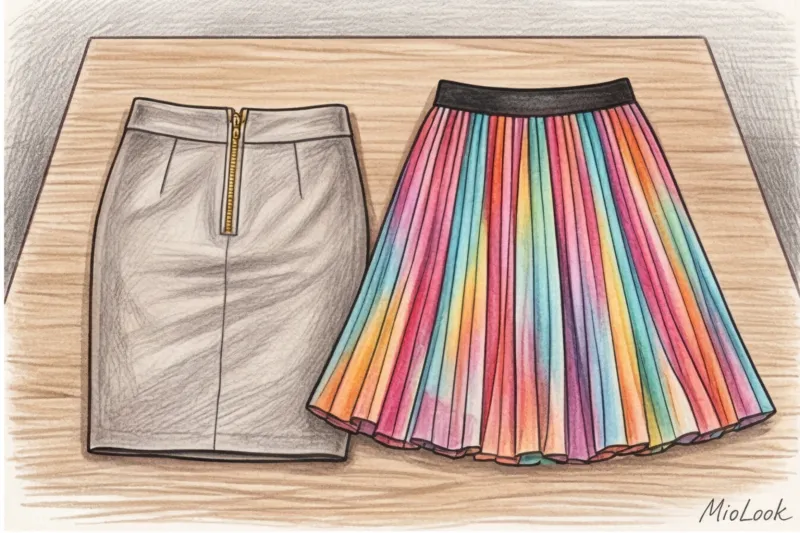
Low-waist pencil skirt made of thin fabric
The low waist has made a comeback thanks to Y2K style (wide-leg jeans and cargo pants), but paired with a skinny pencil skirt, it's the worst possible architectural choice. The thin, elastane-infused fabric bunches treacherously at the crotch, and the back vent falls apart due to improper tension, revealing the lining.
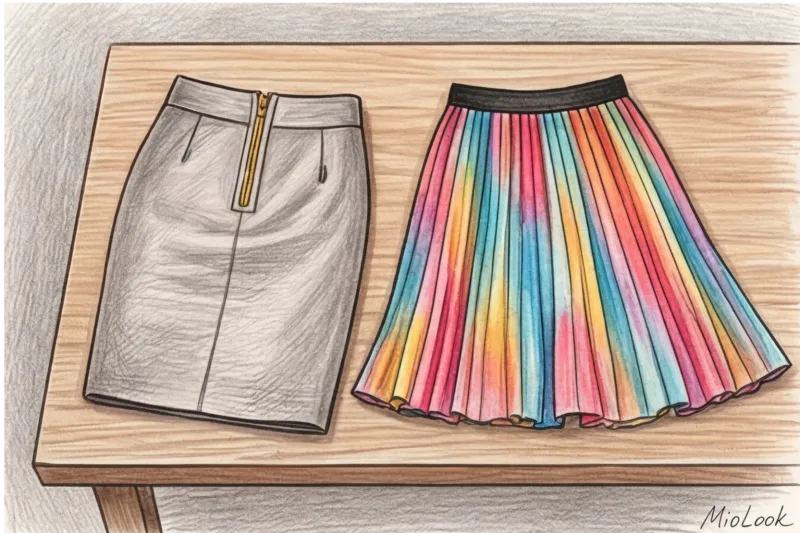
The right pencil skirt today is a high or mid-rise, below-the-knee length (midi), and a fabric that can be described as "stand-up": thick suit wool, high-quality faux leather, or denim. You can even wear such a skirt to an office with a strict dress code, adding bright accent in the form of a shirt.
Pleating on open black elastic
Remember that pleated midi skirt craze of 2016? They quickly went from being a beautiful trend to a mass-market cliché. The most obvious sign of cheapness and outdated style in such a skirt is the exposed elastic waistband, often in black with lurex.
This detail instantly negates any attempt at an expensive look, as it betrays the manufacturer's lazy cut. A modern take on pleats is an asymmetrical hem, large, wide pleats, a hidden belt, or leather options. The skirt should fasten with a zipper and button, not be pulled tight at the waist like sweatpants.
Your perfect look starts here
Join thousands of users who look flawless every day with MioLook.
Get access — €0.99 onceTelltale Details: What Instantly Gives A Thing Away
Over 12 years of working as a stylist, I've developed a professional reflex: I can scan a rail in a store in two seconds. I don't need to take the entire item out to know it's anti-trend—just look at the hardware. Here's a list of details that scream a design is stuck in the past:
- Exposed metal zippers at the back: In 2012, brands (from Zara to the premium segment) sewed massive gold zippers all over the back as a decorative touch. Today, hardware should be hidden or functionally justified.
- Inserts made of cheap guipure and mesh: Especially in the décolleté or on the sleeves. It looks untidy rather than seductive.
- Short cap sleeves: They visually broaden the shoulders and emphasize the volume of the arms. Modern short sleeves should be loose, straight, and reach mid-shoulder.
- Fabric belts to match the dress: Those thin strings made from fabric scraps that come with your dress. Throw them away immediately and replace them with a proper leather belt.
- Small floral print on a dark background: Especially on thin synthetics, it creates a "granny robe" effect. Choose abstract geometric patterns or deep, solid colors.
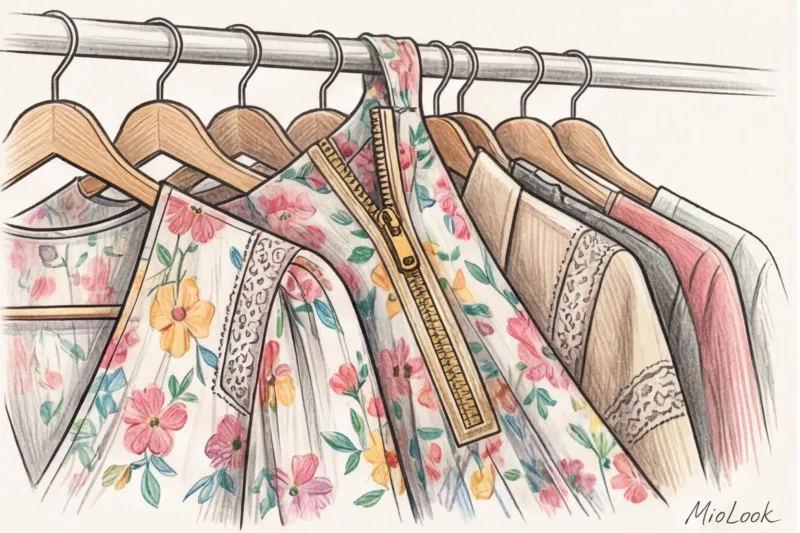
Can the Anti-Trend Be Saved? Styling Tips
Sometimes clients ask, "Camilla, I love the color of this old dress so much, can it be saved?" My answer: sometimes yes, but you have to know your limits. If you want to integrate an outdated piece into a modern wardrobe, you'll have to work with contrasts and go eclectic.
A great trick is to hide an outdated, skinny silhouette with hyper-volume. Put on that same form-fitting sheath dress, throw on an oversized men's jacket made of thick wool, and put on some chunky boots with tractor soles. The result is a great look that fits in perfectly with grunge style.
To find fresh combinations with what's already hanging in your closet, I highly recommend using the "smart wardrobe" feature in MioLook app The program helps you create outfits from your real items, combining volumes just like a stylist would.
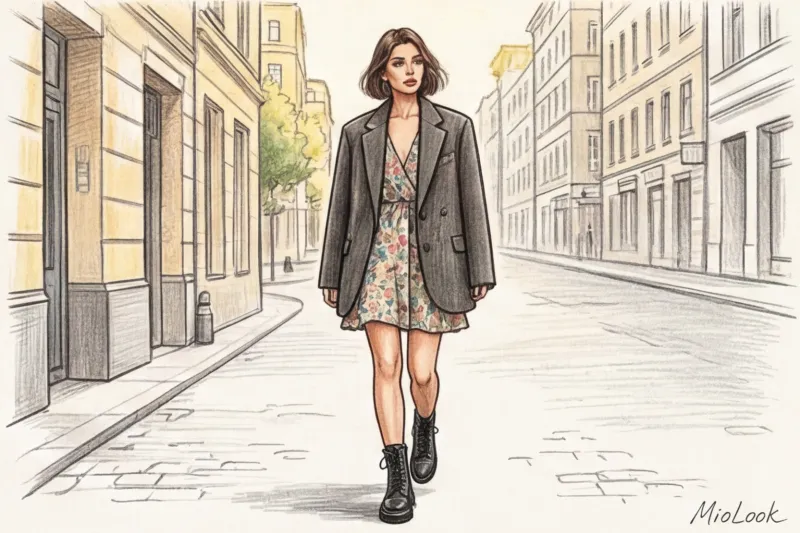
But I'll be honest: this technique doesn't always work. What you should absolutely not do: Trying to salvage a dress whose architecture is irreparably damaged is pointless. If the garment has a high waistline, lace inserts, and short sleeves, no man's jacket will save it. The economics of upcycling (altering) are also useless here: having a good seamstress alter the darts and armholes will cost more than buying a modern dress from a mass-market store. Such garments simply need to be let go.
Checklist: How to check if a dress or skirt is still relevant
To avoid making shopping mistakes and conduct a proper inventory of your existing items, use this simple three-point checklist:
- Air test: Put the item on. Can you pull the fabric away from your stomach or hips at least a couple of centimeters? If the dress fits like a wetsuit, it's not a trend.
- Proportion test: Look in a full-length mirror. Where does the hem end? The hemline should always run along the narrowest part of the leg (ankle, below the knee, mid-thigh). If the hem cuts into the calf at its widest point, the silhouette is off.
- Hardware test: Pull the zipper. Is it functional? If there are too many decorative buttons, shiny zippers, and odd ties, the garment looks cheap.
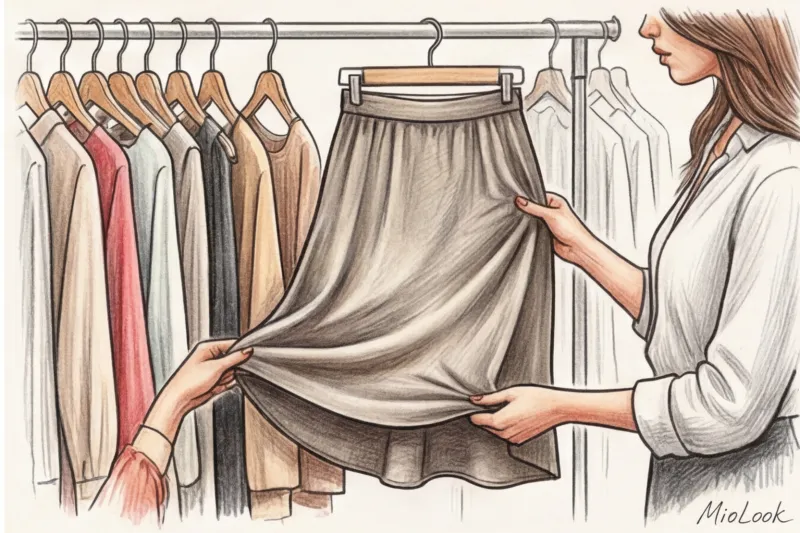
Conscious consumption doesn't start with buying eco-friendly collections, but with choosing the right silhouette that will last for years to come. Forgo momentary embellishments in favor of clean lines and sturdy fabrics. Remember: your clothes should work for you, emphasizing your status and confidence, not make you tug at your hems and suck in your stomach every minute.