About three years ago, Marina, a partner at a major law firm, came to me for a consultation. She was brilliantly prepared for complex merger negotiations, wearing an impeccable Jil Sander suit, but one detail nearly derailed the deal. Every time she gestured, her multilayered charm bracelet rang like bells. Twenty minutes later, her partners were looking not at their charts but at her wrist, irritatedly awaiting the next "ding." This incident perfectly illustrates the cardinal rule: office jewelry and dress code — it’s not about beauty, but about managing the interlocutor’s attention.
In 14 years of working as a personal stylist for top executives, I've learned one thing: in the corporate world, accessories speak for you before you even open your mouth. I wrote more about how details shape perception in our a complete guide to current accessory trends Today, we'll explore how to transform your jewelry wardrobe into a tool for nonverbal influence, why matching sets convey insecurity, and how to mix metals to create a luxurious look.
Status Architecture: How Office Jewelry and Dress Code Work Together
In the era of corpcore and total minimalism in clothing, jewelry remains practically the only legitimate way to express individuality. If you're wearing a standard gray or navy blue suit, it's the shape of your earrings or the texture of your watch that communicates your refinement and status.
Study Journal of Nonverbal Behavior (2023) confirmed an interesting pattern: interlocutors subconsciously associate geometrically clear, minimalist jewelry with the owner's composure, punctuality, and analytical mindset. Conversely, an abundance of small, dangling, or childish details (flowers, butterflies, hearts) reduces professional trust.
"Quiet luxury in the office is when your jewelry isn't recognizable by a flashy logo, but its weight, matte shine, and architectural form make people take you seriously"—that's the mantra I repeat to my executive clients when we're working to break free from brand obsession.
Access to MioLook for €0.99 — one-time payment
A smart AI stylist will select the perfect business look based on your dress code and jewelry collection.
Get access — €0.99 onceBusiness Style Mathematics: The 13-Point Rule
If you're unsure whether you're wearing too much, use math. In conservative business circles, there's the so-called "13-point rule." The idea is that each visible element of your outfit has its own "weight," and the total shouldn't exceed 13.
Here's how I calculate this formula during personal consultations:
- Two-piece suit – 2 points (jacket + trousers/skirt)
- Blouse or shirt - 1 point
- Shoes - 2 points
- Tights - 1 point
- Watch - 2 points
- Glasses for vision - 2 points
- Each piece of jewelry (one ring, a pair of stud earrings, a simple pendant) — 1 point
If you're wearing a suit with a blouse (3), shoes and tights (3), glasses (2), and a watch (2), you already have 10 points. That leaves exactly 3 points for jewelry. That means stud earrings, a wedding ring, and one accent ring. That's it. Any additional brooch or bracelet will overwhelm the look.
To be fair, this formula doesn't work if you work for a creative agency or IT company with a casual dress code—layers and a touch of casualness are prized there. But for banking, consulting, and the courtroom, it's a given. Coco Chanel's famous rule "take off what you put on last" takes on a completely mathematical meaning in the office.
Hands and gestures zone: rings, watches and bracelets
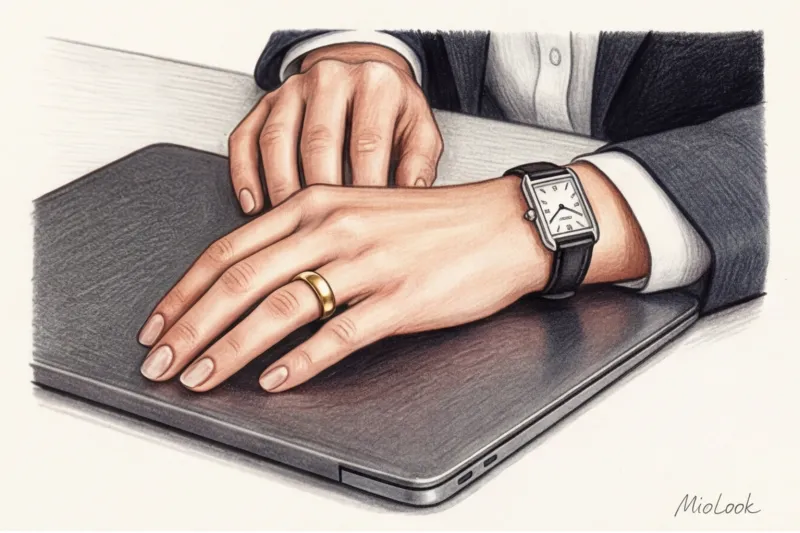
During negotiations, presentations, and document signings, your hands are always the center of attention. They're the most telling part of your business attire.
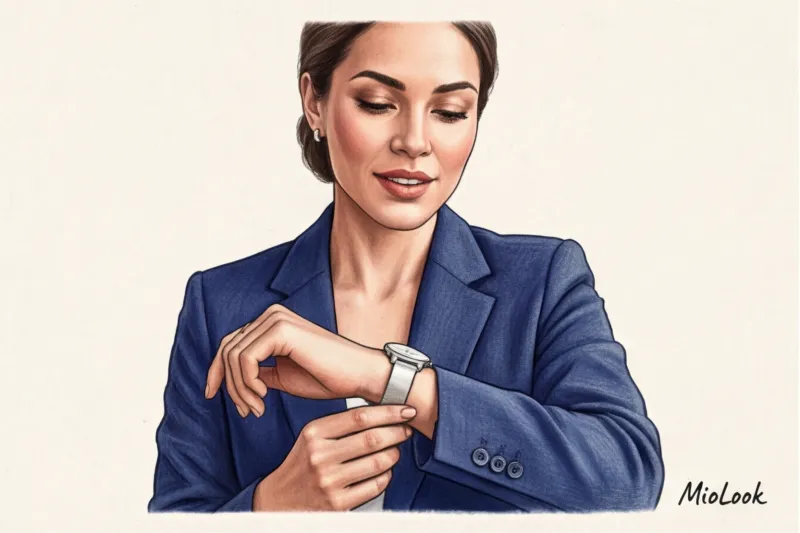
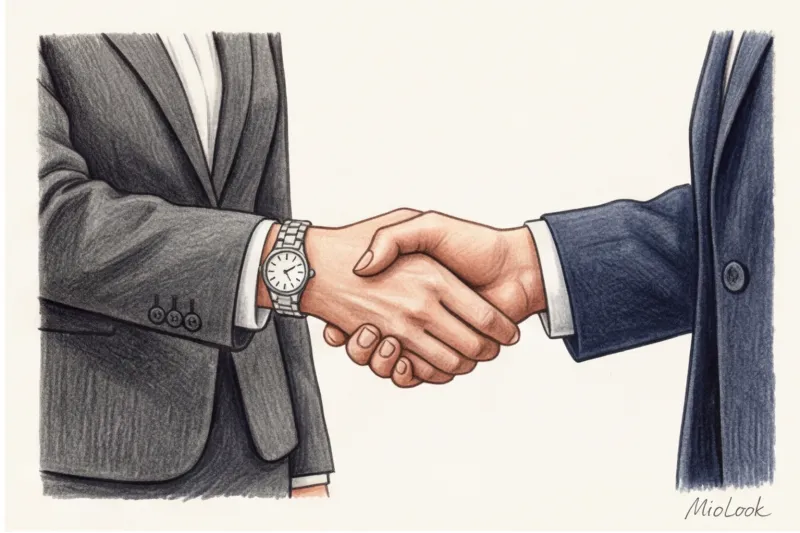
Let's be honest: a smartwatch with a neon silicone strap ruins the aesthetics of a €500 wool jacket. If you can't give up step tracking and notifications, invest in a metal bracelet (Milanese weave) or a high-quality leather strap for your Apple Watch or Garmin. However, nothing can replace a classic mechanical or high-quality quartz watch with hands—they are the ultimate status symbol.
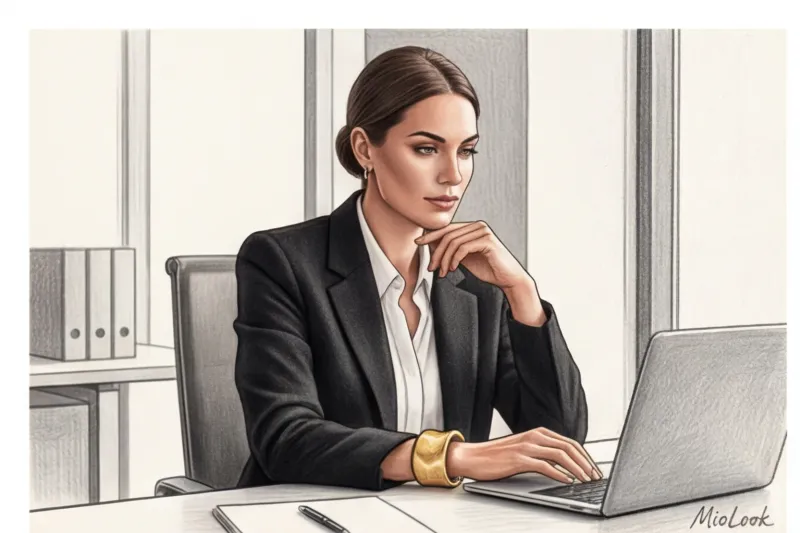
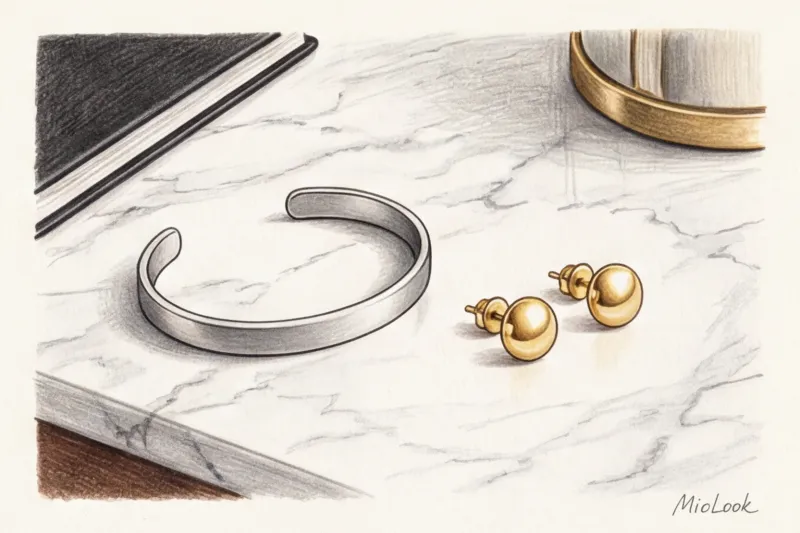
Regarding rings: besides the wedding ring, protocol allows no more than one accent ring on each hand. Choose architectural shapes without a scattering of stones (signet rings, smooth spheres, wide, minimalist headbands). As for bracelets, as we recall from Marina's story, it's best to avoid them altogether, or opt for a single, rigid cuff that fits snugly on the wrist and doesn't make a sound when placed on the table.
The Secret to the Perfect Business Formal Watch
The dial of a women's business watch should be simple, with a diameter of 28 to 34 mm. Avoid mother-of-pearl accents and rhinestones instead of numerals. Black, white, graphite, or deep blue dials look the most elegant.
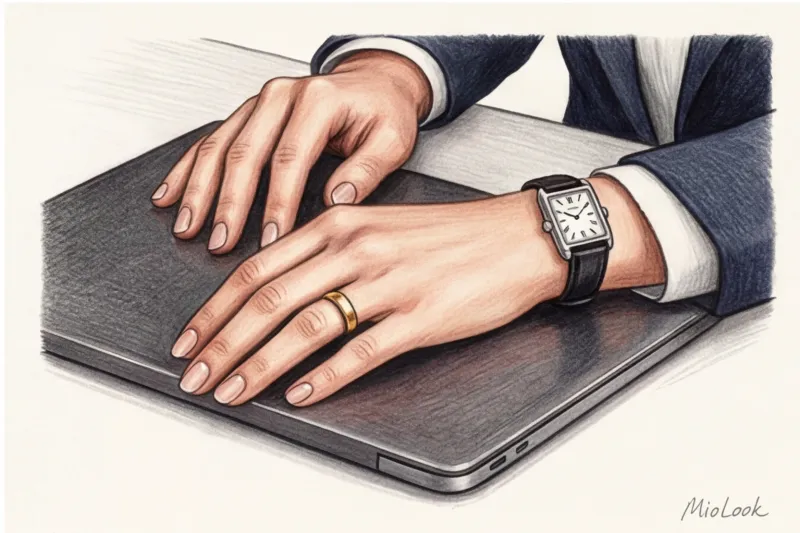
Just because your watch case is steel doesn't mean you have to wear only silver. Modern styling easily integrates a bicolor watch (steel and yellow or rose gold) as a link between the different metals of your jewelry collection.
Your perfect wardrobe starts here.
Digitize your accessories and clothing. MioLook will show you which items enhance your status and which ones are time to ditch.
Get access — €0.99 oncePortrait Zone (Zoom Effect): Earrings and Necklaces
According to McKinsey analytics (2024), more than 40% of corporate employees continue to work in a hybrid format. This means that half the time, colleagues only see your headshot. In a video conference, earrings and pendants take on all the style weight.
Pearls have undergone a tremendous evolution. Perfectly round beads on a strand, reminiscent of the 1950s, often seem older today. Instead, opt for irregularly shaped baroque pearls (a single accent pearl on a simple chain) or modern studs with geometrically framed pearls.
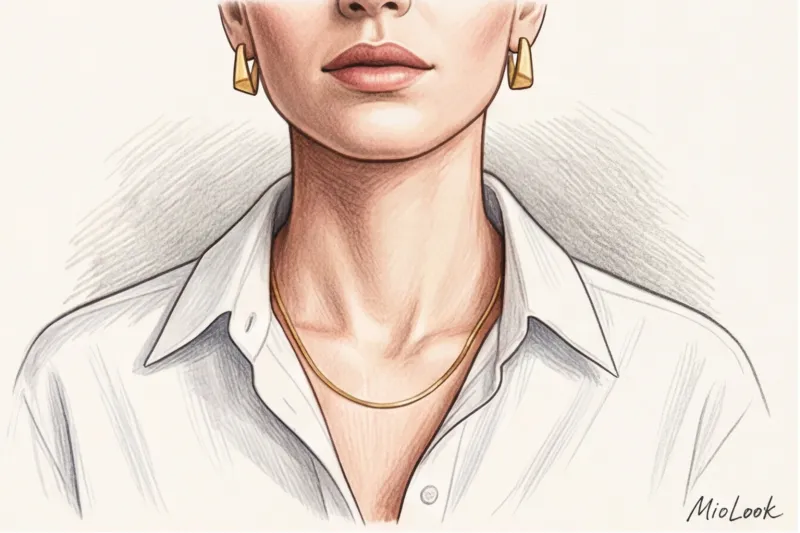
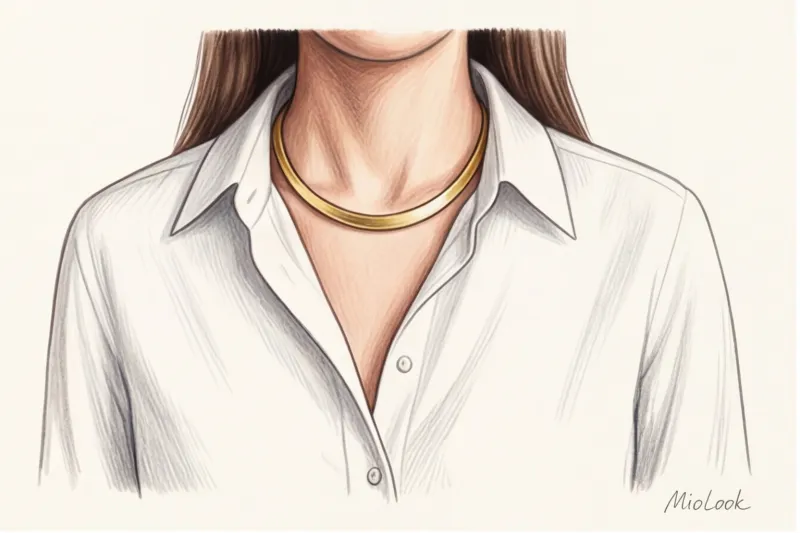
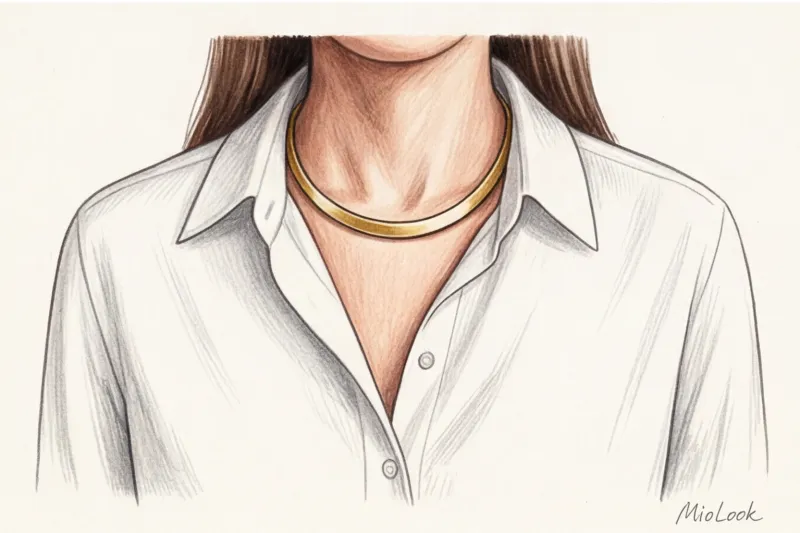
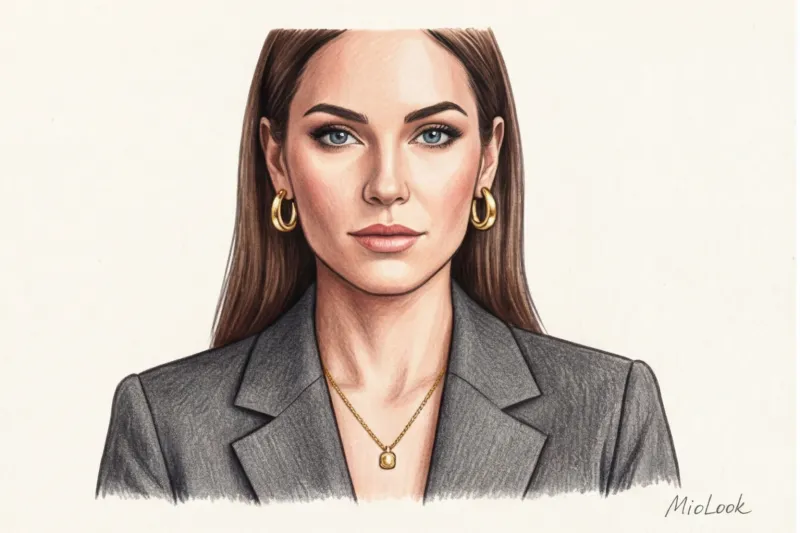
My absolute favorite for the office are huggie earrings. These are small, wide hoops that hug the earlobe tightly. Unlike long pendants, they don't swing when you move your head and won't distract your conversation partner from your words. If you wear a necklace, be careful about the length: it should either end right at your collarbone (in the neckline of a shirt unbuttoned two buttons) or rest over the top of a turtleneck. A pendant constantly "hiding" in the cleavage creates unnecessary fuss.
Busting the myths: what's actually OUTDATE about a strict dress code
Do you know what betrays an outdated approach to style the quickest? Jewelry. When a woman wears a ring, earrings, and pendant from the same set with the same design, the look instantly becomes stiff and "protocol-like" in the worst sense of the word. Modern luxury requires a curated approach—jewelry should look like it was collected gradually, not bought in bulk from a single store.
Another myth from the 90s is the ban on mixing gold and silver. Today, this rule has been lifted. However, balance is essential. I recommend that clients use the 80/20 formula. Choose a dominant metal (for example, 80% yellow gold: a watch with gold accents, earrings, and a ring) and add 20% accent (one sleek silver ring in an interesting shape). This creates intrigue.
And finally, diamonds. For a long time, wearing them before 5:00 PM was considered bad form. But the authoritative Debrett's etiquette institute, in its updated rules, stated that small solitaire diamonds in stud earrings or a thin "track" on an engagement ring are perfectly appropriate during the day. The main rule is that the stone should not dazzle the listener with glare.
Ready to update your business style?
Upload photos of your items to MioLook, and artificial intelligence will assemble them into stylish office capsules.
Try MioLookJewelry Box Investments: Costume Jewelry vs. Fine Jewelry
Do you need to spend a fortune on office jewelry? No. High-quality fashion jewelry has long been a staple in the business wardrobe. Brands like COS or Massimo Dutti produce beautiful, minimalist brass pieces that look more expensive than their price tag.
But there is a clear distinction between where savings can be made and where investment is needed:
- A base that is in contact with the skin 24/7 (studs, watches, basic rings) – requires investment. Budget-friendly options are out of the question here. A fine stainless steel watch will cost €300–€800, while basic earrings made of rhodium-plated silver or gold will cost between €150 and €400.
- Accent seasonal shapes (large cuffs, complex chains) - here you can get by with a high-quality alloy in the range of 50-100 €.
Pay attention to the texture. Glossy, mirror-polished metal is more likely to pick up micro-scratches from your desk and laptop. Matte, brushed (scratched), or dented gold or silver looks more refined from day one and ages beautifully without losing its luster.
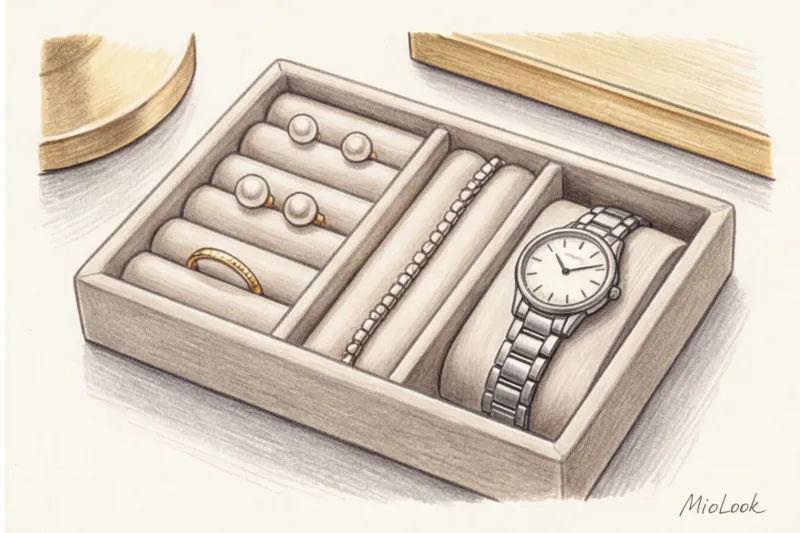
Checklist: A Basic Jewelry Capsule for the Business Lady
Instead of spending 15 minutes every morning choosing the perfect earrings, put together a mini capsule collection whose pieces coordinate perfectly and complement 100% of your outfits. Here are 5 items that will cover all the needs of a strict dress code:
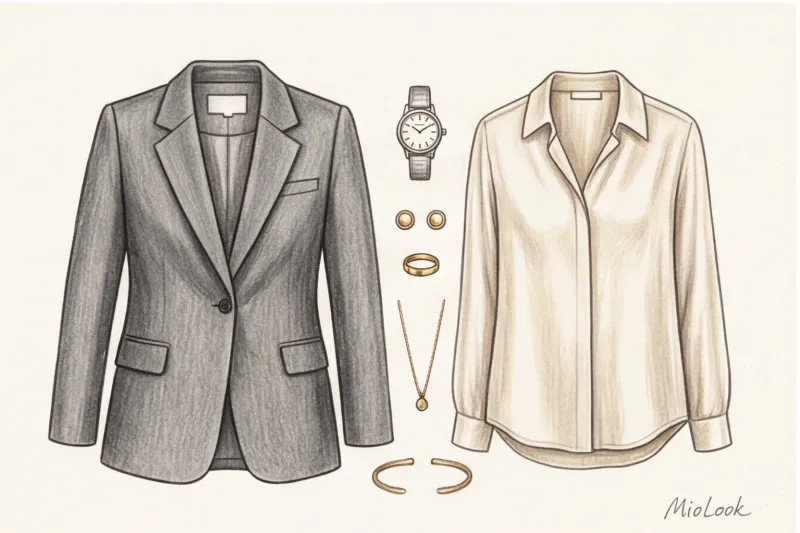
- Watches on a leather or steel strap (dial without unnecessary details).
- Stud earrings or hugh earrings (diameter no more than 1.5 cm, made of smooth metal).
- Accent signet ring or smooth sphere (worn on the index or middle finger).
- Thin chain with micro geometric pendant (length 40-45 cm, so as not to intersect with the edge of the clothing).
- Smooth rigid cuff bracelet (Wear on days when there is no active keyboard work or complex negotiations).
The right office jewelry isn't just decoration. It's your business armor. It should speak volumes about your taste right up until the moment you start talking business. Save the loud charms and frivolous pendants for the weekend, and on Monday, arm yourself with architectural minimalism.