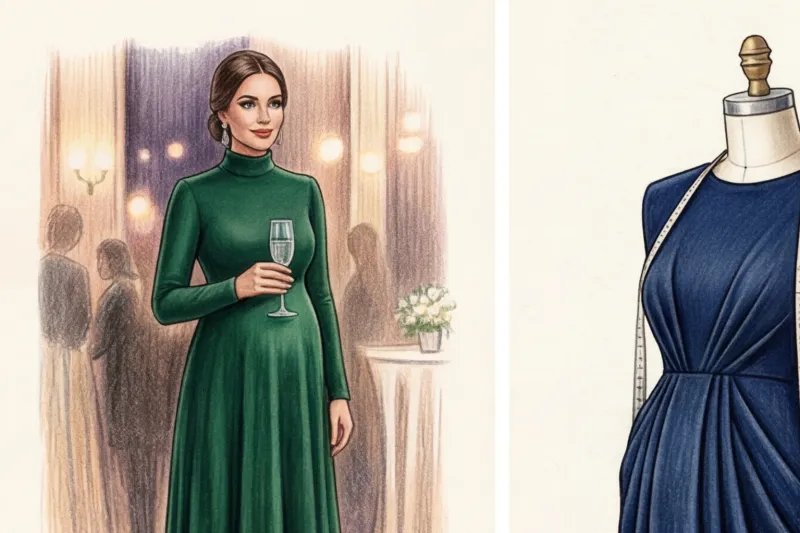
Pregnant clients often approach me with the same request: "Darina, I need a dress for an important event, but I don't want to look like a marshmallow." One of the most telling stories happened to Elena, a partner at a large law firm. Seven months pregnant, she was about to receive a professional award. She brought three typical options to the fitting room: a tight ribbed knit, a shapeless flowy dress, and a classic gathered dress. I ruthlessly rejected all three.
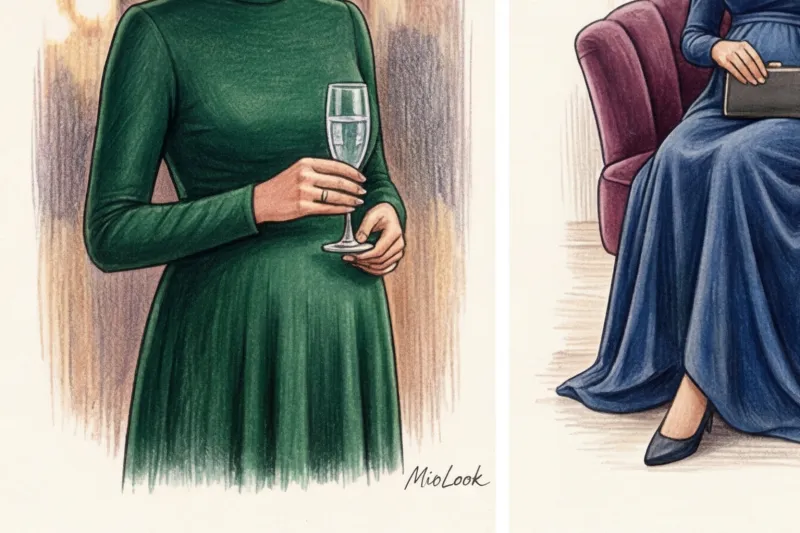
Instead of trying to "hide" or "cutely highlight" her belly, we chose an architectural column dress in a deep sapphire hue with a capped neckline and accentuated shoulder line. The effect was stunning—this wasn't just a mom-to-be, this was a woman of power and impeccable taste. Properly chosen closed evening dresses for pregnant women — it's a powerful style tool that operates according to the laws of architecture, not just simple drapery. We covered the evolution of this trend in more detail in our complete guide: Evening Dresses: A Symbol of New Luxury.
Let's explore how to apply the aesthetics of "quiet luxury" and the laws of color to create a classy evening look that will make you feel physically comfortable.
Why maternity evening dresses are the new status marker
Attitudes toward evening fashion for expectant mothers have changed dramatically. While ten years ago the market offered either extreme form-fitting or infantile "doll" silhouettes, today, "modest fashion" reigns supreme. According to a McKinsey report (2024), the segment of covered-up clothing has finally transcended religious restrictions and become a global secular wardrobe trend, symbolizing intellectuality and status.
A closed-off style—long sleeves, no cleavage, maxi length—creates mystery and shifts the focus from the body's physiological changes to the woman's personality. Consider the outfits worn by pregnant royals. Their looks are always built on closed, architectural forms. This conveys a calm confidence: you don't need to expose your body to attract attention.
Your perfect look starts here
Join thousands of users who look flawless every day with MioLook. A smart AI stylist will select styles that will highlight your beauty.
Get access — €0.99 onceThe Anatomy of the Perfect High-Length Dress: Cut and Architecture
When we completely cover the body with fabric, the geometry of the silhouette comes to the fore. If we neglect the cut, a closed dress will turn into a sack. The main rule I repeat at every consultation: the more area covered, the clearer the design lines should be.
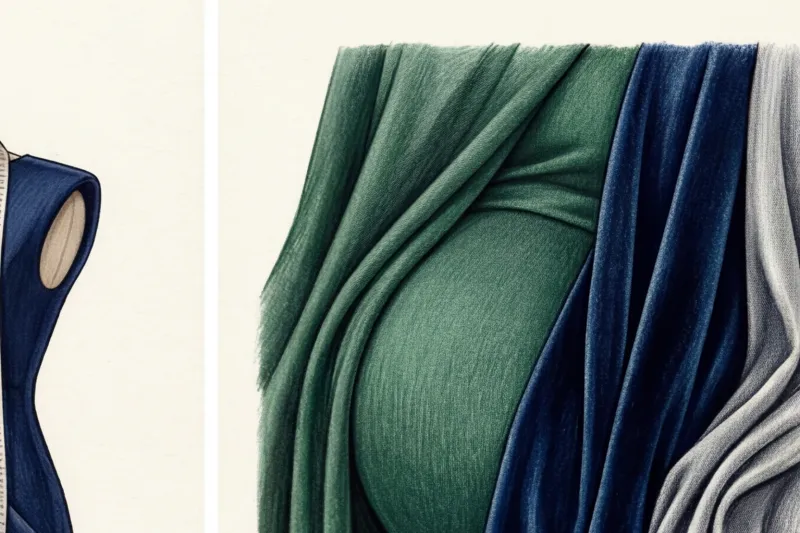
A 2023 study by the WGSN Fashion Institute confirmed what tailors have known for centuries: adding a firm shoulder line (for example, with small shoulder pads) visually balances the increased volume at the waist 30% more effectively than a loose fit alone. By widening the shoulder girdle, we create the correct proportions, preventing the figure from becoming a triangle.
The neckline is crucial for a high-neck dress. A stand-up collar, an elegant boat neck, or a subtle asymmetry draw the eye to the face. A column dress with a straight or slightly tapered silhouette and a back slit for a step will always look more luxurious than a flared A-line, which visually adds extra pounds.
Let's break free from stereotypes: why empire style doesn't always work
The most clichéd choice for pregnant women is a high-waisted dress (empire silhouette). It's believed to conceal the belly. In reality, if you have a full bust (which is natural during pregnancy), the low waistline, combined with a high-necked top and a long skirt, creates a "monument" effect.
"An empire waist without a deep neckline often transforms the figure into a monolithic block. A modern alternative is a semi-fitted cut with thoughtful darts that delicately contours the figure, leaving air between the body and the fabric."
To be fair, I'll point out a caveat: my advice to avoid empire waists doesn't work for petite women (up to 160 cm) with small busts and a very tummy. On them, such dresses can indeed look harmonious.
Fabrics that work for you: comfort without losing polish
Cut is the foundation, but fabric is the façade. The main problem with mass-market clothing is that about 70% of maternity evening dresses under €100 are made of thin polyester. It doesn't hold its shape, highlights even the slightest unevenness in lingerie, and, worst of all, acts like a greenhouse.
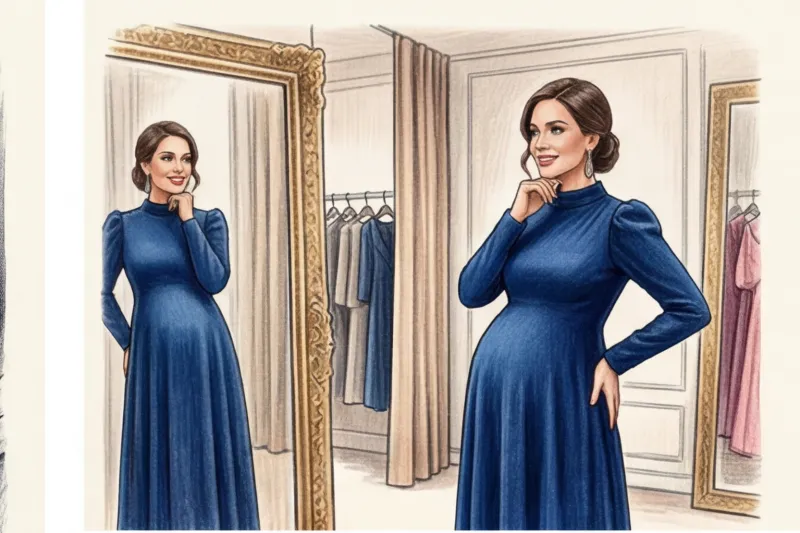
For pregnant women, temperature regulation is a matter of surviving a party. Choose heavyweight silk crepe, matte viscose jersey (at least 250 g/m²), or cold wool suiting with added elastane. These fabrics are sufficiently heavy. A heavy hemline pulls the dress down, creating the perfect balance for your growing belly—the dress drapes gracefully, rather than clinging to your figure.
A smart wardrobe on your smartphone
Upload your items to MioLook, and the algorithms will suggest what to pair your evening dress with for different occasions.
Get access — €0.99 onceColor Palette: How to Control Proportions with Color
As a certified colorist, I love observing how color alters the physical perception of volume. In a high-neck maxi dress, color covers a maximum area, creating that monochromatic vertical line that's the key to visually correcting height and weight.
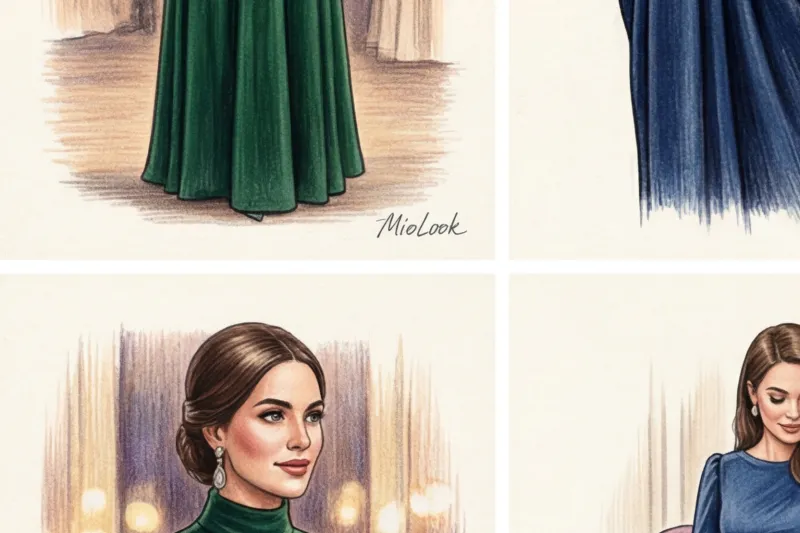
But color is inseparable from texture. The physics of light are unwavering: shiny fabrics (satin, silk, lots of sequins) reflect light and visually increase volume. Matte textures absorb light, creating the illusion of compactness. If you're choosing a high-necked dress, opt for matte fabrics and add sparkle through accessories.
The myth of "slimming black" in maternity evening fashion
Now let's dispel a major stereotype. Most women believe that to look slimmer, you need to wear black. But all-black in a high-neck maxi dress on a curvy figure turns into a real "black hole." The silhouette becomes heavy, monolithic, and gloomy, losing the nuances of the cut.
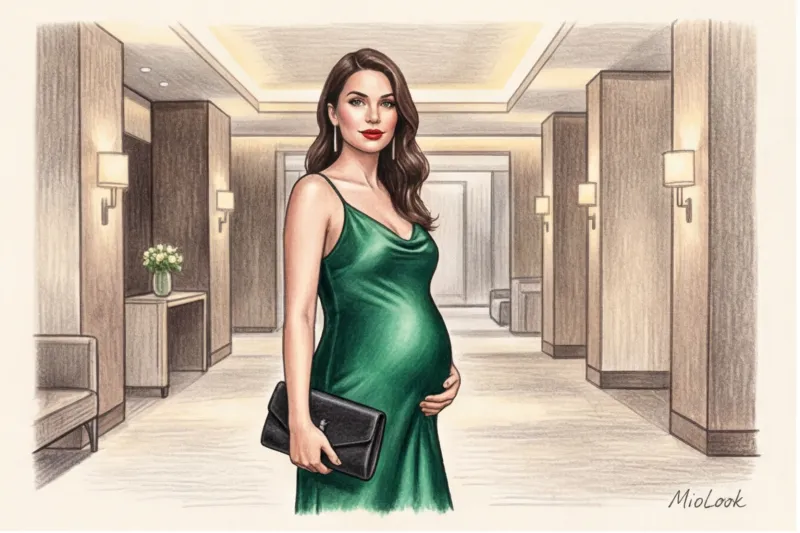
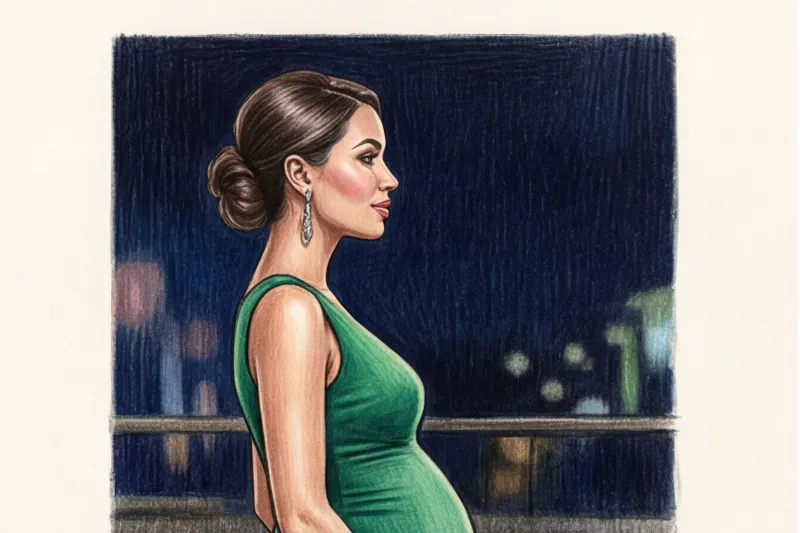
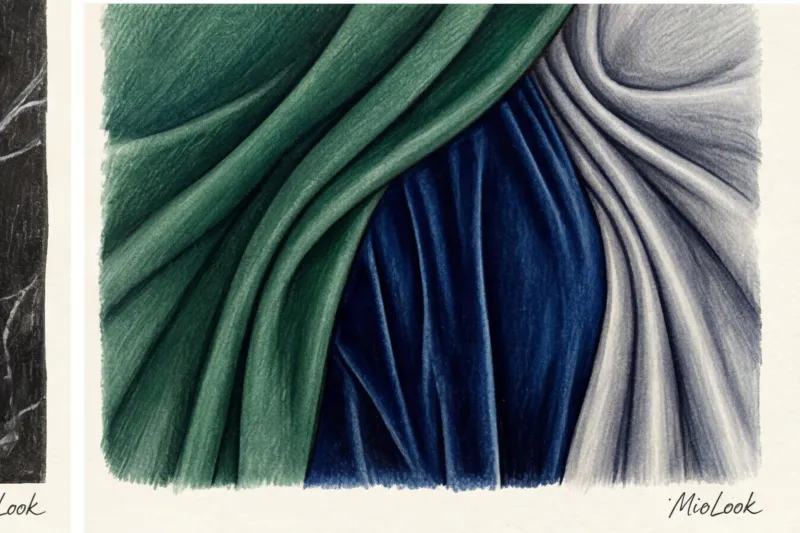
Instead of black, I always recommend deep jewel tones to my clients, which PANTONE experts (2025) call "the new black" for evening wear. Dark emerald, night sapphire, rich marsala, or dark chocolate (depending on your color temperature). They offer the same correcting power as black, but retain depth and subtly illuminate the face.
Checklist: How to Choose and Try on a Long Evening Dress
Experience shows that a dress that looks stunning in the mirror can become a torture device an hour later at the event. Here's my professional fitting checklist, which we run through with every expectant mother:
- Squat and deep breath test. After putting on the dress, be sure to sit on a chair (not a soft ottoman!). Take a deep breath. Is the collar pressing? Is the seam under the bust digging into your midriff? If so, take it off immediately.
- Accounting for the term. If you're shopping for a premium dress a month before your big day (where prices start at €300), factor in your growing belly. Look for styles with hidden side gathers or elastic panels integrated into the seams.
- Revision of the inside. During pregnancy, skin becomes hypersensitive. Check all seams and zippers—they should be covered with a lining. No itchy lurex on the inside.
Completing the look: shoes and accessories for a modest outfit
A full-length dress is a luxurious, blank canvas. It's here that we unwind. status accessories Since the arms, chest, and neck are covered by fabric, we create a focal point in the portrait area: large geometric earrings (gold or pearl) or a chunky bracelet worn directly over a long sleeve (hello, Saint Laurent aesthetic!).
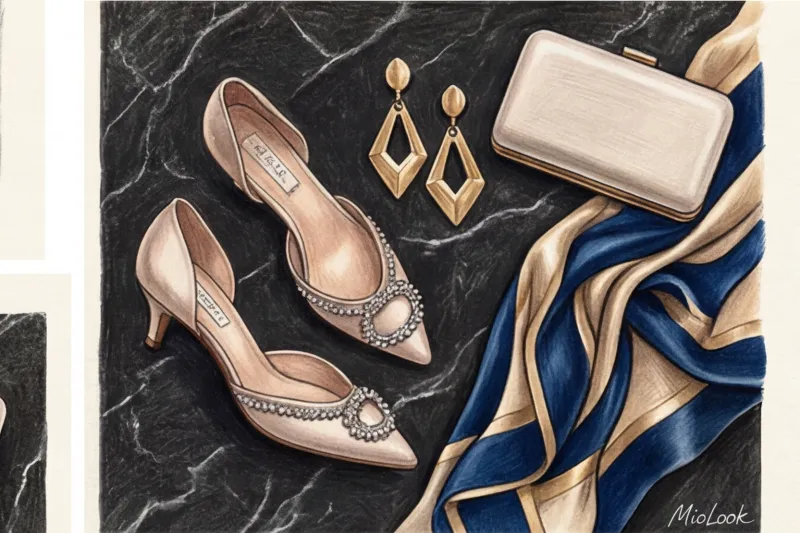
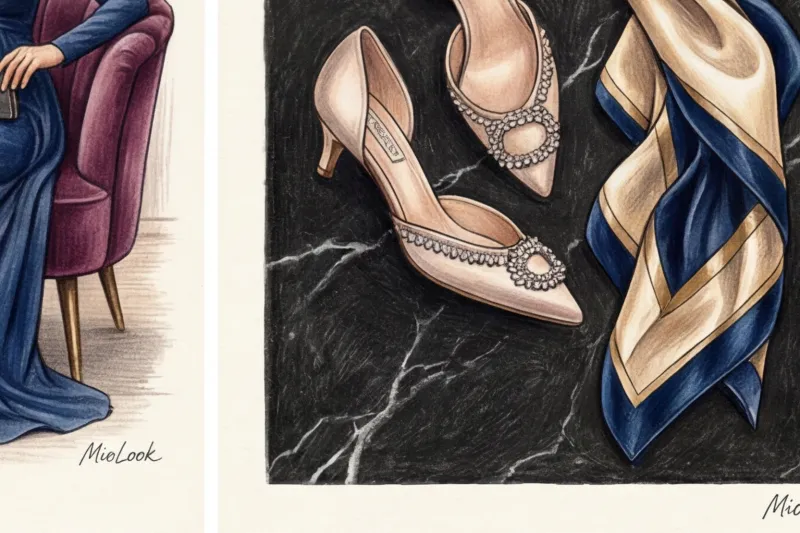
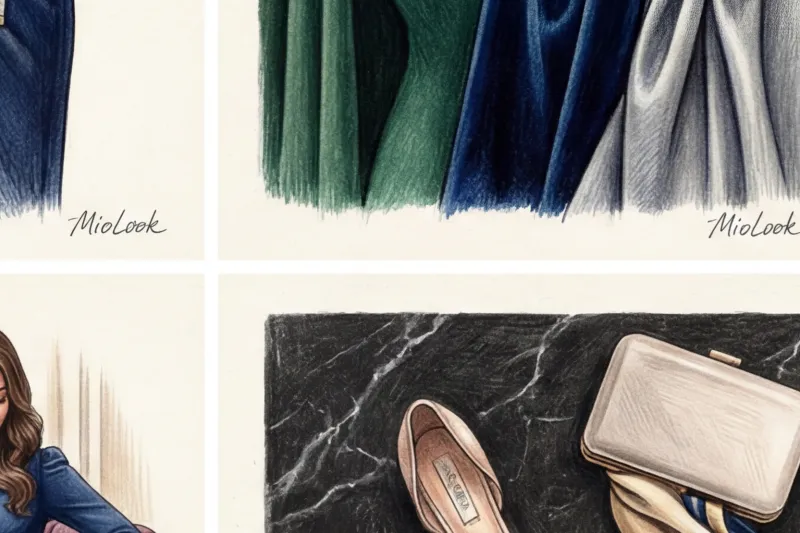
When it comes to footwear, it's simple: take care of your feet. Forget stilettos. Evening dress codes (even Black Tie) today favor elegant flats or micro-heels. Pointed-toe kitten heel mules or elegant velvet flat slingbacks look just as elegant, but will spare you the pain of inevitable swelling.
And the final touch—the bag. The soft lines of a pregnant figure in a flowing dress require a sharp contrast. Choose a minaudière or a framed clutch with a crisp, geometric shape. This small architectural element instantly ties the entire look together.
Forget about the need to smooth things over or hide in robes. Your body is doing a tremendous amount of work right now, and you have every right to occupy space with dignity, style, and maximum comfort.