Modest fashion isn't about restrictions, it's about awareness.
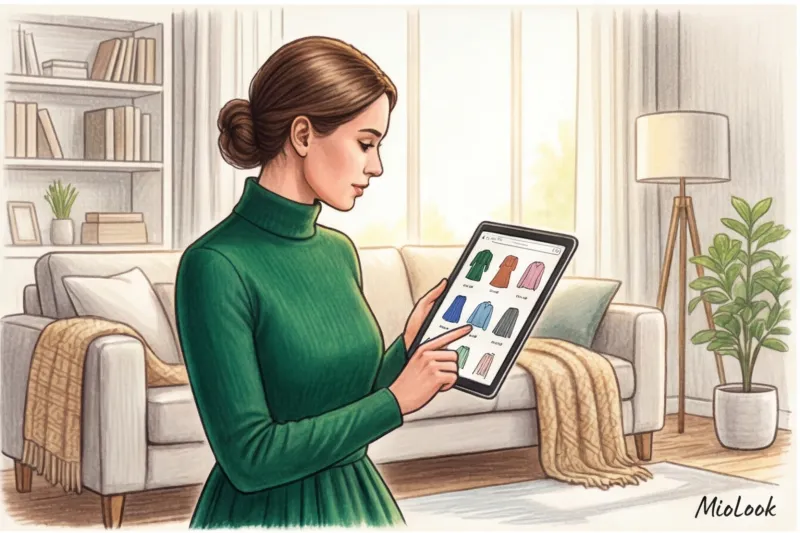
Over the past six months, seven out of ten of my new clients have come to me with the same request: "Katarzyna, help me find stylish but low-profile clothing." When we visit fashion retailers' websites, it often feels like the industry caters exclusively to Zoomers: low-waisted silhouettes, extreme crop tops, and sheer fabrics reminiscent of the 2000s are at the forefront of trends. For women who prefer a more understated style, finding the perfect basic piece can be a grueling quest. It's precisely in this reality that virtual clothing try-on online ceases to be just a fun technological toy and becomes the only way to save nerves, time and budget on returns.

Let's get one important detail out of the way: modest fashion has long since transcended the confines of purely religious precepts. Today, it's, above all, a conscious choice. It's about personal boundaries, physical comfort, privacy, and, of course, adherence to strict corporate dress codes.
According to a major McKinsey report (2024), demand for low-key, understated clothing has grown by 34% among women over 30 working in conservative and academic fields. My clients—lawyers, senior managers, and analysts—choose low-key clothing not because they're prohibited from doing so. They do so to manage their impressions and feel confident.
Consider why items from the premium mass market segment—for example, thick architectural shirts from COS or wool suits from Massimo Dutti—always look so classy. The secret lies in the very approach to constructing these closed-toe garments.
The architecture of modest fashion tolerates no compromise on quality. Without distractions like plunging necklines or miniskirts, impeccable cut and fabric texture take center stage.
A straight-cut midi dress made of thick cotton for €120 will always look much more expensive and elegant than a trendy mini with cutouts for the same price. Cover-ups require a perfect fit, otherwise they'll instantly turn you into a shapeless blob. But herein lies the main pitfall of online shopping. Finding the "right" piece in a sea of naked trends is only half the battle. The other half is understanding how this architectural piece will suit your body shape. And if you often find yourself thinking that you're Don't like your figure in the fitting room? It's not you. — it's all about standard average patterns.
This is where technology comes to the rescue. Intelligent algorithms are forever changing the rules of finding the perfect proportions. We no longer have to order three sizes to choose from and wonder if the armhole will be too loose. Using modern tools like the app MioLook , allows you to preview the silhouette and fit on your exact 3D model. If you're interested in learning more about this process, read the article Virtual clothing try-ons: how to try on clothes online Technology takes care of the routine: it mathematically calculates the balance between a closed style and your individual body shape, eliminating unsuccessful options even before you add them to your cart.
The main pain points of online shopping for a closed wardrobe
According to a global McKinsey report (2024), approximately 70% of online clothing returns are due to disappointing fit expectations, not defects. For those building a modest wardrobe, this figure subjectively approaches 90%. The design requirements for closed-toe clothing tolerate no compromise: one poor dart or an extra half-centimeter of neckline, and the garment loses its functionality.
I regularly see how much money and stress we lose on returns of unsuitable items. A recent example from my practice: a client and I were looking for the perfect, completely opaque white semi-fitted shirt. It seemed like the most basic item in the world! We ordered eight options from well-known European brands, ranging from €50 to €150. The shopping cart included shirts from COS, Arket, Massimo Dutti, and & Other Stories. The result? Seven of them were returned. We spent about €45 on return shipping fees alone (many brands now charge €3-5 for each return), not to mention two weeks of lost time and frozen funds on our card.
Three Main Pitfalls of Online Catalogs
Illusion of length. This is a classic proportional error. Manufacturers tailor catalog samples for tall women. A midi dress that elegantly ends just below the knee on a 180 cm tall studio model becomes something completely awkward on a 160 cm tall woman. The hem falls to the widest part of the calf or hangs above the ankle, visually shortening the height and adding heaviness to the bottom. Worse, the waistline and bust darts also slip along with the length. If you're not prepared to take the item to the tailor immediately after purchase, it's an automatic return.
The insidiousness of necklines and armholes. In professionally lit and retouched shots, clothes always fit perfectly. The model may pose with her arms slightly pressed to her body or half-turned. But in reality, what seemed like a delicate boat neckline reveals collarbones and underwear at the slightest tilt. And overly wide armholes in vests or dresses are a real disaster for a closed wardrobe. You raise your arm, and the side of your bra becomes public knowledge.
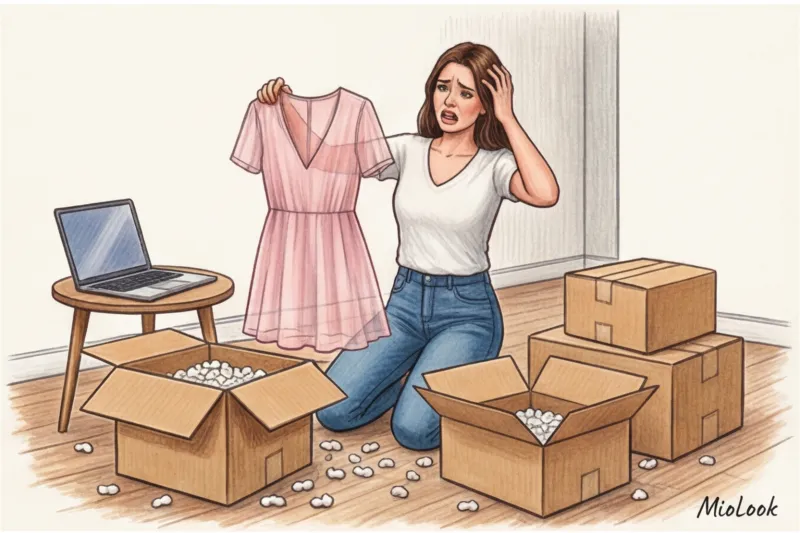
The problem of "transparency". Sound familiar? You order a simple dress. In the photo, it looks like a thick, structured material. But thin H&M cotton or flowing summer viscose from Zara are tricky. Under studio softlights, they appear matte and thick, but the moment you put it on during the day and step outside into the sun, the fabric turns into an X-ray. The formal look instantly collapses, revealing the contours of your legs against the light. A full lining has become a rarity these days, even in the mid-price range (between €100 and €200), so the issue of transparency is more pressing than ever.
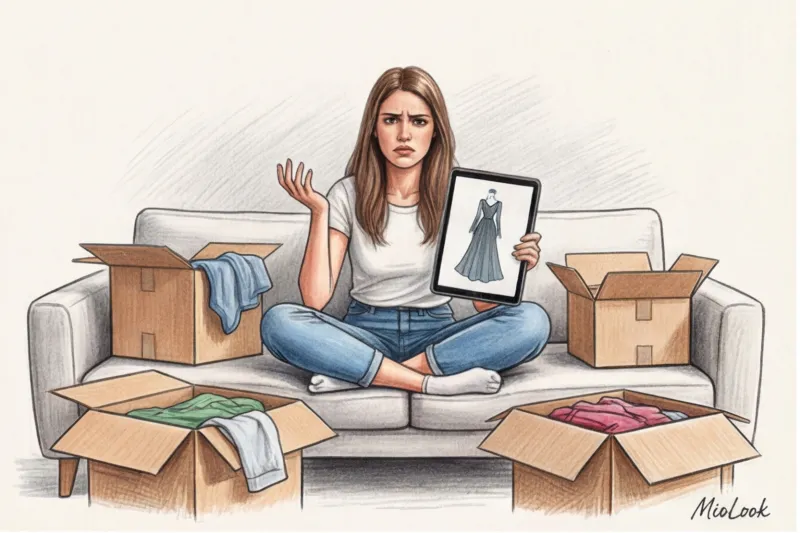
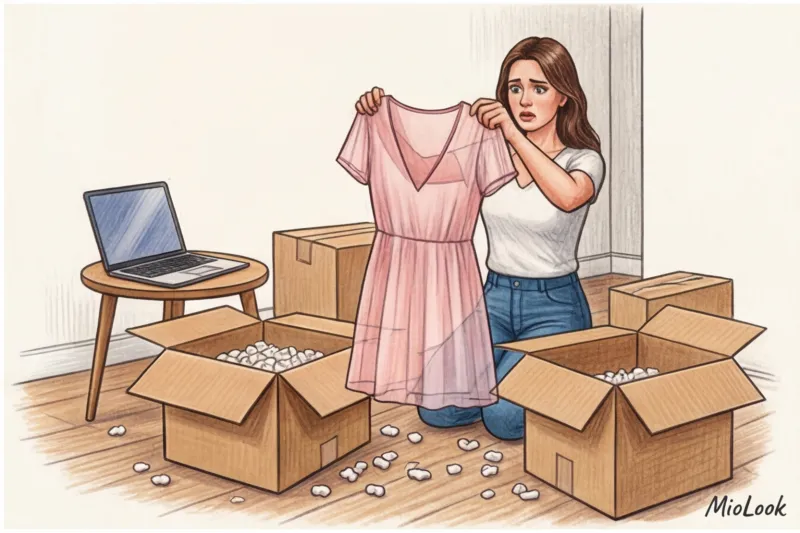
It's these nuances that make us order five sizes of the same item and turn our living rooms into fitting rooms full of boxes. To stop funding courier services and wondering if the fabric is see-through, we need a system that analyzes thread tension based on your actual measurements, not on some abstract, flat image.
Access to MioLook for €0.99 — one-time payment
A smart AI stylist will select the perfect look based on your proportions and fit requirements.
Get access — €0.99 onceVirtual Clothing Try-Ons: How AI is Changing the Game
Have you ever noticed how something looks perfect on the hanger or in a studio catalog, but once you put it on, the magic disappears? In their 2023 report, technologists at the Fashion Institute of Technology (FIT) proved that flat 2D photographs distort our perception of a garment's volume and fit by almost 40%. For modest fashion, where fit is absolutely everything, this error is critical. This is where the power of virtual clothing try-on online — a technology that has transformed the process of choosing closed items from an expensive lottery into an exact science.
Let's look at how this works in practice. When you use MioLook app With , you don't simply superimpose a picture of a dress onto your photo, as primitive entertainment services did five years ago. The system creates a complete digital twin of you—an accurate 3D model of your body. To do this, the algorithm requires your mathematically precise measurements, and every millimeter matters: height, bust, shoulder width, waist, and hip measurements. The AI even takes into account such nuances as a curved back or the slope of your shoulders.
Why is this so important for a closed wardrobe? I had a telling case with a client from Vienna. She has a stunning but unconventional figure: narrow hips and rather broad, athletic shoulders. The standard Zara double-breasted jackets (in the €60–€90 range) always snapped at the armholes on her, even though the waist and bust were perfect according to the size chart. The problem is that the typical studio mannequin, on which brands try on clothes during production, is completely static and generic. It has no individual curves, muscle definition, or postural characteristics.
The artificial intelligence algorithm works fundamentally differently, and this is its absolute superiority over any mannequin. It calculates fabric tension On a specific, living figure. The system analyzes the physical properties of the material—the density of stiff cotton poplin, the flow of heavy viscose, or the elasticity of a cashmere blend. A smart algorithm mathematically calculates how this specific fabric will behave when it meets your shoulder width. Will horizontal creases appear? Will there be tightness in the chest when you move? The virtual fitting room answers these questions in advance, saving you money and stress.
Length tracking: from midi to maxi for your height
In modest fashion, length isn't just an aesthetic choice; it's a key architectural element of your silhouette. A difference of just four or five centimeters can determine whether you look statuesque and elegant, or visually gain a couple of sizes and lose height.
Let's take a classic example. You found the perfect, minimalist one-piece dress at COS for €115. On a studio model who is 178 cm tall, the hem elegantly ends at the narrowest part of the ankle—a perfect midi. But what happens if you're 162 cm tall? The dress will fall lower, the hem cutting through the widest part of your calf, mercilessly weighing down your lower body. The elegant midi you'd originally planned will turn into an awkward, floor-sweeping maxi, making your look bulky.
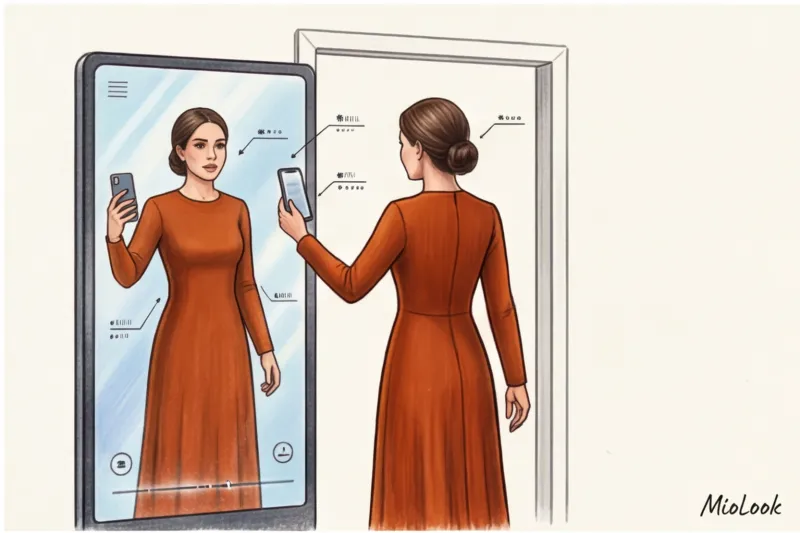
The AI algorithm solves this problem intricately. By creating a digital twin of you, the online virtual try-on doesn't simply scale the image. The system takes the back length of the garment from the brand's technological database and compares it with your individual hip height, calf length, and overall proportions. As a result, the algorithm calculates the exact point where the skirt hem will end.
"Sleeve length is the most insidious traitor in a closed wardrobe. If a shirt sleeve falls even a couple of centimeters below the wrist bone, the whole look instantly becomes sloppy, as if you're wearing someone else's second-hand item. In modest fashion, where the body is covered, it's the wrists and ankles that define elegance."—I repeat this rule at every wardrobe review.
The same goes for jacket sleeves from &Other Stories or Massimo Dutti (usually starting at €150). Thanks to AI, you can see in advance whether you'll need to take the garment to a tailor to have the sleeves shortened and buttons moved (which adds another €25-35 to the cost) or whether it will fit perfectly right out of the box.
Fit and ease test
The key, unbreakable rule of modest fashion is that clothing should softly frame the figure, not cling to it. But how can you tell from a Photoshopped photo from an online store whether there's that saving "air" between the body and the fabric that ensures comfort and respect for personal boundaries?
Here, virtual fitting achieves a true technological revolution thanks to its ability to calculate the gaps between your body and the fabric. Technically, this works like an advanced layer physics simulation. The AI matches the garment's 3D patterns to your measurements, then displays the precise degree of freedom of fit dynamically.
Let's say you've set your sights on a basic ribbed knit dress (around €90). In a studio photo, it looks formal, covered, and sturdy. However, during a virtual try-on, the system takes into account the fabric's composition—viscose with 5% elastane. The algorithm clearly shows that, given your hip measurement, the fabric won't fall straight but will stretch, hugging your body contours, accentuating every line—a completely unacceptable fit for modest fashion.
How to test fit in a virtual fitting room:
- Analyze your waist and hip area: The algorithm will clearly show whether there's the necessary 3-5 centimeters of clearance between your skin and the material. If the AI detects a tight fit on your stomach, feel free to go up a size.
- Check your bust line: For those with a full bust, it's crucial to be able to see if the buttons on a closed shirt will come undone. The system simulates stress points, showing where the fabric will lie flat and where unsightly gaps will form.
- Assess the armhole and forearms: Armholes that are too narrow not only restrict movement but also make the arm look fuller. A virtual test allows you to see the sleeve width and volume, ensuring that a thin turtleneck or top will fit under the jacket.
Smart algorithms don't just show you a pretty picture; they give you real control over your own silhouette. You're no longer dependent on the lighting in a brand's studio or the clothes pinned to the model's back. A virtual fitting room transforms shopping from a blind guessing game into a conscious investment, where every euro spent brings a flawless, perfectly tailored piece to your private wardrobe.
Modest Fashion Capsule: What to Try on First
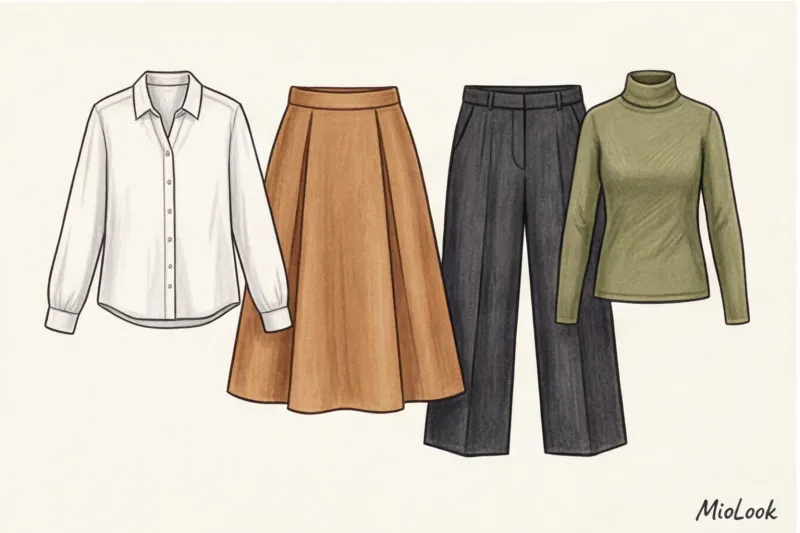
A basic wardrobe isn't a boring uniform, but a set of impeccably fitting tools. When it comes to modest fashion, every millimeter of space between the body and the fabric matters. Forming a capsule wardrobe here becomes truly geometric: we look for pieces with a clear structure that hold their shape and don't cling to the contours of the figure. That's why virtual clothing try-on online It's becoming more than just a convenient addition to your shopping experience, but a strict filter for weeding out poor fits even at the planning stage. Let's look at three fundamental pieces to start building the perfect foundation.
Architectural Shirtdresses and Button Test
The shirtdress is a versatile staple of any closet. But it has a classic Achilles' heel: fabric tension across the chest. Nothing is more detrimental to an elegant and modest look than buttons treacherously coming apart at the placket with the slightest breath or arm movement.
In this case, the AI model acts as your personal designer. When you input precise girth measurements, the algorithm reads the material properties and calculates the physical tension of the cotton. If the pattern doesn't fit, you'll immediately see the characteristic ray-like folds emanating from the buttons on the digital twin. My professional advice: always choose dresses with an architectural A-line silhouette or a light "cocoon." They create the necessary air pocket while maintaining a strict vertical line.
Palazzo pants and wide-leg jeans: a fit that's not too tight
Palazzo and wide-leg jeans are often purchased solely for the volume in the legs, completely neglecting to consider the hip area. Many mass-market styles are cut paradoxically: they are indeed wide from the knee down, but the fabric stretches like a drum across the hips. This is a critical mistake for a closed-toe style—a tight fit in the groin and buttocks instantly detracts from the overall look.
Wide-leg jeans in heavy denim from Massimo Dutti or the right pair of suit palazzo pants should address the main challenge: smoothing out the sharp difference between the waist and hips, creating a smooth, straight line. When virtually testing these pants, focus on the upper third of the garment. The right pair of palazzo pants fall in straight folds from the most prominent point of the hip. If the artificial intelligence highlights a tight fit in this area, feel free to go up a size or look for a different style with pleats.
Knitwear: An Investment versus a Disposable Item
The fast-fashion industry has conditioned us to think of knitwear as a consumable item. The most common mistake I correct during wardrobe reviews is buying dozens of identical thin turtlenecks. Thin knitwear from basic H&M or Zara lines for €25–30 is the worst enemy of modest fashion. It's see-through in the sun, reveals every fold in your underwear, and irrevocably loses its shape after the third wash.
The secret to a luxurious and sophisticated look lies in the high fabric density (GSM). Let's do some math and calculate the Cost Per Wear (CPOW). Let's say you buy a chunky merino wool blend sweater from &OtherStories or COS for €110. Thanks to its tight knit, it doesn't cling to your figure, maintains its shape for years, and is worn at least 50 times over two seasons. Its CPOW is only €2.20. Meanwhile, a flimsy €30 jumper that will pill after five wears (and which you'll be embarrassed to wear without a jacket over it) will cost you €6 per wear. The difference is clear.
If a knitted garment flows in soft, heavy folds on a virtual model, rather than clinging to the body like a second skin, this is a sure sign of high-density yarn. These are the kinds of garments that truly repay every penny invested in them.
Access to MioLook for €0.99 — one-time payment
Start creating perfect images with the help of artificial intelligence.
Get access — €0.99 onceThe Biggest Myth of Modest Style (And How AI Is Debunking It)
Did you know what item I mercilessly toss in the trash nine out of ten times I clean out my wardrobe? A shapeless tent dress or a sweater three sizes too big. In an attempt to conceal their figure and adhere to the dress code of modesty, women make the most counterintuitive mistake: hiding in total oversize clothing.
The logic of shoppers is clear: more fabric means less skin is visible. However, as a wardrobe architect, I have to disappoint you. If the fabric falls in a straight line from the widest point of your figure (be it your chest, stomach, or hips), your silhouette automatically takes on volume at that widest point. Instead of graceful modesty, you get a massive, heavy visual block.
One of my long-standing clients, a finance executive, wore baggy XL shirts for years, even though she was actually a size M. She was absolutely convinced she was effectively hiding her curves. When we replaced the shapeless knits with structured, true-to-size blouses (from mass-market basic collections, priced around €85), where the volume was determined by the cut rather than excess fabric, her colleagues decided she'd lost weight dramatically. This is the visual mathematics of proportions.
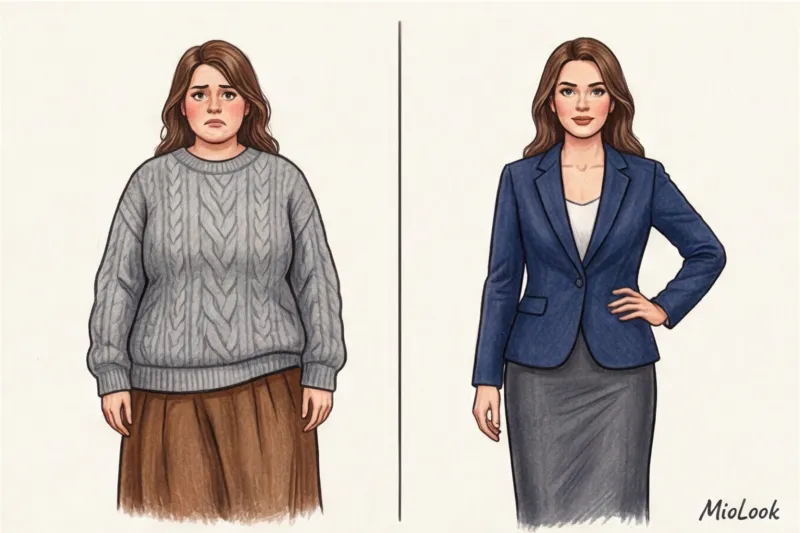
The secret of stylists, which is rarely written about in glossy magazines, is this: the best friend of closed fashion is semi-fitted This is the "golden mean" where there is air between the body and the fabric (usually 2 to 4 centimeters of freedom of fit), but the clothing still has a clear shape.
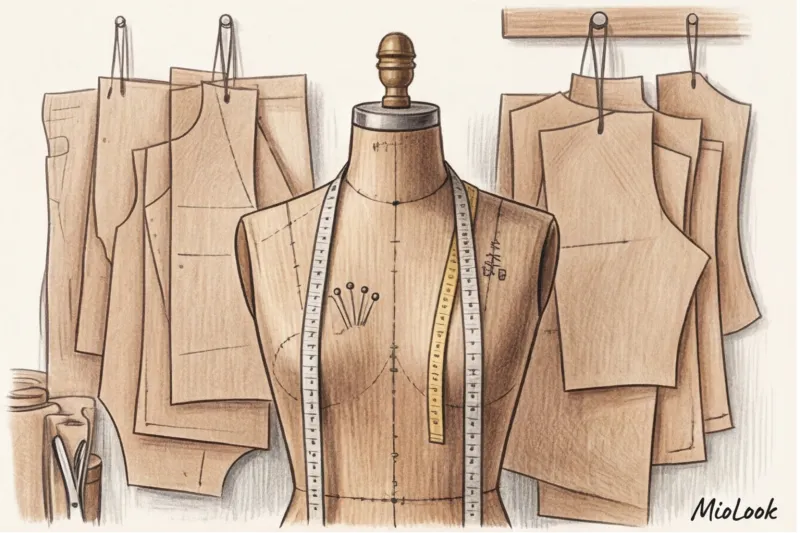
Think of classic jackets or shirts from premium lines. Their secret lies not in the fabric, but in their complex design. The perfect silhouette is created by a well-cut shoulder, precise darts (especially at the back), and structured armholes. The garment should hold its own shape, not rely on your curves. When the shoulder seam is perfectly positioned—not a centimeter below the knuckle—even a loose hem looks like a designer's elegant design, not a sloppy sizing error.
But how do you find that perfect semi-fitted cut without buying half the online store's selection? Until recently, it was a real lottery. Today virtual clothing try-on online takes on the role of a tailor-consultant entirely. In the MioLook app, AI algorithms analyze not just the brand's size chart, but the garment's patterns in 3D space.
When you upload your precise measurements, the neural network mathematically calculates how the darts and armholes will behave on your specific figure. You clearly see the so-called "risk zones": the AI shows where the fabric will cling treacherously, violating modesty principles, and where it will hang loosely. The technology literally illuminates the balance between freedom and shape, allowing you to avoid buying yet another loose robe and reliably choose that perfect structured semi-fitted silhouette.
The Art of Layering: Testing Combinations in MioLook
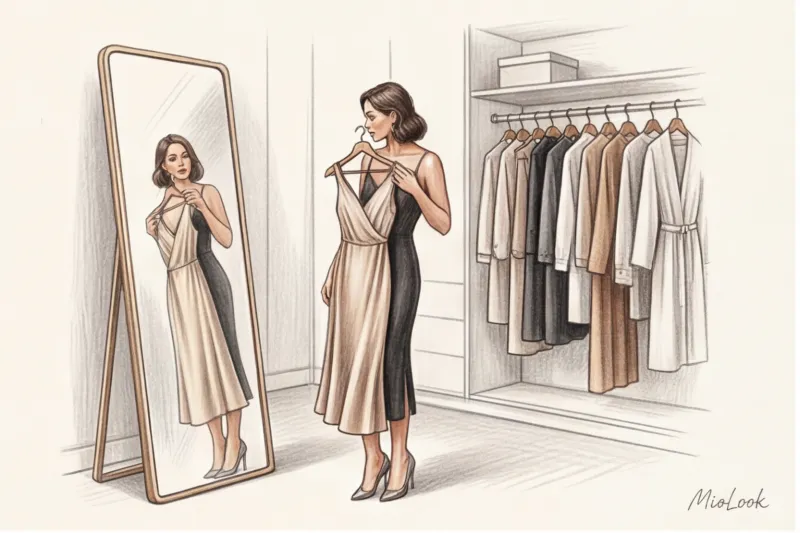
Do you know why most attempts to wear a trendy open sundress over a basic turtleneck end in complete disappointment in front of the mirror? It's not about color combinations, but the ruthless physics of fabrics. Layering is the absolute foundation of modest fashion. It's this stylistic approach that allows us to embrace beautiful, yet overly revealing, pieces. A slip dress, a formal sleeveless vest, a blouse with a deep V-neck—all of these can easily be adapted to the requirements of a closed dress code if you choose the right layer underneath.
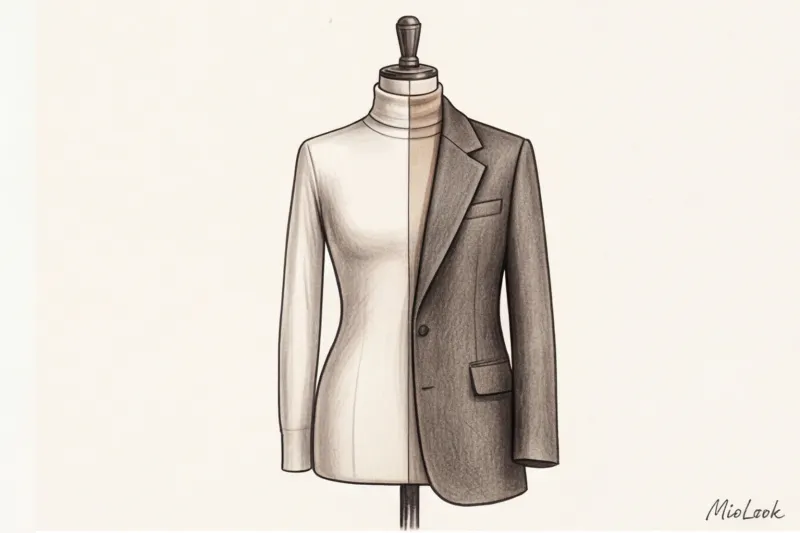
But in practice, we often face a tricky problem: how to combine these elements without looking like a shapeless "cabbage"? The effect of excess volume and bulk appears when we ignore the density of materials and the geometry of the cut. For example, if the armhole of a top is no wider than the armhole of a bottom by at least a couple of centimeters, a hard fold will immediately form in the armpit. And a thick cotton shirt worn under a soft knit vest will inevitably create unsightly bulges at the back and waist.
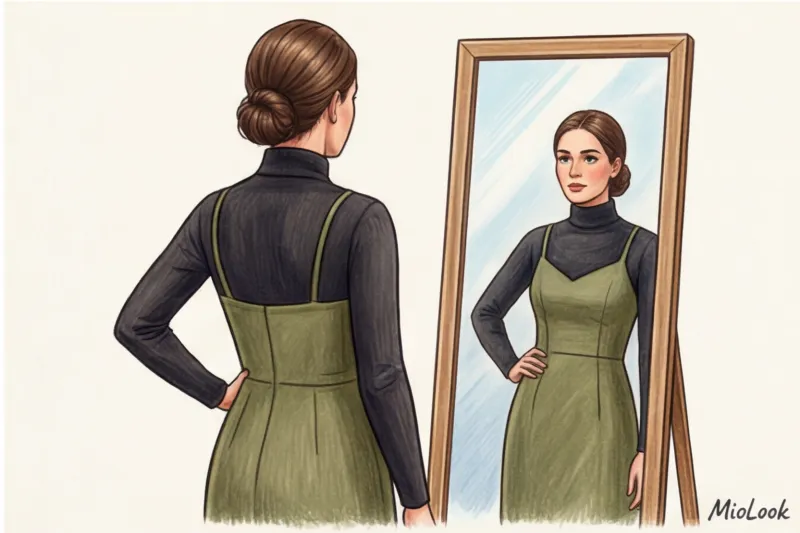
Recently I decided to arrange the functions of combining images in MioLook app A true professional stress test. I loaded two obviously conflicting items into my digital wardrobe: a delicate silk slip dress (costing around €120) and a voluminous cashmere turtleneck. In real life, the thick cashmere instantly "eats" the silk's smoothness—the underlayer shows through the thin fabric in rough seams, and static clings to the hem.
To my genuine surprise, the algorithm didn't simply superimpose one flat 2D image on top of another. The AI brilliantly visualized this conflict of textures! On the digital double's screen, it was clearly visible how the silk had become unnaturally taut across the chest, losing its signature flowing fall, and how those telltale rolls had formed at the waist.
In modest fashion, the base layer should always have a higher slip coefficient and be thinner than the top layer. If you wear a matte, clingy fabric (wool, heavy cotton) under a thin, smooth one, you'll visually add 5-7 kilograms to your weight.
This is how the combination feature in the virtual try-on saves us from costly mistakes. It literally tests the density of layers before you even hit the "pay" button. You can virtually try on an ultra-thin smooth modal turtleneck under a structured wool sundress—and the program will show you a perfect, even fit without sacrificing elegance.
This approach radically changes the rules of online shopping. We stop guessing whether a shirt sleeve will fit under a tight cardigan and start putting together complex, multi-component, closed-off looks with mathematical precision.
Your ideal image begins Here
Join thousands of users who look flawless every day with MioLook. Stop wasting money on clashing outfits.
Get access — €0.99 onceKatarzyna's Checklist: 5 Steps to a Successful Virtual Modest Fashion Try-On
Data scientists have a ruthless rule: GIGO (Garbage In, Garbage Out). It's exactly the same in digital styling. You can use the most advanced neural networks, but if you feed them the wrong inputs, the results will be disappointing. Before entrusting your next &Other Stories basket or €150 COS to an algorithm, I insist on following a strict protocol.
Over the years of working with closed wardrobes, I've developed an algorithm that eliminates 99% of mistakes. Here's my personal checklist—save it and go through each step before hitting the "Pay" button.
1. Update your settings in the app down to the millimeter
It sounds simple, but you can't imagine how many returns happen due to simple laziness. One day, a regular client of mine complained that her online clothing try-on was malfunctioning: all the new jackets seemed downright baggy. It turned out she'd lost 3 kilograms after her vacation, but had forgotten to update her digital profile.
In modest fashion, a difference of 1.5–2 centimeters in the shoulder or chest measurement can make all the difference: whether a garment will look like a refined, semi-fitted silhouette or a shapeless sack. Use a stiff tailor's tape measure and update your measurements every two to three months. Technology demands precision.
2. Check things "in motion" (evaluation of cuts)
The most insidious enemy of modest fashion is hidden vents and side slits. When held still in a studio photo, a €60 midi skirt may seem like a monolithic fortress. But take a step, and the fabric opens up to mid-thigh.
Algorithms are great at modeling tension and fit, but they can't always predict wind strength or your sitting cross-leggedness. Always look for technical specifications for slit lengths in the product description on the store's website before trying on an item on your digital avatar.
3. Analyze fabric composition before virtual fitting
Artificial intelligence will flawlessly display the silhouette's geometry, but the physics of fabric behavior are dictated by chemistry. AI will demonstrate how a garment should fit in an ideal world, but you must clearly understand what exactly you're looking at: 100% dense linen or fine viscose.
"If you see a beautiful, flowing drape on the screen, but the description says it's 100% cheap polyester, the algorithm won't protect it from static electricity. It will inevitably cling to your figure as you walk, violating the cardinal rule of a closed-toe style."
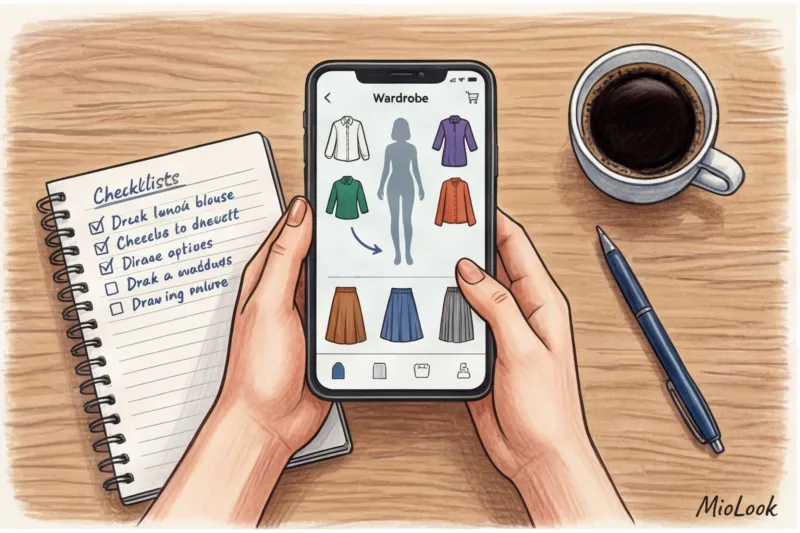
4. Always complete your look with a base layer
A closed wardrobe is often built on layering. The worst thing you can do is vacuum-test a cami dress or a poplin shirt if you plan to wear them over something else.
Load both items into the fitting room. Check to see if the tight seams of the bottom layer (for example, a thin merino wool long sleeve) create unsightly bulges under the smooth fabric of the top. Only a complete set, put together, gives a true picture of the volumes. This is the magic of the combination function. MioLook app - it takes into account the density of the layers.
5. Consider the proportions of the shoe in combination with the chosen length
Shoes change everything. A maxi skirt that looks incredibly elegant paired with pointed slingbacks will instantly transform you into a squat rectangle when paired with chunky, tractor-soled boots.
Never judge hem length barefoot or in abstract shoes. Always include the footwear you plan to wear with the item in your simulation. The length of a skirt or trousers should work in strict synergy with the shaft height and toe box of the boot.
Modest fashion tolerates no fuss or compromise. It's the conscious choice of women who value their personal boundaries and comfort. Use digital tools with a cool, calculated approach, approach online shopping with the rigor of an investor—and every item you buy will become a reliable foundation for your impeccable style.
Guide Chapters
Closed-toe office wear: a modest and stylish wardrobe
A strict business dress code without distracting accents is a powerful tool for a successful woman. Learn how to put together an elegant wardrobe for negotiations.
Evening Dresses: Secrets of Selection and Fitting
Think a high-necked dress will hide all your flaws? A stylist explains why it's the most dangerous outfit to wear, and how virtual fittings can save you from fashion disasters.
What to wear with a long skirt to look expensive
Maxi length isn't just about beach vacations; it's also a status symbol. Learn the stylists' secrets on how to pair long skirts with any outfit.
Layered Clothing Looks: A Guide to Online Try-Ons
The perfect layered silhouette isn't magic, but the physics of texture. Discover how online fitting technologies help you create high-coverage outfits without excess bulk.
How to choose clothes for a hijab online using a photo
Assembling a stylish, closed-off wardrobe without see-through fabrics or time-consuming preparation is a true quest. Discover the stylists' secrets for choosing Muslim looks.
Capsule Wardrobe: Modest Fashion in an App
Cover-ups don't have to be shapeless. Let's break down stereotypes and create the perfect feminine capsule wardrobe using your smartphone.
Modest Summer Clothing for Women: AI-Powered Heat Relief
Covering up in the heat is no longer a problem. Learn how to choose breathable fabrics and comfortable fits with AI to stay comfortable.
How to choose oversized clothes online and avoid them being too tight
Buying clothes one size too big won't make your look stylish. We'll explore the architecture of loose fits and learn how to order the perfect oversized garment online.
AI Stylist: An App for Choosing Cover-Ups
Finding stylish, modest clothing in mass-market stores is a real quest. We'll explain how smart algorithms solve this problem and save you time shopping.