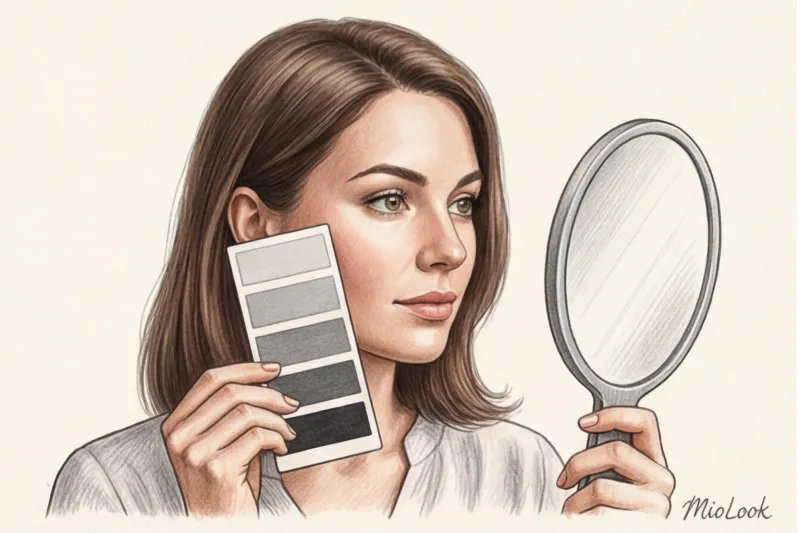
Have you ever put on a strict black and white suit for an important meeting and suddenly realized that the reflection in the mirror isn't of a confident woman, but rather of a uniform? It's as if your face "erases," your eyes become dull, and the clothes take center stage. Over 12 years of reviewing wardrobes, I've seen this effect hundreds of times. It's all due to a mismatch between your natural coloring and the clothes.
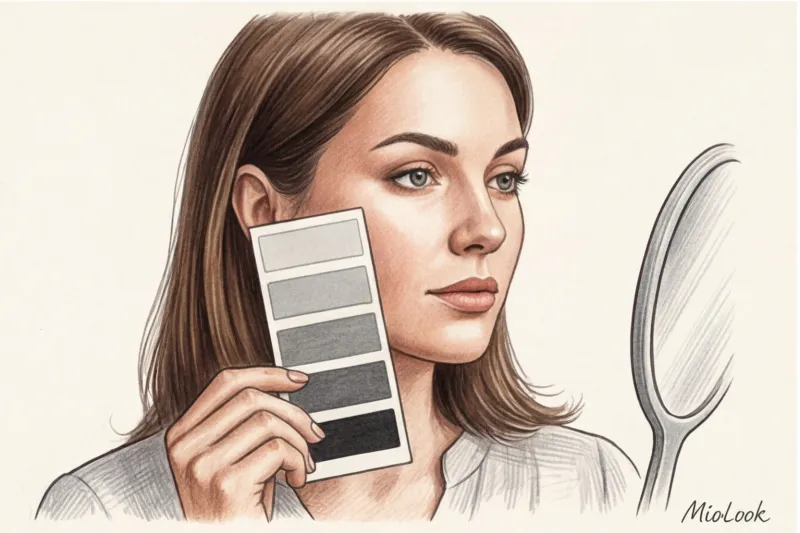
According to my personal statistics, about 60% of women of European and Slavic types have exactly this parameter - average contrast in appearance But the paradox is that in stores, they stubbornly gravitate toward either radical contrasts (black with pure white) or completely dissolve into pale beige monochrome, afraid to take a step away. We discussed how the physics of color works in more detail in our A complete guide to contrasting your appearance and choosing the perfect shades.
In this article, I won't be advising you with the clichéd "avoid extremes." We'll take a different, more profound approach. I'll show you how to build a smart basic wardrobe not by searching for "safe" colors, but by masterfully playing with textures and fabric densities. This is the sustainable approach (conscious consumption) that will allow you to buy less but wear things for years to come.
What is average contrast in appearance in the language of physics and style?
To avoid guessing, let's turn to science. In 1905, artist and physicist Albert Munsell created the Munsell Color System, which is still used in design and the textile industry. It features a value scale from 0 (absolute black) to 10 (pure white).
Your contrast is the difference on this scale between the darkest part of your face (hair, eyebrows, irises) and the lightest (skin, whites of the eyes). If this difference is between 3 and 6 steps, congratulations—you have medium contrast. This isn't "drab," as outdated magazines mistakenly describe it. It's the most flexible, refined canvas for a stylist.
Why is it important to know this before you go shopping? According to the Sustainable Apparel Coalition's 2023 global report, items that clash with their wearer's appearance (overwhelming or dulling) are worn on average only 2-3 times, after which they sit as dead weight on shelves or end up in landfills. Understanding your style is literally protecting your wallet from impulse purchases that won't last.
How to measure your level: a black-and-white test
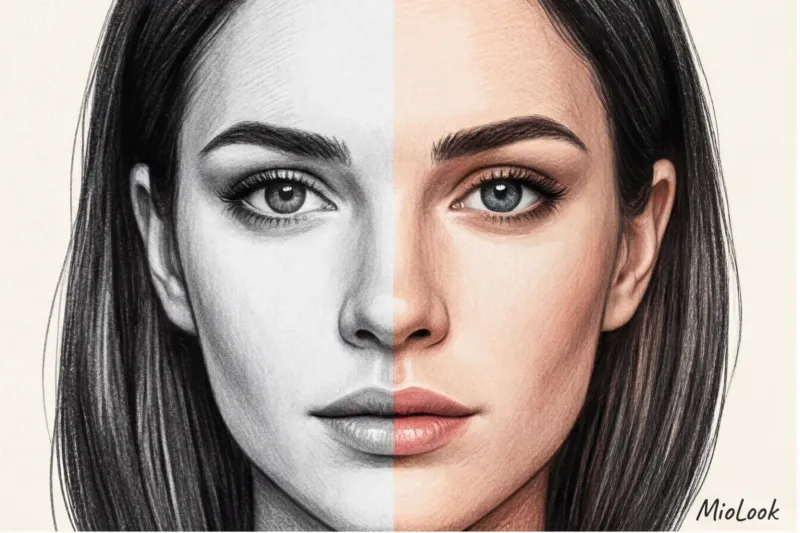
The easiest way to determine your parameters without visiting a stylist is to take a selfie in daylight (facing a window, out of direct sunlight) and convert the photo to black and white in any photo editor. This will remove color noise and leave only pure highlights.
- Find the darkest point in the photo (usually the hair roots or eyelashes).
- Find the lightest spot (skin on the forehead or whites of the eyes).
- Evaluate the difference: if it doesn’t hit the eyes with a sharp transition from charcoal to paper-white, but looks like a soft gradient of gray tones, you’re in the middle zone.
This method has one obvious limitation: it won't work if you've just returned from vacation with a deep bronze tan, or if you're photographed under a powerful ring light that artificially bleaches your face. Perform the test in your natural, everyday state.
Access to MioLook for €0.99 — one-time payment
A smart AI stylist will select the perfect look based on your contrast levels and facial features.
Get access — €0.99 onceThe Biggest Myth of a Basic Wardrobe: Why Black and White Classics Are Bad for You
For decades, we've been taught that "white top, black bottom" is a universal elegance that flatters everyone. This is a dangerous misconception. For medium-contrast looks, classic color blocking is detrimental. It creates an optical illusion: the sharp border between colors in clothing draws attention from the face to the chest, making the face appear tired and disconnected from the body.
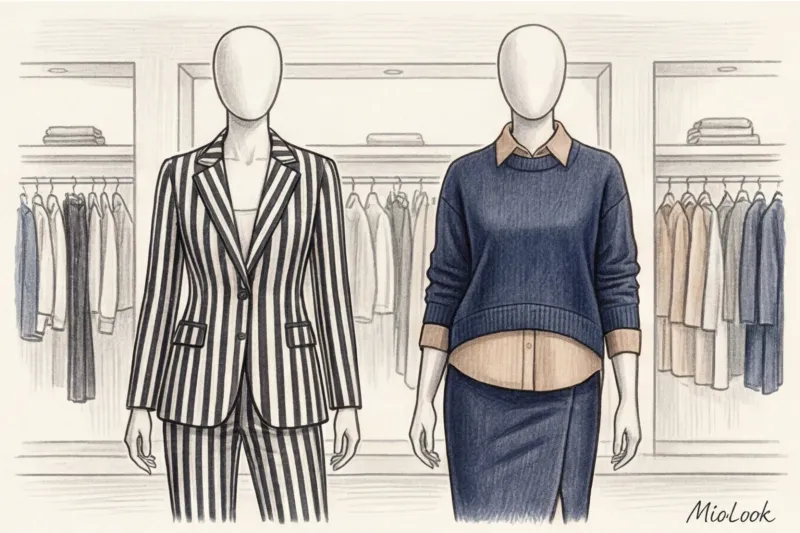
One of my clients, a top manager at an IT company, complained that during important presentations, in her expensive black Prada suit and white shirt, she felt less like a boss and more like a "first-grader at a school assembly." We swapped the radical black for a deep matte navy, and the crisp white for a flowing cream top made of thick silk (around €180 for a basic model). The understated look was maintained, but her face instantly brightened up, and the dark circles under her eyes disappeared.
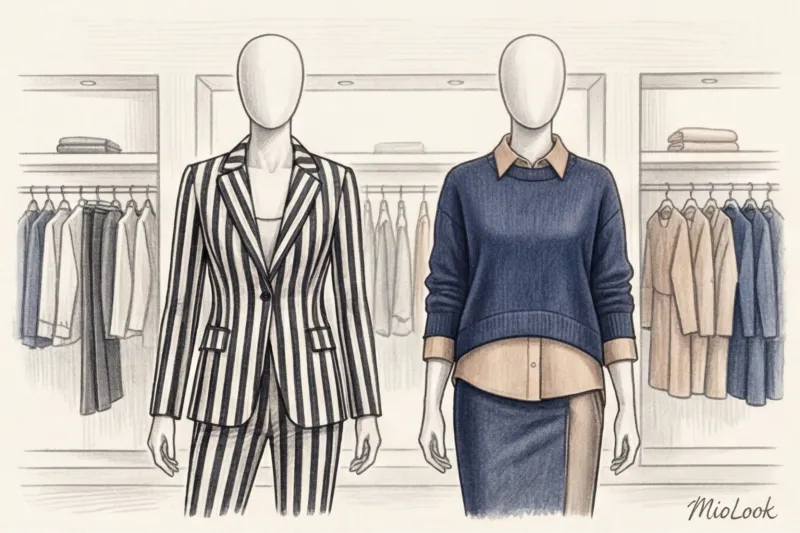
Your ideal base is a combination of adjacent or alternate steps on the value scale. Remember these fail-safe combinations:
- Graphite (instead of black) + dusty rose
- Dark chocolate + warm caramel
- Deep emerald + oatmeal
- Soft denim + ecru
Texture over color: The secret tool of fabric experts
If we remove sharp color blocks, how can we avoid making the look boring? This is where my favorite rule comes into play: micro-contrast through texture. This is the secret to creating those "expensive" quiet luxury looks so often captured by street style photographers.
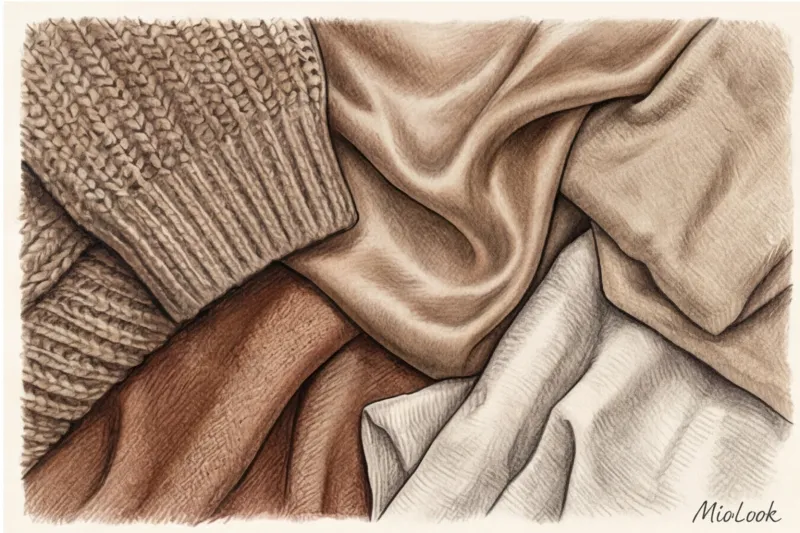
Light interacts with materials differently. Matte surfaces (wool, cashmere, heavy linen) absorb light, appearing deeper and darker. Shiny surfaces (silk, satin, viscose) reflect light, creating highlights. If you wear a camel-colored sweater made of loose alpaca over a tone-on-tone silk skirt, you'll achieve stunning volume and movement without a single bright spot.
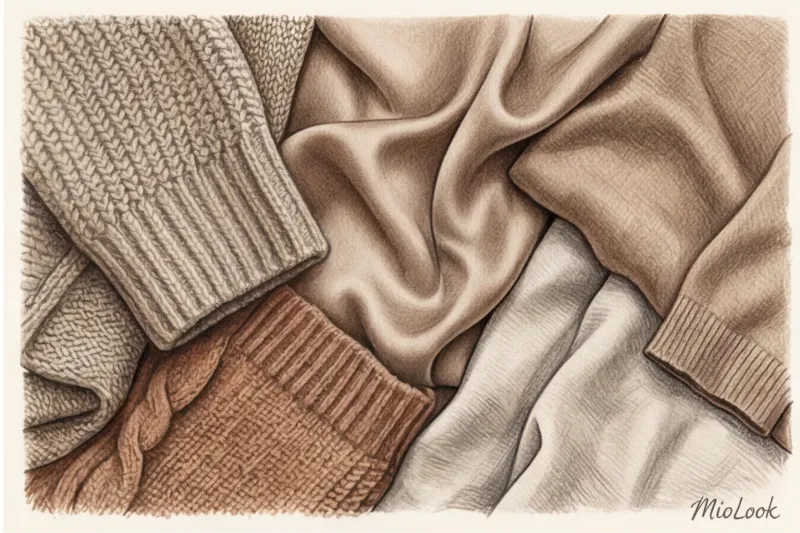
Twill denim next to plain cotton with a weight of 180 g/m² or more also produces this effect. It's the difference in weave that allows the eye to "catch" on details, making the outfit difficult to discern.
Eco-friendly fabrics for medium contrasts
Consider natural materials. Organic linen, hemp fiber, and Tencel (lyocell made from eucalyptus) have a natural, slightly muted matte finish. Their natural aesthetic perfectly matches the softness of your appearance.
Cheap synthetics are your number one enemy. A 100% polyester dress from a mass-market retailer for €30 often has a distinctive, harsh, "glassy" sheen. This synthetic sheen clashes with average contrast, cheapens the look, and highlights even the slightest imperfections in the skin. Invest in the quality of the fabric, not the number of trendy cuts.
Your perfect look starts here
Join thousands of users who look flawless every day with MioLook. Digitize your items and create capsule wardrobes in one click.
Get access — €0.99 onceMedium Contrast Capsule Collection Guidelines: Prints, Proportions, and Shades
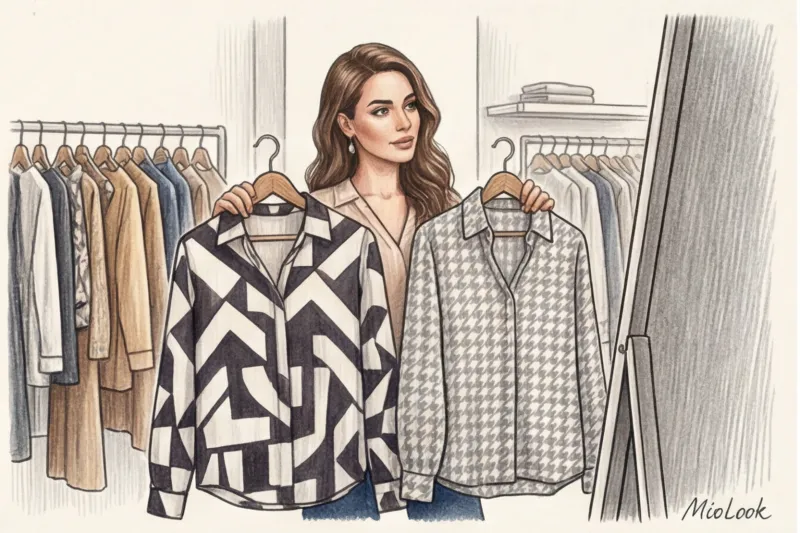
In addition to color and texture, the scale of details plays a huge role. Medium-contrast looks require equally medium-scale prints. The famous "rule of proportionality" states: if a pattern on a fabric is too small (micro-ripples), it will cause visual dizziness. If it's too large (huge geometric blocks or giant 70s-style flowers), it will "eat" you whole.
Your best friends among patterns:
- Classic pied-de-poule of medium caliber.
- Moderate tartan or Prince of Wales check.
- Paisley (Turkish cucumber) in muted tones.
When assembling a capsule wardrobe, I recommend using the "color stretching" method. Instead of sharp boundaries between tops and bottoms, create gradient transitions. For example, light gray pants, a wet asphalt top, and a graphite cardigan. We discussed how to professionally mix shades using the Itten circle in detail in the article about color wheel in clothing.
People often ask, "What if I'm a classic 'winter,' but my contrast has decreased with age or after coloring my hair?" Contrast is more important than your base color type. If your colors have softened, you'll need to lighten up your palette a bit. Feel free to choose your usual cool shades, but a couple of shades lighter and softer.
A practical checklist: auditing your wardrobe for contrast levels
Theory is useless without practice. Set aside an hour this weekend to do a quick inventory of your belongings. Here's the process I use in paid reviews with clients:
Step 1. Sorting by lightness. Arrange your basic items from lightest to darkest. Check for any obvious polarity bias (all black and all white). If the middle is empty, that's the first area for future purchases.
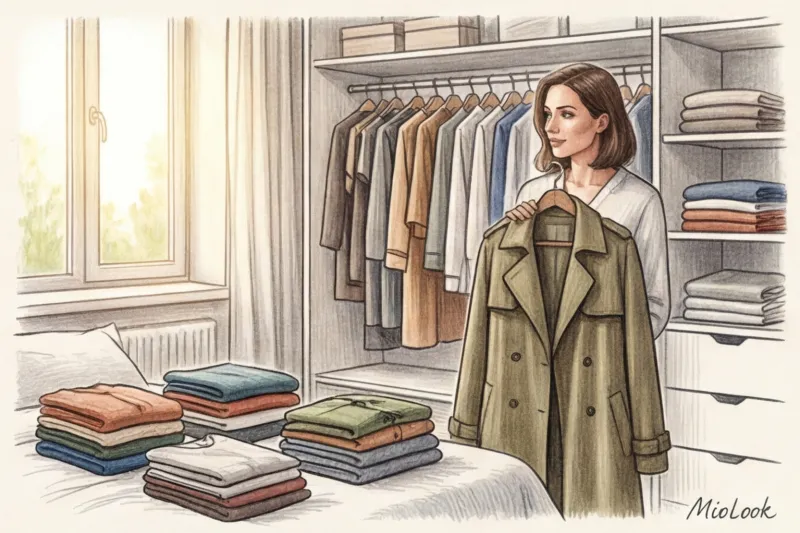
Step 2. Search for "vampire things". These are the sweaters or blouses you put on, look in the mirror, and realize you look tired even though you slept eight hours. Chances are, these items have the wrong contrast or are too bold a color. Set them aside in a separate pile.
Step 3. Rescuing your favorites. What if that €300 black cashmere jacket, dear to your heart (and wallet), just doesn't suit you? Use a buffer zone. Move the aggressive color away from your face. Wear a top in your ideal mid-contrast shade under the jacket, add a voluminous scarf in a soft color, or reveal your décolletage. The further the "unsuitable" contrast is from your portrait zone, the less damaging it will be.
To make this process easier, I highly recommend digitizing your basic pieces. By uploading photos of your clothes to MioLook smart wardrobe , you can virtually assemble outfits and immediately see which combinations create a soft, elegant gradient, while which ones "cut" the silhouette.
Sustainable Fashion: How Understanding Contrast Saves the Budget and the Planet
Fashion is one of the most polluting industries in the world. And our personal contribution to the environment begins not with buying a tote bag made from recycled plastic, but by avoiding pointless purchases. A McKinsey study (2024) shows that the cost per wear (CPE) of items that perfectly suit a woman in color and cut is four times more profitable than spontaneous, trendy purchases.
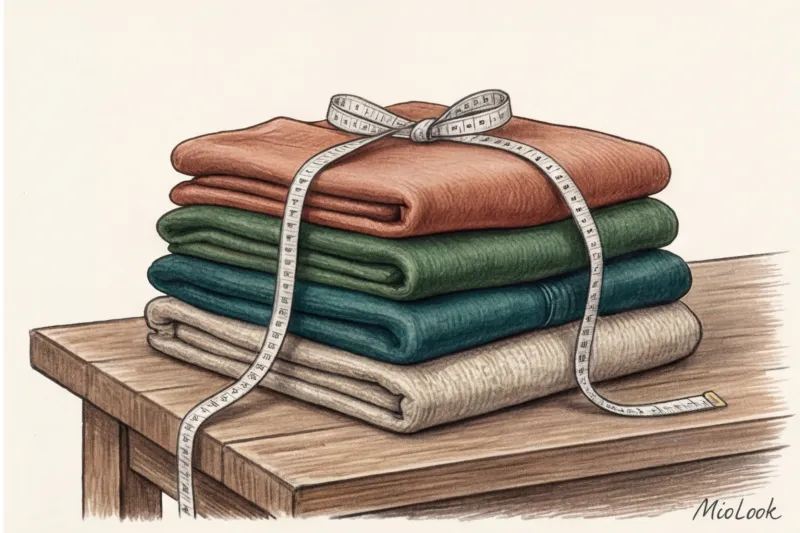
When you know you have a medium-contrast complexion, it becomes very difficult for marketers to sell you a neon sweater or an ultra-black patent leather coat simply because "it's the hottest thing." You begin to see things through. You realize that investing in a quality taupe wool jacket in the mid-price range (€150–€250) will pay for itself many times over, because it will become an extension of your appearance, not a competing defense.
A harmonious basic wardrobe isn't a list of "10 essential items" downloaded from the internet. It's a mathematically proven system built around your personal characteristics. Explore your level of contrast, embrace the soft transitions of textures, and you'll forever forget the problem of "a full closet, but nothing to wear."