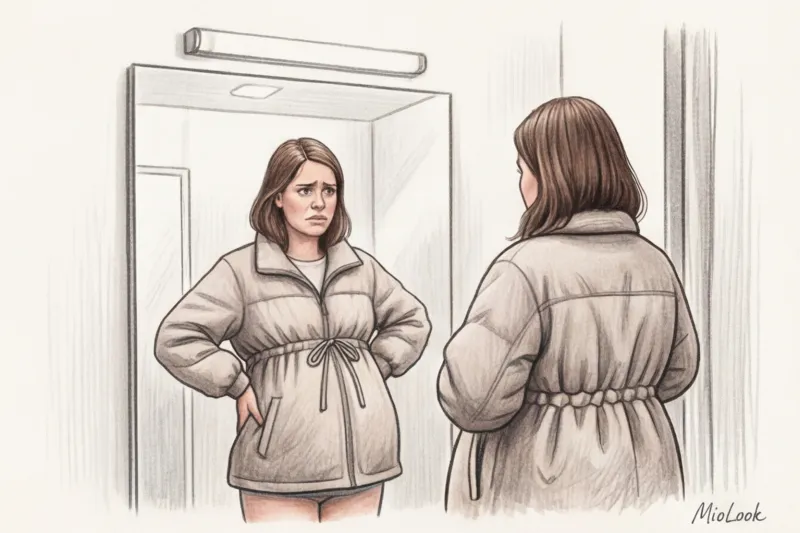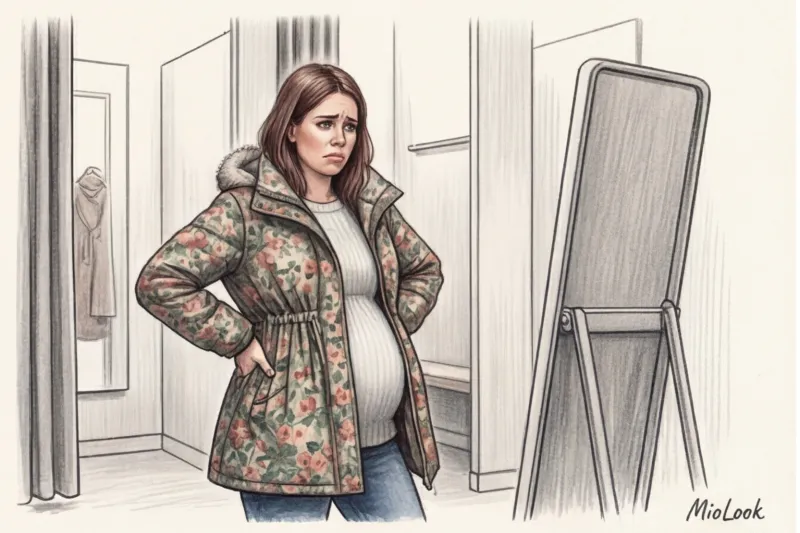
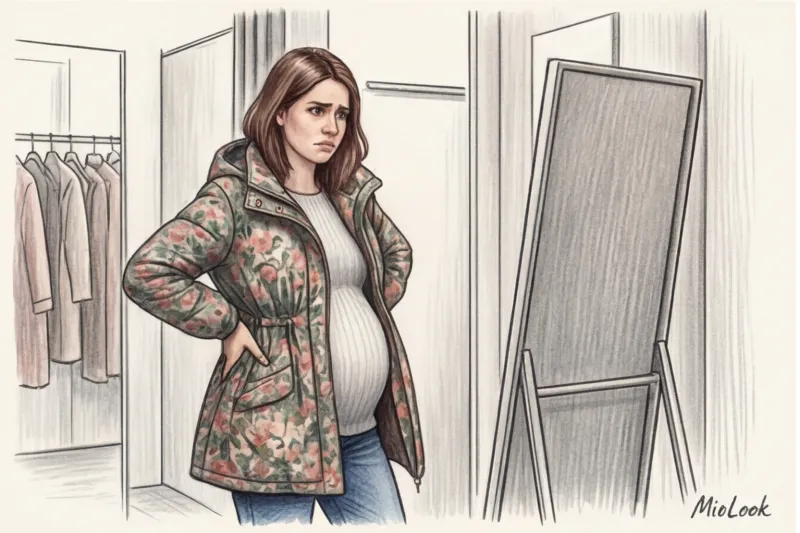
I still remember my client Isabella bursting into tears in the fitting room. She was wearing a classic maternity down jacket: an ugly drawstring right under her breasts, a strange, small floral print, and a shiny fabric that suspiciously resembled a trash bag. "I look like a huge flowerbed," she sobbed. And as a stylist, I was forced to agree. The garment distorted her proportions, made her look bulky, and didn't reflect her personal style at all.
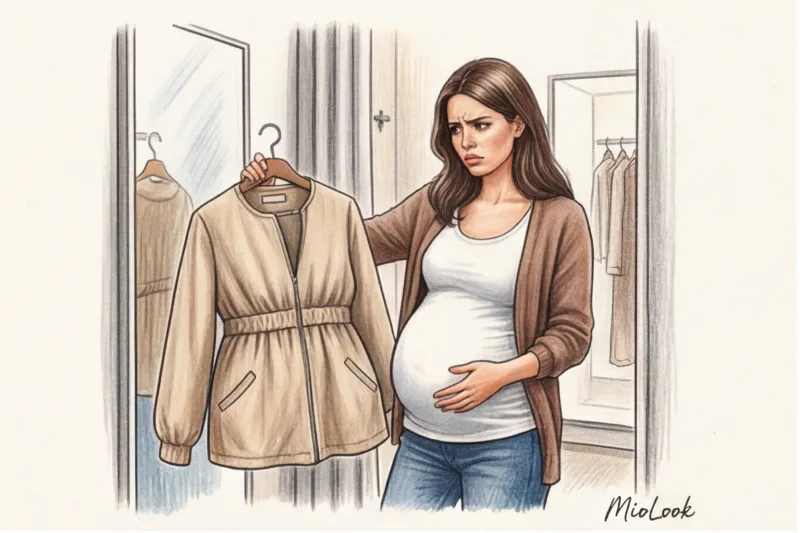
Let's be honest: specialized winter down jackets for pregnant women are, in 90% of cases, a brilliant marketing ploy and a waste of money. Brands profit from selling you disposable items labeled "maternity" that you'll throw away or donate after three months. We've already discussed wardrobe architecture for expectant mothers in more detail in our article. The complete guide to stylish maternity outerwear Today, I'll tell you how to choose a technologically advanced, stylish, and smart winter jacket that will be worth every penny and will stay in your closet for years to come.
Winter down jackets for pregnant women: why specialized models are often a mistake
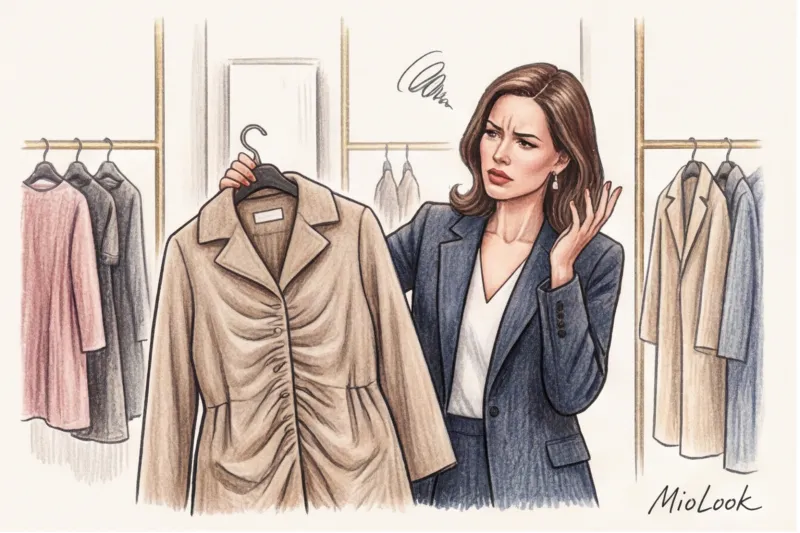
The maternity wear industry often preys on the fears of expectant mothers: "You'll be cold," "It has to be special." As a result, store shelves are overflowing with empire-line jackets. Why is this bad? The drawstring under the bust visually cuts off the figure at its widest point. Instead of neatly framing the changing curves, this cut turns a woman into a rectangle, adding visual weight not only to the belly but also to the shoulders.
Over 12 years of working as an image consultant, I've developed a strict rule: calculate Cost-Per-Wear. The math is ruthless. Let's say you buy a typical maternity jacket for €150. You'll wear it for a maximum of 100 days. The cost per wear is €1.50. Now let's take a high-quality, basic oversized down jacket for €350. You'll wear it during pregnancy, on strollers, and in everyday life for at least 3-4 years. With regular wear, the cost per wear drops to a paltry €0.30.
And most importantly, the loss of style DNA. Pregnancy is no reason to abandon your taste and wear shapeless, ruffled clothes. You have every right to be yourself.
What to look for when choosing: insulation, weight, and technology
Between 7 and 9 months of pregnancy, your center of gravity shifts, and the strain on your lower back becomes colossal. I often see women choosing heavy shearling parkas that literally weigh them down. The weight of outerwear is critical now. A jacket should be lightweight yet function like a thermos.
Natural down vs. modern synthetic alternatives
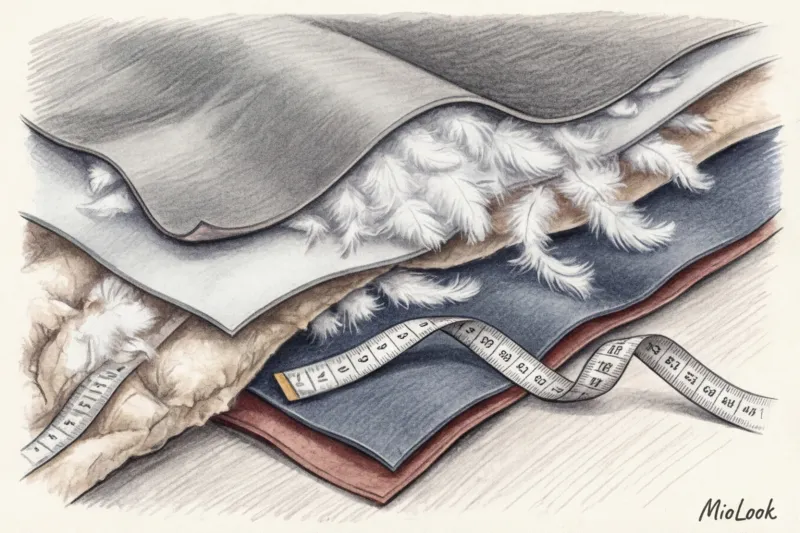
If you are a fan of natural materials, look for the marking on the label. Fill Power (FP) According to international textile lab standards (such as IDFL), the minimum fiber content for comfortable urban winters is 600 or higher. The down-to-feather ratio should be no worse than 80/20 (80% down). More feathers will make the jacket heavy and cold.
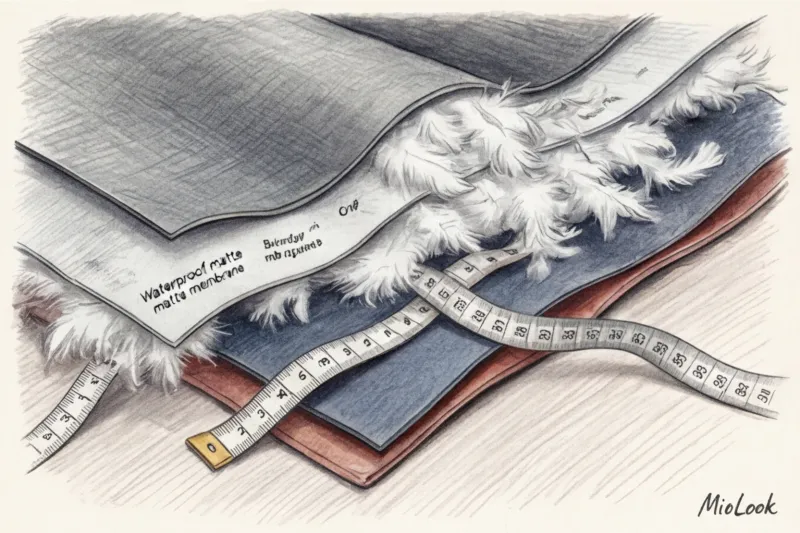
However, I strongly recommend considering high-tech synthetics. Manufacturer specifications for modern insulations (such as 3M Thinsulate, Isosoft, or Primaloft) prove that they often outperform natural down. Why? First, they're hypoallergenic. Second, synthetics don't clump after washing (and Mom will have to wash her jacket often). And third, Thinsulate microfibers keep you warm even when wet, unlike down, which completely loses its insulating properties when wet.
Outer fabric: protection from wind and wet snow
Avoid cheap, shiny polyester. It doesn't breathe—you'll sweat on the subway or in the car, and you'll freeze instantly when you step outside. Look for matte membrane fabrics.
Be sure to check availability DWR impregnations (Durable Water Repellent). How do you do this right in the store? Put a drop of water from a bottle on the sleeve. If the drop forms a ball and rolls off, the impregnation is excellent. If the fabric has darkened and absorbed moisture, leave this jacket on a hanger; it will be soaked through in the first snowfall.
Access to MioLook for €0.99 — one-time payment
A smart AI stylist will select the perfect winter look based on your proportions and favorite items.
Get access — €0.99 once3 Smart Styles That Will Last After Childbirth
The main rule of maternity wardrobe design: we look for volume not locally in the abdominal area, but in the overall geometry of the garment. A jacket should have air inside.
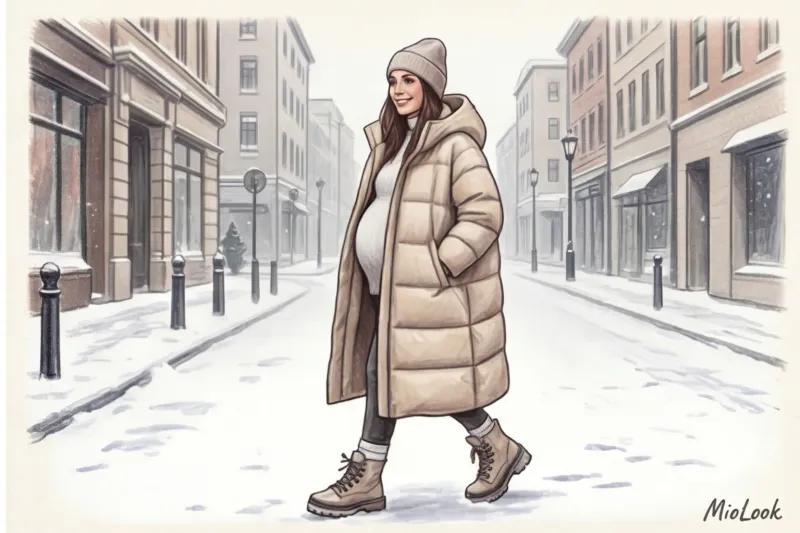
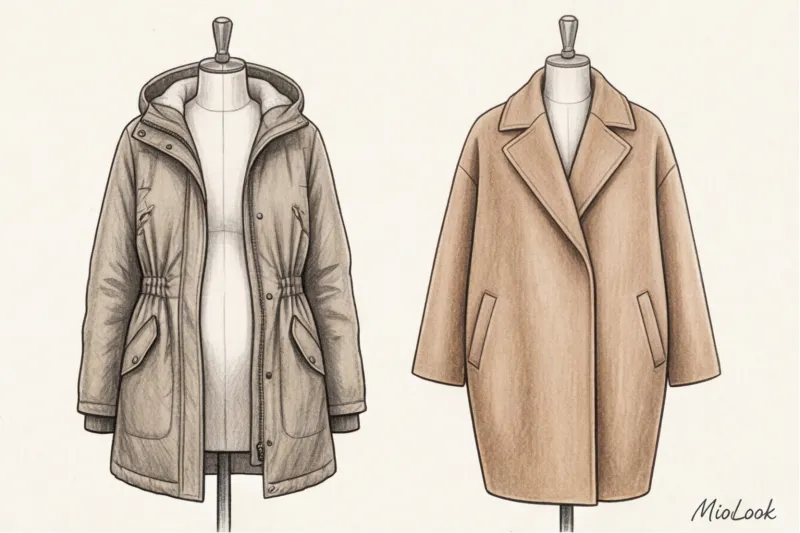
Cocoon down jacket (O-silhouette)
This is an absolute favorite among my clients. The cocoon has an architectural cut that gently hugs the figure. It flares out at the waist and hips, providing ample room for a growing bump, but tapers toward the bottom. This taper serves a crucial function—it protects against icy winds from below. After giving birth, this down jacket looks like a trendy, intricately cut designer piece.
Oversized straight cut with adjustable hem
Here's an important detail: the drawstring should be positioned strictly along the jacket's hem, not under the bust or at the waist. A straight oversized jacket allows for layering. You can easily layer it with a chunky wool sweater or your favorite hoodie.
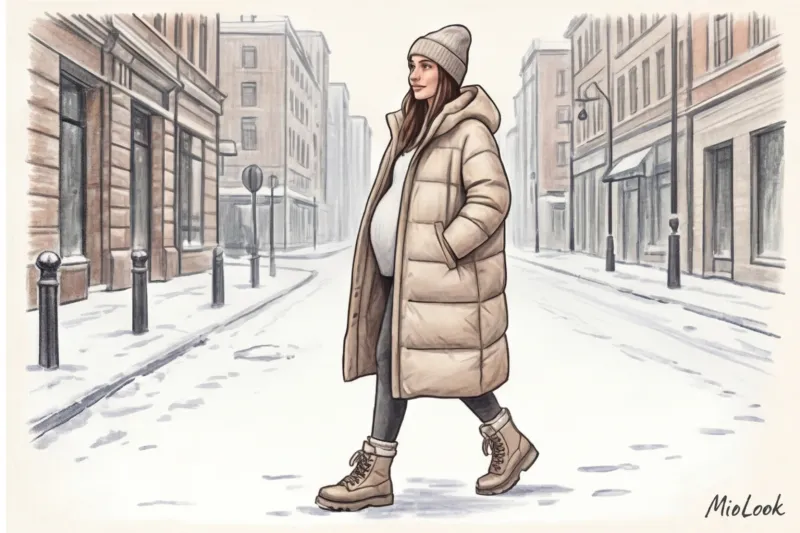
Models with side zippers (extenders)
This is a brilliant invention from Scandinavian brands (often found at COS or in premium mass-market lines). It looks like a regular straight down jacket. But hidden zippers are sewn into the side seams. Unzipping them gives you an extra 10-15 cm of space, perfect for your belly. Once your pregnancy is over, you can simply zip up the zippers and wear the jacket as a classic basic.
3-in-1 down jackets and sling jackets: when a special item is justified
I always say that specialized maternity gear is just marketing. But here I must admit an honest exception. If you plan to actively use a baby carrier or sling during the first months of your baby's life, a 3-in-1 babywearing jacket is a brilliant investment.
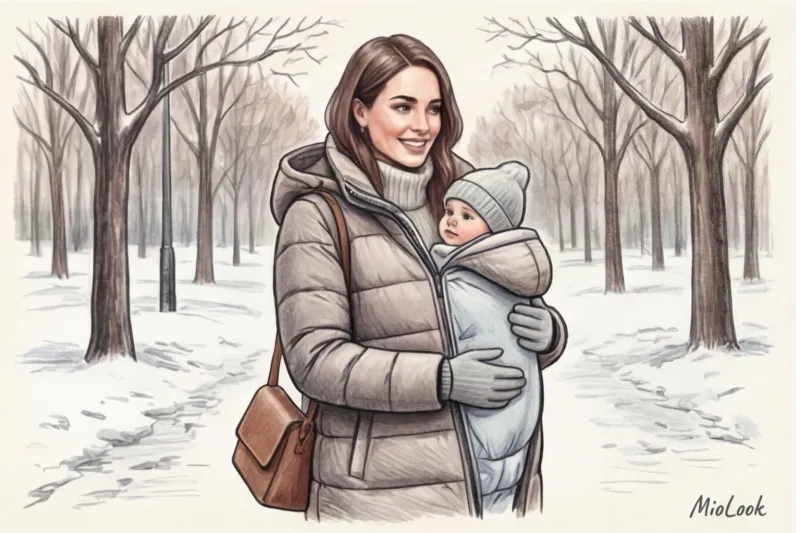
How does it work? The basic jacket comes with two removable zippered panels. At first, you wear the jacket alone. As your belly gets bigger, you attach the first insert (the extender). After the baby is born, you switch it out for the sling insert.
"A proper babywearing jacket doesn't hold the baby (the sling underneath does that), it simply creates a warm cocoon for both mother and baby. This eliminates the need to bundle up the baby in winter overalls before every walk," shares one of my stylist colleagues.
When choosing, pay attention to the details: the insert should provide reliable protection for the mother's neck and chest (otherwise, air will blow through the neckline), soft support for the baby's head when sleeping, and easy access to the inside so you can adjust the sling without unzipping the entire jacket.
How to Avoid Looking Like a Cloud: A Stylist's Tips on Color and Proportions
As a certified colorist, I often see the same mistake: trying to hide behind a small, variegated print. Remember: a small floral on a voluminous garment makes you look wider. Choose deep monochrome shades (chocolate, graphite, deep blue, emerald) or color blocking. Research by the trend agency WGSN (2024) confirms that large color blocks (for example, a dark bottom and a light top on a down jacket) create excellent structure.
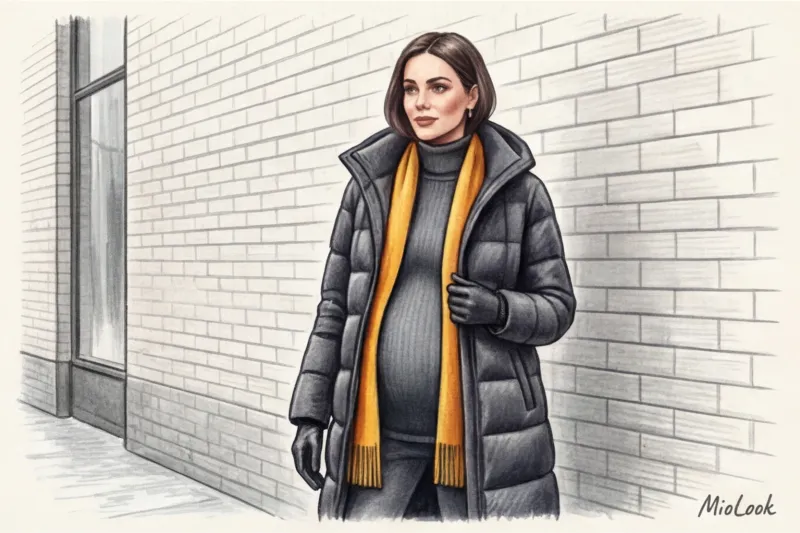
How to manage visual weight when you're wearing a lot of bulk:
- Create verticals. If the weather permits, wear your down jacket unbuttoned and tie a long, contrasting scarf inside, letting the ends hang down. This vertical color scheme instantly elongates your height and makes you look slimmer.
- Open up the weak spots. Balanced volume is the key to styling. If your jacket is chunky, accentuate your slender ankles (wear tall Chelsea boots or leggings) and wrists (choose styles with thick knit cuffs).
- Pay attention to the proportions of the head. A voluminous down jacket paired with a thin, fitted hat will make your head look tiny. Opt for chunky knit beanies, hoods, or add a voluminous scarf around your neck.
Your perfect look starts here
Join thousands of users who look flawless every day and easily create capsules with MioLook.
Get access — €0.99 onceChecklist: 6 Details for the Perfect Maternity Down Jacket
Before you take your jacket to the checkout, check it against this checklist. If even two items are missing, keep looking.
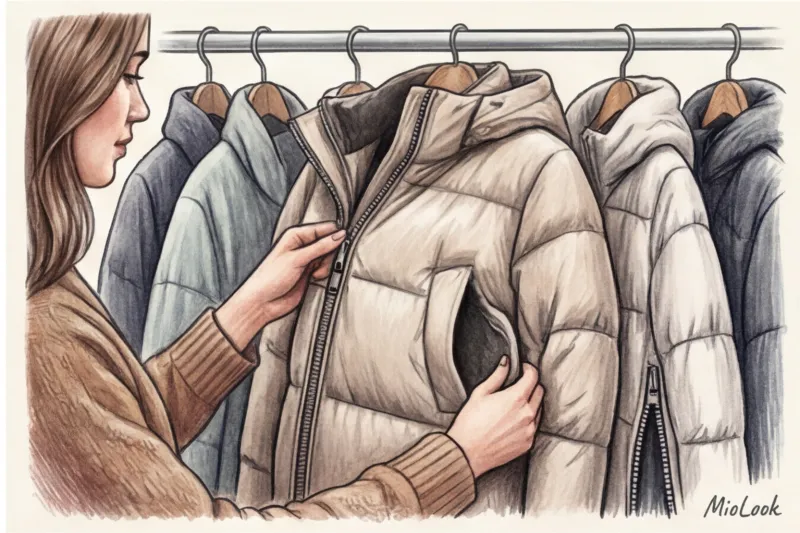
- Two-way zipper. This is an absolute must-have. You should be able to unzip your jacket at the bottom when getting into a car or public transportation, otherwise the tension on your stomach will be unbearable.
- Deep pockets with fleece lining. In the third trimester, putting on and taking off gloves becomes difficult. Fleece lining the pockets will warm your hands in seconds.
- Wind protection strip. The zipper is the most vulnerable point to wind. Above or below it, there should be a thick fabric flap with snaps or magnets.
- Knitted cuffs on the sleeves. They prevent cold air from getting in when you raise your arms.
- Deep hood with adjustment. It should be roomy enough to fit a beanie hat, but have drawstrings to prevent it from blowing away in gusts of wind.
- Midi length. The ideal length is mid-calf, or at least a longer jacket that completely covers the hips. Short down jackets will leave the lower back exposed.
Choosing winter outerwear is always an investment in your comfort and health. Don't compromise on uncomfortable, specialized styles. Look for smart cuts, high-quality insulation, and pieces that will last for seasons to come. And to seamlessly integrate your new down jacket into your wardrobe, try uploading a photo of it to MioLook app — Artificial intelligence will suggest dozens of stylish combinations with your current shoes and accessories.