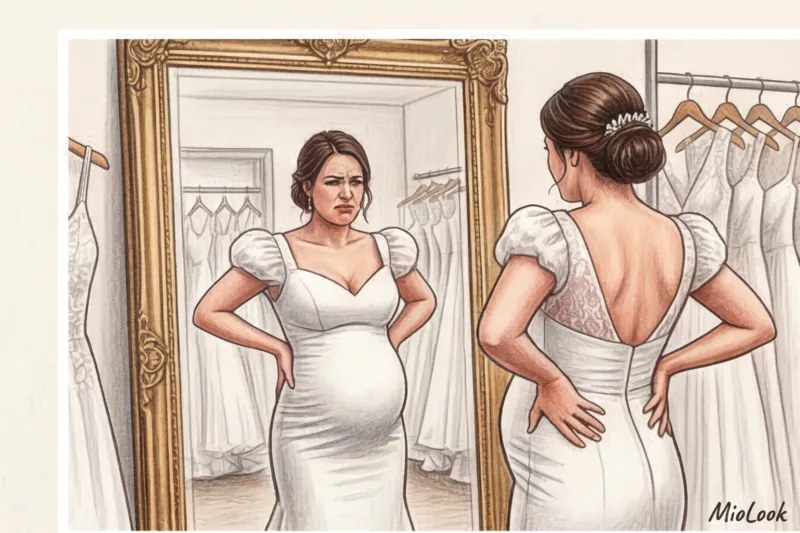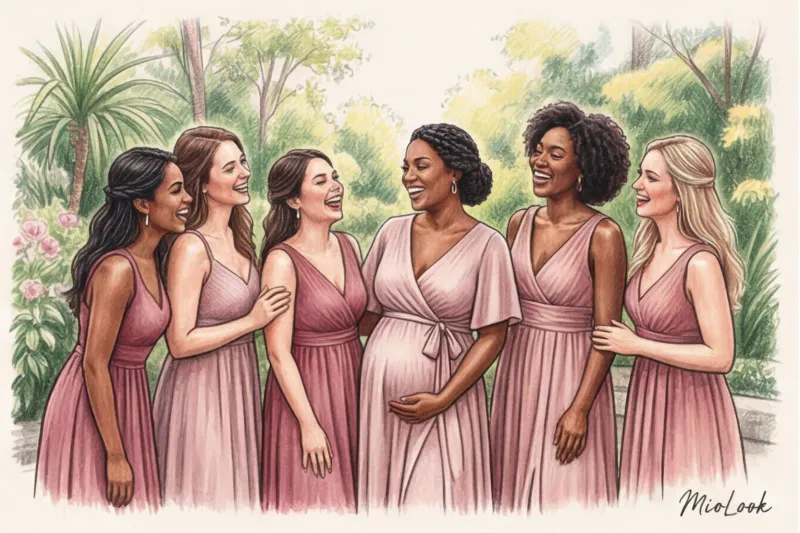
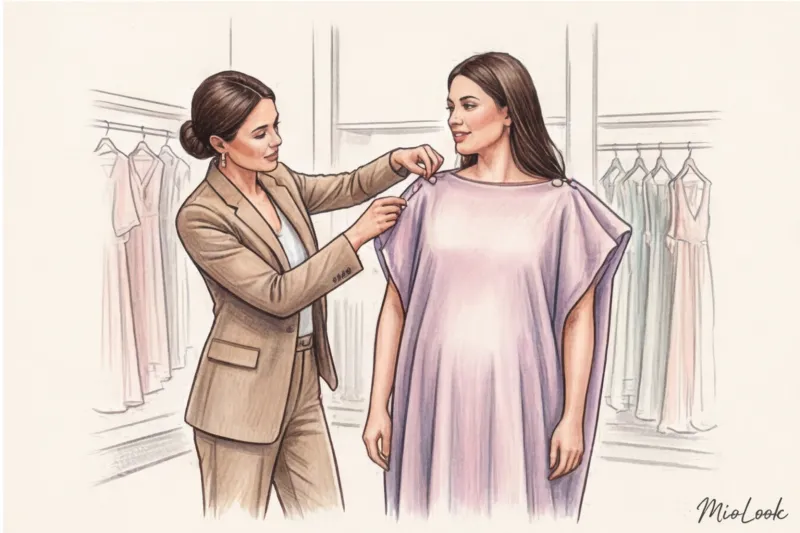
Imagine the scene in a fitting room: you're seven months pregnant, looking in the mirror and barely holding back tears. You're wearing a stiff, stiff fuchsia satin dress, identical to the ones four other girls will be wearing at your best friend's wedding. It cuts into your ribs and hangs loosely from your shoulders. Sound familiar?
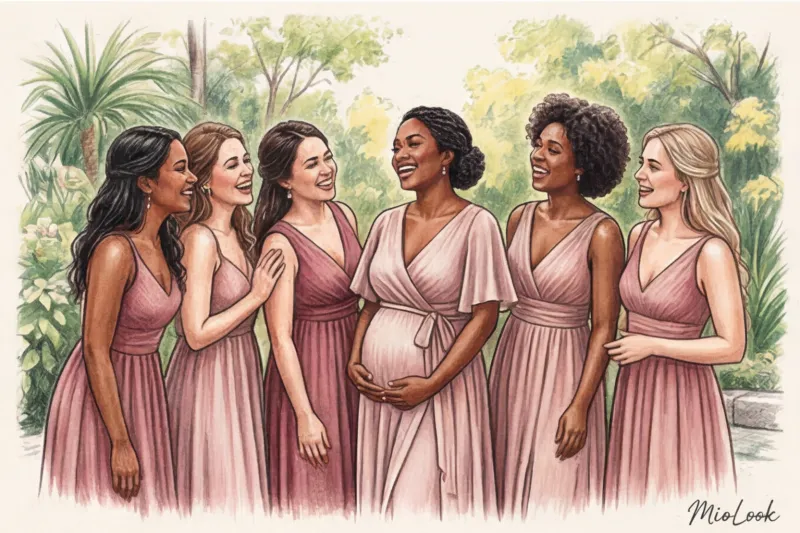
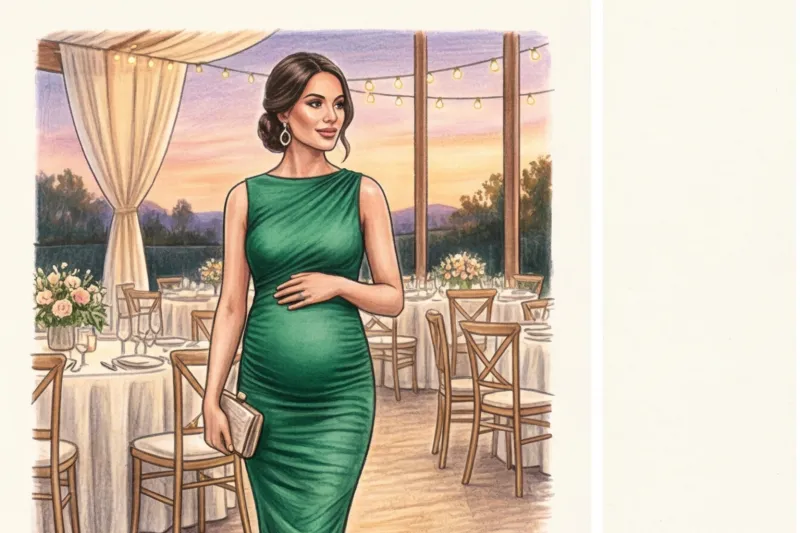
In my 12 years as a personal stylist, I've seen this drama dozens of times. The tradition of dressing all your girlfriends in identical clone outfits is an aesthetic crime, especially when it comes to their changing figures. Choosing maternity bridesmaid dresses , we must shift our focus: desperate attempts to "hide the belly" in tight covers are a thing of the past. Today, we celebrate the new body shape with thoughtful, architectural cuts.
I talked in more detail about why modern wedding fashion is finally abandoning identical outfits in our The complete guide to bridesmaid dress trends.
Forget the Teapot Covers: Maternity Bridesmaid Dresses and the Mix & Match Concept
Pregnancy isn't a problem that requires urgently draping with endless layers of tulle. It's an opportunity to choose a luxurious, individual silhouette. The Mix & Match concept elegantly saves the day: the bride specifies only the color palette or fabric texture, and each woman chooses a style that complements her figure.
Let's look at the real numbers. A large-scale study by the analytics platform Lyst for 2023 revealed shocking statistics: 85% of traditional bridesmaid dresses are worn exactly once, after which they end up in the closet or in the landfill. Meanwhile, adaptive styles that accommodate body changes are worn at least three times more often after childbirth. Pregnant women often, out of politeness, buy a rigid, compromised dress that is impossible to adapt to everyday life.
By integrating the bride into the overall wedding palette (for example, all in dusty rose shades, but with different textures), she will receive long-awaited comfort, and the bride will receive stunningly stylish, glossy, and "lively" photos without forced smiles.
Your perfect look starts here
Join thousands of users who look flawless every day with a smart assistant.
Get access — €0.99 onceThe biggest style myth: why you can't just buy a dress three sizes too big
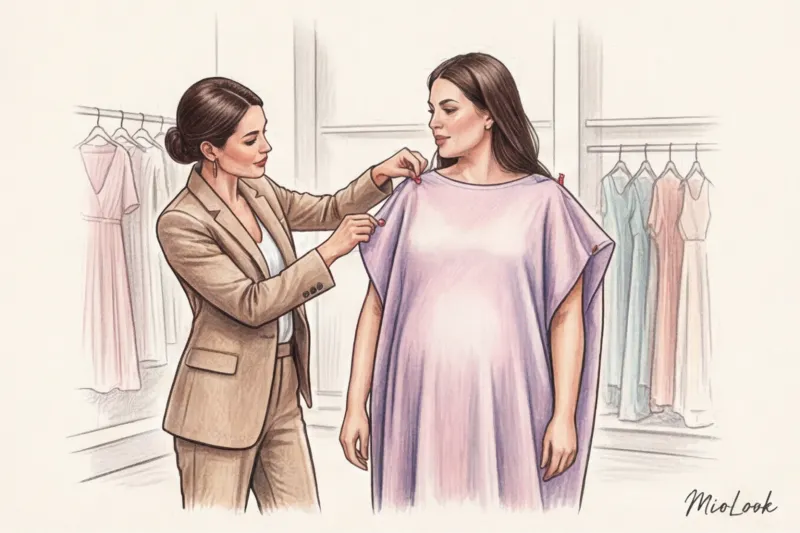
"Just get your favorite style, but in an XL instead of a medium, and your belly will fit!"—I hear this "good" advice all the time on forums. Following it is guaranteed to ruin your look. It's the most counterintuitive, yet ironclad, rule of tailoring.
"Pregnancy rapidly changes your waist, hips, and bust measurements, but your shoulder width and back length remain the same. If you buy a garment three sizes too big, the shoulder seam will sneak up to your elbow, the armhole will sag to your waist, and the neckline will reveal what should be hidden. Oversize is your worst enemy here."
The psychological effect of such an unjustified increase in size is disastrous: baggy clothes make your figure look bulky and squat. You'll look less like an elegant pregnant woman and more like someone wearing someone else's clothes. Unless the dress is from a special maternity-friendly line, the only stylistic solution is to buy your actual shoulder size, but carefully choose styles with a raised waistline or a bias cut.
Silhouette architecture: adaptation for each trimester
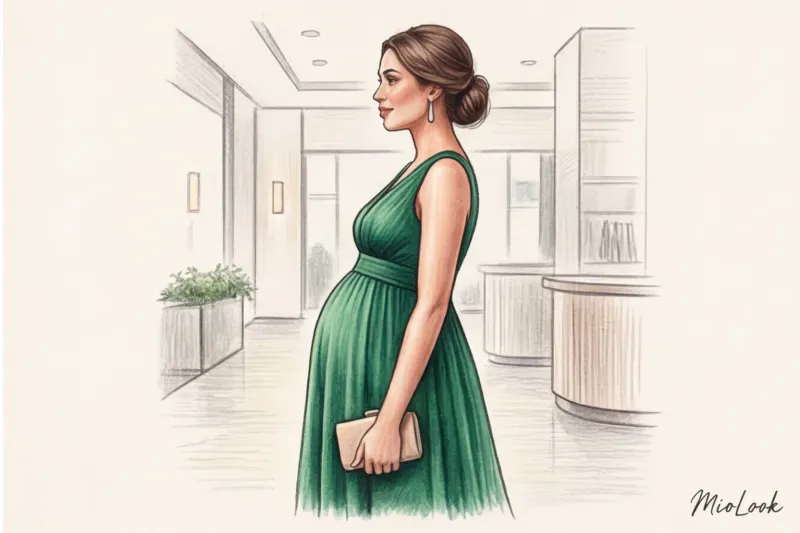
The body's dynamics during pregnancy are completely unpredictable. A dress that fits perfectly at 12 weeks has a 90% chance of not even closing at 28. One of the golden rules I religiously apply to my clients at any stage is that if we add volume to the abdominal area, we must reveal the most graceful and delicate parts of the body—the collarbones, wrists, and ankles. This instantly and visually lightens the silhouette.
First and second trimester: semi-fitted and draped
Early pregnancy, when the belly is just beginning to show, is the most dangerous styling zone. A poorly cut dress can make a pregnancy look less like the birth of a new life and more like the result of a heavy dinner at a banquet.
A-line dresses made of dense, shape-retaining cotton (180 g/m² and above) or viscose, as well as complex asymmetrical draping, work brilliantly here. Our main goal is not to cling to the changed waist with spandex, but to create a refined semi-fit that leaves a layer of air between the fabric and the body.
Third trimester: a celebration of form and maximum comfort
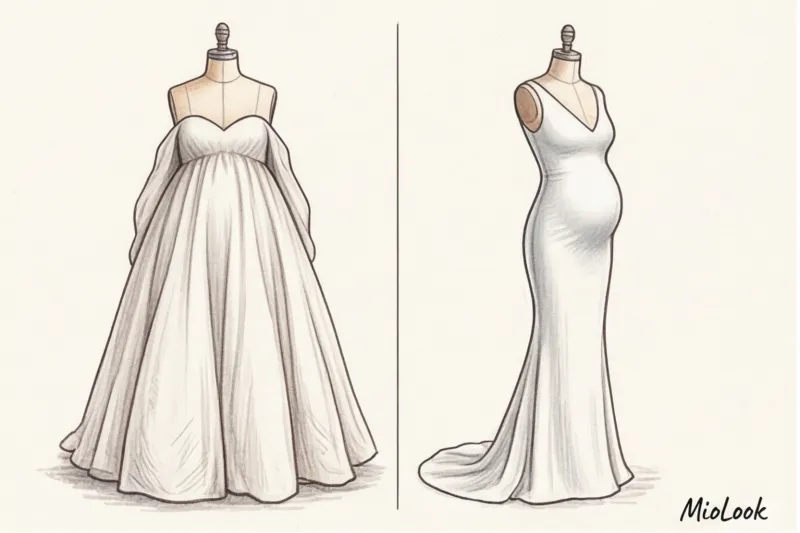
When a belly becomes pronounced and rounded, hiding it is pointless—it looks comical. The classic empire waist (cut just below the bust) is a tried-and-true solution for decades, but it's far from the only one.
Deep V-necklines paired with flowing, flowing hemlines perfectly balance the new proportions. Don't be afraid of elastic side panels: modern premium brands have masterfully integrated them so skillfully that they look like an intentional element of a complex design, not like a medical bandage.
Top 3 Maternity Bridesmaid Dress Styles That Work Better Than the Classic Empire Style
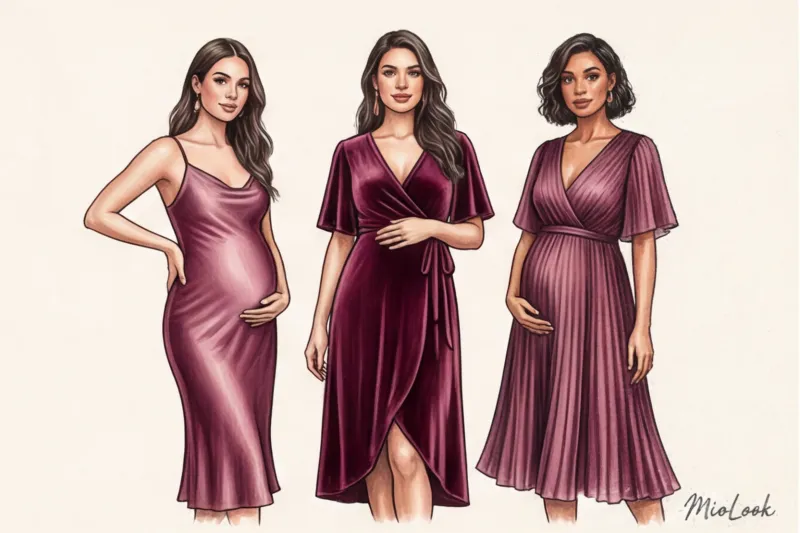
When my client Elena, seven months pregnant, was preparing for her sister's grand wedding, she categorically rejected the selection of maternity stores, considering their designs outdated. We found a luxurious solution in regular collections, simply by choosing the right design. Here are three styles that will save the day:
- Bias-cut slip dress. This is a brilliant invention by fashion designer Madeleine Vionnet. The fabric, cut at a 45-degree angle to the grain, acquires phenomenal natural elasticity. It stretches delicately where volume is needed and flows softly along curves. Fair Limit: This cut absolutely does not tolerate textured lace underwear; you will need smooth, seamless bras and panties.
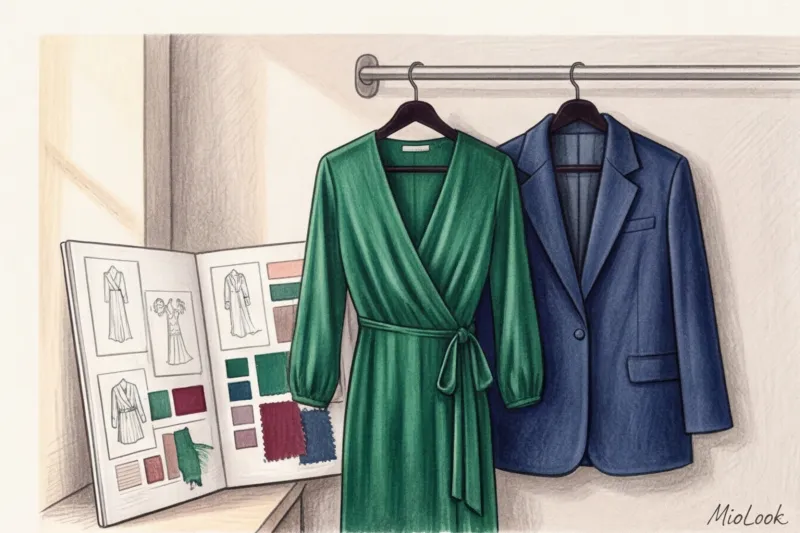
- Wrap dress. The perfect customizable volume system, invented by the legendary Diane von Furstenberg. You adjust the fit millimeter by millimeter, while the V-neckline luxuriously elongates your neck. It's an incredibly smart investment—after you give birth, you'll simply need to tie it a little tighter.
- Pleated and corrugated. Dresses in the recognizable style of Issey Miyake, composed entirely of fine, pressed pleats. This dynamic texture not only delicately conceals minor imperfections but also allows incredible freedom of movement, expanding at the stomach like an accordion.
Key bonus: these styles will fit easily and naturally into your capsule wardrobe After the celebration, you can add them to your virtual closet in the app. MioLook , and a smart AI stylist will show you dozens of ways to style a silk slip: for example, with a voluminous cashmere sweater and Cossack boots for stylish autumn strolls with a stroller.
Ready to get started?
Try MioLook's free plan—no hidden terms or obligations.
Get access — €0.99 onceFabrics That Will Save Your Party (And Those That Will Turn It Into Torture)
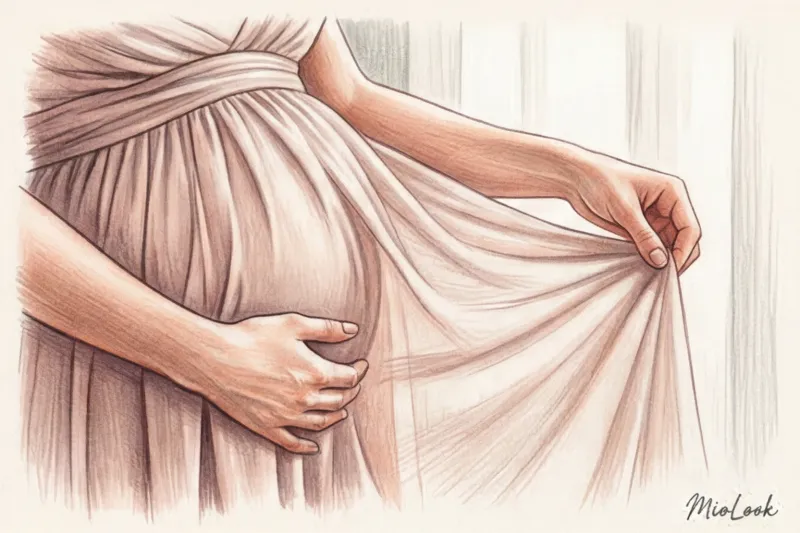
One of my pregnant clients almost fainted during a touching ceremony at a summer wedding in Tuscany. The reason? The luxurious-looking powder-colored dress was made of 100% polyester, which created a merciless greenhouse effect at 28°C (82°F). A pregnant woman's body temperature changes dramatically: even on a cool, windy evening, she can experience intense heat.
Strict blacklist: stiff taffeta (it painfully digs into the skin under the chest when sitting), thick synthetic satin (it doesn’t stretch at all and treacherously emphasizes the slightest evening swelling), non-breathable brocade.
Stylist Whitelist: Natural flowing silk chiffon, dense viscose with the obligatory addition of 5% elastane for dynamism, eco-friendly Tencel, soft matte crepe.
But here lies the main catch: the lining. Many popular mass-market brands make beautiful outer layers out of breathable viscose, but cynically cut the lining out of cheap polyester. A synthetic base layer will instantly ruin the whole effect and deprive your body of the ability to breathe. My rule: always turn the garment inside out before checking out. The lining should be cotton or viscose.
Shoes and Accessories: Elegance Without Back Pain
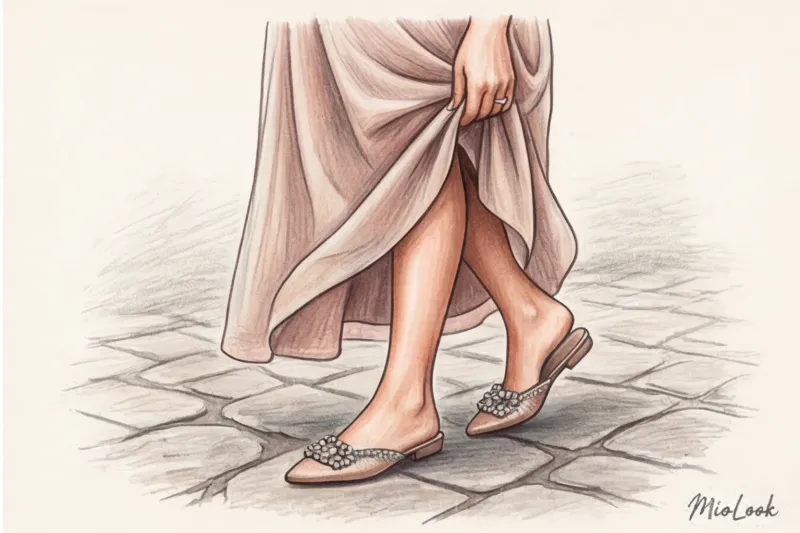
Evening swelling and a significant shift in the center of gravity are not horror stories from women's blogs, but a harsh physiological reality. Demanding a pregnant bridesmaid to stand manfully in 10-centimeter Jimmy Choo stilettos is the height of selfishness. Fortunately, modern dress etiquette has long since legalized elegant flat shoes.
Here are three stylish alternatives to classic pumps that won't ruin your look:
- Mules on kitten heel. An elegant micro-heel, 3-4 cm high, provides the necessary orthopedic lift for the foot (which is physiologically much better for the back than the completely flat sole of ballet shoes), but does not overload the vulnerable lower back at all.
- Elegant ballet flats with a pointed toe. An elongated, accentuated pointed toe visually lengthens the leg and adds height just as well as a stiletto heel.
- Sandals with a stable block heel. If your dress code or personal preference strictly requires heels, choose architecturally wide shapes that provide a secure base of support.
Secret trick from the site: Always pack two pairs of shoes in matching shades. Elegant heeled slingbacks are reserved for the 20-minute formal photo shoot at the arch, while luxurious velvet or soft suede ballet flats are for the hours-long banquet, toasts, and dancing.
Stylist Checklist: 5 Must-Have Fitting Room Tests
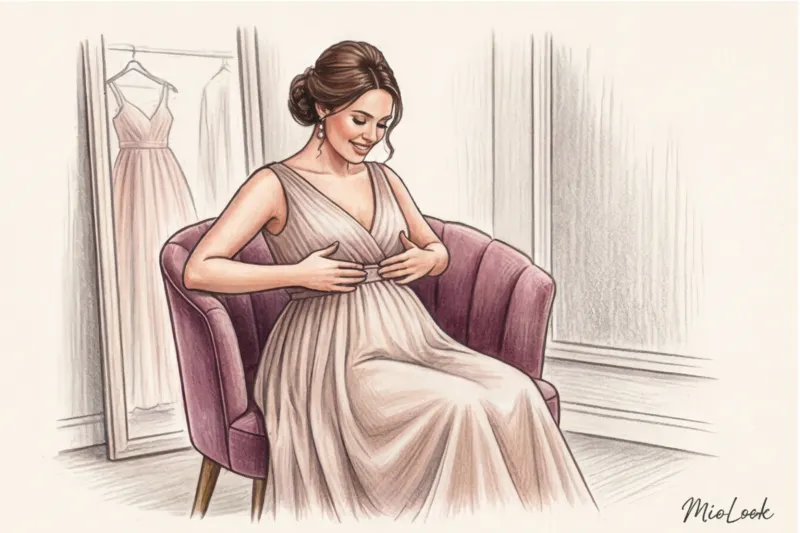
Recent Bridal Fashion Week trends (especially noticeable in the new collections of Vera Wang and Monique Lhuillier) are clearly and confidently moving toward adaptive ready-to-wear solutions for pregnant women. But even the most expensive and trendy designer dress must pass my uncompromising, signature test drive. Take a screenshot of this checklist before you visit the boutique.
- Sitting test. This is the most important step. Sit on a firm ottoman in the fitting room and completely relax. The fabric should not dig in under your bust, and the hem should not ride up indecently high. Remember: at a gala dinner, you'll spend about 70% of your time sitting.
- Underwear test. Does the back and shoulder design allow you to wear your most comfortable, tried-and-true supportive bra with wide straps? If your dress strictly requires silicone pads, this is a complete disaster for sensitive pregnant breasts.
- Step test. Take a wide, sweeping step forward. Is the hem wide enough? Does the fabric restrict the natural movement of your hips?
- Inhalation-exhalation test (diaphragmatic freedom). Take a deep breath into your stomach and chest. No seams should be popping, and the corset should not be pressing on your lower ribs.
To summarize: your physical well-being literally translates into your posture, facial expressions, and overall confidence in photos. Choose maternity bridesmaid dresses that gently embrace your figure, rather than trying to overshape it. Your main mission at this wedding is to comfortably and joyfully share happiness with your closest friend, not to struggle with your own outfit for ten hours.