
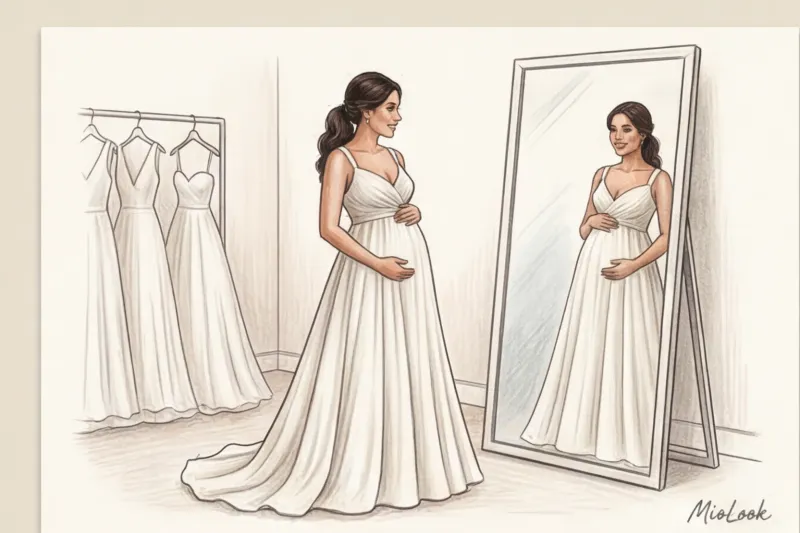
One day, my client Alina nearly fainted right there on the catwalk in the fitting room. She was seven months pregnant, and she was wearing a luxurious couture dress, lavishly embroidered with glass beads and crystals. This architectural beauty weighed almost 8 kilograms. It was then that I, Darina Marchenko, as a practicing stylist and colorist, realized: the traditional fashion industry is completely inept at working with expectant mothers.
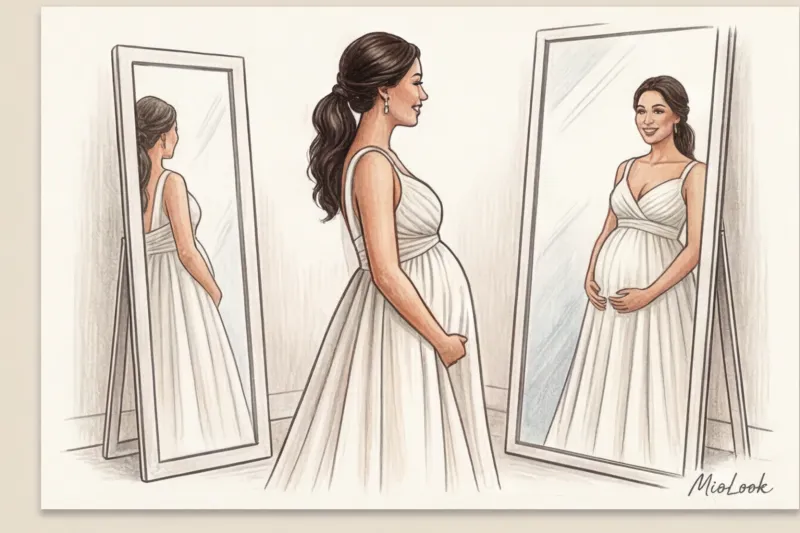
If you have a task ahead of you choosing a wedding dress for pregnant women Forget the clichéd advice from the glossy magazines of the early 2000s. "Just buy two sizes bigger" or "empire style will hide everything"—these are the worst things you can do to your proportions. In this article, we'll combine the laws of color, cutting architecture for a shifting center of gravity, and fashion technology to ensure your special occasion doesn't turn into an endurance test. We've covered smart technology in more detail in our complete guide to trying on a wedding dress online , and now we’ll look at the physiology and aesthetics of your ideal image.
The biggest mistake brides make: why you shouldn't just choose an oversized outfit when trying to find a maternity wedding dress
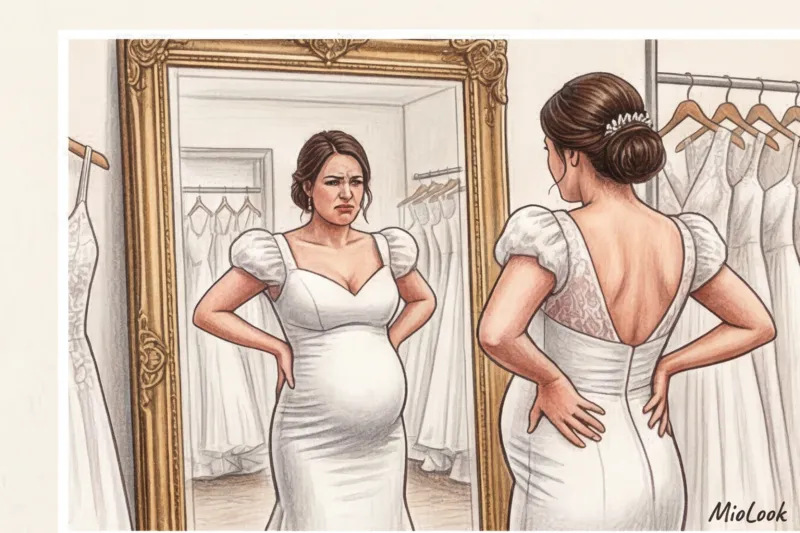
My personal stylistic anti-rating is topped by a bride's attempt to buy a standard plus-size dress, hoping to accommodate her growing bump. Buying a larger dress mercilessly disrupts the shoulder and armhole architecture.
Let's look at things from a design perspective. When you go for a size 48 instead of your usual 42, the fabric expands not only at the waist. Your shoulder line shifts, your armholes become too deep (revealing your underwear), and your bust darts are misplaced. As a result, your figure doesn't look pregnant, but simply bulky and shapeless.
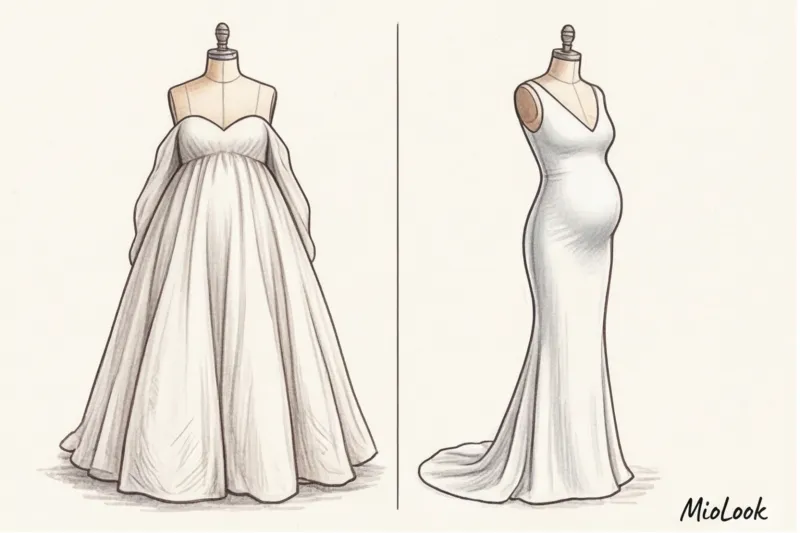
The second popular myth is the empire line (with a cut-off line under the bust) that's so life-saving. For some reason, it's generally believed to suit absolutely all expectant mothers.
"The empire line, especially when made from stiff fabrics like taffeta or standing tulle, often turns a woman into a massive cupcake. The straight cut line under the bust visually expands the rib cage, which already expands during pregnancy due to the separation of the lower ribs."
Don't forget about physiology: during pregnancy, your center of gravity shifts forward. If your skirt is too heavy or long in the front, you'll instinctively lean back, putting strain on your lower back. A proper hemline should be slightly shorter in the front (just 1-2 centimeters) to prevent you from stepping on the edge of the fabric when walking.
Access to MioLook for €0.99 — one-time payment
A smart AI stylist will select the perfect look based on your body shape.
Get access — €0.99 onceHow to Choose the Right Maternity Wedding Dress: A Trimester Guide
The choice of dress depends crucially on the stage of pregnancy at which the celebration will take place. What looks perfect at 12 weeks may become a torture device at 30.
- First trimester: The tummy is still unnoticeable or appears as a slight bulge. Concealing drapes, wrap dresses, and thick silk crepe that doesn't cling too tightly are ideal here.
- Second trimester: The golden age of pregnancy. Your curves are becoming more rounded, and your well-being is improving. Feel free to accentuate your bump with a form-fitting dress made of thick jersey with 5% elastane.
- Third trimester: The main priority is support and weight distribution. Medical recommendations for compression during pregnancy strictly prohibit rigid corsets on the ribs.
Fabric is everything. Choose materials that flow rather than stay put. Natural silk crepe with a 22-mommie count or flowing viscose is preferable to multi-layered, stiff tulle. And remember weight: while a standard couture dress weighs 5-8 kg, your late-pregnancy outfit shouldn't exceed 2-3 kg, otherwise, by the end of the evening, you'll be wishing you could take it off.
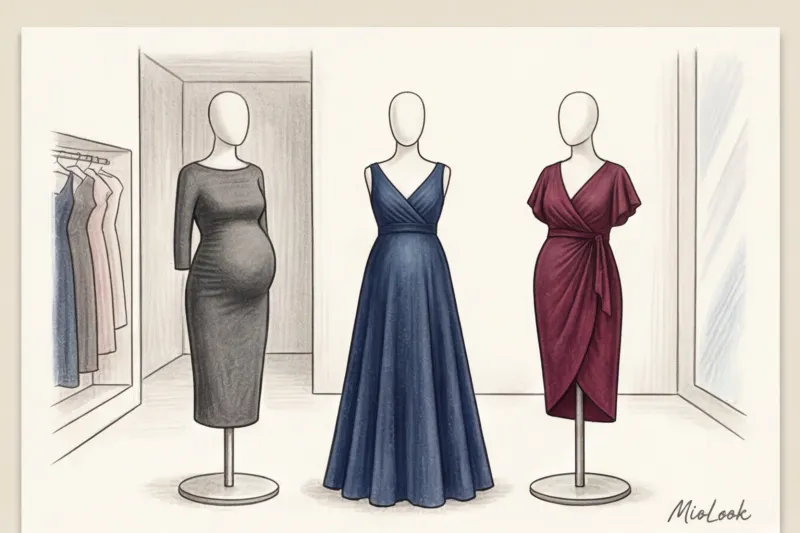
Alternative silhouettes: A-line, slip-dress, and asymmetry
If empire style isn't a panacea, what should you choose? My absolute favorite for expectant mothers is a proper A-line. Unlike a full ball gown, it flares out gradually, visually elongating the silhouette.
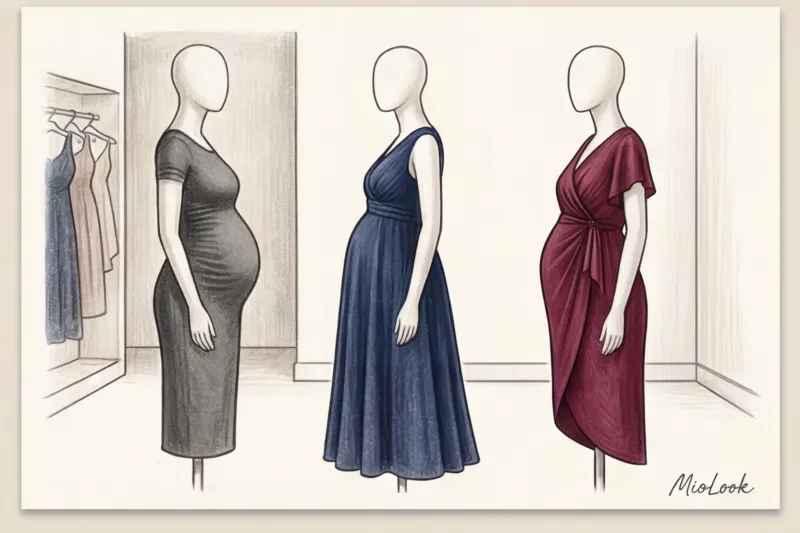
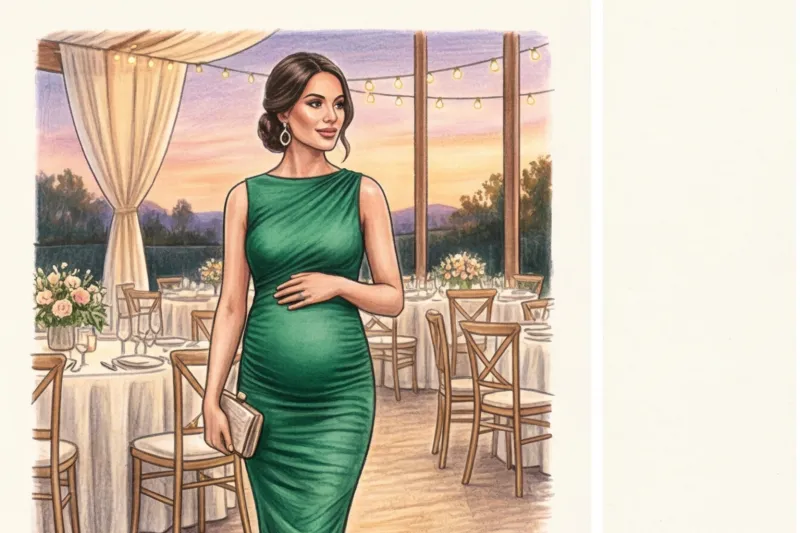
Asymmetrical cutting is another stylist's secret tool. Diagonal lines (for example, an asymmetrical one-shoulder drape or a bias-cut wrap) create an optical illusion that breaks up volumes and makes the look more dynamic and harmonious.
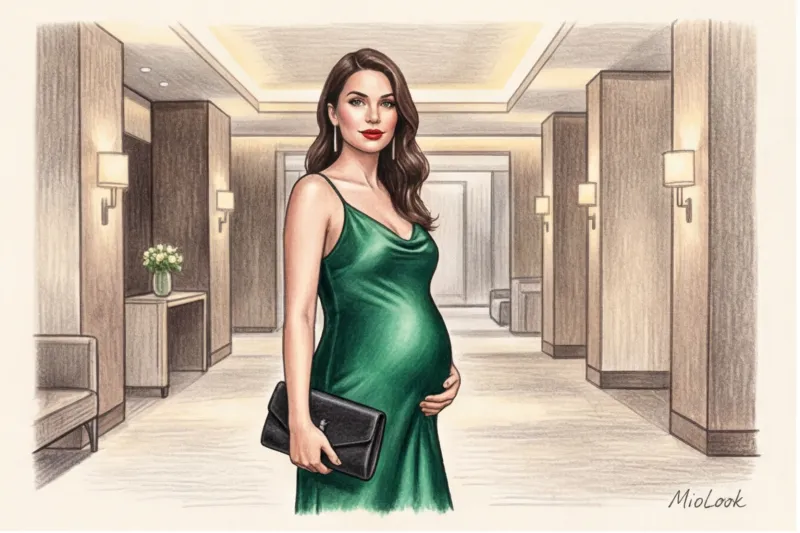
Fair limitation: Popular slip dresses made of thin satin, cut on the bias, look luxurious in early pregnancy. But let's be honest—in the third trimester, thin, shiny silk will mercilessly highlight the changing anatomy of the belly button and the contours of the maternity support. This is a trend that's best skipped.
Your perfect look starts here
Join thousands of users who look flawless every day with MioLook.
Get access — €0.99 onceHormones and Color: Why Pure White Can Let You Down
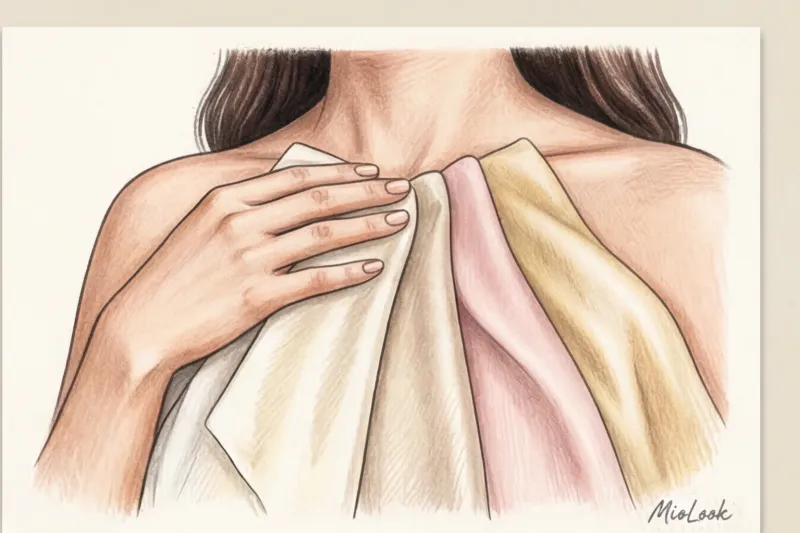
As a certified colorist, I constantly see the same thing: a bride who has been a cold "winter" her whole life and worn contrasting colors suddenly loses her usual palette during pregnancy. Why does this happen?
According to medical statistics, 70% of women experience changes in their skin's microrelief and undertone due to dramatic hormonal changes. They become prone to pigmentation (the so-called pregnancy mask), rosacea, or simply a persistent flush due to increased blood volume. The natural contrast in their appearance softens.
If you wear a harsh, crisp white (True White) during this period, it will act as a photo-reflector, mercilessly highlighting even the slightest puffiness, under-eye fatigue, and redness. White is unforgiving of undertones.
What to choose instead of pure white:
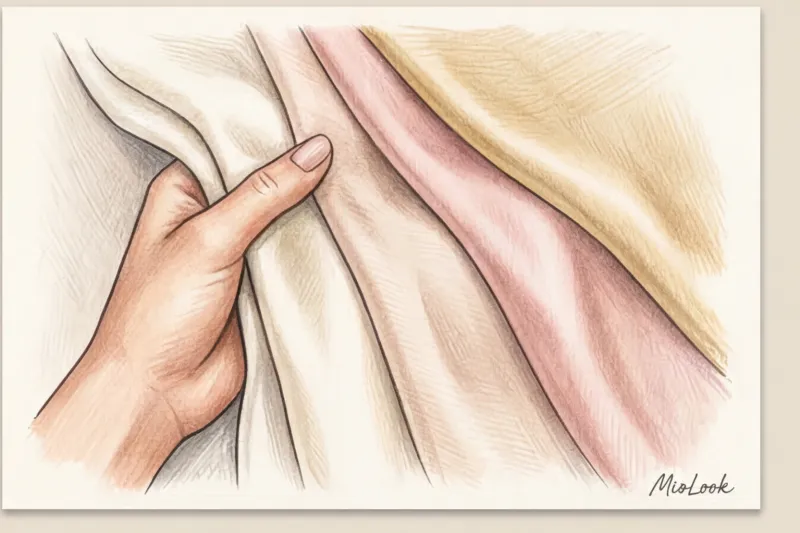
- Ivory: It has a warm drop of yellow and is great for neutralizing dark circles under the eyes.
- Champagne: Ideal for girls whose skin has acquired a warm, peachy undertone during pregnancy.
- Dusted Rose: amazingly refreshes the face, making the image softer.
- Pearl Gray: A choice for those whose skin undertone remains cool but has become more translucent.
Evening dresses for expectant mothers: from a social event to an intimate party
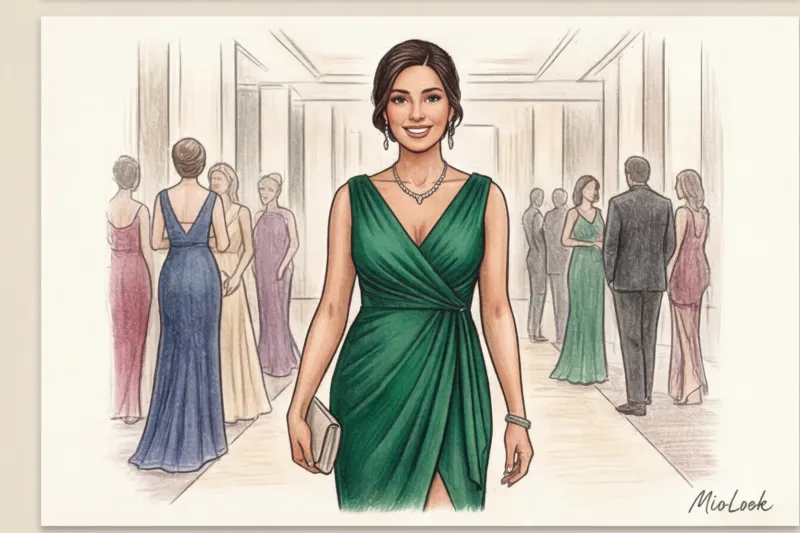
Weddings aren't the only occasions—mothers-to-be also attend corporate events, premieres, and anniversaries. If the dress code calls for black tie or cocktail attire, forget about shapeless robes.
An ultra-fashionable alternative to a dress is an evening pantsuit. Choose palazzo pants with a special elasticated knit insert under the belly and pair them with a long tuxedo jacket in matte crepe. The vertical line of the unbuttoned jacket will visually elongate your height and hide any extra volume at the sides.
The secret to luxurious looks lies in shifting the accent. Use statement accessories in the portrait area (large chandelier earrings, chunky necklaces) to draw attention away from the belly and toward the face and shoulder line.
Ready to get started?
Try a free plan—no commitment. Create your perfect capsule wardrobe online.
Get access — €0.99 onceFashion Tech as a Pain Reliever: Trying on a Wedding Dress Online

According to The Knot (2023), the average bride tries on 10 to 15 dresses before making her final choice. For a pregnant woman, 15 fittings in a salon with blinding artificial lighting, rigid corsets, and the need to constantly change is a sure path to emotional and physical burnout.
I remember my client Anna, who burst into tears in the fitting room of her third salon. Not because the dresses were bad, but because of simple physical back pain. This is why I actively incorporate fashion-tech solutions into my practice.
AI algorithms can narrow the selection funnel from 1,000 dresses to 3-4 ideal options, taking into account your deadline, body type, and color type. Using the virtual try-on feature MioLook You can test dozens of silhouettes while sitting at home on a soft sofa with a cup of chamomile tea. The technology analyzes proportions and shows how the draping will fall, saving you time, energy, and stress for the big day.
Stylist Checklist: 5 Steps Before the Final Purchase
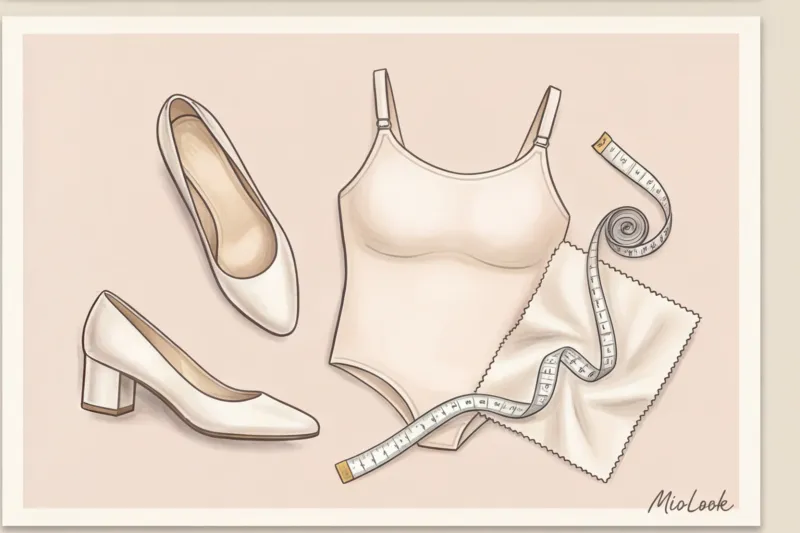
Before you punch in the receipt or click "Order," run your choices through this insider checklist. These are the kinds of things you rarely see in glossy magazines, but they're the ones that save the day.
- Restroom logistics: Consider whether you can use the restroom on your own or with minimal assistance. Tiered tulle skirts weighing several kilograms make this basic need an impossible task.
- Swollen Leg Test: By evening, a pregnant woman's feet can increase by half or even a full size. Evening shoes should be chosen for a dress in the evening, when feet are already swollen. Avoid narrow straps that dig into the ankle.
- Temperature comfort: Due to increased circulation, expectant mothers experience fever more often. A long-sleeved dress made of thick polyester will turn into a greenhouse. Look for breathable materials (silk, viscose, cotton).
- Inhalation-exhalation test while sitting: Have you ever noticed how a perfectly fitting dress in the morning starts to dig into your ribs when you sit down at the table? Be sure to sit down in the dress during the fitting and take a deep breath.
- Chest dynamics: Remember that your breast size can change even within a single day. The inner bodice of your dress should have some elastic or lacing to avoid disrupting milk flow and circulation.
Preparing for a wedding or a social event as a mother-to-be isn't about finding a compromise between "pretty" and "comfortable." It's an engineering challenge that's easily solved today with the right fabrics, an understanding of your proportions, and modern technology. Don't try to squeeze your changing body into old shapes—let the cut work for you.