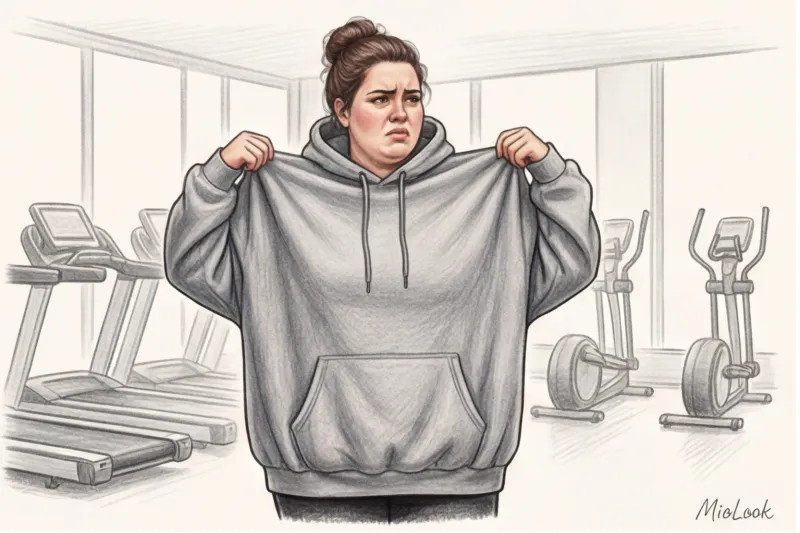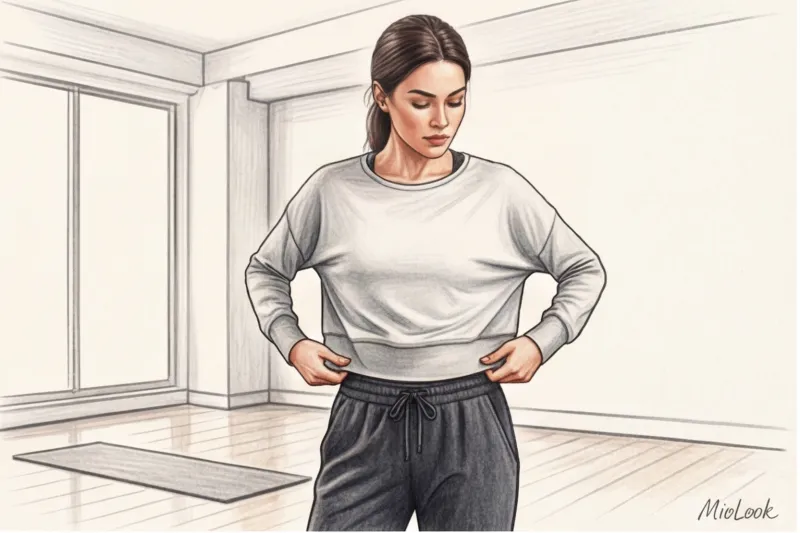
The most modest item in your everyday wardrobe—an oversized cotton hoodie or an oversized T-shirt—paradoxically becomes the most revealing and uncomfortable piece of clothing on the yoga mat. Ever notice how treacherous your favorite tank top is during a simple bend?
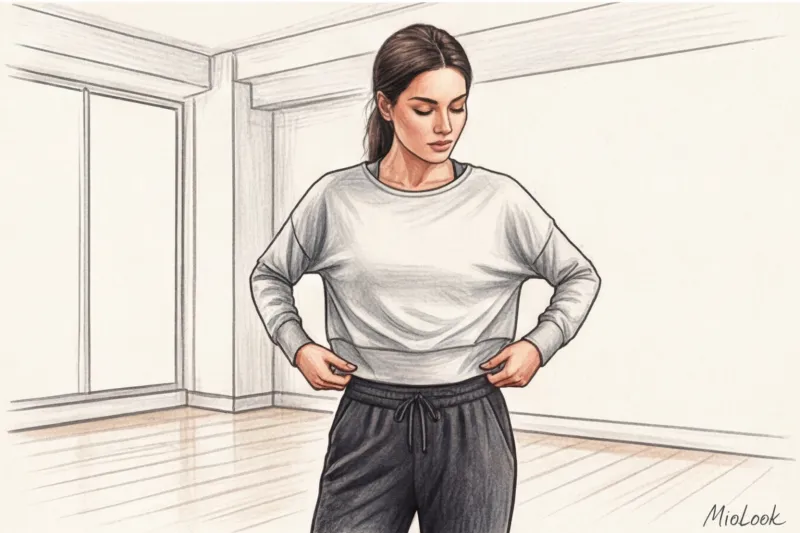
I often see this mistake: girls who want to hide their figure features or simply don't like tight biflex, buy sportswear three sizes too big. But a properly chosen women's loose-fitting yoga clothes It's not a shapeless bag. It's a carefully designed "architectural volume" that protects you from awkward situations in inverted poses and allows you to focus on your breath, not the slipping fabric.
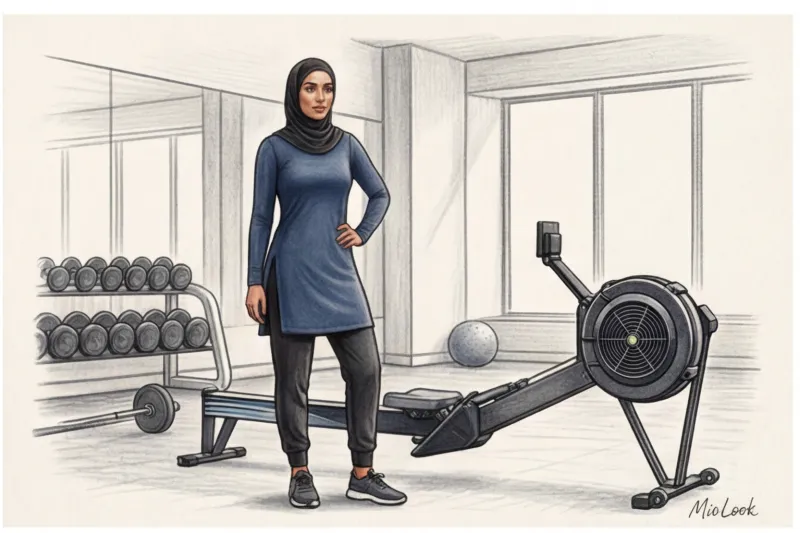
We have already discussed the standards of closed equipment in more detail in our The complete guide to sportswear for Muslim women , but the principles of proper tailoring work for absolutely everyone. Let's look at how to choose a loose fit that will stay in place even during a headstand.
Loose Women's Yoga Clothes: Why Street Oversize Works Against You
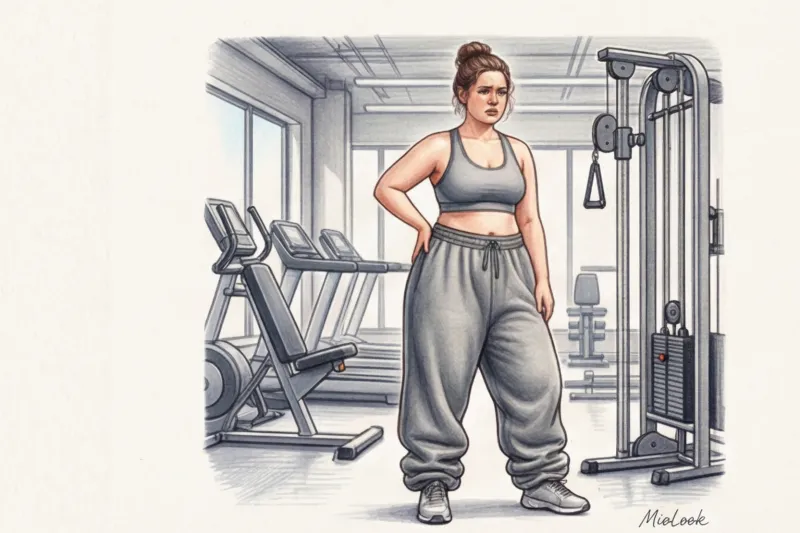
One of my clients, let's call her Anna, showed up to her first Hatha yoga class wearing a 3XL men's T-shirt. The idea seemed brilliant: to hide her stomach and thighs. The reality was harsh. During her very first Downward-Facing Dog pose, the collar of the T-shirt fell over her face, exposing her back and stomach for the entire room to see. Anna spent the rest of the class frantically pulling the hem back over her hips.
Oversized streetwear is designed for static positions or simple walking. Yoga and Pilates emphasize inversions, deep twists, and active floor work. The golden rule applies here: clothing should be loose-fitting but have firm anchor points.
- No: Straight cut without cuffs or elastic bands.
- Yes: 'Architectural volume' concepts where the fabric flows freely along the body, but is securely fastened at the waist, hips or wrists.
Bottom architecture: how to choose trousers that don't slip or get tangled
The fashion for wide-legged palazzo and Aladdin pants has firmly established itself in the fitness segment. They look incredibly aesthetically pleasing in photographs, but they pose a real danger during workouts. According to the Pilates Institute of Biomechanics (2022), excessively wide hems without support increase the risk of loss of balance and injury on a Reformer machine by 40%, as the fabric easily gets caught in the springs and rollers.
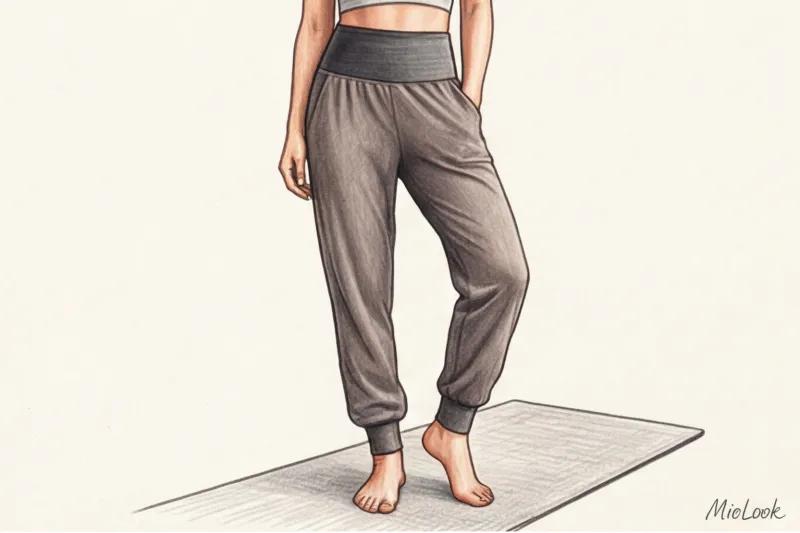
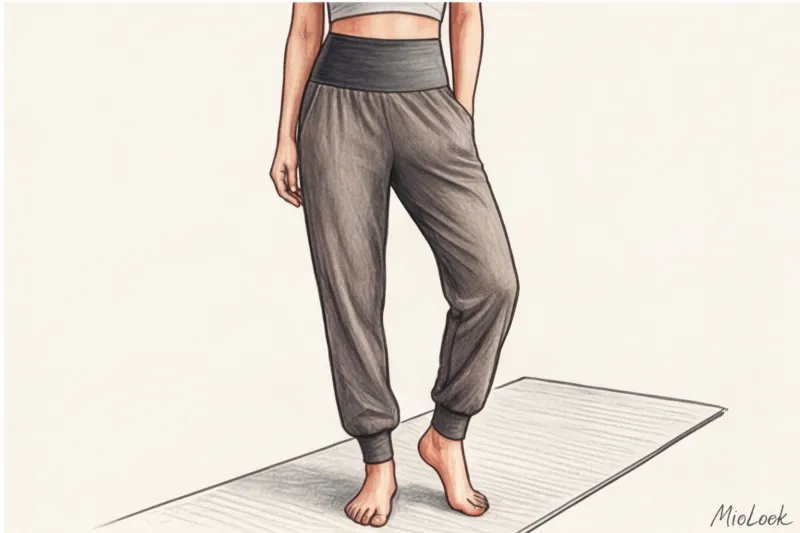
To make loose pants work for you, look for two essential details. The first is a wide gusset (the diamond-shaped inset in the inseam). This gives you that extra freedom of movement and protects the inseam from tearing when doing splits. The second is a high compression yoke or a thick waistband at least 8–10 cm wide. The bulk at the hips is offset by a secure hold at the waist.
"A fair point: if you're doing intense aerial yoga in hammocks, forget about baggy pants of any cut. The fabric will inevitably get tangled in the straps. This is the only time when tight leggings are a safety issue, not a style one."
Cuffed joggers are the perfect compromise
If you want to conceal the contours of your legs while maintaining functionality, choose joggers made of soft, draping fabrics with thick ankle cuffs. The cuffs act as a stopper: when you lift your legs into Birch Pose (Sarvangasana), the fabric will gather slightly, preventing it from bunching up toward your knees.
The optimal amount of looseness for yoga is 3–5 cm of space between your body and the fabric. High-quality branded joggers (such as those from Oysho or Uniqlo's basic sports collections) cost an average of €40–€80, making them a great investment in your comfort.
Ready to get started?
Try a free plan—no commitments. Create your perfect gym capsule today.
Get access — €0.99 onceThe perfect top: to keep your stomach and back covered
Finding the right loose top is a challenge. Your choice should be based on where exactly you want to create volume and what you plan to conceal.
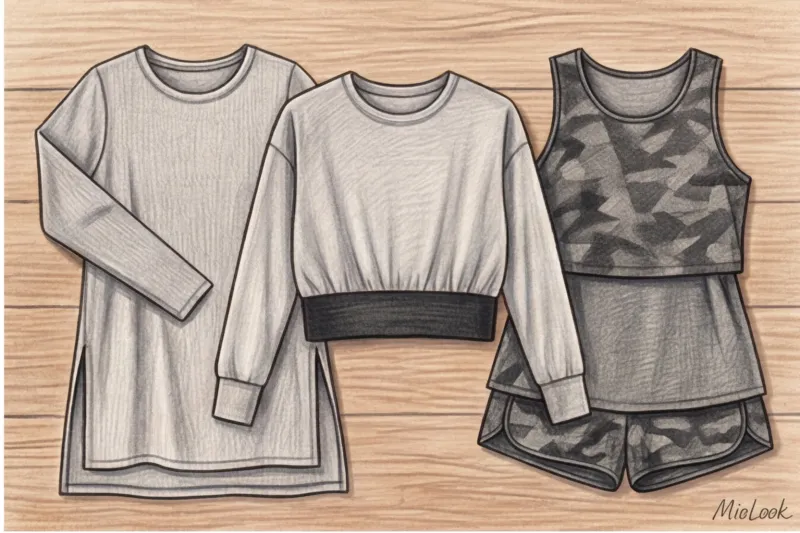
My top style secret for low-key fitness is tops with banded hem (with a wide elastic waistband at the bottom). They create a soft, loose fit over the stomach, completely concealing folds, yet still stay firmly in place on the hips. You can do a handstand or hang upside down—this long-sleeve top or T-shirt won't move a millimeter.
If you prefer elongated silhouettes, consider tunics (longline) with deep side slits. The slits here are not decorative, but biomechanically necessary. They allow your pelvis to move freely, allowing you to perform deep lunges without straining the fabric at your hips.
Pay special attention to the armholes. Avoid tops with deep armholes (muscle tees). When raising your arms, such armholes will reveal your chest and underwear from the sides. The armholes should be covered, even if the top itself is very loose.
Fabrics that won't betray you: Forget about cotton forever
Let's debunk the biggest myth in the industry: "natural cotton is the best choice for sports." For a light warm-up, maybe. For a full-fledged workout, absolutely not.
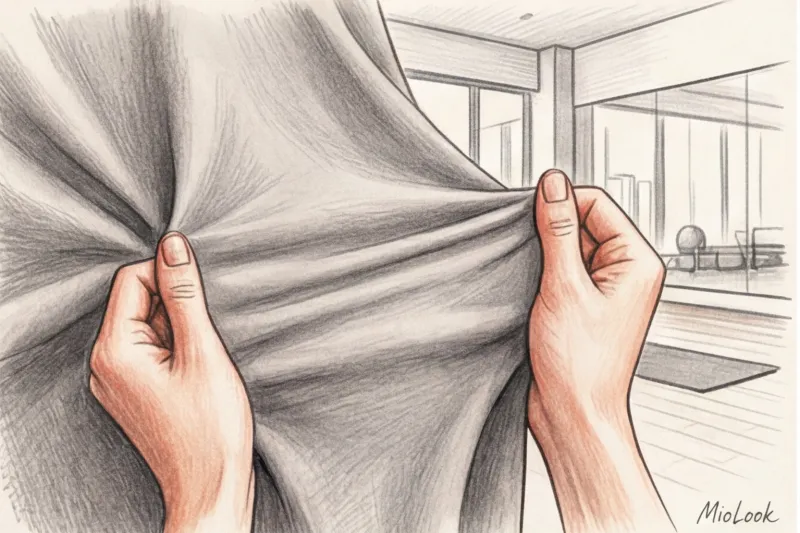
Research in the Textile Research Journal (2023) confirms that cotton can absorb 27 times its own weight in moisture and takes three times longer to dry than modern high-tech fabrics. In practice, this translates into the "wet T-shirt effect." Even the loosest cotton top becomes damp with the slightest sweat, becoming heavy and clinging to your skin, outlining every curve and highlighting what you were trying so hard to hide.
Instead of cotton, look for the following compositions:
- Modal and Lyocell (Tensel): Wood fibers that drape beautifully, cool the skin and wick away moisture without clinging to your back.
- Bamboo with elastane: Bamboo viscose has antibacterial properties, and elastane (there should be at least 10-15% of it) ensures that pants that have stretched out at the knees will return to their original shape.
Also, pay attention to texture. Always choose completely matte fabrics. A glossy sheen (like that of classic biflex) acts as a highlighter—it visually increases volume and mercilessly accentuates even the slightest unevenness.
Layering for Pilates and Yoga: A Secret Styling Trick
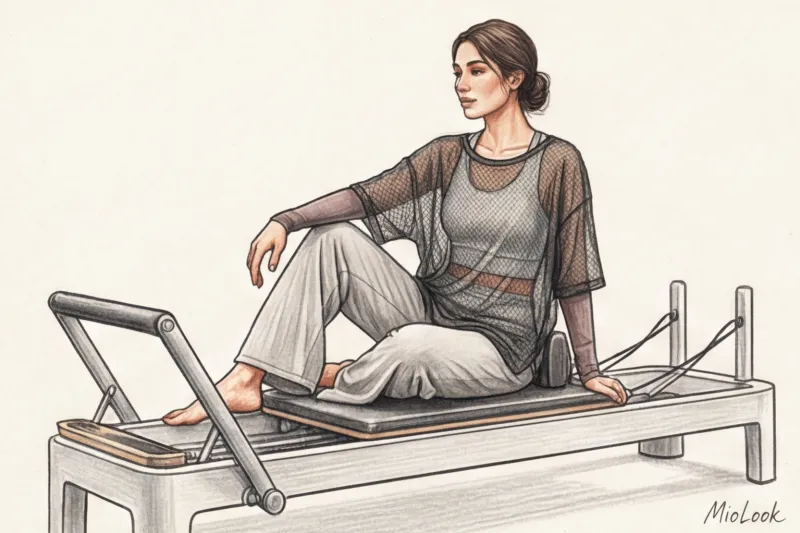
What if you're psychologically uncomfortable in tight-fitting clothing, but the specific nature of your workout (for example, using complex equipment) requires a more closed-toe outfit? Layer. This is my favorite technique, which I often recommend to clients when putting together a capsule wardrobe for the gym.
The method is simple: for the first layer, you put on a form-fitting but maximally covering basic garment. This could be a long-sleeved bodysuit, a full-coverage compression top, or a thin sports rashguard. Then, with the second layer, you add volume—a flowy mesh top, a loose crop top, or a sleeveless tunic.
This creates an airy, understated silhouette. Even if the top layer slips or rides up during rolling, a secure, closed base remains underneath. No constriction, total freedom of movement. In the app MioLook You can easily load up your workout gear and put together these layered looks ahead of time so you don't have to waste time before you hit the gym.
Your perfect look starts here
Join thousands of users who look flawless every day with MioLook. Match layers and colors without mistakes.
Get access — €0.99 onceOptical Illusions and Color: A Colorist's Perspective
As a certified colorist, I always pay attention to how color plays dynamically under the harsh artificial lighting of fitness centers. The most common mistake is choosing a light monochrome (beige, light gray, pastel pink) when trying to conceal contours.
Light shades reflect light and visually expand the boundaries of an object. If you're self-conscious about volume, light, loose clothing will make you look like a cloud. Instead, use strategic optical illusions:
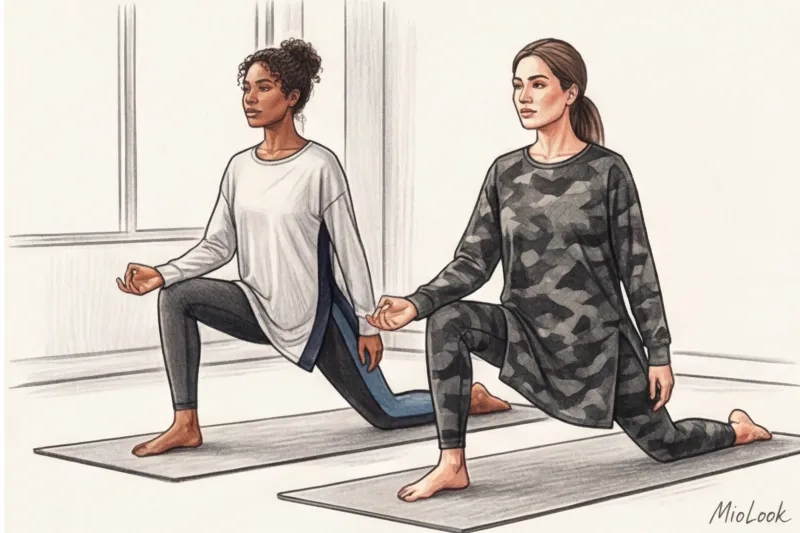
- Side color block: Long sleeves or T-shirts with a light center and wide dark inserts on the sides literally “eat up” the waist, creating an elongated silhouette even on a loose garment.
- Small print: A complex abstract pattern, geometric print, or dark camouflage are the best friends of discreet fitness. The print breaks up the lines, preventing the eye from focusing on the actual contours of the body beneath the fabric. And as a pleasant bonus, sweat stains are completely invisible on the patterned fabric.
Checklist: Test drive the uniform in the fitting room
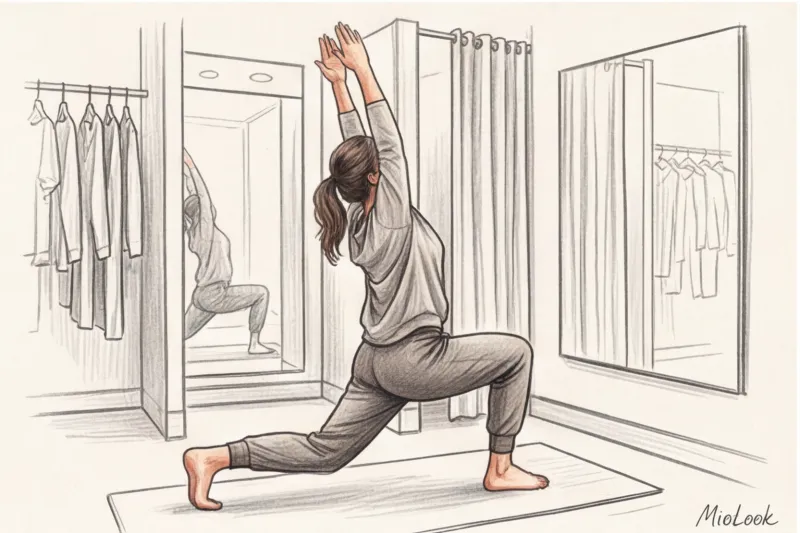
I physically keep my clients in the store's fitting room until they've fully crash-tested their chosen sportswear. Standing up straight in front of the mirror isn't enough. To determine if you'll be comfortable on the mat, follow these three simple steps right in the booth:
1. Raise both arms sharply upwards. Look in the mirror: is your stomach showing? Is the center seam of your pants digging in? If your top rides up and doesn't go back down when you lower your arms, return it to the hanger.
2. Bend forward deeply, reaching your hands to the floor. Ask a friend to check (or turn to look at the mirror): is your underwear showing through the fabric stretched across your buttocks? Loose pants can also be treacherously see-through if they're pulled tight.
3. Squat deeply. Is the waistband of your pants slipping down your back? If you need to pull them up, you'll be doing it every five minutes during your workout. Look for a style with a higher, firmer rise.
The right loose clothing is your invisible armor. It gives you a feeling of complete protection, allowing you to focus all your energy not on how you look, but on how your body feels in the moment. Invest time in finding the perfect cuffs and fabric thickness, and your practice will reach a whole new level.