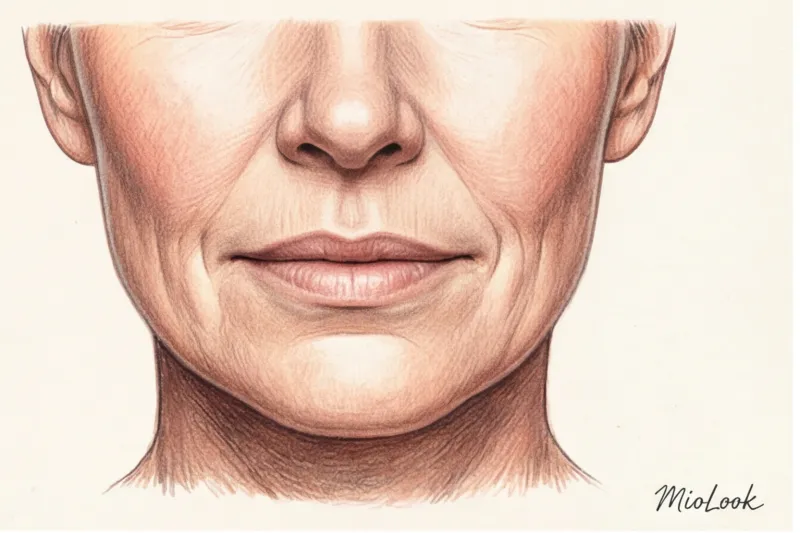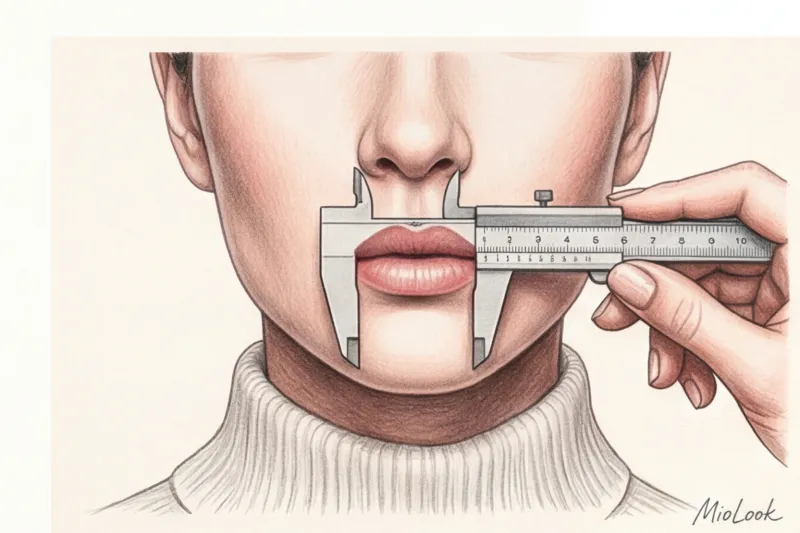
Do you know what detail on your face can visually add five to seven years to your age or, conversely, make your chin appear heavy and coarse? Spoiler: it's not deep nasolabial folds or pigmentation. It's just a couple of millimeters from your nose to your upper lip.
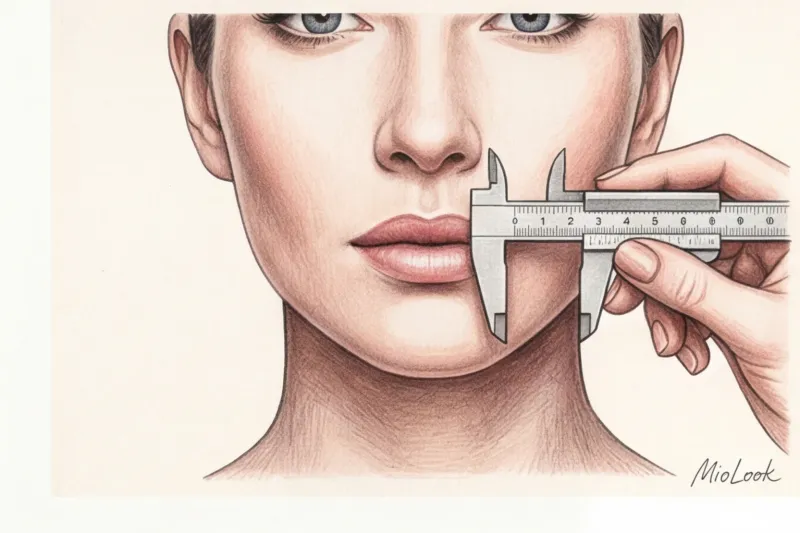
Unlike the thousands of videos on social media that simply teach you to "draw lips well beyond the outline," I suggest looking at the face through the eyes of an architect. Correcting the shape of lips with makeup — is not the art of coloring within (or outside) the lines. It is working with proportions, the length of the chin, the width of the jaw, and the use of light and shadow.
We have covered in more detail how different zones influence each other in our The complete guide to perfect makeup for every face shape And today we'll talk about the lower third.
Facial Anatomy: Why Blind Lip Augmentation Destroys Harmony
The history of makeup is a history of attempts to trick genetics. Think back to the 1920s: Clara Bow's tiny, bow-shaped lips visually widened her cheeks, making actresses' faces look doll-like. The 2010s ushered in the era of hypervolume—dense matte textures and fillers brought lips to the forefront, but also created a widespread problem. Enormous lips on a narrow face visually "devoured" the chin, making the lower jaw appear disproportionately small and the nose appear large.
Over 12 years of working with faces, I have developed an ironclad rule: any local increase in volume immediately changes the perception of adjacent features.
One of my clients, a senior manager in the IT sector, complained about communication problems with new partners. While analyzing her image, I realized the problem. Her harsh, graphic, and artificially exaggerated lip line created an aggressive, distrustful mask that was completely at odds with her soft negotiating style. Once we replaced the graphic style with a softer, more shaded lip line, harmony (and the trust of her interlocutors) returned. If you're unsure whether your image is appropriate in a corporate environment, consider stylish makeup for work in the office — We analyzed similar errors there.
Filtrum and the Golden Ratio: The Mathematics of Youth
In modern maxillofacial surgery there is a concept filtrum The philtrum is the vertical depression between the nose and the upper lip. Research shows that the ideal length of the philtrum in women is 11-15 mm. With age, the orbicularis oris muscle weakens, the upper lip turns inward, and the philtrum lengthens.
What does this mean for us? An incorrectly drawn upper lip contour (especially if you underline the Cupid's bow) instantly adds age. Previously, Leonardo da Vinci's 1:1.6 ratio, where the lower lip is noticeably fuller than the upper, was considered the gold standard. However, according to WGSN's 2024 data, the aesthetic trend has finally shifted to a 1:1 ratio. It is this symmetry that we will strive to achieve.
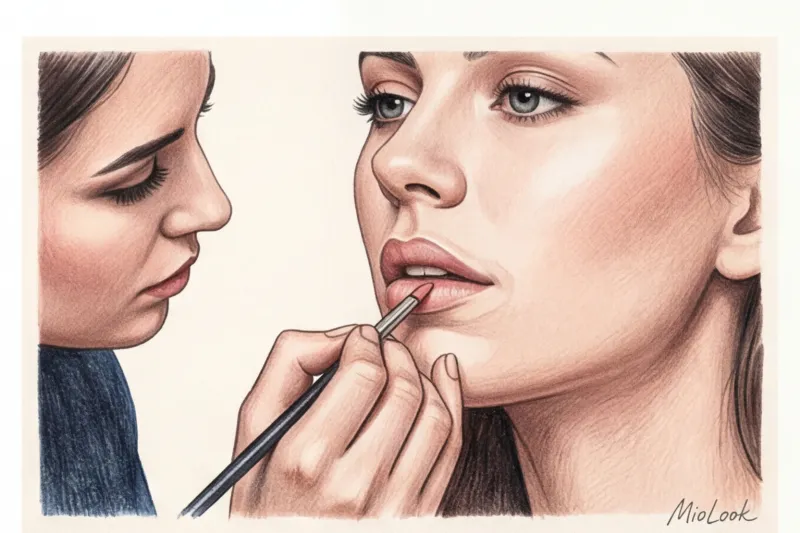
Correcting the shape of lips with makeup: basic rules of architecture
Contouring always begins with the lips, not the cheekbones. Backstage at Paris Fashion Week, I watched Dior's creative director of makeup, Peter Philips, prep models for the show. He never started with lip liner.
His secret? He'd take a thick matte concealer in a puck (like NARS Soft Matte) and, with a thin brush, apply it along the outer edges of the models' lips. This erased natural asymmetries, redness, and uneven pigmentation. Only after he had a clean canvas would he begin to sculpt a new shape.
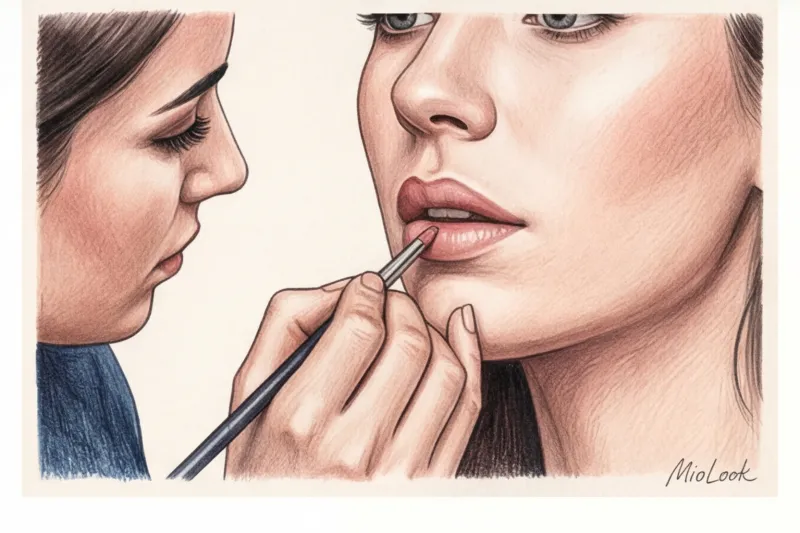
- Ditch the graphics: Clear lines, as if drawn with a ruler, look alien. The trend is blurred lips (blurred lips) is not just a fashion, it is a way to make the correction invisible.
- Light and shadow technique: Instead of filling everything in with a solid color, use a cool-toned (taupe) pencil only in areas of natural shadow - under the lower lip and in the corners.
- Blik decides everything: A drop of light concealer or highlighter exactly in the center of the upper lip gives more volume than a millimeter of pencil outside the contour.
Try MioLook for free
A smart AI stylist will analyze your facial features and select the perfect makeup and wardrobe.
Get access — €0.99 onceHow to change shape and volume: solutions for different input data
There are no universal makeup schemes. What works perfectly on an 18-year-old with smooth skin will be a disaster on a face with pronounced purse-string wrinkles (the vertical creases around the mouth). And another thing: a good stylist always evaluates the face dynamically. When speaking, smiling, or articulating, the muscles tense, and your perfectly drawn contour can slip.
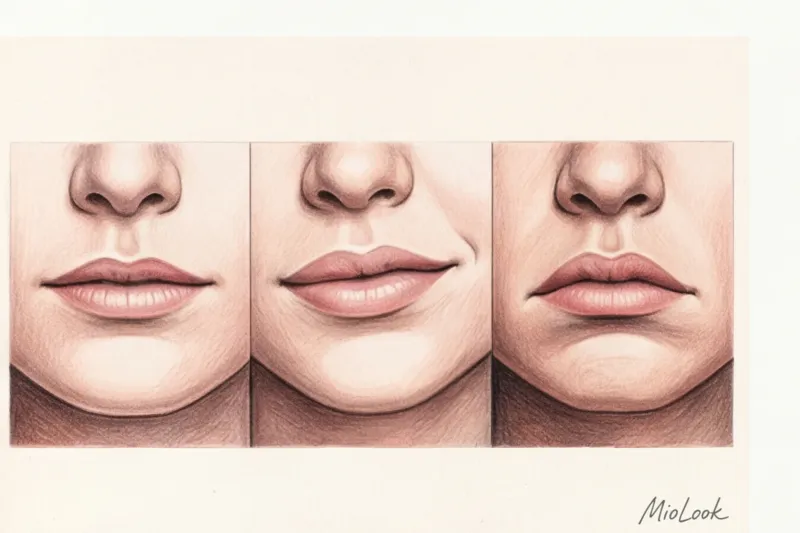
Thin lips: creating 3D volume without the drawn-on effect
The main mistake with thin lips is applying a glossy gloss thickly all over. Gloss reflects light everywhere, making lips look flat, like glass. We're looking for 3D volume.
Use the gradient rule: darken the outer contour with a pencil a shade darker than your lips and blend it toward the center. Dab a light lipstick into the very center with your finger. Apply highlight sparingly—only to the Cupid's bow and the center of the lower lip. Avoid dull matte textures and overly dark wine shades—they will visually "collapse" the volume.
Asymmetry: How to smooth out your contours without anyone noticing
The human face is naturally asymmetrical—that's a fact. But when lip asymmetry is very noticeable, we work with diagonals. If the right upper half of the lip is thinner than the left, don't try Draw both to gigantic proportions. Adjust only the part that lacks volume.
Insider trick: Use two shades of pencil. Use the lighter shade (matching your lip color) to outline the side you want to enhance, extending a millimeter beyond the outline. Use the darker shade to outline the side that already has volume, strictly following the natural line. The difference in pigment will deceive the eye.
Drooping corners of the face ("Pierrot lips"): lifting effect
Drooping corners of the mouth instantly give the face a tired, sad expression. To create a lifting effect, forget the "bring color to the very edges" rule.
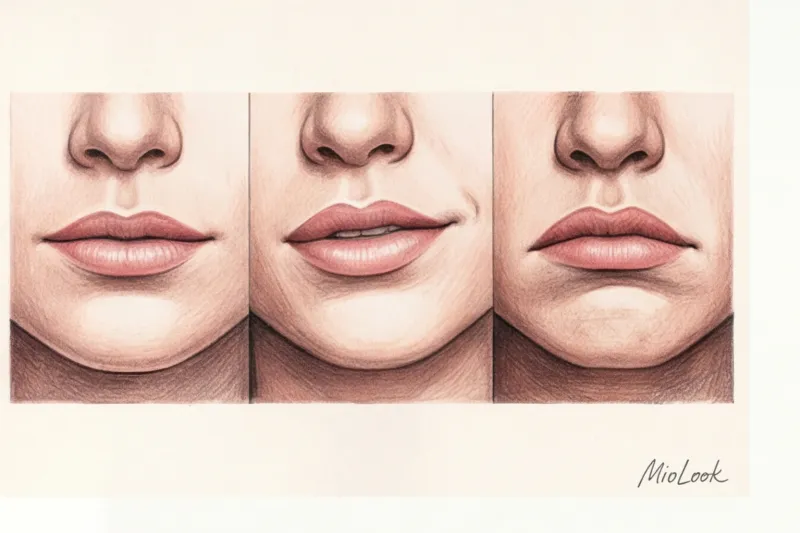
- Apply color to lips, stopping 2-3 millimeters before the outer corners.
- Take a light concealer and an angled brush.
- Draw an ascending line from the corners of the lower lip upwards towards the cheekbones (literally 5-7 mm) and blend.
This will visually “cut off” the falling shadow and lift the face.
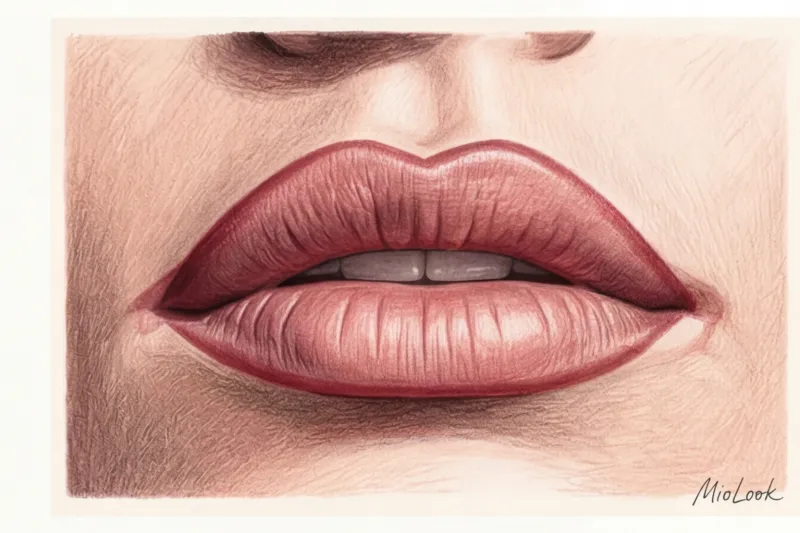
The Biggest Beauty Myth: Why Overlining Often Looks Cheap
It's time to take a hard-hitting, expert stance. Popular on TikTok overlining (especially coloring the Cupid's bow with a solid line) is a fatal mistake for 80% of women in real life.
Makeup created in front of a video ring light doesn't work in daylight. Why? It's because of physics. Most people have a lip ridge (a light, raised band of skin) along the edge of their lips. When you draw over this ridge with a matte pencil, trying to imitate lip tissue, the overhead light outside hits this relief, casting a shadow.
Instead of plump lips, you get a "messy mustache" effect. You can only go beyond the contour on flat areas—the center of the lower lip and the sides of the upper lip. We never touch the Cupid's bow and corners. And fair warning: this technique absolutely does NOT work if your natural lash line is prominent. In that case, only apply the gloss within the contour.
Your ideal image begins Here
Join thousands of users who look flawless every day with MioLook. The virtual fitting room will help you find your perfect proportions.
Get access — €0.99 onceTextures and Shades: Tools of Optical Illusion
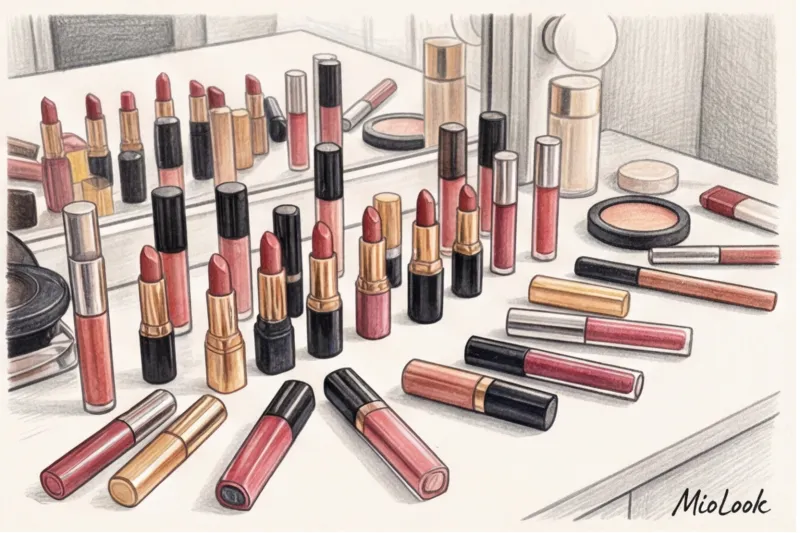
Makeup is a physics of color and reflection. Matte lipsticks absorb light. They're ideal for formal dress codes because they don't distract from your eyes, but they inevitably reduce the volume of your lips. Satin and glossy finishes reflect light, visually "pushing" your lips forward.
The color temperature also plays a role in optical illusion. Cool tones (plum, cool red, fuchsia) make teeth appear whiter, but also make lips appear thinner. Warm peach and terracotta shades add softness and volume, but can highlight yellow enamel.
Finding the perfect temperature balance for your entire look—from makeup to clothing—is no easy task. That's why I recommend using MioLook This app acts as your smart wardrobe and personal AI stylist, helping you visualize how specific shades will look on your face without having to buy half the cosmetics store.
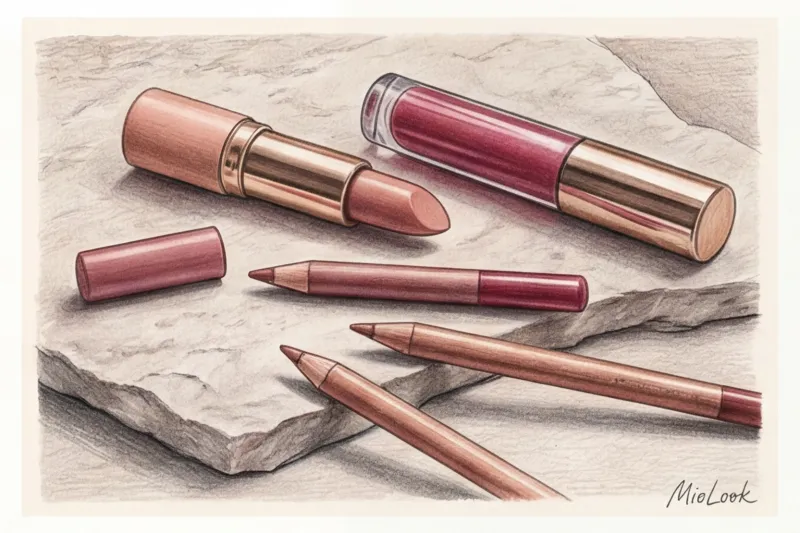
How to: A Step-by-Step Guide to Creating Architectural Lip Makeup
I use this algorithm when preparing clients for business photo shoots or important public appearances. It guarantees fuller, yet completely natural-looking lips.
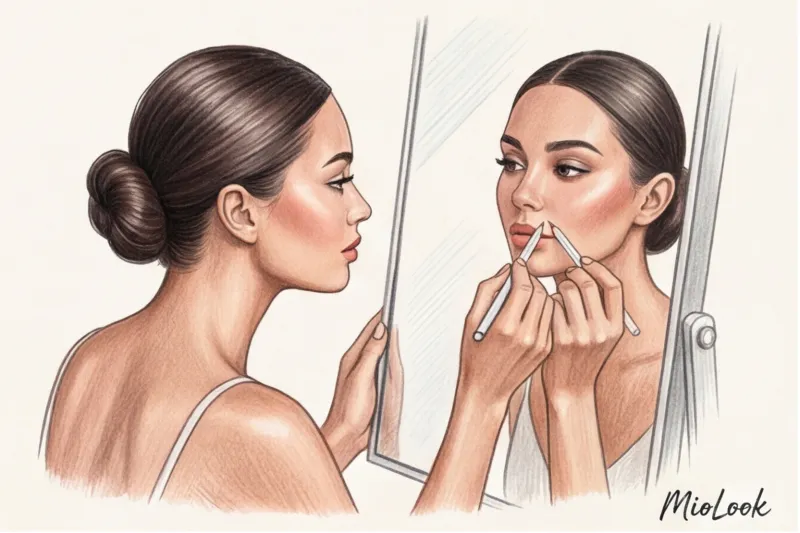
- Step 1: Preparation. Texture is more important than color. Be sure to apply the balm 15 minutes before applying makeup, and blot it with a dry tissue before applying the pencil. Skin should be moisturized but not slippery.
- Step 2: Neutralization. Using any remaining foundation or a light concealer on a fluffy brush, apply it along the lip contour. This will remove redness and blur the natural lines.
- Step 3: Building the shadow (shading). Take a long-lasting pencil in a dusty rose or cool beige shade. Don't draw a solid line! Use light, sweeping strokes along the center of the lower lip (slightly extending beyond the outline) and along the sides of the upper lip.
- Step 4: Filling. Apply lipstick not from a stick, but with a dabbing motion using your fingertip. This will create that kissed-lips effect.
- Step 5: Light test. Be sure to stand near a window with a mirror. Artificial light in the bathroom hides sharp edges, while daylight reveals everything. If you see a sharp pencil line, blend it with a cotton swab.
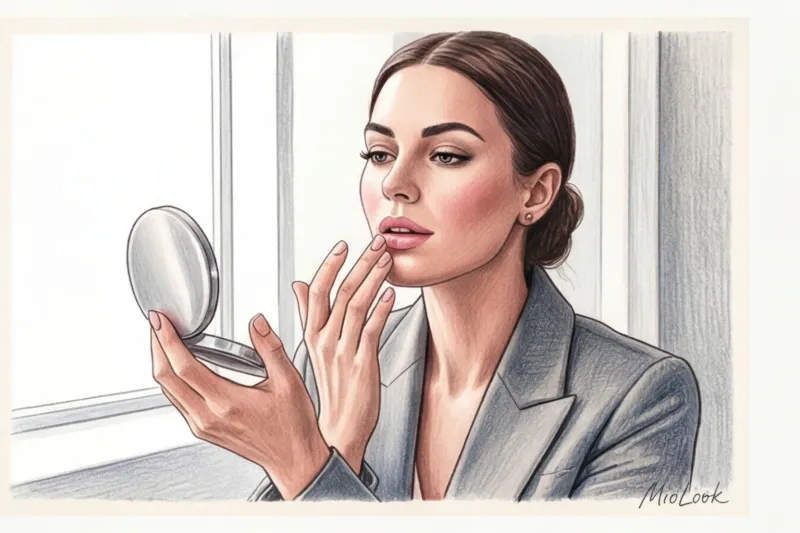
Lips aren't a flat canvas for painting, but a complex architectural element of your face. Stop blindly copying other people's augmentation schemes and start working with your own proportions. Sometimes, to look younger and fresher, you don't need to draw volume where it doesn't exist, but simply apply the right shadows. Study your face, experiment with lighting, and you'll see how a few millimeters of proper shading can change everything.