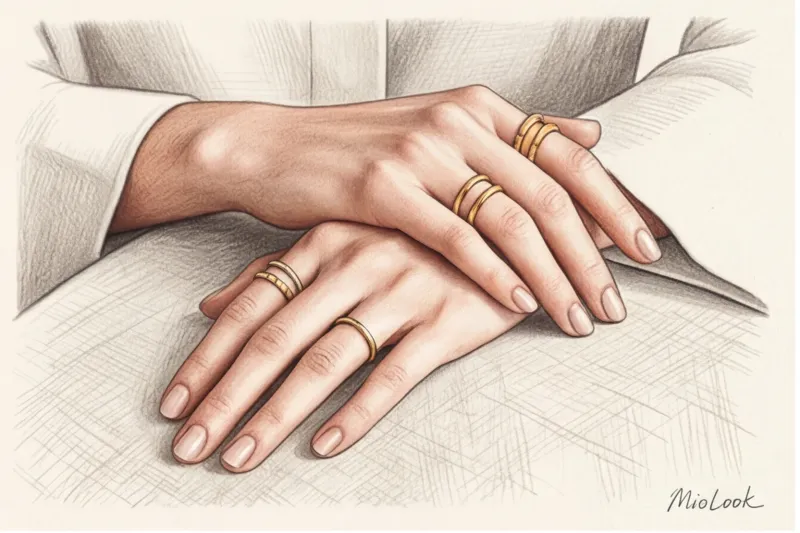
I remember one of my clients, a partner at a major law firm, laying out a dozen expensive rings on the coffee shop table and saying, "Isabella, I want to wear them all, but I'm terrified of looking like a fortune teller. How should I combine them?" Sound familiar? We often buy beautiful jewelry, but end up wearing one or two run-of-the-mill rings simply because we don't know the math behind their compatibility.
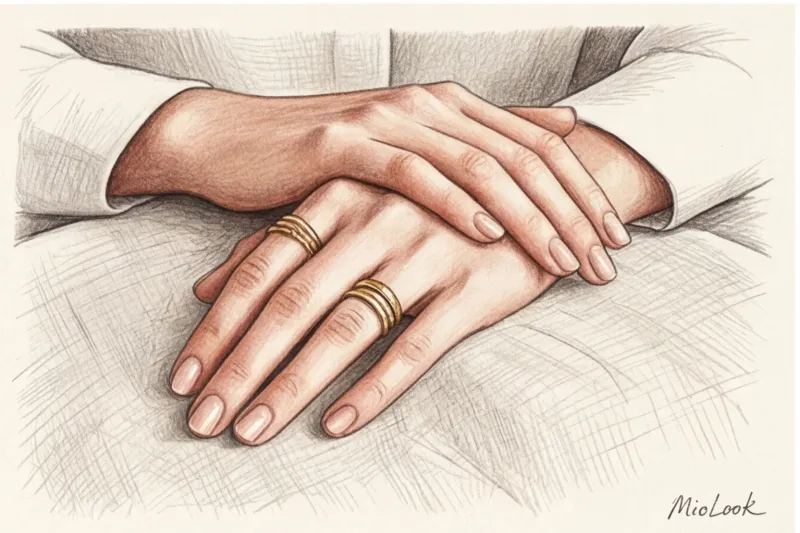
We have already discussed in more detail the basics of forming a jewelry base in our The complete guide to a basic jewelry wardrobe But today I want to take it a step further. Forget the clichéd rule of "wearing your best at once." In this article, I'll share with you an architectural approach to How to wear multiple rings while maintaining status, elegance and, most importantly, convenience.
Hand Architecture: Basic Rules for Wearing Multiple Rings
The main jewelry trend of the last decade is the complete rejection of sets. A ring, earrings, and pendant in a single set now looks like you tried too hard. Stacking has taken its place.
The Italians have a great term for this. sprezzatura — the art of deliberate casualness. Your look should convey a sense of ease: as if you threw on the first rings you saw before leaving the house, and miraculously, they turned out perfectly. But behind this "miracle" lie strict rules of visual weight.
Creating a ring set is similar to assembling a capsule wardrobe. You need a foundation (smooth base rings) and accents (stones, intricate textures, signet rings). A classic rule of jewelry design is that one statement ring visually weighs as much as three thin base rings (minimalist bands). If you're wearing a large ring with a stone, balance it with a couple of thin bands of metal on adjacent fingers.
Access to MioLook for €0.99 — one-time payment
A smart AI stylist will select the perfect look and help you create a jewelry capsule collection to match your wardrobe.
Get access — €0.99 onceThe One-Finger Rule and Geometry
The most common mistake I see on the street is rings placed tightly on every finger. It instantly turns the hand into a monolithic display case. My golden rule: leave at least one finger (usually the middle or ring finger) completely empty. This creates the necessary "visual air."
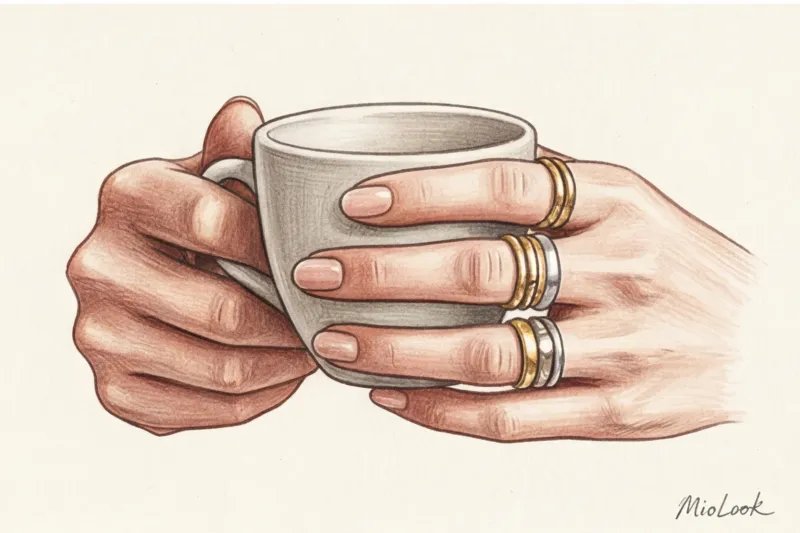
Also, pay attention to the geometry of the ring's placement. If you draw an imaginary line along the top edges of your rings, it should form a zigzag or V-shape, not a straight, even line. Varying the height of the ring's placement (for example, adding knuckle rings) makes the hand appear longer and more graceful.
Mixed Metals: Breaking Outdated Stereotypes
Perhaps the most persistent myth is: "You can't wear gold and silver on the same hand." As a stylist, I officially declare: you can and should! According to a 2024 report from analytics platform Lyst, searches for "bimetal jewelry" increased by 47%. It's the mixing of metals that distinguishes a modern, expensive look from the outdated, garnished approach.
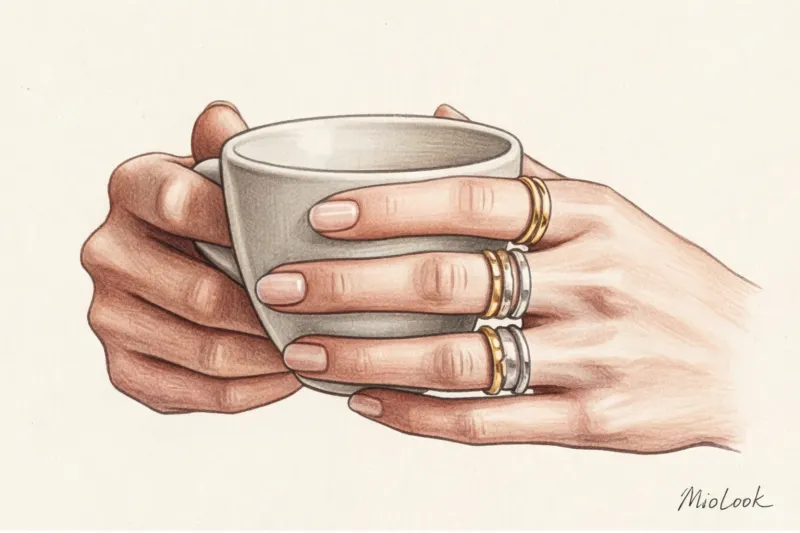
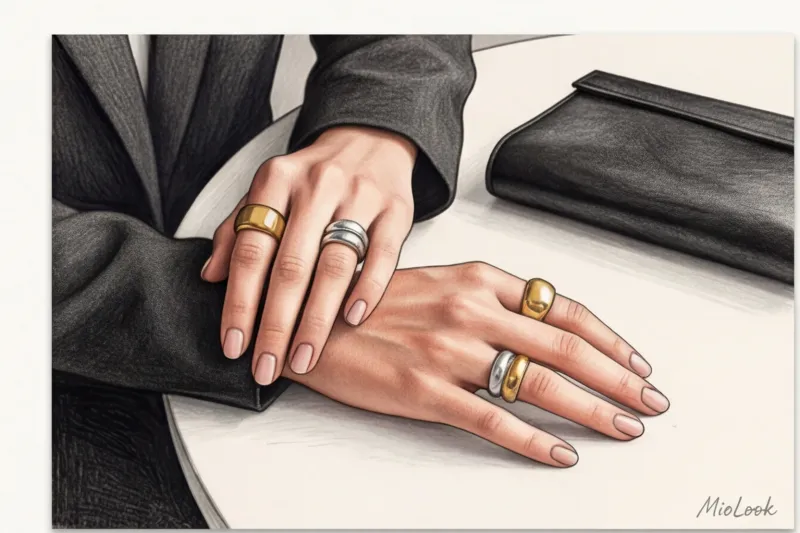
To create a harmonious mix of warm lemon gold and cool silver, use the 80/20 rule. Avoid a 50/50 ratio—it looks haphazard, like you forgot to take off a ring. Choose a dominant metal (e.g., 80% silver) and add an accent (20% gold).
"The secret to perfect bimetal stacking is using a bridge piece. This is a ring or bracelet that physically fuses the two metals together. It serves as a visual bridge, bringing the silver and gold together on your hand."
By the way, if your style vector involves scale and brightness (for example, you Larson's dramatic natural ), massive two-alloy geometry will emphasize your status much better than a scattering of small, single-color rings.
Secret Stylist Formulas: Putting Together the Perfect Set
To avoid the "magpie" effect, which attracts everything shiny, I give my clients specific mathematical formulas. You can save them in MioLook app , so that before leaving the house you can simply repeat the proven scheme.
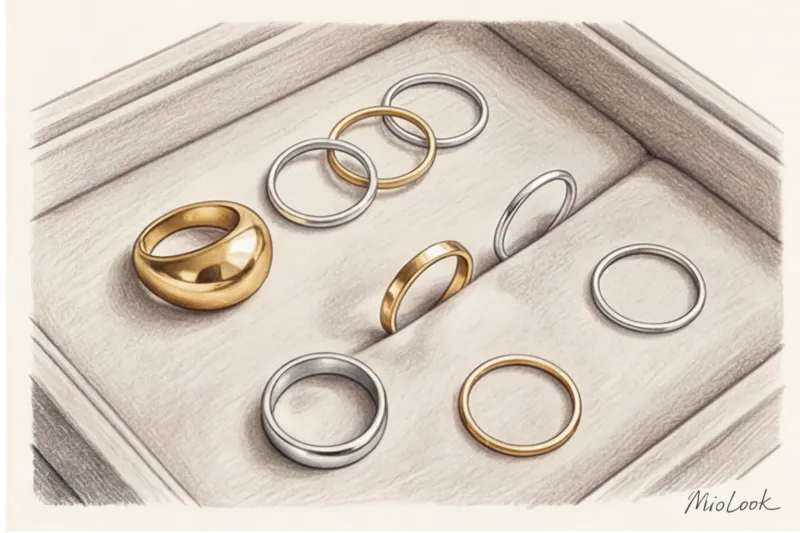
Formula 1: Signet Ring + Two Thin Companion Rings
Signet rings are no longer a strictly masculine accessory. Wear a smooth metal signet ring on your pinky or index finger. Because it adds visual weight, wear two ultra-thin rings (up to 1.5 mm thick) on the ring finger of the same hand. One can be smooth, the other twisted or micro-encrusted. It's the perfect contrast between ruggedness and delicacy.
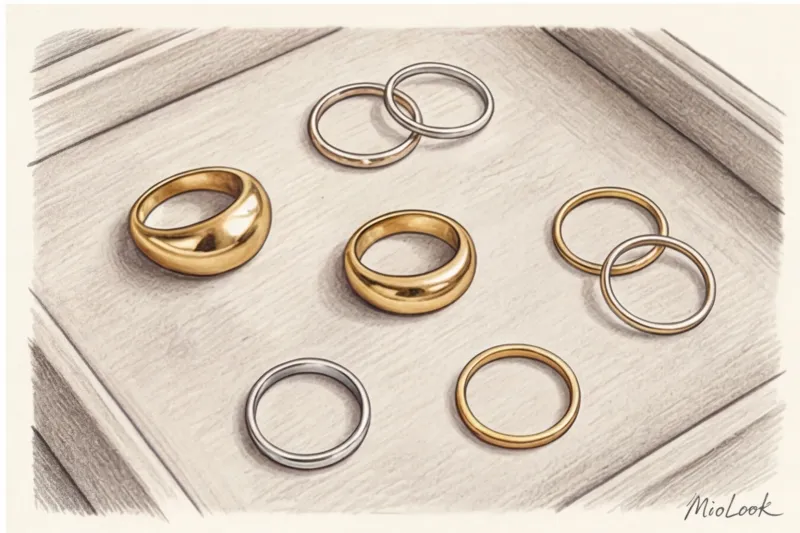
Formula 2: One-Finger Vertical Stacking
This formula is especially good for girls with long fingers (by the way, this is often found in this type Gamin Dramatik by Larson ). Instead of spreading rings across your entire hand, create a "tower" of 3-4 rings on one finger (usually the ring or middle finger). The key: the rings should have different textures. Combine a smooth ring, a rope ring, and a stone-studded ring. Visually, they will merge into one wide, intricate ring.
Your perfect look starts here
Join thousands of users who look flawless every day with the MioLook AI stylist.
Get access — €0.99 onceHow to Wear Multiple Rings in the Office Without Breaking the Business Dress Code
Let's return to my client Elena, a partner at a law firm. In her world of smart casual and business formal, unspoken but strict rules apply. We couldn't leave her favorite cocktail rings with large, prominent stones out of place—they're inappropriate for contract signings.
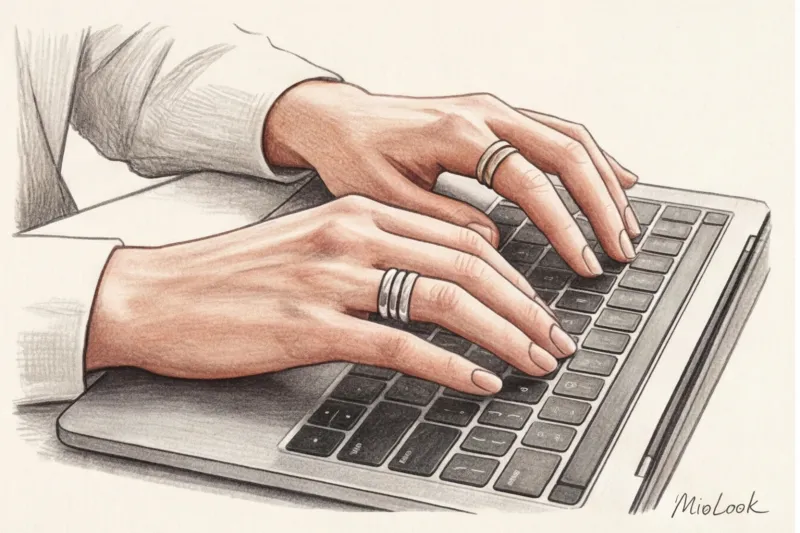
How did we adapt this trend? We put together a set of four minimalist rings with clear geometry. The main rule of office stacking is no acoustic noise. Your rings shouldn't jingle against each other or bang on the table during meetings. So, we chose rings that fit snugly on the knuckles.
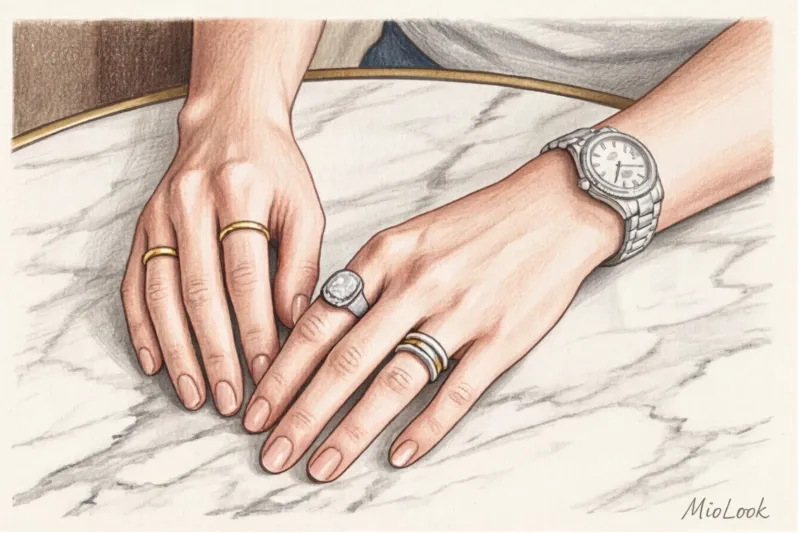
For the office, it's also important that your hand set doesn't clash with basic stud earrings and a statement watch. If you wear a steel-cased watch on your left wrist, transfer the gold accent from your ring set to your right hand.
Practicality: Test Drive of Tights and a Keyboard
My advice may sound great in theory, but as a practical stylist, I have to tell you the truth: some rings just aren't made for real life. Before recommending a set, I always mentally "test-drive" the tights.
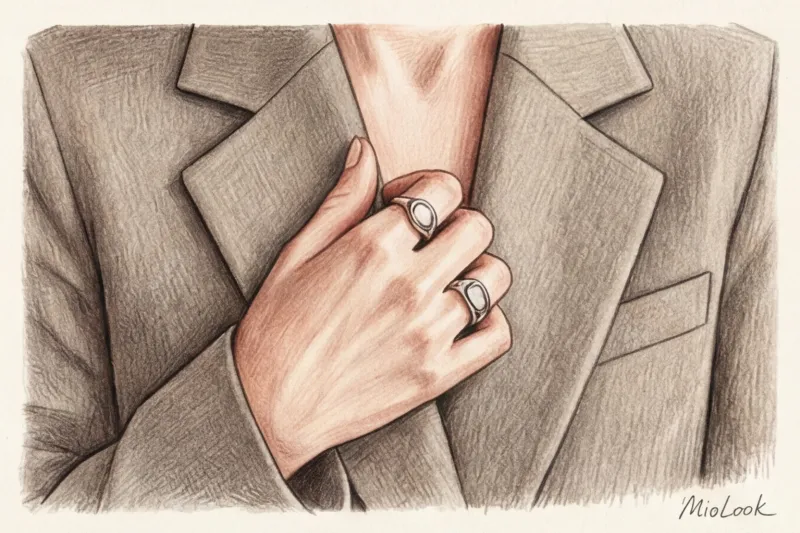
Remember: rings with a prong setting (where the stone is held in place by metal "prongs") will inevitably snag on 20-denier nylon tights and will catch on silk blouses. For layered, everyday wear, choose a bezel setting, where the metal gently wraps around the stone.
The second consideration is ergonomics when working on a laptop. Rings on the index finger often interfere with touch typing and pen writing if their thickness on the sides (shank) exceeds 2 mm. The ideal place for an accent ring, the widest one, is the pinky or middle finger. You'll be surprised how much more comfortable it will be.
Checklist: Assembling Your First Jewelry Set Step by Step
Ready to try it right now? Get out your jewelry box and follow this algorithm. And don't worry about your budget—a basic silver ring today starts at €30, while a high-quality gold-plated ring ranges from €80–€150, making this trend completely affordable.
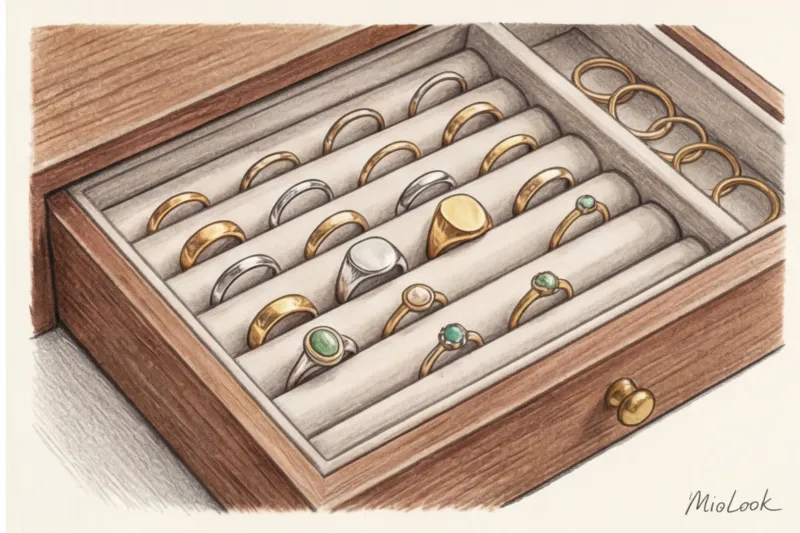
- Step 1: Choose a "soloist". This will be the largest, brightest, or most textured ring in the set. Wear it on your index or middle finger.
- Step 2: Add a base. Take 2-3 thin, smooth rings without stones. Place them on other fingers or create vertical layers on one.
- Step 3: Implement the invoice. If your first rings are glossy, add one with a matte finish, enamel, or a swirl texture. The contrast in surfaces will draw the eye.
- Step 4: Check for asymmetry. Don't distribute the rings evenly. The "three on the right, one on the left" rule works flawlessly.
Layering jewelry isn't a fashion test, but a way to express yourself without words. Don't be afraid to break the rules (except, perhaps, the rule of comfort while typing). Start small by adding just one thin strip of contrasting metal to your usual ring. And remember: the perfect style is one in which you feel comfortable being yourself.