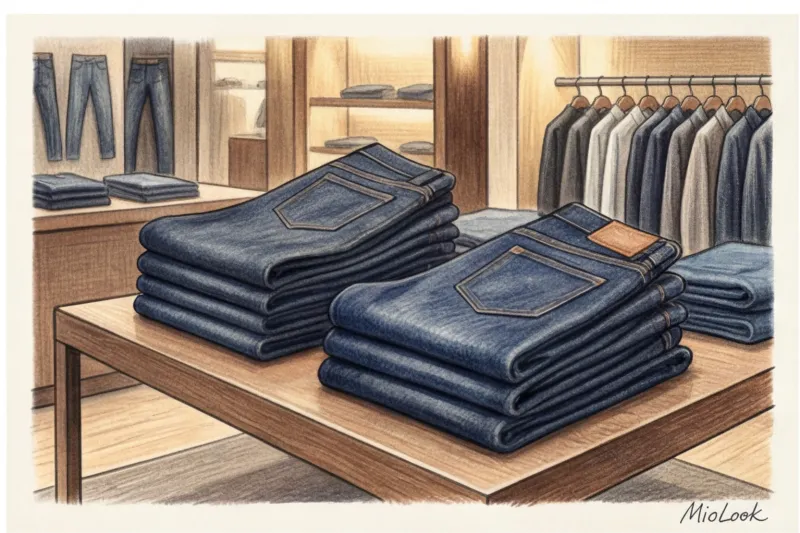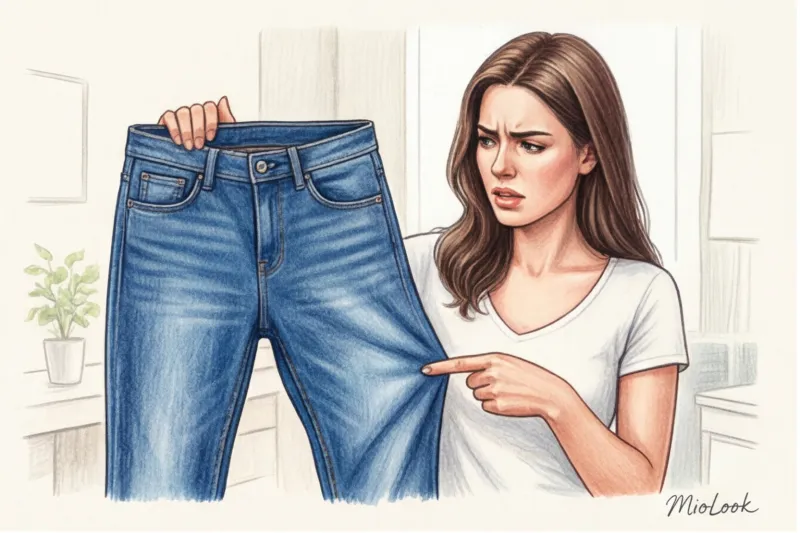
"I haven't washed these jeans in over a year," Levi's CEO Chip Bergh proudly declared at a conference in 2014. This statement instantly spread across glossy magazines and gave birth to the most destructive myth in the history of wardrobe care. Millions of people stopped washing their denim, sincerely believing they were saving the fabric. But the truth is, this advice, while it works great for collectible raw denim, is mercilessly killing your favorite mass-market basics.
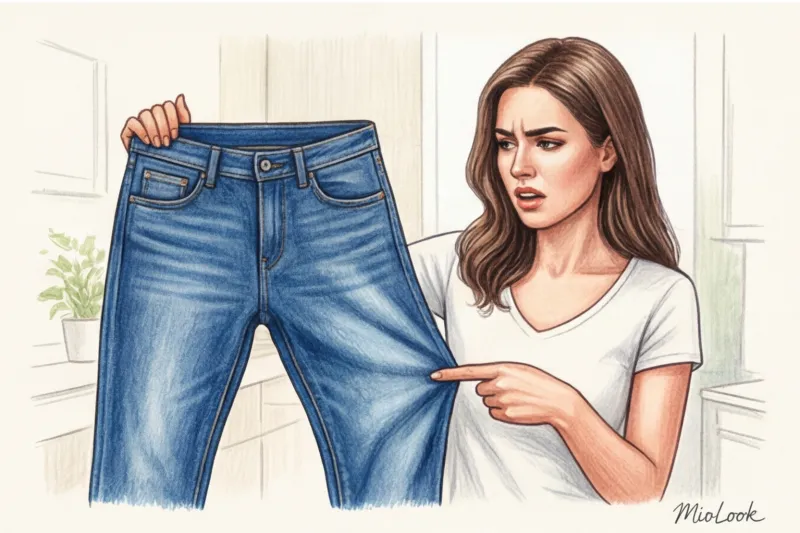
Over 12 years of working as a personal stylist in Europe, I've seen hundreds of ruined pairs. My clients complained about stretched knees, loss of shape, and faded stains, not realizing that the problem wasn't the brand's quality, but rather blind adherence to glossy myths. We discussed the basic principles of careful handling in more detail in our a complete guide to proper clothing care , but denim requires a completely separate, mathematically precise approach.
Today we'll explore fabric chemistry and answer the key question: How to wash jeans without losing their color and why the composition of your favorite pair dictates a strict laundry schedule.
The "Indestructible" Myth: Why the Old Rules of Washing Denim No Longer Work
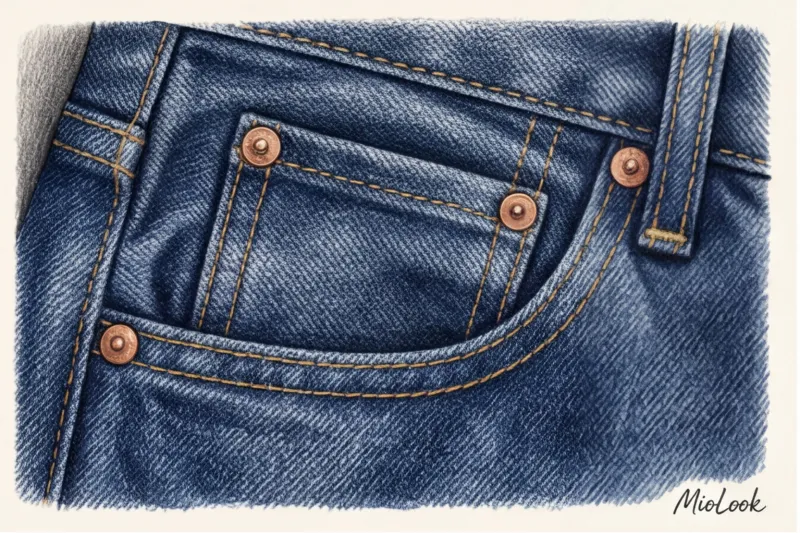
To understand why jeans fade, we need to understand how they are dyed. Factories use a technique called ring dyeing. The indigo dye doesn't penetrate the core of the cotton fiber; it simply settles on its surface as a thick layer. This is why denim fades so beautifully at the folds, revealing the white core of the thread.
When Chip Berg advised against washing jeans, he was talking about premium raw denim, which costs between €200 and €300 and is made of stiff, 100% cotton. But if you wear Zara, H&M, COS, or Massimo Dutti jeans in the budget or mid-price range (€50–€120), this advice works against you.
A 2021 study by the Cotton Incorporated Textile Institute revealed an interesting mechanism: when we leave our everyday jeans unwashed for a long time, sebum, dead skin particles, and street dust become trapped between the fibers. When we walk, this mixture begins to act like microscopic sandpaper. The friction wears the fibers from the inside out. As a result, the fabric becomes thinner, and the color fades much faster than with proper machine washing.
How Often Should You Wash Jeans? The Math for Different Fabrics
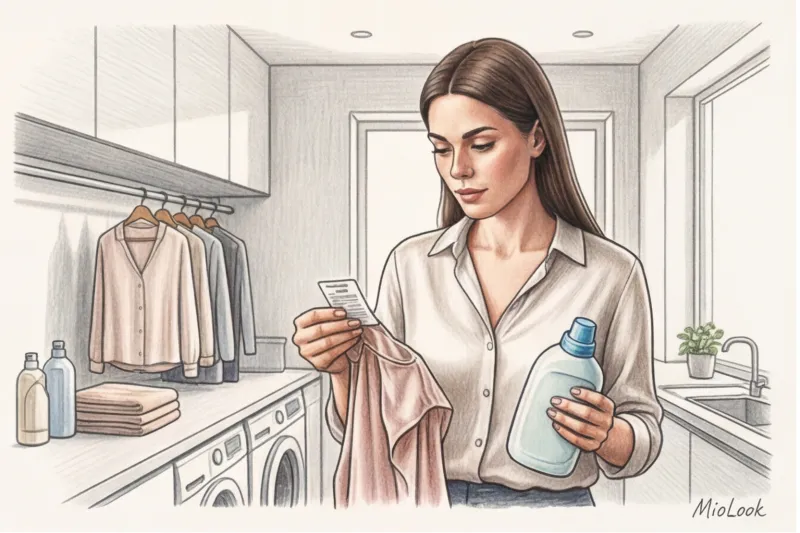
The first rule of a smart wardrobe is to always check the inside label. It's the composition, not the brand or price, that determines how often an item should be washed. The misconception that one size fits all when it comes to denim costs women dozens of discarded pants every year.
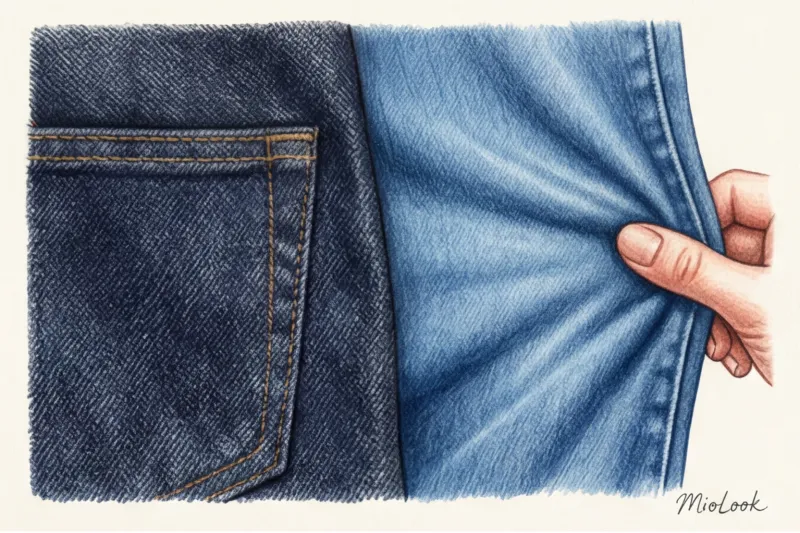
For 100% dense cotton (Rigid Denim)
If your jeans are made from 100% high-density cotton (12-14 ounces), they're truly forgiving of occasional washing. The tight weave of the threads holds its shape well and absorbs less dirt.
- Periodicity: every 7-10 socks.
- Signs it's time to wash: the fabric has become too soft in areas where it is constantly bent (below the knees, in the groin area), has lost its original “crispy” structure, or has become oily to the touch.
For jeans with elastane (Stretch Denim)
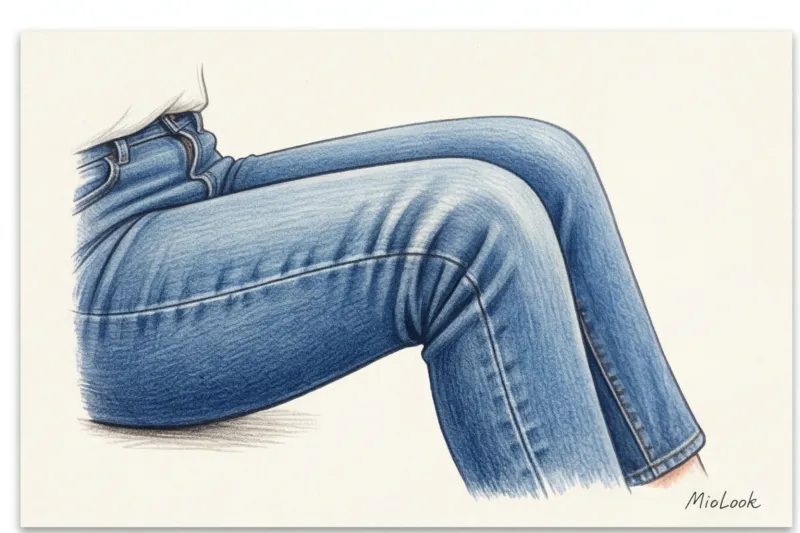
The statistics are stark: adding just 2–3% elastane (spandex or lycra) completely changes the care instructions. Elastic fibers are sensitive to stretching and stains.
"The biggest mistake when caring for stretch denim is washing it infrequently. Elastane needs water to shrink the fibers back down and restore their structure."
I had a telling case. A client bought a gorgeous pair of basic jeans from Massimo Dutti for around €80. After reading fashion blogs, she decided not to wash them but to "freshen them up" in the freezer (we'll come back to this myth later). The result: after two months, the elastane on the knees and buttocks had irreversibly deformed due to the effects of sebum, which had literally "eaten" the synthetic fibers. These pants were beyond saving.
- Periodicity: every 3-4 wears maximum.
Tired of forgetting what you wore and what you went with it?
MioLook, the smart AI stylist, will help you digitize your wardrobe, create the perfect capsule wardrobe, and track which items need refreshing.
Get access — €0.99 onceInstructions: How to wash jeans without losing their color
So, we've established that washing is necessary. Now the question is—how exactly? To preserve a deep indigo or rich blue hue, the process must be meticulously calibrated.
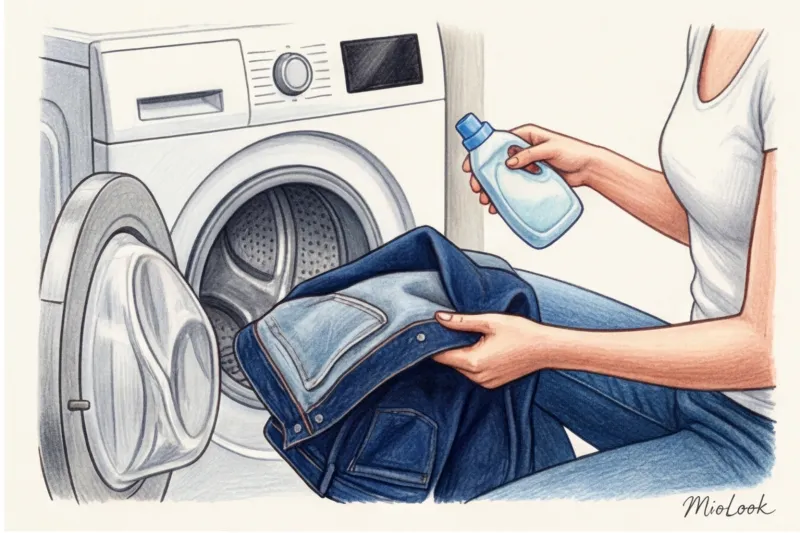
- Preparation - protection from friction. Close all zippers and buttons. This is critical: an exposed metal zipper in the drum will scratch the fabric of adjacent items. And most importantly, always turn your jeans inside out. This absorbs the brunt of the mechanical friction of the drum, preserving the dye on the front side.
- The temperature regime is a strict 30°C. According to textile technologists, washing at 40°C removes 35% more surface indigo dye than washing at 30°C in cold water. Denim simply doesn't tolerate hot baths.
- Smart loading. Never wash jeans with rough items (such as sneakers) or heavy terry towels. Vigorous rubbing literally knocks the pigment out of the fabric. The best company for jeans is other jeans of a similar shade.
Choosing a Product: Why Powder is Denim's Main Enemy
Dry laundry detergent is an abrasive. Its crystals don't completely dissolve in cold water (and we wash at 30°C, remember?) and act as a micro-exfoliant on fabric. Furthermore, 90% of all-purpose detergents contain optical brighteners. Their purpose is to make whites dazzling, but on dark denim, they create a faded, whitish dust effect.
For denim, use only liquid gels. Ideally, use a specialized gel for dark or colored fabrics (without enzymes that aggressively break down cellulose).
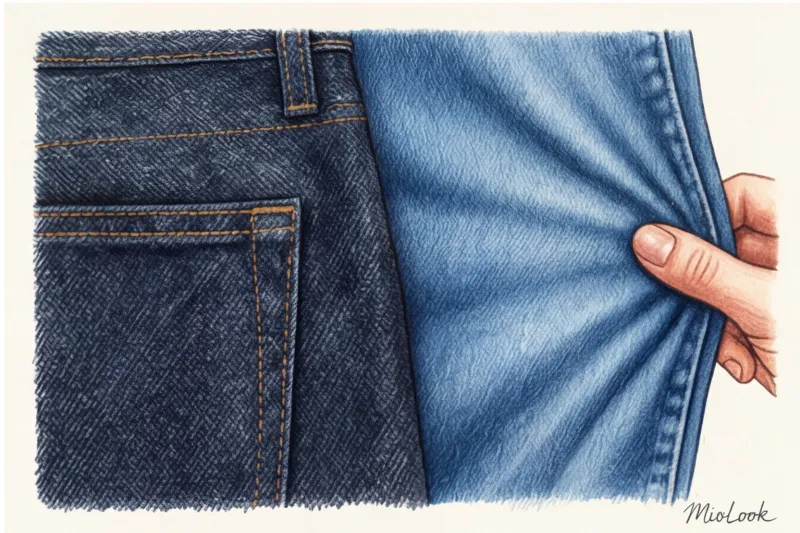
Black and dark blue denim: saving color from fading
A unique characteristic of mass-market black denim is that it fades much faster than traditional indigo. Factories use sulfur dyes, which are extremely unstable in aqueous environments. You've probably noticed how your new black jeans from Zara take on a dull gray-brown undertone after the third wash.
Two years ago, I conducted my own test drive. I bought two identical pairs of black jeans from Zara (€40 each). I washed the first pair with regular detergent as they got dirty. The second pair I washed with an old fashioned lifehack—adding regular white vinegar.
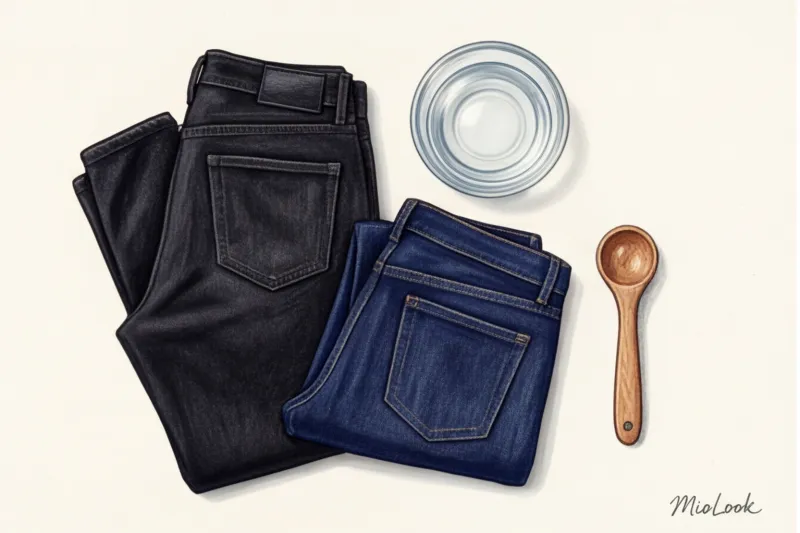
The chemistry of the process is simple: acetic acid acts as a fixative. It lowers the pH of the water, causing the fiber scales to close and "lock" the pigment inside. Add half a cup (about 100 ml) of clear white vinegar to the conditioner compartment. Don't worry, the smell will completely disappear after drying. After six months of experimenting, the second pair remained jet black, while the first lost about 30% of its saturation.
Limitation of the method: It's important to understand that vinegar won't restore the color of already faded jeans. This is a preventative measure that only works on new or well-preserved jeans.
Alternatives to Washing: How to Freshen Up Jeans Between Wears
If stretch fabric needs to be washed every 3-4 wears, and hard cotton every 7-10, how can we keep it fresh in between? And here we come across the most ridiculous internet advice: freezing.
Microbiologists have long since debunked the freezer myth. The temperature of a home freezer (-18°C) doesn't kill the bacteria that cause odor. It merely puts them into a state of suspended animation. As soon as you take your jeans out and put them on, your body heat instantly "awakens" the microbial colonies, and the odor returns within 15 minutes.
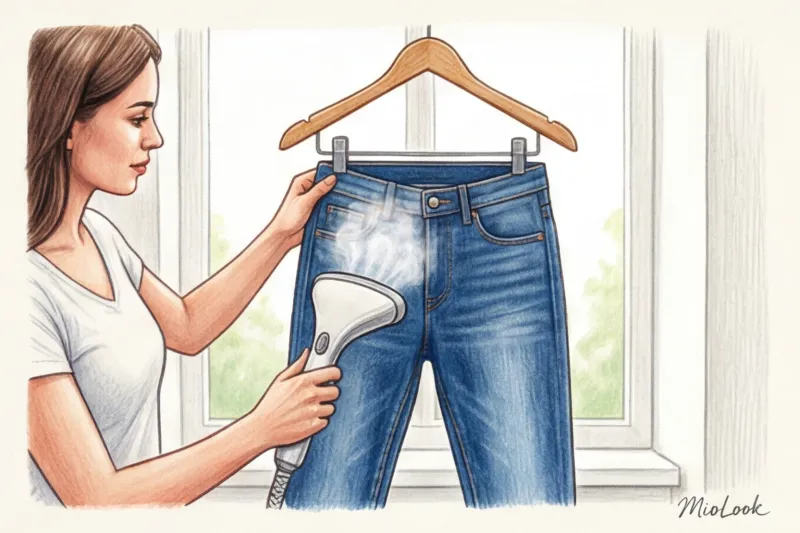
Instead of the freezer, use a scientific approach:
- Handheld steamer: Hot steam (temperatures above 100°C) instantly kills most bacteria, smooths out small creases on knees, and completely eliminates food or perfume odors. It's the best way to freshen up your jeans in just 2 minutes before heading to the office. Learn more about How to transform office style into evening wear , we talked about earlier - the fresh look of things plays a key role there.
- Textile sprays: Professional alcohol-based clothing fresheners neutralize odors without having to wet the fabric.
- Ventilation: Hang your jeans on the balcony overnight (avoid humid weather). Fresh air works better than any chemical fragrances.
Your perfect look starts here
Join thousands of users who look flawless every day and save time in the morning with the MioLook app.
Get access — €0.99 onceA Checklist for Proper Drying (Why Tumble Drying Is Your #1 Enemy)
You've successfully washed your jeans at the right temperature and preserved the color with vinegar, but one misstep during the drying process can ruin all your efforts. Tumble drying is the absolute enemy of denim, especially those with elastane.
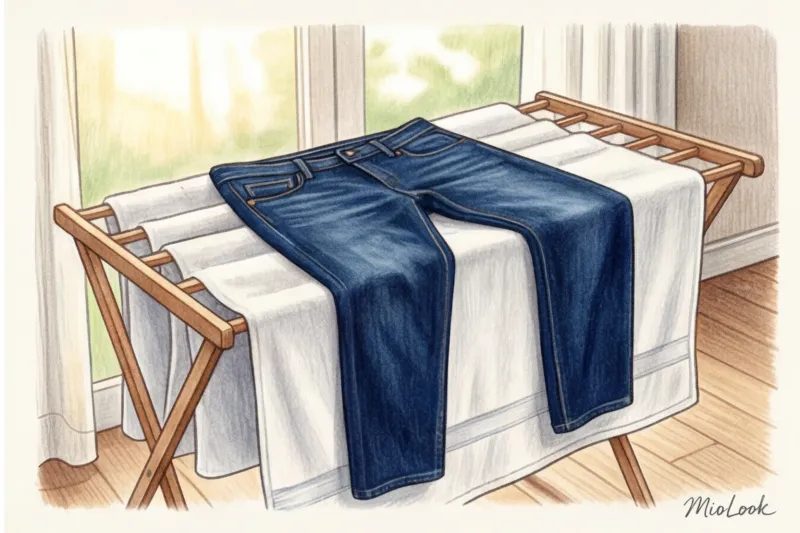
High tumble dryer temperatures (usually around 70°C) literally bake the synthetic fibers of elastane, making them brittle. Cotton, on the other hand, experiences extreme shrinkage under such harsh conditions. The result is stiff, misshapen pants that will wear out between the legs twice as fast.
My algorithm for safely drying denim:
- Remove jeans from the drum immediately after the wash cycle is complete. If they're left crumpled for a couple of hours, the creases will turn into light streaks (the dye on the folds will rub off).
- Carefully straighten the damp fabric with your hands: pull the legs lengthwise, smooth out the seams.
- Never drape jeans over a clothesline, as this will create permanent creases at the knees. Dry them either flat on a towel (ideal for heavy denim) or by hanging them by the belt loops on a hanger with hooks.
- Protect from sunlight. UV rays destroy pigment faster than bleach. Dry dark jeans only in the shade or in a well-ventilated area.
Stylist's Summary: Basic Rules for Caring for Your Favorite Pair
Proper care allows even inexpensive mass-market pieces to look classy, maintaining their deep color and crisp silhouette. This is the foundation of a smart wardrobe: investing time not in finding new items to replace worn-out ones, but in maintaining the quality of what you already own.
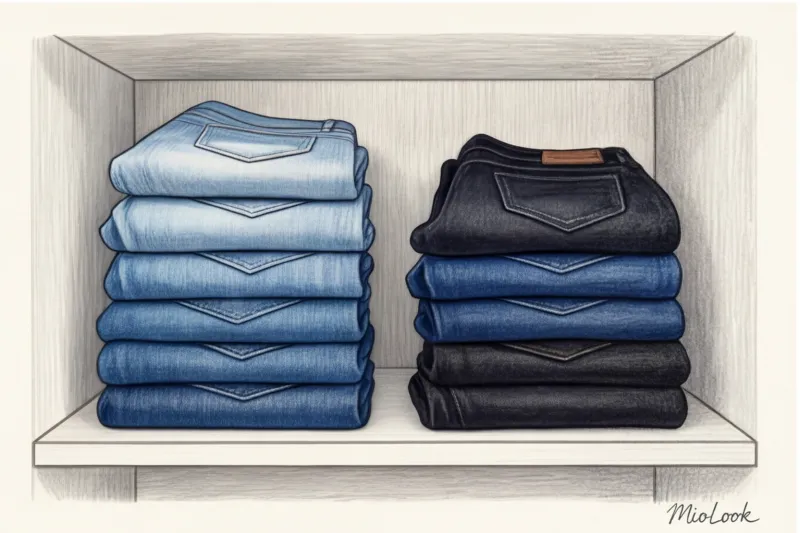
Let's consolidate the main points:
- Always read the ingredients: does it contain elastane (2% already requires frequent washing to restore its shape).
- Always turn inside out, zip up, and use liquid gel (no powder).
- Wash strictly at 30°C, and for dark shades, add white vinegar instead of fabric softener.
- Forget about the freezer and tumble dryer. Your arsenal is a handheld steamer and air drying in the shade.
If you want your denim to always fit perfectly into well-designed capsules, try digitizing it in MioLook app You'll be able to not only track how often you wear a particular item (so you can wash it promptly), but also create dozens of new looks with a single basic pair of jeans, based on the advice of a smart AI stylist.