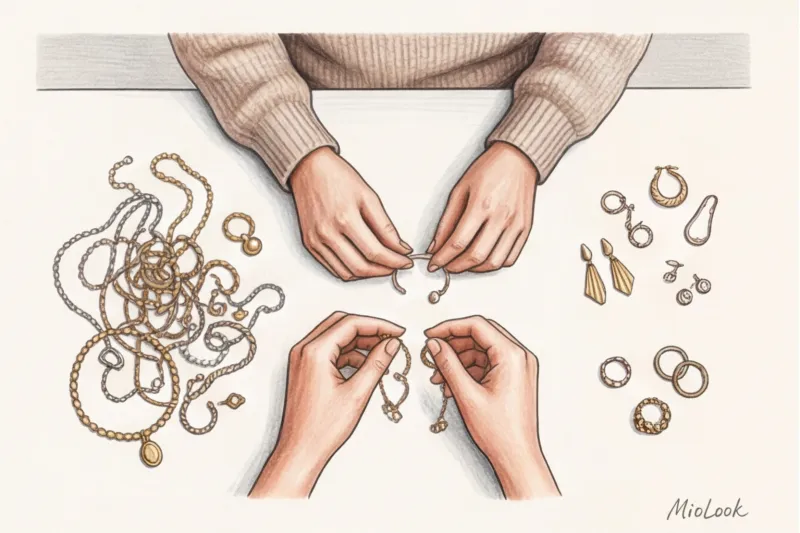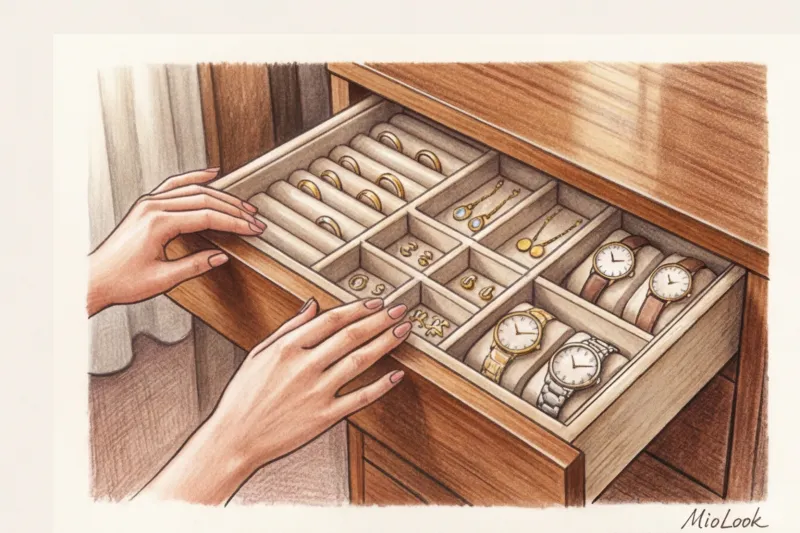
I had a case in my practice that would have stopped any jeweler's heart. My client, a successful corporate lawyer, hastily threw her large diamond engagement ring into a wooden box along with a vintage Cartier Love bracelet. After a month of shaking it every morning, a network of deep micro-scratches appeared on the polished 18-karat gold. Restoration and professional polishing cost her €400, but some of the metal was irreparably removed.
This story perfectly illustrates the biggest mistake: we're willing to invest thousands of euros in accessories, but we don't think about how to protect them. If you've already assembled your ideal base (I wrote about this in more detail in our The complete guide to a basic jewelry wardrobe ), it's high time to learn how to handle it. Today we'll take a detailed look at How to store jewelry so that diamonds don't destroy gold, silver doesn't turn black within a week, and morning preparations take exactly two minutes.
The Price of Chaos: Why Even Think About How to Store Jewelry?
A typical "grandmother's" jewelry box, where chains, stud earrings, and massive rings are all jumbled together, is a mass grave for your investments. And it's not just a matter of aesthetics; it's a matter of simple physics. Friction is the main enemy of any precious metal.
Let's recall mineralogy: on the Mohs scale of hardness, diamonds have a maximum rating of 10, sapphires and rubies have a rating of 9, while gold and platinum barely reach 2.5–4.5. This means that any gemstone will act like sandpaper when in contact with metal. The proximity of these materials in a confined, unseparated space is fatal.
"You don't wear what you can't see. According to WGSN's 2023 wardrobe analysis, 80% of women wear only 20% of their jewelry each day simply because the rest is buried at the bottom of their jewelry boxes."
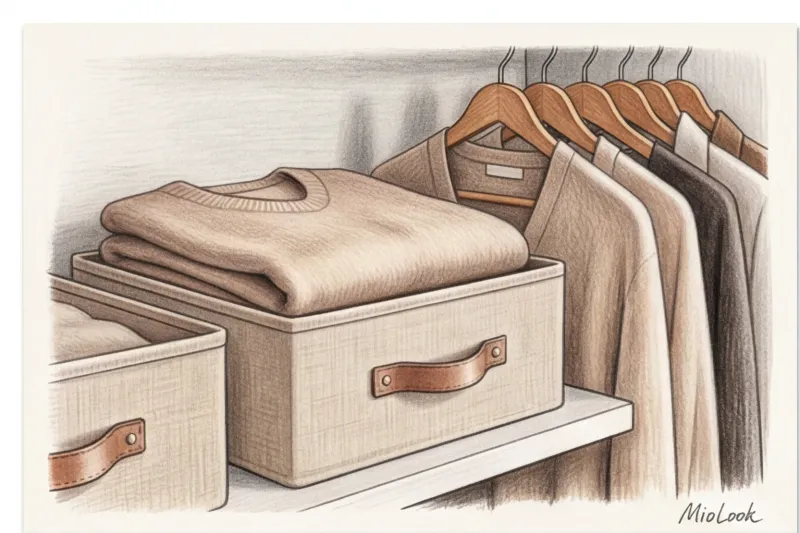
Chaos leads to stylistic stagnation. You wear the same basic earrings every day simply because you don't have time to untangle that tangled chain. When I personally reorganized my closet storage system, the time spent choosing accessories dropped from a stressful 10 minutes to a relaxed two.
The Physics and Chemistry of Jewelry: Sun, Air, and Humidity
The most common mistake I see in 9 out of 10 new clients is storing jewelry on a bathroom shelf. It's the worst place in the house. Constant temperature fluctuations and high humidity destroy the alloying elements, causing the metals to tarnish before your eyes.
Silver, for example, tarnishes 10 times faster when stored outdoors. This is a reaction to hydrogen sulfide, which is always present in the atmosphere. The rule for silver is strict: it must be kept in a dark place and have minimal exposure to oxygen. Use zip-lock bags or special anti-tarnish strips that absorb aggressive gases.
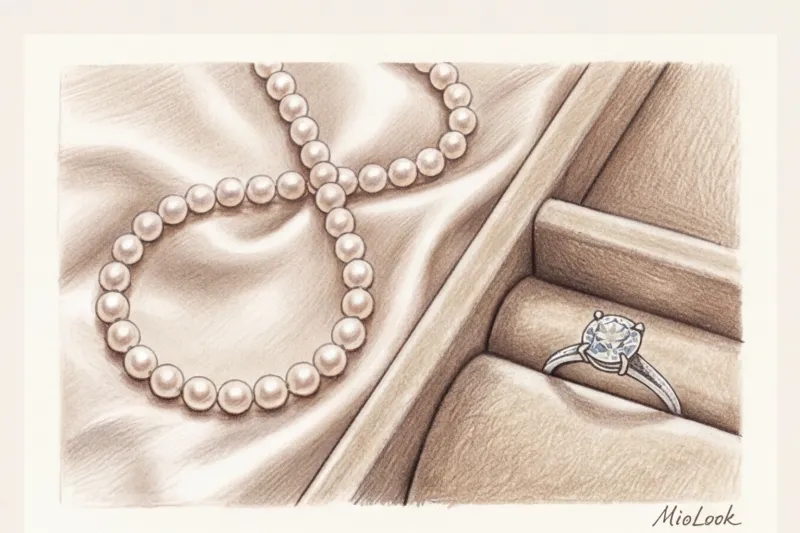
The situation with organic stones is diametrically opposed. According to official recommendations from the Gemological Institute of America (GIA), pearls, coral, and opal should never be stored in plastic or sealed safes. These stones require natural ambient humidity (around 40-50%); otherwise, they dry out, become cloudy, and develop microcracks. Pearls need to "breathe," so their ideal home is a cotton or silk bag in a cool place.
Don't forget about ultraviolet radiation. Direct sunlight is harmful to many colored gemstones. Amethysts, kunzites, and topazes quickly fade in the sun, losing their investment and aesthetic value.
Access to MioLook for €0.99 — one-time payment
A smart AI stylist will help you find the perfect look and remember your favorite jewelry.
Get access — €0.99 onceCasket Architecture: Distinguishing between Basic and Evening Investments
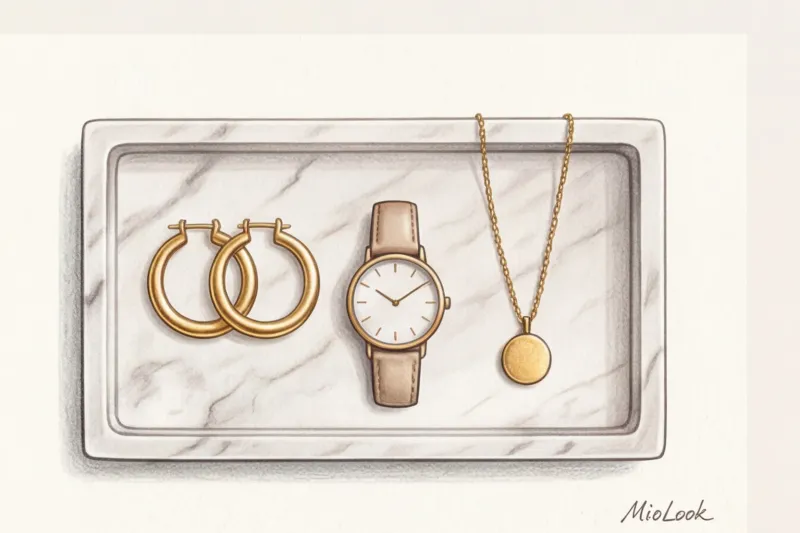
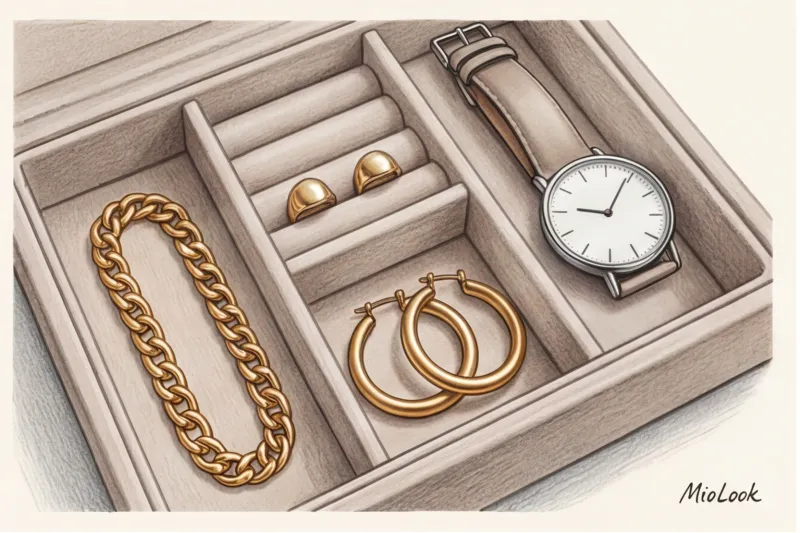
The secret to a functional wardrobe lies in proper zoning. I use the "Hot Zone" principle with my clients. Your everyday capsule wardrobe (usually 5-7 items: a watch, stud earrings, a couple of minimalist rings, and a basic necklace) should be kept in the most accessible place in the drawer, literally within reach.
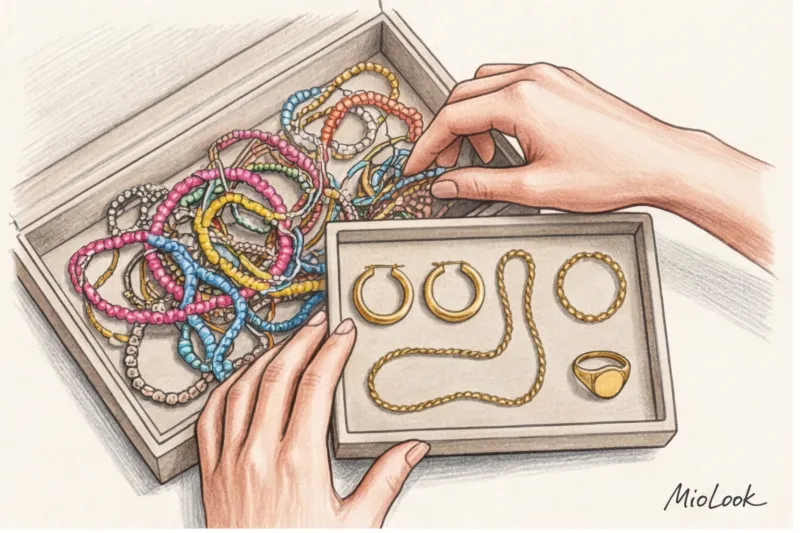
Statement evening jewelry—chandeliers, cocktail rings, and statement necklaces—should be stored on the bottom tier or in a separate box. You only need them a couple of times a month, so there's no point in rummaging through them every morning looking for basic earrings.
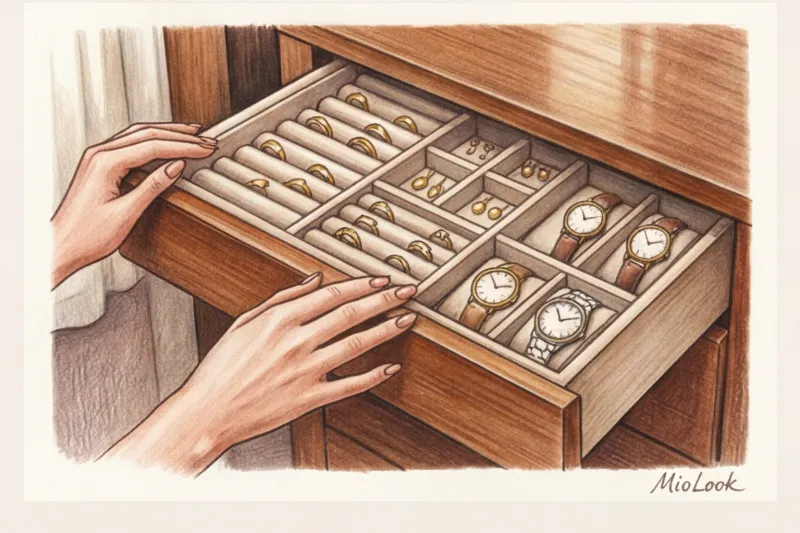
Forget deep, single-bottomed boxes. The future belongs to modular systems (stackable trays). Brands like Stackers or Wolf offer the perfect solution: you buy individual flat trays with different compartments and stack them on top of each other. Everything sits in a single layer, in plain sight, and nothing touches anything else.
How to Store Different Types of Jewelry: Instructions
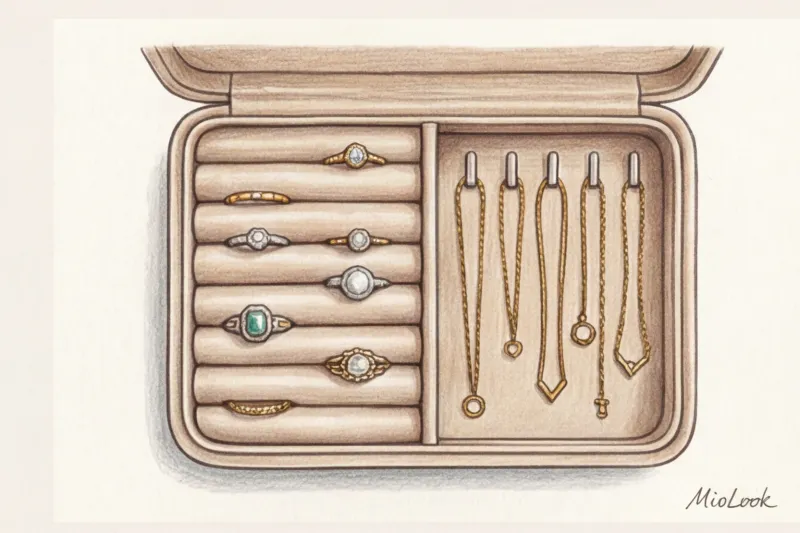
The geometry of a piece of jewelry dictates its storage requirements. What works for a rigid gold bracelet is completely unsuitable for a flexible anchor chain.
Chains and necklaces: the end of the era of disentanglement
A stylist's golden rule: when removing a chain, always clasp it before storing it in a jewelry box. An unclasped chain will tangle three times faster. Fine weaves (such as snakeskin) are prone to creasing, so it's best to store them hanging inside a closed closet or in individual flat microfiber envelopes.
There's a brilliant life hack for transporting thin chains: thread half the chain through a regular drinking straw and secure it with a lock. This way, it will never tie into a Gordian knot in your suitcase.
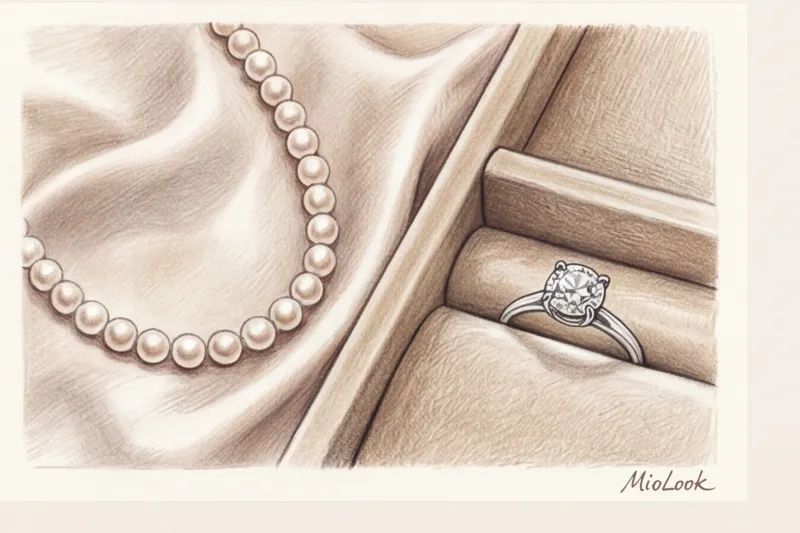
Rings and Earrings: Protecting Your Prongs and Finding a Match
For rings, a must-have is a special velvet cushion. Not only do they beautifully present the ring, but they also serve an important function: they hold the ring in an upright position, preventing deformation of the shank (band) and protecting the prongs (the claws that hold the stone) from mechanical pressure.
Studs and small earrings are best stored clipped to special porous supports or thick cardboard with a velvet coating. This way, you'll never lose the butterfly clasp. For large, statement earrings, use separate square compartments.
Bracelets and watches: maintaining geometry
Hard bracelets (bangles) and watches with metal straps require storage on special cushions. This relieves mechanical stress on the links and maintains the correct radius. However, soft "tennis" bracelets with diamonds should be stored exclusively in an extended horizontal position in a long compartment, otherwise the hinges between the stones will stretch over time.
Organization Myths: Why Jewelry Trees Ruin Your Stuff
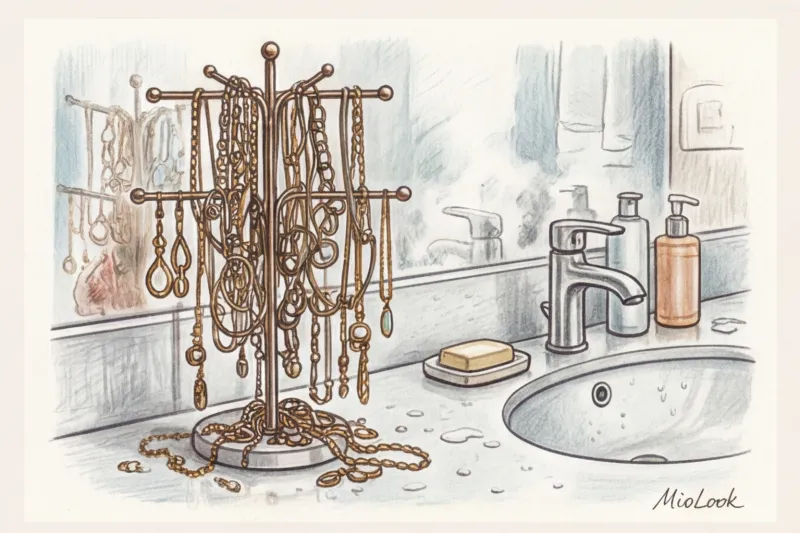
It's time to debunk one of the most harmful myths perpetuated by the Pinterest aesthetic. Open stands, delicate "jewelry trees," and saucers on a dresser are the worst thing you can do for your accessories. Yes, they look pretty in photos, but in reality, open storage leads to immediate oxidation of metals from exposure to oxygen.
In addition, household dust, mixed with particles of your perfume and hairspray, settles on the microscopic prongs and pavilions of the stones. After a month of open storage, a diamond loses up to 40% of its sparkle due to this greasy film. Want to enjoy the beauty of your collection? Upload it to MioLook — there you can assemble images visually without putting real products at risk.
Another myth is storing jewelry in factory cardboard boxes. Many people think that if a boutique sold a ring in beautiful packaging, that's the ideal place for it. This is not true. The glue used in cardboard releases sulfur compounds over time, which cause silver and low-karat gold to yellow and stain.
And one last strict rule: never store costume jewelry (especially brass and copper) in the same storage compartments with jewelry made of precious metals. Contact between different alloys triggers a galvanic reaction that can irreparably damage the plating of expensive items.
Your ideal image begins Here
Join thousands of users who look flawless every day with MioLook by planning their jewelry capsules in advance.
Get access — €0.99 onceTravel Format: How to Transport a Jewelry Capsule on Business Trips
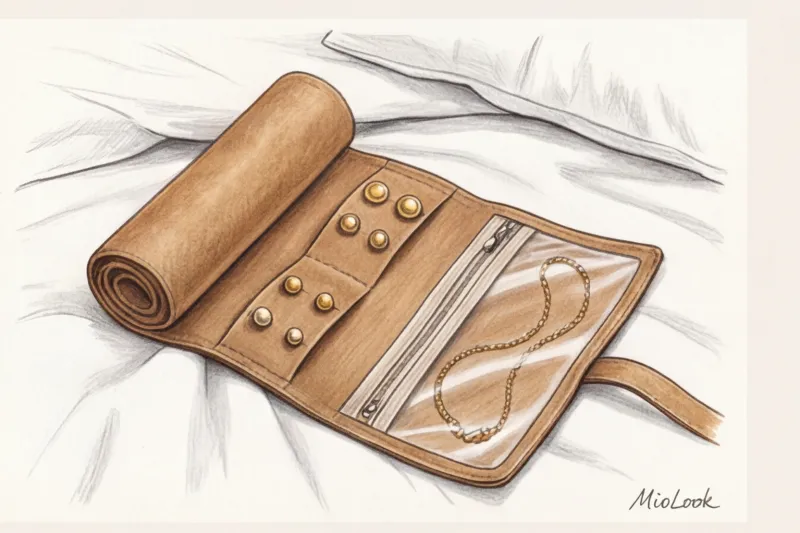
My clients, who frequently present at international conferences, constantly ask how to transport their prestigious accessories. Forget about silk bags where everything gets thrown in bulk. Vibration during travel increases friction tenfold.
Your best travel companion is a specialized jewelry roll made of genuine suede or soft leather. It features stitched straps for rings, perforated earring bands, and individual zippered pockets for pendants. Each piece is securely held in place and doesn't touch its neighbors.
However, I must be honest: this advice doesn't work in every scenario. If you're flying to a social event and carrying a massive, rigid necklace or large investment stones, a soft roll won't protect them from accidental bumps in your carry-on. For such cases, you'll need a hard travel case with individual inserts.
How much jewelry should you pack? I recommend the "1+2" rule: one statement piece (like a cocktail ring or statement earrings for an evening out) and two minimalist basics (a daytime watch, stud earrings, or a sleek ring) that coordinate.
Checklist: Reorganize Your Jewelry Wardrobe in 30 Minutes
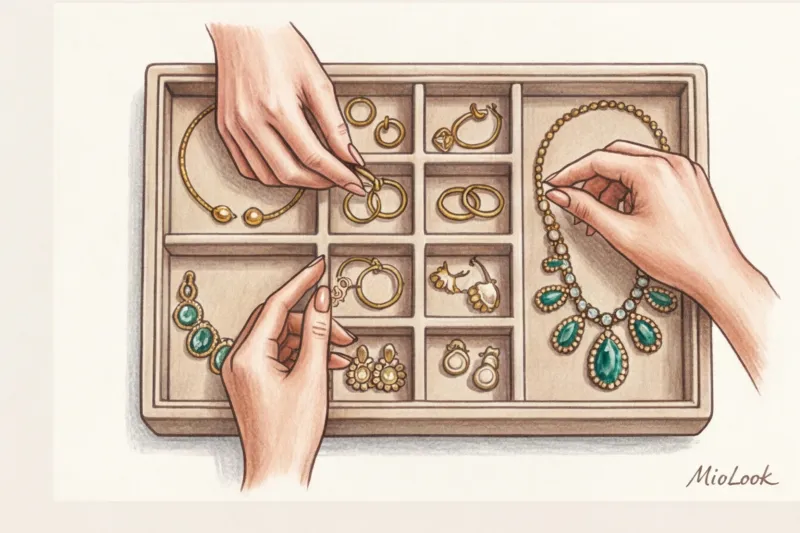
Style is urgent. I suggest you take half an hour this weekend to get your investments in order. Here's the step-by-step process I use when reviewing my clients' wardrobes:
- Step 1: Complete inspection and cleaning. Take out absolutely everything. Wipe each piece with a jewelry cleaning cloth (avoid abrasives and hard brushes). Place any items that need repair in a separate zip-lock bag for your repair shop.
- Step 2: Sorting by metals and hardness. Separate the silver from the gold. Keep the diamonds away from the pearls and emeralds. Put the costume jewelry in a completely different box.
- Step 3: Separate your daily capsule. Choose 5-7 items that you wear most often (price ranges from €80 to €300 per item for premium items). This is your "Hot Zone."
- Step 4: Placement in stackable trays. Place the base on the top tier of a tray lined with soft velvet or suede. Place the rest of the items on the lower tiers.
Properly organizing your jewelry wardrobe isn't just a matter of maintaining order. It's about managing your assets intelligently. By spending just 30 minutes organizing your space, you'll not only extend the life of your favorite pieces for decades, but also give yourself the luxury of choosing accessories every morning easily, quickly, and with impeccable taste.