Introduction
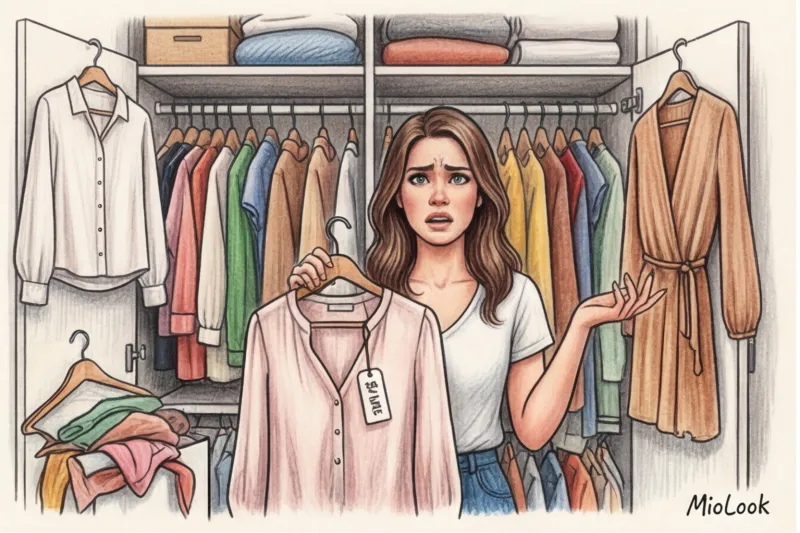
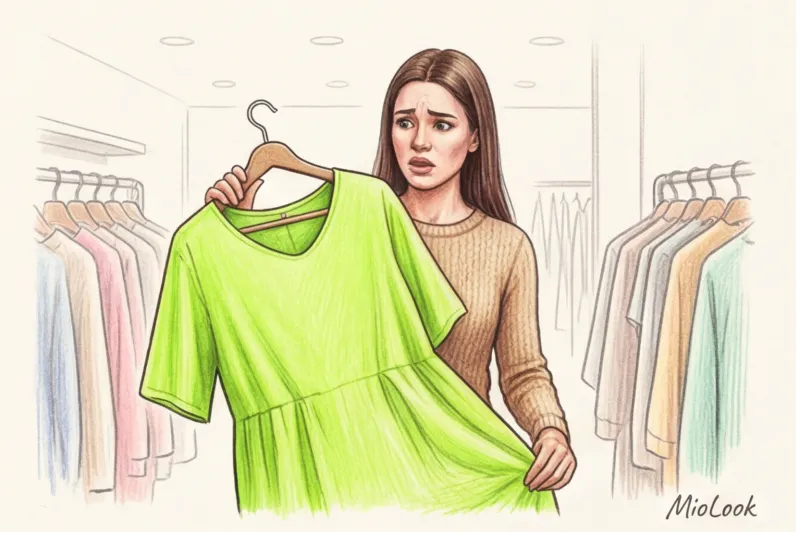
Over 12 years as a stylist, I've sorted through hundreds of women's closets. And you know what I see in every other one? Items with the tags still attached. Let me tell you the story of one of my clients. Anna, a successful corporate lawyer, spent years buying flowing boho dresses, colorful tunics, and straw bags online. She spent a significant portion of her budget on them, building a wardrobe for her "inner freelance artist." The paradox was that Anna spent 300 days a year in court, the office, and at business meetings. Her real life required stately suits, but the dresses gathered dust in bags, causing her only feelings of guilt.
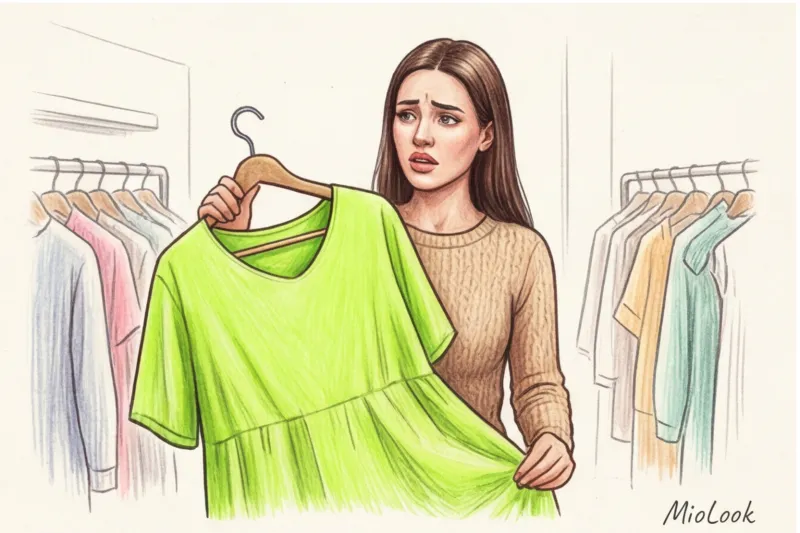
If you, too, regularly open an overflowing closet and dreadfully Google how to stop buying clothes that don't fit, know that the problem isn't your figure. And certainly not a lack of innate taste. The problem lies in your choice algorithms, which are breaking down under the onslaught of aggressive marketing and our own illusions. We've covered the neurobiology of such breakdowns in more detail in our the complete guide to the psychology of shopping In this article, we'll examine the practical side of the issue through the lens of color and body architecture.
Why We Buy Things That Are Not Ours: The Perfect Mannequin Trap
Glossy magazines often advise: "To avoid impulse purchases, put something aside for 24 hours." This is the most popular rule, and it absolutely doesn't work if you don't know your appearance. A bad item will still be bad tomorrow. If you wait, you'll simply buy an ill-fitting piece with a cool head.
The main trap is that we fall in love with the garment itself. We're hypnotized by the texture of thick silk, the perfect stitching of a jacket, or the alluring color of Marsala on a hanger. But we forget to appreciate the most important thing: how this particular piece of fabric interacts with our unique appearance.
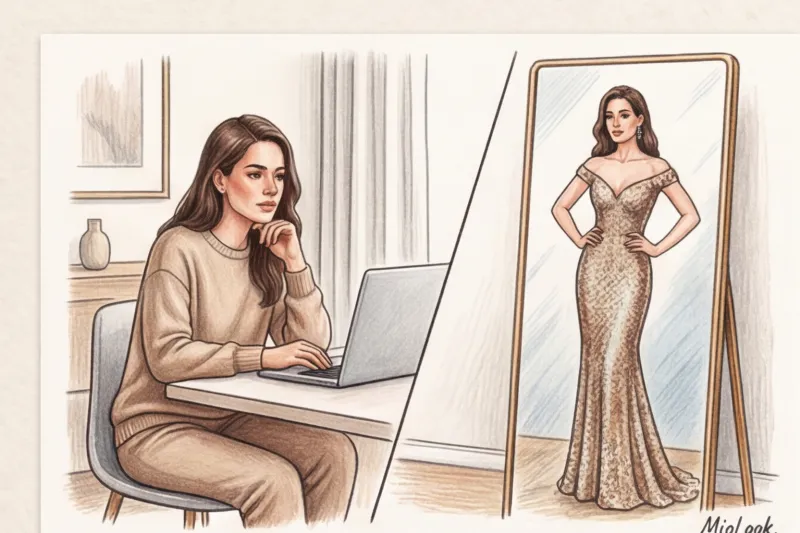
According to a 2024 McKinsey research report, up to 40% of clothes ordered online are returned to warehouses. And the leading reason for returns isn't defects, but rather poor skin tone and fit. We continue to cater to the concept of a "Fantasy Self," buying clothes for a life we don't have. We buy sparkly tops for imaginary parties while sitting on the couch with a laptop in a stretched-out T-shirt.
The Illusion of Color and the Magic of Store Lighting
Have you ever noticed how stunning your reflection looks in the mirror of a spacious fitting room at a fine boutique? Your skin appears radiant, and the color of your chosen sweater is incredibly deep. This isn't a coincidence, but a carefully calculated calculation.
Research in retail psychology has long proven that properly positioned lighting sells better than any discount. Fitting rooms at premium brands feature lamps with a focused, warm light temperature of around 3000-3500 Kelvin. This light softens natural shadows on the face, acts as a subtle blur filter on smartphones, and visually warms skin tones by 2-3 shades. In this warm light, any color of clothing seems "flattering." But step outside into the harsh, cold daylight—and the carriage turns into a pumpkin.
Herein lies the root of the problem with choosing shades. Let's address the most ingrained myth in the industry: "black is universal and suits absolutely everyone." Based on the classical color theory of Johannes Itten, I can confidently state the opposite. A dull, graphite black near the face mercilessly ages 70% of women with Slavic and European facial types. Due to the physics of light reflection, black fabric casts harsh micro-shadows on the face, instantly emphasizing nasolabial folds, the slightest redness, and dark circles under the eyes, making you look tired and unwell.
Access to MioLook for €0.99 — one-time payment
A smart AI stylist will select the perfect look.
Get access — €0.99 onceHow to Stop Buying Clothes That Don't Fit: The 3-Filter Method
Over the years of working as an image consultant, I've developed a rigorous yet highly effective system for evaluating items before purchasing. It helps quickly and painlessly separate the emotional "I want this because it's fashionable" from the pragmatic "I'm buying this because it makes me look better."
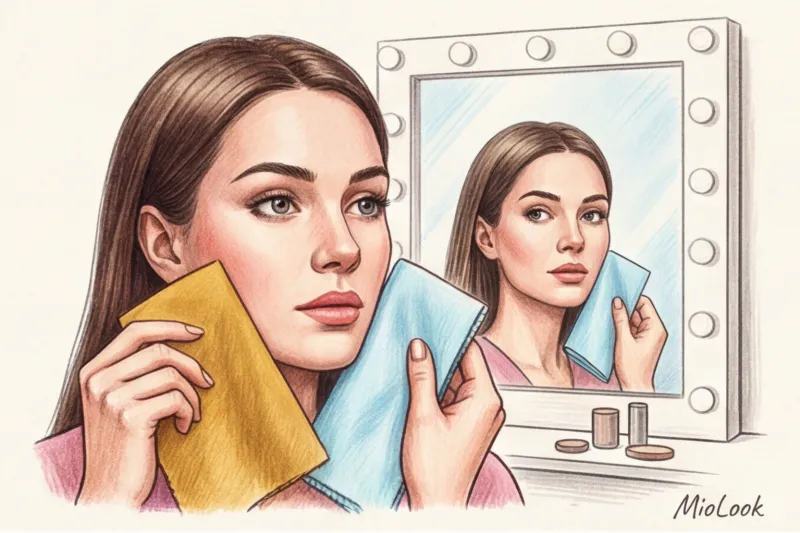
In my personal consultations, I use a professional tool called directional draping. This process involves sitting in front of a mirror, makeup-free, under neutral lighting, and I alternately apply test pads of varying temperatures, brightness, and contrast to the client's face. The skin's reaction is always obvious. But you don't need to carry a styling kit to avoid making mistakes. Simply run each piece through three simple filters.
Filter #1: Portrait Zone and Your Real Palette
Remember the stylist's number one rule: if the color doesn't suit your complexion, don't buy it. Even if it has a phenomenal fit, natural ingredients, and is 80% off.

To check your shade, do a "no makeup" test. Place your chosen sweater or blouse against your chin. Ideally, leave the fitting room and approach the store window to catch natural daylight. The right, natural color will work like a good concealer from a luxury brand. The whites of your eyes will instantly appear whiter and brighter, your face will be lifted, and your skin tone will be evened out.
If your complexion suddenly takes on a sallow, gray, or greenish undertone, and pigment spots become prominent, return the item to the hanger immediately. To avoid any more guesswork in the mirror, I strongly recommend getting to grips with your color palette once and for all. Learn 12 color types of appearance and build your own base palette that works for you, not against you.
Filter #2: Body architecture, not fashion trends
Global trends sell us the idea of versatility. We're told that oversized, mannish jackets or extremely low-rise jeans are must-haves in every modern woman's wardrobe. But this is a marketing illusion.
Clothing is all about geometry. The lines of a cut should either harmoniously follow your natural curves or skillfully correct them. If you have sloping, soft shoulders and pronounced curves, a stiff, architectural jacket in heavy tweed will make you look like a rectangular wardrobe. Conversely, a soft, shapeless, chunky knit cardigan will make someone with pronounced, graphic shoulders look like a tired orphan.
Of course, every rule has exceptions. This advice does NOT work if your goal is to create a shocking street style look for Fashion Week, where deliberately distorting proportions is an artistic technique. But for a harmonious everyday wardrobe, ignoring your body architecture - this is a direct path to a closet full of disappointments.
Insider Stylist Secret: The Cost Per Way (CPW) Rule
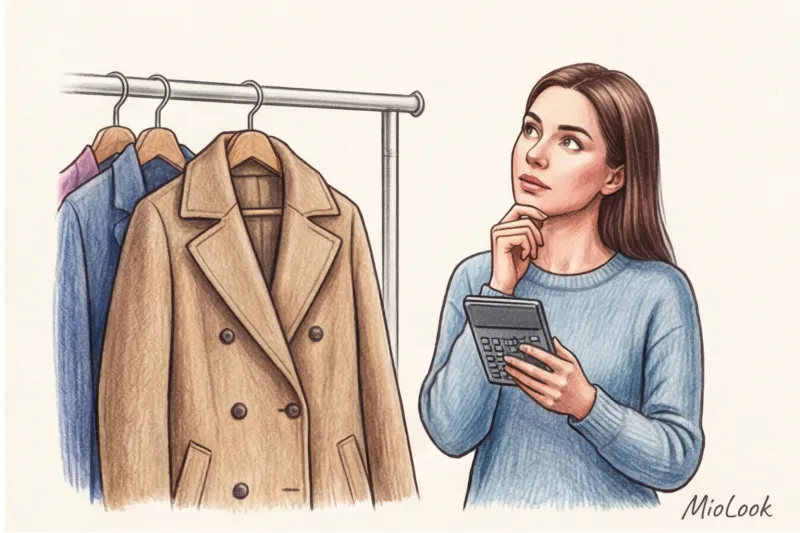
Do you know how to instantly and effectively sober up your mind when you're suddenly tempted to buy another "cute blouse on sale"? Use the Cost Per Wear (CPW) formula. This straightforward mathematical approach will forever change your attitude toward price tags.
The formula is simple: take the cost of an item and divide it by the realistic number of times you plan to wear it over the next few years. Let's look at a specific example from my own experience:
- Scenario A: You buy a trendy asymmetrical skirt with large sequins for $50 (or the equivalent in your currency). You wear it to a New Year's office party and maybe again to a friend's party. Total: 2 outings. CPW = $25 per outing.
- Scenario B: You invest in a classic, basic trench coat made of premium heavy cotton for $200. Thanks to its versatile color and cut, you wear it every day: 50 days in the spring and 50 days in the fall for at least three years. Total: 300 outings. CPW = $0.66 per outing!
Mathematics is ruthless. A cheap polyester item, bought on impulse and as a one-time purchase, will actually cost you tens of times more than a quality, basic investment like a cashmere sweater or a good wool coat.
Your perfect look starts here
Join thousands of users who look flawless every day with MioLook.
Get access — €0.99 onceFitting Room Audit: A Strict Checklist Before Going to the Checkout
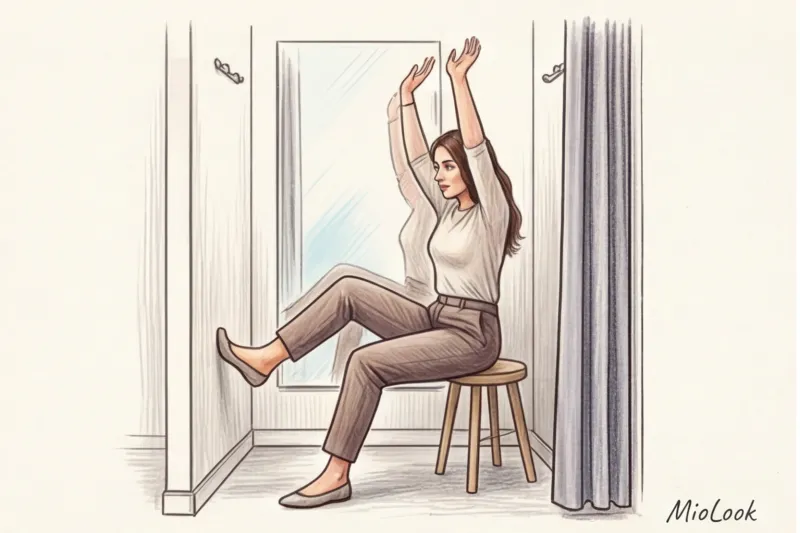
So, you're in the fitting room. The item has been filtered by color and pattern. But that's not the end of the world. Our biggest mistake is judging a garment's fit by standing at attention in front of the mirror, sucking in our stomachs, and holding our breath. We forget that we live in a dynamic world.

Conduct a rigorous three-step checklist:
- Test in motion: Never buy pants without sitting down on a ottoman in them. Raise your arms up as if you're trying to reach a heavy folder from the top shelf. Bend over to pick up dropped keys. If the belt cuts into your stomach, the armhole pulls on your shoulders, or the skirt rides up dangerously high, take them off. Anything that requires constant tugging will end up on the back of your chair.
- The rule of three sets: Can you, right now, standing in the fitting room, come up with three complete looks with this new item and things from your current wardrobe? If you're out of ideas for combinations, put them back on the hanger. To make this task easier, the app MioLook There's a wardrobe digitization feature: you can open your virtual closet right in the store and check if a new skirt will pair with your favorite sweaters.
- Tactile test: Close your eyes and touch the material with both hands. My personal method of blindly testing fabrics is incredibly sobering. If the fabric creaks even slightly under your fingers (a sure sign of low-quality 100% polyester) or is noticeably itchy, you won't wear it. The human body will always choose comfort.
Secret from an image maker: Always take a photo of yourself in the fitting room mirror at stomach or chest level. Our brains emotionally distort our reflections, mistaking wishful thinking for reality. But the camera lens will dispassionately show the true proportions: where the garment has added an extra five kilograms, and where it has shortened your legs.
How to eco-friendly get rid of things you've already bought and don't fit
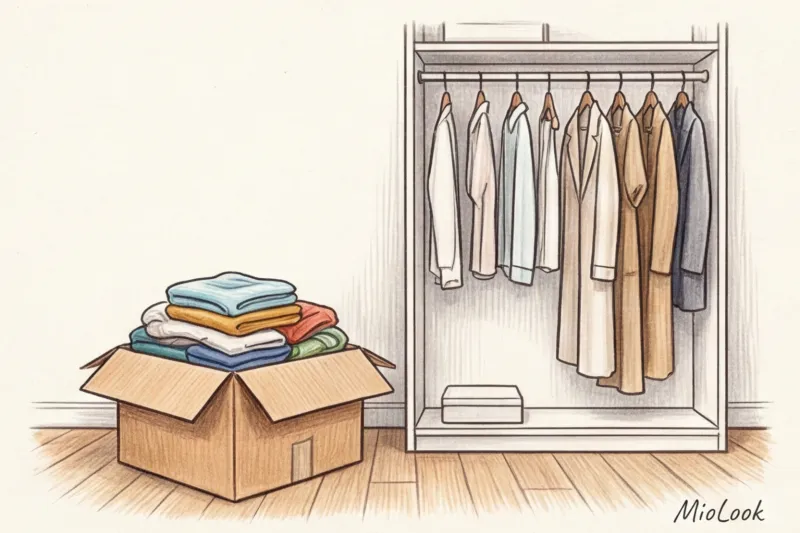
If, after reading the previous points, you're looking longingly at your closet, take a deep breath. The first step to healing your style is honestly admitting your mistakes without the corrosive guilt. Every stylist, including me, has had their share of fashion mishaps.
Things that don't suit you shouldn't become "things of reproach." When you see in your closet every day a dress you promised to lose weight in three years ago, or a sweater that makes your face look tired, you're programming yourself for negativity from the very morning. This visual noise needs to be eliminated.
Today, there are many civilized and environmentally friendly ways to part with clothes:
- Resale platforms: High-quality branded items with tags can be sold on international platforms like Vestiaire Collective or on local classifieds services.
- Swap parties: Have a swap with your girlfriends over a glass of wine. Your "unlucky" warm terracotta top might be perfect for a friend with an autumnal coloring.
- Charity: Clean, undamaged items are always accepted at local charities or clothing collection containers.
Use the proceeds from the sale not for new emotional purchases, but for building a smart base. Read our guide on capsule wardrobe to understand the algorithm for creating a functional core.
Conclusion: From impulse to conscious wardrobe

Stopping buying things that don't suit you isn't about strict prohibitions or asceticism. It's about respecting yourself, your body, and your time. Conscious style begins precisely where the exhausting pursuit of other people's trends and imaginary images ends.
Let go of your illusory "fantasy self" and dress the beautiful woman you are today. Explore your natural undertones, always test the fit over time, and remember the sobering rule: "cost per outfit."
Remember: a perfect, functional wardrobe isn't 100 ultra-fashionable items that wrinkle at the first glance and make you constantly suck in your stomach. It's 30 carefully selected pieces that make you feel completely confident and relaxed in any situation. Take the first step toward this state this evening: take out of your closet that one item you haven't worn in over six months and honestly run it through the three filters. The answer to what to do with it will come instantly.