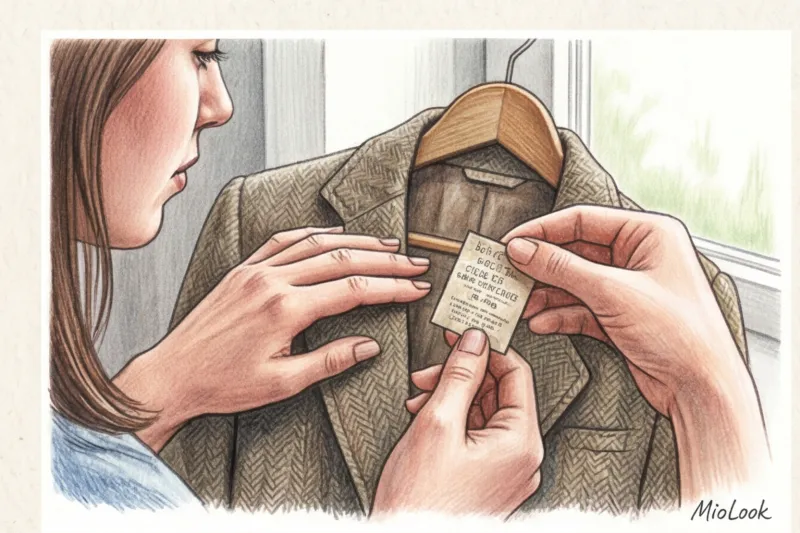
Imagine this: you found the perfect vintage Yves Saint Laurent jacket in a small boutique in the Marais district of Paris for just €80. The cut is perfect, the fabric is luxurious, and it's in like-new condition. But when you open the suitcase at home, a pungent, distinctive chemical aroma fills the entire room. Sound familiar? We've shared more about where and how to find these fashion gems in our article. The complete guide to clothing resale and vintage: how to buy brands profitably But now we face another, purely practical task.
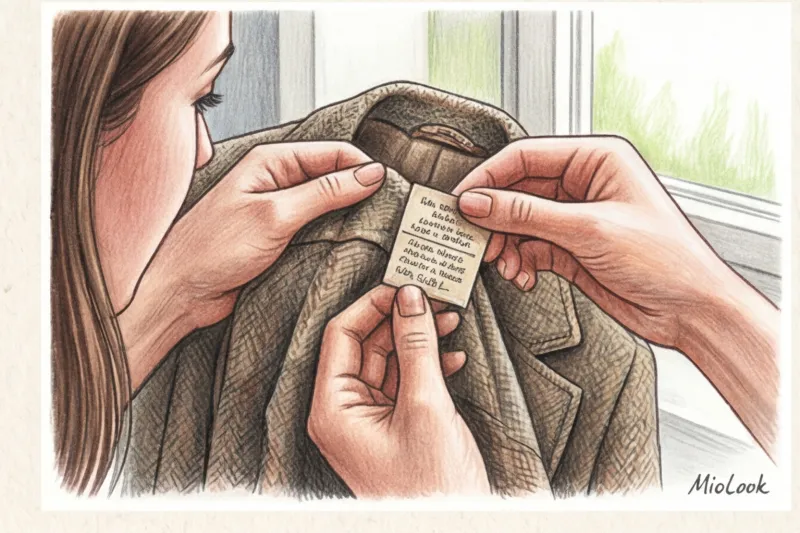
Over the 12 years I've been working as a personal stylist, I've brought dozens of unique pieces from Europe for my clients. And the main question I'm asked after each purchase is how to get rid of the second-hand smell once and for all. The internet is rife with "grandmother's recipes" that, at best, don't work, and, at worst, irreparably ruin expensive fabrics. Let's leave aside the mysticism about "someone else's aura" and approach this issue like professionals: with an understanding of the chemistry of processes and a careful approach to wardrobe care.
The Chemistry of the Process: Why Do Second-Hand Items Smell So?
Let's start by debunking the biggest myth: that distinctive sweet-pungent aftertaste isn't the scent of "old age," a previous owner, or a musty warehouse. It's the smell of extreme sanitization.
According to international sanitary and epidemiological standards, any clothing entering the secondary market on an industrial scale undergoes gas disinfection. The most commonly used methyl bromide or formaldehyde This ensures that no dust mites, bacteria, or fungi remain on the fabric. According to the independent association OEKO-TEX (2023), the safe level of formaldehyde for clothing in contact with the skin should not exceed 75 ppm (parts per million). However, during the sorting process, the concentration can be significantly higher, allowing the gas to penetrate every fold of a bale weighing several hundred kilograms.
"You can't just 'wash' this smell out with regular detergent because you're not dealing with dirt. You're trying to wash out a gas whose molecules have firmly clung to the fabric fibers at the cellular level."
This is why a regular 40-degree cycle in a washing machine is completely useless. You need products that can break down the chemical bonds, not just superficially remove stains from the fabric.
The Biggest Mistakes: What You Should Never Do with Vintage
Before we get to the detox, I must warn you about three fatal mistakes. A client named Anna once came to me in tears: she'd bought a stunning 1990s Max Mara cashmere coat for €120, read a bunch of advice on a women's forum, and... boiled it. The coat had shrunk by 30%, turned into a thick felt, and ended up in the trash. The patterns were destroyed.
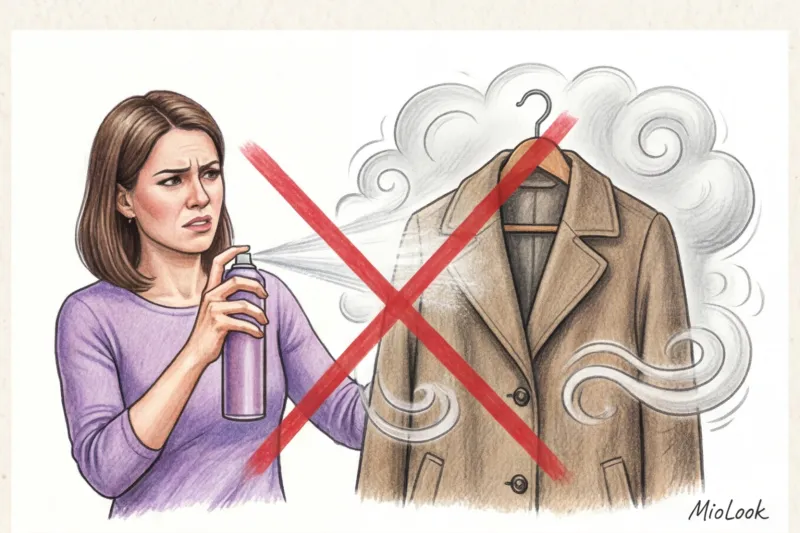
What should I do absolutely? it is forbidden:
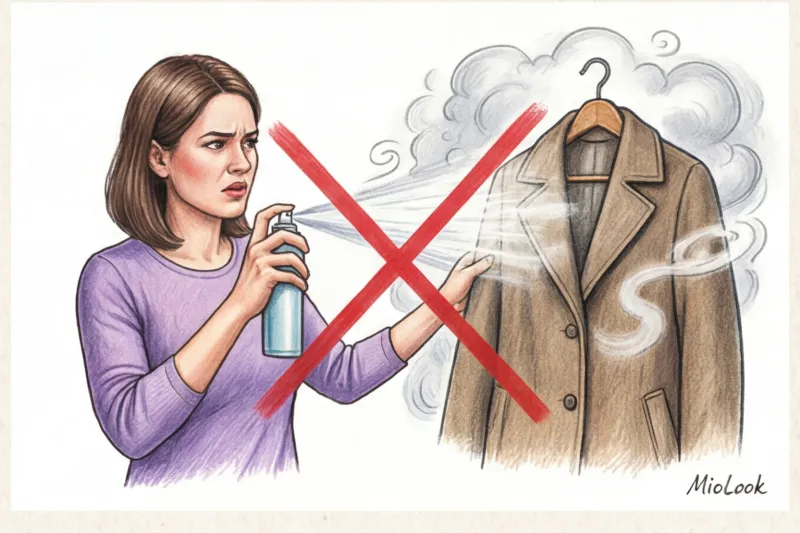
- Mask the smell with heavy perfume. This is the worst thing imaginable. Formaldehyde reacts chemically with the essential oils and alcohol in your perfume, creating a nauseating, suffocating aftertaste that's guaranteed to give you and those around you a headache.
- Pour liters of fabric softener into the item. It's a completely counterintuitive insight, but fabric conditioner is your enemy. It contains silicones that coat the fibers, making them soft. By applying fabric conditioner to fabric that hasn't been washed to remove formaldehyde, you're literally "sealing" the toxic gas within the fibers. Removing it afterward is virtually impossible.
- Boil items or wash at 90°C. High temperatures permanently shrink wool, destroy elastane (the item will become wavy), and wash out dye from cotton.
Your perfect look starts here
Join thousands of users who look flawless every day with MioLook. Create your own virtual capsule collection.
Get access — €0.99 oncePreparing for a "detox wash": Strictly sorting by fabric type
The foundation of professional wardrobe care is reading labels. There are no universal recipes. What will save vintage Levi's jeans will mercilessly destroy a natural silk blouse.
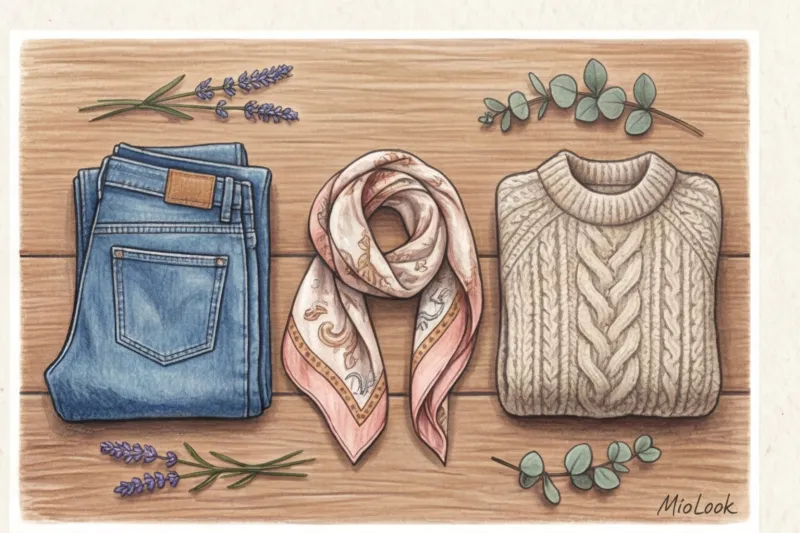
Before you start thinking about how to get rid of the second-hand smell, analyze the item and divide your purchases into two categories.
Natural dense fabrics (cotton, linen, denim)
These are the most rewarding materials. Cellulose fibers (cotton and linen) tolerate prolonged soaking and alkaline and acidic environments within reasonable limits. The optimal temperature for them is 30–40°C. They are resistant to mechanical stress, so the most effective water-based cleaning methods work with them.
Delicate fabrics (silk, cashmere, fine wool)
Wool and silk are protein-based fabrics (similar in structure to human hair). They absolutely cannot tolerate alkali, as it makes them stiff and brittle. They should not be soaked for long periods of time, rubbed, or wrung out. We use only gentle ventilation and dry odor-absorption methods for them.
How to Get Rid of the Smell of Second-Hand Clothing: 4 Effective Home Remedies
In my experience, these four methods have proven 100% effective. Important: Follow the instructions exactly.
Method 1: Table vinegar solution (for cotton, linen, viscose)
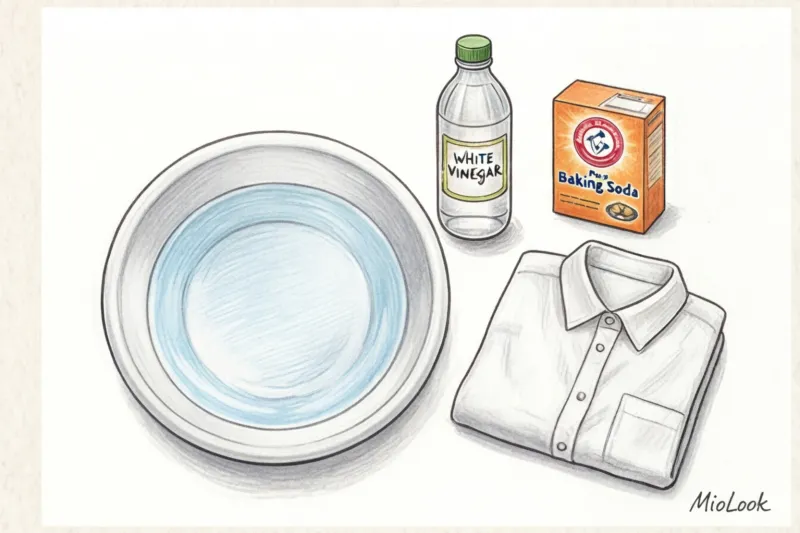
Acetic acid is excellent at neutralizing alkaline components of sanitizing products.
- Take a basin of warm water (about 5 liters).
- Add exactly 100 ml of 9% table vinegar (not essence under any circumstances!).
- Soak the item for 3-4 hours.
- After this, machine wash on a standard cycle with the addition of liquid washing gel.
Limitation: Do not use this method on silk - the acid may damage the delicate dye.
Method 2: Ammonia for deep cleaning (for synthetics and denim)
Ammonia dissolves chemical resins better than any powder. This method worked perfectly on my heavy men's shirts from the '90s and polyester jackets.
- Proportion: 2 tablespoons of 10% ammonia per 5 liters of water.
- The soaking time depends on the volume of the item (from 1 to 3 hours).
- Important: Don't be alarmed by the strong ammonia smell during the process. After machine washing and air drying, there will be no trace of it, nor of formaldehyde.
Limitation: Strictly prohibited for wool, cashmere and alpaca.
Access to MioLook for €0.99 — one-time payment
A smart AI stylist will choose the perfect look for you and help you incorporate vintage finds into your everyday wardrobe.
Get access — €0.99 onceMethod 3: Baking soda and salt as dry absorbents (for items that cannot be washed)
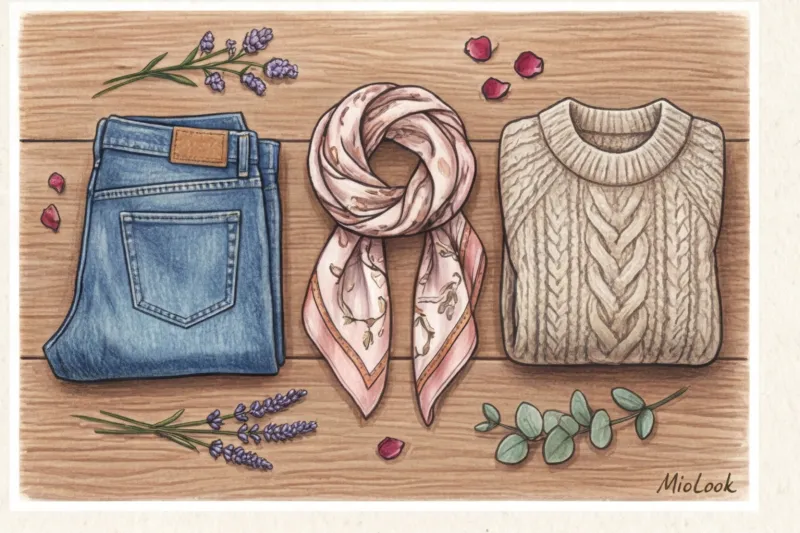
If you have a vintage silk scarf or a bulky sweater that you're afraid to wet, dry clean it. Place the item in a sturdy plastic bag. Add 300-500 grams of regular baking soda (or a mixture of baking soda and fine salt). Tie the bag, shake well to distribute the powder throughout the fabric, and let it sit for 2-3 days. Baking soda is a powerful natural absorbent that will draw gases out of the fibers. Afterwards, simply shake the item thoroughly.
Method 4: Freezing and contrast ventilation
Physics also works on our side. Formaldehyde molecules are extremely volatile, but they need to be "broken down." Hang the damp item (after a regular wash) on the balcony in freezing weather or in direct sunlight. Low temperatures and ultraviolet light break down the chemical bonds of the disinfectant. The "wash and dry in the wind" cycle may need to be repeated 2-3 times for full effect.
Heavy artillery: when home remedies fail
There are situations when home washing won't help. Leather biker jackets, suede blazers, real fur, or complex coats with interlining (the interlining that holds the shoulder's shape) should never be washed.
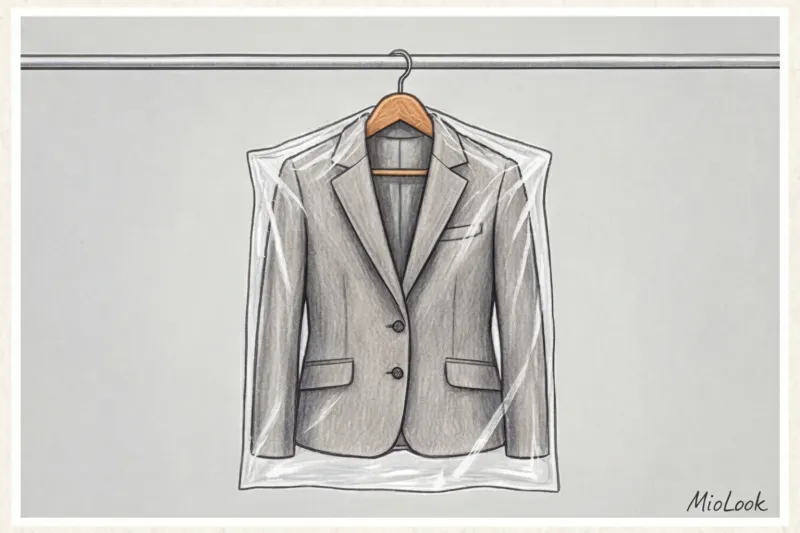
In this case, there's only one solution: professional help. But you need to handle the item wisely. When dropping off a vintage coat, be sure to note the following to the receiver: "odor removal, not just cleaning" Most good European dry cleaners (the service will cost you around €15–€30) have a secret weapon of the professionals: ozonation.
How does it work? The item is placed in a special chamber where ozone gas (O3) is introduced. Ozone is one of the strongest oxidizing agents in nature. According to research by chemical institutes, the reaction of ozone with formaldehyde (CH2O) results in its complete breakdown into completely harmless carbon dioxide, water, and oxygen. The odor is not masked; it physically ceases to exist. Fair Limit: Ozonation only removes odors. It won't remove a twenty-year-old coffee stain; that will require additional wet cleaning.
Checklist: What to do after purchasing an item with a history
So, you've brought home a treasure. To avoid turning your closet into a sorting yard, implement a systematic approach. Save this checklist:
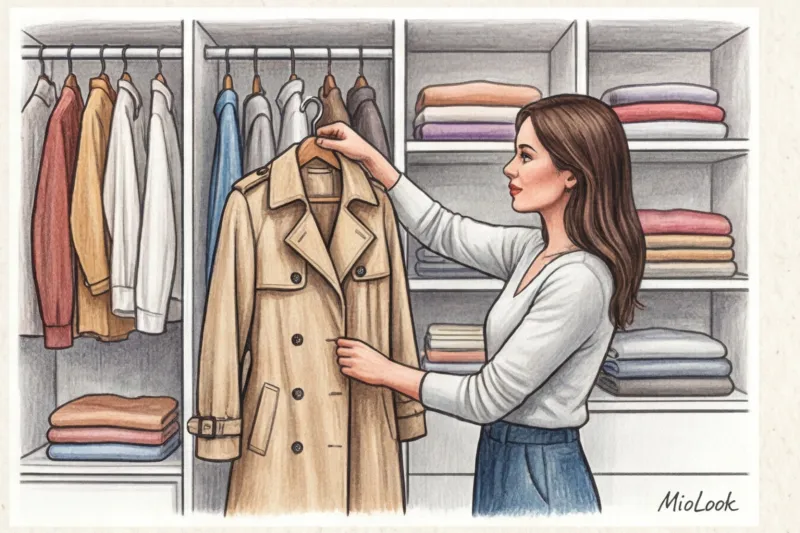
- Quarantine. A newly purchased second-hand item shouldn't be part of your regular wardrobe. Hang it on the balcony or in a separate, well-ventilated area for at least 24 hours.
- Diagnostics. Check the care label for fabric composition and recommended temperatures. If there's no label, use the gentlest method (vinegar for smooth fabrics, dry cleaning for lint-rich fabrics).
- Processing. Soak according to one of the recipes above → delicate wash (without conditioner!) → air out in the fresh air.
- Humidity test. Remember this rule: the formaldehyde smell is strongest when the fabric is damp. If after washing, while the item is still wet, you sniff it and there's no smell, you've won.
Only after this cycle has been completed can the item be steamed, photographed and loaded into MioLook smart wardrobe to create stunning looks by mixing modern basics with unique vintage.
Ready to get started?
Try the MioLook plan for free—no commitments required. Organize your wardrobe like a true stylist.
Get access — €0.99 onceBuying vintage and pre-owned luxury items is always a treasure hunt. And now you know how to properly clean your prize. The main takeaway: don't try to counteract chemicals with perfume; use the laws of physics and basic neutralization principles. Treat the fabric with respect, and a piece with history will last for decades to come.