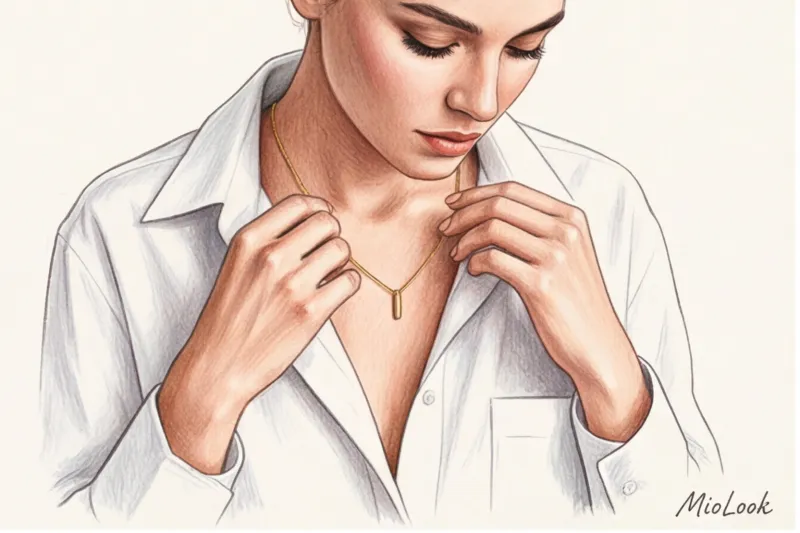
Have you noticed that on the recent red carpets in Paris and Cannes, actresses with the deepest, most dramatic cleavages often walk out to the photographers... with a completely bare neck? If you're Googling it right now, How to choose jewelry to match your neckline This fact may seem strange to you. After all, we've been taught for decades: if there's a gap, it needs to be "filled" with something.
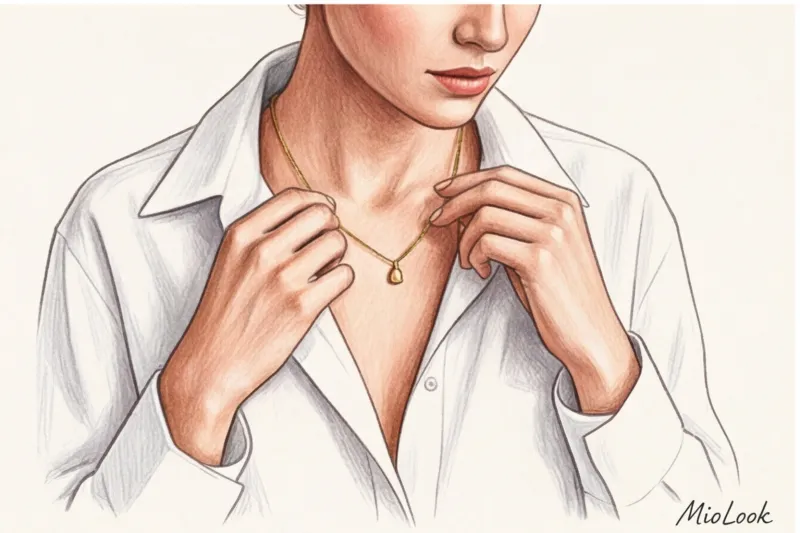
After 12 years of working as a stylist and regularly attending fashion weeks, I've realized one thing: the old rules of jewelry styling no longer apply. The industry has changed, and what was considered a sign of good taste in the 2010s now looks contrived and cheapens the look. The secret to elegance lies not in blindly selecting geometric shapes, but in working with proportions, fabric texture, and so-called "air." We've already discussed a systematic approach to jewelry in more detail in our The complete guide to a basic jewelry wardrobe , and today we will examine the applied anatomy of the portrait zone.
Why the old "shape to shape" rule no longer works
"For a triangle neckline, wear a triangle pendant; for a round neckline, wear a round necklace." Sounds logical? Perhaps. But in practice, this rule turns a living woman into a mannequin from an old catalog. In modern styling, we operate with a different concept— negative space index (Skin-to-Fabric ratio).
Negative space is the distance from your jawline to the hem of your garment. It's this area of exposed skin (or lack thereof) that dictates what should be in the portrait zone. I often have top-management clients who obsessively match V-necklaces to their tailored jackets, creating an overloaded, heavy look. When we removed these rigid necklaces, replacing them with thin sautoirs or leaving their necks bare, they instantly looked five years younger.
Moreover, the old rules completely ignored the physics of materials. The weight and thickness of the metal should be directly related to the density of the fabric on which (or near) it is placed. A thin silk blouse costing €200 would be hopelessly ruined by a heavy, cast necklace that deforms the lightweight fabric with every movement.
Your perfect look starts here
Join thousands of users who look flawless every day with MioLook. A smart AI stylist will analyze your wardrobe and find the perfect combinations.
Get access — €0.99 onceHow to choose jewelry for your neckline: visual geometry
Before we move on to specific necklines, let's establish jewelry length standards, which are essential for proper styling. According to WGSN's 2024 analysis, it's the confusion over length that causes women to forgo jewelry in 70% of cases.
- Choker / Collar: 35–40 cm. Fits snugly around the base of the neck.
- Princess: 45–50 cm. Classic length, falls on the collarbones or slightly below.
- Matine: 50–60 cm. Reaches the chest line.
- Opera (sautoir): 70–90 cm. Falls below the chest, often wrapped in two rows.
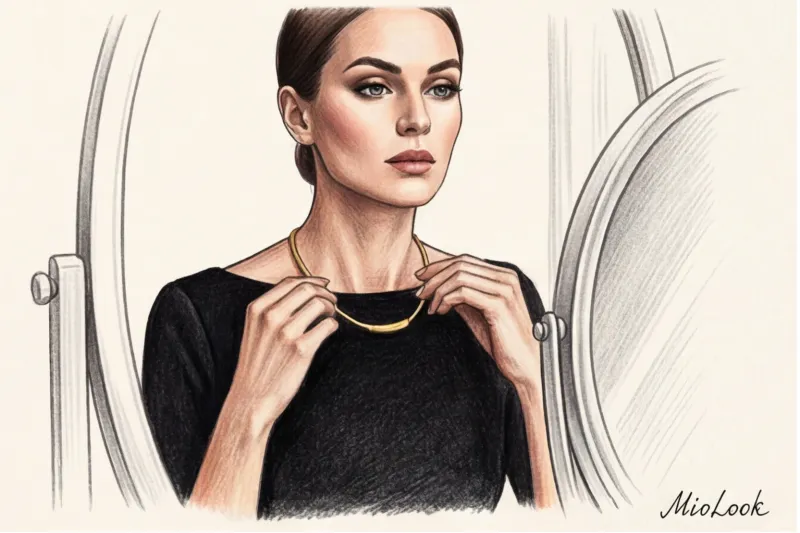
The main and immutable rule of the stylist that you need to remember: the decoration should lie either completely on bare skin , or entirely on fabric Avoid seam conflict—if the edge of the chain constantly falls behind the neckline and hits the edge of the fabric, it looks sloppy.
V-neck and unbuttoned shirt: Managing the vertical
The V-neckline itself is a powerful vertical line that elongates the figure and makes the neck look more graceful. Your goal is to avoid overshadowing this line.
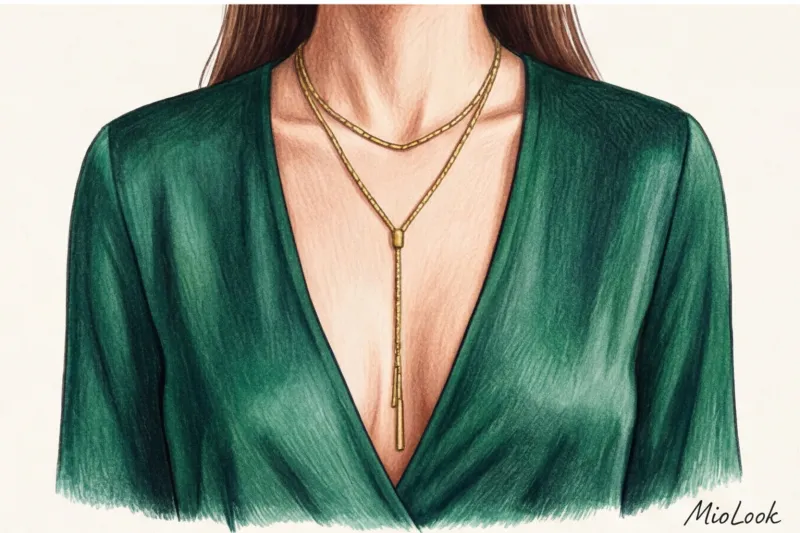
A Y-shaped lariat necklace is ideal for a deep silk top or dress. It follows the contours of the neckline, drawing the eye downwards in accordance with the golden ratio—an adaptation of Leonardo da Vinci's theory of proportions often used by stylists when creating evening looks.
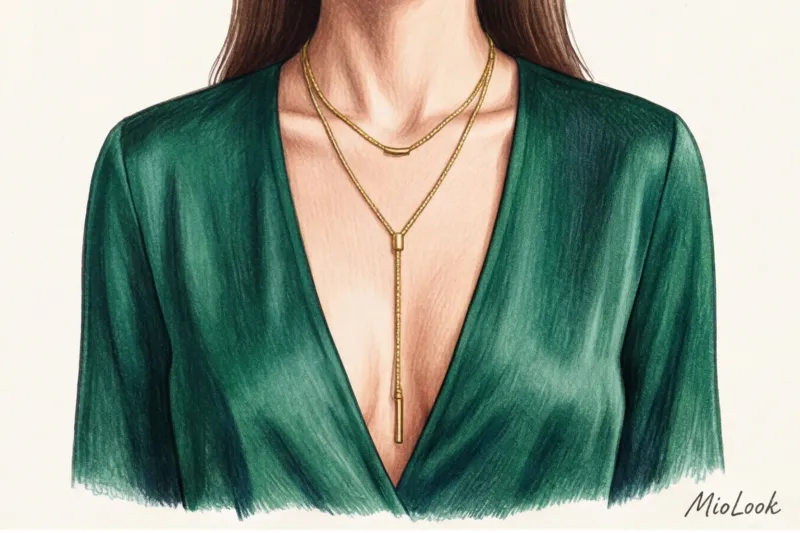
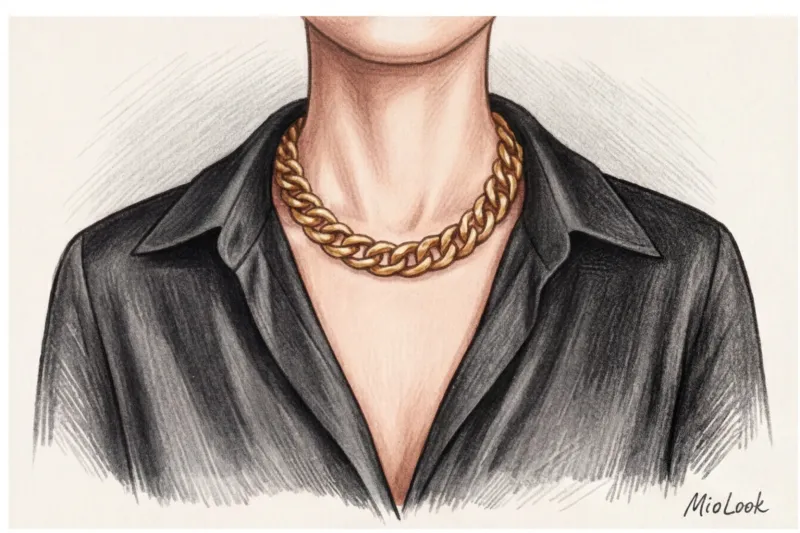
If you're wearing a classic white shirt unbuttoned two buttons, choose a princess-length necklace (45-50 cm). The pendant should end exactly 2-3 cm above the point where the shirt meets. The biggest mistake here is wearing a short, wide choker. It will create a harsh horizontal line that will visually "cut" the neck and ruin the slimming effect of an unbuttoned shirt.
Crew neck and boat neck
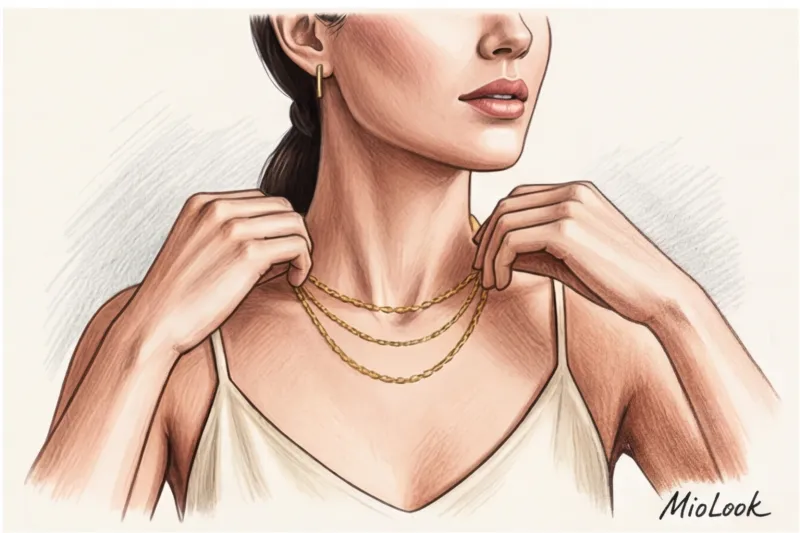
With a round neckline (like a classic T-shirt), short, medium-weave chains work beautifully. They're placed directly over the knit, following its curves without blending in. Layering two or three thin chains looks stunning here.
The boat neckline, so beloved by Audrey Hepburn, works differently. It visually broadens the shoulders and shortens the neck. To compensate for this effect, we need a maximum length—an opera neckline (at least 70 cm). Longer threads will elongate the silhouette.
When it does NOT work: Never wear a short strand of perfect round pearls with a boat neckline. This will instantly add 10-15 years to your age. If you want pearls, choose baroque, asymmetrical ones strung on a long silk strand.
Square neckline and corset neckline (Sweetheart)
The square's geometry is quite aggressive and calls for a softer touch. Pendants with smooth lines, soft curves of metal, or invisible necklaces (a stone on a transparent string) are ideal choices.
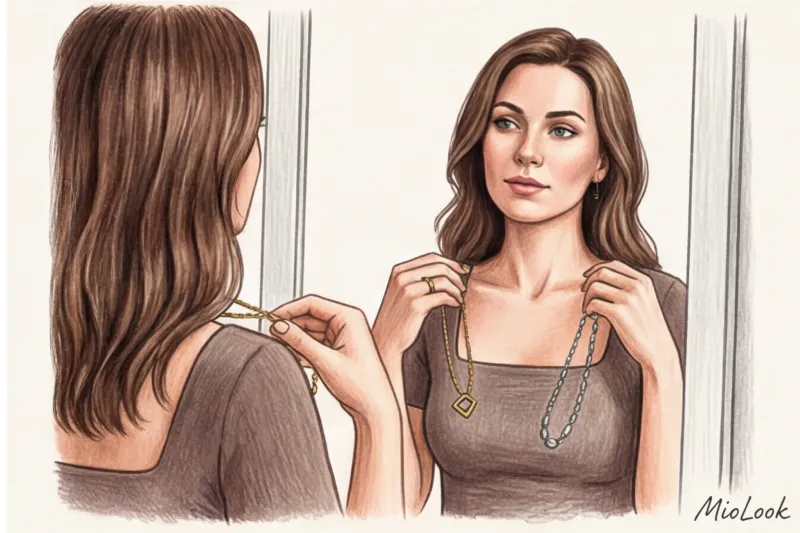
A sweetheart corset neckline leaves too much skin exposed in the portrait area. Unlike a V-neckline, this space needs to be filled. Large chokers that sit high on the neck, leaving some air above the décolletage, are ideal. Just be mindful of boundaries: no element of the necklace should touch the corset line.
Access to MioLook for €0.99 — one-time payment
Not sure if a necklace matches your top? Take a photo of your outfit, and MioLook's smart AI stylist will suggest how to balance the proportions.
Get started with your wardrobeSweaters and turtlenecks: the art of wearing a necklace over fabric
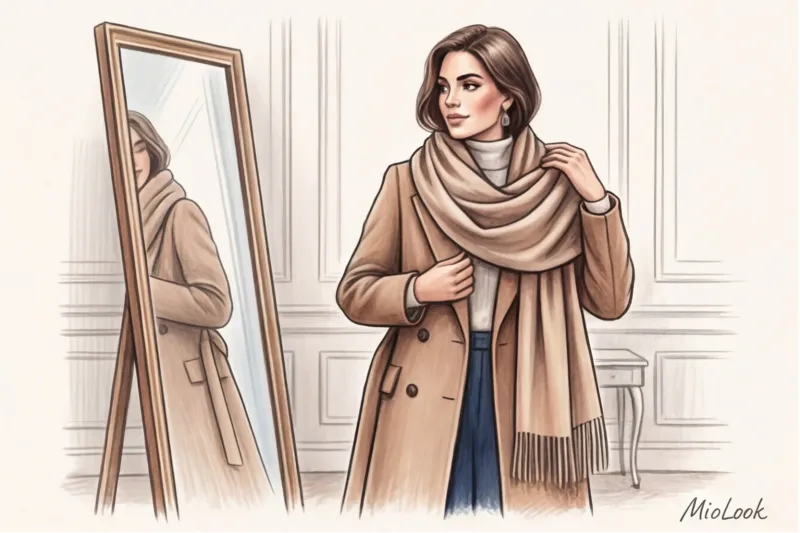
Fall and winter aren't a reason to hide your jewelry wardrobe. However, the rule of contrasting textures comes into play. Smooth, shiny metal looks luxurious against fluffy mohair or cashmere. Textured, wrinkled, and matte metals, however, are best reserved for smooth cotton knits.
I had an instructive experience. In 2019, we were preparing a client, a morning TV presenter. She insisted on wearing a short, brightly shiny necklace over a thick white turtleneck. In the dressing room mirror, it looked acceptable. But when the studio lights came on, the bright glare from the chain merged with the white fabric, visually "cutting off" her head. On camera, it looked as if she had no neck. It's pure physics of light.
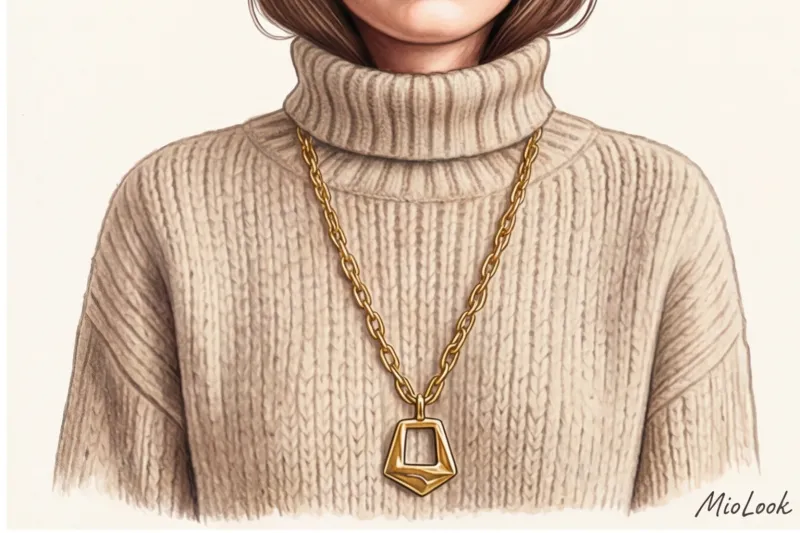
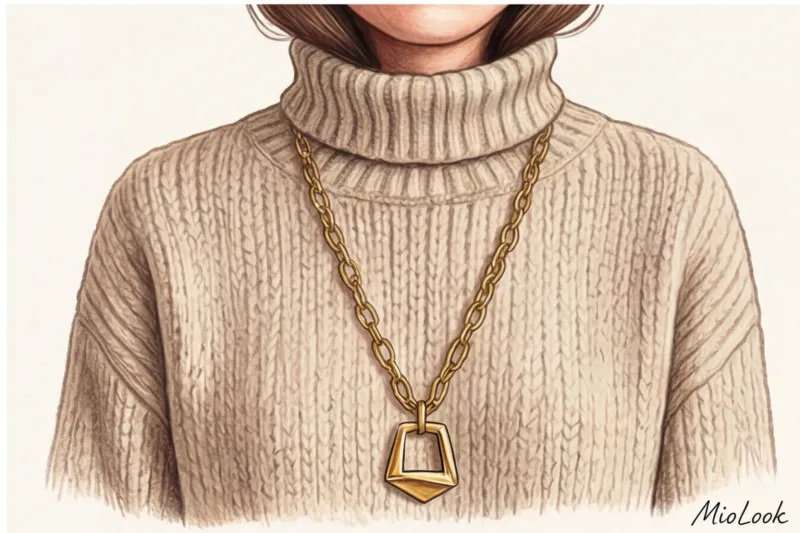
To make a turtleneck look more expensive, use long chains (at least 50 cm) with a heavy, substantial pendant. The weight of the metal is critical here. The pendant should physically pull the fabric down, creating a V-shape across the chest. If the chain is too light, it will ride up unattractively as you walk and distort the silhouette. The thickness of the chain itself should be directly proportional to the density of the knitting: a thin chain will be lost against the bulk of the hand-knitted fabric.
Asymmetry and complex collars: when is it better to skip the necklace?
Here's the counterintuitive insight that many blogs fail to mention: The most stylish solution for a complex neckline is the absence of neck jewelry..
If you're wearing a one-shoulder top (asymmetrical), a halter neck, a cowl-neck blouse, a jabot, large bows, or bold ruffles, stop. Adding a necklace to this already complex fabric will instantly overwhelm the look and make it seem provincial.
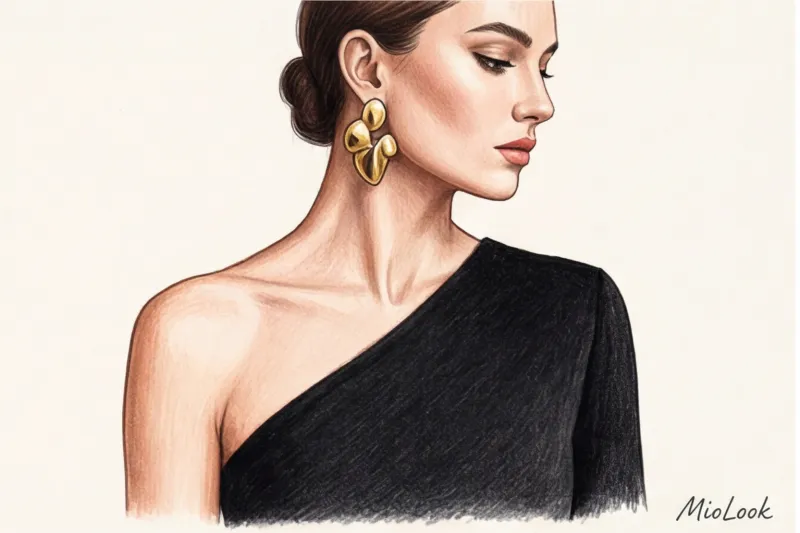
Style is all about commanding attention. If your neckline is already a focal point thanks to your cut, shift the focus higher or lower. Leave your neck bare and wear large, sculptural earrings (like the Saint Laurent stylists do), chunky cuffs, or a pair of wide bracelets (cuff bracelets are a great choice; they're currently trending, and stunning brass options are available for between €50 and €150).
Integration into a Basic Jewelry Wardrobe: 3 Versatile Pieces
There's absolutely no need to buy 20 different necklaces to match every T-shirt in your closet. A smart wardrobe is built on the principle of interchangeability. Chanel has been teaching us the art of layering for decades, and their approach can be adapted to everyday life.
To cover 90% of needs with any cuts, it is enough to have the so-called “universal three formula”:
- Thin choker chain or snake weave (40 cm). It rests in the hollow of the collarbone. It works with round necklines, square necklines, and corsets.
- Medium thickness chain with base pendant (45–50 cm). A versatile soldier for shirts and V-necks.
- Long chain-sautoir or lariat (60+ cm). Salvation for turtlenecks, pumps and deep necklines.
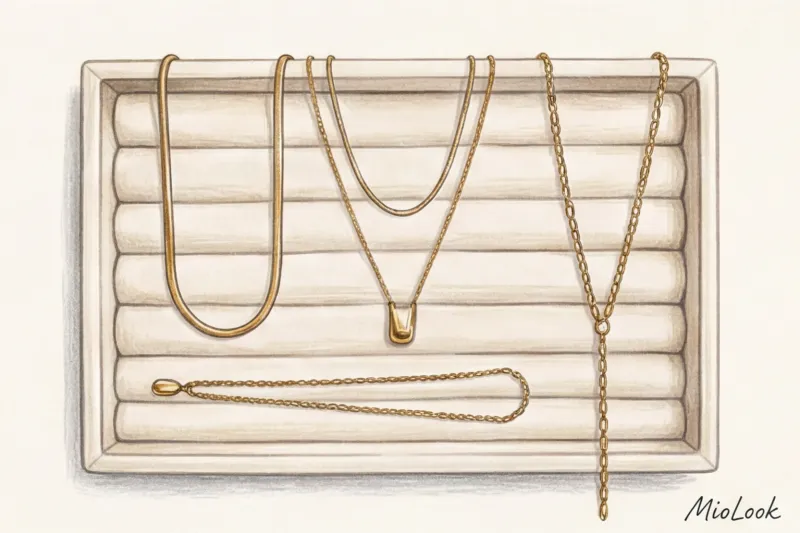
Mix & Match principles allow you to wear them individually or layer them. For example, with a basic white T-shirt, you'd wear items 1 and 2 together. With a plunging neckline on an evening dress, you'd wear only item 3.
Ready to rethink your style?
Digitize your jewelry and clothing with MioLook. The app will help you create a capsule wardrobe and show you which items you're truly missing and which purchases you should avoid.
Create a smart wardrobeChecklist: 3 questions before leaving home
Creating a look is a skill that can be practiced. Before leaving home, professional stylists conduct a quick audit in front of the mirror. Here are three questions I always ask my clients during the final fitting:
- Where does the edge of the decoration end? Check for "seam conflict." If the pendant keeps falling under the hem of your shirt, adjust the chain length. The metal should rest securely on your skin or fabric.
- Is the weight of the metal appropriate for the density of the fabric? Is your heavy pendant crushing the delicate silk of your blouse? Is a thin thread lost against the backdrop of your voluminous winter sweater?
- Is the necklace competing with the earrings for attention? The one-accent rule remains. If you've chosen a complex, statement necklace, keep your earrings minimalist (studs or small hoops).
Knowing how to match a necklace to your neckline isn't about memorizing outdated online advice, but rather about observing the lines of your own body and the texture of your clothes. Let your neck breathe while your clothes speak for themselves, and boldly add a sparkling accent where basic pieces lack character. Ultimately, the most memorable looks are born when you allow yourself to bend the rules a little.