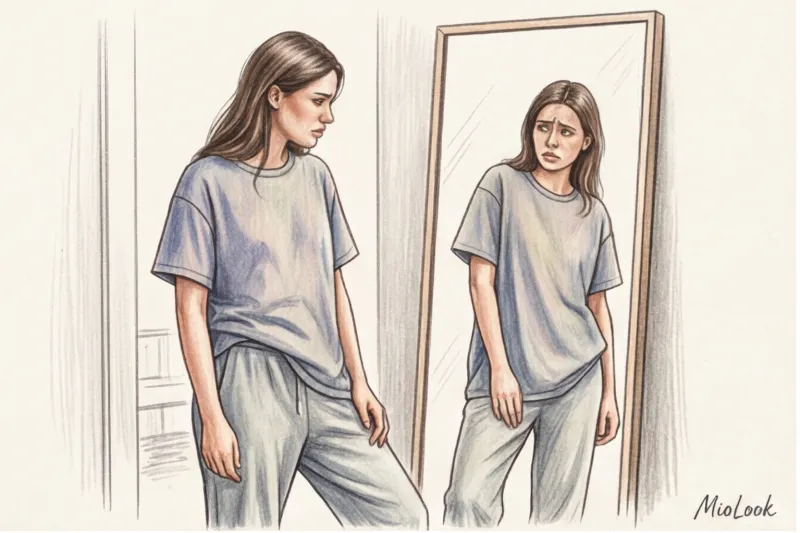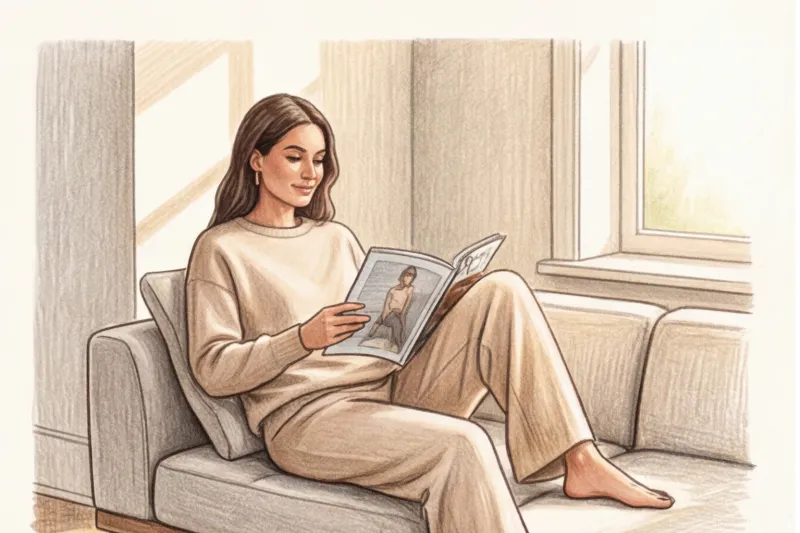
Recall a familiar moment: you're relaxing with your morning coffee, and suddenly the delivery guy rings the doorbell. Your first reaction is to calmly go and answer it, or frantically rush around the apartment looking for something to throw on over your stretched-out T-shirt? Over 12 years of working as a personal stylist, I've asked hundreds of women this question. And you know what? Nine out of ten admitted they "hide" at home.
We're used to dressing up for colleagues, for random people on the street, for our social media followers. But for the most important person in our lives—ourselves—we save things as an afterthought. The question of how to look attractive at home often boils down to banal advice like "buy a silk negligee." But the true Mediterranean approach to style, which I love so much, is based on something entirely different. It's about creating home looks based on the principle of complete capsules, where absolute comfort doesn't compromise elegance. We discussed this in more detail in our the complete guide to home wardrobe , and today we’ll talk about the practical application of these rules.
The Psychology of Your Home Wardrobe: Why It Matters How You Look
My grandmother in Madrid never showed up for breakfast in rumpled pajamas. Even when she was simply cooking paella for the family, she always wore a neat wrap dress and light lipstick. For a long time, I thought this was just old-fashioned European fashion. But science has proven my grandmother absolutely right.
In 2012, Northwestern University (USA) researchers Adam Galinsky and Hadjo Adam introduced the term into psychology Enclothed Cognition Their research has proven that clothing directly impacts our cognitive processes, productivity, and self-esteem. When you wear something that you associate with decadence and carelessness, your psyche literally adapts to this image. You begin to move more sluggishly, feel less confident, and less sexy.
Let's look at the numbers. According to the Global Time Use Survey, modern people spend 60 to 70% of their time at home. Yet, when analyzing my clients' wardrobes, I regularly see the same pattern: the clothes we spend most of our lives in account for less than 10% of our budget, and they occupy a tiny shelf in the back of the closet. This is a catastrophic imbalance that needs to change.
Your perfect look starts here
Join thousands of users who look flawless every day. Create your own at-home capsule wardrobe with our AI stylist.
Get access — €0.99 onceFrankenstein's Wardrobe: The Main Mistake That Kills Your Attractiveness
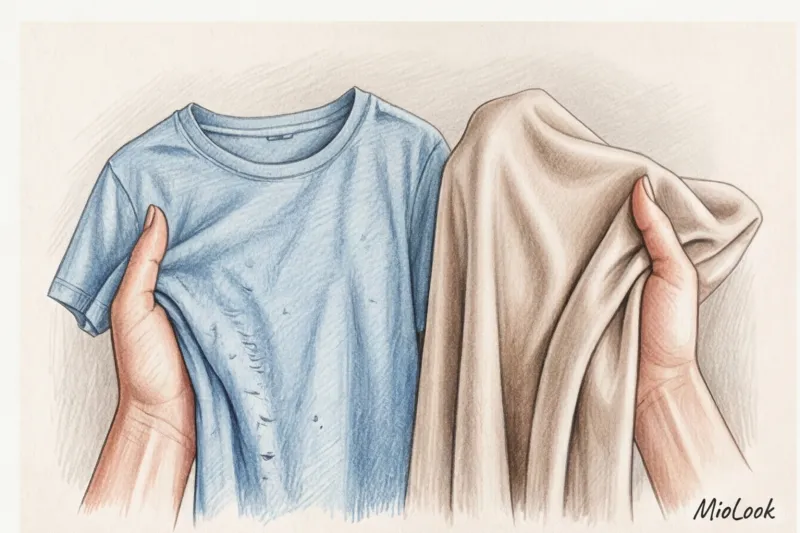
The most dangerous style habit I encounter is the "wear-it-out" rule. This is when a faded T-shirt from a 2015 resort, stretched-knee sweatpants, and a pilling sweater are consigned to "home exile."
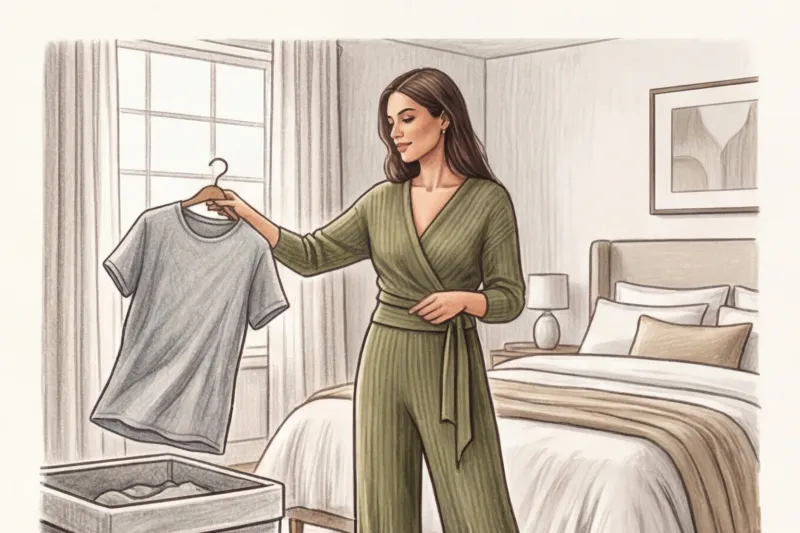
One of my clients, Anna, complained about the lost spark in her marriage. When we started sorting through her wardrobe, it turned out that the moment she walked through the door, she'd take off her immaculate office suit and put on her husband's oversized pants and a hoodie with a coffee stain ("It's small, no one at home can see it"). I suggested an experiment: we ruthlessly tossed out this entire "Frankenstein wardrobe" and replaced it with a knitted set with palazzo pants and a couple of linen shirts. A month later, she wrote to me: "Isabella, my husband has started complimenting me in the evenings again. And most importantly, I've stopped slouching when I go to pour tea!"
By wearing old clothes, you are sending your own brain a daily signal: “I don’t deserve to be beautiful just for the sake of it.”
And another strict but necessary rule: a terrycloth robe is a towel with sleeves. Its only function is to absorb moisture after a shower and keep you warm on the way from the bathroom to the bedroom. Living in it, eating breakfast in it, or greeting guests in it is strictly prohibited. It diminishes the proportions of the figure and creates a feeling of illness or deep apathy.
How to Look Attractive at Home: 3 Golden Rules of a Stylist
Many people think that looking beautiful at home means suffering in uncomfortable clothes. This is a myth. Elegance at home isn't about corsets and heels. It's about a mathematically precise balance between tactile comfort and the architecture of your look.
Rule 1. The magic of textures: what looks expensive and what looks cheap
No amount of clever tailoring can save a garment made of thin, flimsy jersey that's see-through and pilling after the first wash. To look attractive, opt for fine materials.
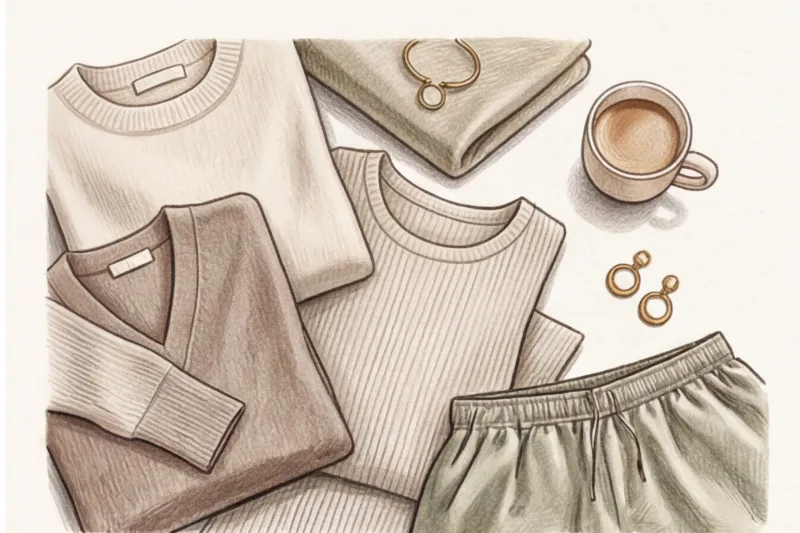
Your best friends in a home capsule:
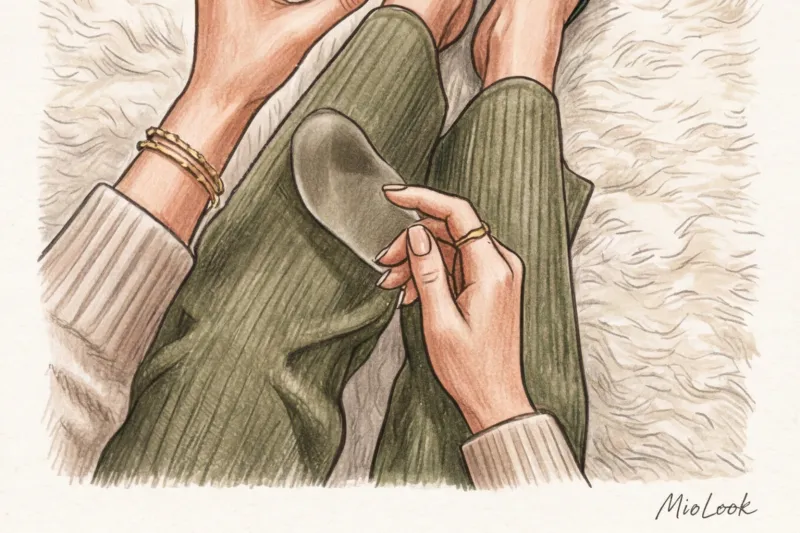
- Modal and Tencel — eco-friendly alternatives to silk. They flow, hug the figure beautifully, yet are breathable.
- Thick ribbed cotton (ribbon with a density of 250 g/m²) - keeps its shape well, does not stretch at the knees and elbows.
- Blended cashmere or merino — for the cold season. A 10-15% cashmere blend with viscose is enough to give the item a premium look.
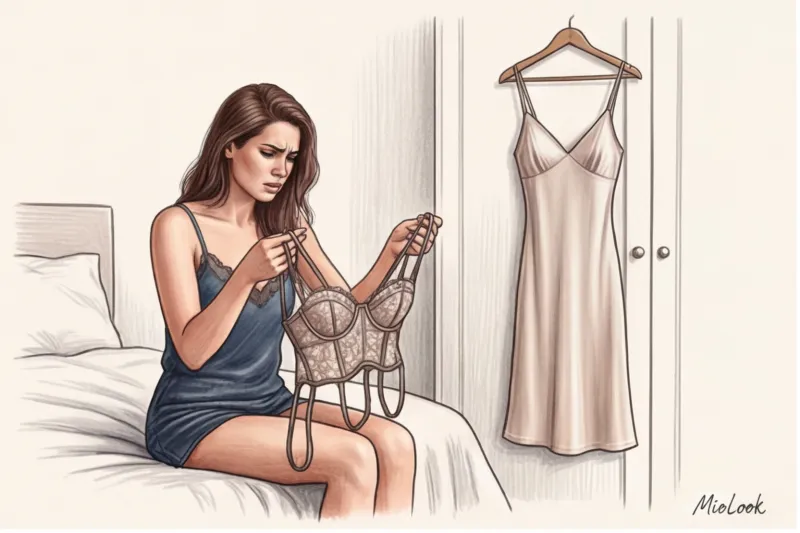
What about 100% silk, you ask? Here I'll defy popular Instagram advice. When I first put together my natural silk capsule wardrobe, I felt like a Hollywood diva right up until my first attempt at washing the dishes. Silk doesn't forgive a single drop of water, wrinkles instantly, and requires the most delicate washing. It's absolutely not suitable for a busy household routine. Save your silk slip for lazy weekend mornings in bed.
Rule 2. Balance of silhouettes: femininity in movement
To prevent the shape from turning into a rectangle, use my favorite formula: "volume + fit".
If you're wearing wide, flowing palazzo pants, keep the top compact—for example, a fitted top with wide straps or a bodysuit with a square neckline. If you prefer a voluminous top (a chunky knit cardigan or an oversized men's shirt), wear fitted ribbed leggings or cycling shorts underneath.
Avoid shapeless, oversized fleece suits. Yes, they're warm, but they completely blur gender and body lines. If you're cold, consider layering a fitted micromodal turtleneck under a voluminous cardigan—this will maintain verticality and accentuate slender wrists.
Rule 3. Color palette for home relaxation
Clothes with childish prints (Mickey Mouse, cats, hearts) and bright colors ruin any attempt at elegance if you're over 12. Save neon pink and bright green for the gym.
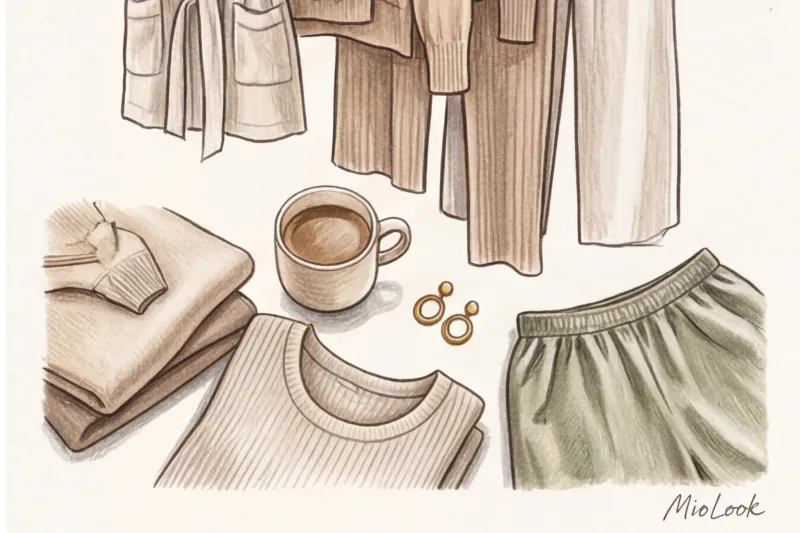
The ideal home palette is one of complex, rich shades that soothe the nervous system:
- Warm Neutrals: ecru, cappuccino, oatmeal, caramel.
- Natural deep: sage, dusty rose, deep emerald, bitter chocolate, complex wine.
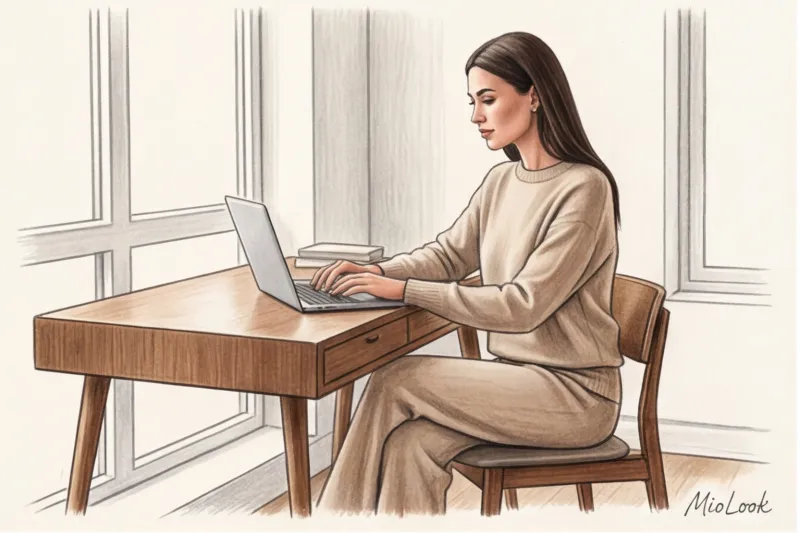
The quickest styling trick: put together monochrome outfits. Pants and a top in the same color (like deep blue or ecru) create a vertical line that visually elongates your height and makes you look slimmer. It looks like a stylist has been working on your look, even though you're simply wearing items of the same shade.
Access to MioLook for €0.99 — one-time payment
A smart AI stylist will select the perfect look for your home, taking into account your figure and preferences.
Get access — €0.99 onceLife Scenarios: Feminine Capsules for Different Tasks
At home, we don't just sit on the couch. We work, clean, cook, have romantic dinners, and play with the kids. That's why your loungewear should be divided into micro-capsules. Just as you wouldn't go for a run in your office suit, you need different formulas for different household tasks.
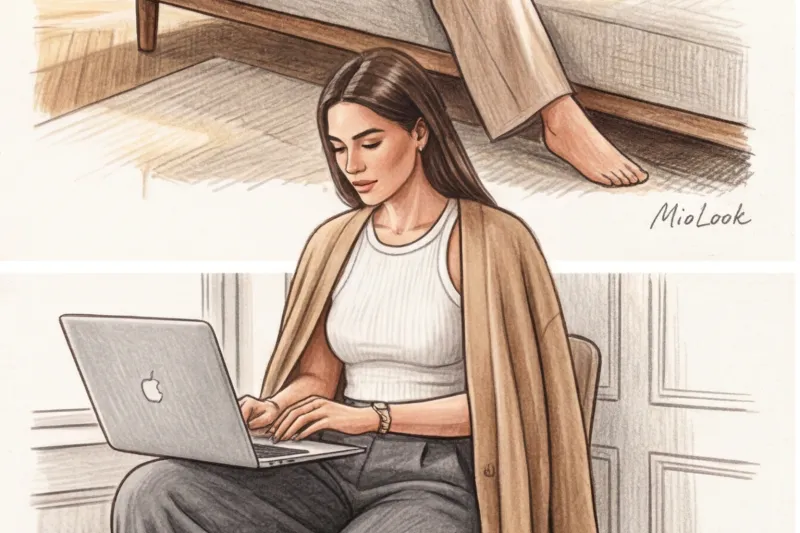
Weekend morning and romantic evening
Aesthetics reigns supreme here dolce far niente (sweet idleness). The perfect uniform: a flowing midi slip dress made of high-quality viscose or cupro. Layer it with a long, chunky knit cardigan—the contrast of delicate fabric and coarse yarn looks incredibly captivating. A pajama-style pantsuit is a great alternative for those who don't like dresses. Brands like Zara Home, Oysho, and Intimissimi regularly release gorgeous options with contrasting piping.
Home Office (When Focus Is Needed)
There's a rule for remote workers: to switch your brain to work mode, you need to change your clothes. We need a home smart casual The perfect combination: heavyweight cashmere-blend joggers (no elastic at the bottom!) + a basic white heavy cotton T-shirt + a structured cotton button-down cardigan. This outfit makes it completely comfortable to suddenly turn on your camera during a Zoom call, but it also keeps your stomach from getting too tight while you're working on your laptop.
Active household routine and cleaning
How to mop floors and dust while still looking attractive? Forget about baggy sweatpants. A stylish and incredibly comfortable alternative: seamless ribbed high-waist leggings (they offer excellent tummy and lower back support) paired with a crop top. Layer a long linen shirt over the top, rolling up the sleeves. It's practical, won't snag your wide legs on furniture, the fabric is easy to wash, and will give you a toned and athletic look.
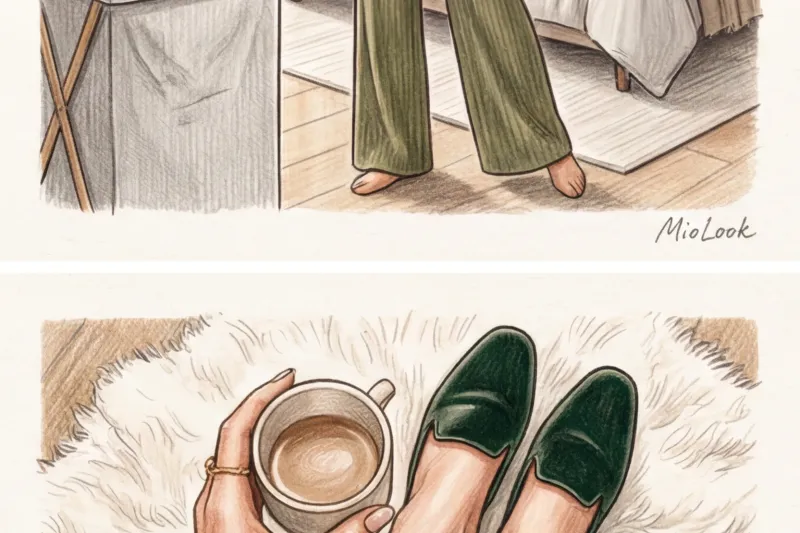
Details that change everything: shoes and accessories
Even the most luxurious cashmere suit will shatter into pieces on a pair of worn-out, fluffy slippers. I call shoes "the hidden secret of home elegance."
What can replace your usual slippers?
- Velvet or suede mules: They look royal and are easy to put on.
- Leather flip-flops (in the style of Hermes Oran): Great option for summer, easy to clean.
- Home ballet flats or Mary Janes made of soft fabric: an absolute trend of recent years.
- Thick socks: If you like to go barefoot, buy some nice angora or cashmere socks to match your loungewear.
Don't forget about your hair and jewelry. Yes, wearing chunky rings or heavy chandelier earrings around the house is absurd (and you risk getting them caught on your blanket). But neat, minimalist hoops (rings up to 1.5 cm in diameter), a thin gold chain around your neck, or an elegant bracelet instantly elevate your style. Instead of a messy bun held together with a stretched elastic band, try a beautiful tortoiseshell clip or silk scrunch—it takes the same 10 seconds, but looks much more polished.
Checklist: How to build the perfect capsule from scratch
Theory is great, but let's move on to practice. As a stylist, I always give my clients a clear action plan. If you want to change your home style, here are your steps for today:
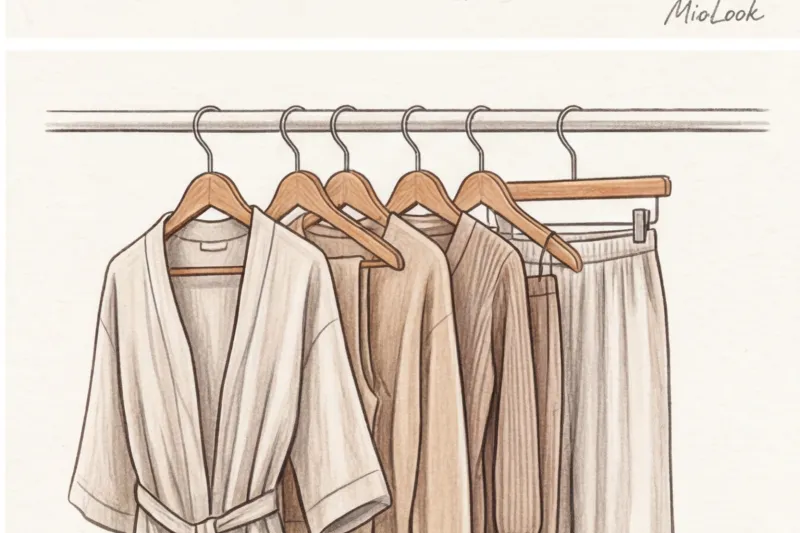
- Conduct a ruthless audit. Take out all the clothes you wear at home. Throw away or recycle anything with stubborn stains, holes, stretched knees, or pilling. Don't keep any "just in case" to paint the fence—an old T-shirt will do the trick.
- Determine your home base. Choose your bottoms based on the temperature in your apartment and your preferences. Let's say it's two pairs of palazzo pants, one pair of joggers, and one pair of shorts or leggings.
- Assemble the tops according to the 1 to 3 principle. For every bottom, you should have 3-4 tops (a basic T-shirt, a long sleeve, a shirt, a cardigan). At home, we tend to get our tops dirty (cooking, eating), so we have to wash them more often.
- Unite everything with color. Choose three or four shades that complement each other perfectly (for example, ecru, beige, sage, white). This will allow you to take things out of the closet with your eyes closed, knowing they will perfectly match.
Many of my clients are afraid to buy expensive loungewear, considering it a waste of money. But let's do the math. Cost-per-wear (cost per wear) A chic cotton loungewear set for $150 that you'll wear 200 times a year (since you wear it almost every day!) will cost you 75 cents per outing. An evening dress for the same price, worn once to a corporate event, will cost you $150 per outing. Investing in a home wardrobe pays for itself faster than any other purchase.
Ready to get started?
Upload photos of your items to the MioLook app, and the algorithm will help you create the perfect home looks from what you already own.
Get access — €0.99 onceStop reserving the beautiful life for special occasions and strangers. You are the most important guest in your own home. And how you look while sitting with a cup of tea in your kitchen sets the tone for how you will feel in the rest of the world.