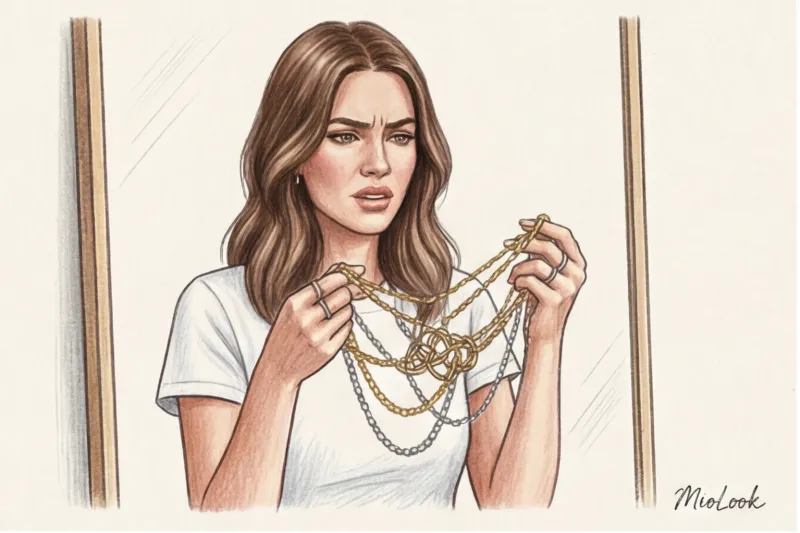
Have you ever stood in front of the mirror five minutes before going out, trying to untangle three thin gold chains that have fused into one inseparable metallic lump? This familiar feeling of despair is a direct consequence of the outdated advice from glossy magazines of the 2000s: "Just put on all your favorite pendants at once."
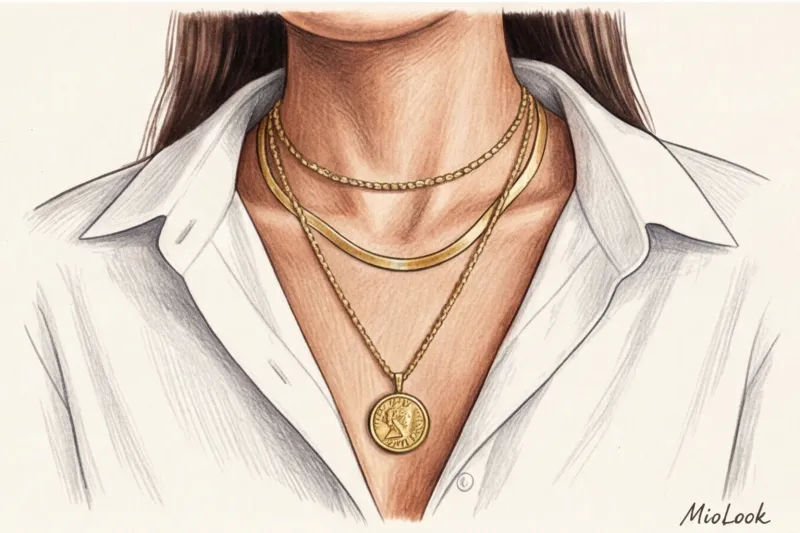
Layering is no longer a passing trend. According to a 2024 report from analytics agency WGSN, sales of basic chains have increased by 45% as consumers seek ways to customize their everyday looks. But the problem remains: 8 out of 10 women wear them incorrectly. If you've been looking for a tutorial, How to wear multiple necklaces at once , forget about chaotic layering. We talked about building a base in more detail in our The Complete Jewelry Wardrobe Guide: How to Wear Jewelry Properly , and today we will analyze the specific mathematics of an ideal cascade.
Style Architecture: How to Wear Multiple Necklaces at Once Without Looking Like a Christmas Tree
Over 12 years of conducting premium wardrobe audits, I've seen hundreds of wardrobe boxes filled with beautiful but dysfunctional pieces. My job as a stylist isn't to push clients into buying more, but to create a coherent, architectural composition from the existing chaos.
Layering is a tool that instantly takes a look from the boring basics category to effortless elegance (casual elegance). Last year, while preparing a client for a business conference on the Riviera, I developed a formula for "Mediterranean chic": we took a tailored linen suit and added a set of three chain necklaces of varying thicknesses. This contrast of masculine tailoring and warm, exuberant gold created a classy yet relaxed look.
In the appendix MioLook You can digitize your accessory collection and plan out combinations for each outfit in advance, without spending hours in the morning trying them on.
The Three-Weight Rule: A Stylist's Secret to Perfect Layering
The key insight, contrary to popular advice, is that wearing thin chains of the same weight together is a guaranteed disaster. Physics is merciless: they will tangle into a painful knot in exactly 30 minutes. To avoid this, the weight difference between adjacent tiers should be at least 2-3 grams.
The secret lies in the visual and physical weight, as well as in the Golden Ratio (proportion 1.618), which in jewelry is translated into standard chain lengths in inches: 14, 16, 18, and 20. The ideal distance between tiers should be 1.5 - 2 cm for clear visual separation.
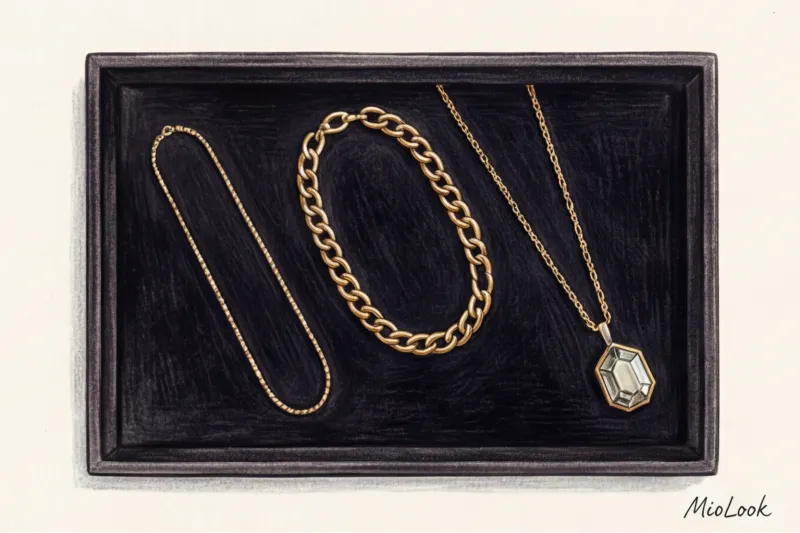
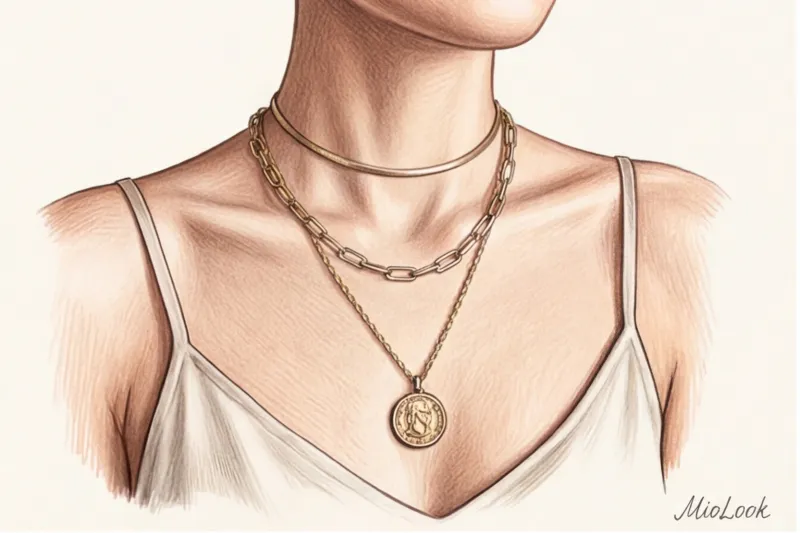
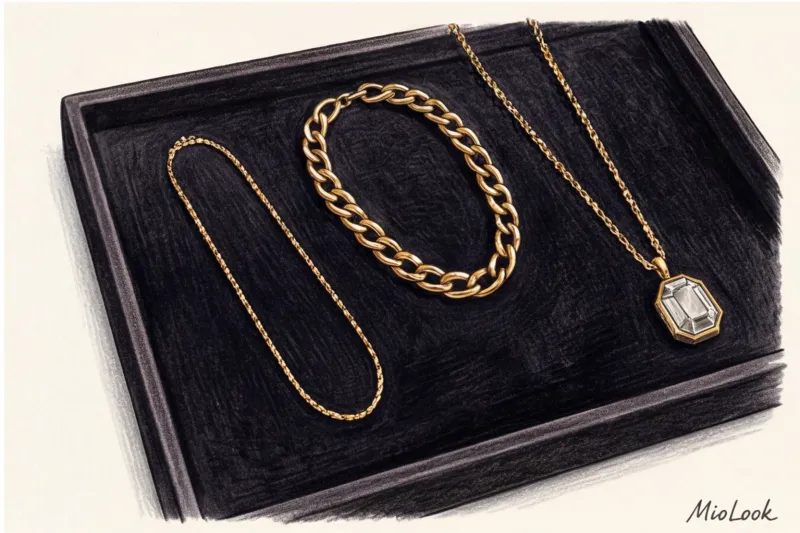
Base: choker or short chain (35-40 cm)
The shortest section should fit snugly at the base of the neck or collarbone. A flat weave (snake, herringbone, or cobra) is ideal. It sits on the skin like a metallic "collar," reflects light with its flat surface, and, most importantly, its rigidity prevents it from tangling with the layers underneath.
Center: texture and volume (45-50 cm)
The middle layer is a place for imagination and maximum visual (but not physical) volume. Link chain (anchor or paperclip), vintage twisted weave, or a thin strand of small baroque pearls work great here. The texture of this layer should contrast with the smooth base.
Anchor: Accent Pendant (55-60 cm)
The longest line should have a heavy pendant. This could be a large coin, a baguette stone, or a medallion. The pendant acts as a physical anchor—it pulls the composition downward under the influence of gravity, tautening the chain and creating that perfect V-shape that visually elongates the neck.
Your perfect look starts here
Join thousands of users who look flawless every day with MioLook. Our smart algorithm will help you create a capsule wardrobe for any occasion.
Get access — €0.99 onceThe Biggest Myth About Mixing Metals (And How to Do It Right)
It's time to dispel a dangerous myth: the advice to "just wear gold and silver loosely" often results in an outfit looking like you dressed in complete darkness. Mindlessly mixing metals cheapens an outfit.
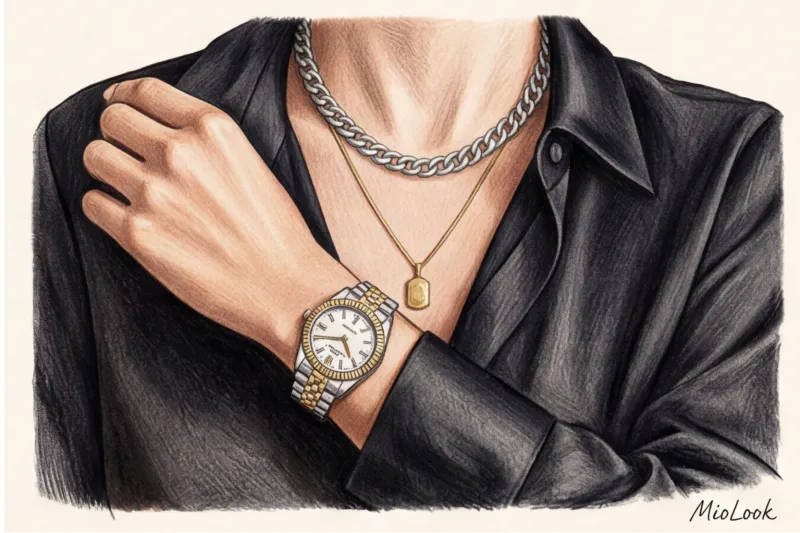
Professional stylists use The 80/20 Rule One metal should always dominate. For example, 80% yellow gold (your base and middle layer) and 20% white gold or silver (the small anchor pendant).
"Eclectic jewelry requires mathematical calculation. Metals should engage in a dialogue, not shout over each other."
I had a telling case in my practice. A client refused to wear trendy yellow gold sets because they clashed with her favorite platinum wedding ring. The solution? We used a "bridge"—a piece that seamlessly blended two metals. We integrated a bicolor Cartier Panthère watch (steel and yellow gold) into the look. This watch instantly legitimized the presence of both colors throughout the entire look, and the necklace set now looked perfectly logical.
Combination formulas: clothing cutouts + multi-layered chains
Embellishments don't exist in a vacuum. They always interact with the collar line. My favorite stylistic formula for my clients: A men's-style jacket + an unbuttoned silk shirt + a cascade of chains = classy casualness.
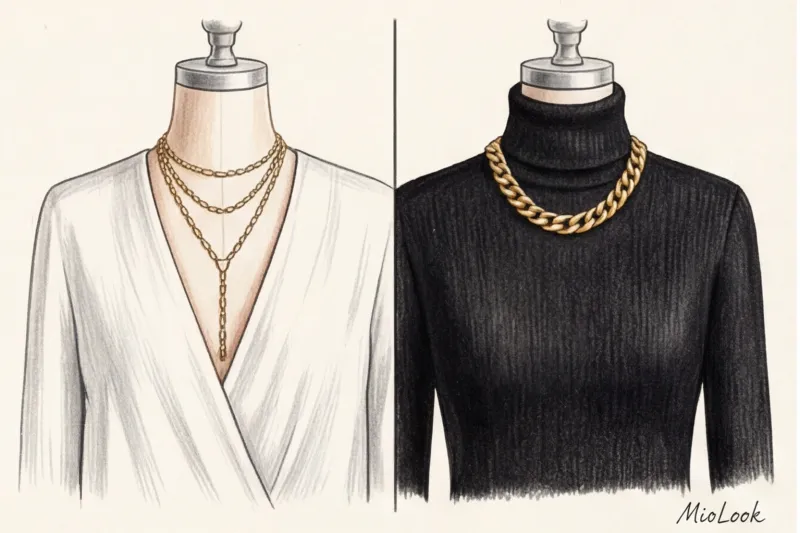
V-neck and unbuttoned shirt
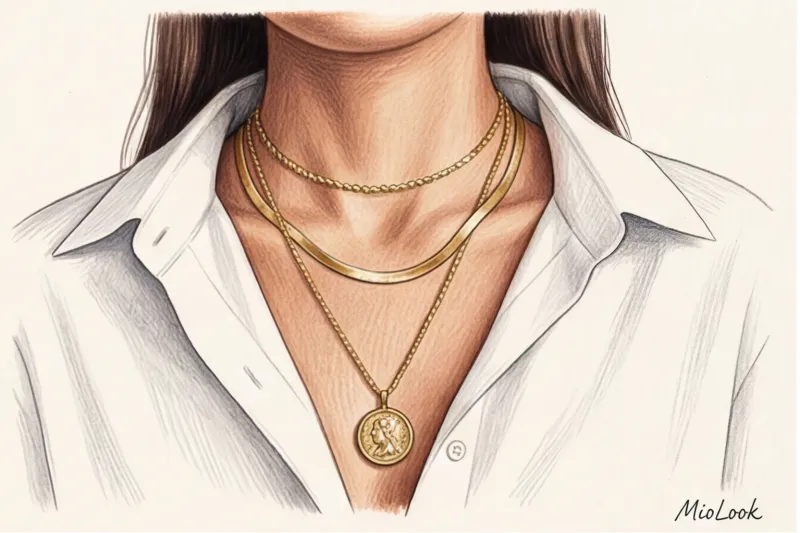
It's the perfect canvas. The V-neckline allows for 3-4 layers without looking overcrowded. The main rule: the longest anchor pendant shouldn't be hidden under the fabric or hit the edge of the collar. It should end exactly 2-3 cm above the neckline, leaving a patch of bare skin.
Crew neck (turtlenecks and jumpers)
Here, my recommendation is categorical: avoid thin, gossamer chains. They get lost against a thick knit (cashmere or merino wool) and look indistinct. Instead, opt for chunky chain links, large vintage medallions, and long sautoirs (at least 70 cm) that will create a vertical line over a solid collar.
Ready to get started?
Try the free plan—no commitments required. Create your first jewelry wardrobe in the virtual fitting room.
Get access — €0.99 oncePractical Magic: How to Keep Chains from Tangling
We've reached the most technical part. If you follow the three-weight rule, the risk of tangling is minimal. But for the perfect result, stylists use multi-strand magnetic detangler clasps.
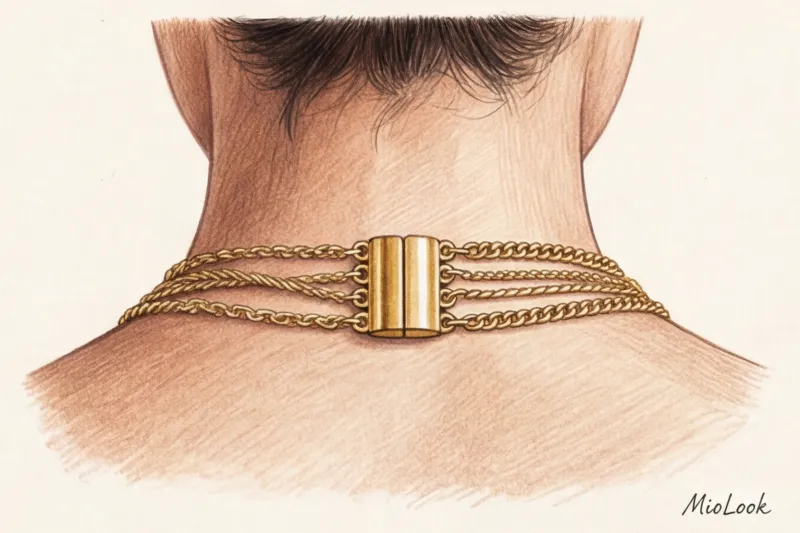
During a 14-hour flight from Milan to Tokyo, I personally tested this magnetic three-row divider. Verdict: it really does keep the thin links from tangling, even if you're sleeping in your seat. But there is one honest limitation here. This magic does NOT work for heavy necklaces. If your bottom layer is a massive chain with a pendant weighing more than 15 grams, the magnet will simply unclasp under the weight.
Another professional life hack if you don't have a divider handy: connect the two chains together before putting them on. That is, attach the clasp of the first to the ring of the second, and vice versa. You'll end up with one huge, long loop with two clasps. Place it around your neck in two turns, and you can easily adjust the length of each layer by simply pulling on the desired part—they'll be half as tangled.
Also pay attention to the weave type. Smooth, woven weave glides over fabric and leather, while twisted, singapore weave snags on adjacent embellishments.
Layering for the Office: How to Incorporate the Trend into a Strict Dress Code
The adaptation of this technique depends heavily on your industry. What looks natural on a creative director at a PR agency might not be appropriate for a partner at a law firm.

If your dress code is Business Formal, limit yourself to a strict two-layer maximum. Avoid jingling details and large coins. Opt for delicate accents: micro-pearls, a single diamond drop (solitaire) on a fishing line or thin chain, and smooth geometric pieces without recognizable logos. We wrote more about choosing accessories for a corporate environment in this article. Smart Casual for Women: A Style Guide for the Office.
For Smart Casual (like a Friday dress code where everyone wears jeans but you want to look a little more put together), you can add a third layer but keep the metallic color scheme consistent.
Checklist: Assembling Your First Perfect Chain Set
Enough theory, let's get practical. Stand in front of a mirror with your jewelry box and follow these four simple steps:
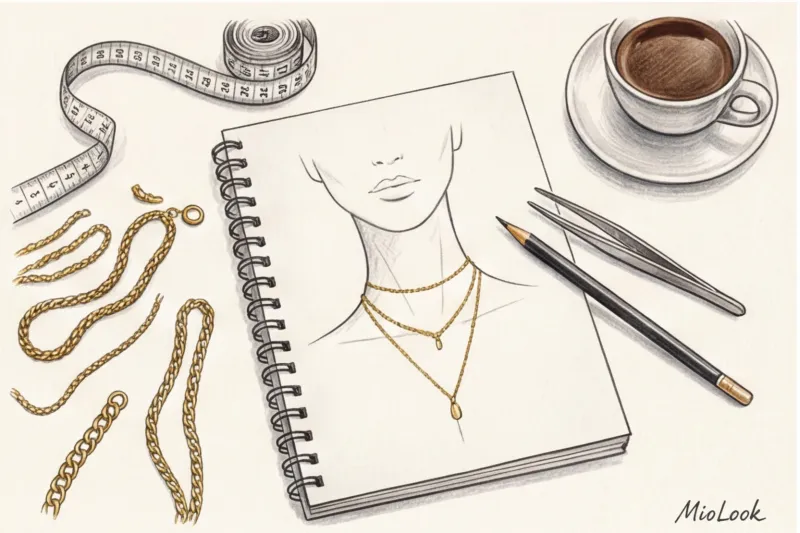
- Step 1: Measure your neck circumference with a tape measure and add exactly 5 cm. This is the length of your ideal basic choker (usually 38-40 cm). Put it on first.
- Step 2: Choose an anchor pendant. This is the longest chain (55-60 cm). Let the symbol on the pendant reflect your personal brand (initial, vintage coin, abstract zodiac sign).
- Step 3: Fill the void. Take the textured chain from the middle layer (45-50 cm). Make sure there's visual "air" between all three layers—1.5 to 2 cm of exposed skin.
- Step 4: Test the set in motion. Lean forward, twist. If the middle layer immediately twists with the bottom layer, their weight is too similar. Replace one of them.
Style isn't an innate gift, but a set of clear formulas and proportions. Once you've found your perfect layering outfit, you'll have a versatile tool that will make even a simple pair of jeans and a white T-shirt look chic. Start with three layers, use different textures, and you'll forget about untangling knots in the morning.