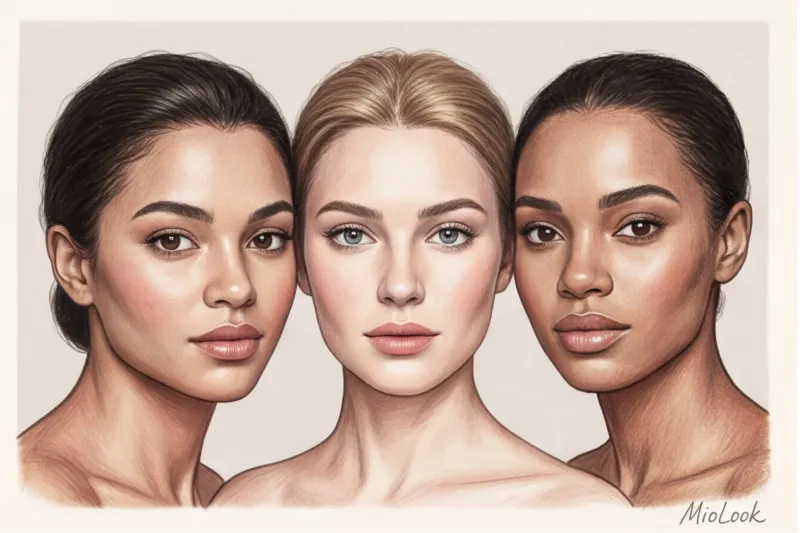
Do you know what 82% of new MioLook app users have in common? According to our internal statistics, when they first start out, they look for a haircut with one sole purpose: to "hide" something. They might conceal cheekbones, camouflage their forehead, or soften their chin. Over 14 years of working as a stylist, I see beautiful women in the mirror every day who perceive their faces as a collection of flaws.
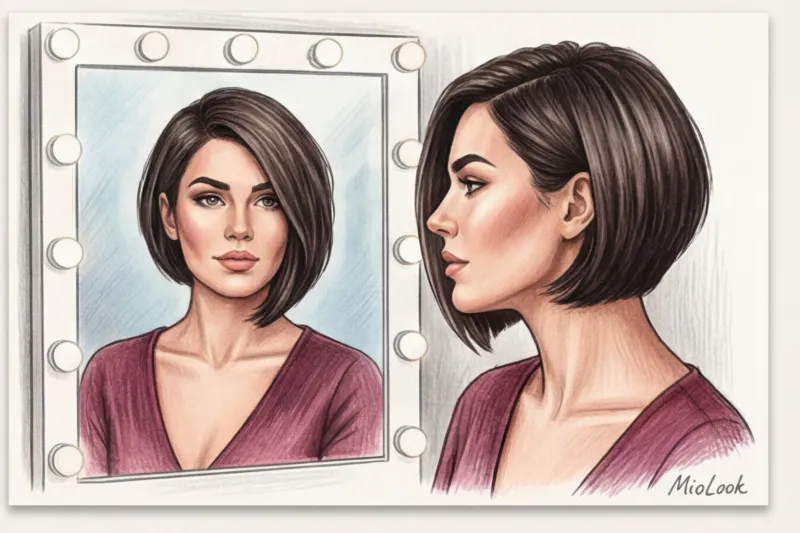
But let's be honest: your face isn't a problem to be solved. It's an architectural drawing. And determining your face shape correctly doesn't determine what you "can't" wear, but rather how exactly you should arrange your hair to look luxurious. We've covered the basic principles in more detail in our A complete guide to choosing a haircut based on your face shape , and today we will engage in pure practice.
Why You Still Need to Know How to Determine Your Face Shape (If the "Oval" Rule Is Outdated)
For decades, hairdressing schools taught one rule: an oval is the ideal, and all other shapes should be visually approximated to it. If you have a square, round it; if a circle, elongate it. I officially declare: this approach is outdated. We no longer strive to make everyone look like an identical oval.
Back in the 1960s, the legendary Vidal Sassoon pioneered the principles of architectural haircuts. He proved that the perfect hairstyle is based on an understanding of bone structure. Knowing your precise proportions gives you the freedom to wear trendy shapes, simply by adapting them to your own geometry. For example, a micro-bang will suit both a square and a round face—the only difference is the thickness and angle of the cut.
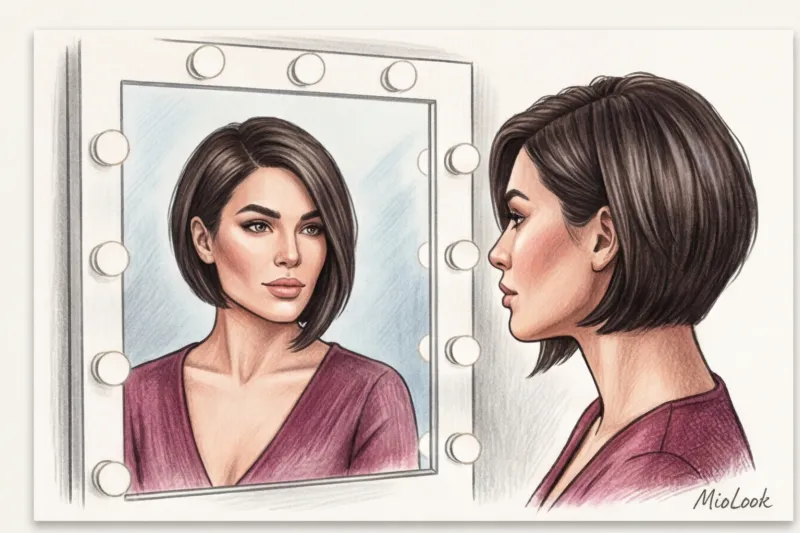
When clients start doing virtual try-ons in the app, something magical happens: seeing themselves for the first time with an open face (for example, with a sleek hairstyle or a short pixie) makes them realize that their natural shape is their main feature, not a flaw.
The Biggest Mistake: Why Popular Online Tests Are Lying to You
If you've ever Googled this question, you've probably come across the advice: "Stand in front of a mirror, close one eye, and outline your face with lipstick." Forget it.
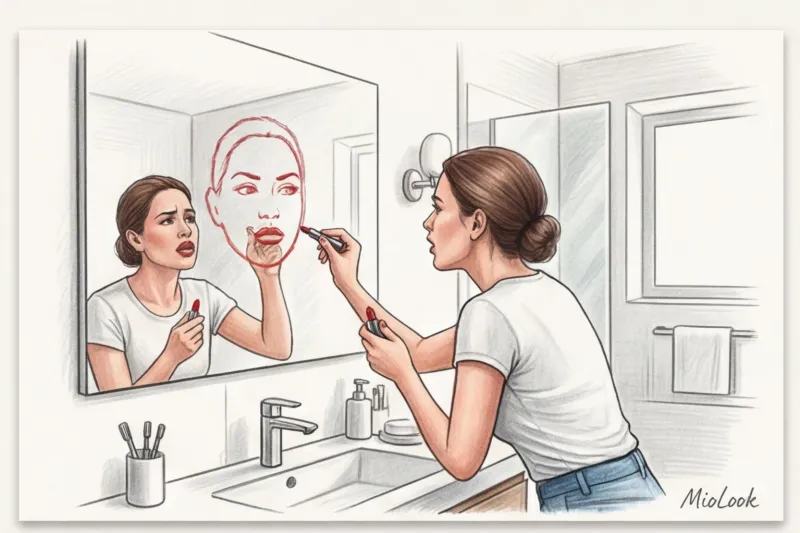
This method is completely ineffective due to basic physics. Firstly, human binocular vision and microscopic head movements constantly shift the viewing angle. Secondly, the glass is thick, creating refraction. The result is a shapeless potato on the mirror, bearing no resemblance to your actual bone structure.
I had a client who, for 10 years, hid her stunning, graceful square jaw behind a dull, layered cut. Why? Because her naturally plump cheeks made her think her face was round and she tried to elongate it. We trimmed the length down to her jawline, created a clean cut, and her face instantly acquired the sculpted contours of an expensive model.
Another pitfall is trying to determine body shape from a standard selfie. A smartphone's wide-angle lens (usually equivalent to 24-26mm) distorts proportions horribly: the center of the frame (the nose and forehead) is enlarged, while the periphery is narrowed. In an arm-length selfie, we all look a little alien.
How to Determine Your Face Shape: A Home Tape Measure Test
The only reliable way to find out the truth is to measure your face. To do this, you'll need a flexible tape measure, a mirror, and good, direct lighting without harsh shadows (ideally, daylight from a window).
Prep: Comb your hair back sleekly, gather it into a tight ponytail, or wear a headband. Remove makeup—contouring can be confusing.
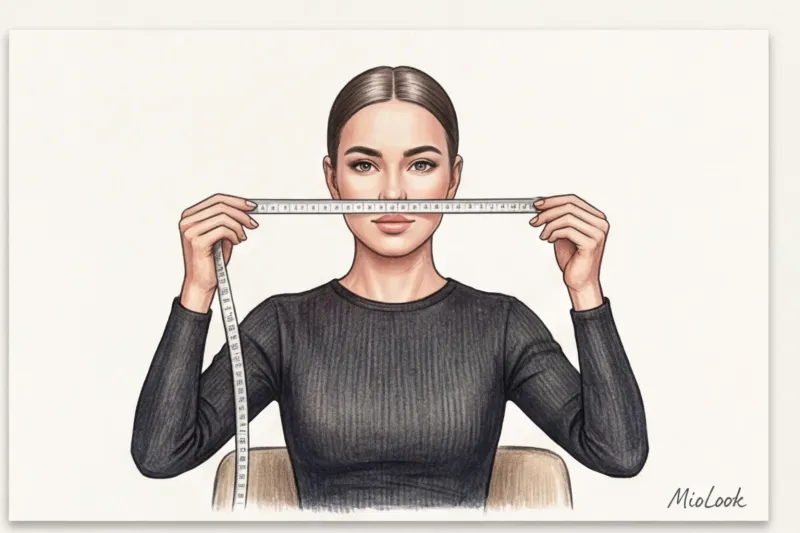
Take 4 main measurements, writing down each one:
- Forehead width: Measure the distance between the peaks of your eyebrows (just above the eyebrows themselves) from one edge of your hairline to the other.
- Cheekbone width: Find the highest point of your cheekbone just below the outer corner of your eye. Measure the distance to the same point on the other side. Important: Keep the tape straight in front of your face, do not press it against your nose!
- Jaw width: Find the corner of your jaw (just below your ear) and measure the distance to the center of your chin. Multiply by two.
- Face length: From the center of your hairline to the very bottom of your chin. Again, hold the tape vertically, without bending around your nose.
Access to MioLook for €0.99 — one-time payment
A smart AI stylist will select the perfect look based on your individual facial proportions.
Get access — €0.99 onceAlternative Method: The Right Photograph
If fiddling with numbers is boring, you can use the photo method, but follow strict rules:
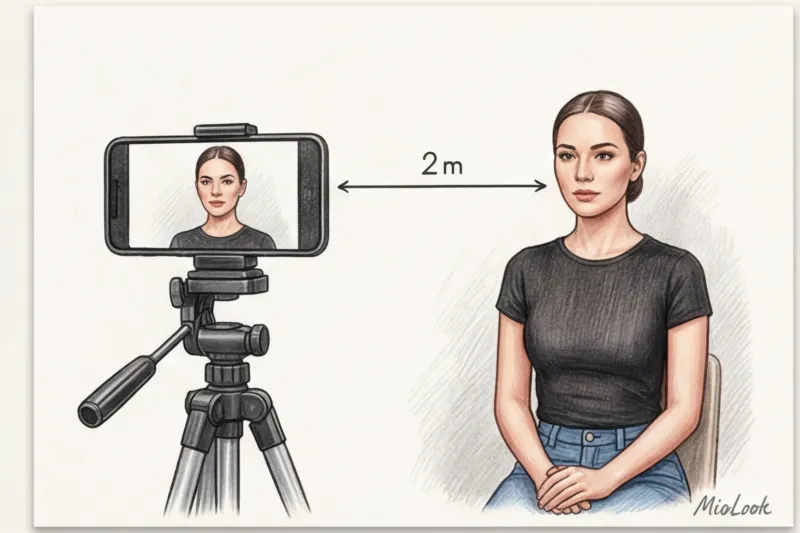
- Mount your smartphone on a tripod exactly at eye level (lower and you'll get a heavy jaw, higher and you'll get a huge forehead).
- Move away to a distance of at least 1.5–2 meters.
- Use your camera's optical zoom (2x or 3x) to fill the frame with your face. This will create a portrait lens effect and eliminate distortion.
- Take a photo with your face straight. Apply a black and white filter with a high-contrast effect—this will clearly show your hairline and chin shadow without distracting your skin tone.
Analysis of the results: architecture of the 6 basic face shapes
Now compare your numbers. Which one is the largest? How do the width and length compare?
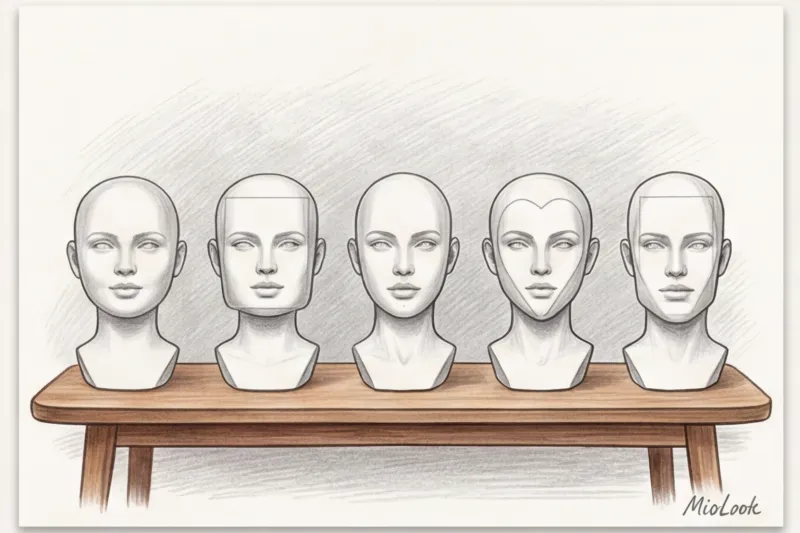
1. Oval. The length of the face is noticeably greater than the width of the cheekbones, and the cheekbones are wider than the forehead and jawline. The angles are soft. This is a balanced base that technically suits most haircuts.
But there is a nuance: If the oval shape is too elongated, a straight parting and long straight hair will make the face look haggard.
2. Circle. The width of the cheekbones and the length of the face are almost equal. The jaw is soft, without pronounced angles, and the hairline is often smooth.
Stylist's advice: Avoid volume on the sides (a cheek-length bob is best). Asymmetry and a side parting are your best friends.
3. Square. The width of the forehead, cheekbones, and jawline are almost equal. The angle of the lower jaw is distinct and accentuated.
Insight: This is the shape that ages most beautifully thanks to its strong bone structure. Don't hide the angles! Angelina Jolie and Olivia Wilde don't hide their faces with curtains of hair; they wear their hair open.
4. Rectangle. The same square, but the face is longer than it is wide. A strong vertical line. Thick bangs work great here, visually cutting off the length.
5. Heart (inverted triangle). The forehead is wider than the cheekbones, and the chin is pointed. It's often accompanied by a "widow's peak" (a V-shaped hairline). Volume is needed in the lower third of the face (at the chin and collarbone) to balance the wide forehead.
6. Rhombus (diamond). The widest part is the cheekbones. The forehead is narrow, the chin is pointed. The shape is luxurious and sculpted. The main rule is to avoid cutting the bangs straight from ear to ear, as this will ruin the grace of the cheekbones.
What to do if your measurements don't fit the standards (mixed types)
I'll let you in on a professional secret: pure personality types are extremely rare in nature. More often than not, we encounter mixed forms.
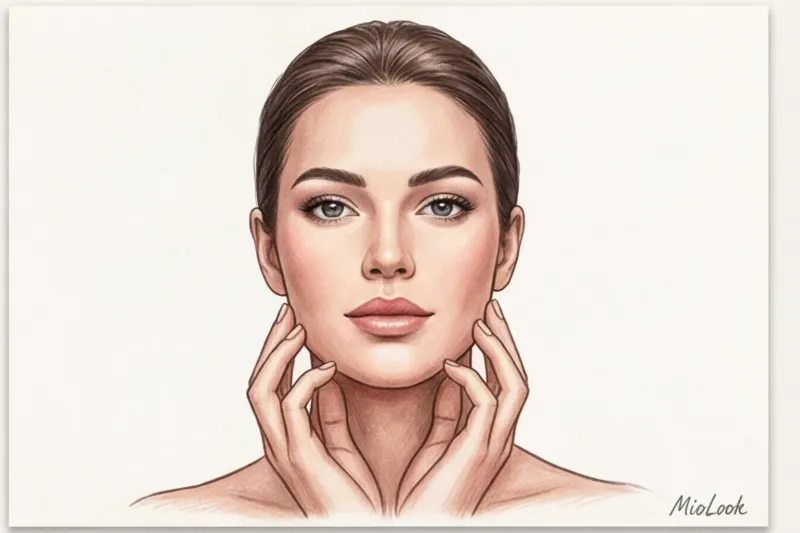
Two factors greatly influence the perception of shape: weight and the hairline. My observation: weight gain or loss changes the volume of soft tissue (cheeks become rounder or hollower), but the bone structure remains unchanged. This is why a round hairline with pronounced jaw angles can be confusing.
How do you analyze yourself in this case? Look for dominant trait What's the first thing you notice? A wide forehead? Prominent cheekbones? A strong chin? At the salon, our top-notch stylists create a haircut based on the most prominent bone. If you have a mixed oval-square face shape, we'll work with your jawline as the dominant feature.
Your perfect look starts here
Join thousands of users who look flawless every day with MioLook. Try hundreds of haircuts on your face in just a few clicks.
Get access — €0.99 onceChecklist: How to Use This Knowledge Before a Haircut
So, you've measured your face and understood your architecture. How do you translate this into hairdressing terms to avoid further disappointment?
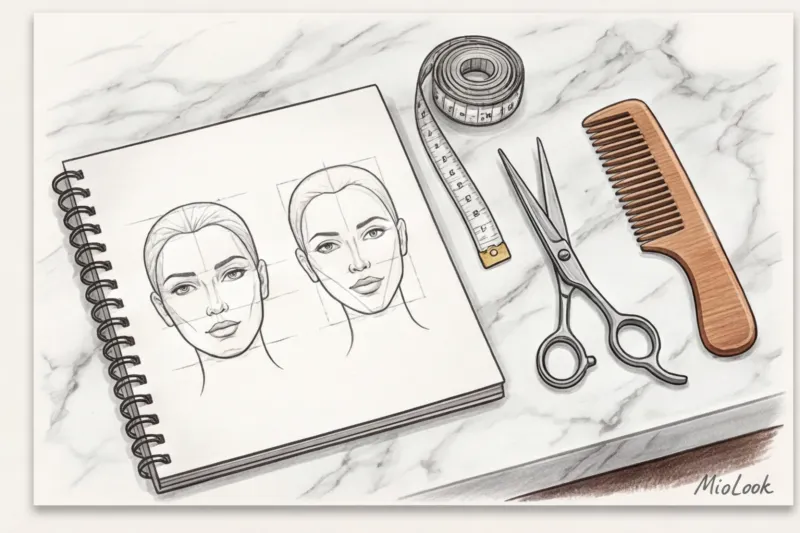
- Control the "volume point". If you have a heart or diamond shape, tell your stylist, "I need volume at the chin level, leaving the crown flat." Conversely, round and square faces often need volume at the crown. This is especially important if you're choosing hairstyle for public speaking , where the spotlights mercilessly illuminate the silhouette of the head.
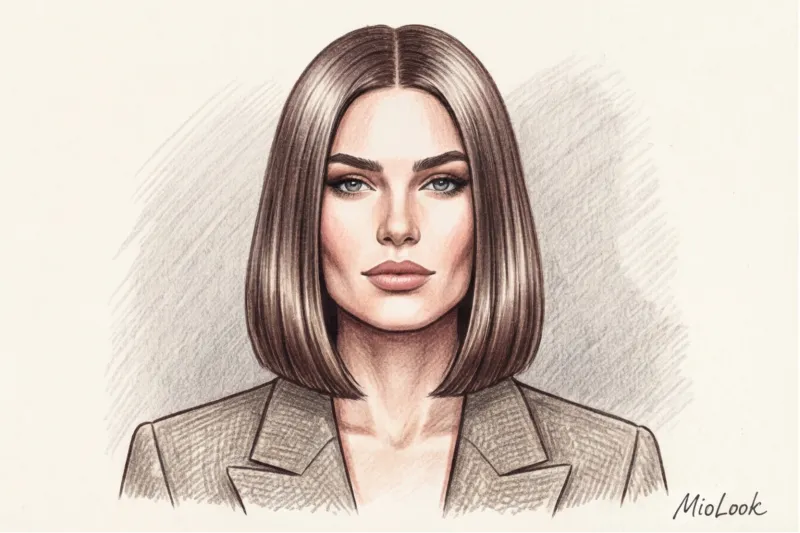
- Control the angles of your face. If you want to highlight your cheekbones, the cut line of the front strands should end just below them. If you are looking for a strict hairstyles for the office , remember that sleek hair requires flawless makeup, as it leaves the face unframed.
- Don't settle for the "one size fits all" bangs. Bangs are a powerful tool for shaping the length of a face. Rectangle faces need thick, straight bangs, while round faces need longer, curtain-like bangs that fall below the cheekbones.
Summary: Your face is your personal brand
Remember: an accurate mathematical measurement always works better than visual guessing in a mirror. Spend 10 minutes with a measuring tape to settle the question of your bone structure once and for all.
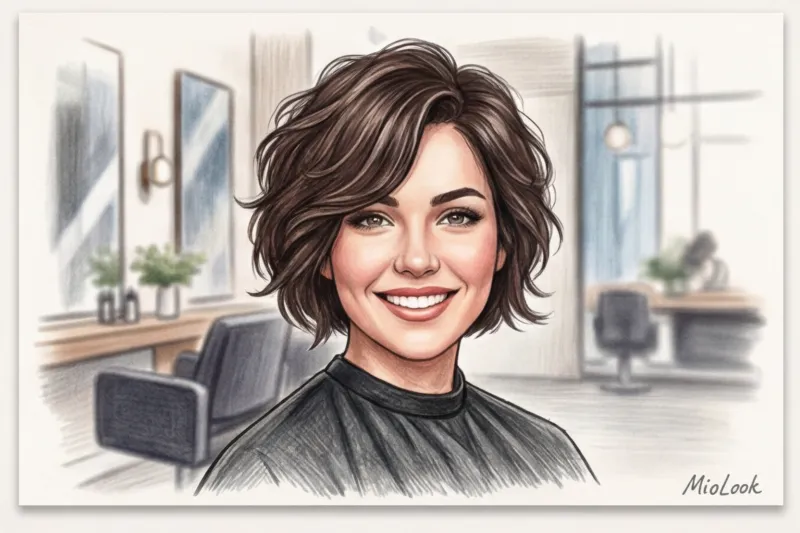
I urge you to let go of your inhibitions. Stop coming to the salon asking for a "cut so your face is hidden." Allow yourself to experiment. And if your fear is too great, take the first step safely—run an honest, unadulterated photo of yourself through MioLook's smart selection algorithms. Seeing your natural contours framed correctly will amaze you with how beautiful you truly are.