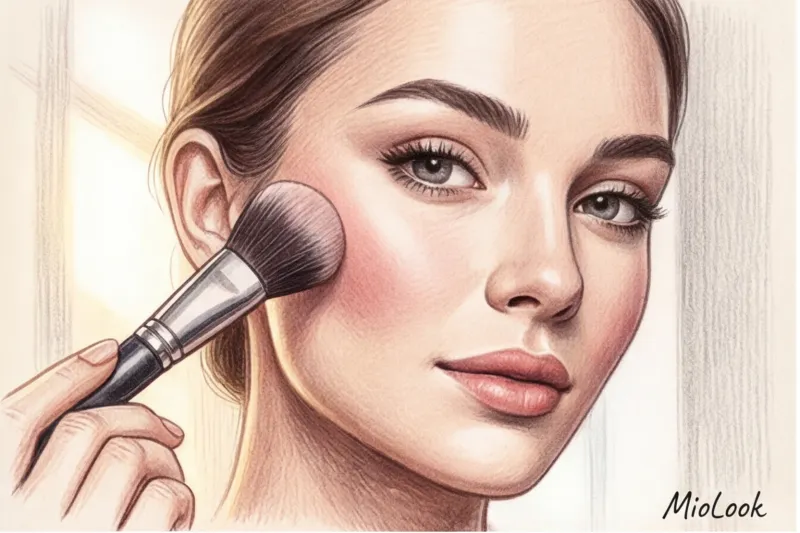
Remember the first beauty tip you read in a teen magazine in the 2000s? "Smile and apply blush to the apples of your cheeks." Forget it. If you're over eighteen, this once-popular trick works against you, mercilessly distorting your facial proportions and adding years.
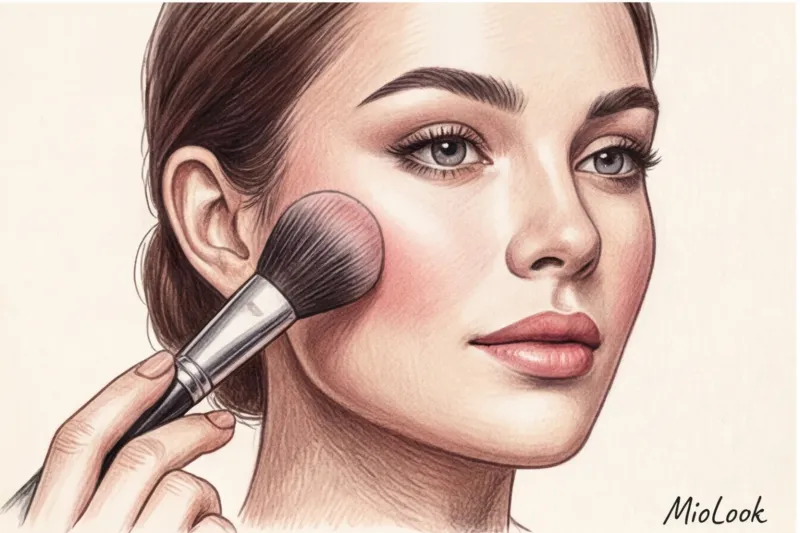
As an image consultant and colorist, I see every day how one wrong brush stroke can ruin the effect of an expensive suit and perfect hairdo. We've already covered why facial architecture is more important than fleeting trends in our the complete guide to perfect makeup Today we'll dig deeper and figure out, How to apply blush according to your face shape , taking into account the laws of gravity, physiology and the color scheme of your wardrobe.
The Anatomy of Color: Why Blush Is More Important Than a Sculpting Tool
The era of Kardashian-style, heavy-handed contouring is officially over. According to WGSN Beauty's 2024 analytical report, demand for cool-toned contouring products has fallen by nearly 34%, giving way to products that impart a healthy glow.
Working with executive clients, I've noticed an interesting pattern: harsh shadows under the cheekbones in a business environment are often interpreted by others as a marker of fatigue, excessive aggression, or illness. If you're interested in how to adapt these trends to your work, check out our article about stylish makeup for work in the office Blush, on the other hand, directs the focus of attention. It restores volume to the face according to the laws of classical chiaroscuro, known in painting.
"Color is the fastest way to create volume where there is none and to draw attention away from what we want to hide" – this basic rule of coloristics also works great in makeup.
The Biggest Beauty Myth: Why the "Apples of the Cheeks" Rule Ages You
Let's break down the mechanics of the most harmful advice from the 2000s from an anatomical perspective. When you smile, the orbicularis oris and zygomatic muscles contract, lifting the tissue upward. You apply blush to this protruding mound. Now relax your face.
The tissues return to a static position, and your "apple" slides downward, closer to the nasolabial fold. This creates the so-called "St. Bernard effect"—the face becomes visually heavier, creating the illusion of gravitational ptosis (drooping). My personal statistics are disappointing: about 70% of women still apply blush too low, distorting the proportions of the lower third of their face.
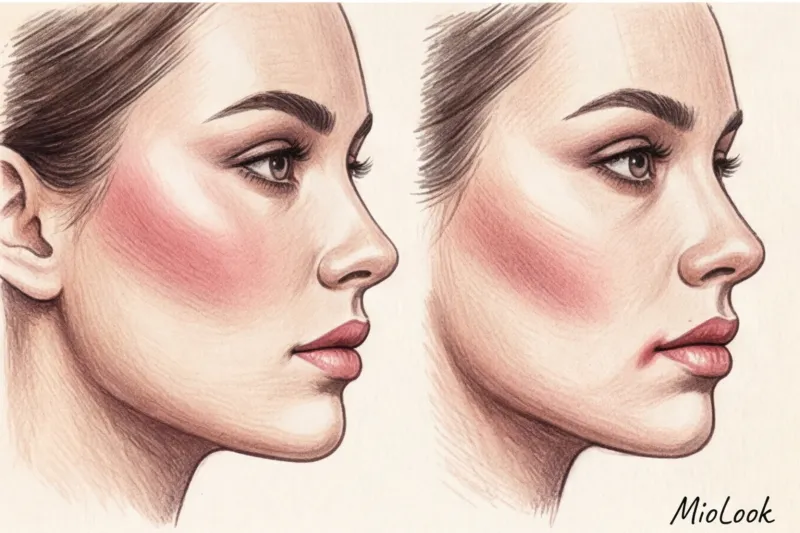
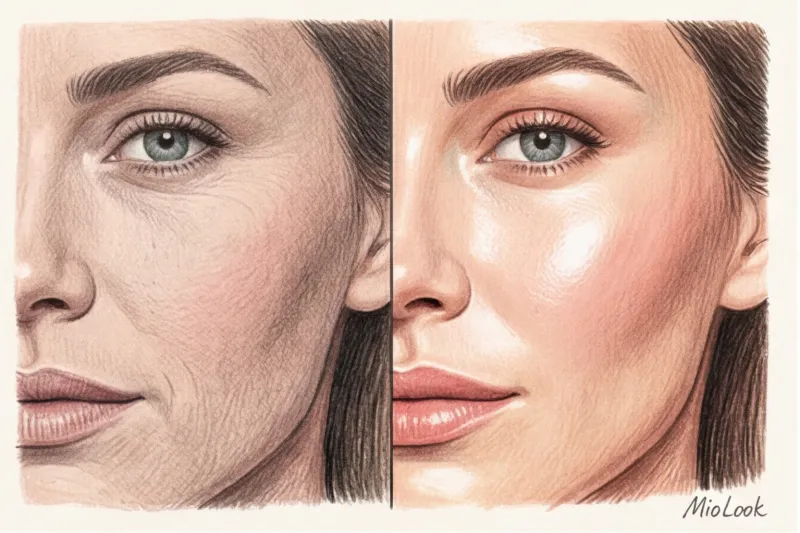
Recently, a 38-year-old client approached me with a request for anti-aging makeup. She was convinced she urgently needed fillers. We simply washed her face and moved her blush blend line 1.5 centimeters higher—right on the cheekbone. This micro-step created a visual lifting effect equivalent to taping. Her face instantly lifted.
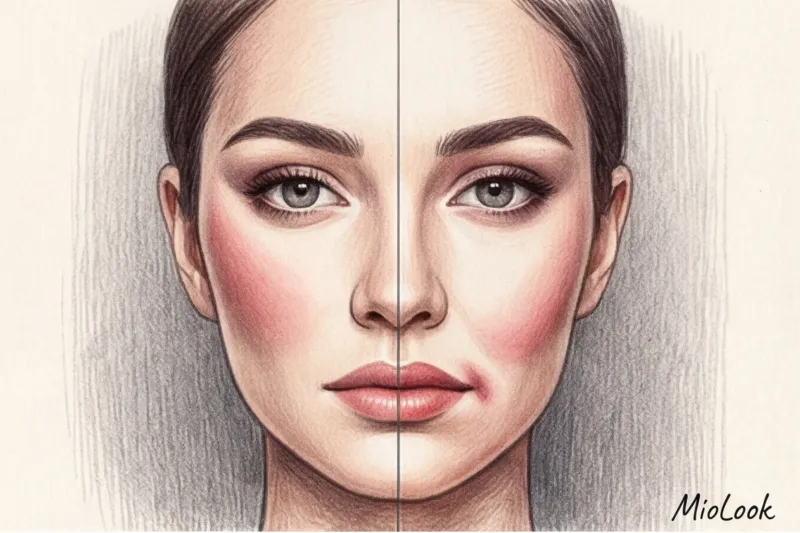
How to apply blush according to your face shape: detailed diagrams
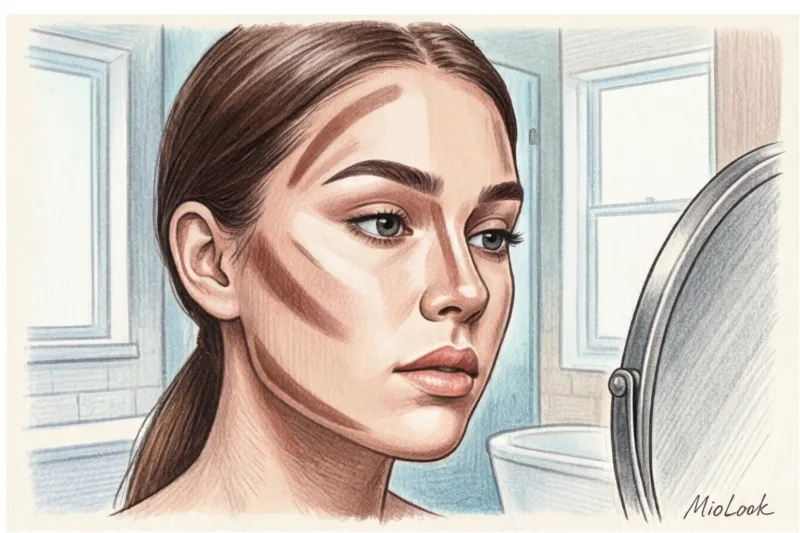
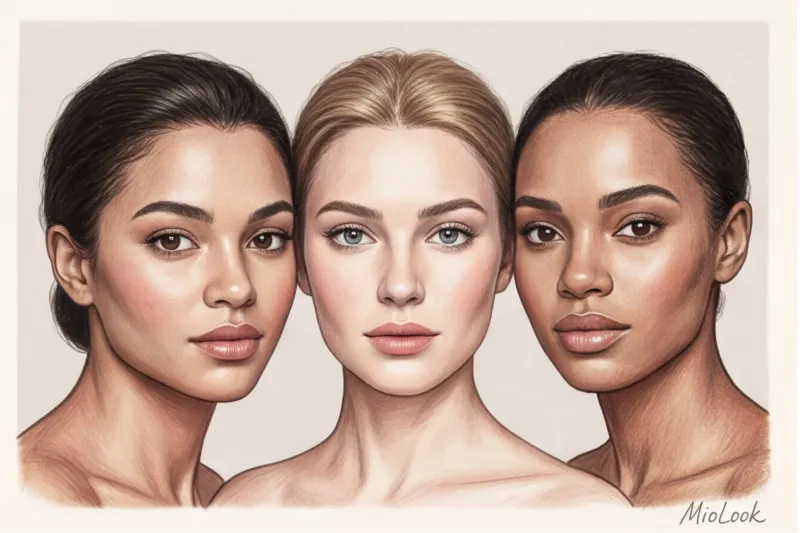
Determining your face shape can be difficult—we tend to be critical of ourselves in the mirror and often see asymmetries that don't exist. Focus not on abstract geometry, but on your own bone structure. This determines the shading direction: horizontal lines widen, while diagonal lines elongate.
Access to MioLook for €0.99 — one-time payment
A smart AI stylist will analyze your appearance and select the perfect look, taking into account your individual characteristics.
Get access — €0.99 onceOval and Oblong Face: Creating Balance
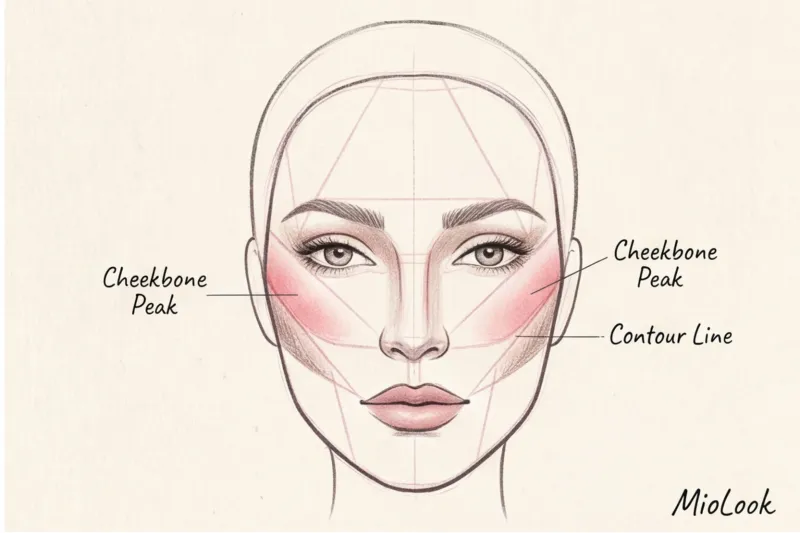
If the distance from the hairline to the chin is noticeably greater than the width of the face, your task is to visually “cut” it by adding horizontal volume.
- Scheme: Apply the product from the center of the cheek (but not below the tip of the nose) and gently blend horizontally towards the middle of the ear.
- Errors: Forget about high diagonals towards the temples. They will make the face appear even longer, turning the elegant oval into an overly severe triangle.
Round and square face: lifting effect
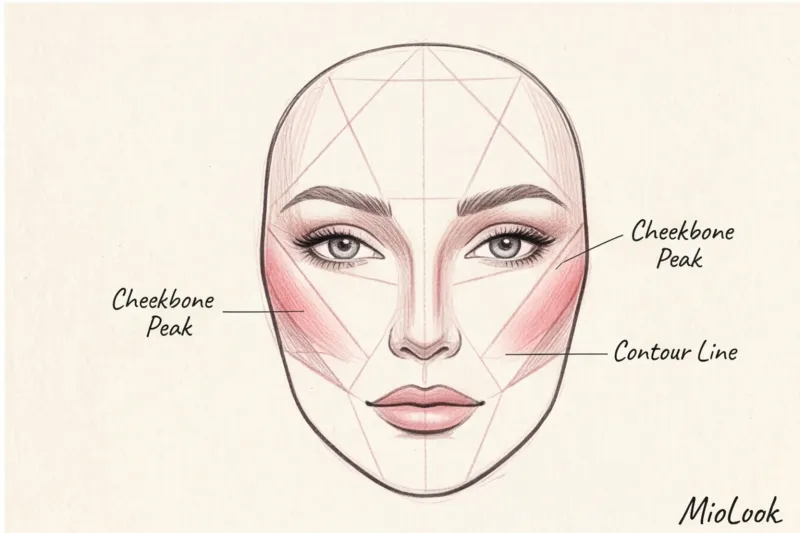
Here the goal is the opposite - to stretch proportions, narrow wide areas and add sculpting to the face without using dark concealers.
- Scheme: Use a clean, diagonal C-shape. Start applying the pigment from your temples, moving down your cheekbone.
- Errors: Never apply blush too close to the sides of your nose. The closer the color is to the center of your face, the wider it will appear. Keep at least two fingers' distance from your nose.
Heart and diamond-shaped faces: softening the angles
Faces with a prominent, wide forehead and a sharp chin (or active cheekbones, like a diamond shape) require visual softening. We want to draw attention away from the sharp protrusions.
- Scheme: Apply the product in a crescent shape just below the highest point of your cheekbone. This will soften the angularity.
- Life hack: Add a subtle touch of blush to the very tip of your chin. It's counterintuitive, but this technique beautifully balances a wide forehead, making your jawline look more proportional.
Texture Matters: Cream or Powder Blush?
A common mistake is choosing a texture based on "convenient packaging." In reality, your skin's texture is the main dictator in this matter. Over 12 years of practice, I've developed a strict rule: the older the skin, the more moisturizing the texture should be.
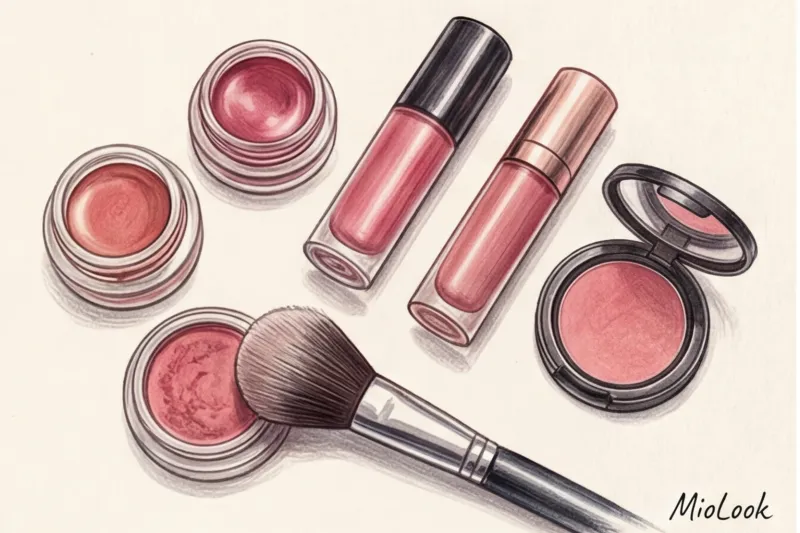
Cream and liquid blush — an absolute must-have for age-appropriate makeup (35+). They blend with the lipid layer, don't accentuate wrinkles, and create a timeless effect. glass skin (glassy, hydrated skin). However, I'll be honest: this doesn't work if you have active acne or very oily skin. On acne-prone skin, the dewy sheen of cream products will act like a neon sign, but on oily skin, they'll simply "float" within two hours.
Dry blush Ideal for oily skin and creating a matte finish. And if you're going to a long event, use the "sandwich" technique, a favorite of makeup artists. Apply cream blush, lightly dust your face with translucent powder, and then match the color with a powder blush. Read more about how to make your makeup last under spotlights and flashes in this article. "Stage Makeup: How to Avoid Losing Face".
Your perfect look starts here
Join thousands of users who look flawless every day with coordinated makeup and wardrobe from MioLook.
Get access — €0.99 onceColoristics: How to choose a blush shade to match your wardrobe
As a certified colorist, I often see the same fashion fail: a stunning, expensive suit in a cool shade and... warm, peachy cheeks that take on a life of their own. Makeup is an accessory, and it must adhere to the general rules of your overall color scheme.
Back in the 70s, the legendary makeup artist Wei Bandi coined the term Draping Draping is the art of sculpting the face with color. The shade of blush should resonate not only with your skin tone but also with the color of the clothing in the portrait area.
- Warm palette: If you're wearing a beige trench coat, a camel sweater, or an olive silk blouse, opt for peach, coral, or terracotta blush.
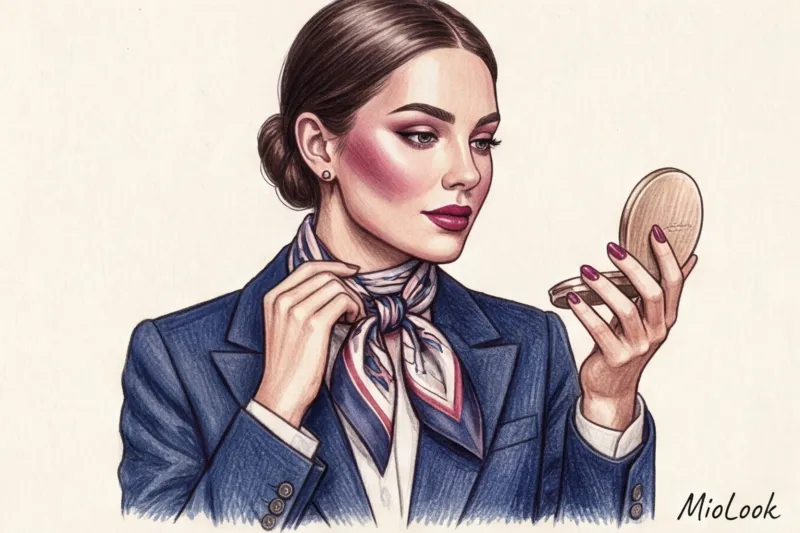
- Cool palette: Berry, cool pink or dusty lilac shades are ideal for a formal navy suit, emerald dress or snow-white shirt.
To avoid guessing in front of the mirror, I recommend my clients to use the image analysis function in MioLook You can upload a photo of your outfit, and the app will help you spot color imbalances before you even leave the house. This saves a ton of time in the morning.
Checklist: 5 Steps to Perfect Cheekbones
To put theory into practice, save this step-by-step algorithm for tomorrow morning:
- Palpation: Use your fingers to feel your cheekbone. Your blush should sit there or slightly above, extending toward your temples, but never fall into the hollow beneath it (save this area for a light bronzer).
- Border control: Place two fingers vertically on the side of your nose—the blush shouldn't extend into this area. The bottom edge of the blended area shouldn't extend below your lip line.
- The right tool: Put away your dense, stiff brushes. A duofiber brush (a blend of natural and synthetic bristles) or a damp sponge for creamy textures is ideal. These will create a smooth, watercolor-like shading.
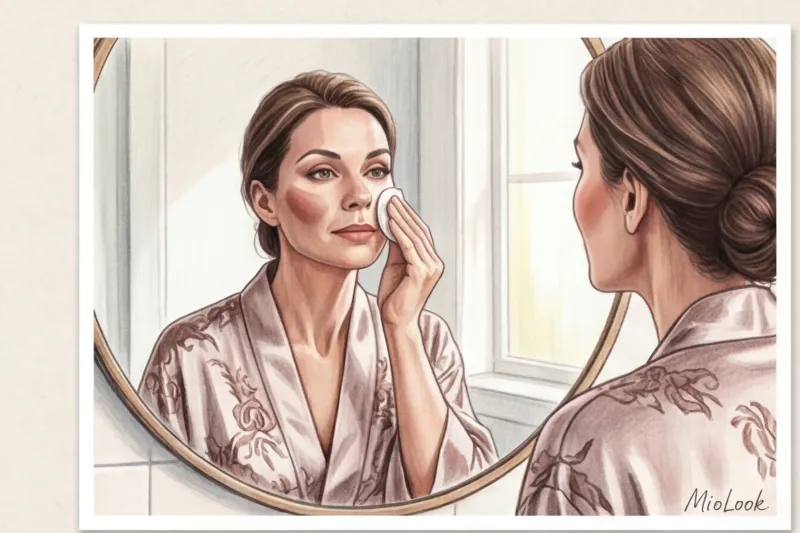
- Lighting: Never apply makeup in a bathroom with warm yellow light. You're guaranteed to overdo the pigment. Apply your makeup in daylight near a window.
- Connection with lips: The final touch of a sophisticated look is matching the temperature of your blush and lipstick. If your blush is a cool pink and your lipstick is a warm brown, your face will look disorganized.
Makeup isn't about painting by numbers; it's about understanding the geometry of your own face. Stop smiling at the mirror when applying blush, find your cheekbone, and remember: shifting your color just one centimeter up can replace a visit to the cosmetologist. Try this technique tomorrow morning, and you'll be amazed at how much fresher and more toned your reflection will look.