Over 12 years of working as a stylist, I've seen the same scene hundreds of times: a client's makeup bag is overflowing with gray contouring products, shimmering highlighters, and red bronzers, and her morning get-up takes 40 agonizing minutes. All for the sake of painstakingly "drawing" on someone else's face. When we first analyzed the bone structure of one of my clients, Anna, she was truly shocked. It turned out that her natural shape is a stunning, graphic square with a noble jawline, and for years she'd been trying to round it out to a standard shape with a thick layer of concealer. Once we changed our approach and abandoned concealment in favor of emphasizing the contours, her makeup time dropped from 40 minutes to 7.
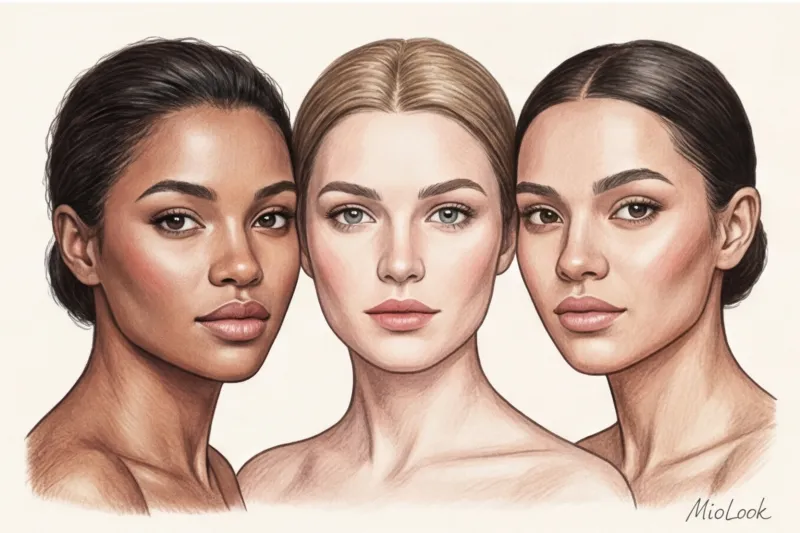
According to statistics, about 70% of women do not know, How to determine your face shape right, and they blindly rely on outdated beauty myths, buying cosmetics that are anatomically unsuitable for them. We've already covered the evolution of beauty standards and the basic principles in more detail in our A complete guide to perfect makeup based on your face shape and contouring secrets Today, I propose you put glossy templates aside once and for all. We'll analyze your bone structure like a complex architectural project—tactilely, thoughtfully, and with an eye toward smart beauty minimalism.
The Myth of the Perfect Oval: Why Old Classifications No Longer Work
For decades, the beauty industry aggressively sold us the idea of the "perfect oval." Any other shape was considered a visual aberration that needed to be urgently camouflaged. Where did this standard come from? It was devised by legendary Hollywood makeup artist Max Factor back in the 1930s. Early film stock was incredibly high-contrast and flattened faces, so makeup artists had to literally recreate oval proportions for actors to achieve a successful shot. This TV craze peaked in the 2010s with the trend for harsh, "Kardashian-style" contouring.
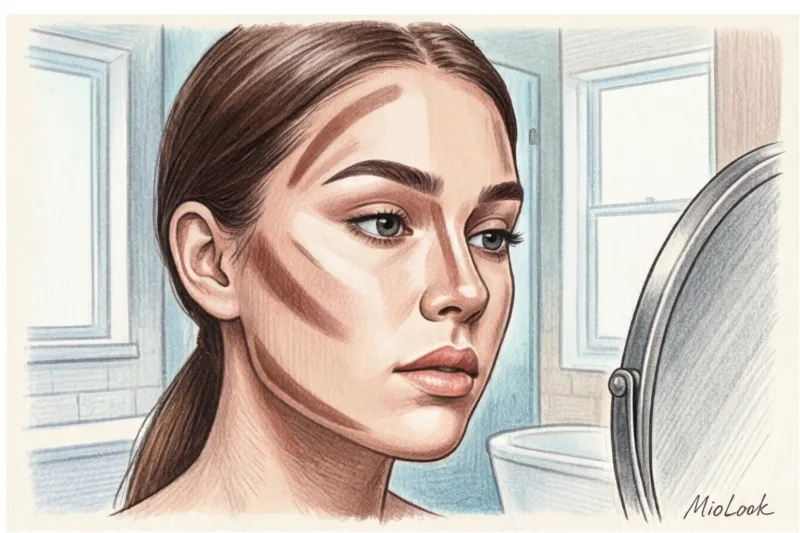
But we don't live under the glare of studio spotlights. In my experience, this staged approach always produces the same disastrous results in real life: "dirty cheeks" in daylight and a visibly aged face that takes five to seven years off.
Extensive research in the field of appearance psychology (including a detailed 2023 WGSN Beauty report) confirms that the human brain interprets attractiveness through the overall harmony of features and healthy symmetry, not through geometric conformity to an oval shape. Hiding prominent cheekbones or a strong jawline under a thick layer of gray powder is voluntarily erasing your uniqueness. You can learn more about how to effectively work with your natural features in our article about facial architecture and why makeup based on shape is more important than trends.
Access to MioLook for €0.99 — one-time payment
A smart AI stylist will select the perfect look based on your unique appearance.
Get access — €0.99 onceThe biggest mistake beginners make: why you shouldn't outline your face with lipstick on the mirror
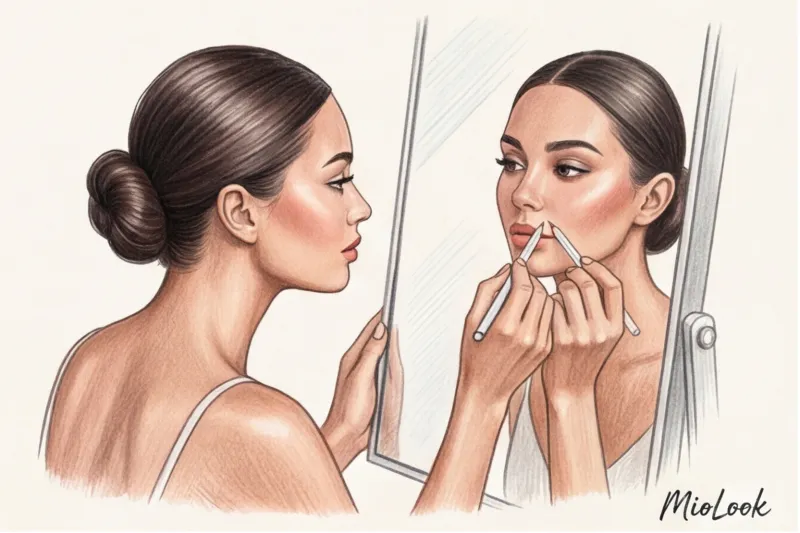
Have you tried this viral social media tip? "Stand in front of a mirror, close one eye, and outline your reflection with your favorite lipstick." It sounds like a fun life hack, but in terms of accuracy, it's completely ineffective.
The answer lies in the basic physics of light and optics. When you stand close to a mirror, an inevitable optical distortion called parallax occurs. The slightest change in your body position, a slight movement of your head, or a change in the distance from the glass radically alters the projection. As a result, you're tracing not your actual bone structure, but a distorted shadow at a random angle.
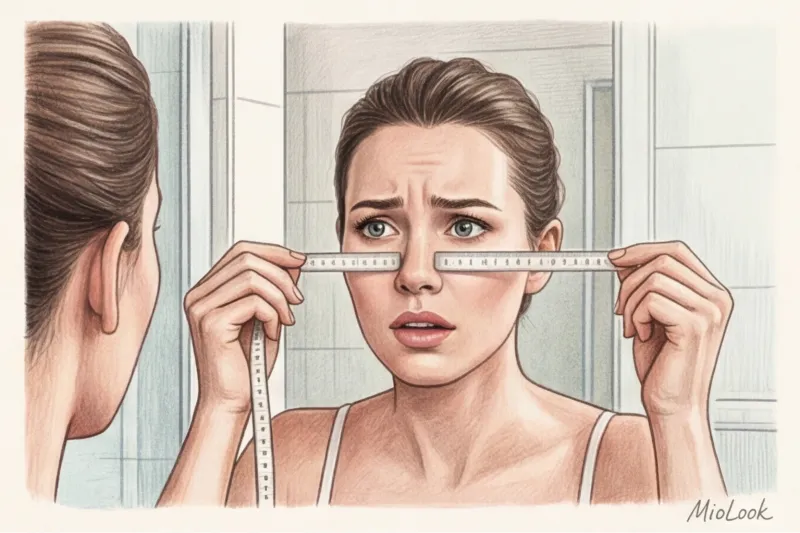
Things are even worse when it comes to trying to determine body shape from selfies, according to a large-scale study published in a prestigious medical journal. JAMA Facial Plastic Surgery (2018), modern smartphone lenses (typically with a focal length of 24-28 mm) create severe distortion when shooting at arm's length. They visually enlarge the nose by 30%, narrow the cheekbones, and distort the jawline. It's these optical illusions that make us rush to the store and buy expensive cosmetics to correct imperfections that simply don't exist in reality!
Anatomical Checklist: How to Determine Your Face Shape Based on Bone Structure
Forget the flat 2D images from old magazines. Your face is a complex three-dimensional object. To understand its true geometry, we need to turn off our visual filters and engage our sense of touch. The secret of professional makeup artists lies not in how they look at a face, but in how they feel its texture with their fingertips.
"You'll never know where to apply blush until you physically feel the highest point of your cheekbone. Makeup is sculpting, not painting."
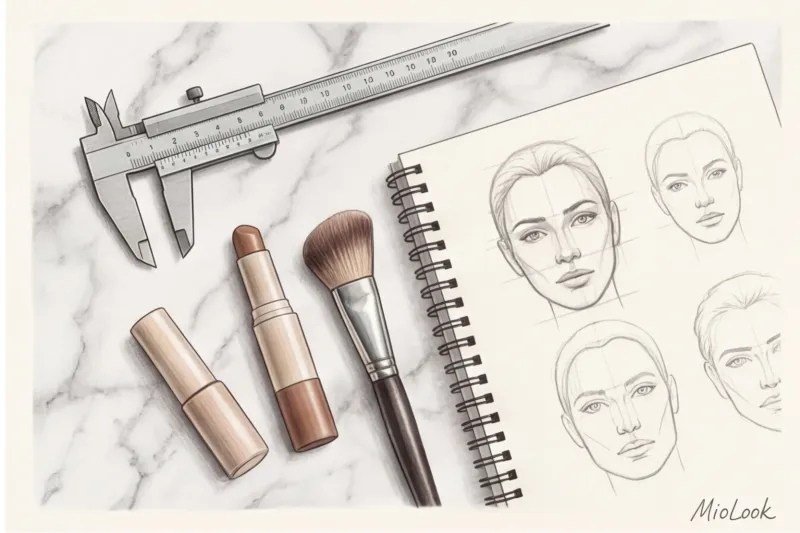
I will immediately point out an important honest limitation: this method of tactile analysis is absolutely doesn't work If you have severe morning facial swelling, consider this. Lymphatic congestion can soften the jawline and hide cheekbones. Wait until midday or perform a light lymphatic drainage massage before taking measurements.
Step 1: Measure the basic proportions (width vs. length)
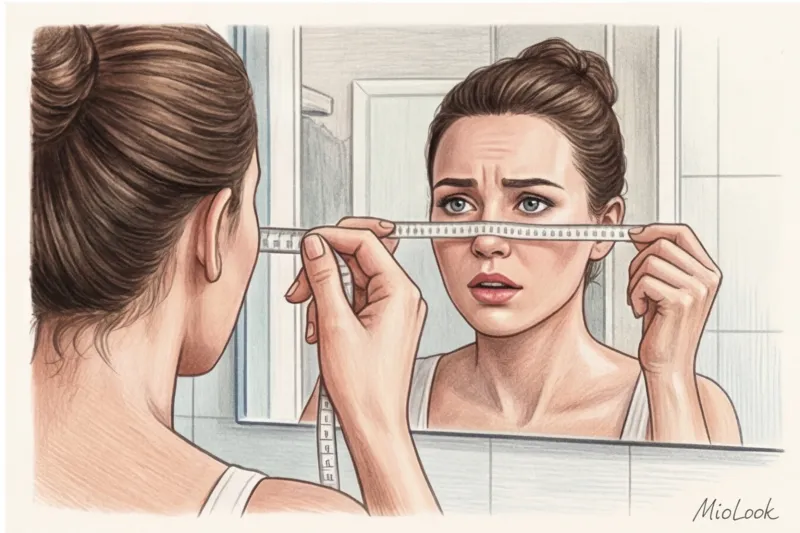
Pull your hair into a tight ponytail to fully open the outline. Use a regular tape measure or just a piece of thread. We only need two key vectors:
- Face length: Measure the distance exactly in the center from the hairline to the lowest point of the chin.
- Face width: Find the distance between the widest points of your cheekbones (usually located just below the outer corners of your eyes).
Now evaluate the ratio. If the length is significantly (more than one and a half times) greater than the width, your profile is elongated. If the measurements are almost equal, your face is shortened (round or square dominant).
Step 2: Analyze the jaw and chin angles
Now place your index fingers on the corners of your lower jaw (they're located just below your earlobes). Feel the bone firmly, moving down toward your chin. Answer three questions:
- What kind of line is this? Soft, sloping, and smooth?
- Or is it rigid, with a clearly defined angle (around 90-120 degrees)?
- Or maybe it tapers sharply downwards, forming a geometric V?
The chin itself is also an important indicator: it can be pointed, delicately rounded, or have a flat, square surface.
Step 3: Hairline and forehead width
The final touch is the upper third of your face. Compare the width of your forehead (the distance between your temples) with the previously measured width of your cheekbones and jawline. Pay close attention to your hairline: is it straight and defined, forming a soft arch, or does it have a so-called "widow's peak" (a triangular ridge of hair in the center of your forehead that forms a heart shape)?
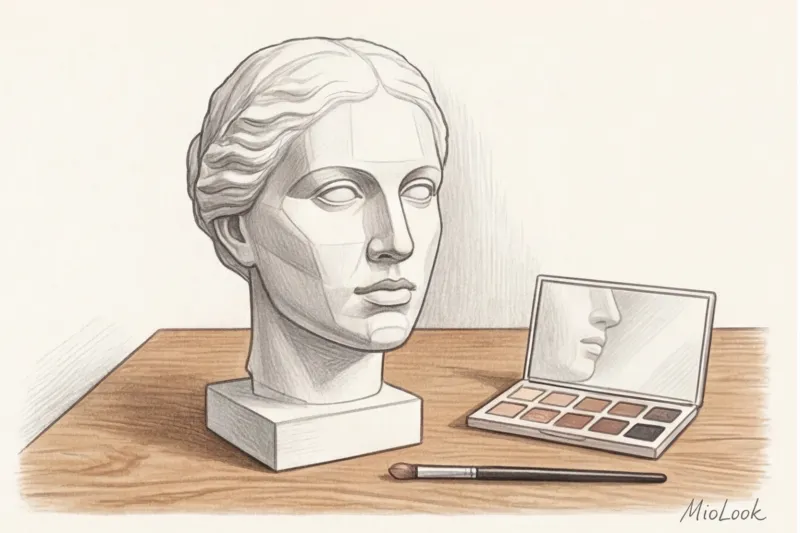
Your perfect look starts here
Join thousands of users who look flawless every day with the MioLook app.
Get access — €0.99 onceHow to Determine Your Face Shape: 6 Architectural Types
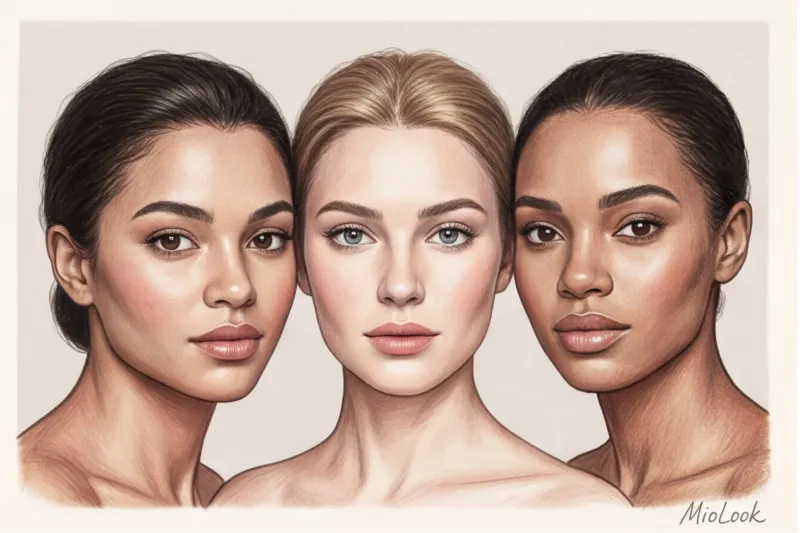
By gathering all the tactile data, we can classify your unique bone structure. I identify six basic architectural types. Let me remind you of the main rule of modern styling: there are no "good" or "bad" types.
- Oval: The length gently prevails over the width, the jawline is delicately rounded, and the forehead is slightly wider than the base. This is a balanced base that doesn't require drastic corrections.
- Rectangular (elongated): The length proportions are the same as those of an oval face, but the jawline and hairline have a strong, defined shape. The face appears aristocratic and naturally sculpted.
- Round: The length and width are almost equal. The cheekbones are the widest part, while the chin and jaw are very soft, without sharp angles. This is the face that ages visually the slowest.
- Square: The length and width are equal, but the jawline is clearly defined. The forehead, cheekbones, and jawline are aligned vertically and are of equal width.
- Diamond: Prominent, wide, high cheekbones, while the forehead and chin are noticeably narrowed. The hairline is often uneven or narrow.
- Heart-shaped: a wide forehead (often with a "widow's cape"), prominent cheekbones and a very narrow, graceful, pointed chin.
Have you ever noticed that many recognized beauties don't fit into one specific type? For example, Angelina Jolie has a mixed face shape—a square with diamond elements. This is completely normal! Your goal isn't to pin a strict label on yourself, but to understand where the widest points and hardest angles of your face are. This information is crucial, especially if you're planning a complex look. I write about this in detail in the article about Stage Makeup: How to Avoid Losing Face in the Spotlight.
Smart Beauty Minimalism: How Your Face Shape Dictates Your Cosmetic Choices
Understanding your natural architecture isn't just theory; it's your direct path to conscious consumption and savings. In my practice, I regularly see how this skill saves clients up to 60% of their makeup budget. We ruthlessly get rid of 15 brushes and multi-layered contouring palettes, leaving just two or three multifunctional products in our makeup bags.
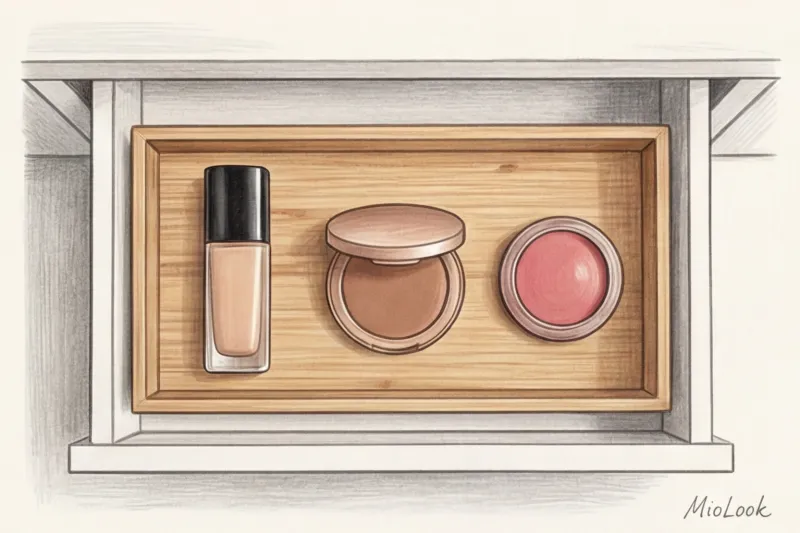
How does your face shape directly dictate textures and techniques?
For graphic faces (square, rectangle, diamond): Your bone structure is already extremely defined. Adding a harsh, gray contouring powder under your cheekbones will create a haggard, theatrical appearance. Swap dry contouring powders for creamy, hydrating textures. Your main tool is blush. Apply it to the apples of your cheeks and blend gently toward your temples to visually soften your natural contours. You'll find plenty of practical tips for this type in the guide. Business Makeup: Rules, Instructions, and Common Mistakes.
For soft faces (round, oval, soft heart): There's absolutely no need to create fake dark depressions at a 45-degree angle. Use a gentle contouring with a warm satin bronzer along the periphery of your face (hairline, subtle shadow under the jaw). This will restore natural volume to your face and help avoid the painful "bruise" effect that a cool taupe bronzer often creates on soft features.
And, of course, don't forget that the shades of these 2-3 products should perfectly match your skin tone. For a precise color match, use our guide: 12 Color Types of Appearance: A Guide to Choosing a Palette.
Portrait Zone: Harmony of Makeup, Neckline, and the MioLook App
A crucial detail that 9 out of 10 beauty bloggers forget: makeup never exists in a vacuum. Your face is just the tip of the so-called portrait zone, which constantly and actively interacts with your collar, the neckline of your clothing, and your jewelry.
Imagine a typical situation: a woman with a pronounced square face wears a stiff office shirt with a sharp stand-up collar and adds graphic contouring to her cheekbones. The geometric shapes begin to clash aggressively, visually weighing down her jawline and shortening her neck. But if the same woman chooses a flowing blouse with a deep V-neck or a soft boat neckline, her facial architecture will instantly soften and elongate.

To avoid having to puzzle over these complex combinations every morning, I strongly recommend my clients to use smart wardrobe feature in the MioLook app Artificial intelligence allows you to visualize your complete look before you leave the house. You can predict how your face shape and current makeup style will look with a specific top, jacket, or dress from your physical closet. This will forever save you from that morning pain: spending an hour applying makeup, putting on the perfect blouse, and then realizing in the hallway mirror that your look looks awkward and "heavy."
Your Action Plan: Do a Self-Analysis Today
Any stylistic knowledge is absolutely useless without practical application. So, I suggest you complete a small micro-task this evening. Just set aside 15 minutes for it:
- Wash your face thoroughly, remove all makeup and pull your hair back tightly at the back of your head (including your bangs, if you have any).
- Stand facing the window. Natural daylight is critical—artificial overhead lights create harsh, false shadows that create non-existent cheekbones or bags.
- Ask someone to take a photo of you or place your smartphone on a tripod at eye level. The distance to the camera should be at least 1-1.5 meters Then simply crop the frame. Never analyze a selfie taken with an outstretched arm!
- Looking at the resulting photo, carefully feel your cheekbones, temples, and the corners of your lower jaw, as we discussed in the anatomical checklist.
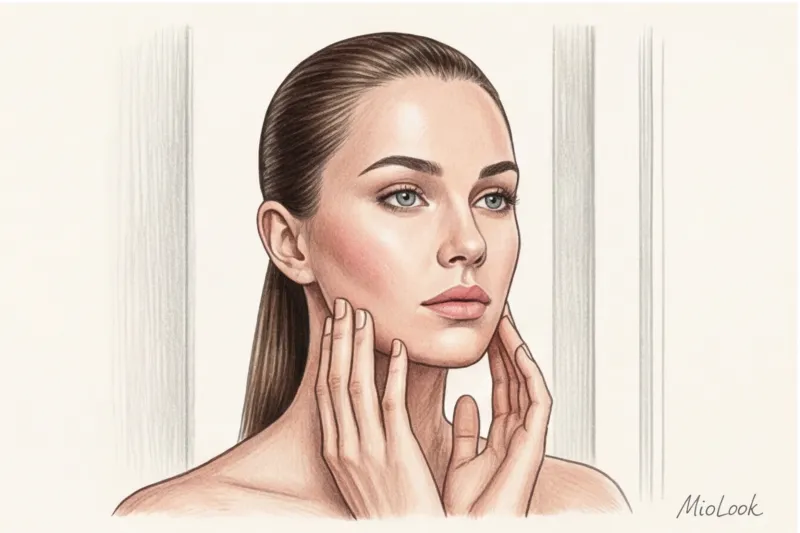
Once you've determined your architectural type, conduct a rigorous yet eco-friendly audit of your makeup bag. Put away all those thick sticks, palettes, and harsh contouring products that tried to impose an "alien" contour on your face. We advocate mindfulness, so don't throw away cosmetics with a good expiration date. Pack up your beauty box and pass on unsuitable products to friends or relatives for whom they would be a perfect fit.
Remember the most important thing: high-quality modern makeup doesn't transform your face beyond recognition. It simply masterfully applies the right lighting to your unique natural beauty.