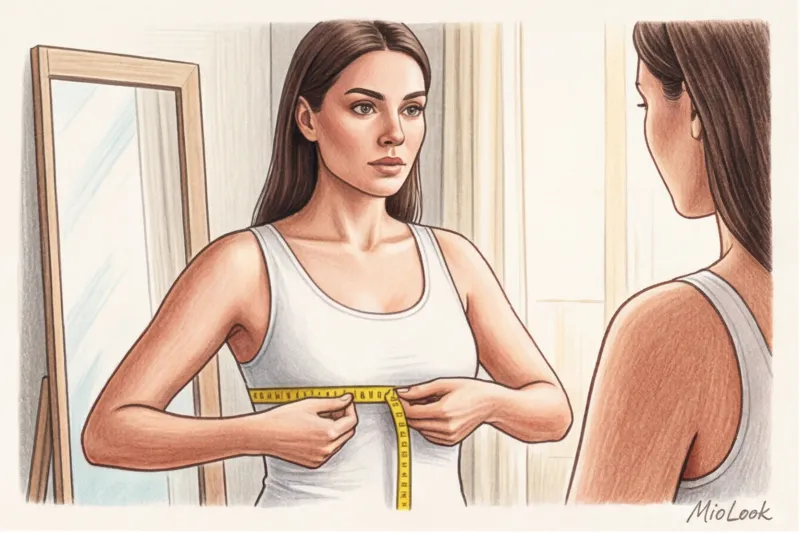
Ask ten random women on the street their underwear size, and at least six of them will confidently answer, "75B." After 12 years as a personal stylist, I've become convinced: it's a veritable epidemic. We get used to one size in our youth and continue to buy it for decades, ignoring changes in weight, anatomy, and the fact that by evening we're irresistibly tempted to take off that "shell."
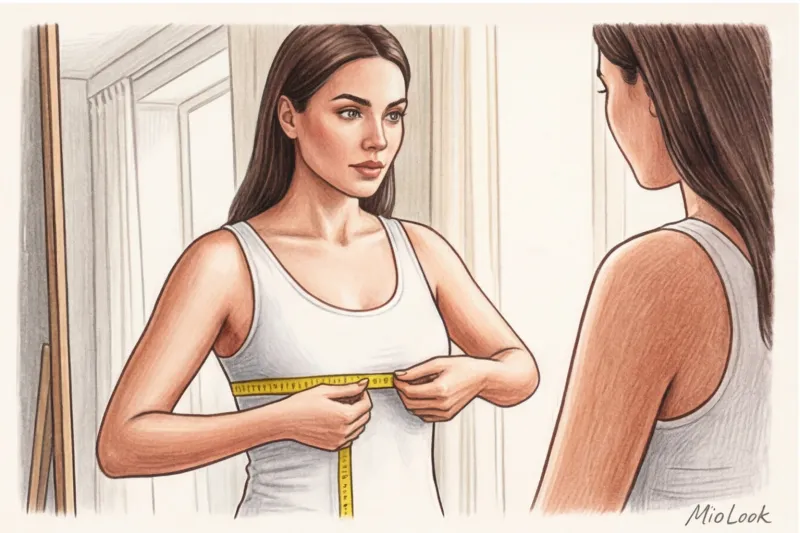
We've covered in more detail what specific models your lingerie capsule should consist of in our The complete guide to a basic lingerie wardrobe But any silk blouse, even the most expensive one, will fit terribly if there's an incorrectly chosen frame underneath.
If you are looking for a way, How to determine your bra size Once and for all, I suggest putting away the calculator. Mathematics only plays a 30% role in bra fitting. The remaining 70% is visual diagnostics and understanding how the band, bridge, and underwire behave dynamically. Let's figure out how to find that perfect fit that will visually shave 3-5 kilograms off your weight.
Why the tape measure lies: the main myth about how to determine your bra size
Most online calculators still use the hopelessly outdated "+4 inches" rule. It dates back to the 1930s, when underwear was made from stiff, non-stretchy fabrics, and centimeters had to be artificially added to the underbust measurement to allow for breathing. Modern microfiber and elastane stretch beautifully, but some brands, out of inertia, still include this extra measurement in their calculations.
A story from my practice: a client, Elena, came to me after complaining of slouching and shoulder pain for years. She wore a classic 75B. When we measured her correctly and changed her to a 70D, a miracle happened. Her chest lifted, freeing up her waist (visually she immediately "slimmed down" a clothing size), and her posture straightened.
According to the University of Portsmouth's Breast Biomechanics Research Group (2023), a tight band provides up to 80% of breast support. If the band is too wide, all the weight falls on the straps, which are physically unable to support it.
Your mathematical measurements are not the final verdict, but only a starting point for a trip to the fitting room.
Home bra fitting: a step-by-step guide to taking measurements
To begin, you'll need a soft measuring tape and the right base. You should measure yourself wearing a soft, non-push-up bra with molded foam. Your breasts should be lifted to their natural position (don't measure barefoot if you have ptosis—the readings will be distorted).
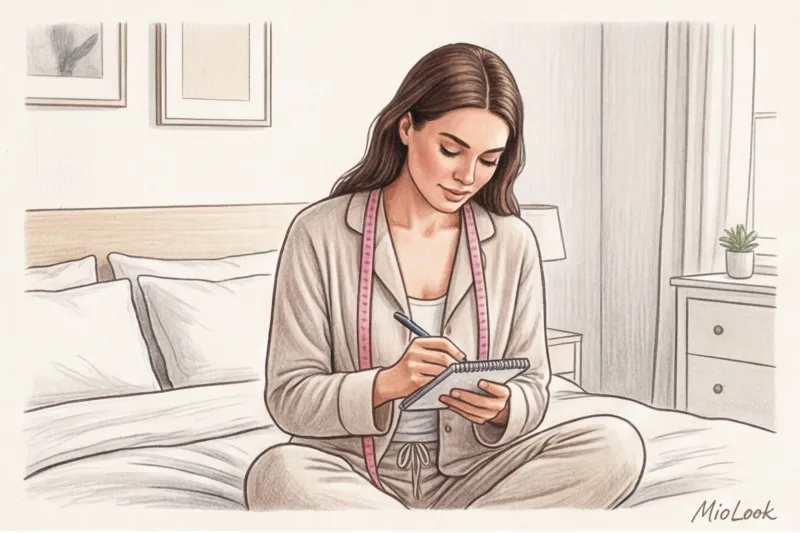
Stand up straight, keep your shoulders down. The most common mistake I see is the band on your back slipping down or riding up. It should go strictly parallel to the floor.
Step 1: Measure your underbust (finding the perfect band)
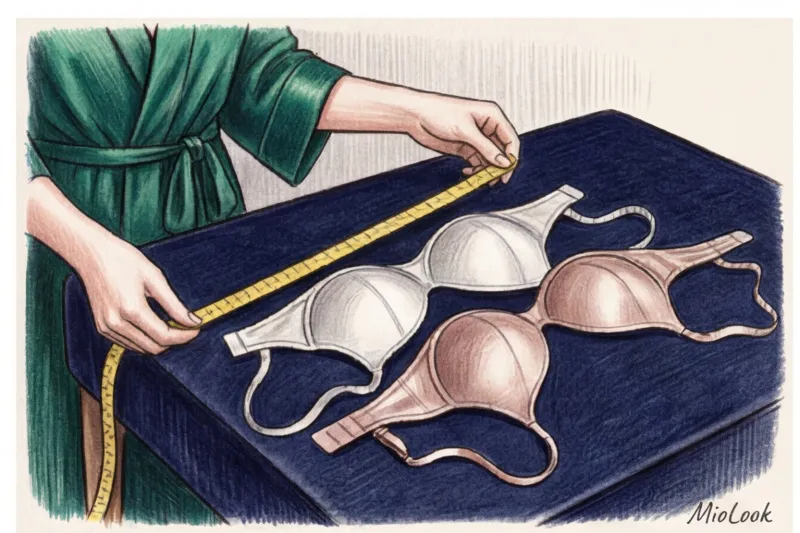
Wrap the band just under the crease of your bust. Now, exhale completely and pull the band as tight as possible, almost digging into your skin. Why so tight? Because the elastic band of a new bra will stretch, and we need to know your true frame.
The resulting figure should be rounded down. If your measurement is 73 cm, you need a 70 cm waistband. If it's 81 cm, feel free to choose 80 cm, and sometimes even 75 cm, depending on the stretchiness of the fabric of a particular brand.
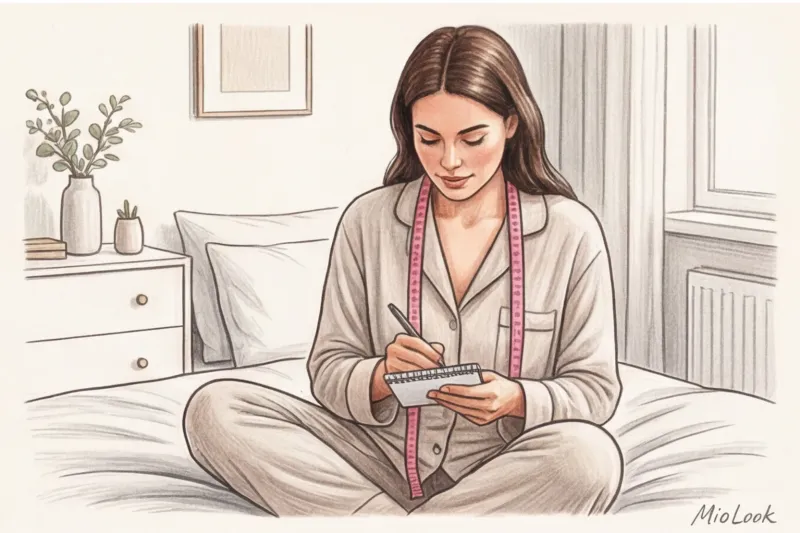
Step 2: Calculate the cup fullness
Now measure the circumference around the fullest part of your bust. Don't pull the tape too tight here. It should hang loosely, without squeezing the breast tissue.
Now it's simple math: subtract the underbust measurement from the bust measurement. The difference in centimeters gives us the cup size:
- 10–12 cm — A
- 13–15 cm — B
- 15–17 cm — C
- 18–20 cm — D
- 20–22 cm — E (DD)
Access to MioLook for €0.99 — one-time payment
A smart AI stylist will help you find the perfect look and organize your new lingerie capsule.
Get access — €0.99 onceSister Size Matrix: How to Save Your Shopping When Your Size Isn't Available
This is where the real magic of shopping begins. A C-cup isn't some fixed volume of a sphere. The letter matters. only in relation to the length of the belt A 70C cup is much smaller in volume than an 80C cup.
Sister (adjacent) sizes are bras that accommodate absolutely identical breast volume , but have different waistband lengths. The "seesaw rule" applies: if you increase the waistband number by one step, you must decrease the cup number by one step. And vice versa.
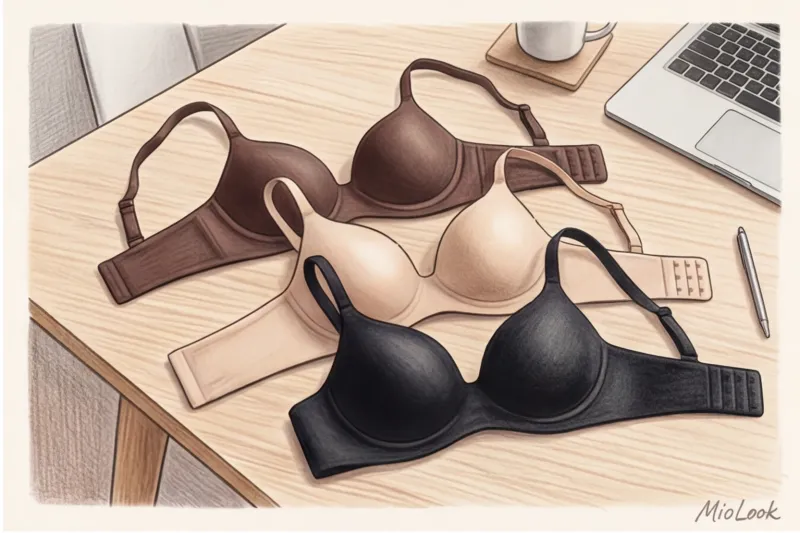
Your bust size will fit perfectly into three sizes: 75C = 70D = 80B.
How do I put this into practice? During sales at Zara or H&M, the popular sizes (those 75B and 75C) are the first to disappear. If I see the perfect smooth basic bra for €15 instead of €40, but my client's size 75C is out of stock, I confidently grab a 70D. At home, we simply fasten it on the outermost (unfastened) hooks, and it fits perfectly.
Fair Limit: This trick doesn't work indefinitely. Don't buy an 85A instead of a 70D—the cup size will be the same, but the underwire of the 85A will be too wide and will extend far into your armpits.
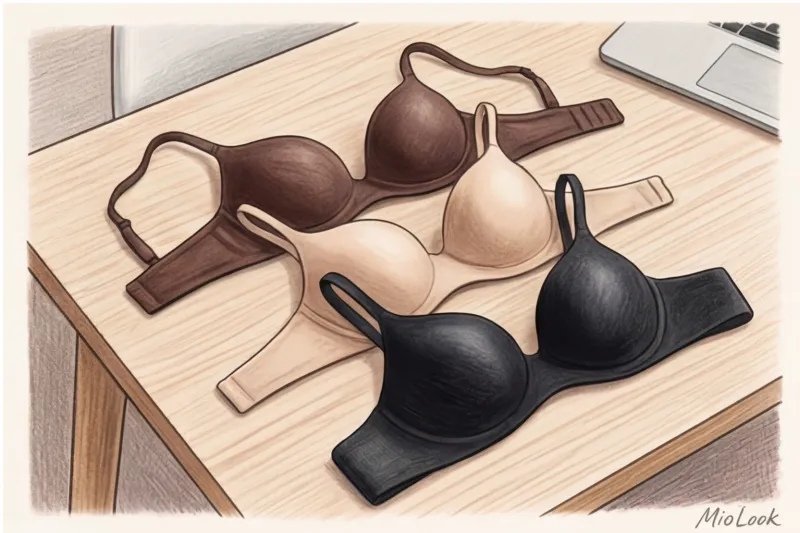
Visual Diagnostics: 5 Signs That Your Bra Size Is Correct
Forget the numbers on the tag. When you walk into the fitting room, trust only your eyes. Here are 5 checkpoints I use to check the fit of lingerie on clients:
- Belt fit. It should be strictly parallel to the floor. Pull the belt away from your back: if it sticks out more than 3-4 cm (two fingers), the belt is too big. It should support your weight.
- Jumper. The center section between the cups should rest firmly on your sternum. If it hangs in the air and you can fit your finger underneath, the cup is too small, and your breasts are simply pushing the structure outward.
- Bones. They should frame the breast tissue and rest on the ribs. If the underwire digs into the breast itself at the side or, conversely, extends far beyond the center of the armpit, the pattern is not right for you.
- Cup. The fabric should not wrinkle (a sign of a cup that is too large), and the breasts should not create a “four-breast effect” by spilling over the edge (a clear sign of being too small).
- Straps. Slide them off your shoulders. Your bra should stay in place and continue to support your breasts. If the strapless design falls down, you've chosen a band that's too wide.
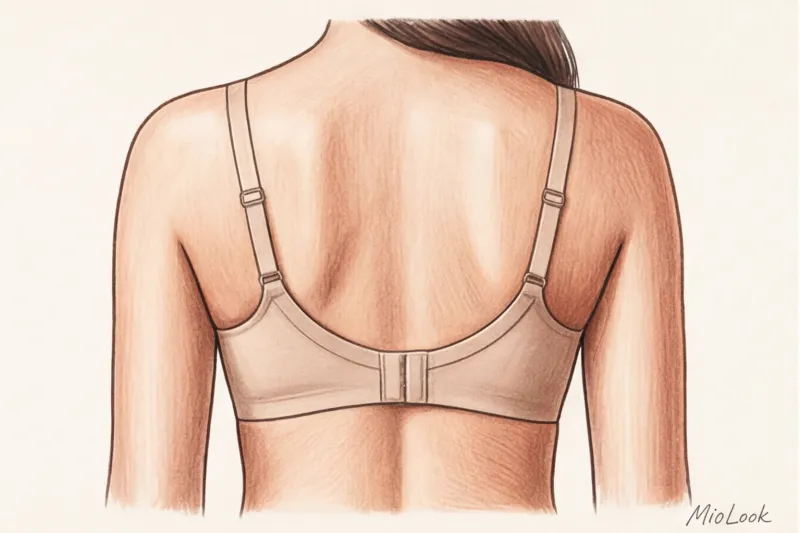
And here I must dispel one of the most persistent myths. Women often think: “If I have red marks on my back in the evening, it means the belt is too tight.” The paradox is that in 9 out of 10 cases, it is too tight that leaves red marks. free belt. It doesn't stay in place on your ribs, but rather rubs against your skin all day with every movement, creating a sandpaper effect (friction burn).
Your perfect look starts here
Join thousands of users who look flawless every day with MioLook's AI-powered tips.
Get access — €0.99 oncePattern Specifics: How to Choose the Perfect Basic Lingerie in the Mass Market
Even if you know your size down to the millimeter, it will fit differently across different brands. This depends on the last (pattern) the brand uses.
For example, the H&M group's brands (including COS and & Other Stories) have historically catered to the Scandinavian body type—they have fairly narrow backs and deep cups. If you have a wide chest, their minimalist styles, priced at €35–€50, can be incredibly tight in the ribs. Furthermore, at H&M itself, the cups often run noticeably small—I almost always advise clients to go up a cup size (for example, 75C instead of 75B).
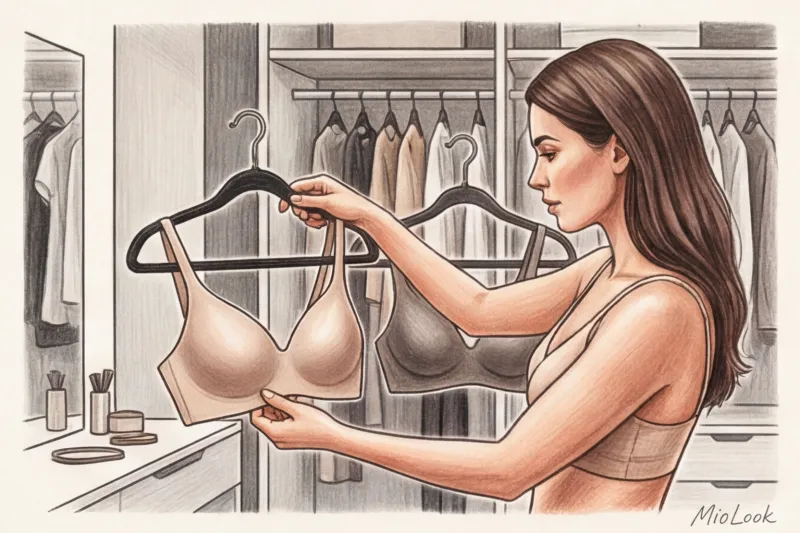
When it comes to specialized lingerie brands, the difference is even more noticeable. Italian Intimissimi (priced €40-€60) offers a wide underwire placement—ideal for naturally slightly splayed breasts. Meanwhile, German Triumph (€60-€100) is renowned for its phenomenal precision support for heavier busts, with more closed cups that center the silhouette.
For a basic wardrobe, I always recommend seamless microfiber styles (like the Spacer bra) under thin cashmere turtlenecks or silk blouses from Massimo Dutti. They create a completely smooth silhouette, without the texture of the lace showing through delicate fabrics.
Checklist: Reviewing Your Linen Drawer
Knowing how to determine your bra size is half the battle. The other half is knowing when to let go of clothes that have outlived their usefulness. Take a rigorous inventory.
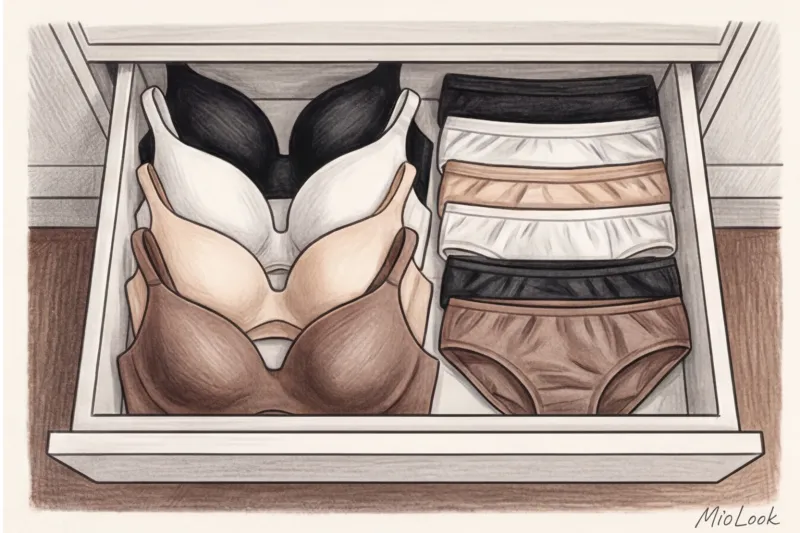
Do the "arms up" test. Put on your usual bra, fasten it, and quickly raise your arms. Has the band moved up onto your breasts, and your breasts slipped out from underneath? That bra belongs in the trash. It doesn't support anything anymore.
Another golden rule: A new bra in a store should always be fastened only with the outermost (freest) hooks Those tight rows of hooks that remain are there solely to tighten the band as the elastane stretches from washing and your body heat. If you fasten your bra to the tightest hook at the store, you'll have to throw it away within a month because there won't be any room to tighten it.
Ready to get started?
Try the MioLook plan for free—no commitments required. Create a smart wardrobe in one click.
Get access — €0.99 onceThe lifespan of a basic bra, with regular wear (rotating between at least 2-3 styles), is about 8-10 months. After that, the elastane breaks down irreversibly. Don't begrudge stretched-out bras, even if they cost €100—they ruin your figure's shape and ruin your efforts to buy good clothes.
Stop buying "your usual size" out of inertia. Your body is unique, changing throughout the month and year. Use these principles of visual diagnostics, try on sizes similar to yours, and remember: you shouldn't feel the right underwear on you throughout the day.