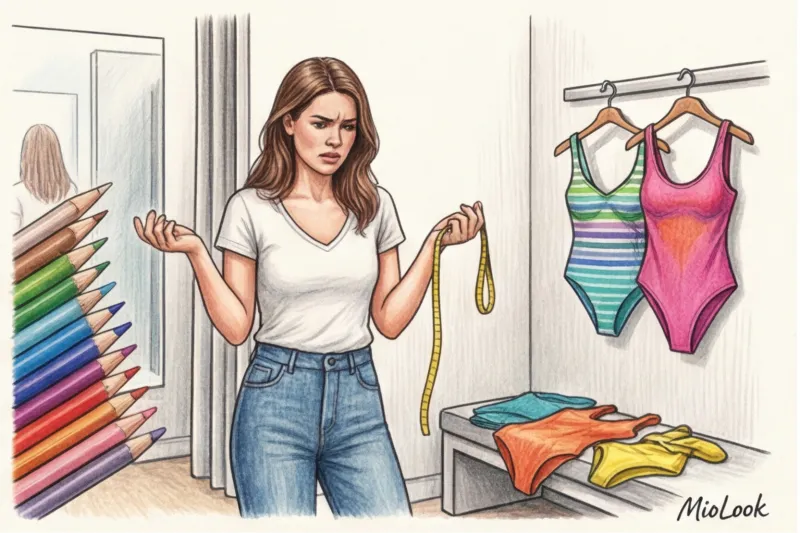
How many times have you bought a basic black one-piece swimsuit hoping it would do wonders for your figure, only to end up with the opposite effect? As a textile expert and stylist, I see the same mistake over and over again. We're trying to solve body architecture problems with color, when we should be solving them with fabric engineering. Ideal swimsuit that hides the belly It's not just a piece of dark fabric. It's a complex construction, where the percentage of elastane, the direction of the threads, and the hidden corset mesh work as a sophisticated foundation.
We talked in more detail about age-related volume migration and why familiar patterns no longer fit us in our A complete guide to how to hide your belly and love handles with clothing after 40 Today, we'll take a closer look at your beach wardrobe. Forget the clichéd advice from the glossy magazines of the 2000s. We'll choose our swimsuits like true pragmatists.
The Illusion of Black: Why Popular Styling Tips No Longer Work
The most damaging myth in beach fashion is: "If you want to look slimmer, buy a black one-piece." One of my clients, 45-year-old Anna, spent years hiding in these shapeless, dark "covers," depriving herself of a feminine silhouette and feeling insecure at any resort.
Let's face it. Solid black without proper seam placement isn't slimming. On the contrary, in profile, it creates the effect of a solid, dark monolith that mercilessly accentuates a protruding belly. There's nothing to catch the eye, no diagonals, no visual waist—only a clearly defined, dark outline of your body.
The second pitfall is excessive ruching around the waist. Lingerie designers often add gathers at the stomach to disguise unevenness. But this is a double-edged sword. Light diagonal gathers work well, but horizontal folds in dense fabric visually add 2-3 kilograms. You create physical bulk in the very place you're trying to hide it.
Access to MioLook for €0.99 — one-time payment
A smart AI stylist will select the perfect look.
Get access — €0.99 onceThe anatomy of a belly-hugging swimsuit: what fabrics are used to create a high-quality belly-hugging swimsuit?
The secret to the shape-correcting effect lies at the molecular level. Why does a €20 mass-market swimsuit stop sculpting after just one vacation? The problem lies in cheap polyester and low-quality spandex.
According to a study published in Textile Research Journal (2023), basic elastic fibers lose up to 40% of their elasticity after just 30 hours of active exposure to chlorinated pool water. The fabric literally "tires" and becomes wavy. An excellent alternative today is Econyl—a recycled nylon (polyamide) derived from fishing nets. It has a higher knit density and phenomenal wear resistance.
The role of elastane and the density of the material
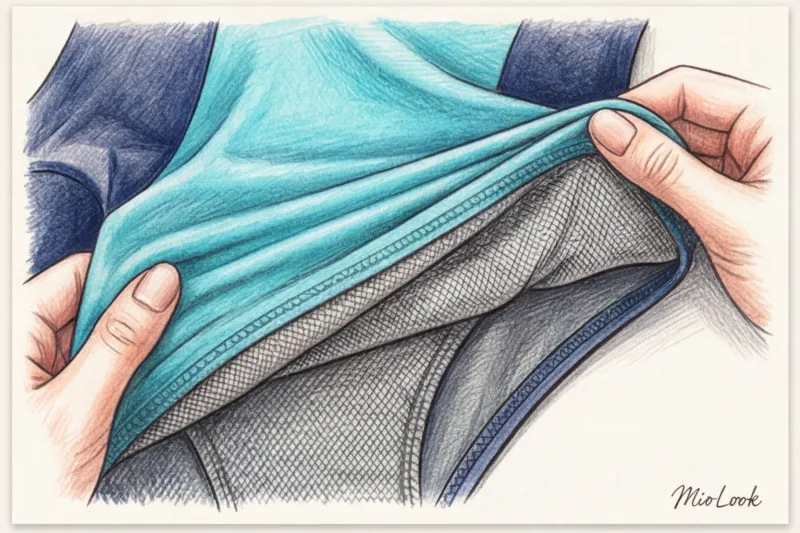
For effective tummy shaping, look for a strict formula on the label: 18% to 25% elastane (Lycra/Spandex/Elastane) and 75–82% dense polyamide (not polyester!). If the elastane content is less than 15%, the swimsuit will simply cling to the body rather than sculpt it.
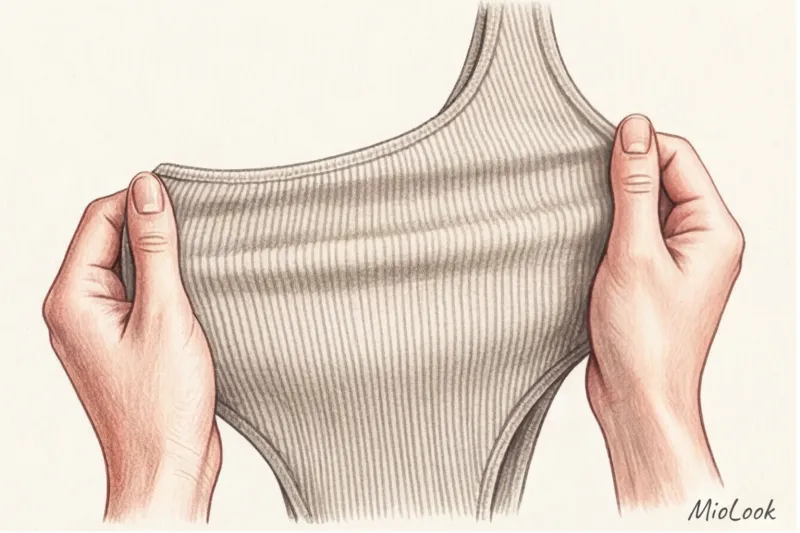
How do you test fabric in a store? Do the light test. Stretch the fabric with both hands and hold it up to a lamp. If you can clearly see the light and the weave becomes loose, the garment won't support your belly. Dense shapewear fabric remains virtually opaque when stretched.
Hidden architecture: corset mesh (Power Mesh)
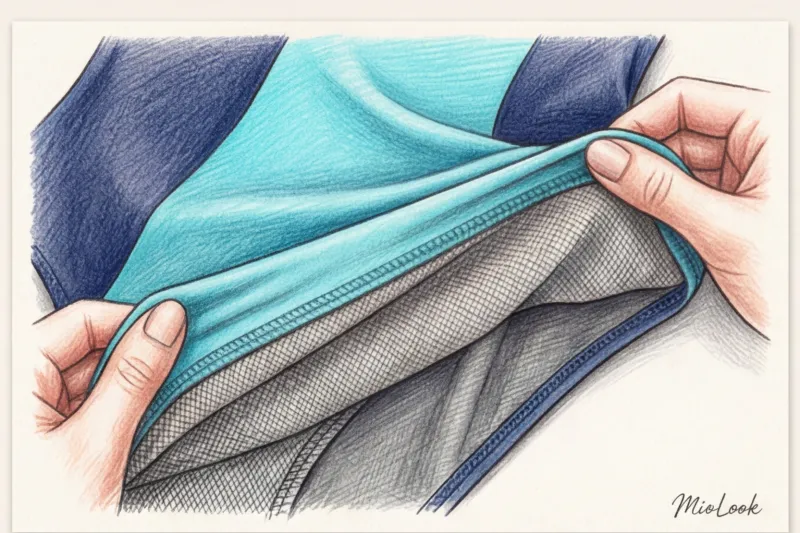
In the premium and high-quality mid-range segment (usually in the €80–€150 range), brands use Power Mesh technology. This is an invisible inner layer of fine-mesh compression mesh, sewn exclusively into the abdominal area.
"Shaped-garment design standards require the use of Power Mesh so that it distributes pressure evenly, supporting the abdominal wall without compressing internal organs, as rigid corsets do," note technologists at specialized lingerie institutes.
One-piece models: styles that shape the waist
Silhouette construction is pure geometry. If nature or age has blurred the waistline, we must re-draw it using the right templates.
Diagonal lines and color blocking
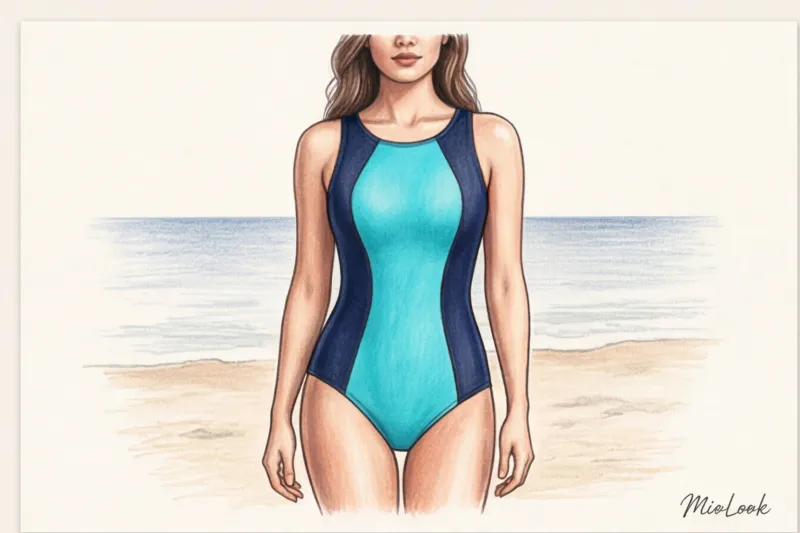
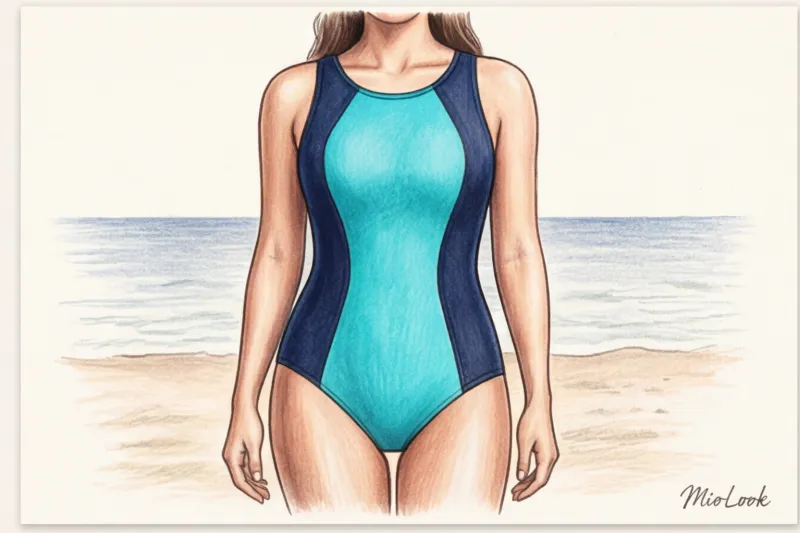
Color blocking is the most powerful optical technique. Ideally, dark panels on the sides and a lighter, brighter, or printed center section. This instantly creates the illusion of an hourglass silhouette.
But there is an important exception here: This tip won't work if you have a pronounced apple-shaped figure with very narrow hips and skinny legs. In this case, dark sides will make your lower half appear even narrower, giving you a "lollipop" look. In this situation, a diagonal wrap style works better, gently breaking up your stomach with an asymmetrical line.
Your perfect look starts here
Join thousands of users who look flawless every day with MioLook.
Get access — €0.99 onceOne-shoulder asymmetry
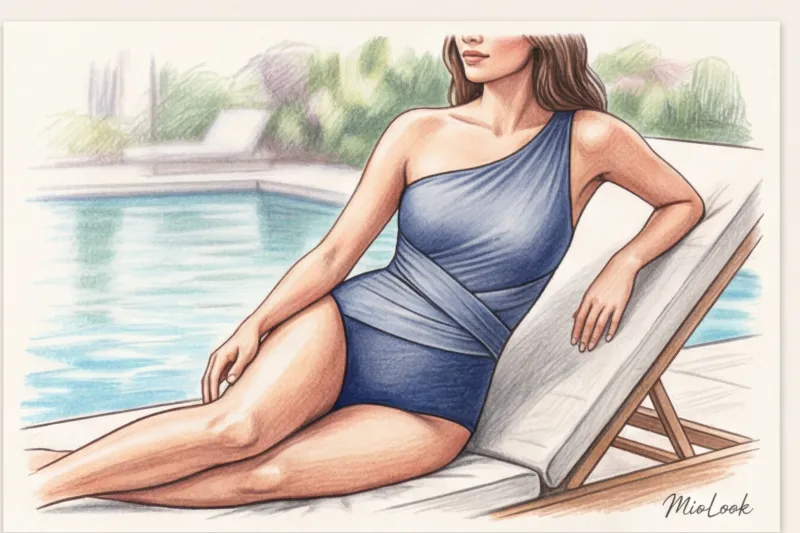
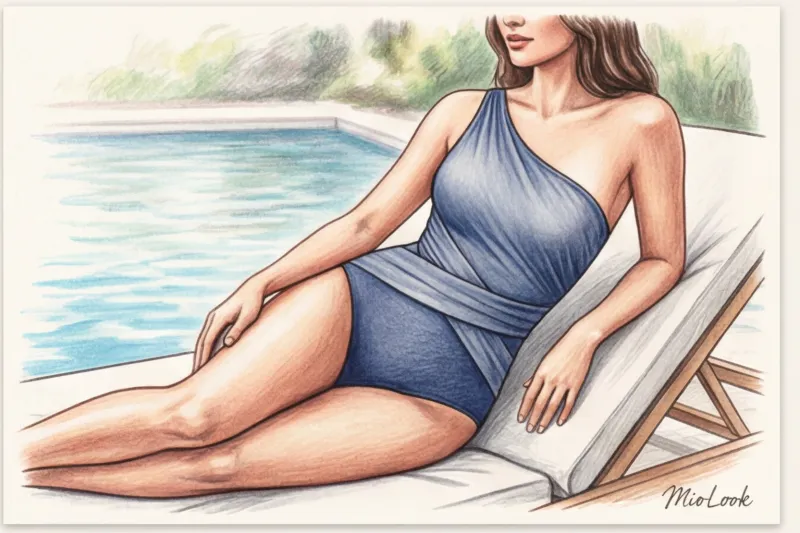
Our brains are wired to follow a continuous line. The diagonal line of an asymmetrical one-shoulder neckline draws attention away from the abdominal area and up to the collarbones, neck, and face. It's a perfect balance of proportions that adds dynamism to the look.
Two-piece swimsuits: Yes, you can wear bikinis and tankinis
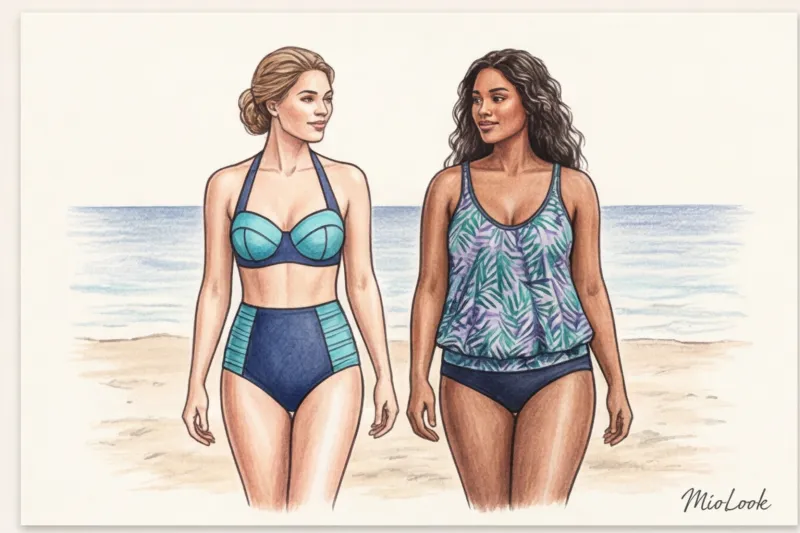
I often encounter a psychological barrier: women with a belly are convinced that two-piece swimsuits are only for cover models. This is a huge misconception. Often, a well-chosen two-piece suit can flatter your figure much better than a one-piece, as it allows you to break up your proportions.
High-waisted swim trunks (retro style)
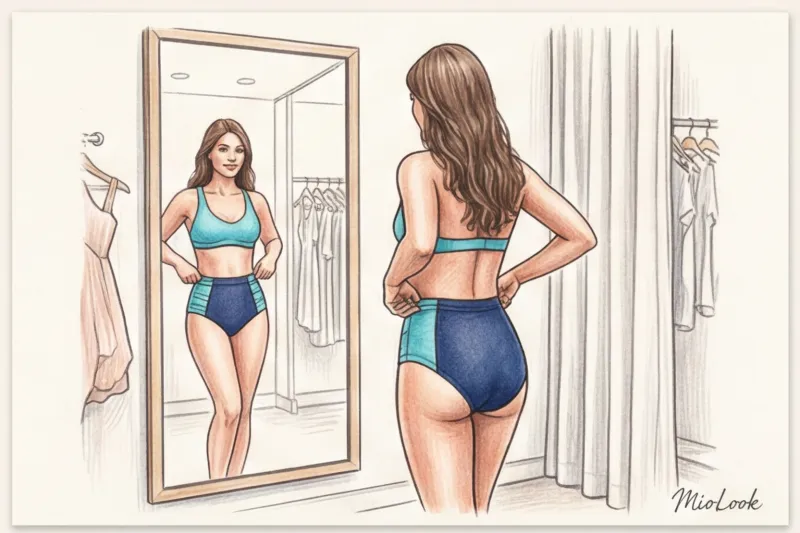
The secret to perfect retro swimwear lies in the rise. The top of the band should cover the belly button and end at the narrowest part of the waist. If the band sits below the belly button, it will inevitably cut the stomach in half, creating an unsightly roll at the top (the so-called "muffin top" effect).
Pay attention to the edge: instead of thin laces or narrow elastic bands that dig into the skin, choose models with a wide seamless waistband or a flat, thick elastic band at least 3-4 centimeters wide.
Tankini: freedom of movement and confidence
A tankini (a set of swimsuit and a tank top) is a lifesaver for those who crave freedom. Choose an A-line top: it fits snugly across the chest and gently flares out at the bottom, creating a looser fit around the stomach. The main advantage of a tankini is the ability to mix and match sizes. If you have a full bust but narrow hips (or vice versa), you can buy a size 48 top and a size 44 swimsuit, which is impossible with a one-piece.
By the way, if you are unsure which shades of tankini will suit your type, try image selection function in MioLook The algorithm will analyze your appearance and suggest the perfect palette before you spend money.
Test Drive in the Fitting Room: Quality and Fit Checklist
Trying on a swimsuit isn't just a glance in the mirror. It's a crash test. Over 12 years of working as a stylist, I've developed a strict rule for my clients: be active in the fitting room.
- Sit on a chair: Standing up makes your stomach look flatter. Sit on a ottoman in the fitting room. If the edge of your swimming trunks rolls up or the top of your one-piece swimsuit cuts into your ribs, your size is too small or the fit is incorrect.
- Checking the straps: The body's physics are unwavering: if the fabric is too tight at the bottom, the resulting volume must be securely held in place at the top. Shapewear should always have wide straps (at least 2 cm) and reliable bust support (underwire or a firm, molded cup).
- Seam assessment: Look for flatlock seams. They're not raised, sewn end-to-end, and won't leave red marks on your skin after a day at the beach.
How to care for your shapewear so it doesn't lose its shape
My personal test drive confirms this: in 2021, I bought a basic swimsuit made from recycled polyamide for €85. With proper care, it maintains its factory compression even after three years of active travel, while cheaper alternatives lose their shape after just one season.
Elastane's main enemies are chlorine, sea salt, and the chemical filters found in sunscreens. Salt crystals, when dried on the fabric, act like microscopic blades, cutting the elastic fibers from the inside.
- Instant rinse: As soon as you get out of the pool or sea, take a shower. Rinse your swimsuit with cool, fresh water. This will reduce the damaging effects of chemicals by 70%.
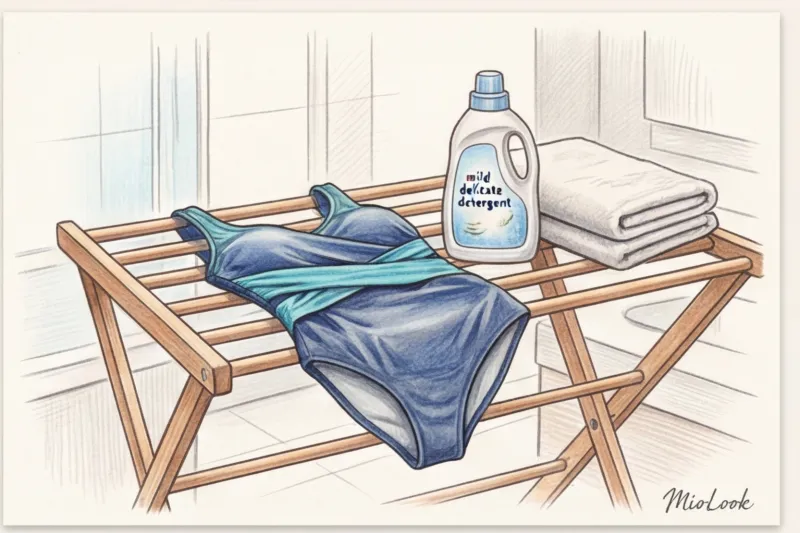
- No twisting: When removing a wet swimsuit, don't wring it out! Simply squeeze it out with gentle pressure or wrap it in a towel.
- Batteries Ban: Never dry compression swimwear in direct sunlight, in a tumble dryer, or on a heated towel rail. High temperatures literally melt the spandex, permanently destroying its ability to return to its original shape.
Choosing a swimsuit that truly conceals your belly and boosts your confidence is an investment in your own comfort. Stop looking for salvation in boring black and pay attention to the composition: dense polyamide, 20% elastane, sophisticated Power Mesh, and clever diagonal lines will do a thousand times more for your figure than a shapeless, dark piece of cheap fabric.