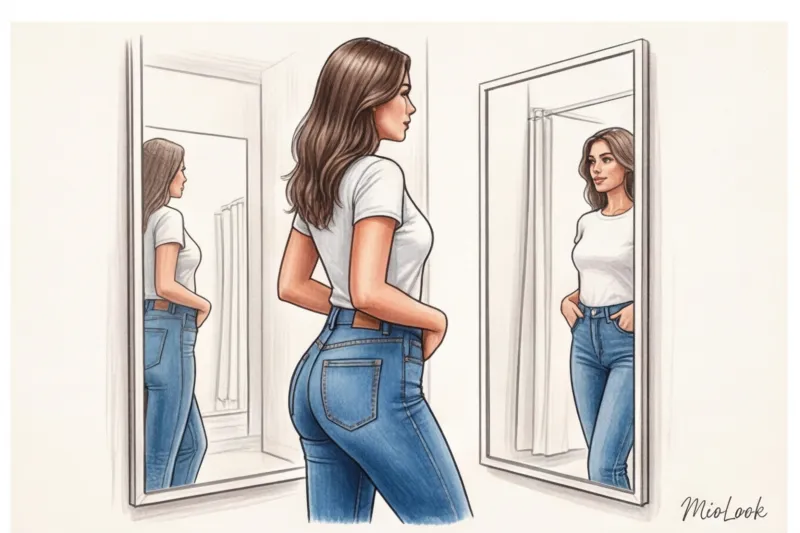
Ninety-sixty-ninety. If you're still trying to buy the perfect bottom based solely on these numbers, I'm sorry to disappoint you—the tape measure is a shameless liar. Over 12 years of working as a fashion journalist and stylist, I've learned one brutal truth: the right jeans aren't a matter of the right fabric, they're a matter of pure design.
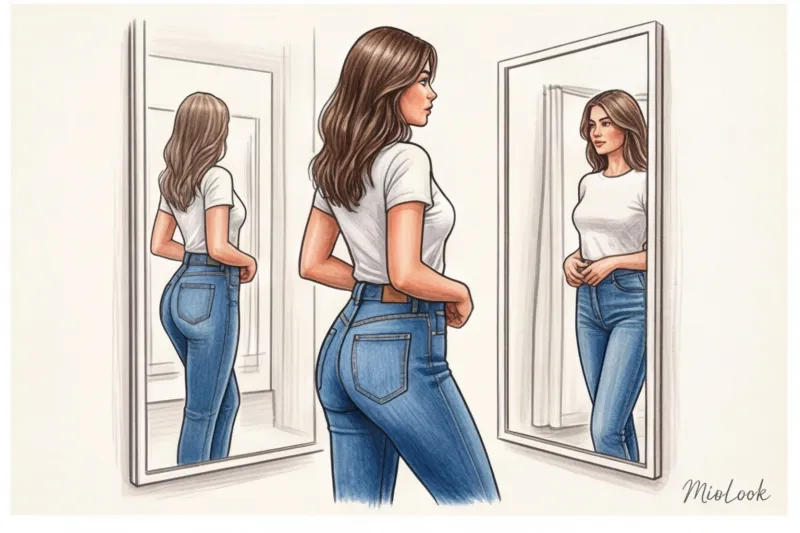
We're used to categorizing ourselves by fruits: "apple," "pear," "inverted triangle." But this flat approach is hopelessly outdated. We discussed in more detail why this system no longer works in our full article. Guide: Female body types - how to determine your silhouette Today, we'll go further and examine the engineering side of the matter: how yoke shape, denim ounces, and seam height differences can shape the body better than any surgeon.
Why Centimeters Lie: 3D Anatomy Instead of "Fruit" Types
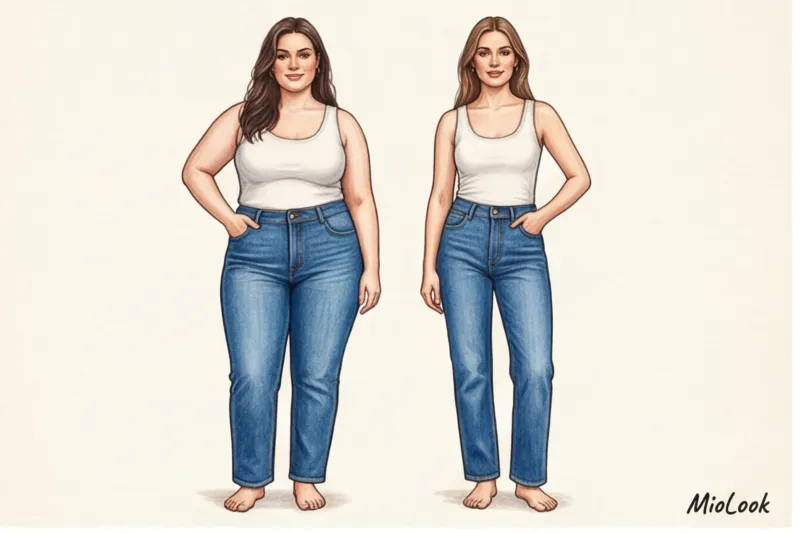
Let me tell you a story from my practice. I had two clients, Marta and Sofia, come to see me. Both had hip measurements of exactly 98 centimeters. We went to the store, and I let them try on an identical pair of straight-leg jeans from a basic brand, in the same size.
On Marta, they fit perfectly, hugging every curve. On Sofia, however, they barely stretched over her hips, and a gap formed in her lower back that could easily accommodate my fist. This is called a phenomenon in the industry. waist gap (emptiness in the waist). Why did this happen if the centimeters are identical?
It's all about 3D volume and visual weight. A measuring tape encircles us, ignoring projection. Marta had a wide hipbone but a flat buttocks. Sofia has a narrow pelvis but a pronounced lower back arch and full buttocks (the so-called "Brazilian" shape). The ideal fit depends not on girth, but on pelvic tilt, weight distribution, and how the fabric interacts with this three-dimensional shape.
The Anatomy of Denim: How Technical Cuts Change Your Proportions
Many people think that style is about choosing the right color or trendy cut. In reality, style is about understanding the garment's construction. Jeans are workwear, originally lacking the darts that tailors use to create curves in classic trousers.
"In 1873, when Levi Strauss and Jacob Davis patented their first riveted jeans, they used a brilliant feature—the yoke. It replaced tailor's darts and allowed the dense fabric to conform to the human body."
Knowing how these technical elements (yoke, rise, inseam) work will save you dozens of hours in fitting rooms.
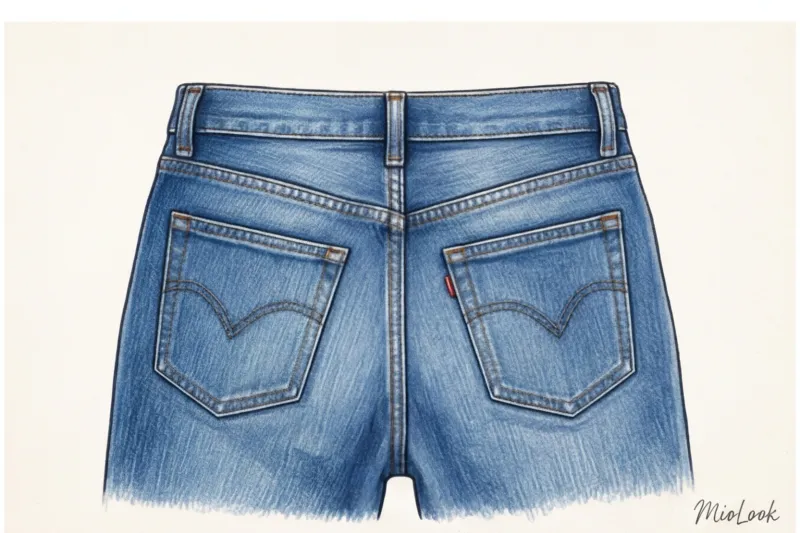
The secret to perfect buttocks: yoke shape and pocket placement
Look at the back of your favorite jeans. See the seam running from the sides to the center above the pockets, forming a swoosh? That's the yoke. The angle of the yoke determines the appearance of your butt:
- Deep V-shaped yoke: Visually rounds and lifts flat buttocks. The sharper the angle, the more volume you get.
- Straight yoke: It creates a flat and wide appearance. It's definitely not recommended for women with narrow hips, but it works great on figures that need to visually "calm" a very voluminous bottom.
- Sweetheart yoke: Creates a maximum push-up effect. Ideal for athletic figures with undefined curves.
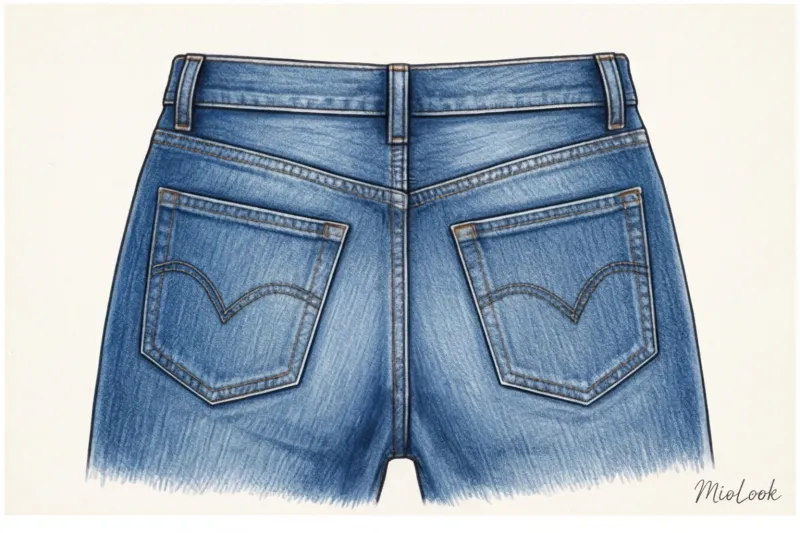
The pocket rule is strict: their size must be strictly proportional to the size of the buttocks. Small pockets on large hips create an optical illusion (the Ebbinghaus effect), making the hips appear even larger.
Rise: Salvation or Fashion Disaster?
The industry has long convinced us that high-rise waists lengthen legs and conceal the belly. But there's one huge "BUT." If you have a short torso (the distance from your lowest rib to your pelvic bone is minimal), a high-rise waist will create a comical "chest-on-your-legs" effect, completely erasing your waist.
For 80% of women, the most complimentary base is mid-rise (medium rise, just below the navel).
Stylist's secret: If you have a prominent butt, look for brands that design jeans with a significant difference between the front rise and back rise. The back rise should be at least 4-5 centimeters longer than the front rise, otherwise you'll be showing off your underwear every time you squat.
Your perfect look starts here
Join thousands of users who look flawless every day with the help of MioLook artificial intelligence.
Get access — €0.99 onceHow to choose jeans for your body type: working with visual weight
When clients ask me how to choose jeans for their body type, I encourage them to forget about cuts and think about balance. Our goal is to draw attention away from areas of visual weight and create a harmonious vertical line.
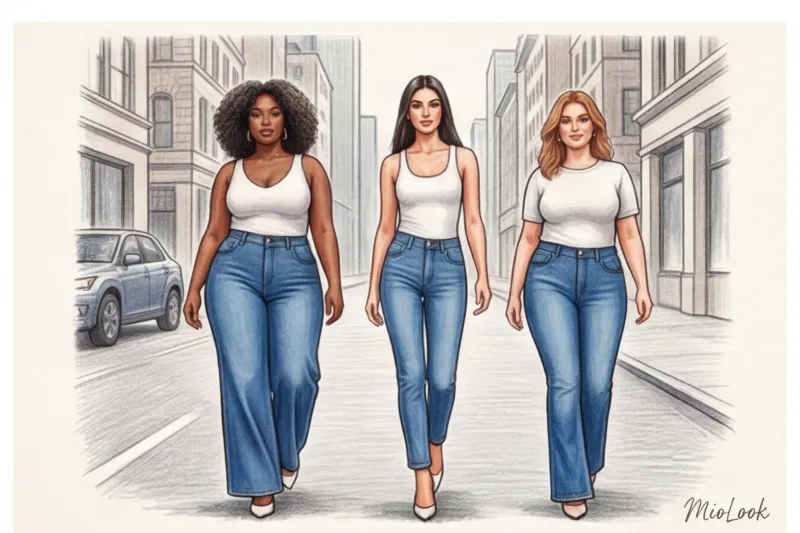
Lower volume (pronounced thighs and calves)
The most common mistake women with large hips make is trying to squeeze into skinny jeans. This creates a "carrot" effect: the wide upper body merges into disproportionately narrow ankles, emphasizing the bulk of the pelvis.
What works: Bootcut and flare silhouettes. The width of the hem visually balances the width of the hips. Wide-legs in very dense denim also work great—they conceal the true contour of the leg, elongating the silhouette.
Central volume (abdominal area and undefined waist)
A soft, elastane-filled belt is your worst enemy. It constricts your stomach, creating the effect of a muffin hanging over the belt.
What works: These straight jeans have a mid-rise fit and are made from 100% cotton. The dense denim doesn't cut into the body, but rather acts as a corset, creating a flat surface where volume is present.
Top volume and narrow hips (sporty silhouette)
If you have broad shoulders but a narrow hips and slender legs, your goal is to add visual volume to your lower body.
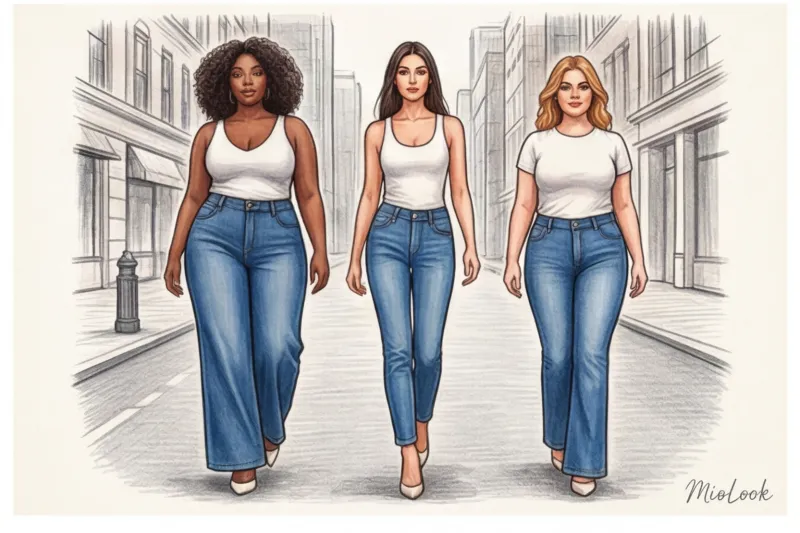
What works: Mom jeans, balloon jeans (slouchy), light shades (blue, white), and active washes on the hips. Additional details like large patch pockets or waistband pleats will work to your advantage.
Choosing Trousers: How Fabric and Pleats Differ from Jeans
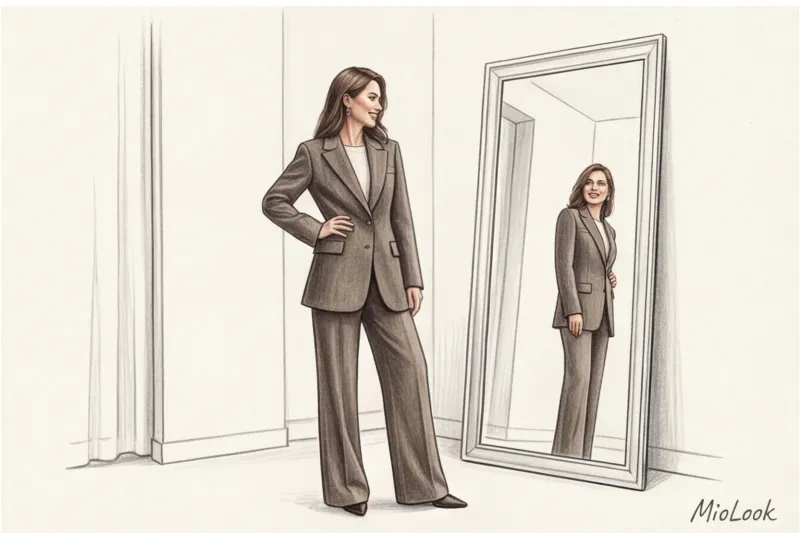
The perfect cut of jeans is not the same as the perfect cut of trousers. While denim shapes the figure through tension, suiting fabric works solely through drape. As tailors on London's famous Savile Row say, "The fabric should flow over the body, not cling to it in a panic."
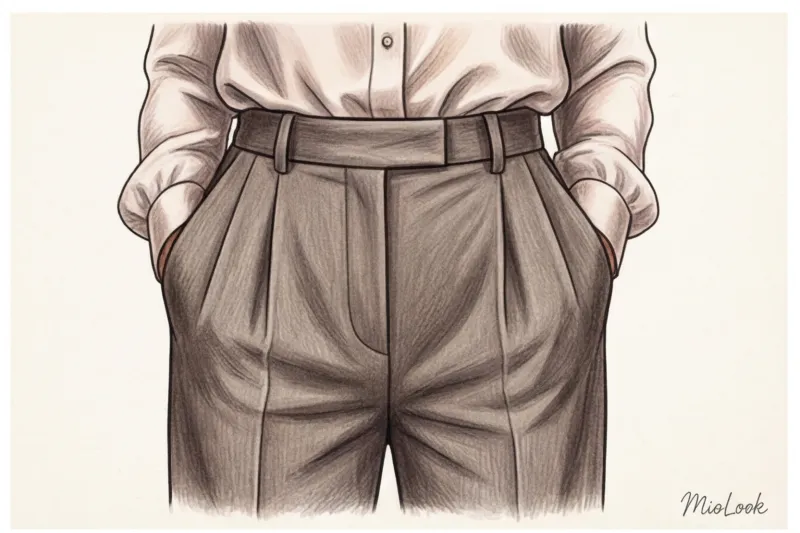
The main tool for adjusting trousers is pleats But they come in different forms:
- Stitched tucks (fastened a couple of centimeters down from the waistband): A brilliant invention for hiding a tummy. They hold a flat shape at the waist and then open up to reveal more hips.
- Free tucks from the waistband itself: They add volume. They're ideal for narrow hips, but not for figures with more weight concentrated in the center.
Don't forget about the creases. A pressed crease is a powerful vertical tool that slims your legs. But there's one rule: the crease should remain straight. If it stretches and disappears at the hips, the pants are too tight, even if you managed to button them.
Access to MioLook for €0.99 — one-time payment
A smart AI stylist will analyze your figure and select the perfect pair of trousers and jeans that will fit you perfectly.
Select imagesThe Illusion of Stretch: Why 100% Cotton Shapes Better
This brings us to the biggest misconception in the mass-market industry. Sales associates often tell curvy clients, "Get stretch fabric; it's slimming and hides imperfections." This is an absolute lie.
Thin denim with a high elastane content (less than 10 oz) acts like a treacherous magnifying glass. It stretches across the body like tights, highlighting cellulite, folds, and unevenness. The fabric conforms to the shape of your body.
Now let's look at raw denim, weighing between 12 and 14 ounces. Yes, it feels stiff as cardboard in the fitting room. But it's precisely this stiffness of 100% cotton that works its magic. This dense fabric has its own structure. It doesn't obey your body—it forces your body to obey the shape of the jeans. This corseted effect gathers the silhouette, hides unevenness, and creates crisp, graphic lines.
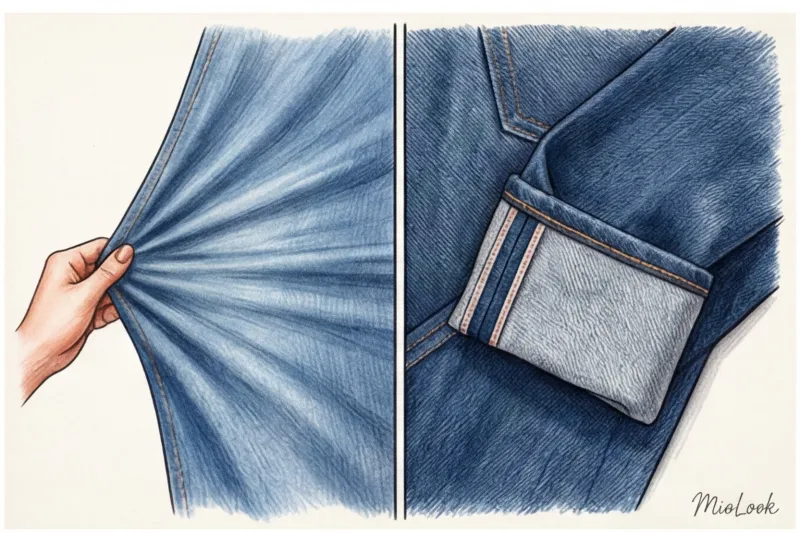
How to break in: If you've bought 100% cotton jeans, remember they need time. Try them on at home, lightly spray the areas where they're most tight (waistband, back of the knees) with water, and walk around in them for an hour. The cotton fibers will stretch and mold to your anatomy forever.
Fitting Room Checklist: 5 Steps to a Perfect Fit
I never let clients go to the checkout until we've given the chosen pair a thorough test drive in the fitting room. Save this checklist:
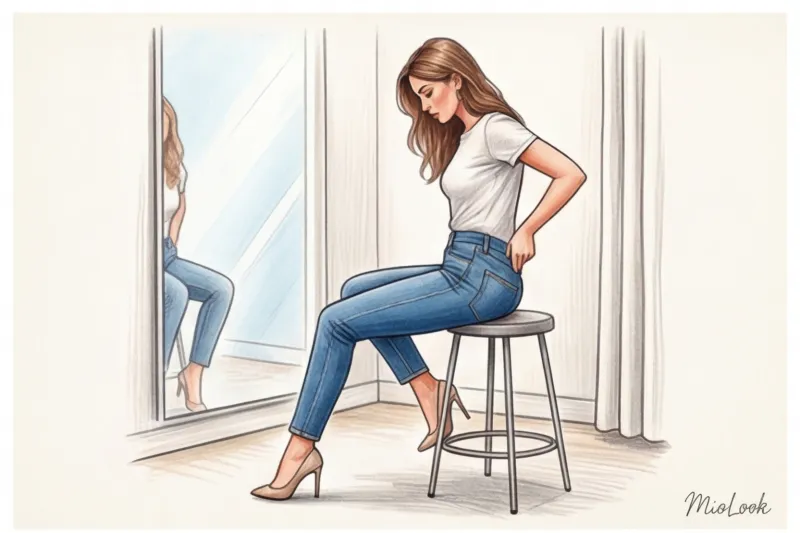
- The Sit Test: Be sure to sit on the ottoman in the fitting room. We only spend 20% of our time standing. If the belt is painfully digging into your stomach or your underwear is showing in the back, take it off.
- Step Width Test: Lunge forward. A good fit should allow for movement in the hip joint.
- Checking the grainline direction: Check the side seams. If the seam starts to "slip" forward toward the knee (this is called leg twist), it's a faulty cut; the fabric wasn't cut along the grain. After the first wash, the leg will become completely twisted. Leave this pair in the store.
- The two-finger rule: There should be enough room for two fingers to fit between the belt and your body. No more, no less.
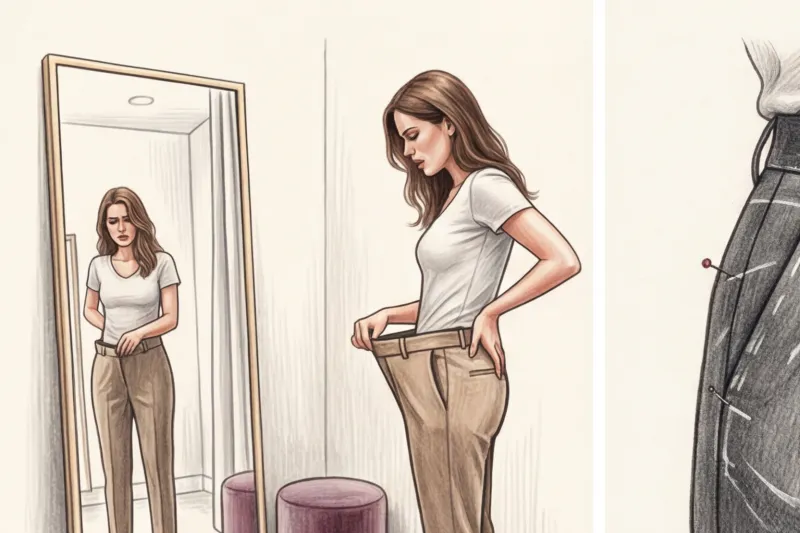
- Ready for the studio: If jeans fit perfectly on the hips but are too big in the waist, that's a success, not a failure. Getting the waistband adjusted at a tailor (by removing darts or altering the yoke) is inexpensive. Invest in the fit at the widest part of the body, and the tailor will fine-tune the rest.
Finding the perfect pair of trousers and jeans isn't a lottery or the preserve of those with "model-like" measurements. It's simply the mathematics of cut, an understanding of fabric density, and an honest look at your three-dimensional proportions. Stop trying to change your body for jeans. Demand that your clothes work for you.