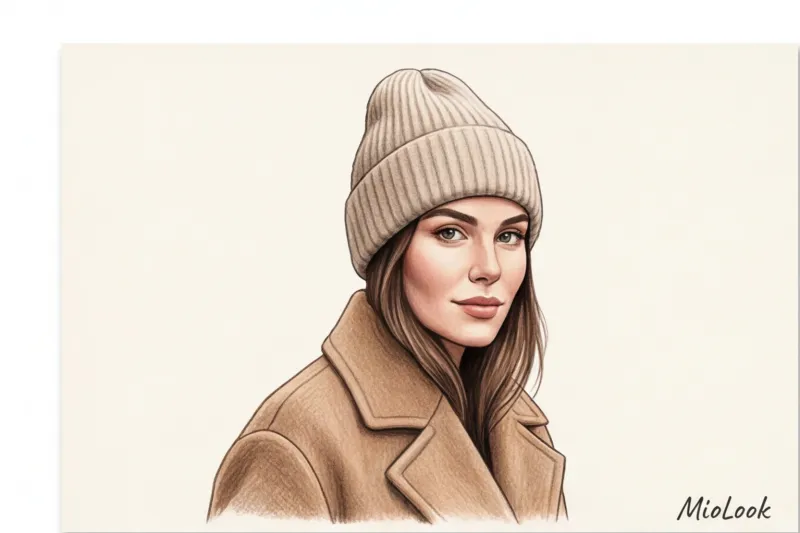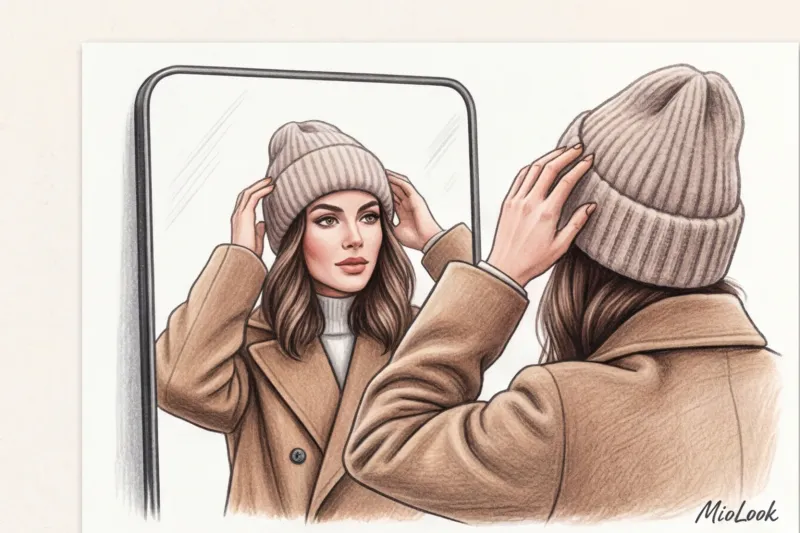
Have you ever had this happen: you buy a seemingly perfect hat, bring it home, try it on in front of the mirror... and suddenly you look like you haven't slept in a week? The dark circles under your eyes have become more pronounced, your nasolabial folds have become more pronounced, and your skin has acquired a sallow tone. It's a familiar fitting experience, causing many women to buy hats by the dozens, only to wear a hood all winter long, complaining of a "bald" appearance.
Hi, I'm Darina Marchenko, a colorist and image consultant at MioLook. After 12 years of working with faces and wardrobes, I've realized one fundamental thing: we choose hats completely wrong. We look for a hat to match our down jacket, our boots, our bag. Anything but our own face. We discussed face shapes in more detail in our guide. How to choose a hat without looking stupid , and today we'll talk about color.
In this article I will tell you, How to choose the color of a hat Using the laws of optics, rather than outdated "color type-season" tables, we'll explore the photographic reflector rule, learn to use hair as a buffer, and finally, dispel the myth that a black beanie suits everyone.
The Reflector Effect: Why Your Hat Color Matters More Than Your Coat Color
According to WGSN analytical agency data for 2024, 80% of European women's basic winter wardrobes (coats, sheepskin coats, and down jackets) are dark, practical colors: black, graphite, navy blue, and khaki. This makes sense—we live in a climate where light-colored outerwear requires dry cleaning every week.
But there's a catch. If your body is wrapped in a dark cocoon, the entire responsibility for your face's freshness falls on the 20 square centimeters of knitwear on your head.
Portrait photographers have a golden rule: never position your model so that light reflects off a dirty or greenish wall and onto their face. A hat is your personal, built-in photographic reflector.
Winter daylight falls from above. It hits the fabric of your hat, casting a color reflection directly onto your forehead, cheekbones, and under-eye area. The wrong shade literally brings out the slightest imperfections, redness, and pigmentation. That's why the main secret of a stylist is this: your hat should complement your skin and irises first, and your outerwear second.
The Biggest Winter Myth: Why a Black Hat (Most Likely) Doesn't Suit You
"I'll buy the black one, it goes with everything" is the most common phrase I hear during shopping tours. It's the biggest stylistic misconception.
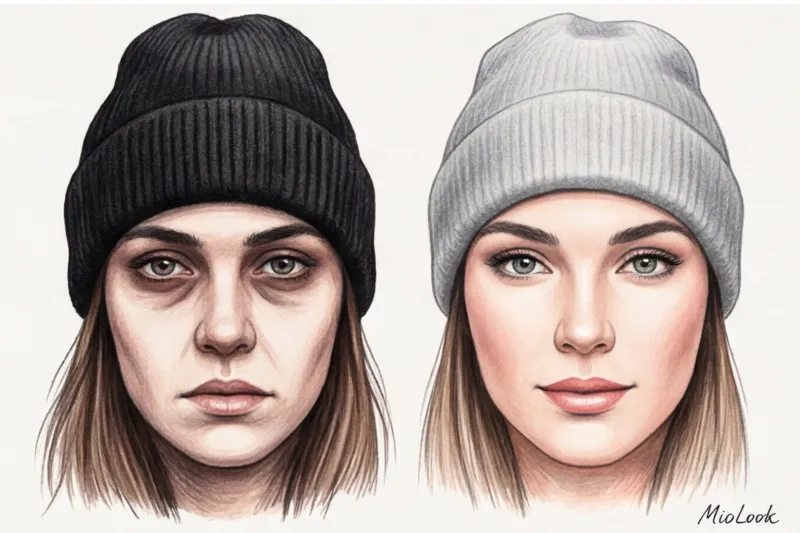
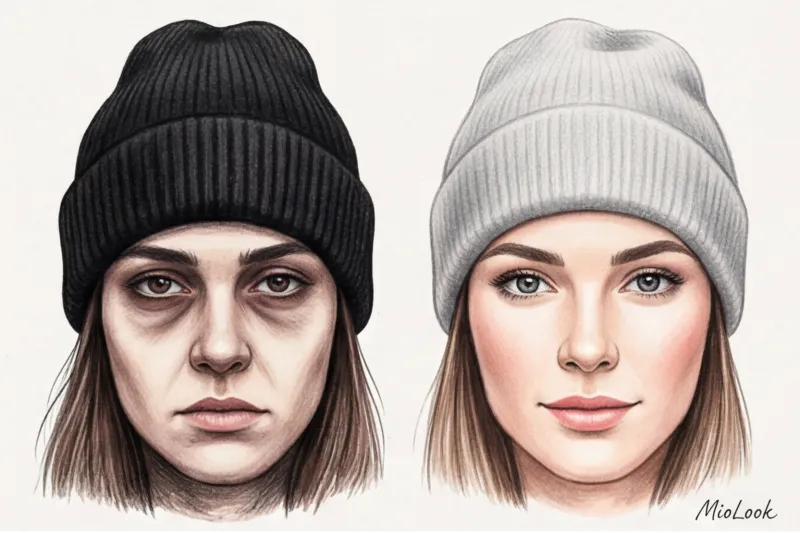
Black near the face is a visual vacuum cleaner. It absorbs light. In winter, daylight is already cold and diffused. Add black felt or matte yarn to this, and you get harsh, graphic shadows on the face. According to my personal statistics, black visually ages 85% of women with a Slavic appearance, emphasizing even the slightest fatigue.
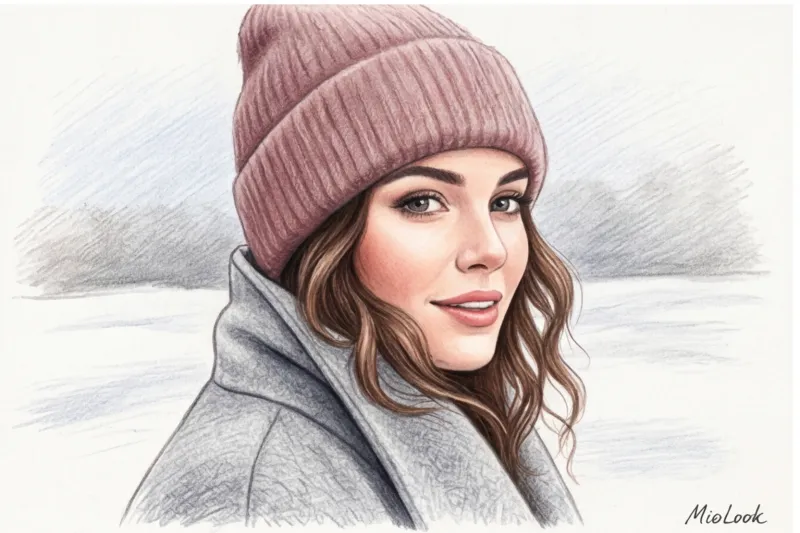
Just last month, my client Anna (34, light brown hair, fair skin) stubbornly refused to take off her "safe" black beanie in the fitting room. I silently handed her a dusty pink merino hat. When she put it on, the effect was akin to an expensive salon facelift: her face looked fresher, and the dark circles under her eyes became virtually invisible. She visually lost five years in 15 seconds.
When black color on the face DOESN'T work:
If you have soft features, light brown or brown hair, a tendency to dark circles under your eyes, or an uneven skin tone.
When Black Works (Fair Limitation):
This rule doesn't apply to contrasting winter color types—girls with porcelain-white skin, jet-black hair, and bright whites of their eyes. For them, black truly serves as a luxurious frame.
What's a good alternative to "safe" black if you're afraid of bright colors? Choose deep yet sophisticated dark shades: graphite (wet asphalt), dark chocolate, blackberry, or rich navy. They provide the right contrast without dulling your skin's radiance.
Your perfect look starts here
Join thousands of users who look flawless every day. Upload your items to MioLook, and the neural network will create perfect combinations based on your natural undertones.
Get access — €0.99 onceHow to Match a Hat to Your Face: Color Theory for Real Life
Let's leave the complex draping and scarves to the professionals. To choose the perfect palette in the store, you need to understand how color physics works. Back in 1961, Swiss art theorist Johannes Itten described the law simultaneous contrast.
The gist is simple: any color against another visually tends to produce its opposite (complementary) hue. What does this mean in practice?
- Green or olive cap It will draw the red pigment out of your skin. If you have rosacea or your nose quickly turns red in the cold, you'll look like you have a cold.
- Bright blue hat will highlight the yellowness of the skin and teeth.
- Mustard or frankly yellow cap will make purple shadows under the eyes visible.
If your skin has a warm, peachy undertone, avoid icy blues and crisp whites—they'll make your face look sickly gray. Opt for ivory or warm beige. Conversely, red and brick-red shades are a definite no-no for girls with cool, pinkish undertones.
Hair as a buffer: a secret trick of stylists
The most common reason women hate wearing hats is the "bald spot" or "egghead" effect. We pull a tight beanie down to our eyebrows, tuck all our hair inside, and end up with a disproportionately small head compared to a voluminous winter down jacket.
But hair is more than just a part of your hairstyle; it's your main color buffer.
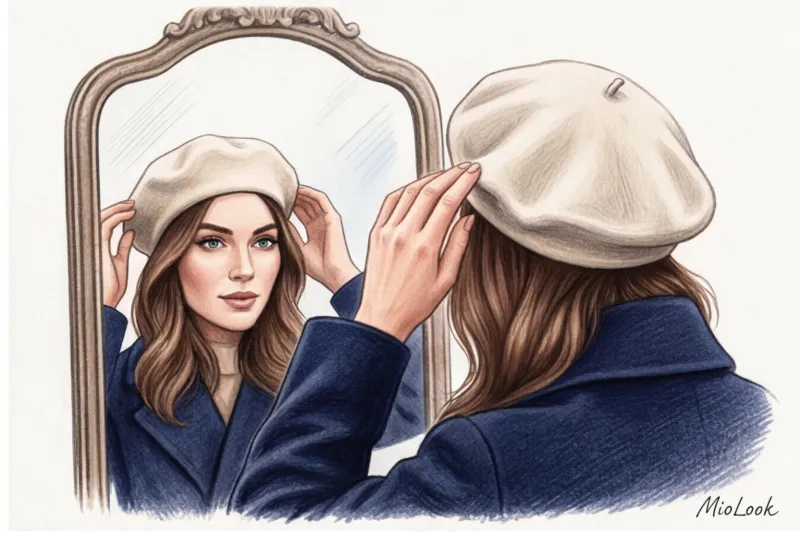
Layers of hair left loose at the cheekbones create a soft border between skin and fabric. If you've fallen in love with a trendy hat color (for example, Pantone 2024 named Peach Fuzz as the top shade, which isn't flattering on everyone), but it doesn't quite suit your skin tone, simply let your bangs or side strands out. The hair color will take the initial hit of contrast, smoothing the transition to your face.
How to match a hat color to your outerwear: 3 working patterns
Remember how we said that 80% of winter outerwear is dark? Your goal is to create balance. When pairing, it's important to consider not only the color but also the texture of the material. A light shade always looks more voluminous on a fluffy angora than on a smooth cotton knit.
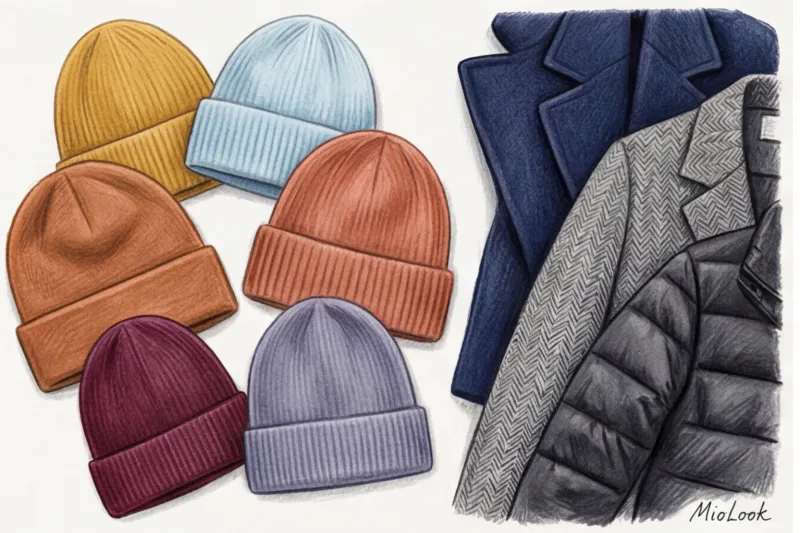
Monochrome and related shades (Tone on tone)
This is the most elegant scheme, and it looks the most expensive. The idea is to match the color of your outerwear, but lighten the headwear by 1-2 shades.
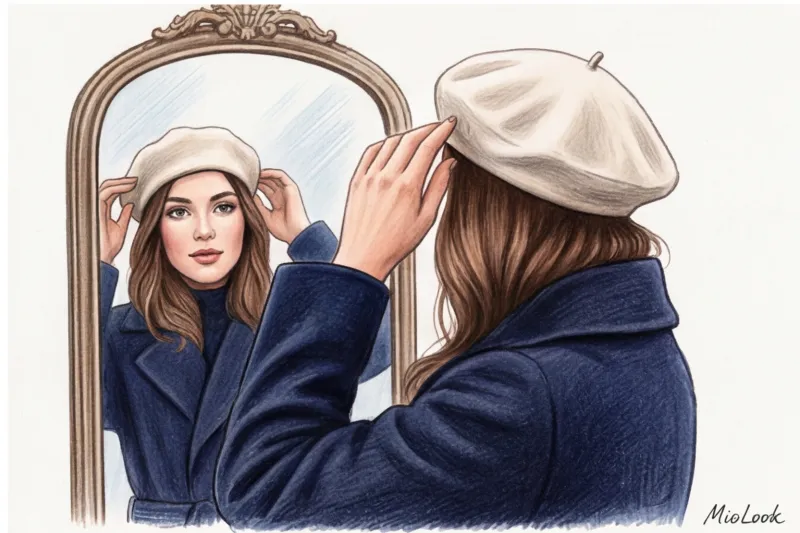
For example, we'd pair a dusty blue or gray-blue hat with a dark blue thick wool coat. A camel or cappuccino hat would go with a brown sheepskin coat. The difference in tonalities creates an optical lifting effect: the dark bottom elongates the silhouette, while the light top highlights the face.
The "Bright Accent" Scheme: How to Add Color Safely
If you're wearing a basic gray or black down jacket, a hat can be the only pop of color in your outfit. The biggest mistake here is trying to rigidly "tie" a colorful hat to other items, following the outdated "bag-shoes-hat-in-one-color" rule.
Today, this seems far-fetched. If you've chosen a terracotta hat to go with a gray coat, there's no need to look for terracotta boots. A subtle affinity between the shade, say, and a small print on the scarf or the color of the gloves, is sufficient. The pairing should be stylistic, not overt.
Access to MioLook for €0.99 — one-time payment
Not sure what to wear with your new bright hat? Our smart AI stylist will analyze your wardrobe and suggest dozens of fresh combinations in just a few clicks.
Get access — €0.99 onceWhy hat and scarf sets reveal a lack of taste
It's time to voice an unpopular but necessary opinion: ready-made sets (hat, scarf, and sometimes even mittens) knitted from the same yarn and pattern are a stylistic dead end. No modern stylist would recommend buying such sets.
Why? The same texture and color over a large area (head, neck, chest) creates a flat, provincial look, and visually cheapens even premium cashmere. It looks like you bought everything at a discounted price from the same department store, without any creative thinking.
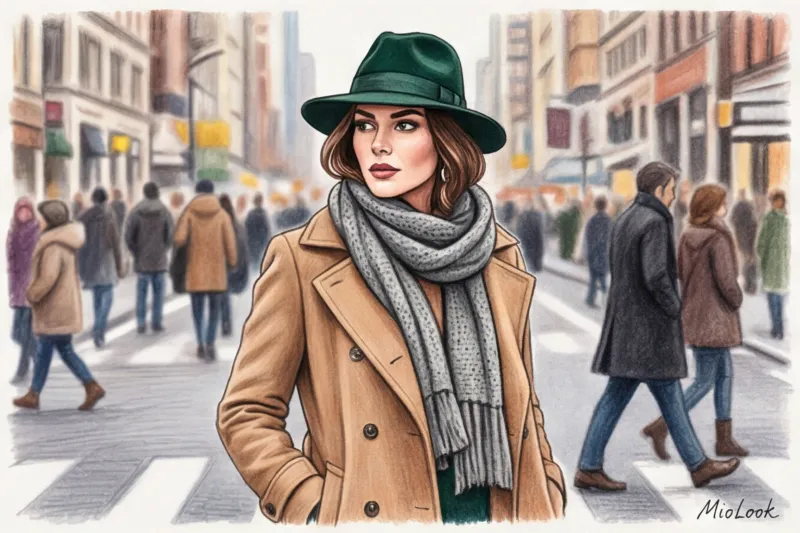
How to do it right:
Mix textures and play with tones. If the hat is a smooth, basic beanie (for example, a merino one from a brand like COS or Arket for €40–60), then the scarf should be voluminous, fluffy, chunky knit, or with a geometric print. The ideal formula: the color of the solid hat should match one of the non-core , background shades in the pattern of your scarf.
A stylist's checklist: how to choose the perfect hat in the store
So, you're at the mall. There are dozens of options around—from mass-market items for €15 to premium brands for €150. To avoid making a mistake and buying something that will end up at the bottom of your closet, use my professional fitting algorithm:
- Look for daylight. Fitting room lighting (especially yellow halogen lamps) distorts shades beyond recognition. Wearing a hat? Step out of the fitting room and into the hallway and approach a window with a mirror. Only then will you see how the color plays with your skin tone outside.
- Take off your outer clothing. Consider the impact of a hat's color solely on your face, not how it looks with your jacket. You change jackets, but your face stays with you.
- Use a neutral scarf divider. If you're wearing a bright sweater, it will create reflections. Drape a light gray or beige stole over your shoulders to isolate the portrait area.
- Let your hair down! Never tuck your hair behind your ears if you wear your hair loose in real life. Imitate your standard winter hairstyle right at the store.
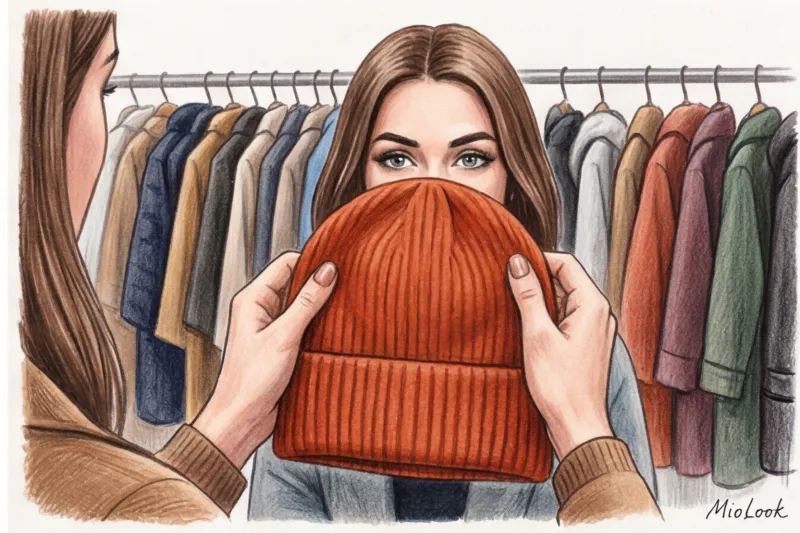
Summary: Your winter portrait in new color
Choose your hat as carefully as you choose your foundation. It's more than just a piece of wool to protect your ears from the wind—it's a tool for controlling how others perceive your face in winter.
Let's make a deal: today, take stock of your hallway shelf. If that thick-knit black beanie that makes you feel tired is still there, put it aside. Try pearl gray, dusty pink, or buttery pink. You'll be surprised how much one perfect color can replace a full eight hours of sleep.
And to avoid racking your brain over how to fit a new purchase into your existing wardrobe, entrust the routine to technology. Upload your winter items to MioLook app , and our AI algorithm will instantly curate dozens of warm, stylish, and harmonious looks for every day. Have a beautiful winter!