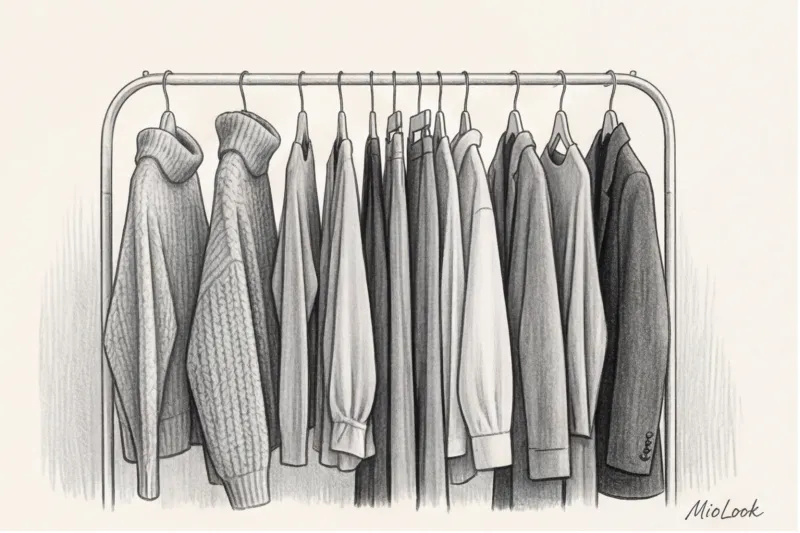
I wore only gray for a whole month. It was a professional style experiment, designed to test the impact color has on perceived status. The results were astounding: people listened more attentively to me at business meetings, and strangers in coffee shops addressed me more formally. But the secret wasn't just the color choice. Most women believe gray suits everyone, because it's a "universal base." In fact, one gray sweater can look like a million dollars, while another looks like a washed-out doormat.
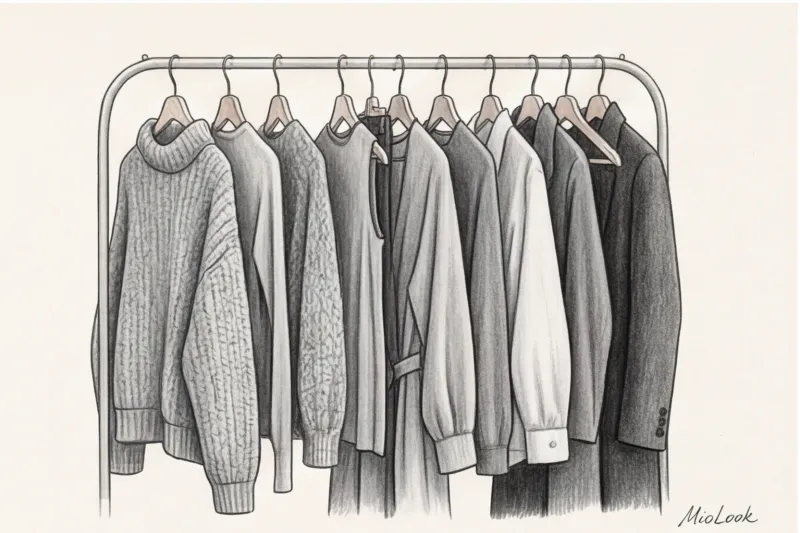
We talked about the basics of working with one color in more detail in our the complete guide to creating a capsule Today, I'd like to debunk the myths and explore the mathematical approach to achromats. We'll discuss the formula "Light Reflectance Index (LRV) + Texture Contrast," which explains how it's truly constructed. gray monochrome wardrobe in the aesthetics of "quiet luxury".
Gray Monochrome Wardrobe: Between the "Gray Mouse" and the "Gray Cardinal"
According to the McKinsey State of Fashion 2024 report, we're witnessing a tectonic shift in consumer preferences. The era of flashy logomania has given way to intelligent minimalism. And gray has become the primary ambassador for old-money aesthetics.
The psychology behind this phenomenon is simple. Gray in clothing conveys intelligence, confident composure, and high social status without the need to prove it. It's the color of people who no longer need to draw attention to themselves with bright accents. But herein lies the main pitfall of achromats: gray is absolutely impossible to hide a poor cut or cheap fabric. Any uneven stitching on a pearl gray jacket will scream low-budget.
Unlike black, which visually "absorbs" design flaws, gray acts like a spotlight. It highlights the quality of the material, the perfect fit, and the richness of the texture. This is why mass-market brands often fail when attempting to copy luxury brands in this shade.
The biggest mistake newbies make: why you look like a courier, not a CEO
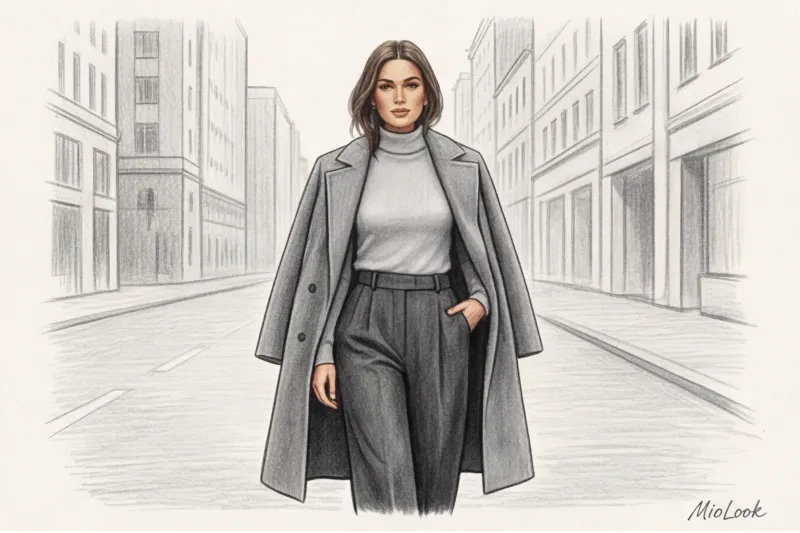
When I first started digitizing my clients' wardrobes, a senior manager at an IT company came to me. She decided to put together a high-status capsule wardrobe and made a classic perfectionist mistake. She spent two weeks finding pants, a turtleneck, and a coat that all matched tone-on-tone. When she put it all on, the effect was disastrous. Instead of the prestigious CEO, the mirror reflected a large, flat gray blob.
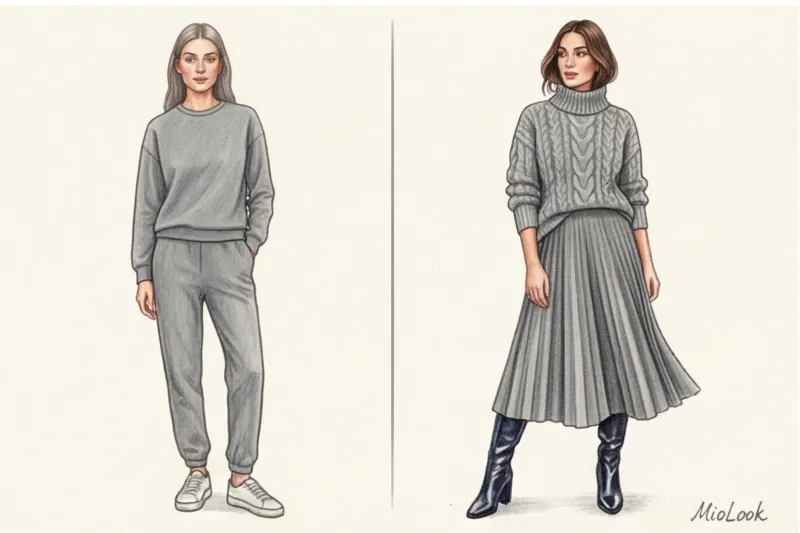
Trying to perfectly match shades of gray when trying to assemble a suit from different stores is stylistic suicide. Perfectionism in choosing the same shade of gray kills the dynamic of the look and creates the effect of a work uniform.
The physics of vision dictates that the absence of a color gradient visually flattens the figure and adds volume where none exists. A study by the WGSN Institute found that outfits with a difference of three or more shades of gray are perceived by others as 40% more valuable than "perfectly matched" outfits. True luxury is always built on a range of shades: from light silver to deep wet asphalt.
Access to MioLook for €0.99 — one-time payment
A smart AI stylist will select the perfect look for every day and help you create a color scheme.
Get access — €0.99 onceColor Architecture: 3 Rules for Expensive Gray Monochrome
Digitizing my executive client's wardrobe in an app MioLook She showed: we transformed her from "invisible" into a status symbol simply by changing the color temperature of her face. Here are three fundamental rules that work without fail.
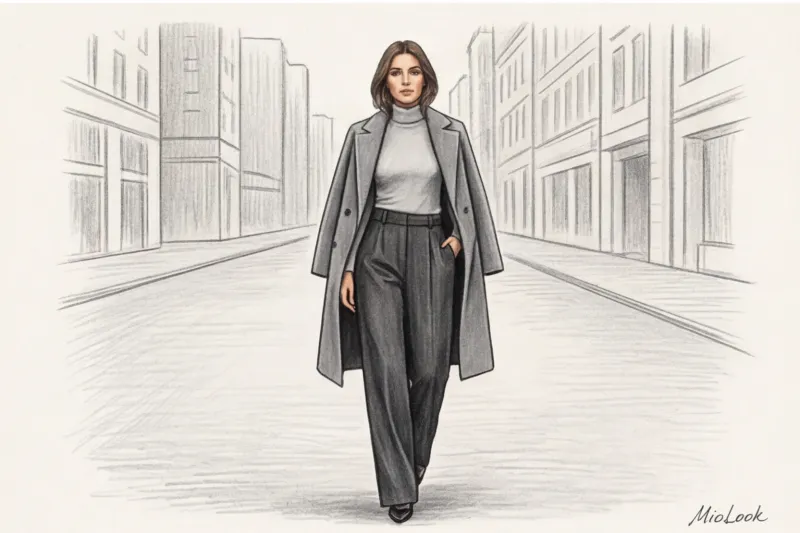
- Temperature balance: Gray can be warm (with a hint of beige, known as "greige") or cool (with a distinct blue or purple undertone). Mixing them in a single look is possible, but the cool shade should always serve as the base, and the warm one as the accent.
- The 60/30/10 Rule: Within the framework of monochrome, it is transformed. 60% of the image is occupied by the dominant medium tone, 30% is given to the supporting light shade, and 10% is given to the dark graphite accent (shoes, belt, bag).
- Lifting strategy: Always place light, pearly gray shades near the face—they act as a reflector, erasing signs of fatigue. Darker tones are moved downwards or to areas where you want to visually conceal volume.
Texture Matrix: The Secret Used by High-End Luxury Brands
Analysis from the Pantone Color Institute highlights the profound influence of lighting on the perception of achromatic colors. This is where LRV (Light Reflectance Value) comes into play. Smooth silk, fluffy cashmere, and coarse wool, dyed in the same dye barrel, will appear as three completely different colors.
Italian luxury titans like Brunello Cucinelli and Loro Piana build their collections on this very principle. The formula for a luxurious monochrome is as follows: Smooth + Fluffy + Dense.
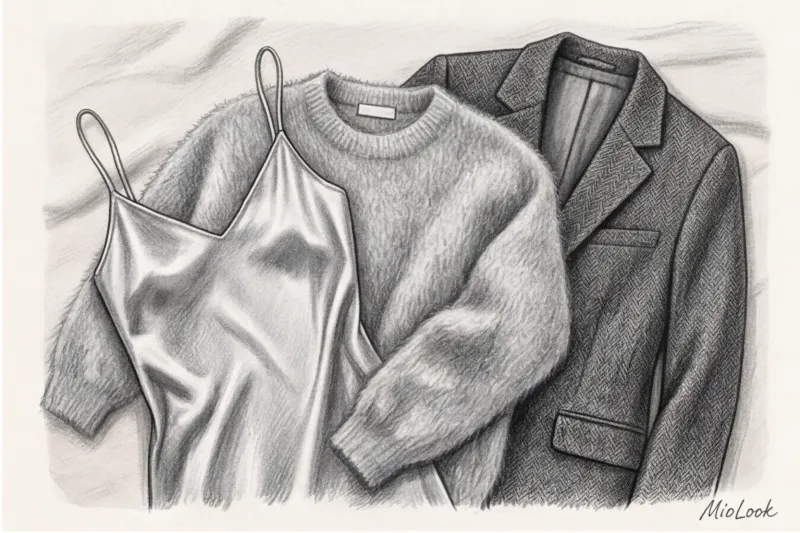
A matte gray without a distinct texture always looks cheap. If you wear a gray cotton T-shirt with simple polyviscose suit pants, you'll look boring. But swap the T-shirt for a silk top, add a mohair cardigan and a drape coat, and the look instantly moves into the "heavy luxury" category.
Gray Monochrome Wardrobe: Putting Together a Status Capsule
Let's talk numbers and compositions. The statistics are merciless: about 70% of gray knitwear in the mass market contains acrylic. Why is this critical for gray? After 3-4 washes, acrylic inevitably becomes covered in pills (pilling) and loses its original shape. A gray sweater covered in pills will forever ruin the well-groomed look. A quality item should be made of at least 80% natural fibers.
Based on my experience analyzing over 100 wardrobes, a quality gray jacket pays for itself (cost per wear) four times faster than a classic black one. Where can you save money? Basic heavy cotton T-shirts (up to €30-€50). Where should you invest? Cashmere knitwear (from €150) and a perfectly tailored wool coat (from €300).
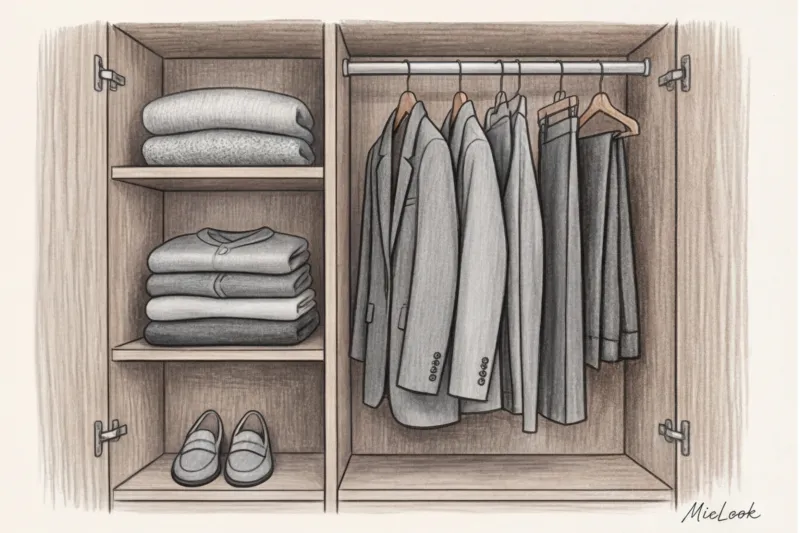
Your perfect look starts here
Join thousands of users who look flawless every day with the MioLook app.
Get access — €0.99 onceTop 5 Things for a Perfect Start
If you're looking to integrate a gray capsule into your wardrobe (for example, for an office with a smart-casual dress code), start with these five architectural elements:
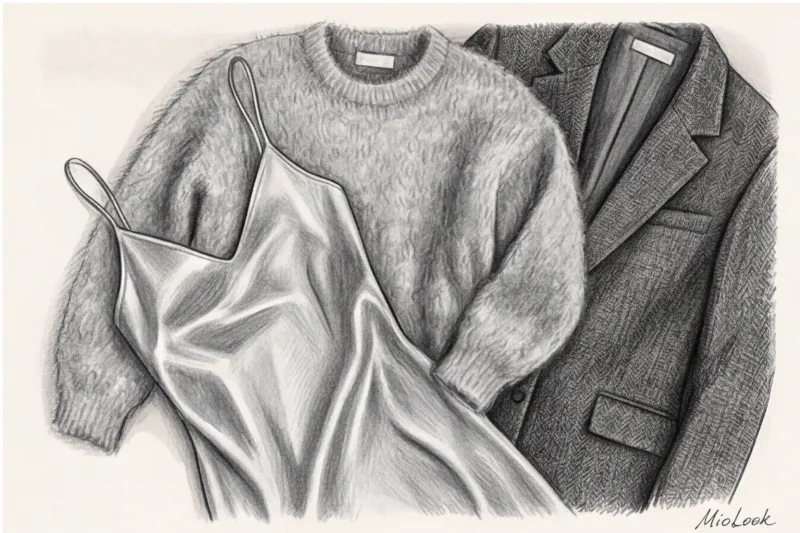
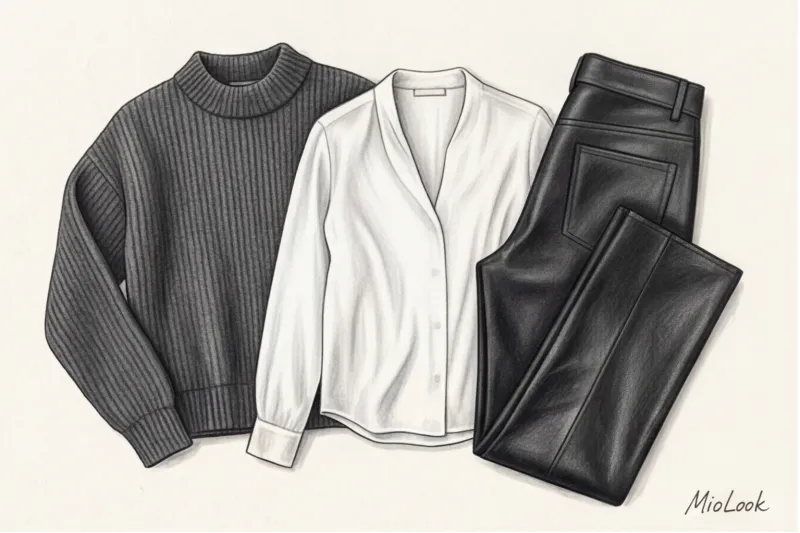
- Wide-leg trousers with creases in graphite color: These will serve as the foundation. Choose thick wool with 2-5% elastane for a perfect fit.
- Oversized sweater in a grey melange shade: The heterogeneity of color (melange) itself creates the texture we talked about above.
- Pearl grey silk blouse or top: Smooth texture that will reflect light onto your face.
- Structured men's jacket: Preferably in a medium gray shade, with a clear shoulder line.
- Classic double-breasted coat in a wet asphalt shade: A dark finishing line that brings the look together.
Danger zones: makeup, accessories, and metals
I have an important confession to make. This is an honest limitation that stylists often overlook: gray monochrome does NOT work if you have a sallow, tired complexion and eschew makeup on principle. Gray, especially light and cool shades, has a tricky tendency to highlight blue-green undertones (under-eye circles, veins).
As the professional makeup artists I work with point out, when choosing a gray all-over look, concealer and a light bronzer are essential. To avoid looking overly pale, add a warm peach blush and highlight your brows—your face needs contrast.
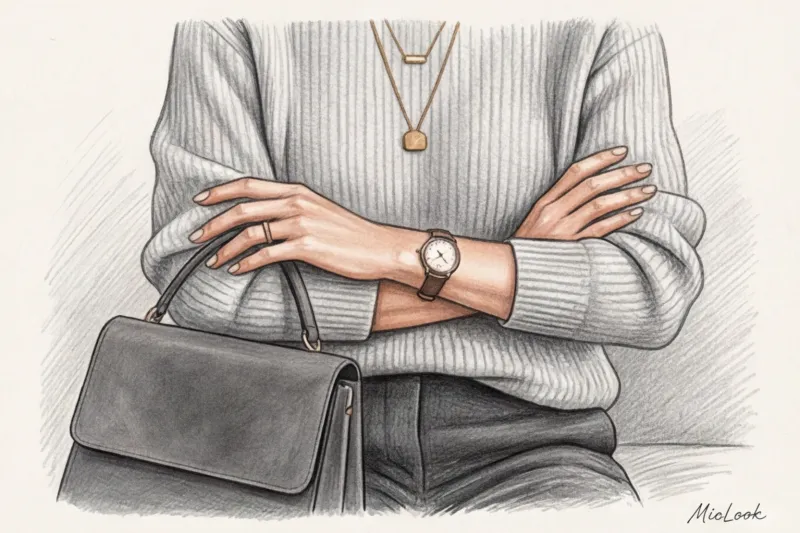
The second danger zone is metals. Intuitively, you want to add silver to a cool gray. But too much silver jewelry makes the look too distant, steely, and austere. Try a counterintuitive move: add chunky matte gold jewelry. Gold instantly warms up the look and elevates its status.
When it comes to accessories, avoid smooth black leather. It looks too flat. Opt for dark chocolate suede or embossed dark gray leather bags for that final textured touch.
MioLook Checklist: Test Your Look Before You Go Out
Theory only works when it's put into daily practice. To avoid wasting precious morning minutes doubting yourself, give your gray monochrome look a quick audit:
- Texture check: Go to the mirror and count. Does your outfit incorporate at least three different textures? If you're wearing only smooth cotton and a plain suit, add a suede belt or throw a textured jumper over your shoulders.
- Gradient test: Squint. Do the items appear as separate elements or blend into a single gray blob? If they do, immediately replace one of the items with a lighter or darker color.
- Focal point: Where does your eye fall when first looking at an outfit? In a well-chosen monochrome, your eye should be drawn to a detail: a distinctive blouse collar peeking out from under a jacket, unusual bag hardware, or geometric jewelry.
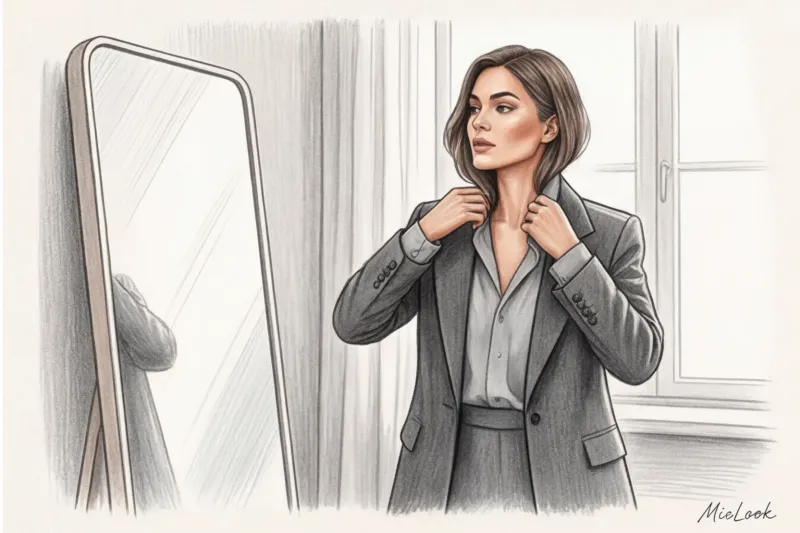
If the look passes muster, be sure to take a photo of it and upload it to the smart wardrobe section of your app. This will start building a personal database of successful outfits that's always at your fingertips.
Gray isn't the absence of color. With the right mathematical approach to textures and contrasts, it's its quintessence.
Remember the most important thing: a luxurious look is never accidental. It's always calculated, architecturally precise, and built on nuances invisible to the naked eye. Stop looking for tone-on-tone pieces, let color play and shimmer in textures, and your wardrobe will begin to work for you, conveying success without a word.