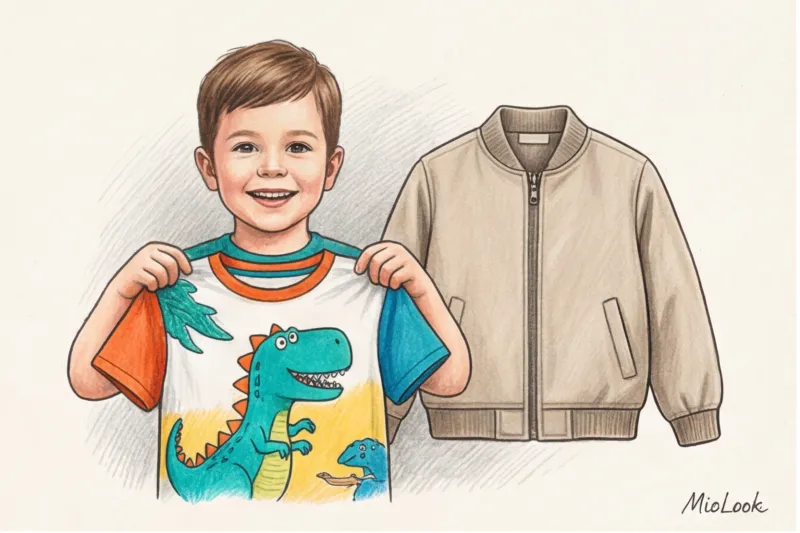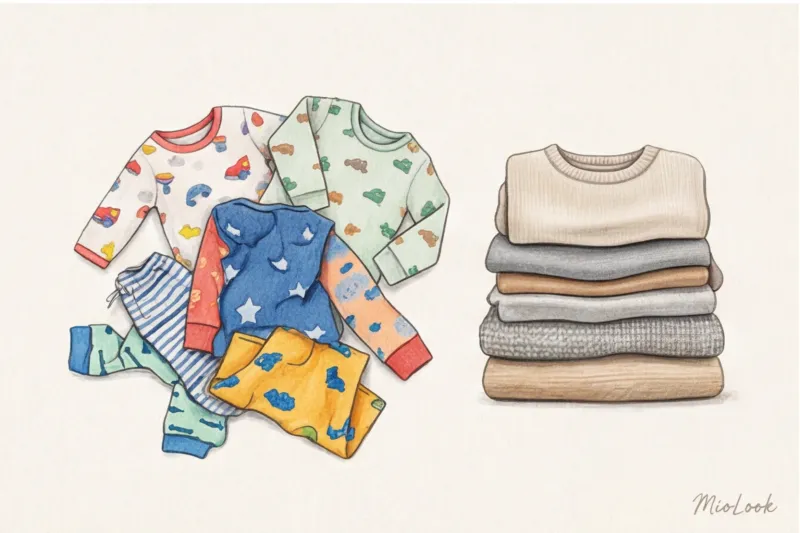
7:15 AM. You pull a stylish beige chunky knit cardigan out of the closet, but your five-year-old clings to a neon dinosaur T-shirt with a death grip, declaring, "It's this or I'm not going anywhere!" Sound familiar? Trying to get their child ready for preschool or school, parents often fall into two camps: some buy only non-marking, gray clothes, while others give up and let their child look like a walking rainbow.
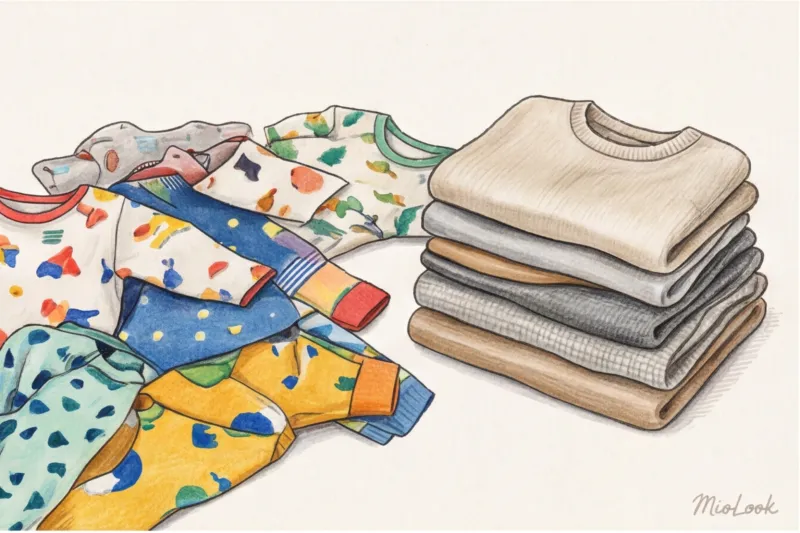
But color combinations in children's clothing It shouldn't be a daily battlefield. As a personal stylist, I see that morning "decision fatigue" can be cured with one simple thing: the right closet system. We've covered more about how to build such a system from scratch in our The complete guide to a child's capsule wardrobe And today I'll share specific color formulas that will allow you to incorporate even the wildest prints into a manageable, stylish capsule wardrobe.
Why Color Combinations in Kids' Clothes Are a Pain in the ass (and How to Fix It)
According to statistics, 80% of children's mass-market clothing (from H&M to Zara Kids) features complex, multi-colored prints. Manufacturers do this intentionally: a brightly colored item attracts a child's attention in the store. But at home, these spontaneously purchased items categorically refuse to form beautiful outfits.
The conflict of interests is clear: Mom wants style, the child wants brightness. And herein lies an important psychological point: when we deprive a child of color choice, we hinder their development of independence. A color-coordinated closet—where everything is predetermined to match—allows the child to feel completely free. They choose "those green pants," and you rest easy because the only T-shirts hanging in the closet that complement them are those that go perfectly.
The "Beige" Aesthetic Myth: Why Neutral Capsules Don't Work as Well as Brighter Ones
In recent years, Instagram has embraced the "sad beige baby" trend. These aesthetically pleasing profiles are dictating the trend for children's wardrobes in shades of oatmeal, ecru, and dusty rose. Spoiler alert: in real life, with an active child, this is an absolute utopia.
Firstly, beige is the worst enemy of pumpkin puree, grass, and marker stains. Washing out such a stain on a light-colored sweatshirt is much more difficult than disguising it on fabric with a vibrant pattern. Secondly, research in child psychology (in particular, the work of the Institute of Color Psychology) shows that children aged 3-7 physiologically require bright colors. Color stimulates the development of the visual apparatus and creativity. Depriving a child of color for the sake of a perfect social media feed is a questionable strategy. A pragmatic parent chooses a bright, but thoughtful capsule.
Access to MioLook for €0.99 — one-time payment
A smart AI stylist will select the perfect look for you and your children based on your preferences.
Get access — €0.99 onceStylist's Formula: The 3-Color Rule and the Perfect Color Combination in Children's Clothing
To make your wardrobe work for you, forget about buying random things. I use the concept of color anchor This is an adaptation of the classic "60-30-10" design rule for children's looks.
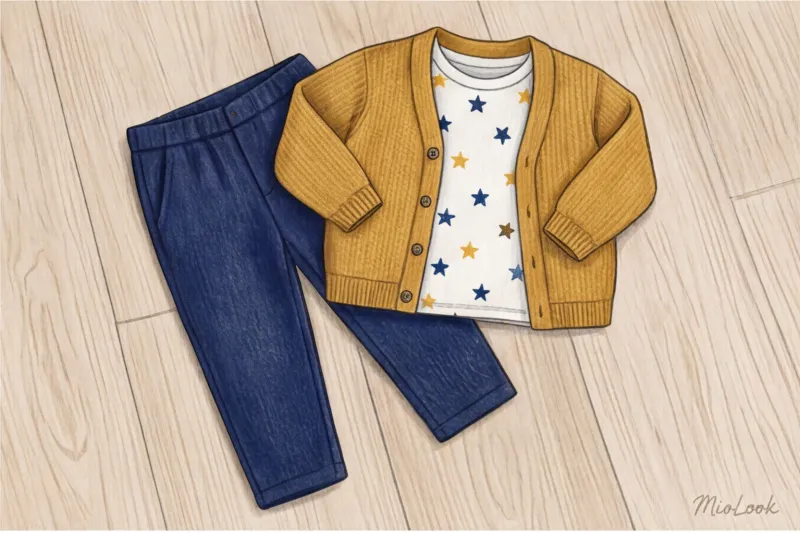
- 60% (Base): The main color of the outfit. Most often, this is the color of the bottom (pants, jeans, skirt) or top layer (jacket). It should be the most subdued.
- 30% (Addition): A supporting color that creates contrast.
- 10% (Accent): A bright detail - a hat, sneakers, a scarf or a print on a T-shirt.
In my experience, this formula has saved more than one morning. Example from life: Basic indigo jeans (60%), a mustard cardigan (30%), and red Converse sneakers (10%). Your child gets the desired pop of color on their legs, and you get a stylish, put-together look.
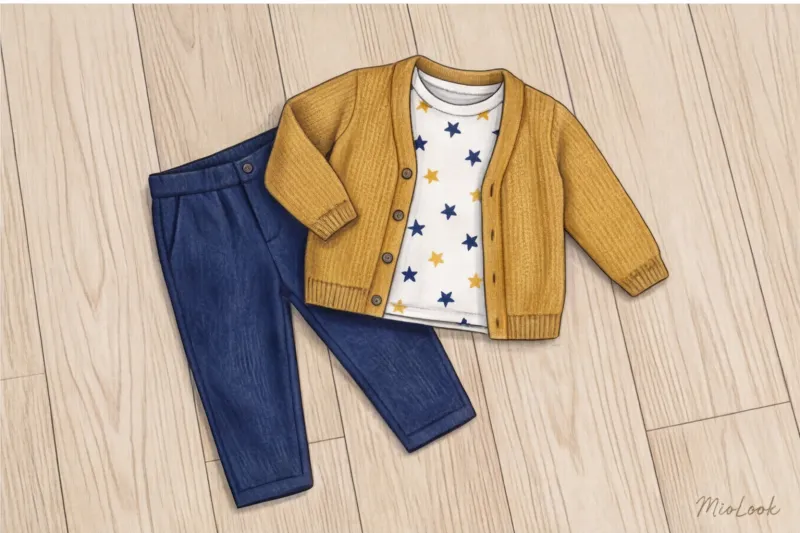
"The 'Bottom + Top + Third Layer' formula shouldn't cut a child's figure in half. If you're wearing contrasting tops and bottoms, be sure to add a third layer (an unbuttoned shirt or vest) that matches the color of the pants. This visually elongates the silhouette."
How to Tame Prints: From Classic Stripes to Favorite Cartoon Characters
Many mothers are afraid of working with prints. In fact, basic prints—striped striped shirts, polka dots, and classic tartan—work as solid wardrobe staples. A €15 striped long sleeve top from Uniqlo will go with any crazy pants.
If you want to combine two different prints in one outfit, use rule of scale A large print always pairs well with a small one. For example, a large checkered shirt looks great with a small stripe on the T-shirt underneath.
My favorite styling trick that I teach all the moms is color extraction principle Let's say you were given a colorful sweatshirt with five different colors: blue, yellow, green, white, and red. How should you wear it? Choose one Choose a pair of these colors (preferably the most subdued, like blue) and pair them with bottoms in the exact same shade. We're literally "pulling" the color out of the print, creating a harmonious look.
The Spider-Man Problem: Incorporating Bold Prints into a Stylish Capsule
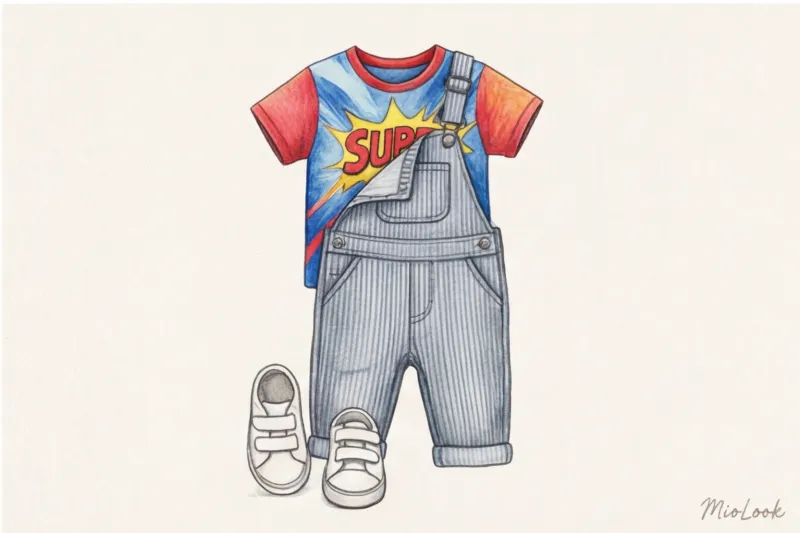
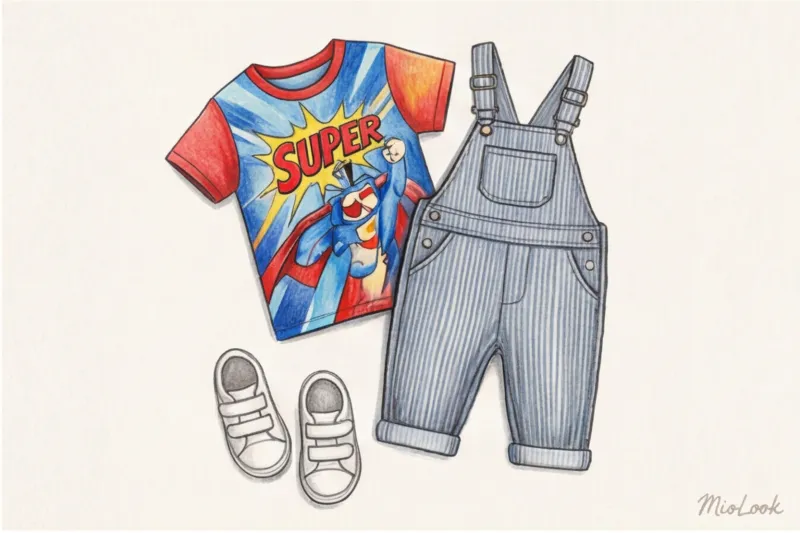
I was once approached by the mother of a five-year-old Paw Patrol fan. The boy refused to wear anything but T-shirts featuring acid-blooded rescue dogs. His mother was desperate, trying to secretly throw the items away. I'm categorically against such methods—clothing featuring their favorite characters is a child's right to self-expression. But we can style it!
Formula for taming merch: A vibrant character print with a minimalist, minimalist monochrome bottom. No distressed jeans, no unnecessary cargo pockets, no rhinestones. Just smooth texture. Layering is another lifesaver. Wear this eye-catching tee under stylish denim overalls or a crisp corduroy shirt (leaving it unbuttoned). The character is visible, the child is happy, and the bright spot is reduced by 60%.
Your perfect look starts here
Tired of racking your brain over outfit combinations every morning? Digitize your wardrobe and create capsule wardrobes in one click.
Get access — €0.99 onceThe Color Wheel in Practice: Worksheets for Boys and Girls
Adapting Johannes Itten's color theory specifically for children's clothing solves 90% of color matching problems. Forget gender stereotypes like "pink for girls, blue for boys." Today, colors have no gender. Here are three foolproof schemes:
- Monochrome for fidgets. Looks in different shades of the same color (for example, from soft blue to deep navy). This looks ultra-modern and can be put together with your eyes closed.
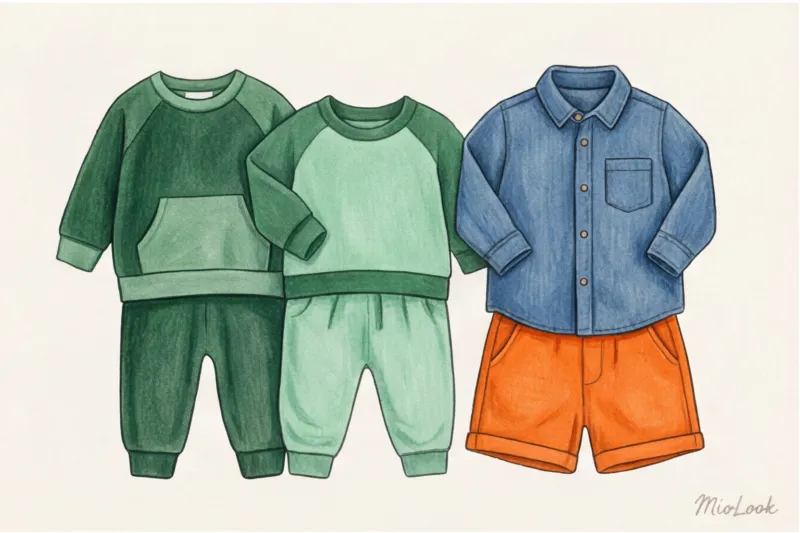
- Analog circuit. A combination of adjacent colors on the color wheel (for example, green + blue + light blue). Ideal for calm images for kindergarten when you don't want to overload the child's nervous system.
- Contrasting (complementary) combinations. Purple and yellow, blue and orange. Important limitation: This rule doesn't work if you use both colors in their maximum neon brightness—the child will look like an animator. The secret is in the dosage: one color should be muted (for example, dark blue jeans), and the other bright (an orange hat).
Age-related nuances: how the palette changes from toddler to school-age child
What looks stunning on a two-year-old will be repulsive to a nine-year-old. A palette should grow with the child.
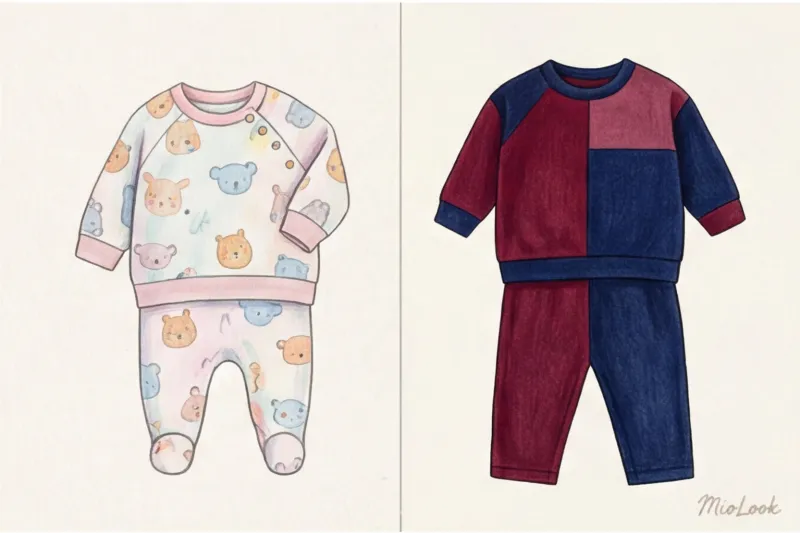
0–3 years: It's a time for soft contrasts and pastel colors. At this age, baby's skin doesn't yet have vibrant pigment, so deep, dark colors (black, graphite, heavy burgundy) can make the face look sallow. Choose large, bold prints (animals, geometric patterns).
4–7 years: The period of color rebellion. A time when children want to make their own decisions. This is where the "color anchor" rule we discussed above comes in handy. At this age, it's best to have 3-4 basic colors in the capsule and allow the child to mix them as they please.
8–12 years: The influence of adult trends. Generation Alpha kids want to dress like grown-up influencers. Bright prints are being replaced by sophisticated, adult shades: khaki, terracotta, graphite, ecru. At this age 12 color types of appearance begin to play a greater role, and clothes should be selected taking into account the contrast of the teenager's face.
Stress-Free Looks: A Smart Wardrobe and Shopping Checklist
For color theory to work in practice, you need the right foundation. The golden rule of a smart wardrobe: For every bright bottom there should be at least three suitable top options Trousers get dirty less often than T-shirts, which saves money (basic trousers cost on average €25–40, and T-shirts €10–15).
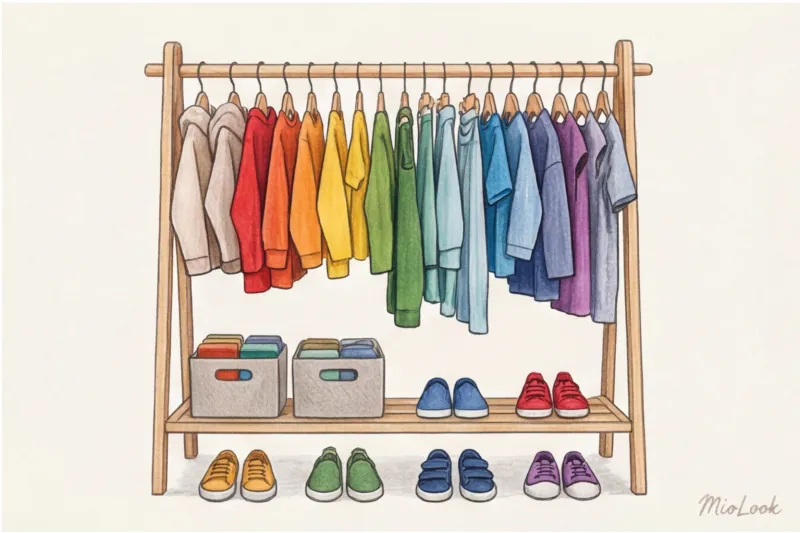
Sort your child's closet not by type (all the T-shirts together, all the pants together), but by complete sets or color blocks. If a separate shelf contains only warm autumn colors (mustard, khaki, terracotta, beige), your child will be physically unable to dress in a dull way, no matter what combination they choose.
Over 12 years of work, I've discovered the key secret: a wardrobe only works when you can see it in its entirety. Digitize your child's things in an app. MioLook Standing in front of yet another "incredibly cute" pink sequined jacket in a store, you can quickly try it on with the jeans and dresses you already have in your virtual closet. If it doesn't match the three bottoms, it stays in the store.
Ready to get started?
Try the MioLook plan for free—no commitments required. Organize your closet once and for all.
Get access — €0.99 onceColor combinations in children's clothing aren't an innate gift, but a skill. Stop fighting your child's desire to wear bright colors. Simply create the right, calming backdrop for this color with a quality base, and getting ready in the morning will turn from drama into a fun game.