In ten years of working as a fashion journalist and stylist, I've learned one hard and fast rule: your perfume speaks to others faster than you can open your mouth. I vividly remember one of my clients, the CFO of a large corporation. She dressed impeccably in structured Jil Sander jackets and minimalist The Row trousers. Visually, she was an iron lady. But at board meetings, her partners would constantly interrupt her and speak condescendingly.
The reason became apparent during our first face-to-face meeting. The trail that followed this brilliant woman smelled of cotton candy, praline, and strawberry syrup. Her visual brand conveyed "tough authority," while her olfactory signature whispered "naivety and vulnerability." This created a cognitive dissonance that our interlocutors' brains interpreted as uncertainty.
That's why standard advice like "choose what your nose likes" no longer works. To manage impressions, you need to understand how they work. groups of fragrances in perfumery and how they match the textures of your clothes. We've covered the fundamental rules in more detail in our A complete guide to creating a basic perfume wardrobe , and today we'll figure out how to stop buying random bottles and start choosing perfume as an extension of your style.
Michael Edwards' Wheel: How Fragrance Groups Work in Perfumery
Until the late 20th century, the perfume world resembled the Wild West—each brand categorized its creations as it pleased. Perfume expert Michael Edwards brought order to the landscape. In 1992, he introduced his famous classification system, the Fragrance Wheel, which remains the industry's gold standard.
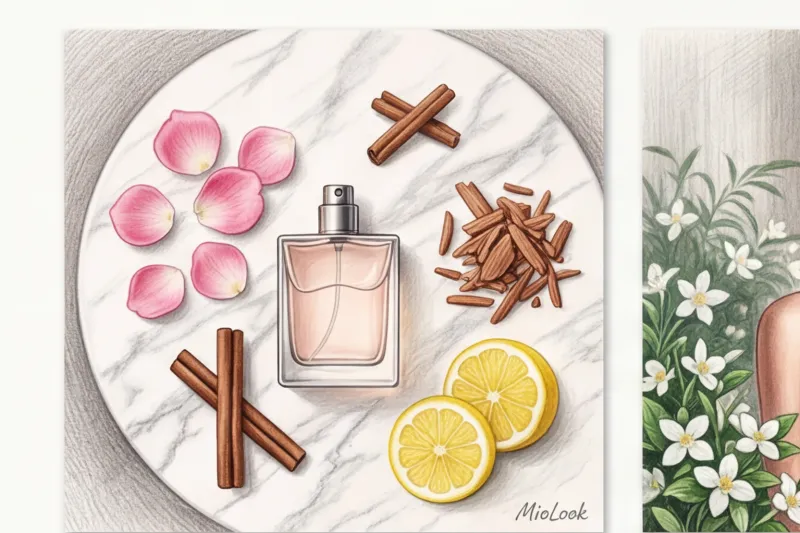
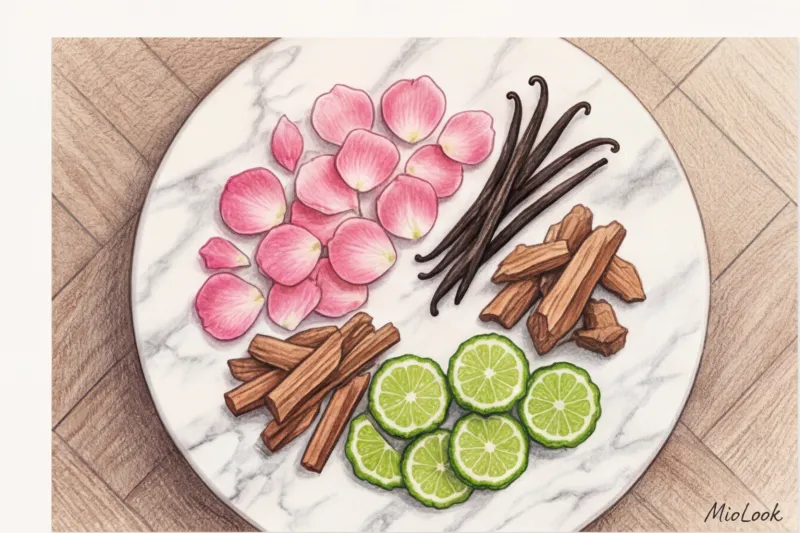
Edwards identified four macro-groups: fresh, floral, oriental, and woody. Within these, there are sub-groups (for example, floral-oriental or woody-mossy). Knowing your macro-group saves you hours in the boutique. Instead of asking the consultant to "show me something with vanilla" (which can smell like cheap plastic or like a dry, noble pod), you ask for "dry woody-oriental compositions."
Why dividing into individual notes no longer works
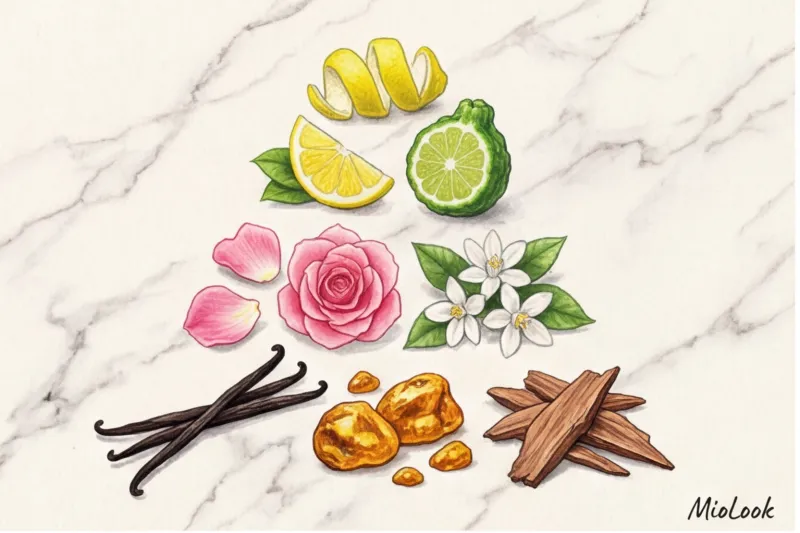
Forget the fragrance pyramids you see in press releases. They're pure marketing. Orchid, freesia, or sea salt essential oils don't exist in nature. What you read in the descriptions are fantasy accords created by chemists from synthetic molecules.
Moreover, our brain perceives a composition synergistically—as a whole. You wouldn't evaluate a Monet painting by counting the number of blue and yellow brushstrokes, would you? You'd look at a landscape. The sense of smell works the same way. That's why professional stylists focus on scent groups rather than searching for the mythical "perfect rose note."
Access to MioLook for €0.99 — one-time payment
A smart AI stylist will select the perfect look based on your preferences.
Get access — €0.99 onceFloral and fruity: from light chiffon to thick velvet
Florals are the most insidious trend. Many women instinctively buy florals, believing them to be a universal and safe choice. But flowers come in many different forms, and their textures and clothing choices vary dramatically.
Light white florals (with notes of lily-of-the-valley, neroli, and young jasmine) and watercolor-like fruits are the olfactory equivalent of silk, chiffon, and fine viscose. They are translucent and airy. Ideal for the Aesthete and Innocent archetypes.
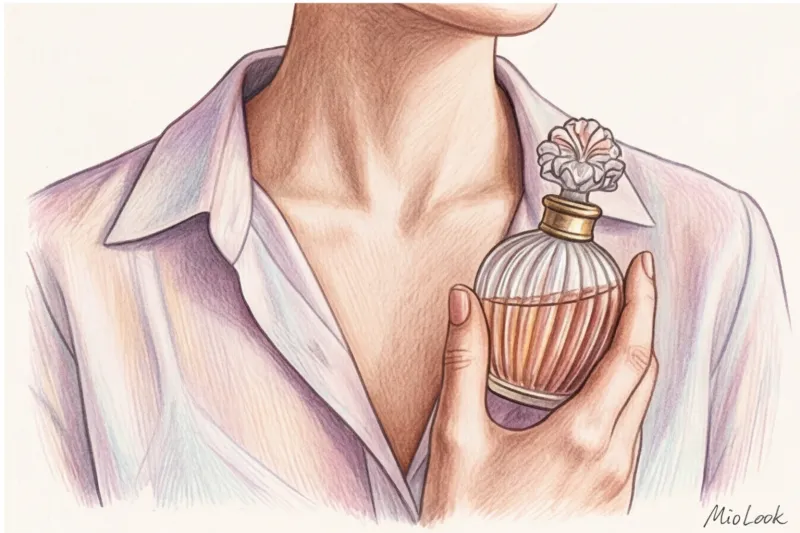
But dense, indolic flowers—tuberose, ylang-ylang, orchid, gardenia—resemble heavy velvet, brocade, and dense satin. This is the territory of the Lover archetype. In my practice, I once had a woman come to a consultation wearing a relaxed, minimalist raw linen suit (COS) and a dense, sultry fragrance with a predatory tuberose as the lead note. The perfume literally "devoured" her look, making it heavy and outdated.
Woody and chypre: the olfactory equivalent of a business suit
If you need to establish boundaries, emphasize your intellect and status, welcome to the chypre and woody fragrances section. These are the very same fragrance groups in perfumery that are essential for a business capsule wardrobe.
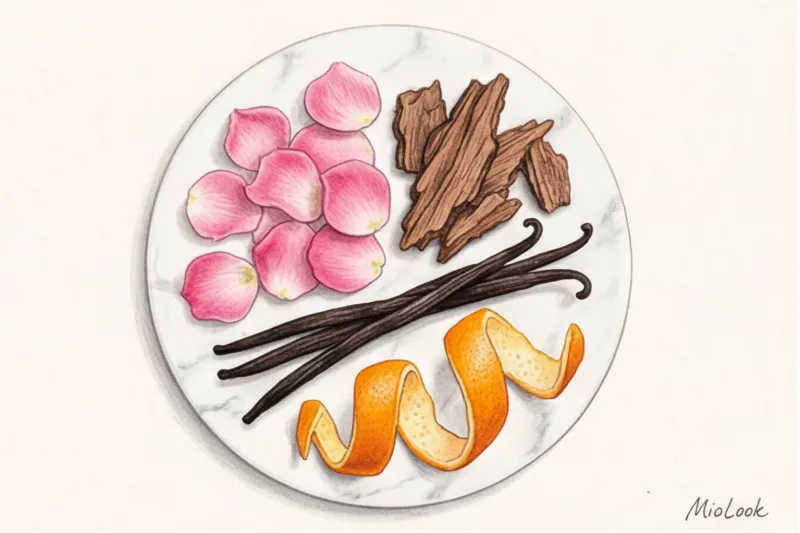
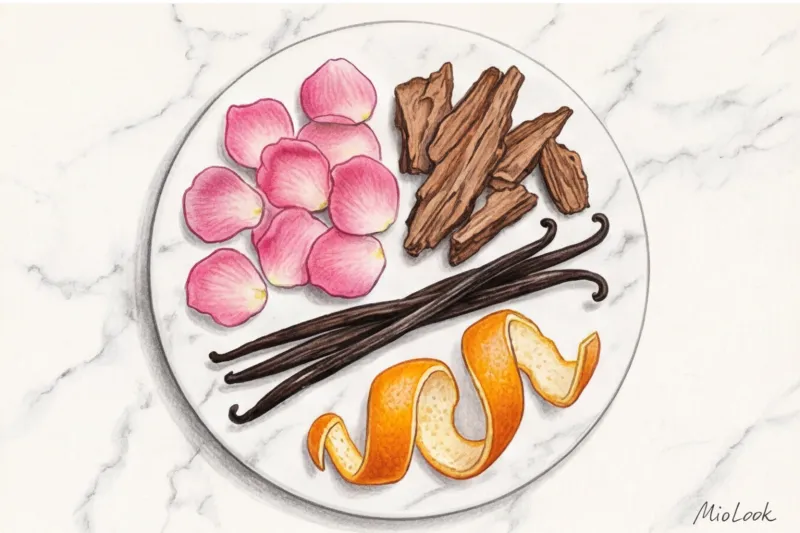
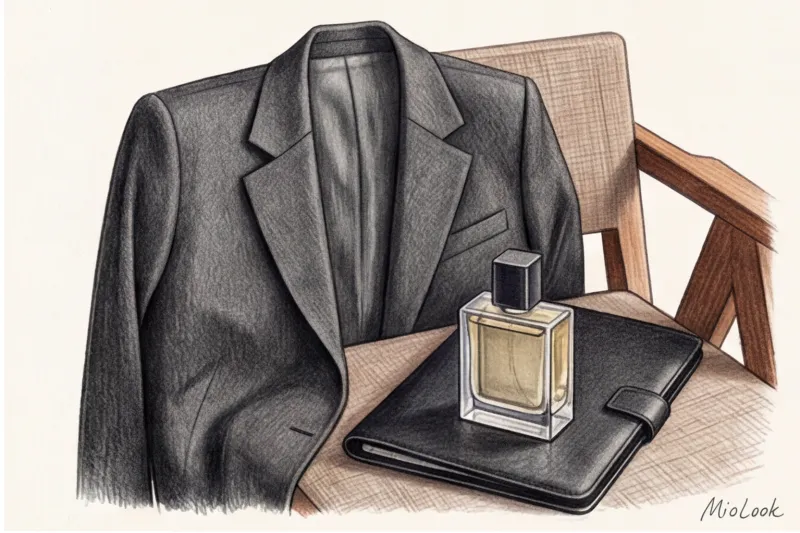
Chypre is a historical symbol of female emancipation. The classic accord (bergamot, oakmoss, patchouli, labdanum) sounds sharp, distant, and precious. It makes you stand up straight. Woody notes (cedar, dry vetiver, sandalwood) are interpreted by the brain as markers of stability and reliability. This is evolutionary psychology: the scent of dry wood is associated with safe shelter.
Remember my CEO client from the beginning of this article? We removed her strawberry perfume and selected a more austere, dry scent based on Haitian vetiver and cedar. A month later, she reported that the dynamics of negotiations had changed: people stopped interrupting her. The dry, woody scent perfectly complemented her structured jackets, creating a cohesive, expert image.
Ready to get started?
Try the MioLook plan for free—no commitments required. Create your perfect wardrobe.
Get access — €0.99 onceGourmet and oriental: cashmere and silk for special occasions
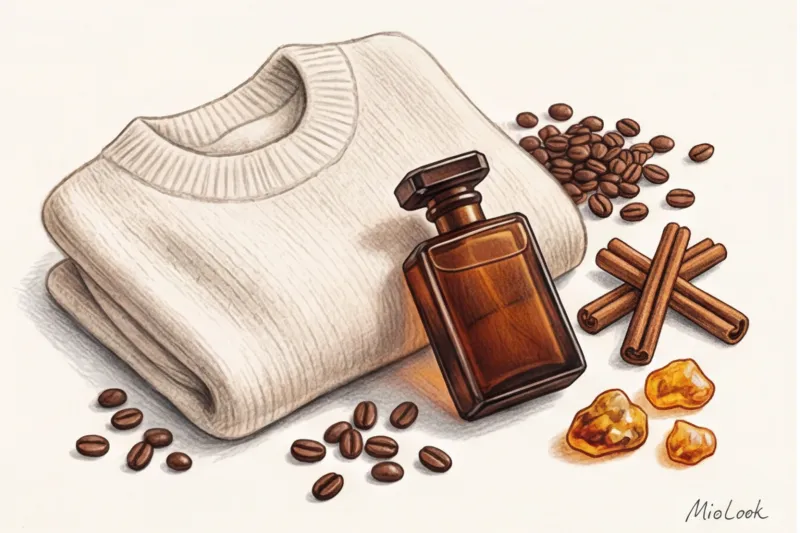
Oriental (resins, amber, incense, spices) and gourmand (chocolate, coffee, caramel, vanilla) are the warmest tactile groups. They work like an expensive, oversized cashmere sweater.
Research at Rockefeller University has proven a direct link between olfaction and the brain's limbic system, which is responsible for emotions and memory. The scent of baked goods, vanilla, or cocoa instantly transports us back to childhood, reduces stress, and artificially reduces the distance between people.
When it works against you: In the office or during tough negotiations. The smell of praline can kill your expertise. You may be a brilliant lawyer, but if you smell like a bakery, you'll be subconsciously perceived as soft and pliable. Save gourmands for dates, get-togethers with friends, or cozy weekends.
The biggest mistake when choosing: why paper blotters lie
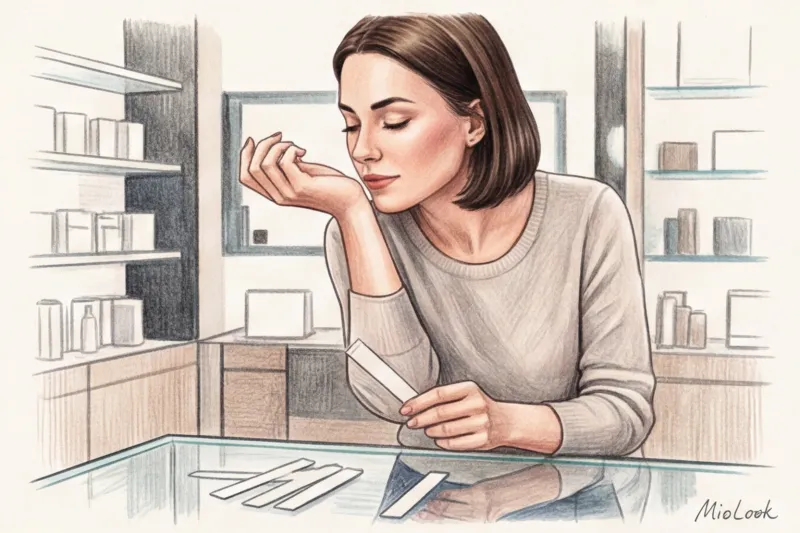
Here's a counterintuitive tip that will save you tens of thousands of euro: never make a purchasing decision based on smelling a perfume from a paper strip in a store. It's completely pointless.
When I worked in the archives of the legendary Osmothèque in Versailles and visited the laboratories in Grasse, I saw how professional evaluators work. They always test compositions. in vivo — on living skin. Paper has no lipid (fat) layer or heat. It literally "freezes" the scent, preventing the heavy molecules—woody bases and musks—from unfolding.
"The pH of healthy skin ranges from 4.7 to 5.5. Combined with individual body temperature and microbiome, this acidity alters the base notes beyond recognition in 80% of people. What smells like fine sandalwood on paper may smell like brine on your skin."
Moreover, the top (citrus) notes evaporate within 10 to 15 minutes. By choosing a fragrance based on the first few seconds of a blotter, you're buying a "trailer," but you'll be watching a completely different "movie."
The correct algorithm is:
1. Apply to a blotter to filter out anything completely unsuitable.
2. Did you like it? Apply it to your wrist.
3. We left the store for some fresh air.
4. We assessed the fragrance after 4 hours, when the base was revealed.
How to Match Fragrance Groups to Your Style: A Stylist's Checklist
To make sure your perfume works for you, do a quick wardrobe audit. What textures predominate in your wardrobe? Smooth and cool? Loose and warm? Rigid and shapely?
By the way, it is for such tasks that I recommend using the digitization function in MioLook — the app will clearly show the percentage ratio of styles and textures in your closet, eliminating the need to guess.
Here's my working combination matrix that you can use today:
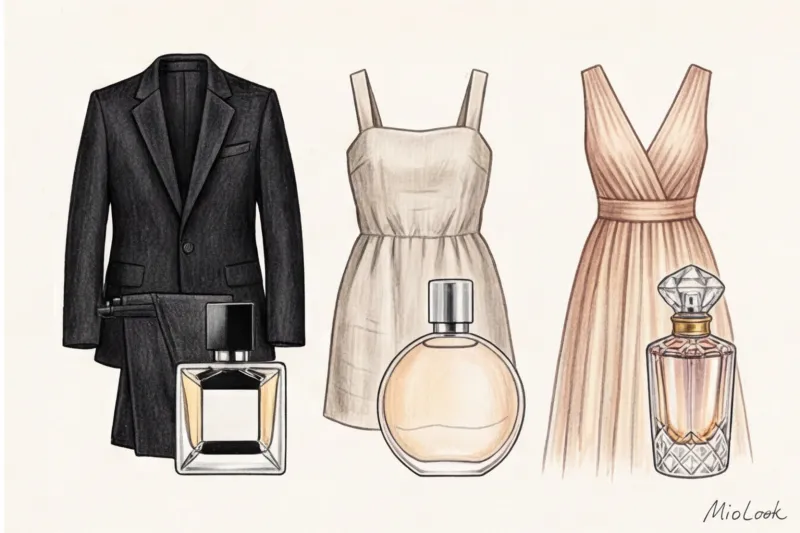
- Formal suit (wool/gabardine) + Chypre/Woody = Increased status, maximum distance, authority. Ideal for leaders.
- Formal Suit + Fresh/Citrus = Dynamic, modern, energetic. Perfect for an interview at an IT company or startup that values quick thinking.
- Linen/Cotton (casual) + Green/Grassy = Relaxed, environmentally friendly, belonging to the creative class.
- Silk/Satin + Heavy Florals = Evening drama, sensuality.
- Chunky Knitwear + Woody Oriental = Intellectual comfort, “quiet luxury”.
Your perfect look starts here
Join thousands of users who look flawless every day with MioLook.
Get access — €0.99 onceThe final step to your perfect perfume wardrobe
Choosing a fragrance style isn't just about finding a pleasant scent. It's about choosing your invisible message to the world. Each fragrance family carries its own cultural and psychological code, which either enhances your visual image or conflicts with it destructively.
My main advice: focus on mindful consumption. You don't need 20 random bottles bought in a fit of emotion at the checkout. Three to five carefully chosen compositions from "your" groups are enough, each one tailored to suit different aspects of your life—from tough negotiations to relaxed Sunday brunches. Treat perfume as the final, most subtle accessory—and you'll notice how the way people react to your presence in the room changes.