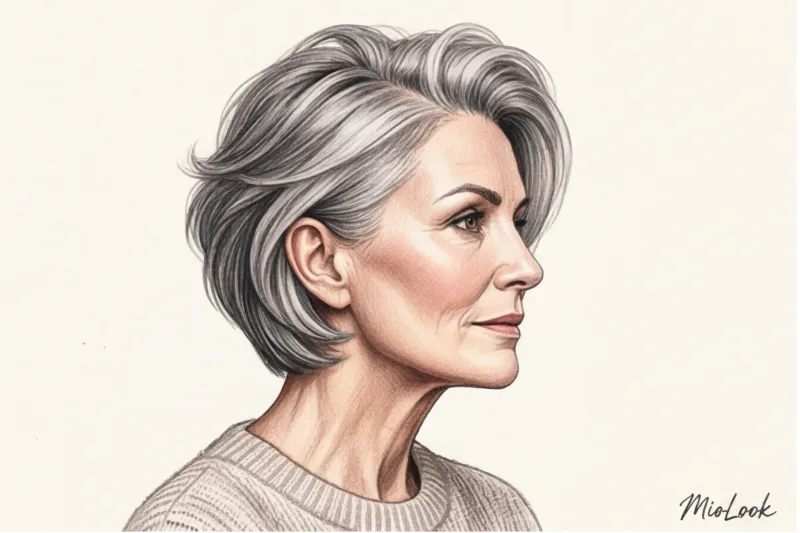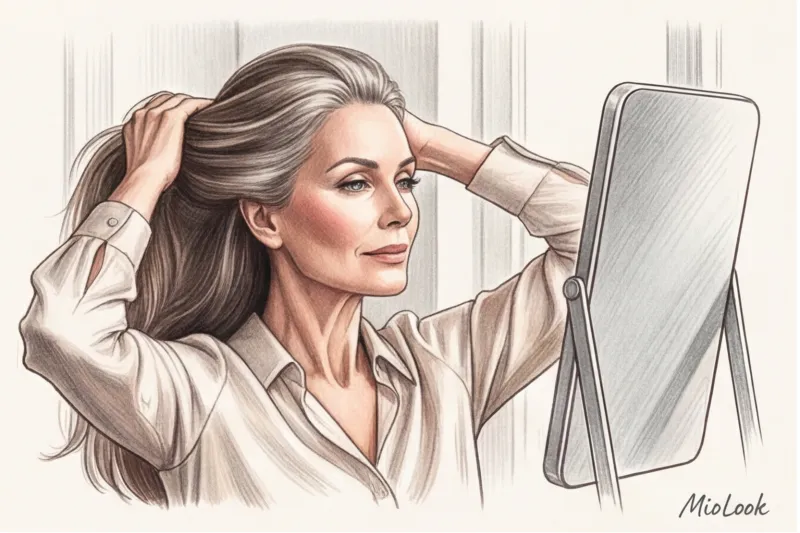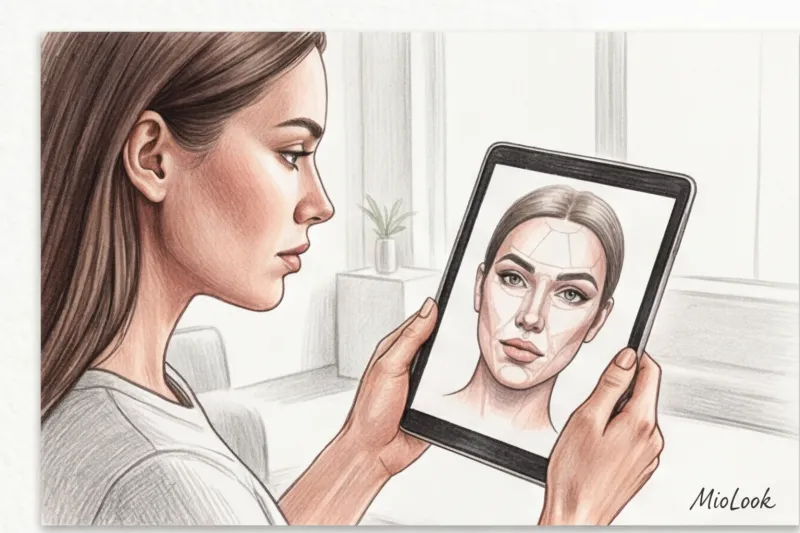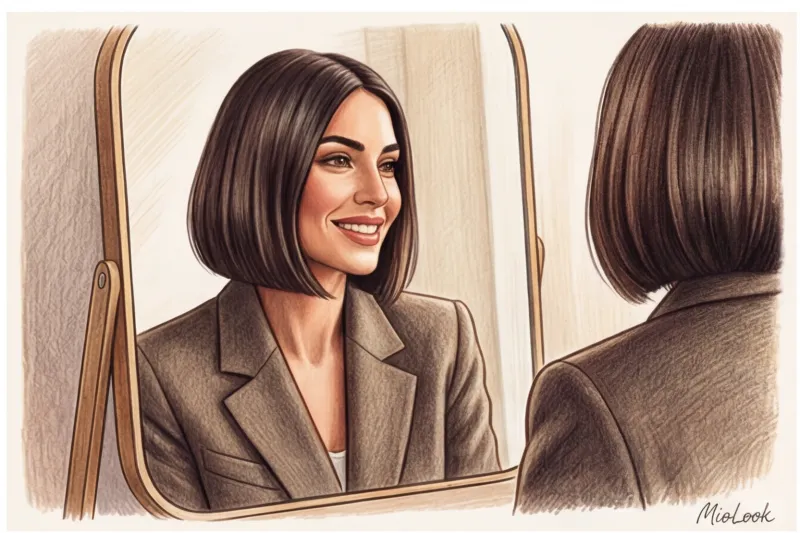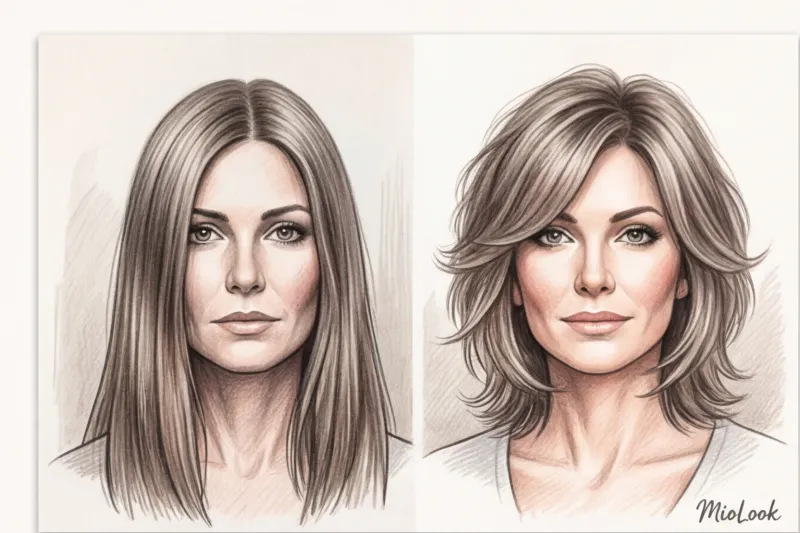
Have you ever noticed how you often look different in casual photos taken by friends than in your own mirror in the morning? The bathroom mirror is a great illusionist. We subconsciously adopt a "working" angle, slightly lift our chin, slightly tense our facial muscles, and see the version of ourselves we're accustomed to. But the actual geometry of the face changes, and the hair architecture should change with it.
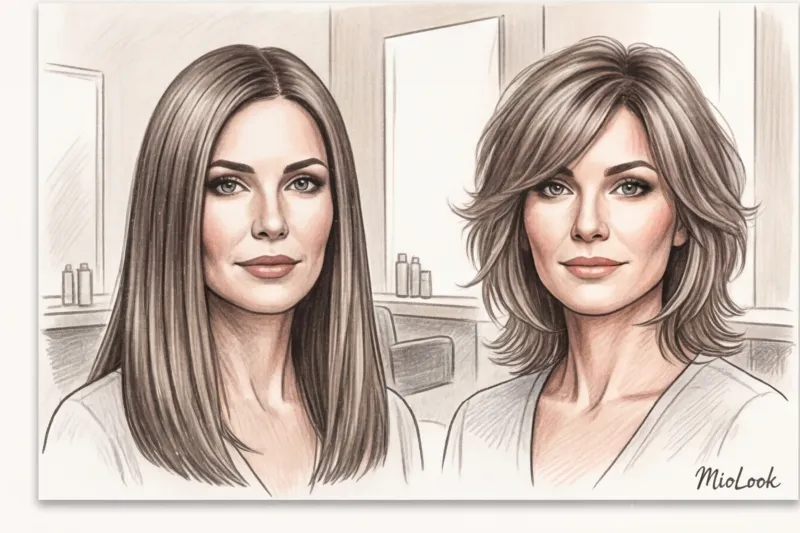
We've already covered the basic principles of working with facial proportions in more detail in our complete guide: Anti-aging haircuts: rules for women 35+ Today I want to explore a practical tool. I'll show you how to bypass distortions of perception and Choose a haircut from a photo: neural network In this process, MioLook acts not just as a fun toy, but as an impartial diagnostician.
The Mirror's Blind Spot: Why We Don't See Our Age-Related Changes
In my experience, about 80% of women over 35 wear the same haircut they had in college or when they started their first serious job. Our brain has a remarkable ability: it "freezes" our internal image at the age of 25-30. We simply stop noticing how gravitational ptosis (the natural drooping of the soft tissues of the face) alters our proportions.
I had a client, Anna, who had worn a perfectly straight, chin-length bob for 15 years. At 28, this horizontal line accentuated her chiseled cheekbones. At 43, that same straight cut began to act as a highlighter, visually accentuating her budding jowls and weighing down the lower third of her face. Anna didn't notice this in the mirror until we took a series of candid photos.
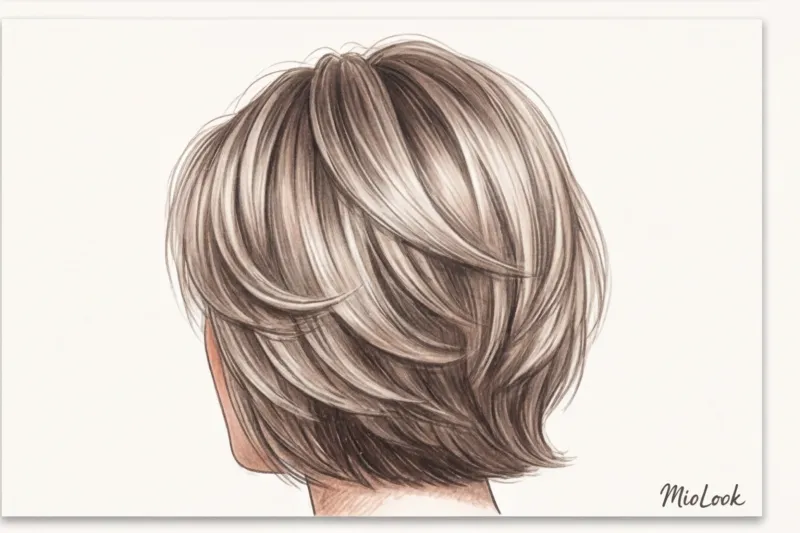
Over the years of working with fabrics and textures, I've developed the "Law of Textures." Heavy, thick, straight hair of a single length works in portraiture like a thick drape or stiff neoprene—it creates a monolithic, weighty silhouette. Meanwhile, layered, textured haircuts behave like silk chiffon: they add airiness, movement, and a visual lifting effect.
This is precisely why old haircuts are starting to work against us. Thick, straight bangs, which once made our eyes look languid, now cast shadows over the eye area, highlighting tiredness and wrinkles. What we need is light and movement.
Access to MioLook for €0.99 — one-time payment
A smart AI stylist will select the perfect look based on your individual facial features.
Get access — €0.99 onceHow to choose a haircut from a photo: MioLook neural network as an impartial diagnostician
What's the main problem with asking a friend or even your regular stylist for advice? Emotional attachment. A friend will say, "You're doing great the way you are!" while a stylist who's been cutting your hair for years is afraid of making drastic changes for fear of losing a loyal client.
This is where algorithms win. According to a 2023 McKinsey study on the implementation of AI in personalized services, computer vision algorithms read between 68 and 106 key points on a face without emotional context. Neural network MioLook It doesn't simply "glue" a wig over your photo, like the primitive masks on social media. It analyzes the notorious "triangle of youth" (cheekbones and chin) and identifies areas where the face lacks visual volume and where, on the contrary, it needs to be reduced.
Proper preparation of the source frame for AI
For a neural network to produce accurate results, you need to feed it the right input data. A poorly executed photo will result in a distorted analysis.
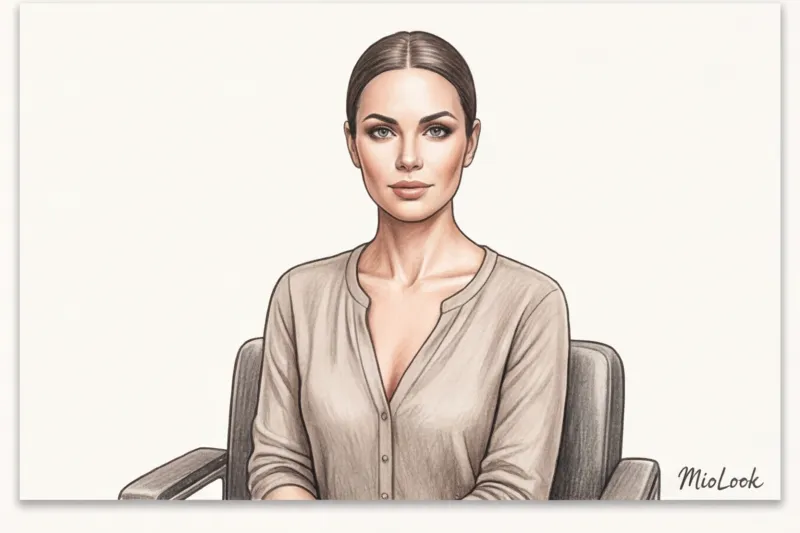
- Light: Only take photos in frontal daylight (facing a window). Overhead lighting from a chandelier will create harsh shadows under your eyes and create nasolabial folds that aren't actually there, causing the AI to suggest incorrect corrections.
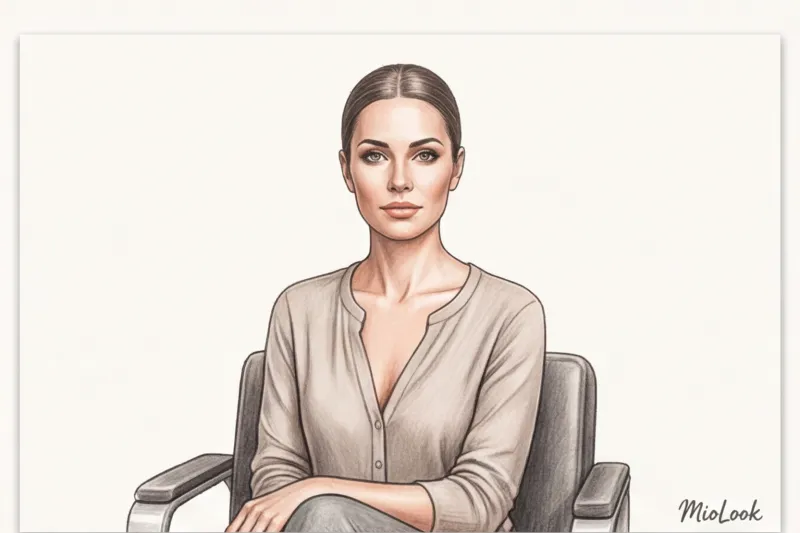
- Angle: Hold the camera strictly at eye level. Shooting from slightly below will add volume to the chin, while shooting from above will artificially enlarge the forehead.
- Cloth: Choose a basic top with an open neckline (V-neck or deep U-neck), preferably in a neutral color. The neck is a crucial element in the haircut's design. If you're photographed wearing a turtleneck, the AI won't be able to accurately calculate the length of your strands relative to your collarbone.
Choosing an Architecture: Layers, Diagonals, and Volume
When you upload your photo to MioLook, don't rush to click on everything. The key rule for a rejuvenating haircut is to create upward diagonals. Our faces tend to slant downwards with age (the corners of the lips, eyes, and oval line droop). The hair should be drawn upwards and to the sides.
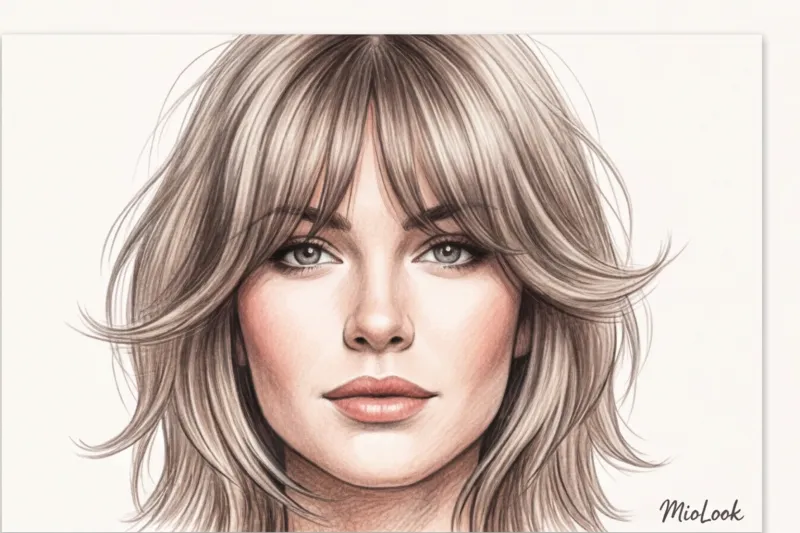
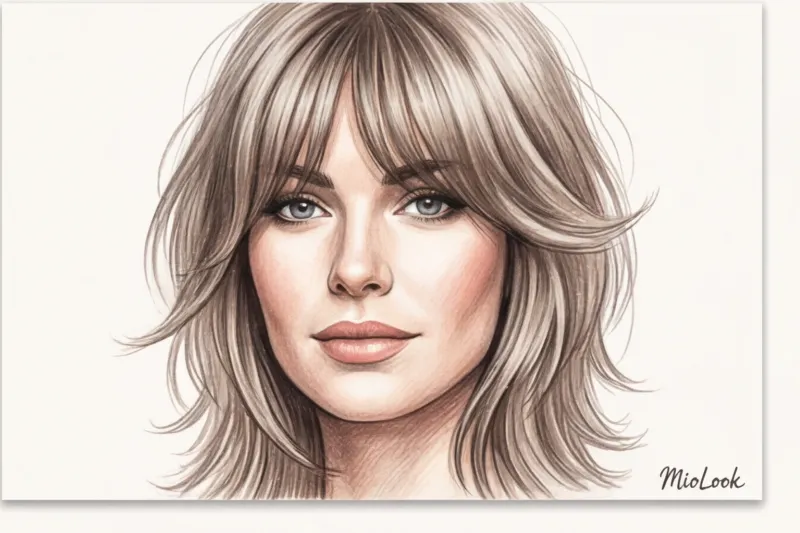
Try shapes with curtain bangs that gently sweep from the center of the forehead to the cheekbones. Try textured strands that frame the face but don't hang straight. And be sure to avoid harsh horizontal lines in your hairstyles: straight, thick bangs that reach the eyebrows and a straight bob that cuts right along the jowls (this will create the effect of a wider jawline).
Your perfect look starts here
Join thousands of users who look flawless every day with MioLook. Experience your new facial proportions risk-free.
Get access — €0.99 onceAnalysis of Results: How to Read Generated Images
Generation achieved. How do you know if this haircut truly refreshes you? I use the "Three-Second Rule" with my clients.
Open the "Before and After" collage and quickly take a look at the result. Where does your first glance fall? If in the first three seconds you look at the hairstyle ("Oh, what beautiful curls") is a failure. The right haircut works like an expensive picture frame: your eye should immediately focus on a woman's eyes and cheekbones.
Notice the jawline in the generated photo. Has it become visually more defined? The AI often suggests options with a bit of volume at the temples and a slight lengthening at the back. This is no coincidence. The volume at the temples visually "opens up" the eyes and compensates for the loss of volume in the middle third of the face.
The Age and Length Myth: Why It's Worth Breaking the Rules
Here we come to the most persistent and harmful stereotype of the post-Soviet space: "A woman over 40 should have her hair cut short." This is a colossal misconception that has ruined many an image.
I often see women, in an effort to "look younger," opt for an ultra-short pixie or a classic layered cut at the nape. The counterintuitive truth is that a short haircut mercilessly exposes the neck and jawline. If there are already noticeable signs of aging there (like Venus rings on the neck or a sagging jawline), short hair won't hide them, but rather puts them on full display, as if under a spotlight.
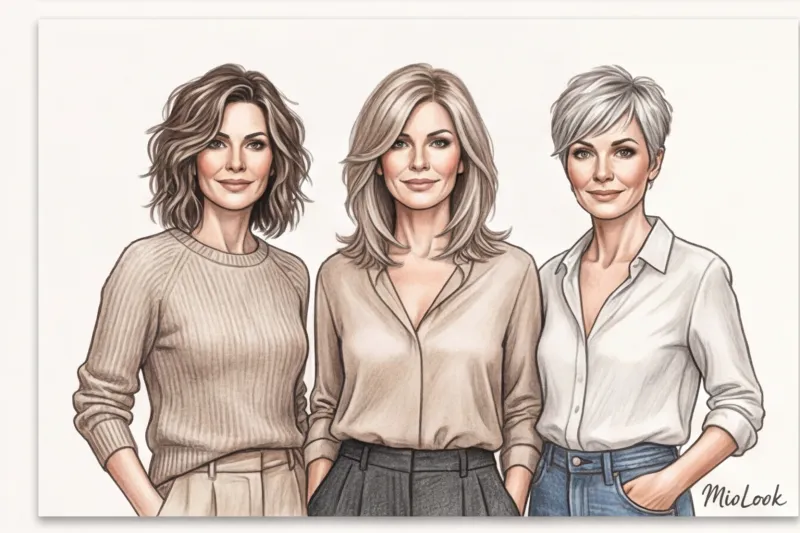
According to reports from the analytical agency WGSN Beauty (2024), the focus of modern anti-aging styling has shifted from "length dictates" to "texture management." A long bob (lob) or a dynamic mid-length cascade (modern shag) are ten times more effective than a short haircut. Age is betrayed not by an open face or hair length, but by static, sleek, and lacking movement in the strands.
However, there's an important caveat here. Long hair only makes sense if it has density. If the hair structure is very thin, faking thickness with a properly cut to the collarbone becomes more important than a shoulder-length cut.
Ready to get started?
Try the free plan—no commitments required. Upload your photo and try out modern textured haircuts.
Get access — €0.99 onceFrom virtual fitting to salon: how to set a task for a stylist
You've found your perfect look at MioLook. What's next? The biggest mistake is showing up at the salon, showing your smartphone, and saying, "I want exactly the same."
Here lies an important and honest limitation of any artificial intelligence. A neural network can draw perfect architecture, but it can't feel your hair. It doesn't know that you have a cowlick at the back of your head, that your hairline has unique features, and that your hair itself is porous and frizzes when wet.
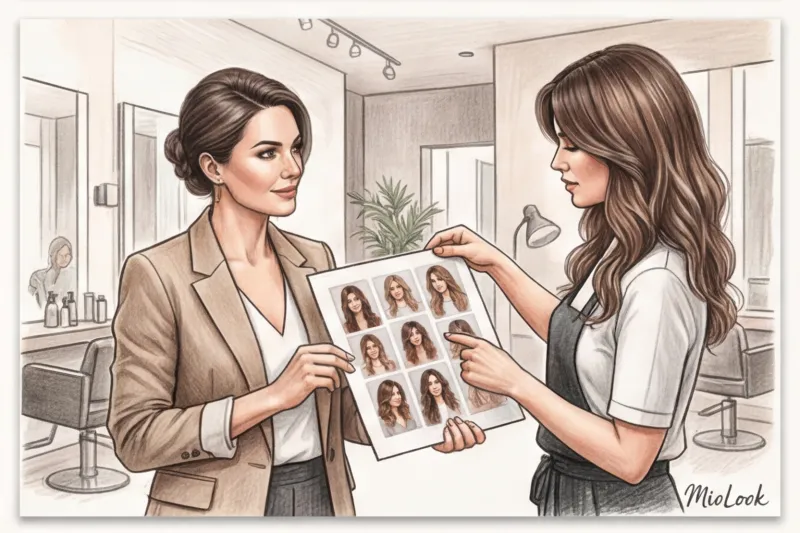
Use the generated results as a mood board, not a strict engineering drawing. To build a sustainable and productive dialogue with the designer, use the right vocabulary:
- Instead of "make it shorter for me" say: "I love the volume at the temples in this photo. Can we achieve this layered look with my thickness?"
- Draw the master's attention to the dynamics: "I want the strands around my face to flow outward from the center, creating an open face effect.".
- Discuss edge density: "In the photo, the ends look loose. Perhaps we need some light thinning or point-cutting on the ends to remove the blunt cut?"
Checklist: 5 Signs It's Time to Launch MioLook
If you're unsure whether you need a hair texture change right now, check out this self-diagnosis checklist. It's time to take action if:
- Your hair takes more than 30 minutes to style, but by lunchtime it's out of shape. This is a sure sign that your current haircut does not match the natural texture and growth direction of your hair.
- In all the photographs you try to tilt your head. A subconscious desire to hide changes in the oval of the face by using a favorable shooting angle.
- Your wardrobe has changed, but your hairstyle has remained the same. You've switched to high-status jackets made of high-quality wool and silk blouses, but on your head you still have the same careless bun from the 2010s or a static "tower" that clashes with your modern look.
- People compliment your hair, not you. "What a beautiful hairstyle!" instead of "You look so fresh today!"
- You wear a straight parting and a straight cut with noticeable changes in the oval shape. The central axis of the face emphasizes the slightest asymmetry, which intensifies with age.
Your hair is the only accessory you wear every day, without taking it off. You might change your bag, put on different shoes, or switch from a formal suit to relaxed denim, but your haircut will always be yours. Before entrusting this important part of your image to the scissors, let technology help you avoid mistakes. Upload your photo to a neural network, analyze your facial geometry without illusions, and find the perfect shape that will restore dynamism and lightness to your look.