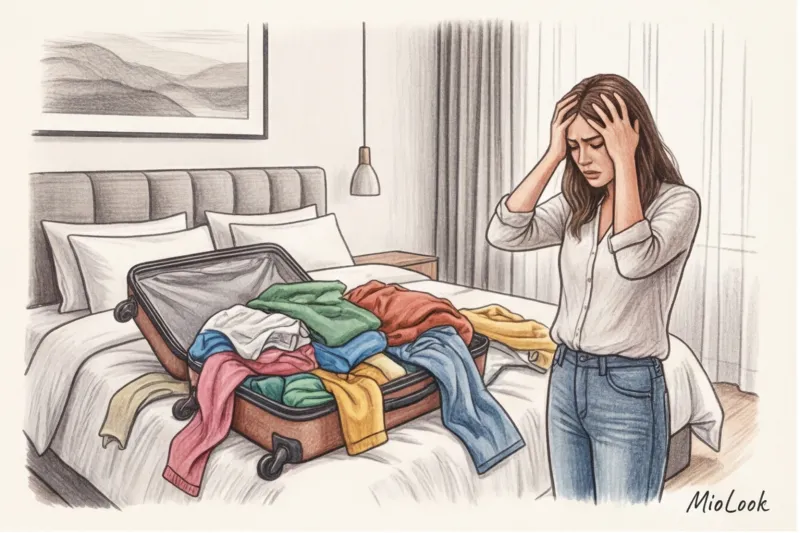
The "What if" Illusion: Why Our Vacation Wardrobes Are Full of Unnecessary Items
Have you ever noticed how a completely different person awakens within us before a vacation? Someone who suddenly decides they absolutely need stiletto sandals on a pebble beach, and in the evening, that same sparkly floor-length dress that's been hanging in the back of the closet for three years. We frantically throw things into a suitcase late at night, chanting a magic spell: "What if I need it? What if we get invited on a yacht? What if it gets really cold?" Of course, the perfect vacation wardrobe often crumbles against the harsh reality: half the outfits never leave the hotel closet, and we spend the entire vacation in the same favorite linen shorts.
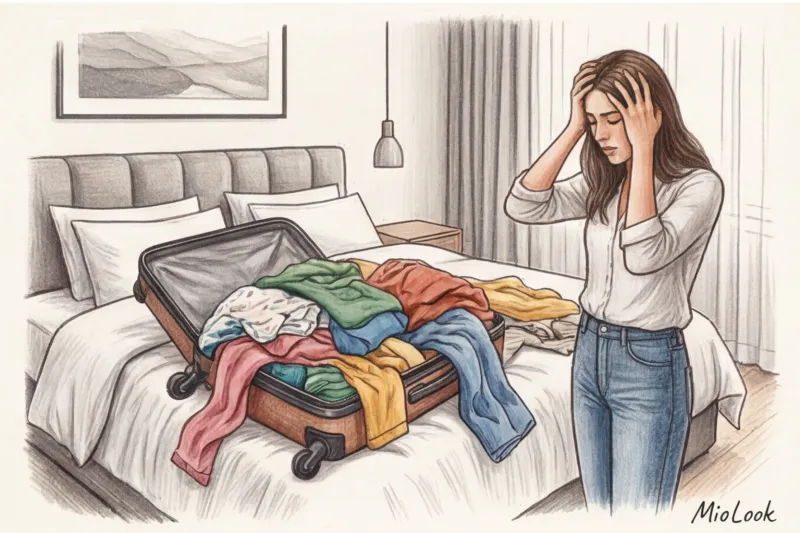
Last year, I conducted a large-scale experiment. For six months, I asked my clients to meticulously track (note) every item they wore during their summer vacation. The results were astounding. In 12 years as a stylist, I've seen a lot, but these numbers were relentless. It was then that I discovered and described the phenomenon of the "evening dress that just travels in a suitcase." Eight out of 10 women had a complexly tailored dress (and uncomfortable shoes to go with it!) in their luggage, which simply flew business class there and back, never seeing the spotlight. Why? Because after a day in the sun, everyone wanted to relax in a comfortable cotton shirt.
Psychologists at the Fashion Psychology Institute call this a classic cognitive bias when packing. We pack not for the real us, but for a "fantasy" version of ourselves—that ethereal girl from the ads, gracefully sipping a cocktail at sunset in flowing chiffon, not chasing kids along the beach with a tube of SPF.
But do you know what the raw data says? When we analyzed anonymous statistics in MioLook app Smart wardrobe algorithms have revealed a clear picture: users carry, on average, only 40% of the contents of a large suitcase. The remaining 60% is dead weight, dictated by our anxieties and illusions.
This illusion has a very real cost. First, it's financial: excess baggage will cost you an average of €50 to €120 each way, depending on the airline. For that kind of money, you could have a luxurious dinner by the ocean. Second, it's emotional: the overwhelming choice of clothes on vacation doesn't cause joy, but the notorious decision fatigue. Instead of relaxing and enjoying the moment, you stand in front of an open suitcase and feel stressed because your clothes don't match. To stop carrying air, it's important to implement the principles eco-friendly wardrobe: take less, but more consciously.
The main mistakes when packing for a family trip
When it comes to packing suitcases for the whole family, the logistical chaos increases exponentially. In my experience, mothers most often take on the role of chief packer, making three fundamental mistakes that turn luggage into an unwieldy burden:
- Lack of a unified color concept. If you buy neon green swimming trunks for your husband, a leopard-print dress for yourself, and a T-shirt with a colorful cartoon character for your child, you're complicating life on two levels. First, they can't be washed together (hotel laundry often starts at €10-€15 per item). Second, in spontaneous family photos, you'll look like visual noise. Choosing three or four basic shades for the whole family solves both problems.
- Packing things in rigid sets that cannot be combined. It's a trap to think, "I'll only wear these white linen pants with this silk top." If coffee accidentally spills on that top on the first day, the bottom half of the outfit automatically becomes useless and just takes up space. Every item should work in at least three different combinations.
- Ignoring the weight of the clothes and shoes themselves. We're used to evaluating items by volume, completely forgetting about weight. A pair of heavy denim shorts weighs around 400 grams, while lightweight shorts made from a technical blend (linen and viscose) weigh only 120-150 grams. Your husband's chunky leather sneakers or your wedge sandals will add another 1.5 kg to your suitcase. With strict carry-on baggage limits, the physical weight of the fabric becomes a critical factor.
The Perfect Family Capsule Formula: An Engineering Approach to Style
To break the vicious cycle of "full suitcase, nothing to wear," I suggest abandoning emotion in favor of engineering. The capsule wardrobe concept, conceived by London boutique owner Susie Faux back in the 1970s, perfectly suits the realities of modern travel. But for vacation, we need a special, more rigorous approach.
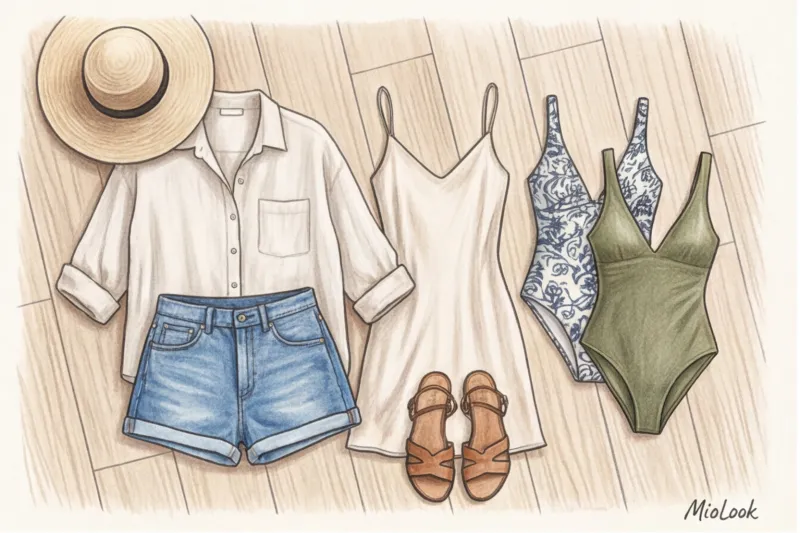
The basis of smart collections is 3-2-1 principle Your basic weekly outfit matrix looks like this: 3 tops, 2 bottoms, 1 dress or jumpsuit. Does that seem critically low? Let's do the math. Multiplying 3 tops (a T-shirt, a tank top, a linen shirt) by 2 bottoms (shorts, a light skirt) gives us 6 unique outfits. Adding a dress brings the total to 7. And if you use the shirt as a second layer (worn over a dress or unbuttoned over a top), the number of combinations easily exceeds 12 complete looks.
Over 12 years of working as a stylist, I've developed a clear plan for calculating your packing needs based on the length of your trip:
- For 7 days: basic formula 3-2-1 (only 6 key things).
- For 10 days: formula 4-3-1 (8 things).
- For 14 days: formula 5-4-2 (11 things).
This math only works flawlessly if you strictly adhere to the "cross-pollination" rule. Every item you pack in your suitcase should pair with at least three others. If you're packing a fancy skirt with a complex tropical print that only goes with one specific top, feel free to remove that pair from your vacation wardrobe.
To digitize compatibility before the packing stage, I recommend uploading your planned items to MioLook smart wardrobe — the algorithm will immediately highlight “lonely” items of clothing that do not fit into the overall capsule.
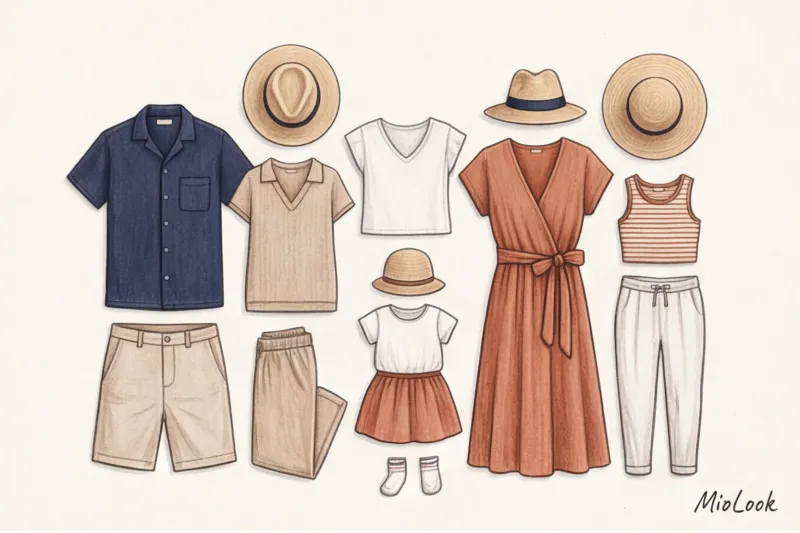
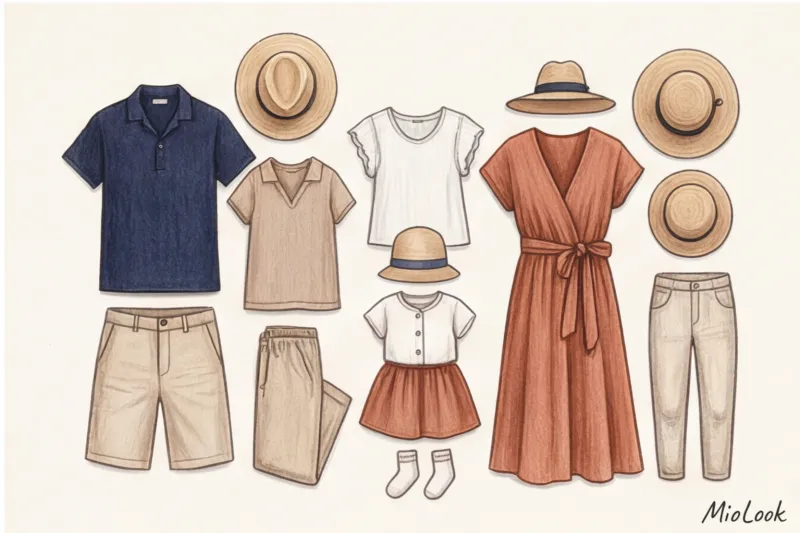
Now about family gatherings. Choosing a common color palette for the whole family is the secret to those flawless vacation photos without the dull "uniform" effect. We all remember the 2000s trend of families photographed in identical white T-shirts and blue jeans. Today, the approach has become much more subtle.
Choose two base colors (for example, sand and deep navy) and one or two accent colors (terracotta and soft olive). Divide these shades among family members: let your husband wear olive chinos, your child a terracotta bucket hat, and you a blue-and-white striped dress. You'll look stunningly harmonious, yet each person will retain their own individuality.
Build the perfect vacation capsule
Try MioLook for free: A smart AI stylist will select the perfect looks from your items and suggest what you should definitely pack.
Get access — €0.99 onceFabrics that work for you in the heat
An engineering approach applies not only to quantity but also to the composition of items. Why is 100% linen beautiful in pictures, but not always practical in reality? Pure linen looks elegant and expensive (even in budget lines for €30–40), but in a suitcase it quickly turns into a crumpled lump, and after a 15-minute taxi ride, it becomes covered in stiff creases. My professional advice: look for a blend. A combination of 55% linen and 45% viscose (or lyocell) preserves all the breathable properties of the material, but the fabric flows beautifully and wrinkles much less.
The next step toward lightweight luggage is a decisive rejection of heavy denim. Classic jeans (12 to 14 ounces) can take up to two days to dry in humid maritime climates, taking up an unreasonable amount of space in a suitcase. Look for modern alternatives: shirts and shorts made of chambray or 100% Tencel. They are visually virtually indistinguishable from lightweight denim, but weigh a third as much and allow the skin to breathe freely.
Finally, pay attention to the high-tech properties of fabrics. Did you know that a regular white cotton T-shirt has a UV protection factor of only about 5? If you're planning active recreation, long excursions, or yachting trips, invest in clothing with a UPF 30 or 50+ rating. Add quick-drying properties (quick-dry technology, now widely used by many brands, from basic Uniqlo to specialized Patagonia), and you'll have clothes you can wash in the hotel sink that evening and wear completely dry in the morning.
Women's wardrobe for a seaside vacation: from the beach to the restaurant
According to statistics from the analytics platform Lyst, over the past few years, demand for the "resort wear" category has shifted decisively toward multifunctional pieces that are equally at home on a sun lounger and in a city café. My personal audit of over fifty client suitcases confirms the same picture: the biggest logistical mistake when packing is rigidly separating your wardrobe into "day" and "evening." You end up packing two completely different sets of clothes, although for the perfect vacation you only need one, but one with a clever design.
Let's start with the base layer. A modern woman's vacation wardrobe has long since moved away from viewing a swimsuit as a purely swimwear item. Think of one-pieces as high-tech bodysuits. A textured seersucker swimsuit (brands like Hunza G excel at creating similar textures) or a simple, asymmetrical one-shoulder style paired with a flowing silk midi skirt instantly creates an elegant look for brunch by the pool. This not only saves luggage space but also time changing in your room.
The key transformative piece of your vacation capsule is a basic oversized shirt. I always highly recommend choosing a heavy cotton or premium linen shirt two sizes larger than your usual size. Excellent options for around €80–€120 can always be found in the men's departments or at COS and Massimo Dutti. In the morning, this shirt works as a sunshade over your swimsuit. During the day, casually tied at the waist, it transforms into a stylish top with shorts. And in the evening, if the length allows, you can tie it with a wide braided belt, turning it into a relaxed minidress.
Here we come to the most persistent stereotype, which I methodically dispel at every consultation: the myth of the need for a separate "dressy" dress. Forget about heavily embellished evening gowns that take up half a suitcase and are worn only once for a photo. In a resort environment, excessive dressiness looks heavy and inappropriate; true chic lies in relaxation.
See how a well-built base works: during the day, you wear wide-leg linen palazzo pants and a minimalist silk top with thin straps with simple flip-flops. In the evening, you leave the same clothes You simply swap your beach shoes for elegant sandals, apply a drop of perfume, and put on large statement earrings made of crushed metal. The contrast of textures (matte linen and the delicate sheen of silk) instantly elevates the look. To test these transformations in advance, I recommend loading your items into MioLook wardrobe app — the algorithm will clearly show whether the selected top really works in both beach and evening scenarios.
Shoes and accessories: the three-pair rule
Shoes are the main cause of excess weight (and, let's be honest, blisters). My golden rule of suitcase design: strictly three pairs of shoes. This isn't a limitation, but rather a liberation from the agony of choice.
- The first pair is beach: minimalist rubber slides or classic flip-flops (like Havaianas) that are resistant to salt and hot sand.
- The second pair is for long walks: anatomical sandals with arch support (Birkenstock format) or lightweight, breathable sneakers in light colors.
- The third pair is "on the way out": Here, I recommend kitten heel mules or simple sandals with thin leather straps in a neutral shade. They visually lengthen your legs and complement any evening outfit configuration.
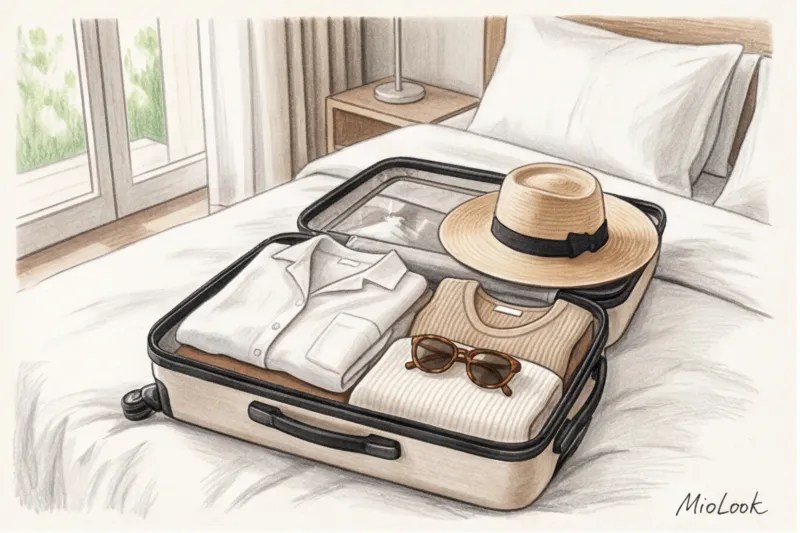
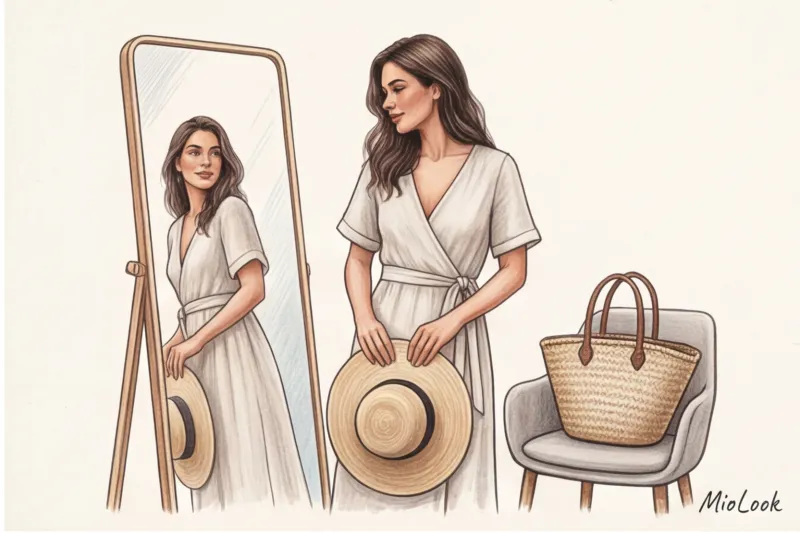
The secret to a stylish vacation is that the mood of the look is set not by the clothes, but by the details. A pair of stylish sunglasses in a trendy shape, a quality straw fedora (the safest to carry on a plane), and a statement leather belt can elevate even the most basic white T-shirt and denim outfit to street style.
Pay special attention to the right bag. The worst thing you can do is pack a flat, space-consuming beach bag at the bottom of your suitcase that's good for nothing else. Invest in a roomy tote made of thick, high-quality raffia, canvas, or recycled materials (excellent, versatile mid-range models cost between €70 and €150). It'll serve brilliantly as your carry-on on the plane, safely storing your laptop and documents, and upon arrival at your resort, it'll seamlessly transform into the perfect beach bag, accommodating towels and SPF cream.
A men's sleep capsule: a balance of comfort and style
While sorting through the vacation wardrobe of one of my regular clients (the CEO of a large fintech company), I encountered a typical male packing mistake. Ten thick cotton T-shirts and three pairs of denim shorts were piled on the bed. The total weight of this pile was almost five kilograms! Men instinctively choose their usual thick cotton, forgetting that in the humid maritime climate, it works against them: such clothes take a long time to dry, trap heat, and simply add weight to their luggage.
I always replace these heavy items with technical blends, lyocell (Tencel), and textured seersucker. They're highly breathable, require no ironing, and weigh half as much as classic denim.
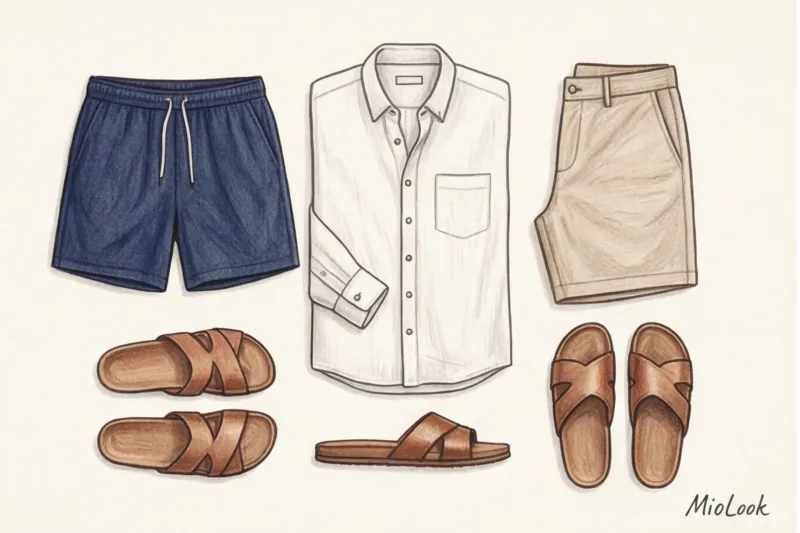
Let's get down to basics. The right shorts are the absolute foundation of men's summer style. The optimal length, which flatters any figure, is 3-5 centimeters above the knee. Look for the markings in the international brand size chart. inseam 7–9 inches And here I'll be categorical: cargo shorts are a no-no. Bulky side pockets visually widen the hips, cut off the height, and make the silhouette look disproportionate. Replace them with simple linen-blend chinos, which look neat and expensive.
As for tops, I recommend saving printed T-shirts for the gym. A more elegant alternative is a short-sleeved shirt with a camp collar, as well as a knit polo shirt. The knit texture instantly elevates any men's wardrobe to a sophisticated aesthetic. Even if you find such a polo shirt at a high-quality mass-market store for €40–€60, it will hold its shape and look far more refined than a simple thin tank top.
And perhaps my favorite find for optimizing a man's suitcase is a versatile pair of swimming trunks that look like regular city shorts ( tailored swim trunks ). The right styles don't have a sporty elastic waistband with dangling laces. Instead, they feature a rigid waistband, a metal zipper, and elegant side adjusters. Paired with the same linen shirt, these swimsuits are perfect for going straight from the beach to lunch at a restaurant, without violating the restaurant's dress code.
To prevent your husband from wasting precious rest time on morning questions like “what should I wear with this?”, I recommend loading his things into the MioLook You simply collect ready-made combinations, and the algorithm saves them on your phone—this completely removes the stress of choosing clothes on vacation.
Access to MioLook for €0.99 — one-time payment
Start creating perfect images with the help of artificial intelligence
Get access — €0.99 onceKids' Vacation Wardrobe: Packing Without Stress
Family travel industry statistics reveal a curious paradox: children may make up only a quarter of a family's total, but their belongings magically take up to 70% of the luggage's usable space. When planning a beach vacation wardrobe, packing a child's suitcase often devolves into a frantic tossing of T-shirts, saying, "Just in case." Ultimately, half of this arsenal returns home unworn. Let's apply the same rational approach to children's belongings.
The key principle that will forever change your vacation routine is to completely abandon the traditional method of sorting items by category. Forget about separate stacks of T-shirts and separate stacks of shorts. Switch to the "ready-made sets" method, or packing by day.
My personal life hack, which saves my nerves every year: transparent zip-lock bags or small organizer cubes. In each bag, I put a complete outfit for the day: underwear, socks, shorts, a T-shirt, and even an accessory like a bucket hat.
The essence of this method is revealed during vacation. In the morning, the child simply takes out one bag and dresses themselves. No shouting, "Mom, where's my blue cap?" or struggling to put on a green T-shirt and red shorts. Everything is already thought out and stored inside. This gives parents 15 minutes of morning silence and the opportunity to enjoy a coffee on the balcony.
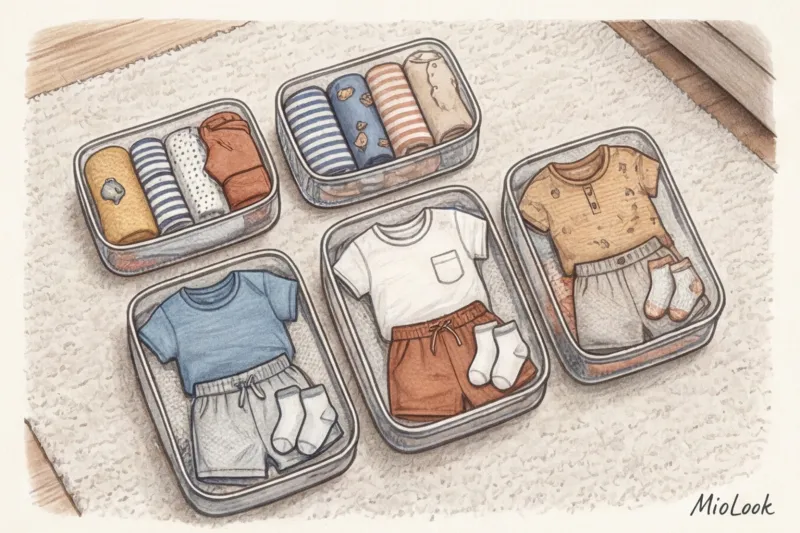
The question naturally arises: how many spare items should I take so I don't have to wash them every day? Over the years of traveling, I've developed a strict math guide. For toddlers (up to 4 years old), we pack 1.5 sets per day. For older children, we pack exactly one bag per day plus exactly two "emergency" sets for the entire trip. To visually control this amount and avoid the temptation to pack too much, I prepare children's capsules in advance. MioLook The algorithm shows an objective picture: 10 sets over 8 days is more than enough.
Even when packing items in pre-made sets, I make sure the palette remains consistent. If my child spills juice on the t-shirt from bag #3, I'll simply pull out the top from the spare set, and it will still match the shorts from the original set.
Another critical mistake parents make is relying solely on the heat. The difference between a scorching hot street (35°C) and a hotel lobby with powerful air conditioning (18°C) is colossal. Smart layering is key. Instead of bulky brushed hoodies, opt for lightweight cotton cardigans, long-sleeved muslin shirts, or thin microfleece zip-up sweaters. Your child should be able to throw on this layer in a flash when entering a cool restaurant for dinner.
And finally, beach gear. If you're still buying your kids regular swimming trunks or one-piece swimsuits, I highly recommend reconsidering this. High-quality long-sleeved rashguards with UPF 50+ protection are the best investment for parents' peace of mind. Yes, a good set made of high-tech fabric will cost between €35 and €60, but it pays for itself within the first day. You'll no longer have to catch your struggling child every forty minutes to reapply the sticky layer of sunscreen on their back and shoulders. The special fabric blocks 98% of UV rays, doesn't fade, and dries instantly. Your child is protected from sunburn; you only need to apply sunscreen to their face and shins, and you can finally relax in a sun lounger with a book.
Carry-On vs. Luggage: Smart Packing Strategies
According to the SITA Baggage IT Insights 2024 Global Report, airlines delay or lose approximately 6.9 pieces of baggage for every 1,000 passengers. This figure seems insignificant until you find yourself at the lost property check-in counter in flip-flops, your carefully planned beach vacation wardrobe having been whisked away to another continent. As a wardrobe optimization expert, I view packing not as a mundane chore, but as logistical risk management.
That's why the first strategy we discuss in our pre-travel consultations is cross-packing technique This is your basic insurance against unforeseen circumstances. The traditional "one suitcase per family member" approach is simply not practical. Instead, we distribute your belongings: if you have two suitcases, each should contain one full set of clothing for each family member. Be sure to pack swimsuits, basic t-shirts, and spare underwear in separate suitcases. If one bag is delayed for a day, your family won't even notice the inconvenience.
Now let's look at the technical side of packaging. There's a raging debate online about which is better: rollers, vacuums, or packing cubes. Let's look at the facts:
- Vacuum bags: The worst choice for a resort wardrobe. Yes, they remove air, but they don't reduce weight. You risk being overweight, for which fines from European carriers range from €50 to €100 per piece. Furthermore, linen, cotton, and viscose items become so creased after a harsh vacuum that even a powerful hotel steamer won't save them.
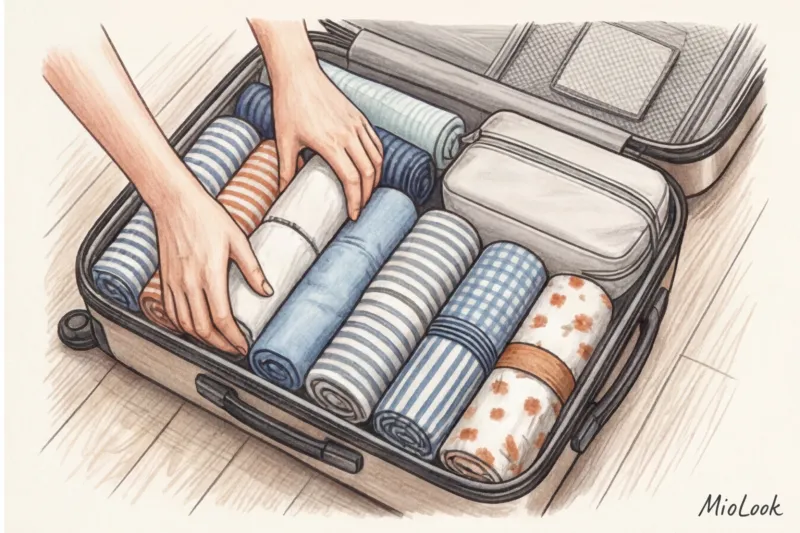
- Rollers: An excellent method for heavy knits, t-shirts, and technical fabrics, this method not only compacts the pile but also minimizes sharp folds.
- Organizer cubes: My absolute favorite when it comes to compression models. The ideal formula is to roll up items and pack them tightly inside a compression cube by category or even by day.
To avoid getting confused by the cubes' contents, I recommend distributing the sets virtually. You can create images in advance in the app. MioLook , assigning them the tags "suitcase 1" and "suitcase 2." This completely removes the anxiety of locking the suitcases.
Another golden rule of logistics: We put on the most voluminous set On a plane or train. Chunky sneakers, jeans (unless you're ready to give them up), a thick cardigan, or jacket shouldn't eat up precious liters of luggage. We make this layer part of our cabin capsule.
Your ideal image
it begins Here
Join thousands of users who look flawless every day with MioLook. Digitize your wardrobe and pack stress-free.
Get access — €0.99 onceWhat you should definitely take on board the plane
Your carry-on bag is your self-contained survival kit for the first 24 hours. Whether you're flying with just a backpack under your seat or carrying a roomy tote, the contents must be strictly functional.
The first rule is - a change of underwear and basic clothing Pack a lightweight cotton T-shirt and thin shorts in a small zip-lock bag. If your suitcase gets lost or you spill coffee on yourself during turbulence, you'll be grateful. This extra bag weighs about 200 grams, but it provides complete peace of mind.
Second - warm layers to protect against air conditioning An airplane often feels like a cryogenic chamber. A voluminous hoodie works great, but I always recommend keeping a wide wool-silk blend stole in your bag. During the flight, it replaces a blanket or a folded pillow, and in the evening at a resort, it can be elegantly draped over your shoulders during dinner on the terrace.
Finally, properly assembled first aid kit and cosmetic bag We adhere to international protocol: all liquids must be travel-size, up to 100 ml, and the total volume must not exceed a liter in a transparent bag. Investing in a high-quality set of silicone travel bottles (between €15 and €25) pays for itself within the first year. Be sure to pack moisturizing eye drops, sanitizer, a basic pain reliever, and a mini sunscreen (SPF) in your cabin bag. Applying SPF is a critical step that should be taken even before leaving the cool airport terminal for the scorching southern sun.
Checklist: Packing for a Seaside Trip Step by Step
The paradox of final packing is that the last 10 minutes before heading to the airport are the most costly. It's in that pre-departure panic that random T-shirts, uncomfortable sandals, and an extra "spare" dress end up in our suitcases. The result is excess baggage, wrinkled clothes, and that notorious vacation closet with absolutely nothing to wear.
Step 1: Digitally assemble and digitize your wardrobe
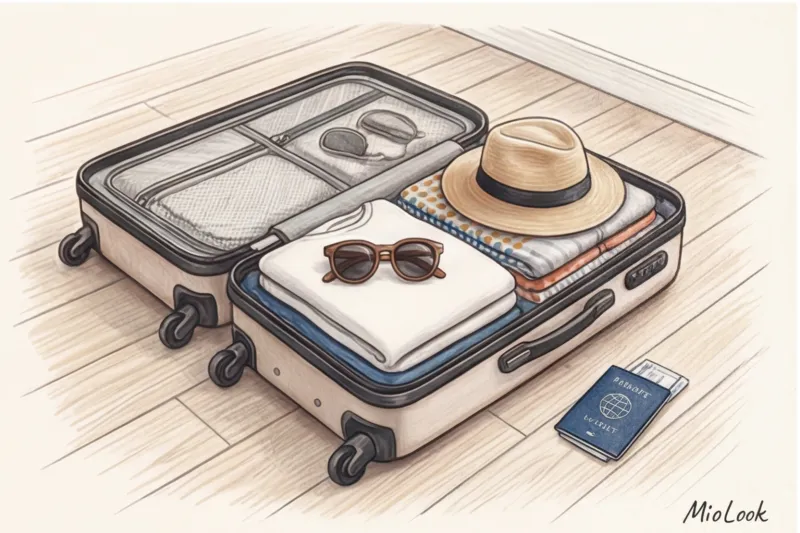
Technology has long changed the way we travel, and packing shouldn't be relegated to the Stone Age. My main principle: pack wardrobe for a seaside vacation You need to do it on your smartphone first, and only then physically move things from the bed to the trunk.
To do this, I strongly recommend digitizing the planned positions in advance by adding them to MioLook By creating a virtual suitcase, you'll be able to visually see the entire color palette and create ready-made capsules right on the screen. This isn't just a matter of visual aesthetics—digital planning saves hours of real-world time. During a recent trip-preparation session, a client and I uploaded 15 basic items into the app; the algorithm generated 24 unique combinations. When it came to physically packing the luggage, the process took exactly 18 minutes, without a single hitch.
Step 2: Ruthlessly try on and fix the images
Never rely on abstract ideas about how things fit you at any given moment. The fabric may have shrunk after washing, and your measurements may have changed slightly. The second step of the checklist is to try on each planned outfit.
- Take mirror selfies: Take a photo of each look yourself. This will eliminate morning doubts on vacation forever, as you'll have a ready-made visual lookbook in your phone's gallery.
- Dynamic test: Put on the outfit, sit on a chair, raise your arms, and take a long step. If the shorts are cutting in and you constantly have to tug at the top, it's left at home. Vacation is not the time for clothes that require constant attention.
The most damaging packing mistake is packing clothes that "need to be slimmed down" or "time to break them in." If your shoes are a bit tight in a cool city, they're guaranteed to become a torture device in a hot, humid climate.
Step 3: Final Revision Rule (Minus 20%)
Before you zip up your suitcase, do a final inventory using what I call a "luggage detox." Remove exactly 20% of your suitcase's contents without regret. It sounds radical, but this method works flawlessly.
Experience shows that we systematically overestimate the need for dressy dresses and warm layers. By removing that fifth T-shirt or extra sandals, you leave room (and weight) for local shopping. You'll agree, it's much more pleasant to bring home a handmade linen shirt or a pair of authentic sandals for €50-70 than to pay an overweight baggage fine on the return trip.
Result: Your freedom of movement
To be fair, this engineering approach requires a certain amount of discipline a couple of days before the trip. Packing your things 15 minutes before a taxi isn't going to work this way. But the results are worth the effort many times over.
A well-planned luggage isn't just pretty stacks in organizers. It means freedom of movement, ease at the airport, and absolute joy in every outfit. When you know for sure that every item of clothing contributes to your confidence, background anxiety disappears. Your main goal on vacation is to collect impressions and enjoy the sea, not to be a personal porter of your own heavy textiles. Start digitizing your suitcase today, and you'll be surprised how much easier your journey to the sea can become.