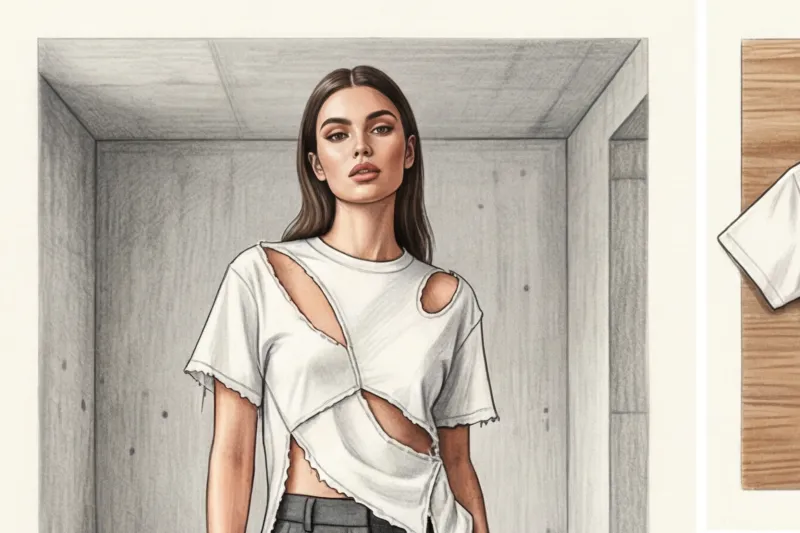
DIY T-shirt Makeovers: From Home Crafts to High Fashion
Raise your hand if, in the early 2010s, you ever tried to fringe the hem of an old T-shirt, embellish it with beads, and then sent this "masterpiece" to the dacha with disappointment. Yes, I've been there too. For a long time, clothing repurposing was associated with the aesthetics of school shop class. But let's forget about that.
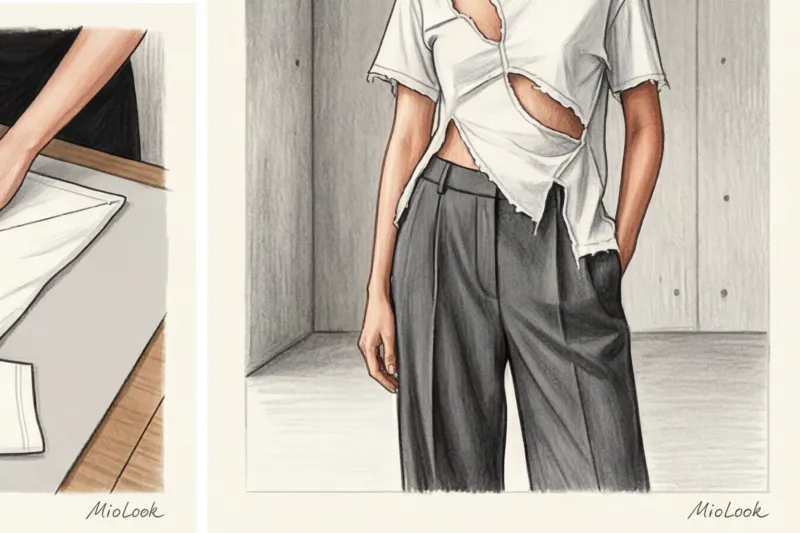
As a stylist and wardrobe analyst, I declare: today, DIY T-shirt redesigns aren't about trying to salvage a stain on the chest with an appliqué. They're about architecture, working with proportions, and a nod to deconstruction, once elevated to the absolute by Martin Margiela. According to a 2024 report from analytics platform Lyst, searches for items with asymmetrical necklines and raw edges increased by 47%. We covered the global circular fashion trend in more detail in our complete guide. Upcycling clothing: how to stylishly repurpose old items.
Transforming a basic T-shirt is the safest way to try on the role of a designer like Alexander Wang or Jacquemus. But to ensure the result looks like conceptual luxury and not like a victim of a lawnmower attack, you need to understand the physics of fabric.
Rules for choosing a "victim": which T-shirt can be cut
The biggest mistake beginners make is grabbing the first stretched-out item they come across. I had a telling example of a wardrobe decluttering client who wanted to throw out five expensive men's heavy cotton T-shirts because she was "bored" of them. In half an hour, we transformed them into stylish, seamless tops, simply because the basics were right.
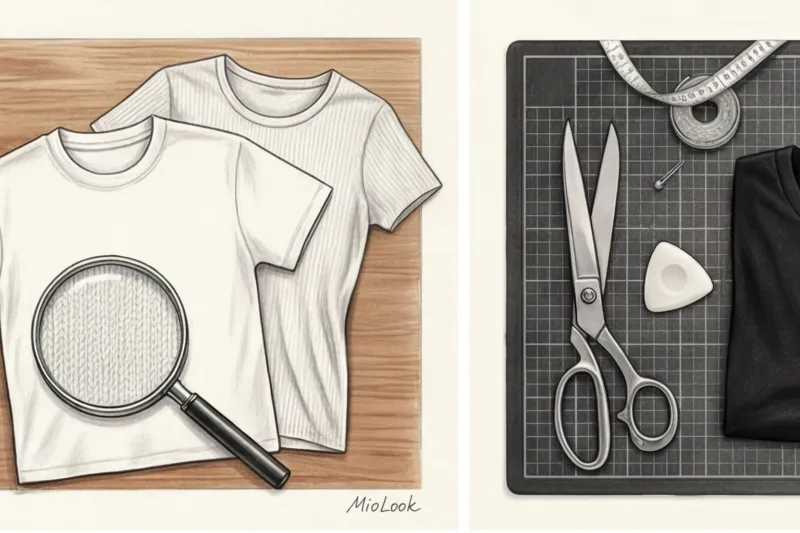
Not every knitwear can withstand a blade. This is where the technical density indicator—GSM (grams per square meter)—comes into play.
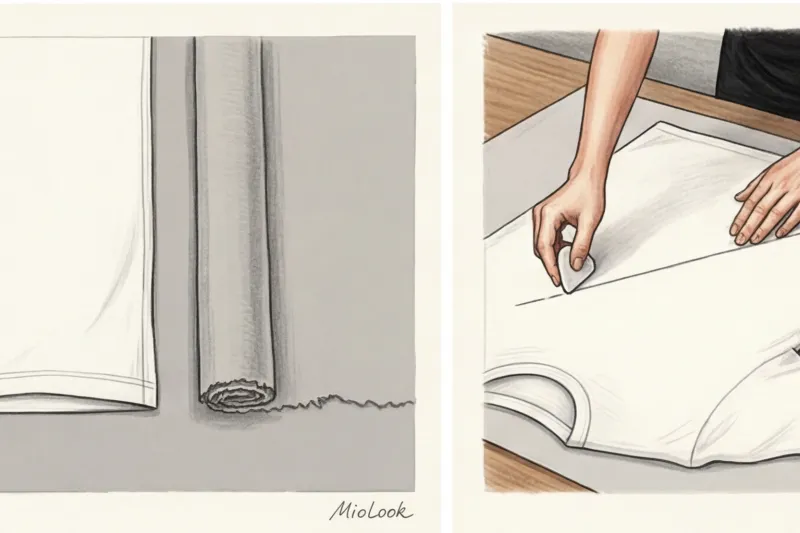
- Ideal density (180–220 g/m²): This is a heavy, high-quality cotton. When cut, it doesn't fray, but curls slightly inward, creating that precious grunge roll.
- Fine knitwear (less than 140 g/m²): A categorical "no." After the first cut, the edge will become wavy, and after washing, it will curl into an ugly tube.
- Compound: Look for 100% cotton. If the fabric contains more than 5% elastane (spandex), it will deform under tension, and a straight, geometric neckline will not be possible.
Geometry and side seams: what to pay attention to
Pay attention to the construction. Seamless t-shirts (tubular knit) behave differently when cut than models with side seams. If you plan on deep side slits, choose t-shirts with seams—they act as a "frame" to prevent the garment from stretching. Men's oversized straight-cut t-shirts are the perfect base for feminine tops. They have enough volume to create a beautiful drape at the waist.
Access to MioLook for €0.99 — one-time payment
A smart AI stylist will find the perfect look for your new top and suggest what to wear it with.
Get access — €0.99 onceThe tools of a stylist-surgeon: why kitchen scissors will ruin your look
Early in my career, I made an unforgivable mistake: I decided to shorten a perfect vintage AC/DC t-shirt with regular office scissors. The result? A frayed, chewed-up edge that began to unravel within an hour. According to textile technologists, dull household blades don't cut, but rather tear and stretch cotton fibers at the microscopic level.
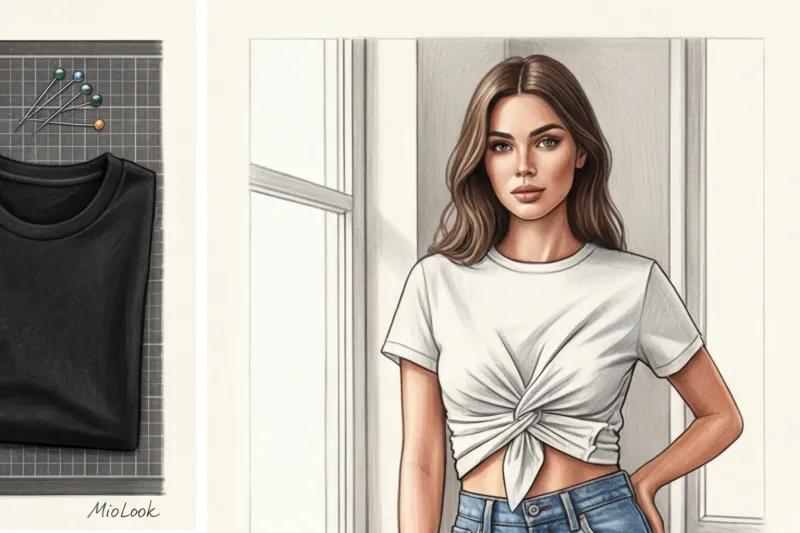
If you want something to look expensive, you will need three things:
- Tailor's scissors: A major investment. A basic carbon steel model costs between €30–50, and it pays for itself with the first item you save. They cut through fabric like a hot knife through butter.
- Tailor's chalk (or soap remnant): No markers or pens! Even washable markers sometimes leave a chemical residue on white cotton after ironing.
- Glass-headed pins and a long ruler: Without a rigid fixation of the layers, the knitwear will definitely “move” under the blade.
Method 1. Architectural crop top with a knot: creating the right proportions
It's a classic that always works if you respect the rules of proportion. The secret to a stylish crop top isn't simply cutting off the bottom, but rather making the fabric work to flatter your figure.
Step-by-step instructions:
- Put on a t-shirt and mark a spot with chalk just above your belly button (or where the waistband of your favorite high-waisted jeans starts).
- Take off the T-shirt and lay it out on a table. Draw a horizontal line down the back at the same level as your mark.
- On the front, from the center point (where the knot will be), draw two diagonal lines down to the side seams, creating a triangle of fabric.
- Cut the back straight and the front diagonally. Make a vertical cut down the center of the remaining triangle in the front to create two tie ribbons.
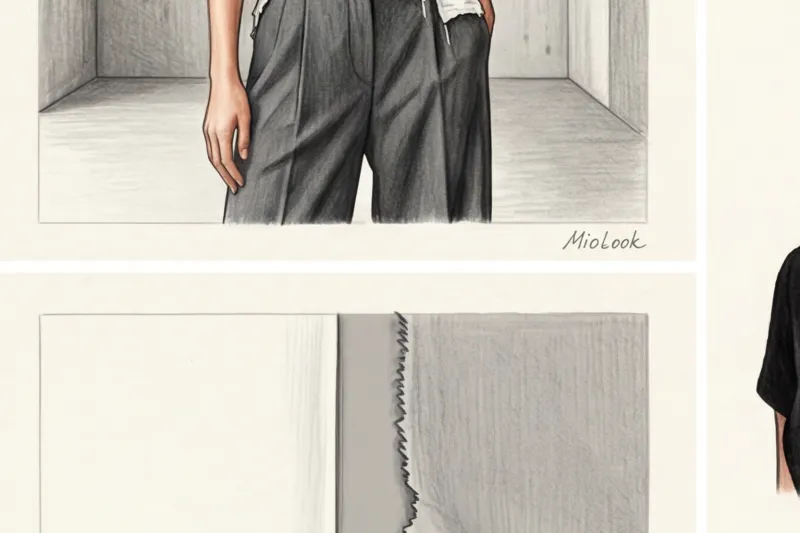
Stylist's advice: As a certified colorist and image consultant, I often use this technique to correct the silhouette. The diagonal folds running from the knot to the sides work according to the golden ratio—they create an optical illusion that visually narrows the waist by a few centimeters. The key is to wear this top with palazzo pants or full-length jeans to elongate your height. If you're unsure about combinations, upload a photo of your pants to MioLook — the application will suggest ideal proportions.
Method 2: Deconstruction with minimalist cuts
My favorite technique, inspired by Maison Margiela's DNA, is asymmetrical cutouts at the collarbone or shoulders that add a touch of fashion to a basic black or white T-shirt.
The strict rule of one accent applies here: the cutout should be in only one area. As soon as you add holes in the stomach, shoulder, and back at the same time, the item goes from "high fashion" to "I've been bitten by dogs" category.
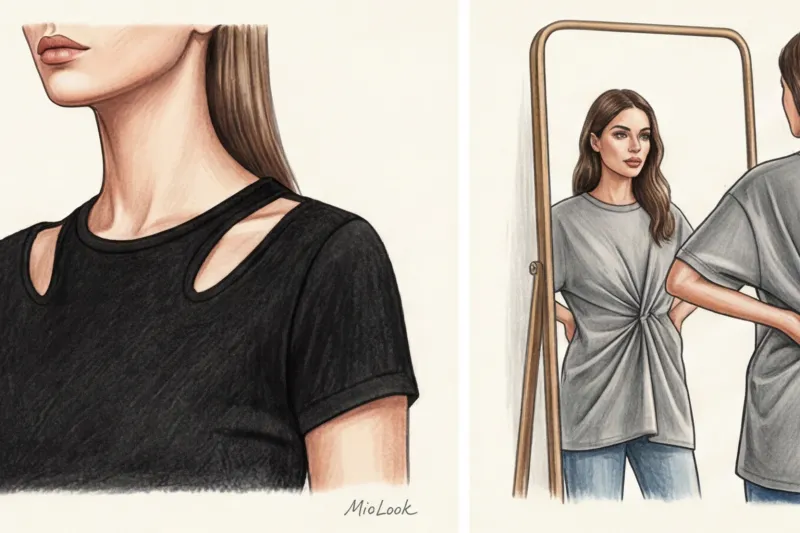
How to make a neat collarbone cutout:
- Put on a T-shirt and feel the sternal notch (the hollow between your collarbones). Move 3-4 cm toward your shoulder.
- Draw a narrow oval or diagonal slit 7-10 cm long along the collarbone line.
- Remove the item, pin the fabric (so as not to cut through the back!) and carefully cut along the outline.
- Magic trick: Grasp the edges of the cut and pull the fabric firmly in different directions. The cotton will stretch, and the edge will fold inward, hiding any minor unevenness in the cut.
Your ideal image begins Here
Join thousands of users who look flawless every day with MioLook. Digitize your wardrobe in just a few clicks.
Get access — €0.99 onceMethod 3: Transforming a Men's Oversized T-Shirt into a Draped Top (No Scissors)
There are situations (for example, an office dress code with casual Fridays) when a raw, ragged edge is unacceptable. This is a fair limitation of upcycling with scissors—it's not suitable for a corporate environment. But there is a solution.
A client once approached me: she was going to a Sunday brunch date and wanted to wear a flowing slip skirt, but the top was either too dressy or too boring. We took her husband's oversized gray T-shirt and created an intricate architectural drape.
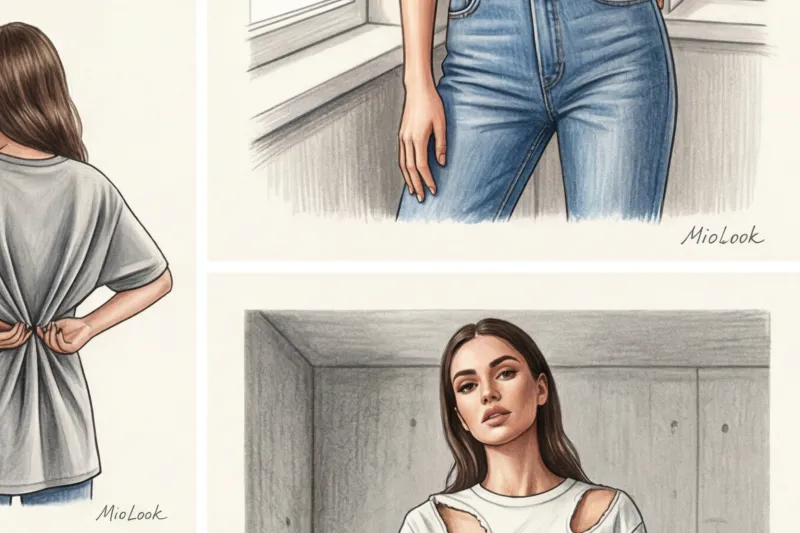
Hidden Knot Technique:
You'll need one tight elastic band. Put on an oversized T-shirt. Grab the excess fabric at the waist from the side (from the inside out!), pull the tail of fabric inward, and tie it tightly with the elastic band, like a regular ponytail. When you release the fabric, a luxurious radial drape will form on the right side, cinching the volume and accentuating the waist. This looks like a sophisticated tailoring from a luxury brand, but doesn't detract from the garment itself.
The Biggest Mistake: Why Your Upcycling Looks Cheap
I often encounter a popular myth: "Recycling a T-shirt is a field for endless creativity; you just need to add more and more." It's counterintuitive, but the most expensive upcycling is always minimalist. Fringe + random holes + rhinestones = a guaranteed failure. The most stylish pieces look like they were cut with mathematical precision.
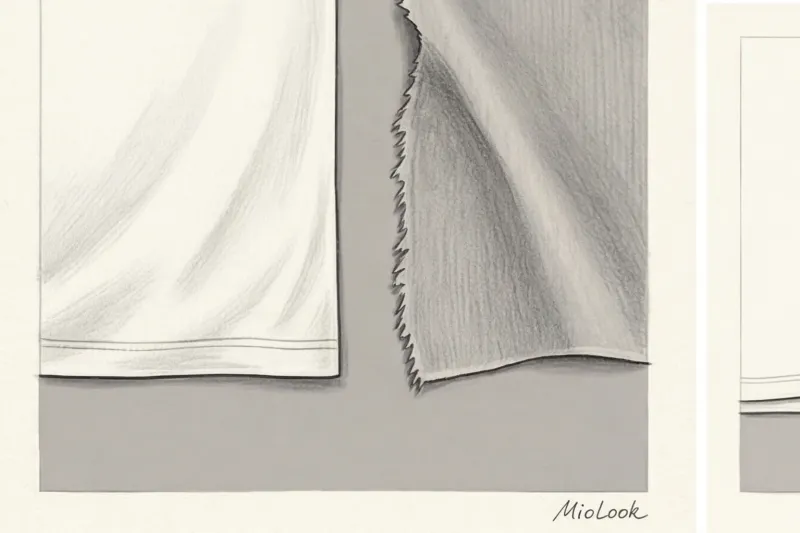
The second fatal mistake is ignoring shared thread Knitwear is knitted with loops both vertically and horizontally. If you cut crookedly, not respecting the direction of these loops, the garment will become crooked after the first wash. The side seam will fall onto the stomach, and the hem will become asymmetrical (and not in a good way). Always follow the ribs of the fabric.
Checklist: 5 steps before making your first cut
To prevent your work from ending up in the trash, we'll outline the steps used by professional tailors and stylists.
- Wash and iron the T-shirt. New cotton shrinks up to 5%. If you cut your top before washing, it may still be too tight tomorrow.
- Mark the points only on yourself. On the table, the object appears flat, but your body has volume. The waist point on the plane and on the figure are different coordinates.
- Use a ruler. Draw a clear line with chalk. Your eye will be 100% accurate on stretch fabric.
- Peel off the layers. If you are cutting the front and back at the same time (for example, shortening the bottom), pin them every 5 cm.
- The two-centimeter rule. Cut 2 cm below the marked line. You can always trim off the excess, but you won't be able to sew the fabric back (and the raw edge will curl, eating up about a centimeter of the length).
Don't be afraid to experiment with shapes, but do so mindfully. Think of a T-shirt not as a piece of old fabric, but as a canvas for sculpting. The right geometric cut can completely transform a silhouette and give a new life to an item that's been gathering dust on a shelf for years.
Ready to get started?
Try our free plan—no commitments required. Create stylish capsule wardrobes with your updated pieces in our app.
Get access — €0.99 once