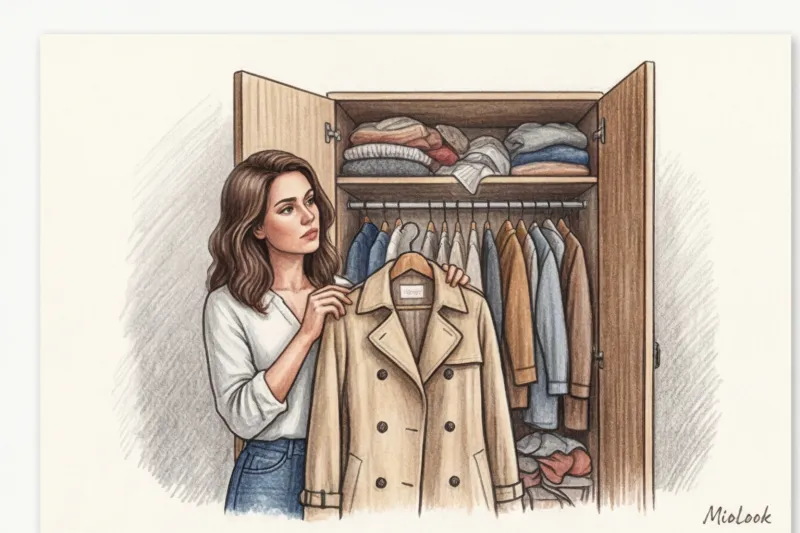
Have you ever wondered what item in your closet is the most harmful to the environment? Spoiler: it's not that old polyester jacket. The most toxic clothing for your budget and the planet is the one that sits forlornly on a hanger with the tags still attached, waiting for years for a "special occasion."
As an image consultant and colorist, I constantly encounter the same misconception. Girls are convinced that conscious clothing consumption — is an expensive luxury for the privileged few. Supposedly, you need to throw out all mass-market clothing and dress exclusively in premium organic cotton or hemp fabrics. But let's be honest: true eco-friendliness doesn't start with a credit card at an eco-boutique, but with a rigorous analysis of your closet. We've covered the tools that help you get this done in more detail in our The Complete Guide: MioLook – An App for Mindful Shopping and Wardrobe And today I'll show you how to cure your shopping addiction and make the things you already own work 100%.
What is mindful clothing consumption really? Debunking the myths
The most harmful myth of modern industry: to be eco-friendly, you need to buy the "right" things. In fact, the most eco-friendly item is the one that's ALREADY hanging in your closet.
I had a telling story in my practice. A client decided to become "sustainable," collecting her entire wardrobe from Zara, H&M, and Mango (around 80 perfectly usable items) in huge plastic bags and taking them to be recycled. In return, she spent over €2,000 on local eco-brands. She bought loose-fitting linen trousers, a top made from recycled ocean plastic, and a dress made from nettles. The result? A month later, she called me in tears because these beautiful, ethically sourced items clashed completely in texture and color. Her "eco-friendly" impulse had merely created a colossal carbon footprint by throwing away ready-to-wear clothing and triggering a new cycle of consumption.
According to McKinsey's "State of Fashion" report (2024), overconsumption, not fabric composition, is the industry's biggest threat. Buying a basic T-shirt with a green "Eco-friendly" label every month is greenwashing, not mindfulness. Your old synthetic jacket, worn for five years, is hundreds of times more eco-friendly than a new alpaca coat you'll wear twice.
The biggest enemy of ecology in your closet: "Lonely Thing Syndrome"
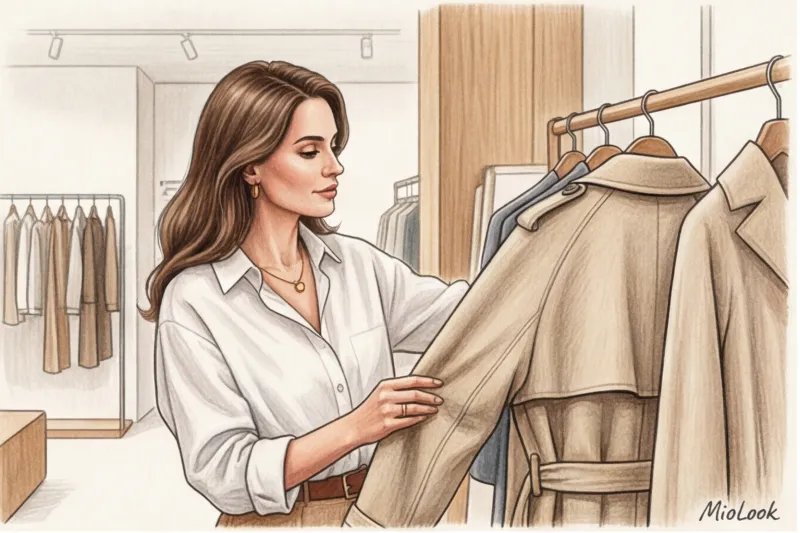
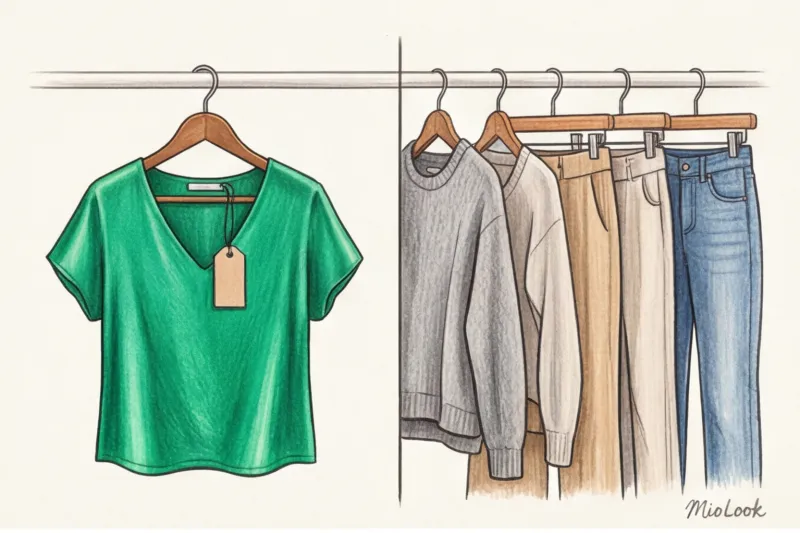
You walk into a store and see a stunning emerald silk top with intricate draping. At that moment, dopamine is released. Your brain conjures up a picture: you're sitting in a restaurant with a glass of wine, the light falling on the silk, you're flawless. You're not buying a top, you're buying a fantasy.
At home, the harsh truth is revealed: the top requires specific pants (your blue jeans will do the trick), seamless underwear in a specific shape, shoes you don't have, and a sleek hairstyle. The top goes in the closet. That's it. lonely thing syndrome.
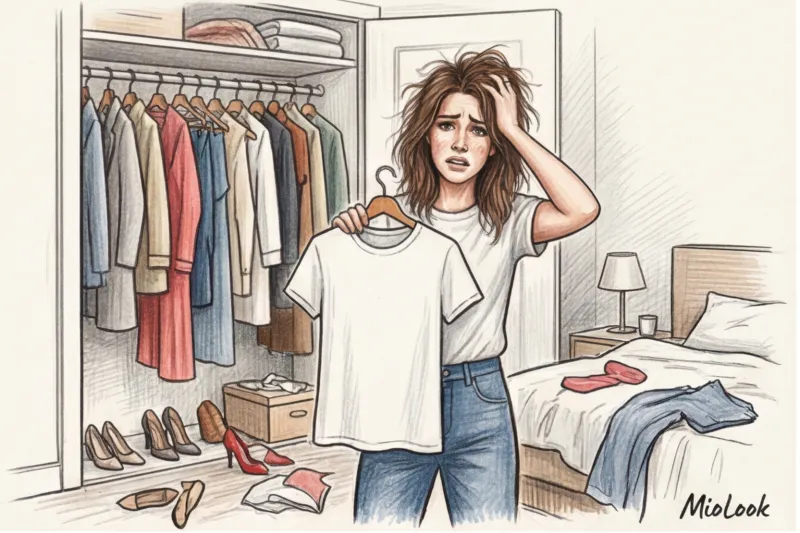
I recently conducted a wardrobe audit. We pulled out 120 items of clothing. Half of them had tags or had been worn only once. Statistics show that women spend about 50% of their budget on these incompatible "single items." They clutter the space, make you feel guilty, and whisper daily, "You have nothing to wear, go to the store."
Access to MioLook for €0.99 — one-time payment
A smart AI stylist will select the perfect look from your items and save you from impulse purchases.
Get access — €0.99 onceWhere to start with an eco-friendly wardrobe? The mathematics of style
A professional stylist always starts with numbers, not with discussing trends. We need to shift the focus from number of purchases on frequency of use each specific thing.
A deep audit instead of a new shopping spree
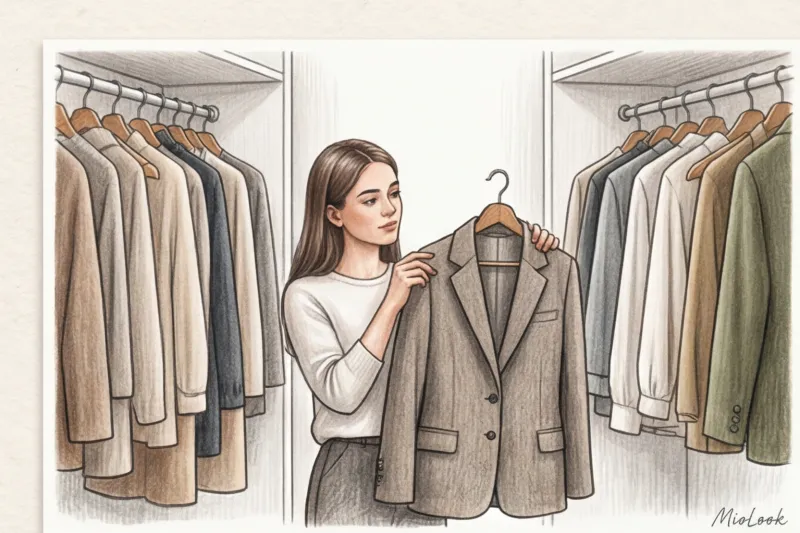
Take everything out. Absolutely everything. And sort it according to the three-stack rule:
- I wear it all the time: Things that make you feel confident right now. This is the core of your style.
- Requires intervention: items you love but need dry cleaning, repair, or alteration.
- "Lethargic sleep": Anything that hasn't been worn in over a year. Don't fool yourself—if you haven't worn it in 12 months, you'll never wear it. We donate, sell, or remake this pile.
Analyze the palette of the first stack. You'll likely see 3-4 dominant shades. These should become your guide for the future.
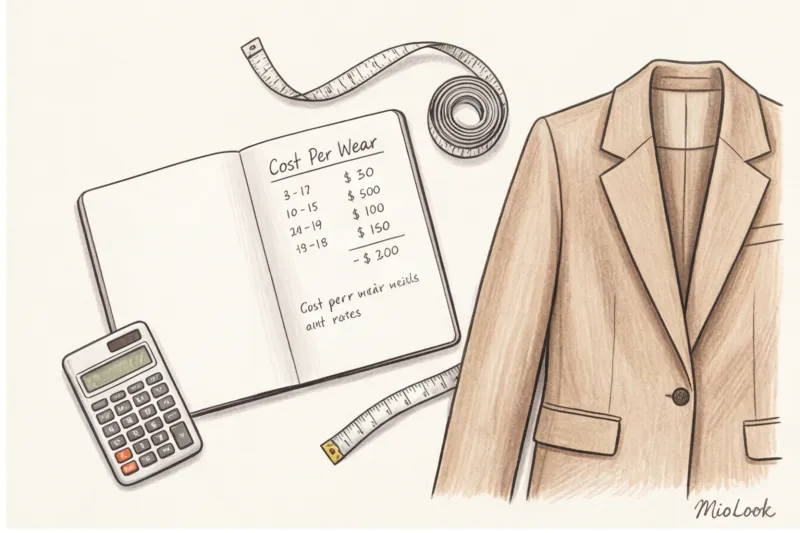
Cost Per Wear Formula
The Ellen MacArthur Foundation's data is shocking: the average person wears a purchased item only 7-10 times before throwing it away. To combat this, implement this formula into your life. Cost Per Wear (CPW).
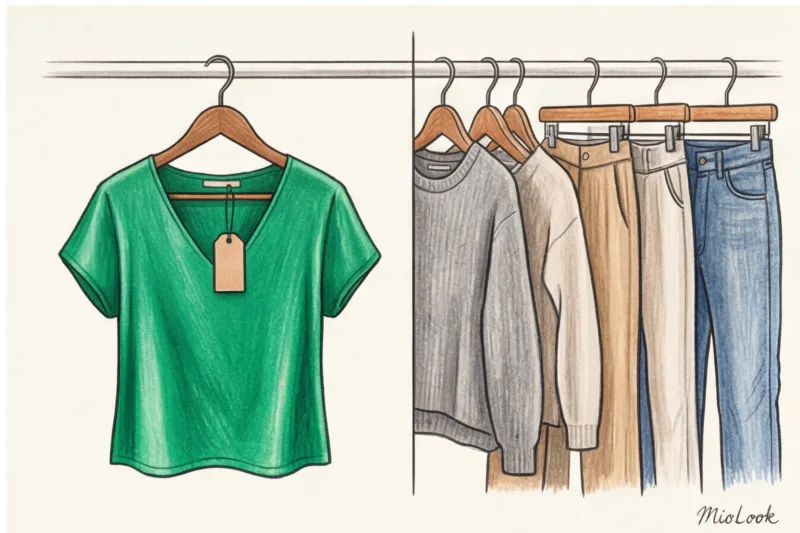
CPW = Item Cost / Number of Wears
Let's compare. A trendy, acid-colored T-shirt from a fast-fashion store costs €15. You'll wear it three times over the summer, then it will fade or you'll stop liking it. Its CPW is €5.
A quality basic wool blend jacket costs €150. You'll wear it to the office, layered over old mane style look Wear it with jeans on weekends and over a dress in the evening. You'll wear it at least 100 times in two years. Its CPW is €1.50.
A "cheap" T-shirt costs your budget and the planet three times more!
The capsule approach as a foundation for conscious consumption
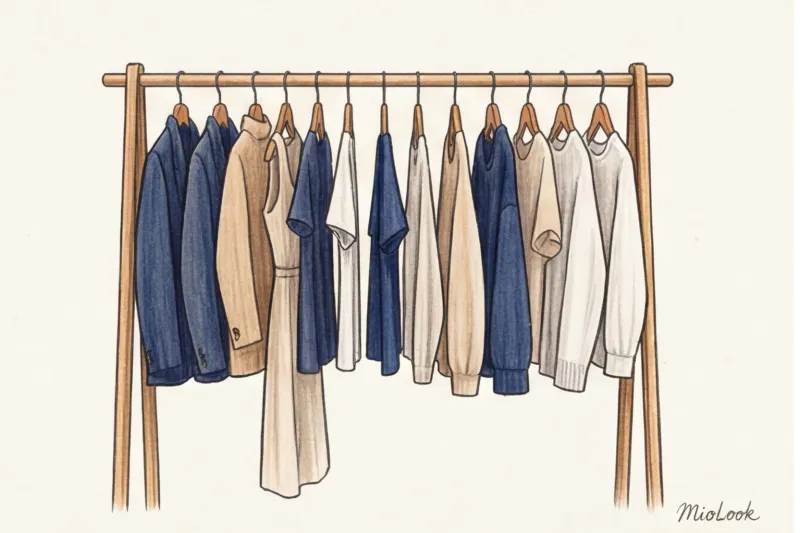
Susie Fo first proposed the capsule wardrobe idea back in the 1970s. The capsule isn't about wearing only gray and beige. It's about architecture: the pieces fit together like Lego bricks.
The golden rule of a stylist: For every bottom (pants, skirt) in your closet, there should be at least three matching tops. Why? Because people remember your appearance. You can wear the same perfectly fitting pants three days in a row, changing your shirt, sweater, and T-shirt with a jacket—and no one will notice the repetition. If you buy complicated printed pants that only go with one specific blouse, you're artificially limiting your style.
To avoid mistakes, add a photo of the item to the app before purchasing. MioLook and visually align it with photos of your current pants. Artificial intelligence will immediately show you if the puzzle fits together.
Color and eco-friendliness: how a palette can save your budget
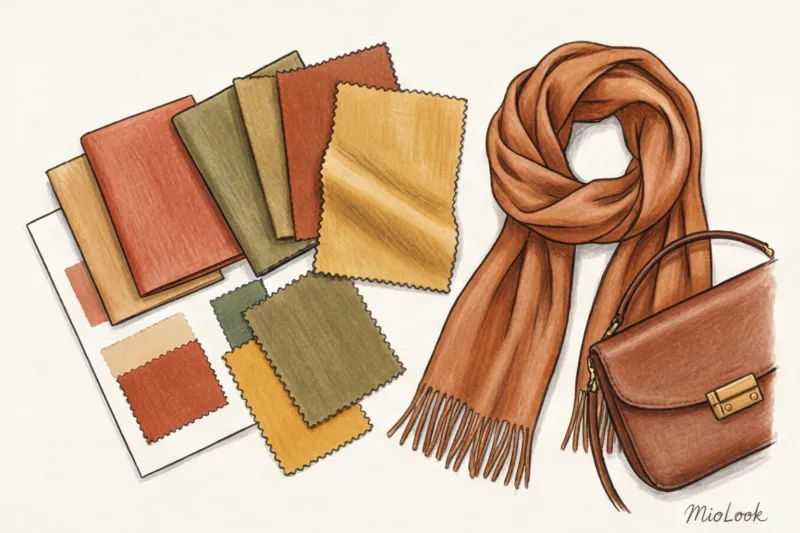
As a certified colorist, I guarantee: knowing your color type is a powerful financial tool. Chaotic colors breed those "lonely pieces." You buy a powder-pink sweater, only to discover that all your pants have a warm, rusty-mustard undertone. The end result is a sickly look, your clothes clash, and the sweater ends up on the shelf.
Creating a color scheme solves this problem. Choose two or three basic neutral shades (e.g., graphite, deep blue, or off-white) and two or three accent colors in your temperature range (e.g., emerald and burgundy). If all your clothes are in the same temperature and contrast range, the compatibility of your pieces automatically increases by 80%.
Your ideal image begins Here
Join thousands of users who look flawless every day and save money with MioLook.
Get access — €0.99 onceThe Second Life of Things: We Style, Repair, and Customize
Research shows that extending the life of clothing by just nine months reduces its carbon footprint by 20-30%. But what if you're tired of it or it's outdated? Here are three tips from my personal experience:
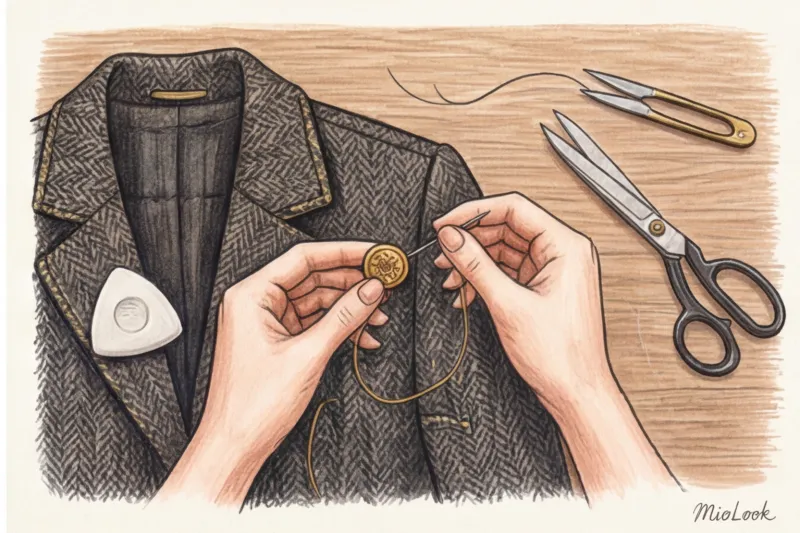
- Replacement of fittings. This is my favorite trick. An ordinary black jacket from a mass-market store for €50 looks exactly like its price because of cheap plastic buttons. Buy vintage metal or horn buttons for €10 at a fabric store. Resew them, and the jacket will look like a premium designer item, perfectly fitting into your outfit. French style of clothing.
- Home coloring. My clients often complain about faded cotton basic T-shirts (180 g/m² and above) losing their rich black color. Instead of throwing them away, I use a washing machine textile dye. For €8, you can restore the color of three or four high-quality items at once. But Please note: this only works with natural fabrics (cotton, linen, viscose), synthetics will not accept the dye..
- Hidden layering. A summer silk slip dress doesn't have to hang in your closet from October to May. Layer it with a thin cashmere turtleneck and a chunky knit cardigan over it. You'll get a sophisticated, warm winter look without any extra purchases.
Checklist: 5 questions for a stylist before buying a new item
To make mindful clothing consumption a habit, turn your shopping trip (or online catalog scrolling) into a mindful process. Before you take an item to the checkout, honestly answer these five questions:
- Will I be able to create at least 3 looks with her from what I already have? If you need to buy two more items to integrate them, leave them in the store.
- Where exactly am I going to wear this next week? Not in a year for that mythical party, but in the next seven days. If there's no response, the purchase is canceled.
- Am I prepared to care for this fabric? A silk blouse requires delicate washing or dry cleaning. If you hate ironing and prefer to throw everything in the washing machine at 40 degrees, this item will quickly become unusable.
- Am I buying a thing or a “fantasy about myself”? Assess objectively whether the cut matches your real, everyday lifestyle.
- What will I give away or sell to make room for something new? The "one in, one out" rule will forever save you from an overcrowded closet.
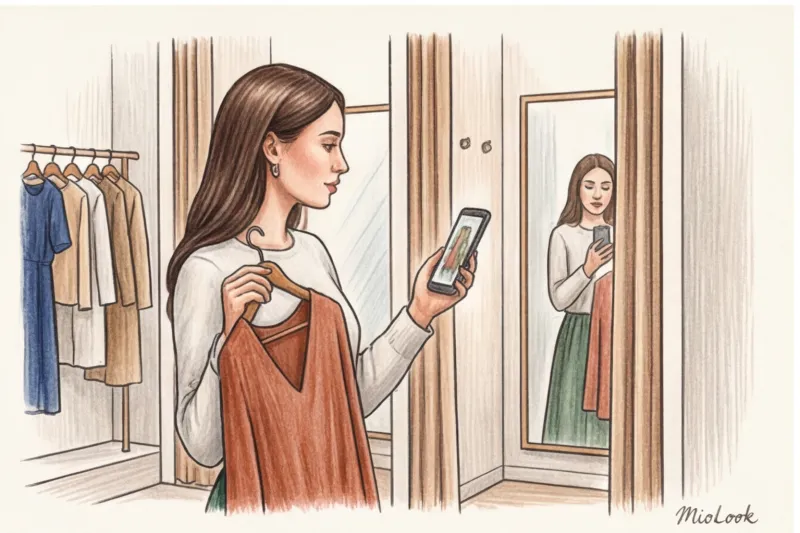
If in doubt, take a photo of the item on yourself in the fitting room and upload it to the virtual fitting room. MioLook AI will analyze your body shape and existing database, giving an unbiased verdict.
Mindfulness isn't suffering or giving up beautiful things. It's a way out of the endless hamster wheel of "bought it, didn't fit, threw it away." Start treating your wardrobe not as a dumping ground for random emotions, but as an investment portfolio. And you'll be surprised how much more freely you and your planet will breathe.