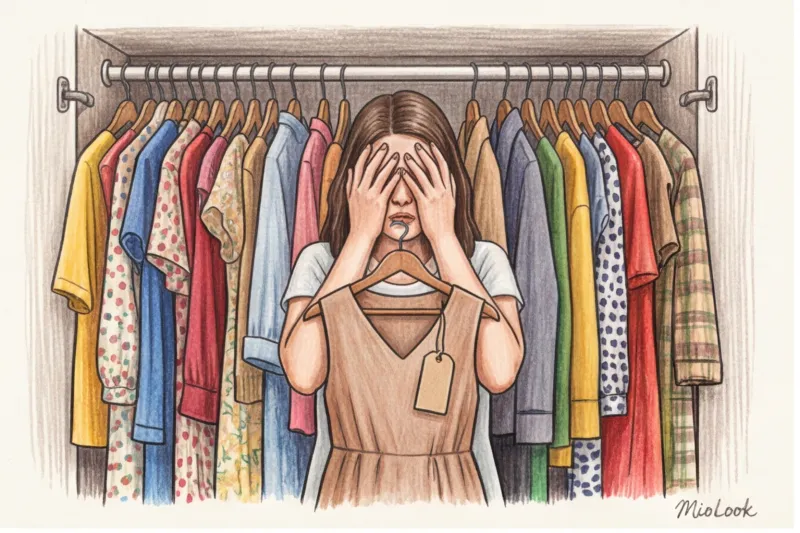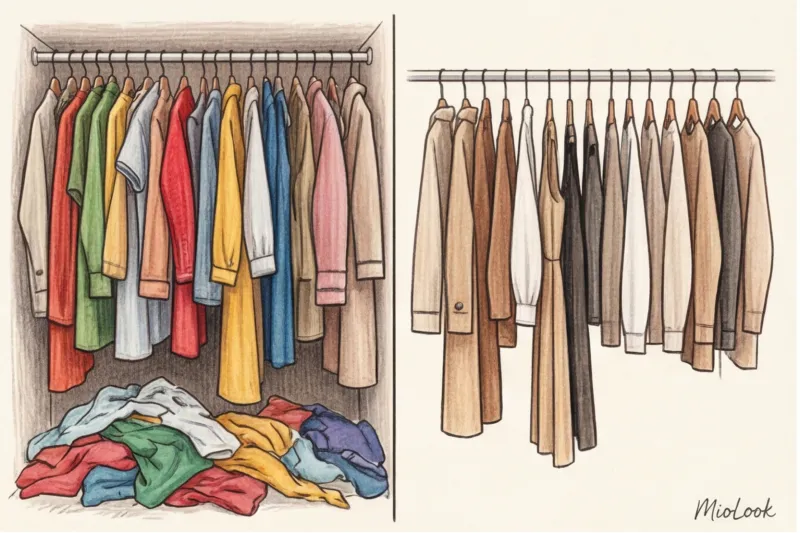
One day, a client of mine burst into tears right there in her dressing room. She had about three hundred hangers full of clothes from Zara to Prada hanging in front of her, but all she could say was, "I'm so tired of making decisions and still have nothing to wear." This scene perfectly illustrates the main problem of our time: visual and cognitive wardrobe obesity. We buy more than we can process.
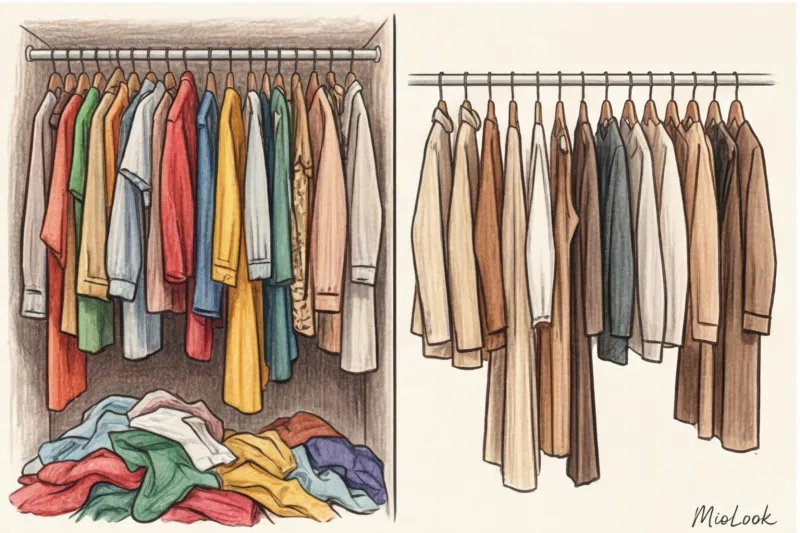
We talked in more detail about how our emotions control the contents of the closet in our the complete guide to wardrobe psychology But today I want to talk about a solution to this problem. Over 12 years of working as a stylist at fashion weeks and in private practice, I've realized: conscious consumption in clothing — it's not just about buying an organic cotton T-shirt. It's a radical shift in thinking. It's about using minimalism not as a fashionable aesthetic, but as a psychological tool for reducing anxiety.
What is conscious consumption in clothing really?
Let's be honest: mass-market marketing has brilliantly brainwashed us. They've convinced us that if we buy jeans made from recycled denim or a sweater with a green "Eco-friendly" tag, we'll save the planet. This greenwashing makes women buy more things, just with less guilt.
But true mindfulness works differently. According to a 2017 study by the Ellen MacArthur Foundation, today we wear an item on average only 7-10 times before discarding it. In my practice, the situation is even more dire: when conducting audits, I regularly see closets where about 30% of items still have their tags. Women buy them for the micro-dopamine rush at the checkout.
Conscious consumption begins with a paradigm shift: from the question "What else should I buy to look stylish?" to "How can I get the most out of that thick silk top already hanging in my closet?" It's a strict filter against information noise and imposed micro-trends that become outdated faster than you can peel off the label.
Access to MioLook for €0.99 — one-time payment
A smart AI stylist will select the perfect look.
Get access — €0.99 onceThe Psychology of Minimalism: Why Does an Empty Closet Make You Breathe Easier?
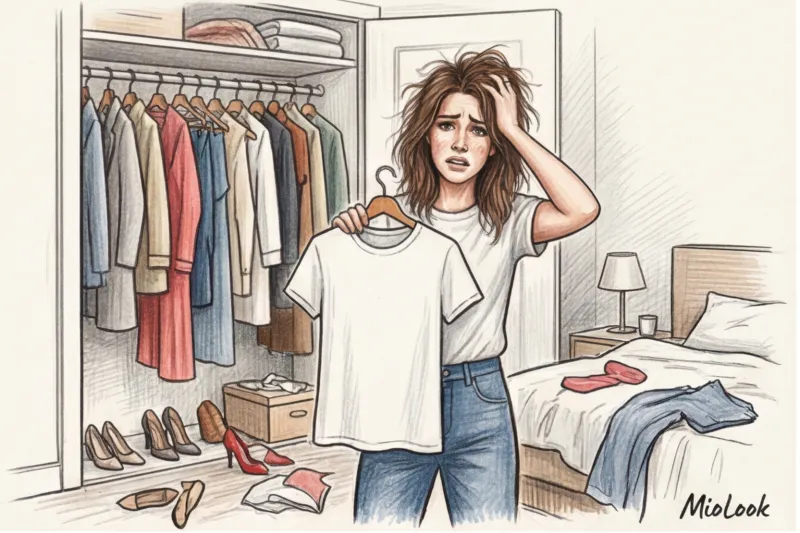
Have you ever noticed how your shoulders physically tighten when you open a crowded, cluttered closet? I call it the "cortisol closet." The visual noise triggers background anxiety even before you've had your morning coffee.
In his landmark book, The Paradox of Choice (2004), Barry Schwartz demonstrated that the more options we have, the less satisfied we are with the final decision. When you have 1,500 possible clothing combinations, your brain expends a colossal amount of energy filtering out the bad ones. Reducing the number of micro-decisions you make in the morning saves up to 15% of your cognitive resources throughout the day.
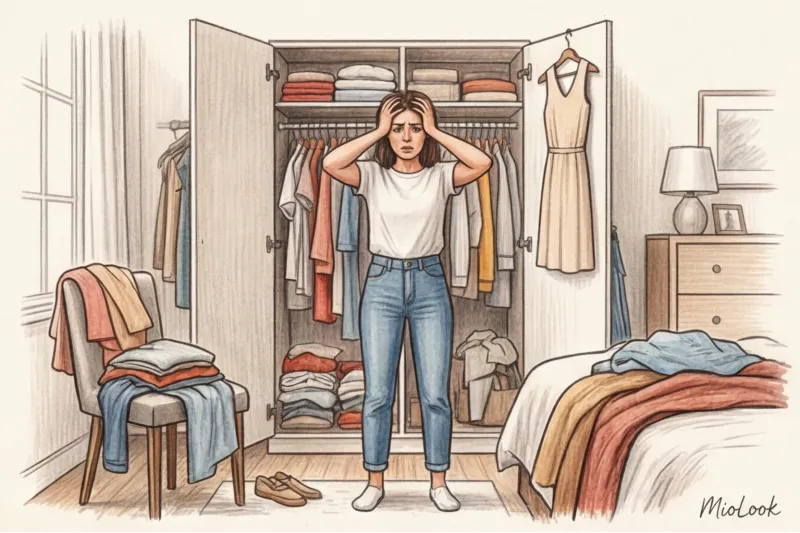
The Pareto principle works flawlessly in the wardrobe. We wear 20% of our clothes 80% of the time. These include those perfect straight-leg jeans, that merino wool sweater. When I remove 70% of unnecessary items from my clients' line of sight (to high shelves or into trunks), something incredible happens: their posture changes. The physical relief of being left with 30 perfect items is visible in their bodies. The focus shifts from the pursuit of visual novelty to physical comfort.

Toxic Detox: Why Radical Decluttering Often Doesn't Work
Here I'll say something I'm often criticized for by proponents of radical minimalism: the Marie Kondo-style method of aggressive decluttering (throwing out everything that doesn't "spark joy" right now) is fraught with enormous danger. It often leads to a "wardrobe boomerang."

One of my clients, in a fit of rage, threw out six huge trash bags of clothes. Yes, she experienced a dopamine rush from the purge. But three days later, she opened her empty closet, panicked, and... went to Zara, buying half the new collection. Over the course of a year, she spent over €2,500 on re-creating the same basic turtlenecks and trousers she'd thoughtlessly thrown out.
The dopamine trap of decluttering is that we derive pleasure from the act of discarding, ignoring systemic analysis. The popular rule "haven't worn it in a year, throw it away" is destructive. Perhaps you didn't wear that perfect jacket because you didn't have the right bottoms, or you were on maternity leave. Instead of a trash bag, I always recommend the "quarantine" method: put questionable items in a box for six months. If you don't remember them, recycle them.
From Chaos to Zen: 3 Steps to a Stress-Free, Mindful Wardrobe
The transition to minimalism doesn't have to be painful. Here's the algorithm I use in my work for a gentle transformation of my thinking.
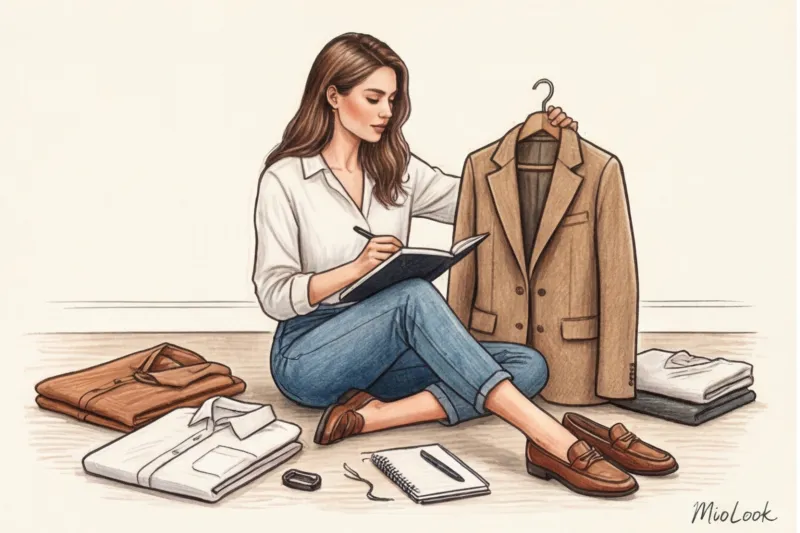
- Step 1: Information Detox. Unsubscribe from all online store newsletters and from influencers whose content is based on unboxing videos. You won't be able to stick to a diet if your entire Instagram feed consists of éclairs.
- Step 2: Cooling off period (30 day rule). Put a moratorium on all purchases for exactly one month. During this time, the urge to buy "that trendy dress" usually fades, giving way to rationality.
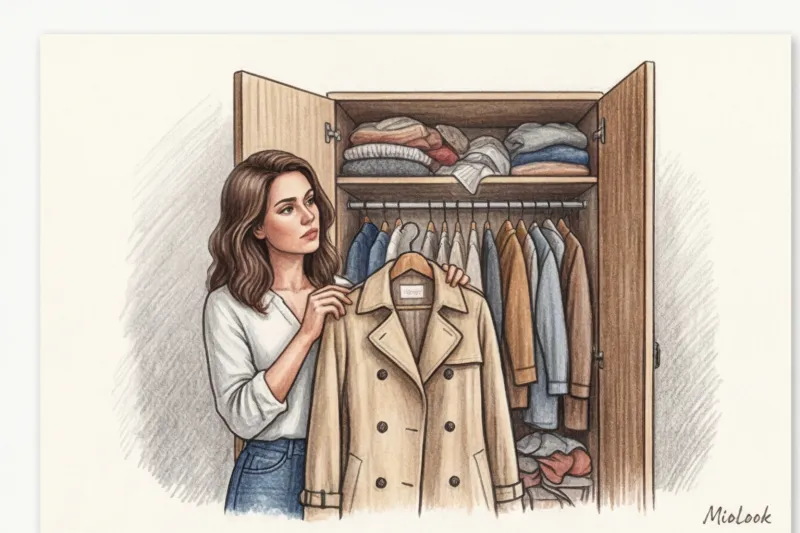
- Step 3: Shopping in your own closet. The most exciting part. I often have clients digitize their belongings in an app like MioLook and start creating unexpected pairings. We take a summer slip dress and layer it with a chunky winter sweater. The result? 15–20 completely new looks without spending a cent.
Your ideal image
it begins Here
Join thousands of users who look flawless every day with MioLook.
Get access — €0.99 onceCost Per Wear (CPW): How Math Can Cure Shopping Addiction
My favorite tool for bringing me back to reality is calculating my cost per wear. The formula is simple: divide the item's price by the expected number of wears.
Herein lies the main paradox of conscious consumption. Let's say you bought a heavy cashmere coat for €900. You wear it every day for three seasons (at least 150 days a year). After two years, your CPW will be: €900 / 300 wears = 3 € per exit.

Now let's take a trendy thin acrylic blouse for €45. You wore it three times to parties, after which it became pilled, stretched out, and went in the trash. Its CPW: €45 / 3 = 15 € per exit.
The "cheap" sweater cost you five times more than the premium cashmere. Mathematics is merciless, and it's the best cure for the urge to buy everything during seasonal sales.
How Conscious Clothing Transforms Your Personal Style
Many people fear that minimalism will make them boring. Thirty items in a wardrobe is supposedly a death sentence to a drab uniform. In fact, it's quite the opposite. Limitations reveal your true style DNA.

"True style is born where excess ends. By removing visual clutter, you finally give your best features a chance to speak."
Think of Phoebe Philo's aesthetic at Celine or Jil Sander's 90s minimalism. It's always about architectural cuts and luxurious textures, not flashy logos. When you have few pieces, you're forced to invest in quality (we wrote about this in detail in guide to choosing fabrics ). You go from being an Instagram fashionista who blindly copies trends to being a woman with impeccable taste (Signature Style).
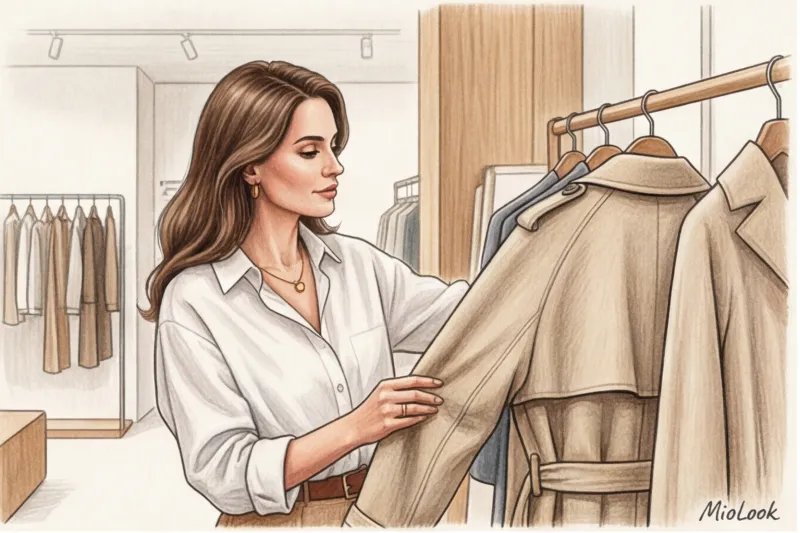
Your eye for detail sharpens. You begin to see the timeless potential of a piece: how that particular trench coat would look with an evening dress or a tracksuit on the way to the croissants.
Stylist Checklist: 5 Questions to Ask Before Every New Purchase
To reinforce this skill, I give my clients a strict checklist. Before you take an item to the checkout (or click "Pay"), ask yourself five questions:
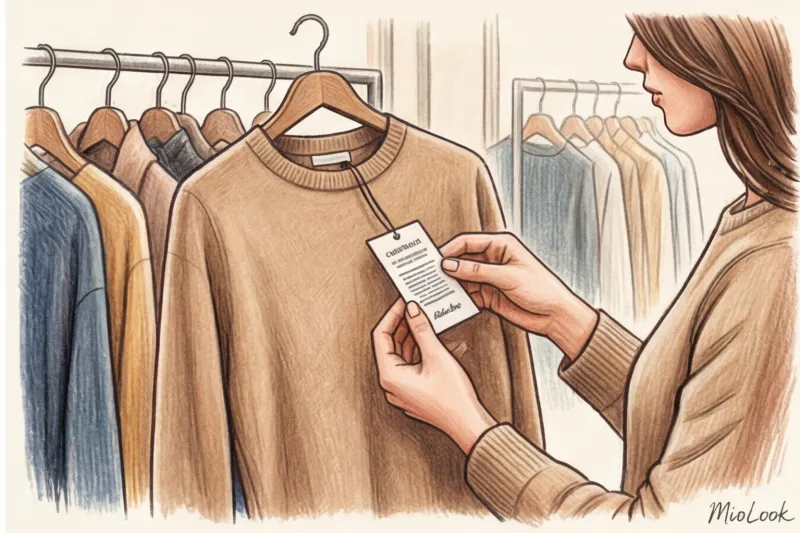
- Will I be able to create at least 4 different looks with this item right now in my mind, using what's already hanging in my closet? If the answer is “no” or “I’ll need to buy some shoes to go with it,” the item stays in the store.
- Am I prepared to care for this fabric? A €150 silk blouse is lovely, but if you hate hand washing and aren't willing to pay €20 a month for dry cleaning, it's dead weight.
- Does it duplicate the functionality of what I already have? Why do you need a fifth pair of black trousers if the first four are in excellent condition?
- Is this really "my" thing, or did I succumb to the influence of a social media stylist? Take a video of the item in the fitting room (not a photo, but a moving video) and look at yourself from a distance.
- What do I feel in her right now: confidence or doubt? If you have to constantly tug at a garment, adjust the collar, or suck in your stomach, it's a bad investment.
Important clarification: I have to admit that this approach doesn't work for 100% of women. If you're the dramatic maximalist type (remember mob wife style For those like Iris Apfel, for whom changing clothes five times a day is a creative process and a source of energy, rigid capsule minimalism can be stifling. And the CPW formula is pointless to apply to a wedding dress or couture.
But for 90% of modern women living in the fast-paced urban world, a mindful wardrobe is a breath of fresh air. It's the opportunity to open your closet every morning and see not a chaos of unresolved problems and wasted money, but a clear, beautiful tool for self-expression.