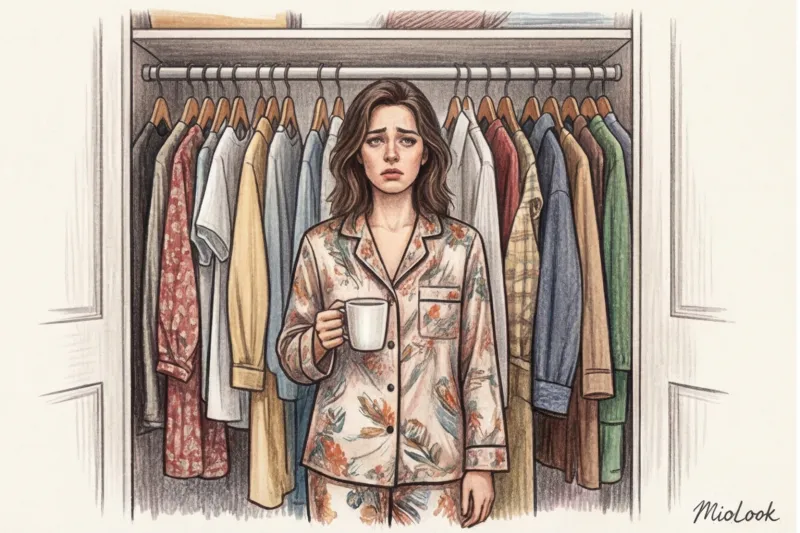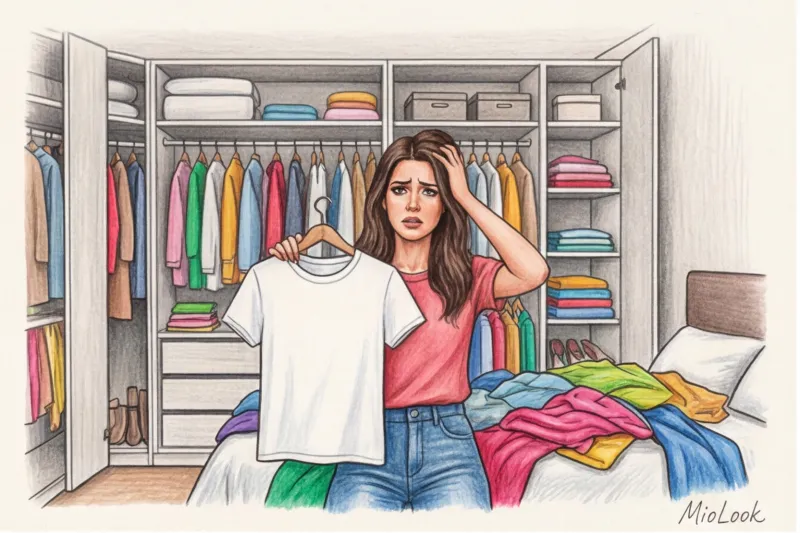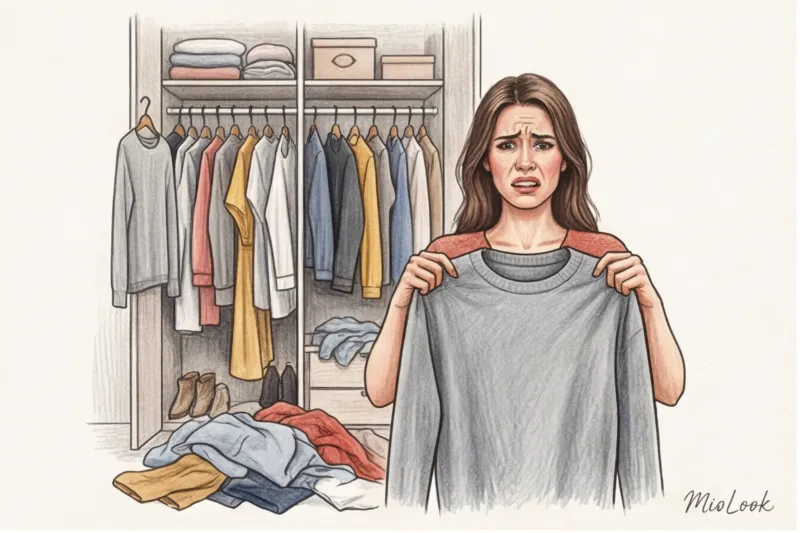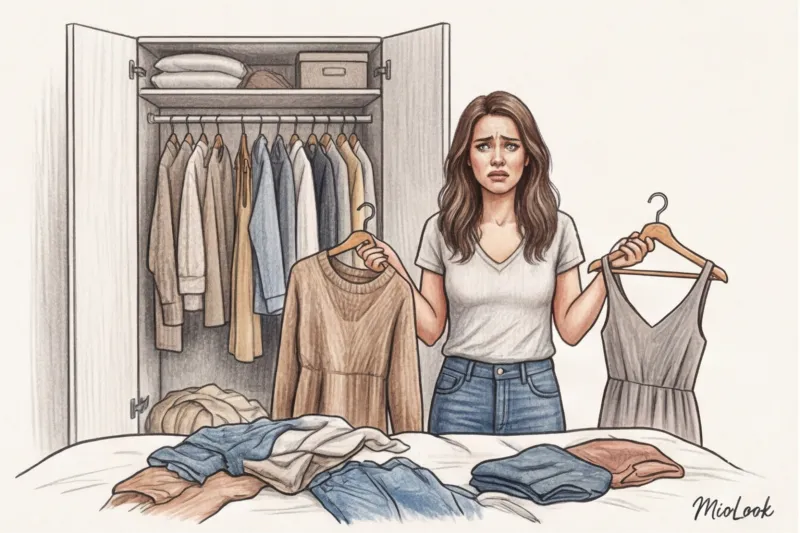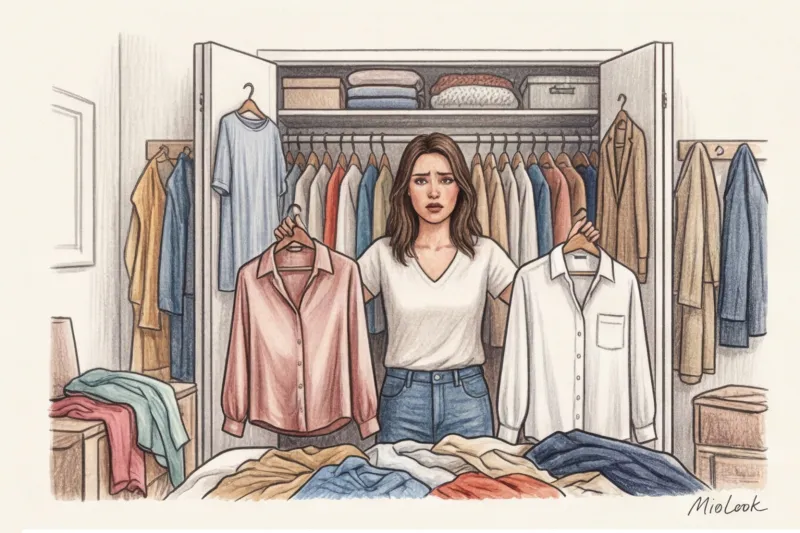
In my 14 years as a personal stylist, I've seen many tears in dressing rooms. But one incident changed my approach to the profession forever. The CEO of a large IT company approached me. She had a stunning closet, full of perfect silk blouses in the €150-€300 price range, perfect trousers, and cashmere jumpers. And yet, every morning, she literally cried from frustration as she gazed at this magnificence.
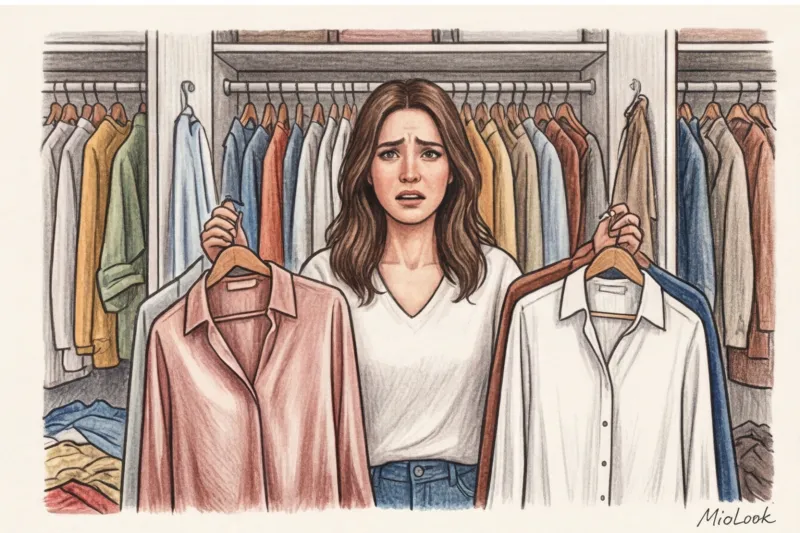
The problem wasn't the figure, the quality of the clothes, or even the lack of taste. It was a classic tired of choosing clothes A condition where the simple act of getting ready in the morning drains the resources needed to manage a multi-million dollar business. We discussed this phenomenon in more detail in our the complete guide to wardrobe psychology , but today I want to analyze the mechanics of this process.
Have you ever noticed that getting dressed on vacation with just one small suitcase is much easier than at home with a huge walk-in closet? It's not the magic of travel. It's the cognitive load and data management.
The Anatomy of Stupor: What is Clothing Fatigue?
There is a term in psychology decision fatigue (decision fatigue). Back in the 1990s, social psychologist Roy Baumeister coined the term "ego depletion." Its essence is simple: our ability to make quality decisions and exercise willpower is a finite resource, like the battery life of a smartphone.
One of my clients once physically struggled to choose an outfit before an important pitch presentation. She changed her outfit six times, her cortisol levels were through the roof, and she ended up going to the meeting in jeans and a hoodie, feeling completely exhausted. The phrase "I have nothing to wear" in front of a full closet isn't a woman's whim. It's the defensive reaction of an overloaded brain that refuses to process a database of hundreds of visual objects.
When you have 200 items, you're not just choosing what to wear. You're conducting a complex visual and tactile analysis: texture pairings, temperature conditions, appropriateness of the occasion, your own mood, and comfort.
The Paradox of Choice: The Mathematics of Your Closet
In 2004, American psychologist Barry Schwartz published the "Paradox of Choice" theory, proving a counterintuitive fact: an excess of options does not make us freer; it paralyzes us and reduces satisfaction with the final decision.
Let's do the math. Let's say your closet contains just 30 "bottoms" (jeans, pants, skirts) and 50 "tops" (shirts, tops, sweaters). Basic combination theory tells us that's 1,500 possible combinations! Add to that 10 pairs of shoes and 5 bags.
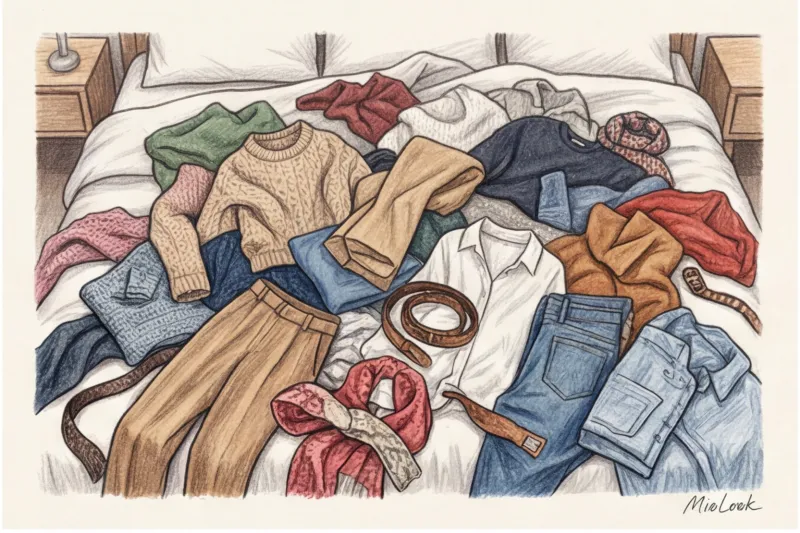
At 7:30 AM, your brain is forced to solve an analytical task comparable to the GMAT. No wonder you grab the same trusty Zara jeans and gray sweater, feeling a sense of irritability.
The Hidden Cost: How Morning Rumination Is Eating Away Your Productivity
According to neuroscientists, the average person makes about 35,000 conscious and unconscious decisions per day. Choosing your clothes in the morning can consume up to 5% of this daily resource. This is called the "decision budget."
Consider the ROI of your morning time. You're wasting mental energy deciding whether to tuck your white shirt into your pants completely or halfway instead of thinking about your negotiating strategy.
Access to MioLook for €0.99 — one-time payment
A smart AI stylist will select the perfect look and save your morning time for more important tasks.
Get access — €0.99 onceThat's why Steve Jobs, Mark Zuckerberg, and Barack Obama chose a "uniform." Obama said it directly: "I don't want to make decisions about what I eat or wear because I have too many other decisions to make.".
Of course, this doesn't mean you have to wear the same gray T-shirt every day. We can adapt this principle without losing style, replacing the chaos with a smart capsule system of quality basics (for example, Massimo Dutti or COS in the €80–€150 range), where everything goes with everything.
The "night before" myth and other non-working tips
Open any article on time management, and the first point will be: "Prepare your clothes the night before." As a practicing stylist, I can honestly say that this advice irritates 90% of my clients.
"In the evening, after 10 hours at the office and putting the kids to bed, I want to pour myself a glass of wine and turn on a TV series, not work as my own personal stylist."
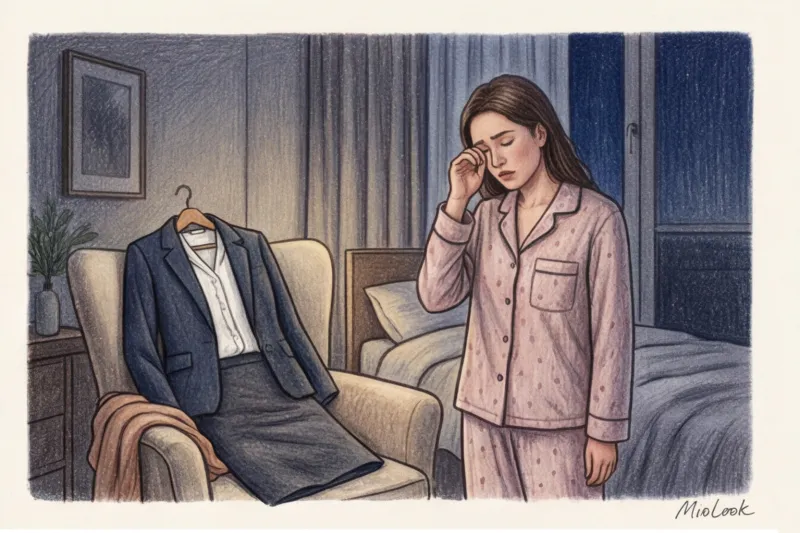
Why does this method often fail?
- Changing context: In the evening you were full of energy and chose a strict layered look with a hoodie and jacket And in the morning you wake up with a slight headache, and you want to wrap yourself in something soft and oversized.
- Weather change: The forecast promised sun, but freezing rain started.
- Problem transfer: You don't solve the problem, you just transfer the cognitive load to the evening, when your "solution budget" is already zero.
The real solution is not to transfer choice, but to eliminate it entirely through smart capsules and digitalization.
Digitizing Your Wardrobe: How Technology Takes the Pain Out of Choosing
When you move from a cluttered physical closet to a digital catalog, magic happens. By offloading data from your head to your smartphone, you free up your brain's "RAM."
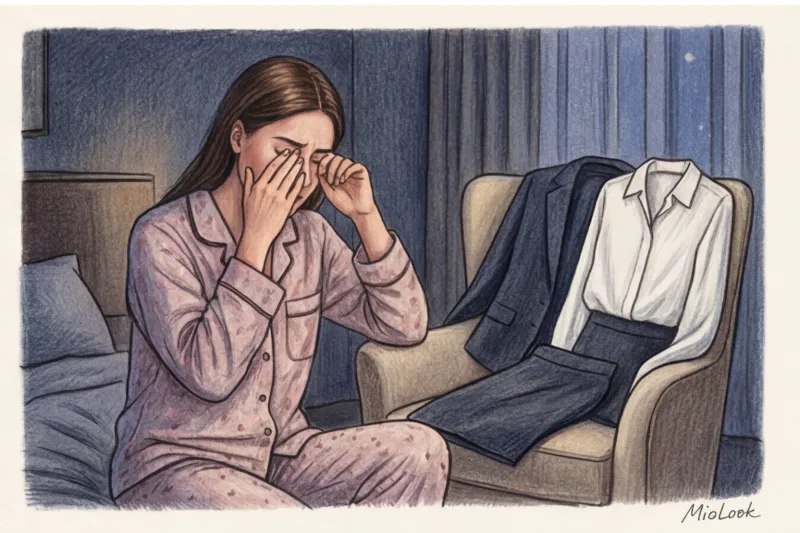
As part of a personal experiment, I digitized my wardrobe in MioLook app Before, as a stylist, I spent about 18 minutes getting ready in the morning (a professional distortion—I wanted perfect combinations). After digitalization, that time dropped to 3 minutes.
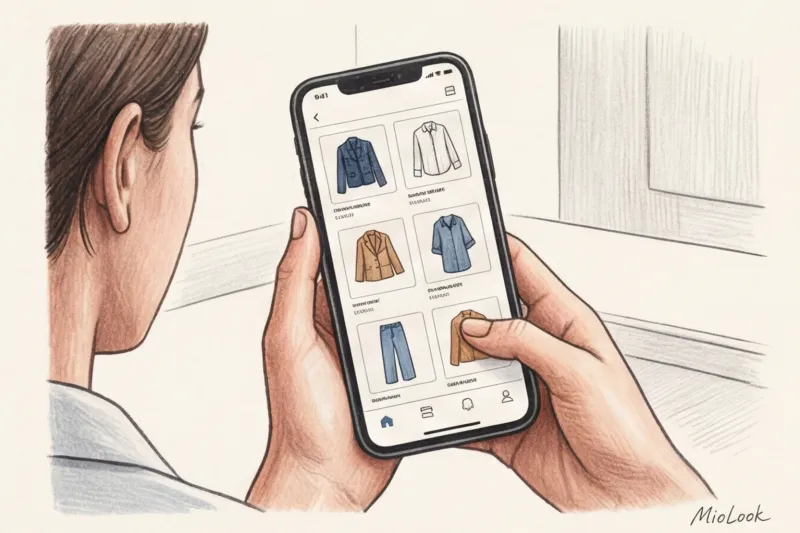
How does this work in practice? You don't stand in front of your closet. You drink your morning coffee, open the app, select the tag "office, 20°C, business meeting," and get five ready-made, flawlessly composed outfits from your very own clothes. Your brain simply chooses from five options, not 1,500.
Your perfect look starts here
Join thousands of users who look flawless every day with MioLook. Digitize your wardrobe and forget the agony of choosing.
Get access — €0.99 onceHowever, there's a significant limitation here. Frankly, digitalization doesn't work if you're digitizing 300 items, 80% of which are too small, worn out, or obsolete. An app won't sew you new pants. Therefore, before implementing technology, a ruthless cleaning is necessary.
An Algorithm for Overcoming Wardrobe Burnout
During my first consultation with clients suffering from excess possessions, I always use the same step-by-step framework. It's painful for the first two hours, but provides incredible relief afterward.
- Audit according to the 80/20 rule. Statistics are relentless: we wear 20% of our clothes 80% of the time. Find your "working" 20%. Remove the rest from the active areas of your closet (in boxes, under the bed, on top shelves).
- Creation of micro-capsules. Divide your life into sections. You should have a mini capsule for "office," a capsule for "weekends out of town," and a capsule for "evening." Items within each capsule should be 100% coordinated in color and texture.
- Implementation of Outfit Formulas. These are ready-made, structured solutions. For example: wide-leg palazzo pants + fitted knit top + structured jacket. You simply change the colors of this formula, but the silhouette remains the same and always flatters your figure.
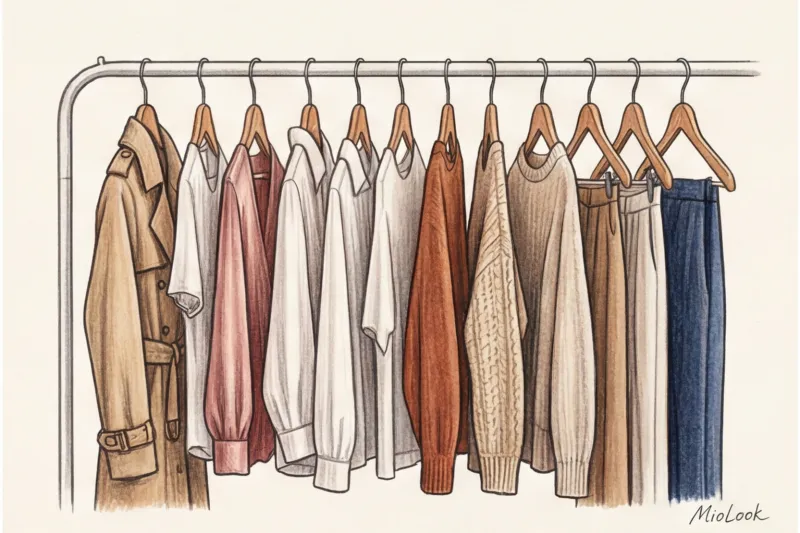
The "Personal Uniform" Concept for Challenging Days
Every woman should have one signature look — your personal uniform. These are 3 fail-safe outfits for days when everything falls apart.
For me, it's dark blue straight-leg jeans, a white men's-style shirt (180g/m² cotton for a great shape), and black loafers. I invested about €400 in this look, but the ROI exceeds all expectations. I put it on with my eyes closed and look put-together.
Create three of these looks. Take photos of them (or save them to a lookbook on your phone). Make a promise to yourself: if getting ready in the morning takes more than 5 minutes and you start to feel nervous, you'll stop trying to be creative and put on "uniform #1."
Checklist: 5 Signs Your Closet Is Stealing Your Energy
How do you know if you're in the wardrobe burnout zone? Check yourself against these five criteria:
- You change clothes more than twice before leaving the house, leaving a pile of clothes on the bed.
- You have “clone items” (for example, 5 almost identical black turtlenecks) that you get confused about.
- You are regularly late for work or meetings solely because of problems with choosing clothes.
- You feel guilty looking at new clothes with tags that have been hanging in your closet for six months.
- You wear the same 3 looks, aggressively ignoring the remaining 80% of your expensive wardrobe.

If you checked at least two of these boxes, it's time to change your system. Clothes fatigue isn't a death sentence for your style; it's a technical flaw in your wardrobe system. And this flaw can easily be fixed with proper organization and technology.
Ready to get started?
Try MioLook's free plan—no commitments required. Digitize your favorite things and wake up tomorrow with a clear mind.
Get access — €0.99 onceClothes should give you strength and confidence, not drain them before breakfast. Treat your morning attention like your most precious currency. Invest one weekend in decluttering your closet and digitizing it. The key insight you'll gain is: when you have fewer choices, you have much more style.