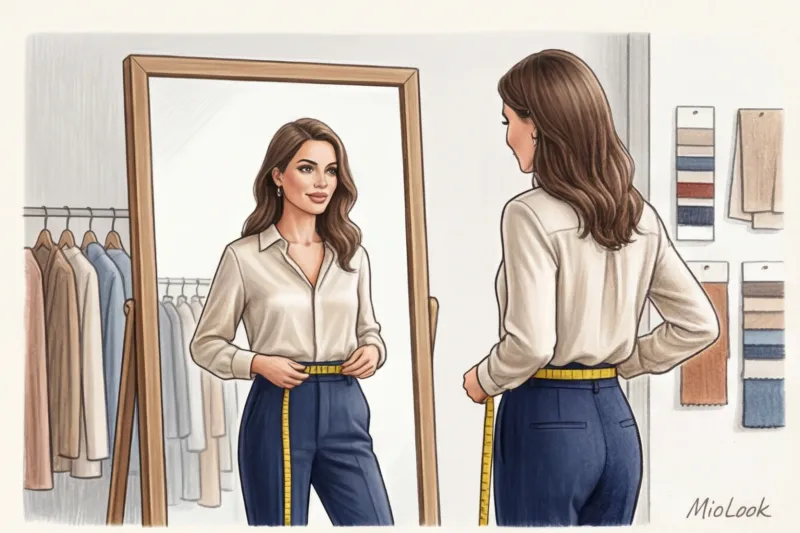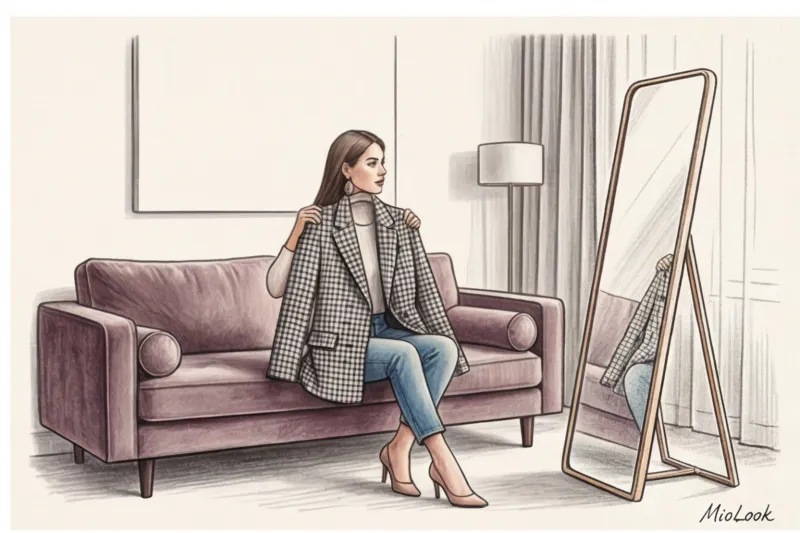
Over 12 years as a stylist, I've learned one immutable rule: print is the most insidious traitor in a woman's wardrobe. One of my clients, a top manager at an IT company, once ordered a luxurious silk midi dress with large tropical flowers from a well-known Italian brand. On the tall model from the website, it looked bohemian and classy. On my petite client, 160 cm tall, it acted like camouflage—the dress literally "devoured" her figure, leaving only the large hibiscus buds visible. We lost time, stress, and about €800 while processing the return.
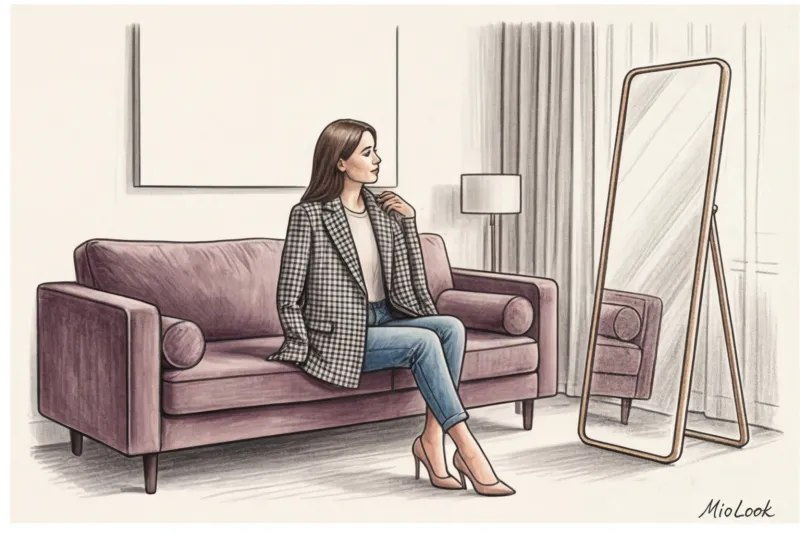
That's why choosing a print online is a challenging task, often thwarted by the human eye, blinded by emotion and a beautiful catalog image. But where emotion fails, mathematics succeeds perfectly. I've already discussed the physics and architecture of the patterns themselves in more detail in our a complete guide to combining prints in clothing , and today we'll look at how artificial intelligence algorithms help avoid costly mistakes.
The Mathematics of Harmony: Why Trust Print Fitting to a Neural Network
According to a McKinsey analytical report (2024), approximately 40% of printed clothing returns in e-commerce occur for one reason: "the pattern doesn't fit." Think about that number. It's not a matter of defects or size. The problem is that online photography mercilessly distorts scale.
When you look at a jacket in the catalog, you see the pattern relative to the proportions of a 180 cm tall model. A 7 cm diameter flower appears as a delicate micro-print on her. On a size 42 model who is 158 cm tall, the same flower becomes a gigantic blotch, disrupting the body's architecture.
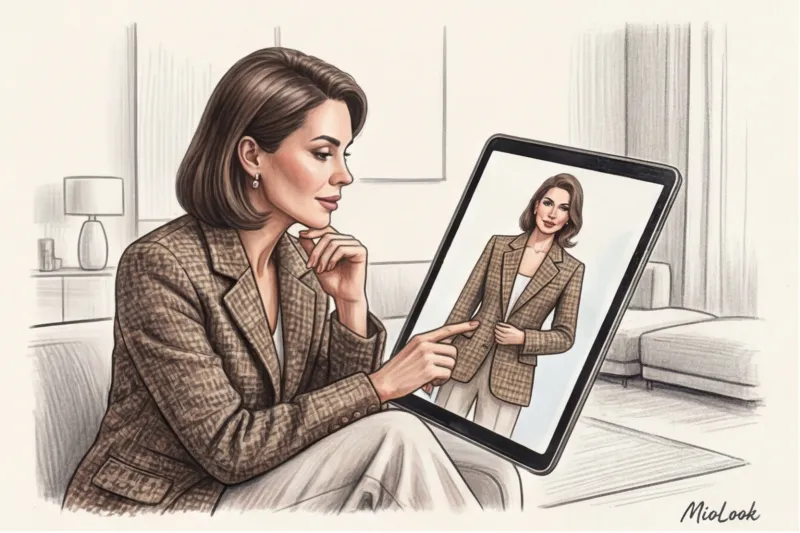
A virtual fitting room isn't a toy for zoomers. In the context of an investment wardrobe, it's your main financial safeguard. It allows you to calculate the pattern's math before your bank card is charged.
Computer vision algorithms are devoid of emotion. They don't know that this tartan is currently trending according to Vogue. AI analyzes your photo, calculating mathematical proportions, vectors, and contrasts that you simply wouldn't notice in the fitting room.
Access to MioLook for €0.99 — one-time payment
A smart AI stylist will select the perfect look and calculate the geometry of your print.
Get access — €0.99 onceHow an AI stylist helps you choose a print online: 3 parameters
For the virtual fitting to work flawlessly, you'll need just one thing: a candid portrait photo in even daylight. No filters, no harsh shadows. The app's neural network MioLook It doesn't interpret your appearance in terms of "beautiful/ugly," but rather breaks it down into vectors. How does this work in practice?
Ornament scale and bone structure
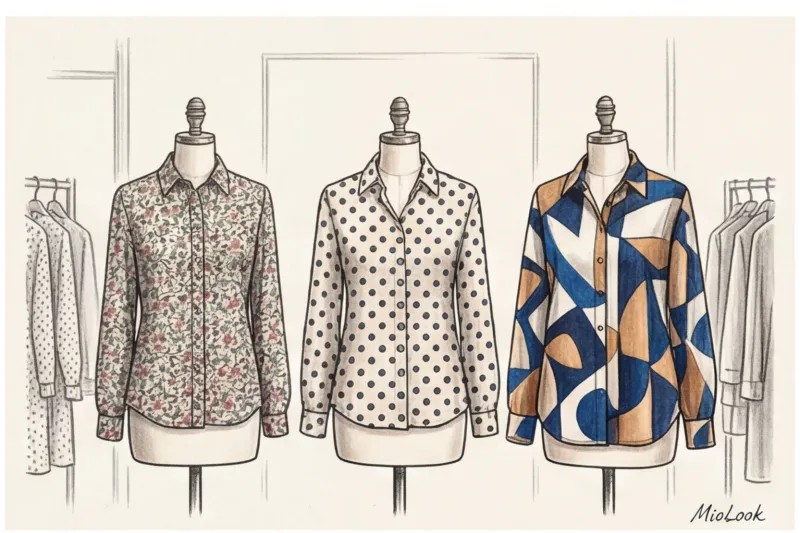
There's a direct correlation between your bone width, height, and the appropriate print size. If you have thin wrists, delicate collarbones, and a short stature, a massive architectural print will overwhelm you.
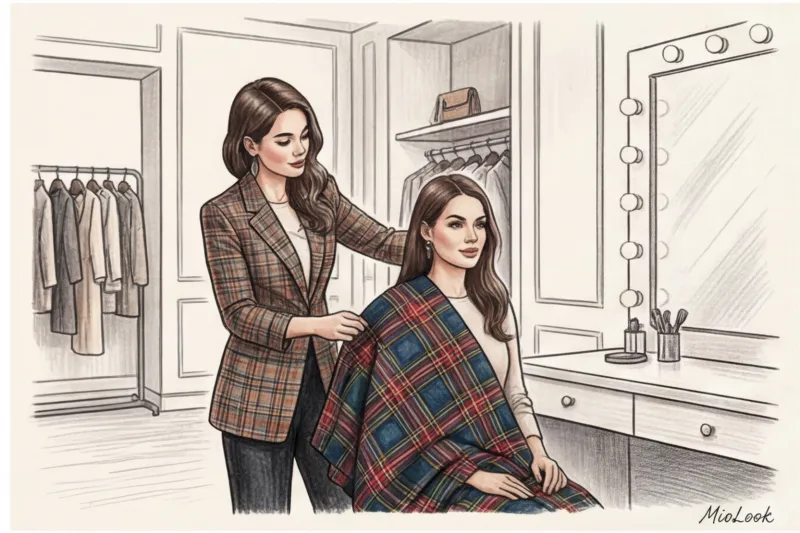
The AI compares the area of a single rapport (a repeating element of a design) with the physical dimensions of your avatar. For example, that large Scottish tartan, which looks luxurious on tall and stately women, often "breaks" petite women. The algorithm simply prevents you from making this mistake by visually demonstrating the scale imbalance on your smartphone screen.
Contrast level and your natural coloring
About 80% of the visual harmony of an image depends on matching the print's contrast level with the natural contrast of your face. Back in the early 20th century, Swiss artist and color theorist Johannes Itten developed principles of color contrasts that have now been translated into the language of machine learning.
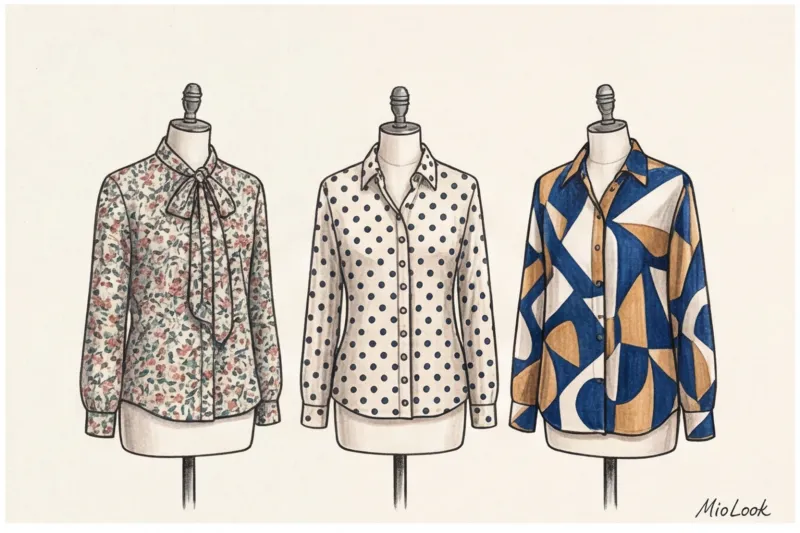
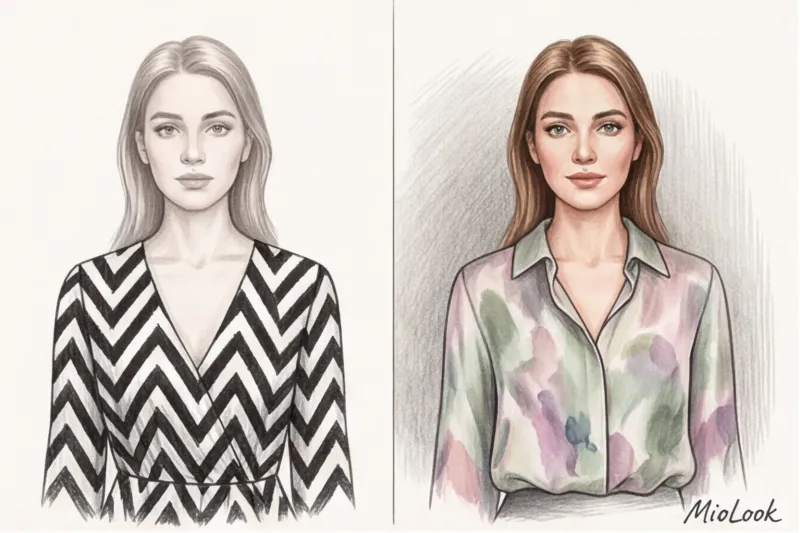
A smart stylist applies a black-and-white filter to your photo and the fabric you've chosen. If you have low contrast (for example, light brown hair, fair skin, gray eyes) and you try on a black-and-white optical illusion, the neural network will show how the print steals the show. You'll look like an accessory to the dress, not the other way around.
Facial geometry versus pattern rhythm
Your facial features are a set of lines. Some people have predominantly sharp angles (cheekbones, chin, straight nose, and prominent lips)—this is linearity. Others have softer faces, rounded cheeks, and plump lips—this is roundness.
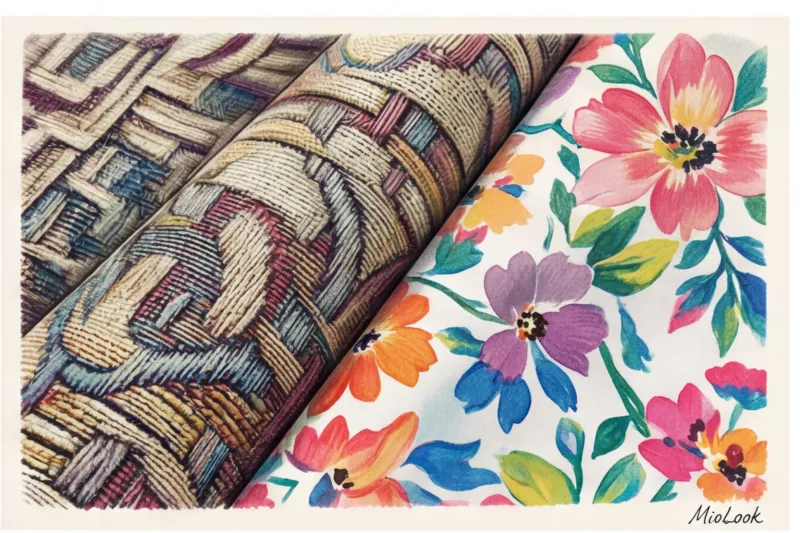
The algorithm reads the angle of the jaw, the shape of the eyes, and the shape of the lips. Women with pronounced linear features look best with strict stripes, chevrons, and checkered patterns. Those with soft features look best with watercolor florals, paisley, and polka dots. Trying to force a rigid geometric shape on a soft face always creates a tired effect.
Your perfect look starts here
Join thousands of users who look flawless every day with MioLook.
Get access — €0.99 onceExpectation vs. Reality: What Algorithms Don't (Yet) See
I'll be completely honest with you here. No matter how good artificial intelligence is, it has a blind spot. AI is perfect at calculating geometry, but it's incapable of assessing the status and tactile quality of a canvas.
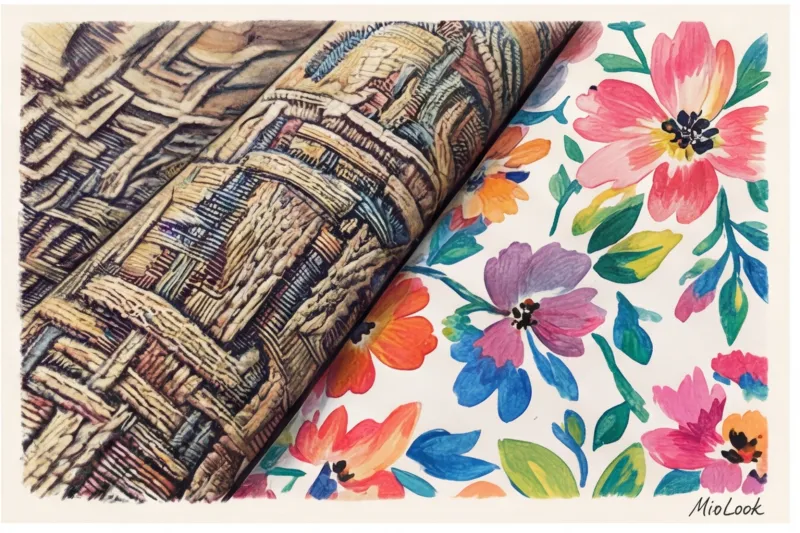
In the premium segment, there's a huge difference between a woven pattern and surface printing. True tweed or jacquard is created by interweaving threads of different colors. This process requires expensive equipment and time. Mass-market fabrics, on the other hand, often use cheap polyester and simply "stamp" a design onto it with pigmented paint.
On a smartphone screen, both options may look like the perfect geometric pattern. But in real life, surface prints often form a hard, rubbery film on the fabric, cheapening the overall look and preventing it from breathing.
That's why I always teach my clients the "blind touch" rule. When the AI has selected the perfect pattern size for you online, and you've arrived in-store (or received a delivery), close your eyes and simply touch the fabric. If it creaks, slides like plastic, or feels like cardboard, refuse the purchase, even if the pattern is flawless. The transition from visual harmony (the AI's work) to physical luxury is your responsibility.
The Myth of "Basic" Patterns: Why Classic Plaid Doesn't Suit Everyone
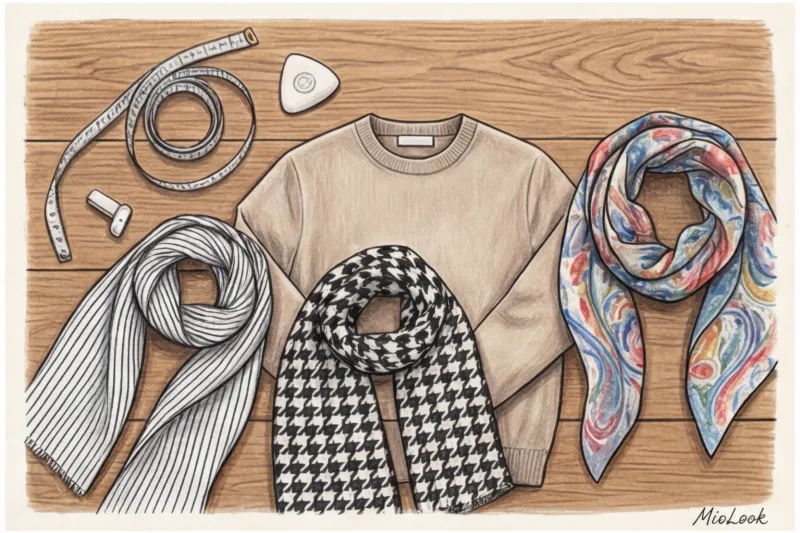
A toxic myth still permeates glossy magazines: "Houndstooth (pied de poule) or thin French stripes suit everyone because they're timeless classics." It's a lie that costs women hundreds of wasted euros.
Classics also have scale and contrast. I had a case in point. A client bought a gorgeous double-breasted Saint Laurent-style blazer for €800. The pattern was a classic pinstripe on a dark blue background. A perfect investment, right? Nope. The client had soft, delicate features and low contrast. The harsh, rhythmic masculine pinstripe made her face appear gaunt, highlighting the slightest shadows under her eyes.
We uploaded her photo to MioLook and started combing through patterns. The algorithm clearly showed that her basic geometry wasn't strict parallel lines, but an abstract, slightly blurred geometric pattern in a medium contrast range. As soon as she tried on a blouse with this print, her face literally lit up.
Don't buy a pattern just because Audrey Hepburn wore it or it's considered a "safe base." Test the math for yourself.
Step-by-step guide: testing complex patterns
If you're looking to invest in a printed item in the €150 to €500 price range (like a nice silk scarf, a Massimo Dutti jacket, or a COS blouse), follow this checklist carefully.
- Step 1: Determine the contrast. Upload a makeup-free photo to the virtual fitting room. Apply a black and white filter to the image. Compare the contrast between your skin and hair with the contrast between the elements of the pattern. They should match in strength.
- Step 2: Select a category. Based on the lines of the face (jaw angle, nose, lips), choose a direction: strict geometry, floral design, abstraction or animalistic design.
- Step 3: Scale test. On your virtual avatar, artificially shrink and enlarge the print. Find the spot where the design appears neither too finely rippled nor too bulky.
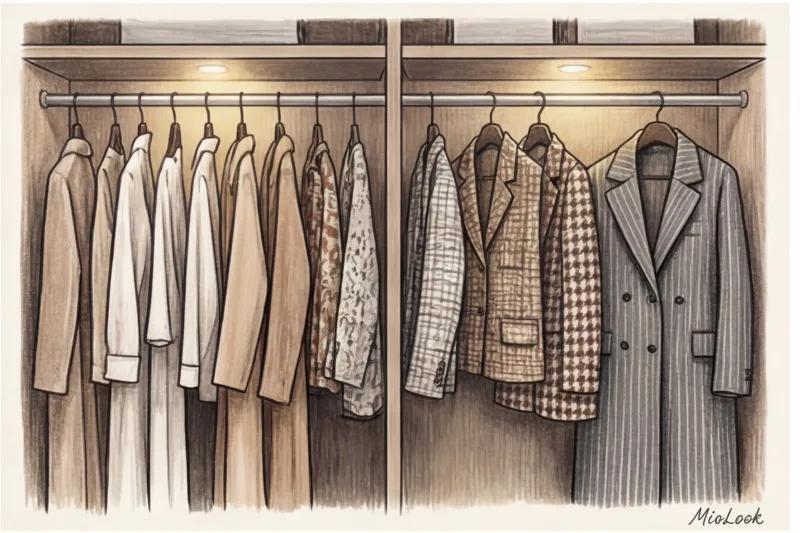
- Step 4: Integration into the capsule. Take photos of three or four solid-color items from your closet (e.g., beige pants, blue jeans, a white top). Place them in a collage next to your chosen print. If they don't fit together seamlessly, the print will remain hanging in the closet.
Ready to get started?
Try the MioLook free plan and start creating perfect looks with AI, no commitment.
Get access — €0.99 onceFrom Pixels to Investment: A Checklist Before Purchasing a Status Item
Smart shopping today is a fusion of high technology and traditional, old-fashioned styling. AI takes care of the tedious part: it filters out 90% of unsuitable options before you even leave the house. But the final decision is always yours.
Before you place your phone on the payment terminal, ask yourself three security questions:
- Did the algorithm confirm that the scale of the pattern is proportionate to my bone structure?
- Is this pattern woven into the fabric (jacquard/tweed), or is it a cheap surface print that will peel off after dry cleaning?
- Does this particular pattern pair with at least four basic solid pieces from my current wardrobe?
Use technology not for entertainment, but as a strict filter. Virtual print try-ons are designed to protect your investment. They save you €300–€500 from wasting on a luxurious, trendy, but completely out-of-place designer jacket. Leave experimenting with unflattering prints to the mass market, and only include geometric shapes that accentuate your facial features in your wardrobe.