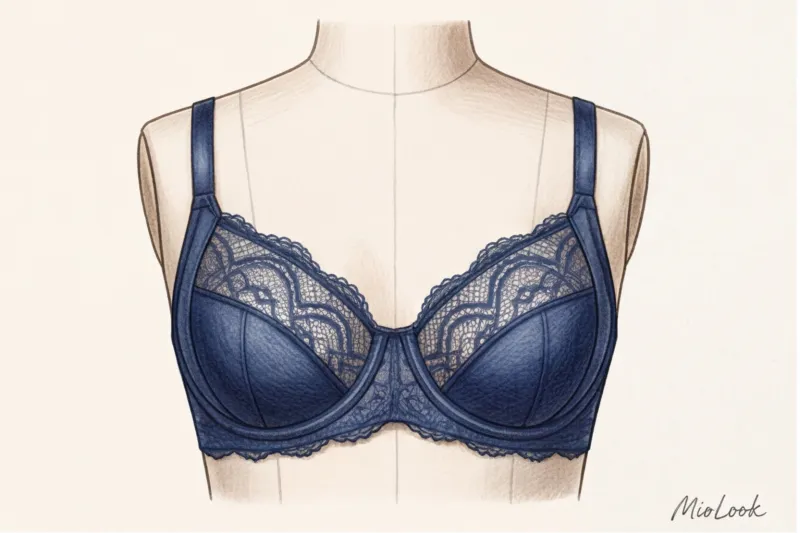
Have you ever wondered why a €120 bra bought at a premium online store sometimes fits worse than a stretched-out oldie from a mass-market store? You measure with a tape measure, check the chart, wait for the courier, and end up with something you can't breathe in. When clients ask me, How to choose a bra for large breasts They usually expect advice along the lines of "how to take measurements correctly." But I teach them something else—the skill of reading the hidden technical language of product cards.
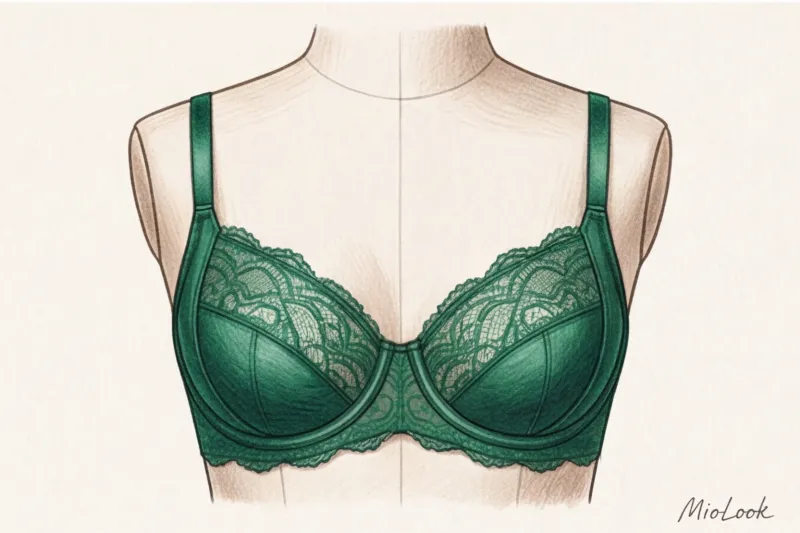
We have discussed the fundamental principles of working with virtual fitting rooms in more detail in our A complete guide to choosing lingerie online using AI Today, we'll focus on the hardcore: how to understand a product's architecture from a couple of lines in the description and studio photos. We'll transform choosing lingerie from a lottery into a precise mathematical calculation.
The Anatomy of a Perfect Fit: How to Choose a Bra for Large Bust in the Online Age
The standard size chart we've been forced to accept for decades is hopelessly outdated. According to WGSN's 2024 size inclusivity analysis, approximately 80% of women still wear underwear that doesn't fit. Why is this? Because the measuring tape doesn't take into account fabric density, breast shape, and, most importantly, pattern variations.
I had a classic case in my practice. A client, Anna, an IT department manager, came to me. For years, she'd been wearing a "standard" 75B bra. She complained of constant shoulder pain, and her silhouette under a smooth shirt looked uneven because her breasts were sagging down and to the sides. When we professionally fitted her with a UK size 65E bra (yes, the band is 10 cm smaller, and the cup is significantly deeper), magic happened. Her posture straightened instantly, the pain disappeared, and her waist became visibly slimmer by 5 centimeters.
The thing is, different bra design schools use radically different approaches. British brands like Panache and Freya have historically specialized in D+ sizes and tailored their designs to accommodate larger busts: they have narrow bands and deep cups. Meanwhile, sophisticated French labels like Chantelle or Simone Pérèle often run small in cup width for larger busts. If you're unaware of these nuances, online shopping can be a real pain.
Reading Between the Lines: A Technical Dictionary of Product Descriptions
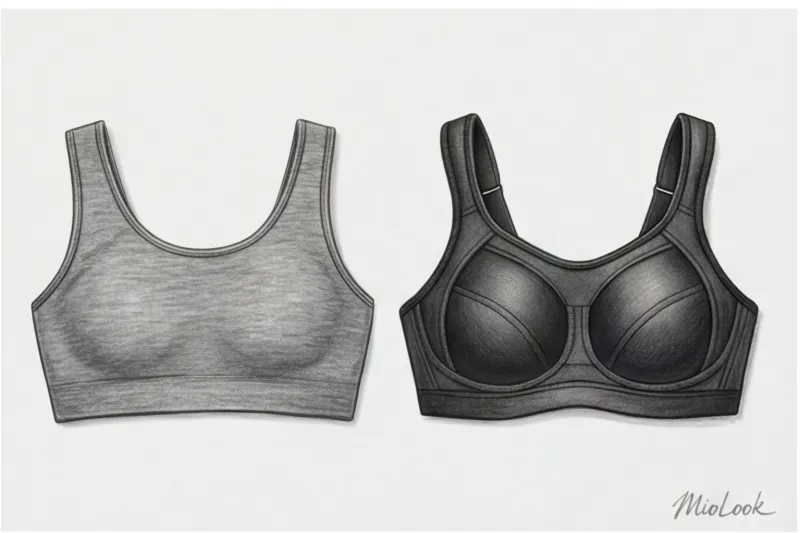
What online store copywriters hide at the very bottom of the page under the "Details" tab is, for me as a stylist, the main selection criterion. If you see a description of a molded foam cup, don't hesitate to close the tab. A molded cup is physically incapable of adapting to a fuller bust; it will simply act as a "hat" on your chest, creating hollowness.
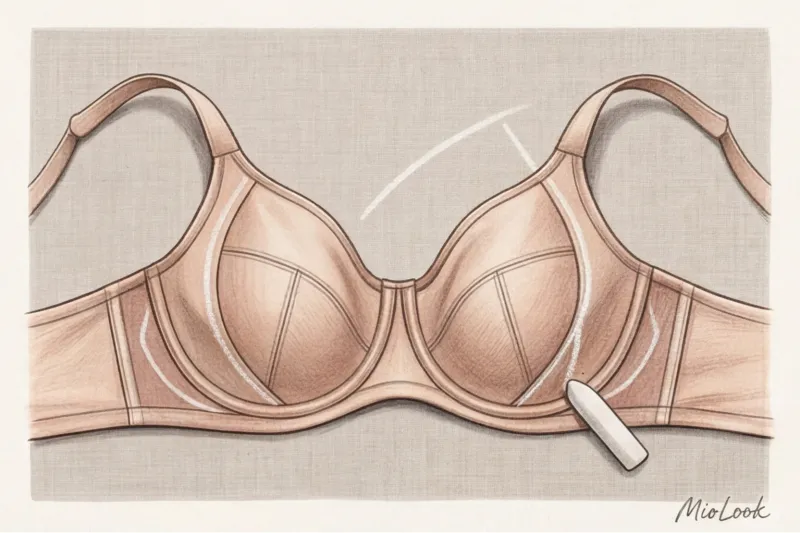
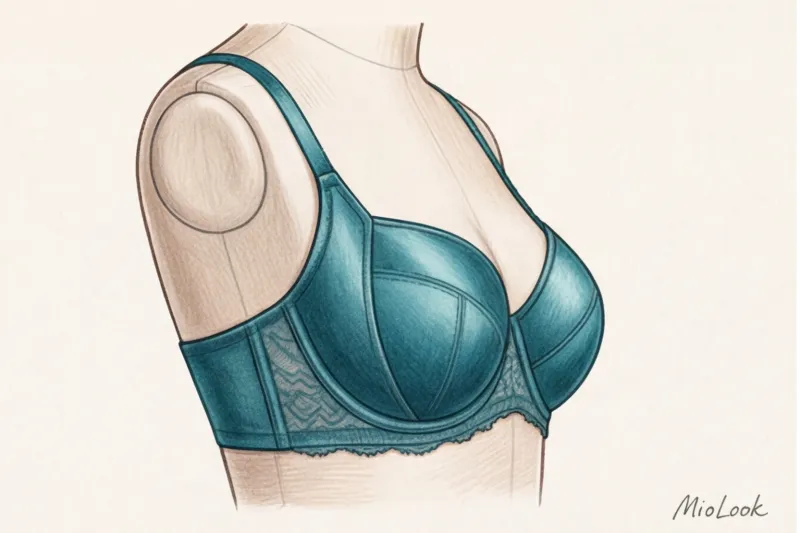
- Three-part or four-part cup: This is the foundation. Only sewn-together components can create a deep, anatomical shape. The horizontal seam provides forward projection, while the vertical seam provides support from below.
- Side sling: A secret weapon for those with a curvier figure. This is an additional panel of fabric inside the cup (closer to the armpit). It gathers volume from the sides and brings it forward. The result? You look slimmer in profile and from the front.
- Corset mesh (power mesh): Look for this phrase in the waistband's composition. Regular elastane will quickly stretch under weight. Corset mesh acts as an architectural framework—it breathes but doesn't deform.
Your perfect look starts here
Join thousands of users who look flawless every day with MioLook. The smart wardrobe planner.
Get access — €0.99 onceWhat is a "closed" and "open" neckline?
If you have slight asymmetry (which is completely normal for 99% of women) or your breasts are losing fullness at the top, pay attention to the cup edge. The tight seam along the top edge (closed line) will dig into your skin with the slightest discrepancy in cup size, creating a "quad-boob" effect.
The ideal solution, which I always recommend, is stretch lace along the top edge. It works like a smart elastic band: it fits snugly around the smaller breasts and gently stretches around the larger ones, creating a completely smooth transition under clothing.
The Biggest Lingerie Shopping Myth: Why Wide Straps Are a Red Flag
I regularly audit my clients' online shopping carts. And you know what I do first? I make them delete luxurious sets costing €100–€150 if I see that the bridge doesn't sit flush against the chest and the straps resemble the ropes of the Golden Gate Bridge. There's a myth that says you need thick straps to hold up a large bust.
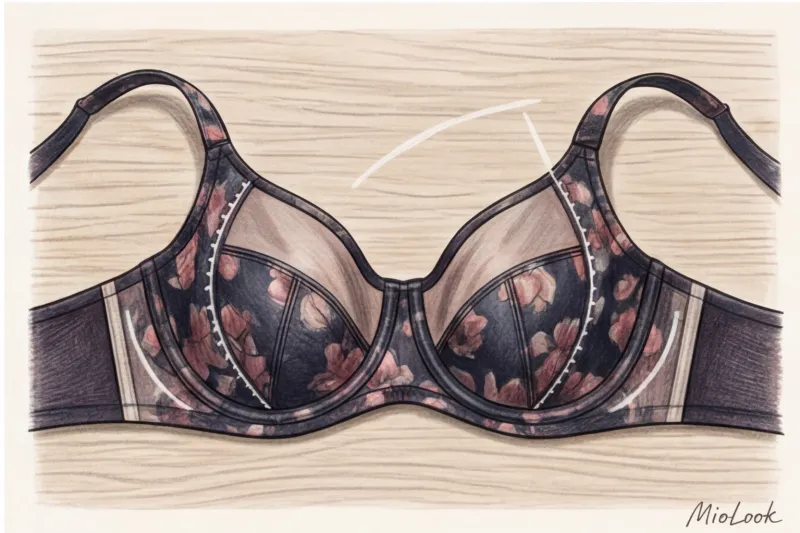
From a physics and clothing design perspective, this is absurd. The 80/20 rule applies. Exactly 80% of the breast's weight should be supported by an anatomically correct, snug band. Straps are left with only 20%—they're only needed to gently shape and fit the upper portion of the cup.
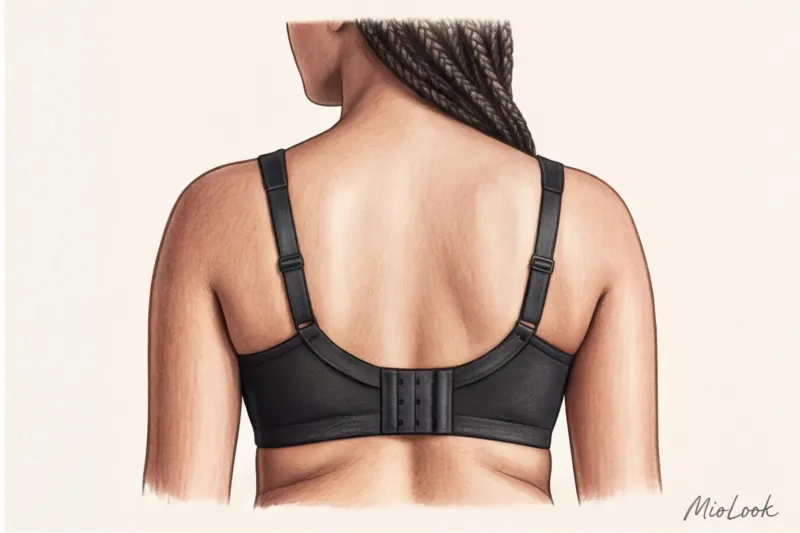
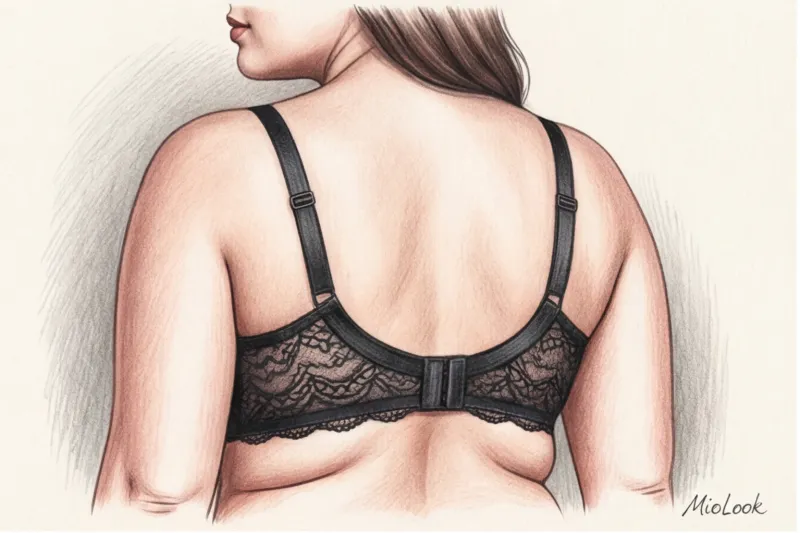
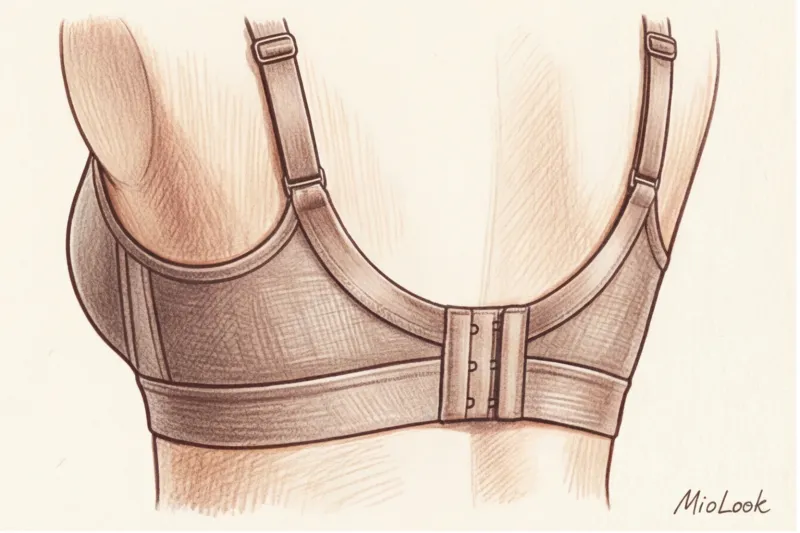
If you're left with deep red marks on your shoulders at the end of the day, the problem isn't with tight straps. The problem is that your belt is too big (or made of weak fabric). It's slipping up your back, putting all the weight on your shoulders. Always check the back of the belt in the product photo: for a size D+, the waistband (the side part of the belt) should be wide, and the clasp should have at least three rows of hooks vertically.
Visual audit of product cards: what to look for in a model photo
Marketplaces spend huge budgets on retouching, but technical fit errors are almost impossible to hide if you know where to look. Stylists and bra fitters use these markers to weed out poor patterns before ordering.
- Jumper position (gore): The center section between the cups should rest directly against your sternum. If the bridge appears to be hanging in the air or sticking out in a studio photo, it's either a catastrophically poor fit or the photographer was too lazy to find a model of the right size.
- Angle of the belt on the back: Draw a visual line. The belt should be strictly parallel to the floor or even slope down slightly at the back. If it rides up in an inverted U shape, the model is wearing too much bandage, which was pinned down for a flattering frontal shot.
- Armpit bone height: Pay attention to where the underwire ends on the side. If your bust is high, underwire that's too long will rub your armpits every time you lower your arms.
Checklist: Filtering the Marketplace's Product Range
Before adding items to your cart, set your filters correctly. Don't just search for "your size." Filter by design type: balconette (ideal for open necklines), full-cup (maximum coverage for a soft bust), or plunge (deep V-neck).
When trying out a new brand, always use the sister size rule. Ordering your usual 75E? Add a 70F (smaller circumference, same cup size) and an 80D (larger circumference, same cup size) to your cart. This will save you weeks on returns and exchanges.
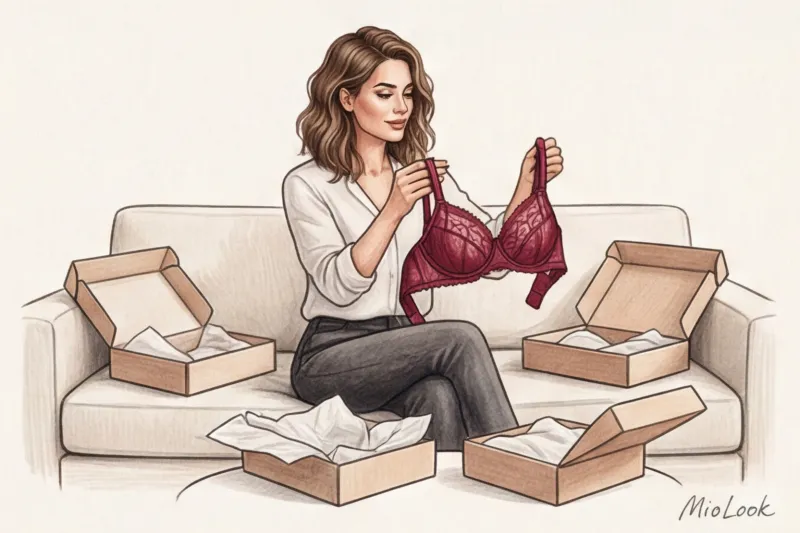
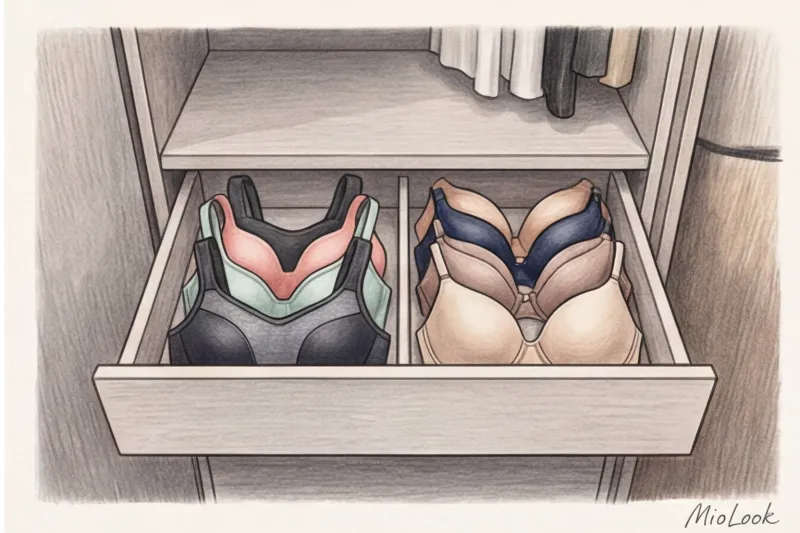
Lingerie is the foundation. For example, when we were discussing, How to style a white shirt for evening wear I emphasized: without a smooth, nude bra that feels like a second skin, even €300 silk will look cheap. Invest in a basic lingerie wardrobe. A good base in the €60–€120 range will last you a long time and pay off with a perfectly fitted outerwear.
Access to MioLook for €0.99 — one-time payment
A smart AI stylist will select the perfect look based on your individual parameters.
Get access — €0.99 onceAI and the Smart Wardrobe: How Technology is Solving the Fit Problem
Fortunately, the era of painfully returning dozens of boxes of underwear is coming to an end. Personalization technologies have reached the point where your smartphone knows more about fit than a sales associate at a chain store.
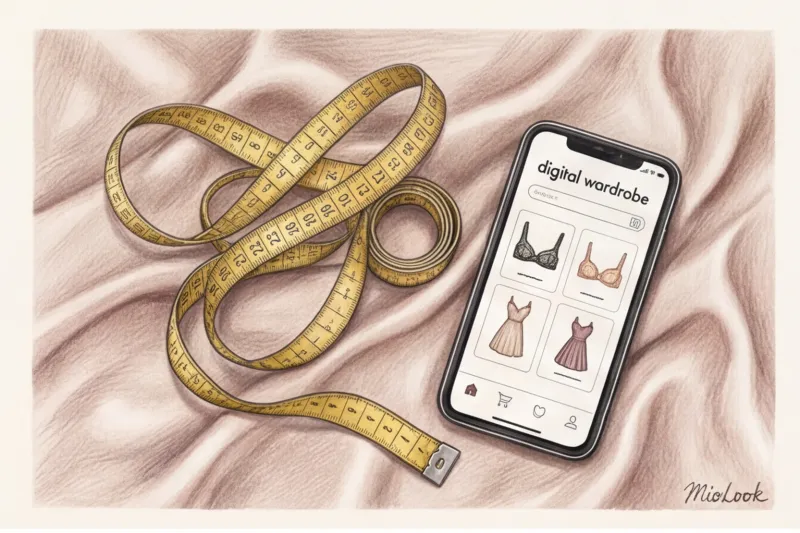
Algorithms of the smart wardrobe function in MioLook They can analyze your measurements and compare them with a huge database of patterns from various brands. Artificial intelligence doesn't just remember your measurements—it understands that if a Panache balconette bra fits you perfectly in a certain size, you'll likely need a smaller size with a different underwire from Elomi.
Integrating a lingerie capsule into your overall wardrobe planning is a game-changer. You'll no longer buy a stunning backless dress only to realize you don't (and can't) own a suitable supportive bra to go with it.
Summary: Lingerie as the foundation of your style and confidence
Lingerie for fuller breasts isn't just a bunch of lace. It's a complex engineering design, an investment in your back health, and a guarantee of a luxurious fit for any jacket or dress. Of course, there are exceptions to these rules. For example, a rigid corset belt isn't suitable for those with medical contraindications to rib compression—in such cases, we seek a compromise in the form of frameless models with a reinforced cross-shaped back.
Stop tolerating discomfort. Forget about "just losing weight" or "finding a bra with wider straps." Remember the three golden rules of online shopping: look for a 3-4-piece cup, check for a mesh waistband, and ignore molded foam forms. Read product descriptions like a professional stylist, and your wardrobe will respond with perfect silhouettes.