Over twelve years of wardrobe review, I've discovered one consistent pattern. Almost every client I work with has three to five pairs of cheap quartz watches in their wardrobes, each with a dead battery, tarnished metal, or scratched crystal. None of them are worn, but they're a shame to throw them away. And when I ask, "Why don't you wear them?" I usually hear, "They don't go with anything."
The problem is that most of the advice on the internet about how to choose basic women's watch , offer us completely unviable options. For years, we've been sold the idea of huge "masculine" chronographs or completely blank white dials as a universal solution. But the reality is: what looks good in advertising renderings often cheapens the real look. We've written more about a systematic approach to detail in our The complete guide to essential accessories for women , and today we’ll talk exclusively about watches.
Why the typical "basic women's watch" from the internet is hopelessly outdated
The main myth I want to dispel right now is that a basic watch shouldn't be huge, perfectly round, and have a crystal-white, blank dial. The trend for minimalist "Scandinavian" Bauhaus-style watches (with huge cases and thin hands) popular in the 2010s did a disservice to thousands of women. On a woman's wrist, such a design looks like a plate, cuts into the hand, and steals all the attention.
In addition, it is necessary to clearly distinguish between the real watch base and the so-called fashion watches Fashion watches are models produced by clothing brands (from mass-market to high-end luxury) that outsource their production to third-party factories as souvenirs. They feature a cheap quartz movement, and the lion's share of the price (often 150–300 euros) is paid for the logo on the dial. Their lifespan is two years at most, after which the coating wears off.
Watches from fashion brands are expensive souvenirs, not tools. If you want a classy accessory, buy watches from brands that only produce watches.
Instead of endlessly buying cheap trends, I suggest using the Cost Per Wear metric. A basic entry-level Swiss watch with a sapphire crystal for €350, worn 300 times a year for ten years, will cost you €0.11 per wear. A fashionable toy for €50 that will get scratched in a month and stay in the box costs €1.60 per wear. Wardrobe math doesn't allow for compromises in the quality of the base.
Shape and Proportion: How to Choose a Basic Women's Watch to Fit Your Wrist
When you read watch specifications online, the first number is always the case diameter. Forget it. Diameter is a lie. The main secret of watch styling is hidden in the term lug-to-lug (distance from ear to ear).
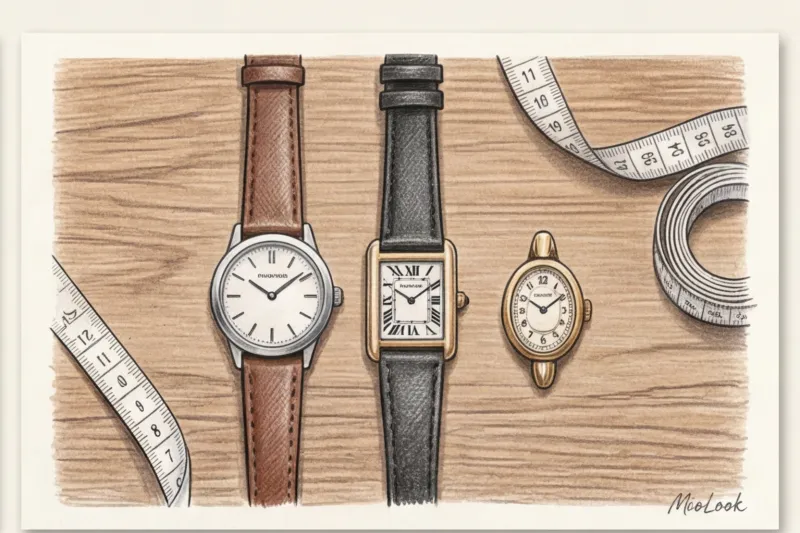
Everyone's wrist anatomy is different. Some bones are round in cross-section, others are flat and wide. The shape of your bone dictates the shape of your watch. If you have a thin but flat wrist, you can wear a slightly larger watch than someone with a similarly sized but round wrist. Why? Because the watch's lugs will rest on a flat surface instead of hanging in the air.
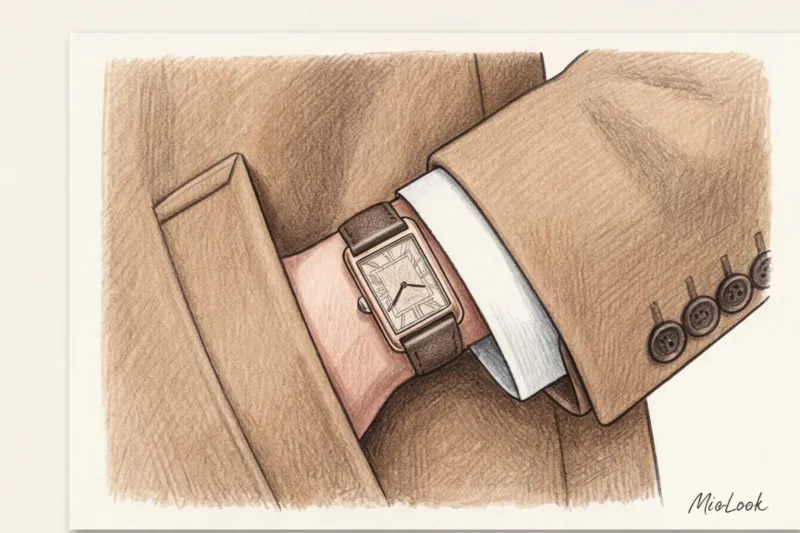
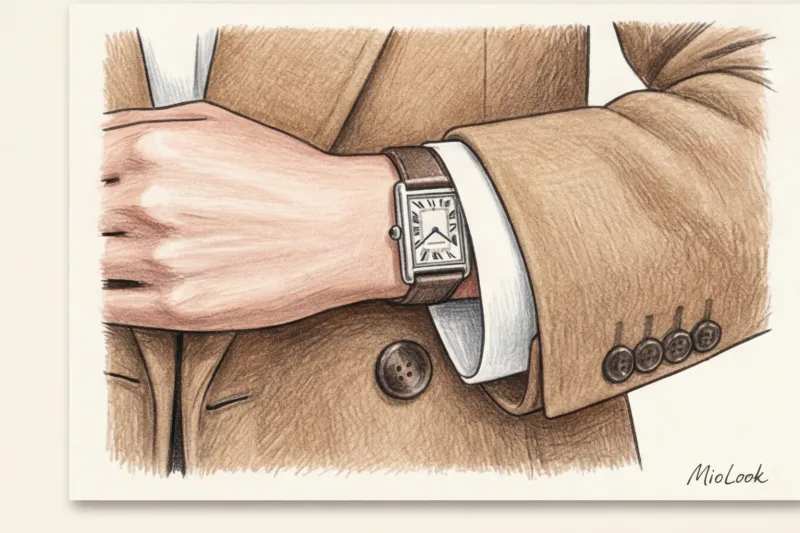
That's why rectangular watches (Tank shape) are the most underrated and elegant basic. Unlike round models, they follow the natural line of the hand. They easily hide under a shirt cuff or office style jacket , without catching on the lining.
The "Eye to Eye" Rule in Practice
How to measure your wrist correctly? Take a caliper or a regular rigid ruler and place it on top of your wrist. You need the width of the visible flat part of your hand, not the circumference.
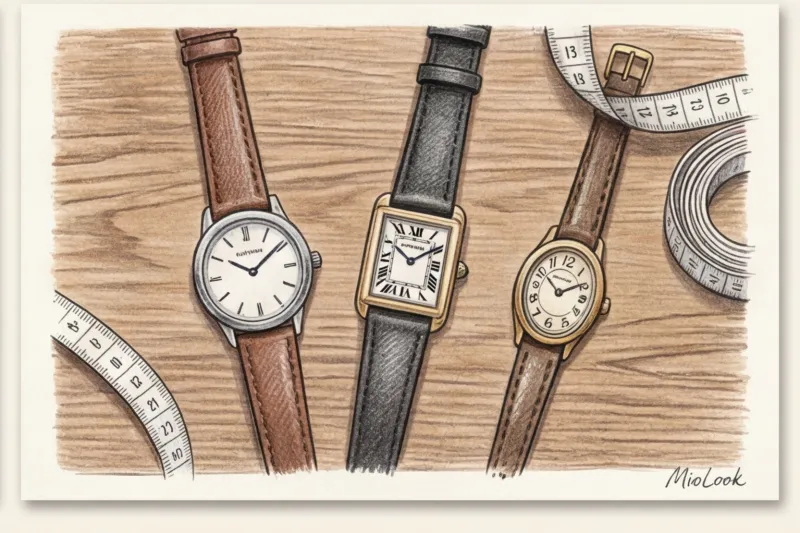
By classic watchmaking standards, a perfect fit means there should be at least 2-3 millimeters of space on each side between the ends of the watch's lugs and the edges of your wrist. If the lugs hang off your wrist, the watch is too big. The oversized trend (watches "on the man's shoulder") is a thing of the past. According to the WGSN analytical report for 2024, the watch market is returning en masse to vintage, smaller proportions—26-32 mm cases for women.
There is one exception here, though: This rule does NOT apply to watches with an integrated design (such as the popular Tissot PRX), where the bracelet is a visual extension of the case. In this case, there are no lugs, and the watch fits the wrist like a single piece.
Metal and Dial Color: Debunking the Black and White Myth
Why do most inexpensive basic watches look... inexpensive? Because of their clean, crisp white dials. In daylight, they resemble a piece of printer paper, betraying the watch's budget nature. Expensive basic models always have a subtle undertone: champagne, ivory, silver satin, or mother-of-pearl.
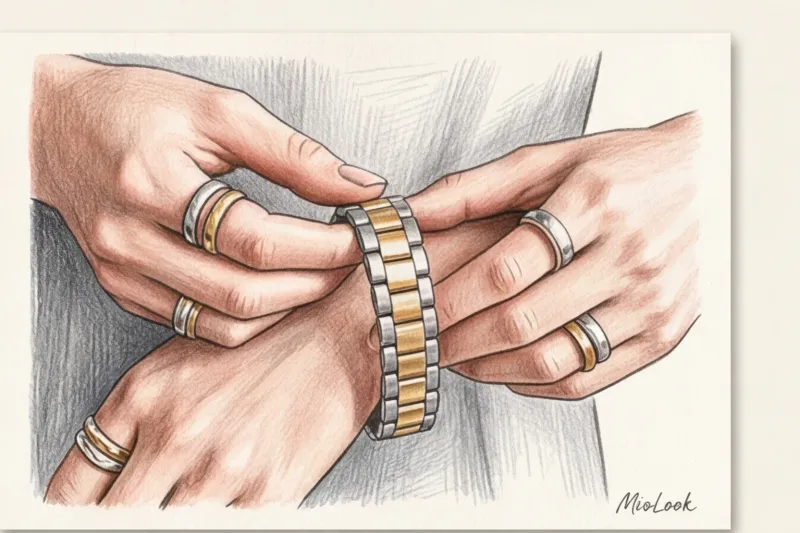
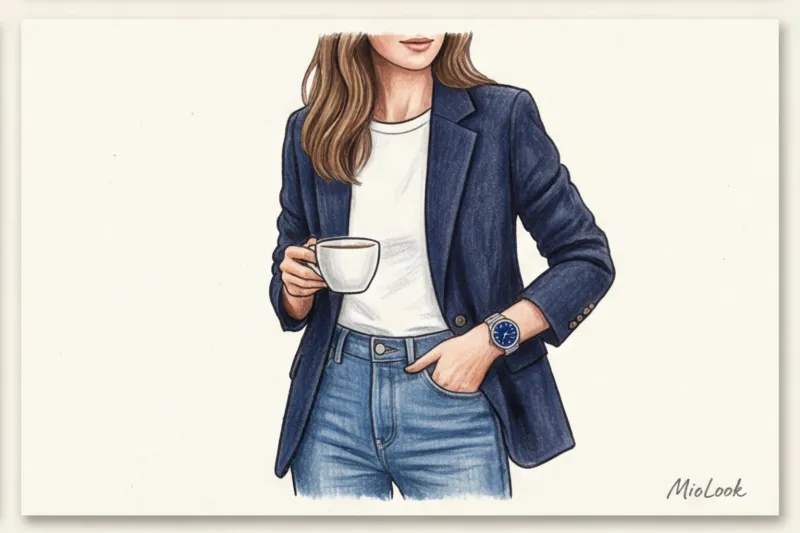
The color of the metal should complement your skin tone. If you're at a loss for a choice, consider colored dials. Deep navy, emerald, and burgundy are the new neutral base. A dark blue dial in a steel case looks as versatile as black pumps, but it adds depth to the look and pairs beautifully with denim.
Bicolor: A Stylist's Secret for Those Who Wear Both Gold and Silver
I once had a client who kept taking off her yellow gold wedding ring because it clashed with her favorite stainless steel watch. It's a classic pain point. The solution I offer in 90% of these cases is a bicolor watch.
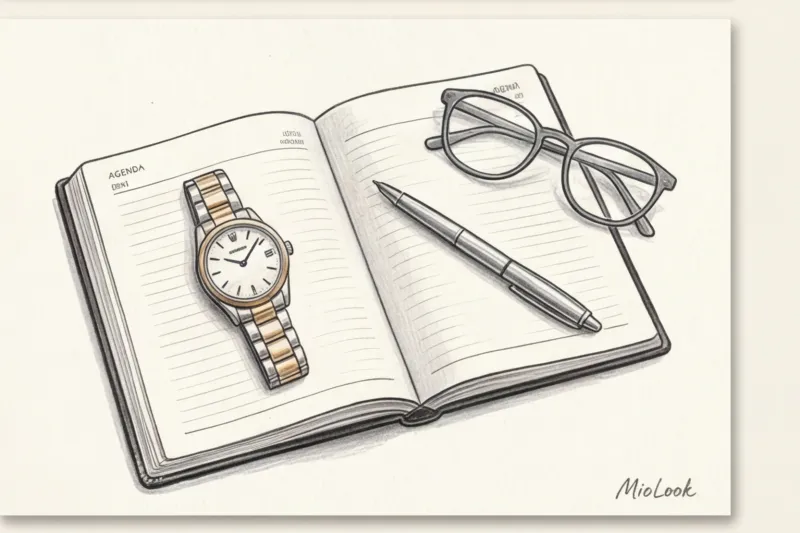
A bicolor (a combination of steel and gold in one piece) works as a stylistic bridge. By wearing such a watch, you legitimize the presence of both gold earrings and a silver belt buckle. It's the most functional tool for a capsule wardrobe. To check how such a watch will fit into your current looks, you can use smart wardrobe feature in MioLook — the app will help you visualize combinations before purchasing.
A strap or a bracelet: which fits better into a capsule wardrobe?
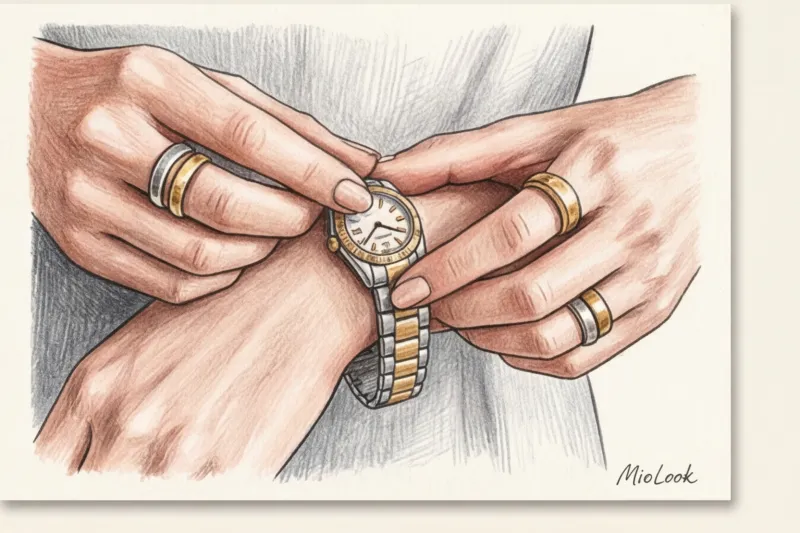
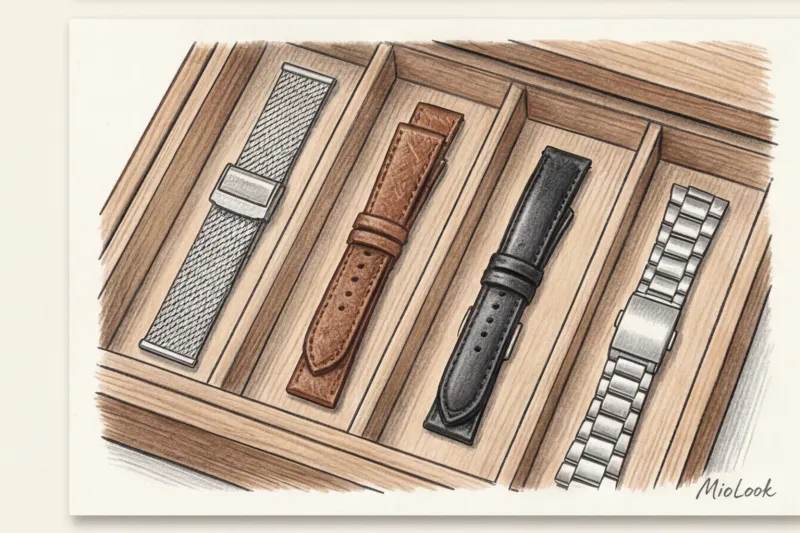
A leather strap looks elegant and sophisticated, but it has a fatal flaw: it's consumable. Even the most expensive calfskin or alligator absorb sweat, perfume, and hand creams. With daily wear, a strap will lose its appearance after 8-12 months. A metal bracelet (classic links or Milanese weave) lasts forever. Simply wash it with a soft brush and soap once a year.
Your ideal image begins Here
Join thousands of users who look flawless every day with MioLook. Artificial intelligence will help you create a capsule collection around your new watch.
Get access — €0.99 onceMy main practical advice as a stylist: if a model has a bracelet version and a leather version - Always buy a watch with a steel bracelet Ordering an original metal bracelet separately will cost you 30–40% of the watch's price, while a high-quality leather strap from a third-party manufacturer costs next to nothing.
And be sure to look for models with a Quick Release system. This is a tiny lever on the back of the strap that allows you to remove it with your fingernail in two seconds, without any watchmaker's tools. Wear a steel bracelet to the office in the morning, and in the evening, swap it for a black satin strap—and you have an elegant watch for the theater.
Investing Wisely: Watch Brands an Expert Wouldn't Be Ashamed to Wear
Forget the accessories section of mass-market stores. If your watch budget is between €150 and €500, your destination is specialized watch stores.
There are two reliable camps in this segment:
- Japanese base: Seiko, Citizen, Orient. These are absolute champions in terms of price/quality ratio. Models from the Seiko Presage line or the miniature Citizen Eco-Drive (which recharge from any light source and never require battery replacement) will serve you for decades. I'd also include the vintage Casio line in this category—an excellent option for a smart-casual style.
- Swiss base (entry level): Tissot, Certina, Frederique Constant. This is the entry ticket to status. The Tissot Lovely Square or Certina DS Stella collections offer the perfect metal finish that will look appropriate even on negotiations with a strict dress code.
Critical condition: in this price segment the watch must have sapphire crystal Unlike mineral glass, it's virtually impossible to scratch under everyday conditions. The watch will look as good as new even after five years.
A Stylist's Checklist: 5 Questions to Ask Before Buying an Everyday Watch
Before you take your watch to the checkout, ask yourself these five questions. If you answer "no" to any of them, it's not a basic model.
- Does the metal match the hardware on my favorite bags and belts? (If you wear bags with silver hardware, the gold watch will stand out. The solution is bicolor.)
- Does the watch fit under a tight shirt cuff? The thickness of the case of a basic watch should not exceed 8–9 mm, otherwise it will snag on clothing.
- Does the dial say Sapphire Glass/Crystal? If the glass is mineral, after six months it will become covered with micro-scratches (the so-called “spider web”).
- Is the contrast level suitable for my appearance? Dark-haired women will appreciate contrasting black dials, while women with soft, fair hair should choose shades of gray, beige, or dusty blue.
- Will I be able to wear them with both jeans and a jacket? If a watch is too fancy (covered in crystals) or too sporty (heavy plastic), it is not basic.
Ready to start planning your smart wardrobe?
Try MioLook's free plan—upload your accessories to the app and create dozens of combinations without any additional purchases.
Get access — €0.99 onceA basic watch isn't just a timepiece; it's a style anchor. It ties together any look, even the most relaxed, demonstrating your attention to detail. Choose not by diameter or fashion influencer lists, but by the right proportions for your bone structure and the quality of the materials. And remember: one high-quality Swiss or Japanese watch on a steel bracelet is always better and cheaper than a collection of five trendy, one-of-a-kind pieces.