Why capsule wardrobe styles aren't rigid frameworks, but rather a constructor
"I have a closet full of basics, but I still look boring and drab." In 12 years as a stylist and fashion journalist, I've heard this phrase more often than declarations of love for vintage Chanel tweed. We're used to thinking that a proper wardrobe consists of fifteen bland, neutral-colored pieces that will magically solve all your morning problems. Spoiler alert: it won't.
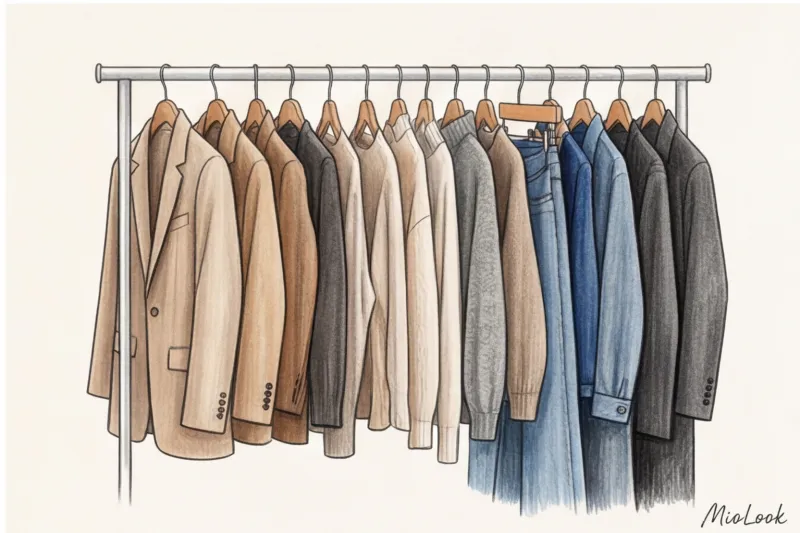
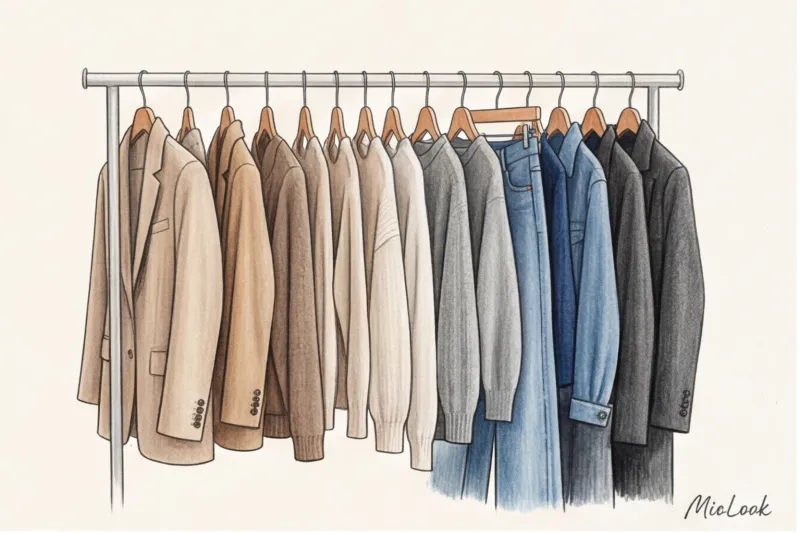
In fact, capsule wardrobe styles It's not a uniform or a prison schedule for your hangers. It's a coherent visual language. It's a flexible design where every detail works for you, rather than you having to adapt to abstract, dry rules from the internet.
Today, the main trap lies in social networks. Algorithms bombard us daily with new "aesthetics": today you must be Mob Wife , tomorrow - an adept Cottagecore , and change into something for the weekend Y2K Blindly attempting to "cosplay" internet trends leads to you buying a €150 satin skirt that looks gorgeous in a one-minute video, but is completely unsuitable for your real life, where you need to walk the dog, go to the office, and pick up the kids from school. The result? The expensive item ends up in the bottom of your closet forever.
Before choosing a specific direction, you need to figure out your "Style DNA." This is your personal core formula: which silhouettes compliment your figure, which fabrics support your real-life pace, which palette lights up your eyes. To avoid buying things haphazardly, I always advise my clients to first digitize what's already hanging in their closet. If you let your favorite pieces go through the motions, wardrobe analysis feature in the MioLook app , you'll immediately see patterns. Choose a development vector only when you clearly understand your base.
One of my clients, a top manager at an IT company, came to me in utter despair. She had meticulously, step by step, assembled a wardrobe based on the "minimalist capsule" template from Pinterest: a crisp white shirt, a classic beige trench coat, and black flat-front trousers. Every morning, she opened her closet and felt incredibly bored—she literally had "nothing to wear" because these clothes didn't reflect her vibrant, dynamic personality. Once we broke this visual sterility by adding them to the database, straight vintage jeans with scuffs and leopard loafers, the problem was solved forever.
The Main Myth: A "Clean" Capsule is the Path to Perfect Style
There's a pernicious misconception that sticking to a single style 100% guarantees a flawless appearance. In practice, this is a surefire way to wardrobe fatigue and downright boredom. If you're dressed head-to-toe in a strict, classic style, you risk looking like you're stuck at a corporate meeting in 2010.
The fashion industry has long abandoned the concept total look (When an outfit is put together in a unified style or from a single brand). Look at the recent Miu Miu or Dries Van Noten shows: the designers deliberately juxtapose formal office jackets with tousled hair and sporty elements. If we analyze the street style of Copenhagen Fashion Week, we'll see the same reality. Girls wear romantic dresses with puffed sleeves paired with chunky trekking sneakers, not the expected neat pumps. Personalized eclecticism has become the new global standard.
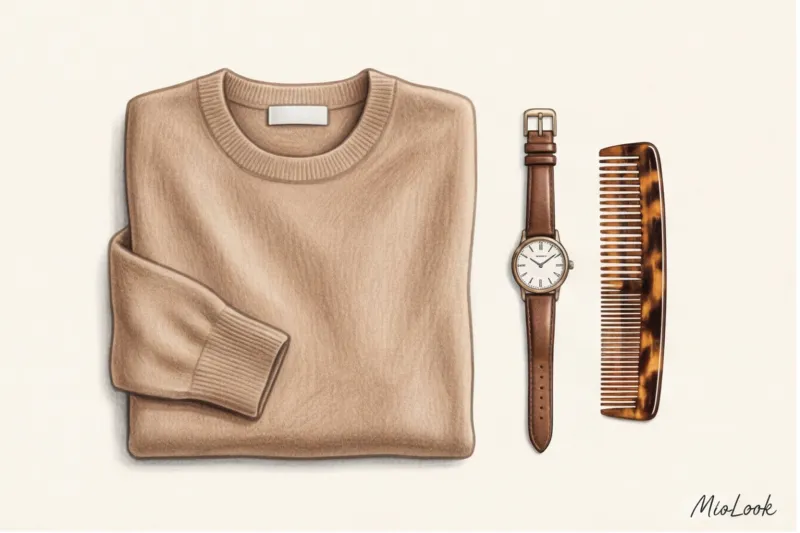
The perfect modern capsule collection is a masterful mix. Yes, the base can be neutral, but without accents and slightly clashing details, it's dead. Think about it: even a well-chosen basic jewelry wardrobe can completely change the feel of a single cashmere sweater—from relaxed casual when paired with a chunky watch, to evening drama when paired with large chandelier earrings.
Old Money and Quiet Luxury: Statement Capsule Wardrobe Styles
The social media generation has convinced us that simply throwing on a white tennis polo and draping a sweater over our shoulders automatically conferres the status of heiress to a multi-million dollar empire. But let's face it: the true aesthetic of Old Money and Quiet Luxury isn't a fad, a viral trend, but a complex visual language that has been developing over decades.
Watching private shows in Milan, I'm always amazed by the approach of Italian giants like Loro Piana or Brunello Cucinelli. The history of Quiet Luxury is rooted in the culture of "generational wealth." In this environment, clothes were never created to demonstrate financial success—they were made for uncompromising, selfish comfort. These brands sell not logos, but a way of life: unhurried, private, and protected from prying eyes.
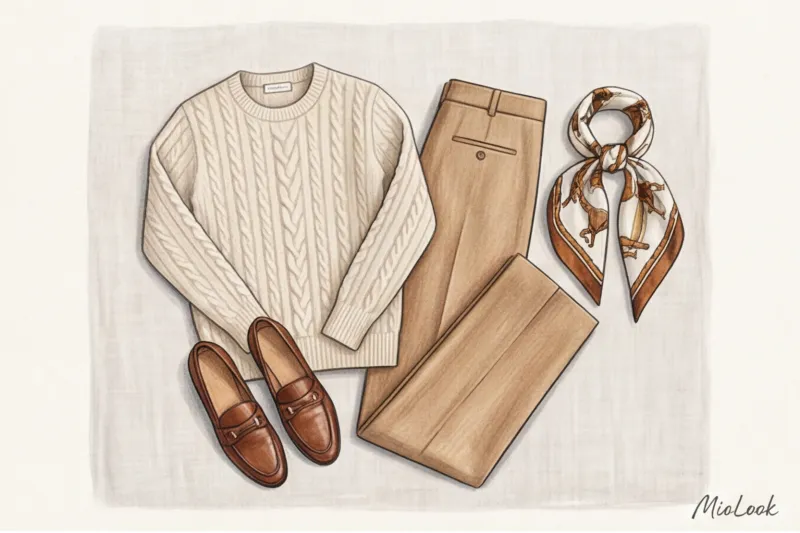
The prestigious capsule wardrobe in the "quiet luxury" style has a rather strict anatomy. The basic elements that form this wardrobe remain unchanged from season to season:
- Cashmere sweaters - preferably double-thread weave, which does not become covered in pellets after the first dry cleaning.
- Tailored wool trousers - with tucks, a high waist and a perfect crease line.
- Silk blouses - matte, dense silk that flows over the body, rather than standing upright.
- Structured loafers — made of soft, but shape-retaining leather or suede, without any accent decoration.
The color palette here works like a mathematical formula. Forget about sharp contrasts. Monochromatic neutrals form the basis: elegant ecru, classic camel, deep navy, and muted olive. These colors layer seamlessly, creating a complex yet visually calming look.
"Luxury is when the back is as beautiful as the front. And this rule applies not only to seams but also to how the fabric behaves dynamically."
Over the years of working with fabrics, I've learned to spot a fake at first glance. As a stylist, I constantly draw my clients' attention to the density of the fabric and its drape. How can you spot an imitation of Old Money? Cheap, low-quality polyester blends (flimsy poly-blends) are treacherously staticky, glitter in the light, and disrupt the silhouette as you walk, clinging to your feet. Another clue is aggressive, garishly shiny gold hardware, which mass-market brands are guilty of in an attempt to "increase the price" of a garment. Genuine investment clothing prefers matte metal, natural horn, or mother-of-pearl, and logos, if present, are hidden on an internal tag.
How to Avoid the Old Money Cosplay Effect
The main danger of status styles is the risk of looking too tried-on. If you wear a tweed jacket, a strand of pearls, a pleated skirt, and a headband all at once, you won't look like a member of the elite. You'll look like you've escaped the set of a period drama.
To avoid a "cosplay" effect, it's vital to balance vintage silhouettes with modern cuts. If you choose a classic Chanel-style jacket, pair it not with a pencil skirt, but with straight-leg jeans in the right shade of blue and a simple white T-shirt.
The essence of true Old Money lies in the concept of "nonchalance"—elegant nonchalance. You shouldn't look starched or overdressed. It's the relaxed attitude of someone who has nothing to prove to anyone. The rolled-up sleeves of a perfect shirt, slightly tousled hair, the absence of stiff, framed bags—these micro-details take the arrogance out of classic pieces.
Can this aesthetic be adapted to a realistic budget? Absolutely. You don't have to buy a €3,000 vicuña pullover. The secret lies in smart material selection. Skip acrylic in favor of heavy cotton, merino wool blends, or high-quality lyocell (Tencel). These fabrics hold their shape perfectly. In the €80 to €150 price range, you can find some great pieces if you get into the habit of testing the fabric right in the fitting room: squeeze the hem of a pair of trousers in your fist for five seconds. If the fabric develops small, hard-to-remove creases, leave the item in the store—it will never look expensive.
Access to MioLook for €0.99 — one-time payment
A smart AI stylist will curate the perfect look from your existing pieces and suggest how to integrate the Quiet Luxury aesthetic into your everyday wardrobe.
Get access — €0.99 onceRelaxed Casual: Big City Comfort
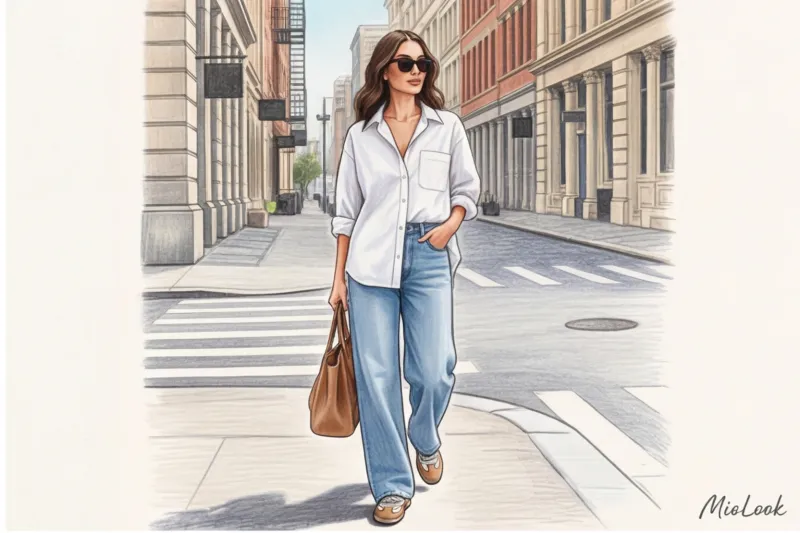
When the Paris Fashion Week shows wrap up, glossy editors and buyers shed their uncomfortable runway looks. Guess what they change into? Not tracksuits, but impeccably tailored jeans and oversized shirts. This is the essence of elevated casual—a style that exudes absolute comfort, yet every detail is mathematically calibrated. It abhors casualness, even though it strives to appear casual.
When developing everyday capsule wardrobe styles, I always focus on the architecture of the pieces rather than their decoration. Relaxed casual is based on specific marker elements:
- Premium Denim: Straight or wide-leg jeans. I strongly advise against models with elastane—only 100% heavyweight cotton achieves a true vintage silhouette.
- Heavy cotton tees: Look for a density of 200 to 300 grams per square meter. They are not see-through, hold their shape, and are not clingy.
- Oversized shirts: classic button-downs, as if taken from a man's shoulder.
- Deconstructed blazers: A throwback to the 80s, when Giorgio Armani removed the stiff shoulder pads and ribbing from his jackets, giving them a fluid feel.
- Minimalist sneakers: leather or suede, without flashy logos.
But simply buying these items isn't enough. The secret to a complete everyday look lies in layering. A single T-shirt and jeans is boring. But add a thin turtleneck under the shirt, throw a deconstructed jacket over it, and casually roll up the sleeves—and the look gains depth.
This is where the key principle of balancing comes into play, which in the styling circles we call "sandwich rule" The rule is simple: the visual weight of the top and bottom halves of the silhouette should match. If you're wearing chunky sneakers with a thick sole (the bottom "piece"), you need to balance them with a voluminous oversized jacket or a heavy coat (the top "piece"), leaving a neutral base inside in the form of a simple, fitted T-shirt (the "filling"). This technique prevents bulky shoes from weighing down the bottom of the figure.
The line between casual and loungewear
The most common mistake I see when analyzing street style is turning relaxed into downright sloppy. How do you avoid looking like you just got up from the couch? The key answer: structure.
Smart casual is built on a clash of textures. Never combine soft with soft. If you're wearing a loose knit sweater or jersey hoodie, layer it with a structured material like stiff denim or thick leather. Conversely, soft, flowing trousers require a structured jacket. This simple rule instantly ties together the silhouette.
Accessories are another lifeline. The simple formula of "jeans and a white T-shirt" becomes a fashion statement solely through the details. Simply add a crisp, geometric bag that contrasts with the softness of the outfit and sunglasses with chunky frames. Don't underestimate the value of quality belts either: a good leather belt in the basic €100-€150 range can visually "value" the entire outfit several times over, creating the right proportions.
Sometimes it can be difficult to keep in mind all the successful combinations of textures and accessories. For my clients, I usually use the "smart wardrobe" feature in MioLook — This is a great way to pre-assemble casual outfits for the week ahead, visually assessing whether the "sandwich rule" works before trying them on.
Parisian Chic: Timeless, Casual Elegance
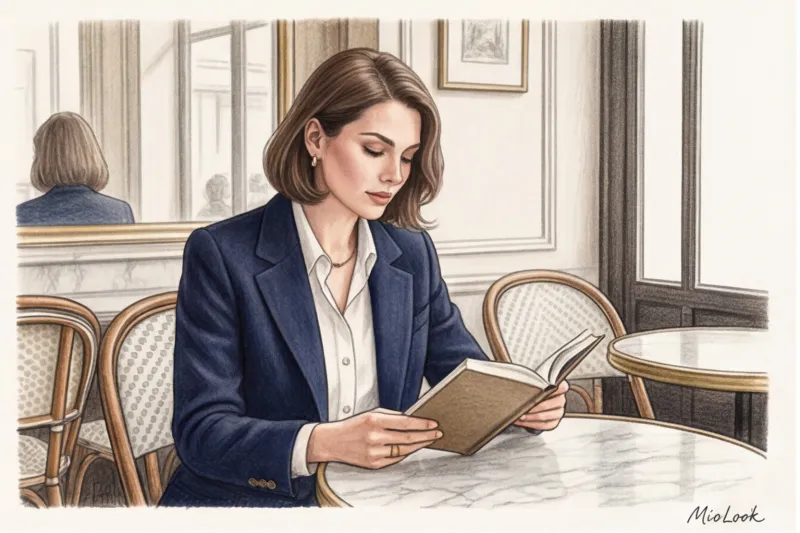
Have you ever wondered why the whole world has been obsessed with the myth of the "French girl" for years? This philosophy is famous je ne sais quoi (literally, "I don't know what") is built on one brilliant illusion. You have to look polished and stylish, but at the same time convey with your whole appearance that you spent exactly five minutes getting ready, simply grabbing the first thing you could find from a chair.
This visual code didn't emerge out of nowhere. Looking at contemporary capsule wardrobe styles, we clearly see how the French foundation draws on the legacy of icons from the 60s and 70s. It was Jane Birkin who taught us to wear a simple white T-shirt with jeans, adding a wicker basket instead of an expensive bag. And Brigitte Bardot made the classic Breton striped shirt a symbol of seductive yet comfortable relaxation.
Parisian style is the art of consciously rejecting perfection. If your outfit is flawless, you look like you've tried too hard. And trying too hard is the main fashion taboo in France.
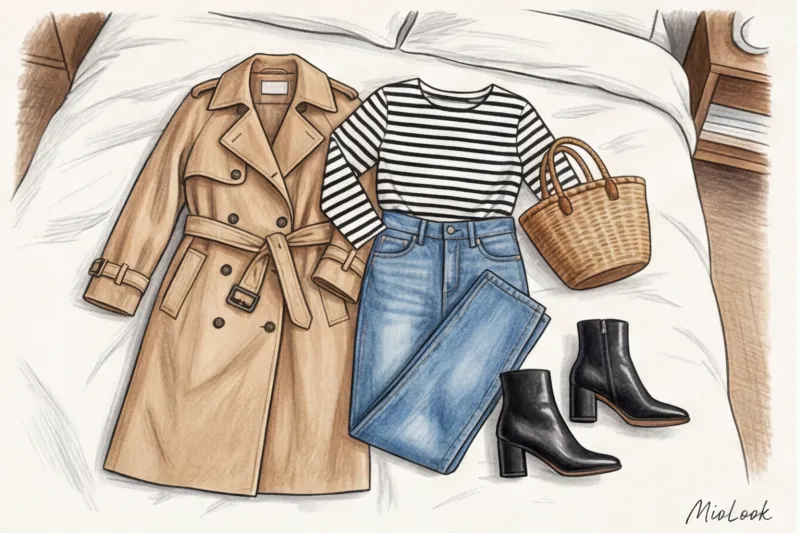
Spending time between shows at the street cafes of the Marais district, I love observing the local women. You won't see them wearing cartoonish berets or overblown logos. The uniform of modern Parisians is pragmatic and consists of a carefully curated list of items:
- The perfect trench coat: necessarily loose-fitting, as if taken from a man's shoulder, midi or maxi length.
- Vintage Wash Straight Leg Jeans: The right faded blue color and thick denim without stretch properties.
- Breton vest: A basic piece that instantly brightens up your face thanks to its geometric print.
- Tweed jacket: You don't have to hunt for vintage Chanel; excellent structured wool options are easy to find from local brands in the €150–€300 range.
- Ankle boots with a stable block heel: elegant, but practical, because walking on historic cobblestones in high heels is a real faux pas.
But clothes are just the basics. The main secret that turns an ordinary set of things into that very Parisian chic is the "one imperfect detail" rule This styling trick works without fail. Wearing a sharp, perfectly tailored tweed jacket? Leave your hair slightly tousled, without any complicated styling. Opting for a simple, basic T-shirt and jeans? Add a bright red lipstick, lightly tapped with your fingertips, to soften the contours.
To learn to see these fine lines and mix strict things with relaxed ones, I recommend digitizing your base in MioLook app When all your trench coats, jackets, and jeans are clearly displayed on your phone, artificial intelligence helps you create unexpected combinations, balancing out strict tailoring with just the right amount of casualness.
Access to MioLook for €0.99 — one-time payment
Start creating perfect looks with the help of artificial intelligence and assemble your flawless capsule wardrobe today.
Get access — €0.99 onceSmart Casual and Business Style: Intelligent Hybrid Capsule
In 2021, McKinsey analytics officially confirmed the death of the rigid office dress code: the overwhelming majority of managers admitted they no longer require employees to wear formal suits. The pandemic has forever changed our perception of corporate uniforms. Buttoned-up shirts and "cardboard" jackets have rapidly given way to an intellectual, hybrid aesthetic.
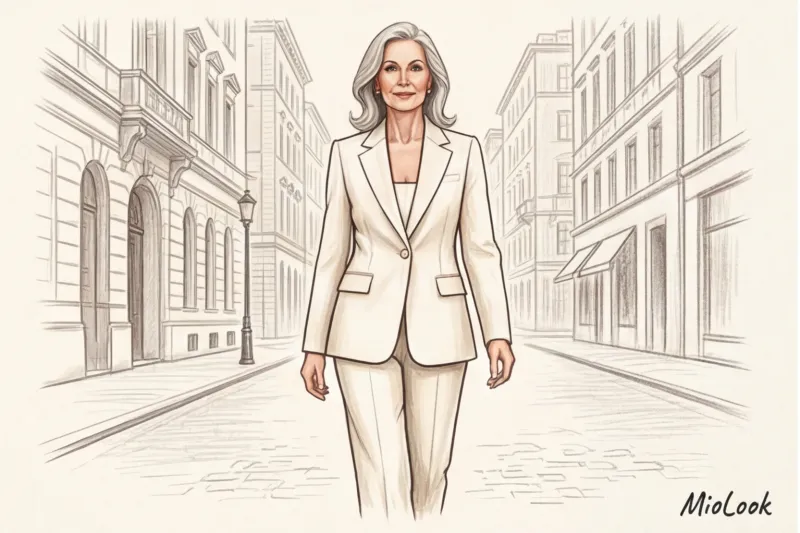
As a journalist who regularly interviews CEOs of international companies, I've noticed a curious shift in the world of personal branding. Today, a slightly relaxed, modern business capsule attire evokes far more trust than a dated, overstuffed corporate suit. A person in a soft-cut jacket and high-quality knitwear conveys confidence and mental agility, while a "person in a shell" is subconsciously perceived as a reserved, anxious, and outdated professional.
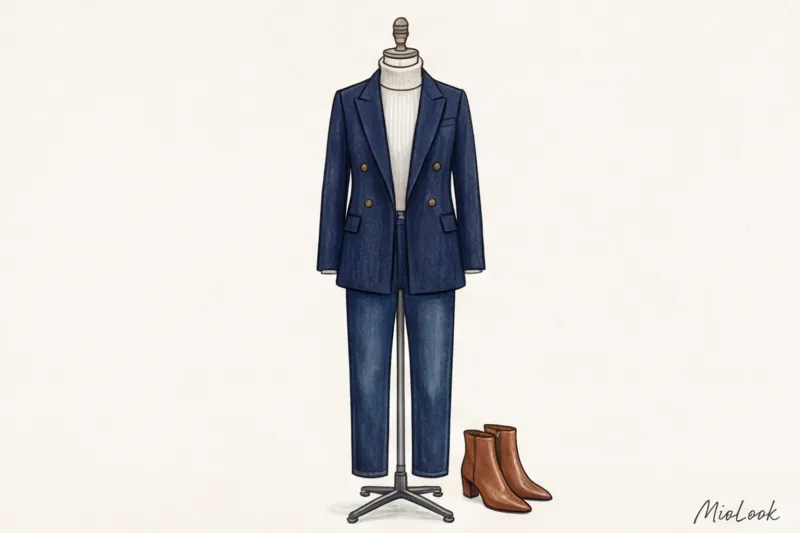
Collecting modern capsule wardrobe styles For work, I recommend completely abandoning rigid structures. The foundation of a hybrid business base is suits in technology. soft-tailoring (soft tailoring without bulky shoulder pads) and flowing trousers made of dense viscose or fine wool (fluid trousers). Instead of classic stiff stiletto pumps, choose elegant flats: pointed leather ballet flats, slingbacks, or textured suede loafers. And crisp, iron-requiring shirts have been replaced by silk camisoles and knit polo shirts made of fine merino wool. An excellent basic premium knit polo will cost you between €120 and €180, but it's worth every penny thanks to its phenomenal versatility.
The main superpower of smart casual is the seamless transformation from daytime to evening with minimal accessory changes. No longer do you need to lug a heavy suitcase to the office with a change of dress for a dinner with partners or a trip to the theater. To transition your look from day to night, simply swap your oversized structured tote bag for a sleek envelope clutch, remove your chunky watch, add statement earrings, and change your lipstick color. Your base color remains the same.
To avoid having to rack your brains over such transformations early in the morning, I strongly recommend digitizing your work kits in advance. After uploading your items to MioLook , you can create virtual lookbooks for "Office" and "Evening"—the app will clearly show you how the same flowing trousers pair perfectly with a knit polo during the day and a silk camisole in the evening, saving you at least 20 minutes of precious time before each outing.
Sporty Chic and Streetwear: Dynamic Capsule Wardrobe Styles
The legendary Karl Lagerfeld is credited with saying that sweatpants are a sign of losing control of one's life. But fashion is ironic. Exploring modern capsule wardrobe styles , we see how streetwear has displaced tailoring even in the premium segment. The elegant integration of sportswear into everyday life (the very same transition from utilitarian athleisure to sophisticated sport-chic) is no longer a passing trend, but a fashion constant in its own right.
A turning point came when luxury brands began to massively adapt athletic silhouettes, combining them with innovative materials. Today, fashion houses like Prada and Balenciaga are creating not just sweatpants, but architectural pieces made from membrane materials and recycled nylon. Tech-wear fabrics are no longer the preserve of the outdoors: innovative neoprene or dense modal don't stretch out at the knees, provide temperature regulation, and maintain a premium look all day long.
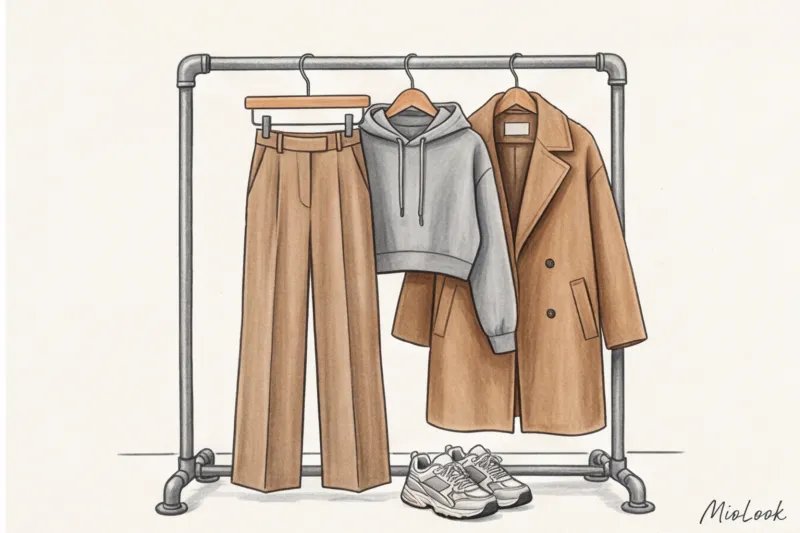
The key styling trick that distinguishes polished sporty chic from a casual gym ensemble is the "high-low" technique (a masterful blend of high and low). My favorite and fail-safe technique, which I regularly use in fashion shoots, is to layer an elegant, classic camel coat over a luxury tracksuit. The secret lies in the geometry: the coat's stiff shoulder offsets the softness of the knitwear, bringing the silhouette together.
To assemble such a dynamic capsule, you will need the right structural elements:
- Tailored joggers Forget shapeless fleece. Look for styles made from dense fabrics, often with pleats or even stitched creases (good basics in this segment usually start at €90).
- Elevated hoodies — minimalist, made of heavy cotton, with a thick, well-shaped hood and no flashy logos.
- Statement outerwear - voluminous puffer jackets with a complex cut or vintage leather bomber jackets that add texture to the look.
- Designer trainers - complex, massive shoes that act as the main accent and “ground” the entire outfit.
Your ideal image
it begins Here
Join thousands of users who look flawless every day with MioLook.
Get access — €0.99 onceIntegrating elements of an active wardrobe into an urban environment can be challenging due to the risk of throwing off proportions. When I create such eclectic looks, I always test them visually: I load the pieces into MioLook I can see how a voluminous down jacket will look paired with a slim skirt and chunky sneakers. This allows you to find the perfect balance of volume before you even try it on in the mirror.
Dramatic and Avant-Garde Minimalism: Architecture in Clothing
When Japanese deconstructors Yohji Yamamoto and Rei Kawakubo burst onto European catwalks in the 1980s, they forever changed our understanding of the basic wardrobe. They proved that all-black isn't boring when form is paramount. Today, capsule wardrobe styles inspired by dark fashion and avant-garde minimalism are the informal yet unmistakable uniform of creative industries, architects, and fashion insiders.
In this capsule, color gives way to silhouette, asymmetry, and texture. Instead of mixing prints, you learn to work with proportions and optical illusions. Smooth matte leather next to crushed linen or coarse, raw wool creates the visual dynamics that underpin the entire look.
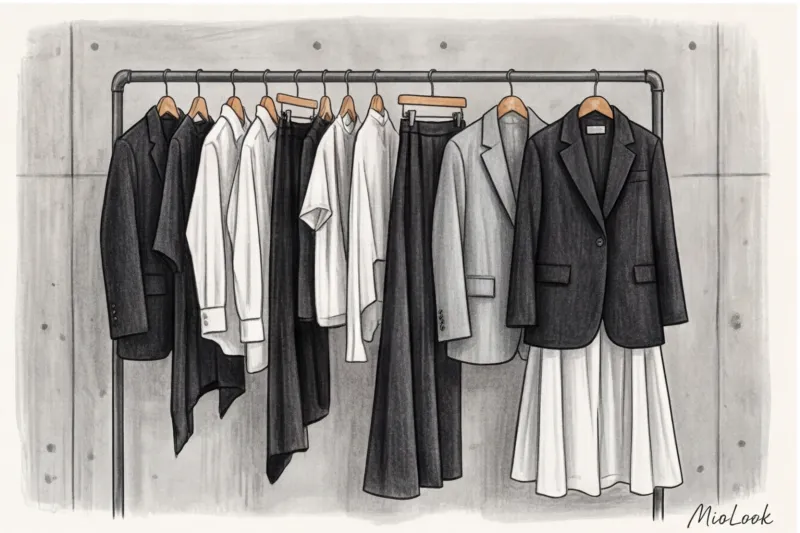
The anatomy of the avant-garde capsule collection is extremely precise. It is based on oversized jackets with rigid, exaggerated shoulders (in the spirit of classic Maison Margiela tailoring), architectural maxi skirts with complex cuts, chunky leather boots with lug soles, and accent geometric jewelry in cast silver or matte metal.
I'll be completely honest with you: of all the trends, this is the most difficult to achieve. Mass-market clothing is physically incapable of accurately replicating a complex asymmetrical cut, and cheap synthetics will instantly ruin the entire design of the garment. If your season budget is, say, €300–€500, you'll have to get creative. I recommend searching for unique pieces with complex construction in indie designer concept stores or engaging in thoughtful reselling—hunting for vintage archives of Jil Sander, Ann Demeulemeester, or Rick Owens.
To prevent deconstruction from turning you into a shapeless blob, such outfits need to be carefully balanced. Before buying another asymmetrical item, upload a photo of it to MioLook and create a collage with your current wardrobe essentials—the app is great for visualizing complex proportions before you spend money on something that doesn't really fit with the rest of your wardrobe.
Checklist: How to Combine Styles Using the 80/20 Rule
Behind the scenes at fashion shoots, we rarely talk about inspiration—we more often discuss proportions and cold calculations. The most damaging mistake I see when sorting through wardrobes is trying to mix aesthetics equally (50/50) or, conversely, to drift into total homogeneity. The main secret of professional stylists, which distinguishes a working capsule wardrobe from a merely beautiful collection, lies in adapting the Pareto principle: the famous 80/20 formula.
According to ThredUp's 2023 analytical report, the average woman regularly wears only about a quarter of her closet's contents. The rest hangs there as dead weight precisely because of the lack of style proportions. Let's turn the abstract concept of "good taste" into concrete mathematics.
Exactly 80% of your capsule should be Base Style Typically, it's smart casual, architectural minimalism, or relaxed casual. Why eighty? This number guarantees maximum mix-and-match. When most of your pieces speak the same visual language, you can get ready in the dark in three minutes. In this zone, we focus on uncompromising quality: an impeccably tailored wool-blend jacket for €200–€300 or perfect straight-leg jeans in heavy denim will recoup every penny thanks to their low cost per wear.
The remaining 20% is your Accent Style. It can be pure drama, sporty chic, grunge, or romantic. It's this micro-percentage that saves us from wardrobe depression and prevents impulse purchases. Imagine: a strict, minimalist base of gray wide-leg trousers and a cashmere sweater suddenly meets 20% drama—square-toe ankle boots and a chunky, sculptural necklace. You get a bold personality while maintaining 100% functionality.
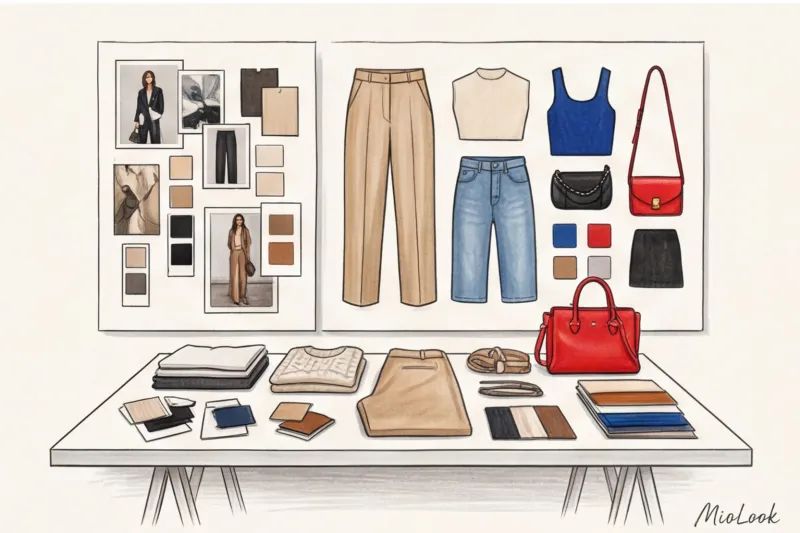
How can I calculate this ideal proportion for myself? I suggest using a tool called lifestyle pie chart Here's a step-by-step algorithm:
- Step 1: Honest time audit. Draw a circle and divide it into sectors that reflect your actual month, not a fantasy life. For example: 60% – office work without a strict dress code, 20% – walks and household chores, 10% – dates and cultural outings, 10% – active recreation.
- Step 2: Selecting a dominant. Your base (80%) should cover the largest sections. In our example, the vast majority of the budget and closet space will go toward a hybrid of smart casual and relaxed classics.
- Step 3: Integrate accents. We devote the remaining 20% to things that warm the soul and cover niche needs (dressy slip dresses for those 10% of dates or high-tech sneakers).
- Step 4: Test one image. The 80/20 rule works great within a specific outfit: wear 4 basic items (jeans, a T-shirt, a trench coat, a tote bag) and add 1 accent piece (leopard loafers).
To avoid calculating these shares by eye, I strongly recommend Digitize your closet with the MioLook app Once you assign style tags to your items, the system will show you real statistics. If your lifestyle chart calls for smart casual, but the app's analytics show 60% cocktail-style romantics and 40% sporty hoodies, the diagnosis "a full closet, but nothing to wear" is entirely reasonable.
Capsule wardrobe styles aren't museum pieces to be protected from dust and mixing. They're living constructs, a language in which you communicate your personality to the world before you even utter a word. Don't try to literally cosplay someone else's aesthetic from social media. Find your essential foundation, add just the right dose of style provocation, and you'll achieve that effortless chic that can't be bought off the rack.
Guide Chapters
Preppy Capsule Wardrobe: A Modern Guide
We're creating a modern preppy capsule collection for mature women without the schoolgirl look. Ivy League academic rigor meets effortless casualness.
Capsule Wardrobe: Romantic Style Without Mistakes
Modern romance doesn't survive in a vacuum. Learn how to skillfully incorporate floral prints and ruffles into your wardrobe to look stylish, not dated.
How to build a grunge capsule wardrobe
Forget teenage rebellion and ripped T-shirts. We'll explore the rules for creating stylish, "grown-up" grunge with complex textures and layering.
Boho Capsule Wardrobe: Urban Looks
Forget about impractical festival outfits. We'll tell you how to put together a truly grown-up and luxurious boho capsule wardrobe for real life.
Capsule wardrobe sport chic: looks for every day
How to dress comfortably without looking like you just came from the gym? We'll explore the key rules for creating a stylish, sporty-chic capsule wardrobe for the city.
Minimalist capsule wardrobe: putting together the perfect base
True minimalism isn't about eliminating color, but rather being mindful of combinations. Learn how to create a minimalist capsule wardrobe that will highlight your individuality.
Smart Casual Capsule Wardrobe: Style Secrets
Smart casual is a unique dress code with chameleon-like qualities. Learn how to put together a versatile capsule wardrobe for work meetings and evening events.
Scandinavian style capsule wardrobe: how to put it together
Nordic aesthetics are built not on color, but on the architecture of cut and texture of fabric. Let's learn how to create cozy essentials from European high street without making stylistic mistakes.
Business Capsule Clothing: Office Style Without Boredom
The classic "white top, black bottom" rule is long outdated. Learn how to put together a modern business capsule wardrobe that will highlight your status and expertise.
Old Man Capsule Wardrobe: Quiet Luxury
The aesthetics of old money aren't about cheap pearls and tennis skirts, but rather the architecture of cuts and the mathematics of fabrics. We're deconstructing the DNA of a prestigious wardrobe from a fashion industry insider's perspective.
Casual Capsule Wardrobe: Relaxed Basics
Relaxed doesn't mean sloppy. Learn how to create a stylish and comfortable capsule wardrobe for work and life by investing in the right textures and cuts.
French Capsule Wardrobe: Secrets of Parisian Women
True Parisian chic isn't about berets and striped shirts, but rather impeccable fit and quality fabrics. We'll deconstruct the DNA of French style and learn how to assemble the perfect foundation.